How to Compete Against Bigger Companies in Sales in 2026
Big vendors win on brand and budget, not on selling. Here are seven concrete plays — niche targeting, speed, proof, and pricing — that let a small sales team take deals off enterprise incumbents.
TL;DR
- You do not beat a bigger competitor on features or brand. You beat them on cycle time, specificity, and the parts of the deal their process makes expensive.
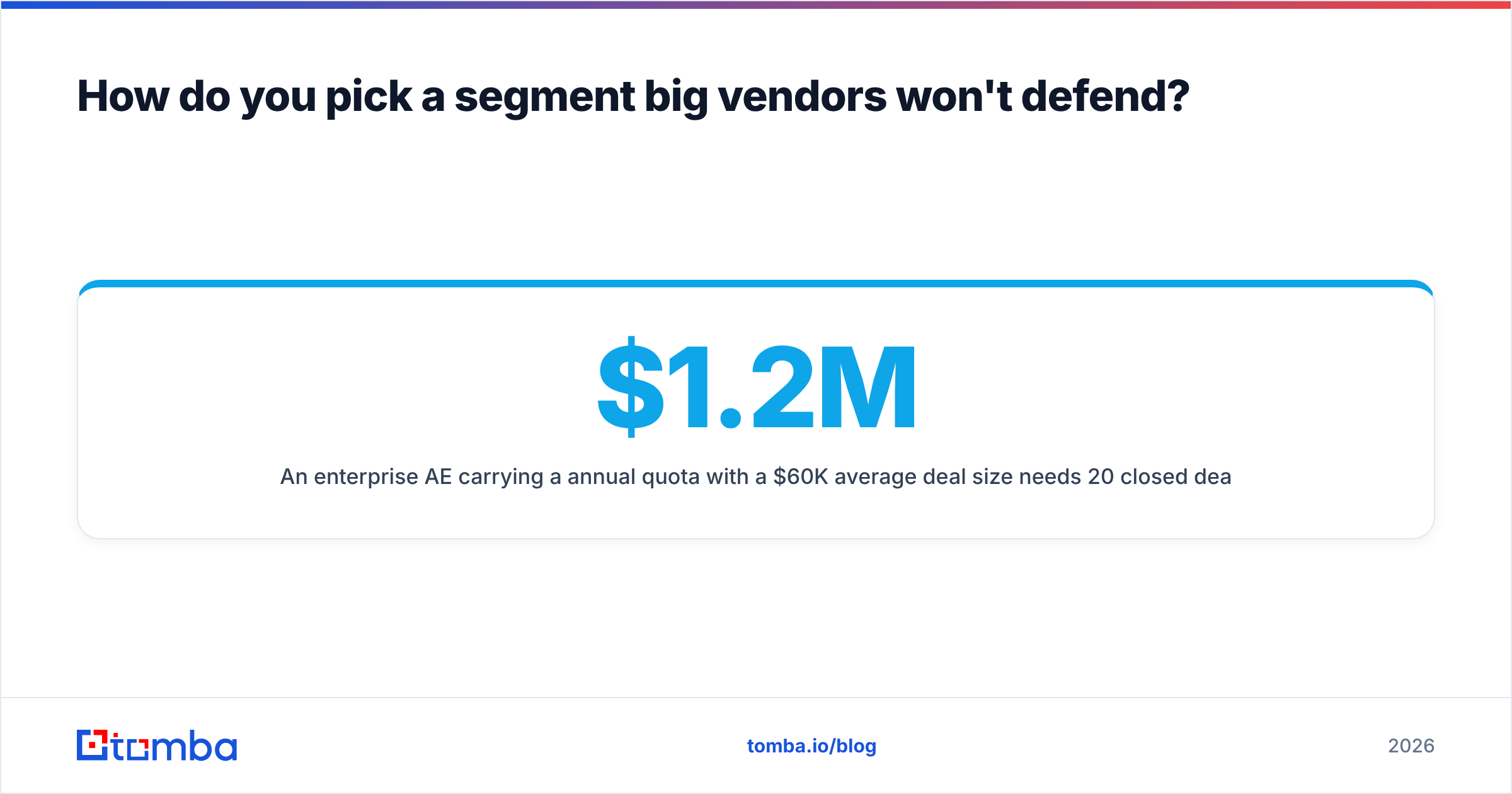
- Pick a segment their compensation plan punishes them for chasing. Sub-200-employee accounts, unusual tech stacks, and single-department buyers are structurally unattractive to an enterprise rep carrying a $1.2M quota.
- Your proof has to be narrower than theirs, not louder. Three customers that look exactly like the buyer beat a logo wall of 400 that don't.
- Answer the "but you're small" objection in the first call, on your terms, with a risk-reversal offer — not in week six when procurement raises it for you.
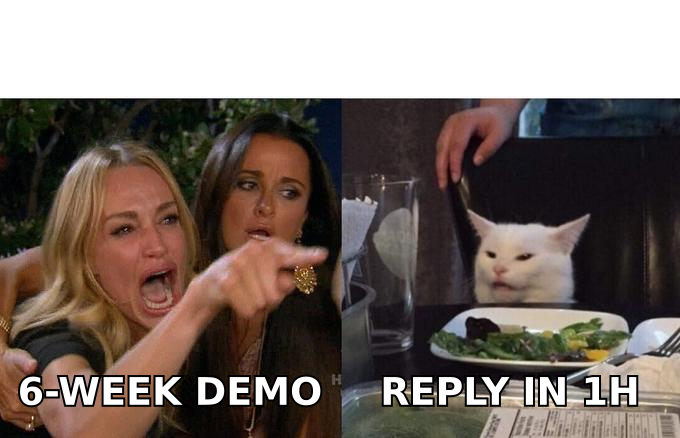
- Speed compounds: replying in an hour, sending a scoped proposal in 48 hours, and going live in a week are advantages a 400-person vendor cannot copy without re-architecting itself.
Why do bigger companies actually win deals?#
Not for the reason you think. Buyers rarely pick the big vendor because it has more features. They pick it because it is the defensible choice — nobody gets fired for it, procurement already has the paperwork, and the security review passed last year for another team.
That is a risk decision, not a product decision. Once you understand that, the counter-strategy stops being "add more features" and starts being "remove more risk."
Three things the incumbent genuinely has:
- Brand recognition — the buying committee has heard of them, so no internal selling is required to get them on the shortlist.
- Procurement gravity — MSAs, SOC 2 reports, insurance certificates, and vendor records that already exist.
- Reference volume — enough customers that some of them will resemble the prospect closely enough.
Three things they do not have, and structurally cannot get:
- Decision speed. Every non-standard request routes through legal, deal desk, and a pricing committee.
- Segment focus. Their roadmap serves the top 10% of their revenue, which is almost never the account you're selling into.
- Founder or specialist access. The person who built the thing will not join a call for a $9K deal at a company with 400 employees.
Your entire competitive strategy is built on those three columns. Everything else is noise.

What structural advantages do you have over an enterprise competitor?#
These are the levers that don't require a bigger budget. Use them deliberately, not accidentally.
- Response latency. You can reply to an inbound form in under an hour. Their SDR queue routes leads on a round-robin with a same-day SLA at best. Response rate data consistently shows first-responder advantage is the single cheapest edge in B2B.
- Scope flexibility. You can say yes to a pilot with a custom export format on a Tuesday. Their answer is "let me check with product."
- Pricing latitude. You can restructure a deal — monthly instead of annual, usage-based instead of seats — without a deal desk. They cannot discount below floor without VP approval.
- Direct expertise on the call. Bringing the person who wrote the ingestion pipeline into a technical evaluation is worth more than any battlecard.
- Narrow, credible proof. You can produce a customer in the exact same industry, same size, same stack, and have them on a call within 72 hours.
- Implementation velocity. Going live in five days versus a six-week onboarding queue changes the buyer's ROI math more than a 20% discount does.
If a play you're considering doesn't sit on one of those six, it's probably a play the incumbent can copy — and they'll copy it with more people.
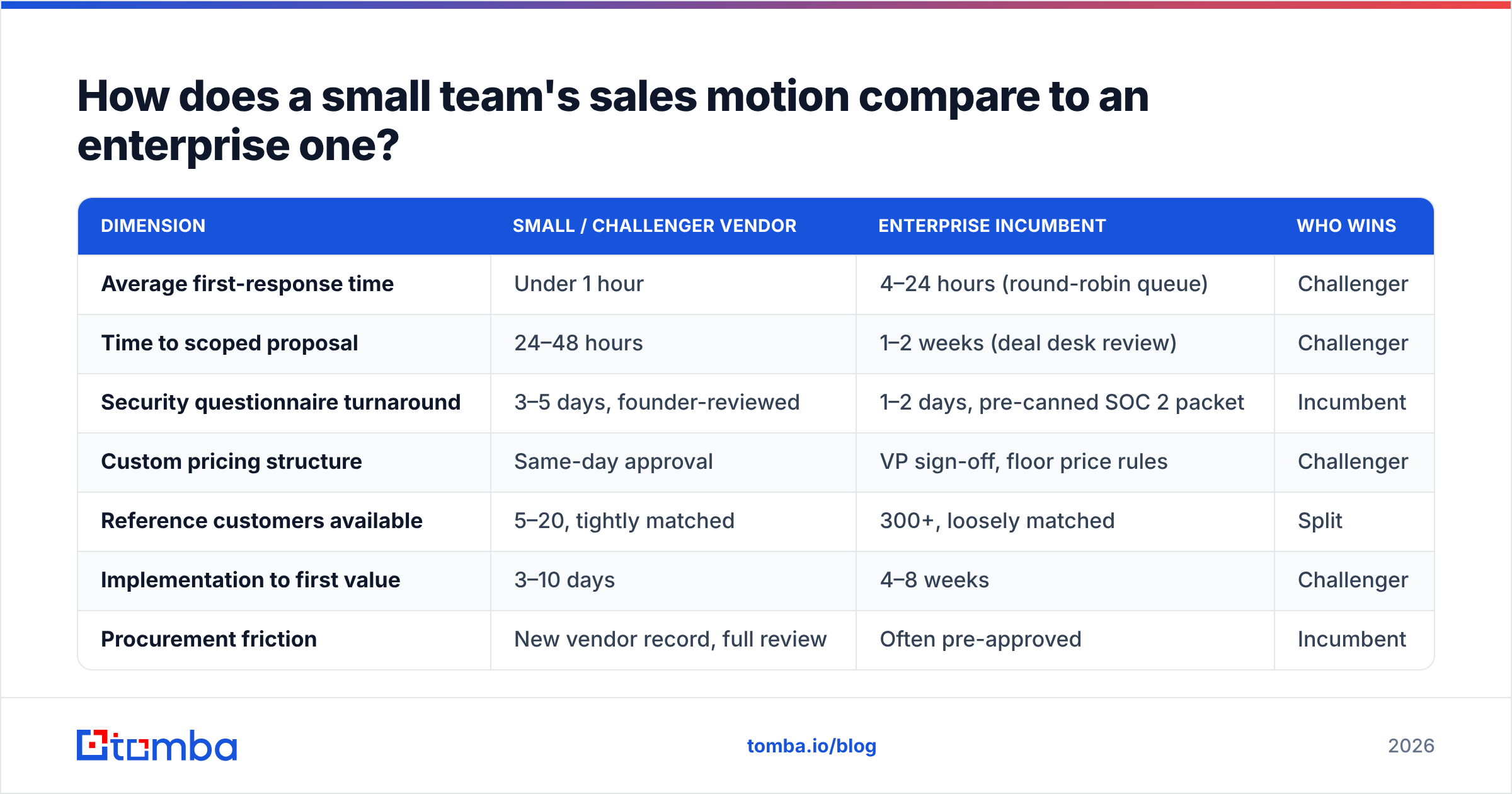
How does a small team's sales motion compare to an enterprise one?#
Here's the honest comparison. Note where each column wins; pretending you win everywhere destroys credibility with sophisticated buyers.
| Dimension | Small / challenger vendor | Enterprise incumbent | Who wins |
|---|---|---|---|
| Average first-response time | Under 1 hour | 4–24 hours (round-robin queue) | Challenger |
| Time to scoped proposal | 24–48 hours | 1–2 weeks (deal desk review) | Challenger |
| Security questionnaire turnaround | 3–5 days, founder-reviewed | 1–2 days, pre-canned SOC 2 packet | Incumbent |
| Custom pricing structure | Same-day approval | VP sign-off, floor price rules | Challenger |
| Reference customers available | 5–20, tightly matched | 300+, loosely matched | Split |
| Implementation to first value | 3–10 days | 4–8 weeks | Challenger |
| Procurement friction | New vendor record, full review | Often pre-approved | Incumbent |
| Roadmap influence for this buyer | High — feature ships in weeks | Effectively zero | Challenger |
| Entry price point | $49–$249/mo | $15K–$40K annual minimum | Challenger |
| Perceived career risk for champion | Elevated | Low | Incumbent |
Read down the "Incumbent" rows. Those are your four workstreams: get the security packet ready before you need it, build tightly-matched references, reduce procurement friction, and de-risk the champion. Everything else is already yours to lose.
How do you pick a segment big vendors won't defend?#
Target where their comp plan makes defending economically irrational.
An enterprise AE carrying a $1.2M annual quota with a $60K average deal size needs 20 closed deals a year. A $6K deal consumes roughly the same calendar time as a $60K deal and pays about a tenth as much. So they don't fight for it — they route it to a self-serve motion, or they let it go and hope to upsell later.
Practical selection filters:
- Company size band. Look one tier below their published "ideal customer profile." If their case studies feature 1,000+ employee companies, live in the 50–300 band.
- Vertical specificity. Horizontal platforms cannot ship vertical workflows fast enough to matter. A logistics-specific field in your data model is a moat against a general-purpose vendor.
- Geography and language. Regional coverage gaps are real and rarely closed quickly.
- Adjacent-tool integration. If the buyer's stack includes a tool the incumbent doesn't integrate with, you have a wedge.
- Buying trigger timing. New department head, funding round, or a renewal 90 days out. Renewal timing is the highest-signal trigger you can track.
Once you've defined the segment, you need contact coverage inside it — which is a data problem, not a strategy problem. Build the list from firmographic filters, then resolve decision-makers with a domain search across each target company rather than buying a generic list every competitor also bought.
How do you handle the "you're too small" objection?#
Raise it yourself, on call one, before procurement raises it in week six. Framing it first means you control the answer.
A working script structure:
"You should know we're a 14-person company. That means two things. You'll never wait a week for an answer, and the person who built the API will be on your technical call. It also means if you need SOC 2 Type II, we have the report — I'll send it today, before you ask. What's the specific risk you're weighing?"
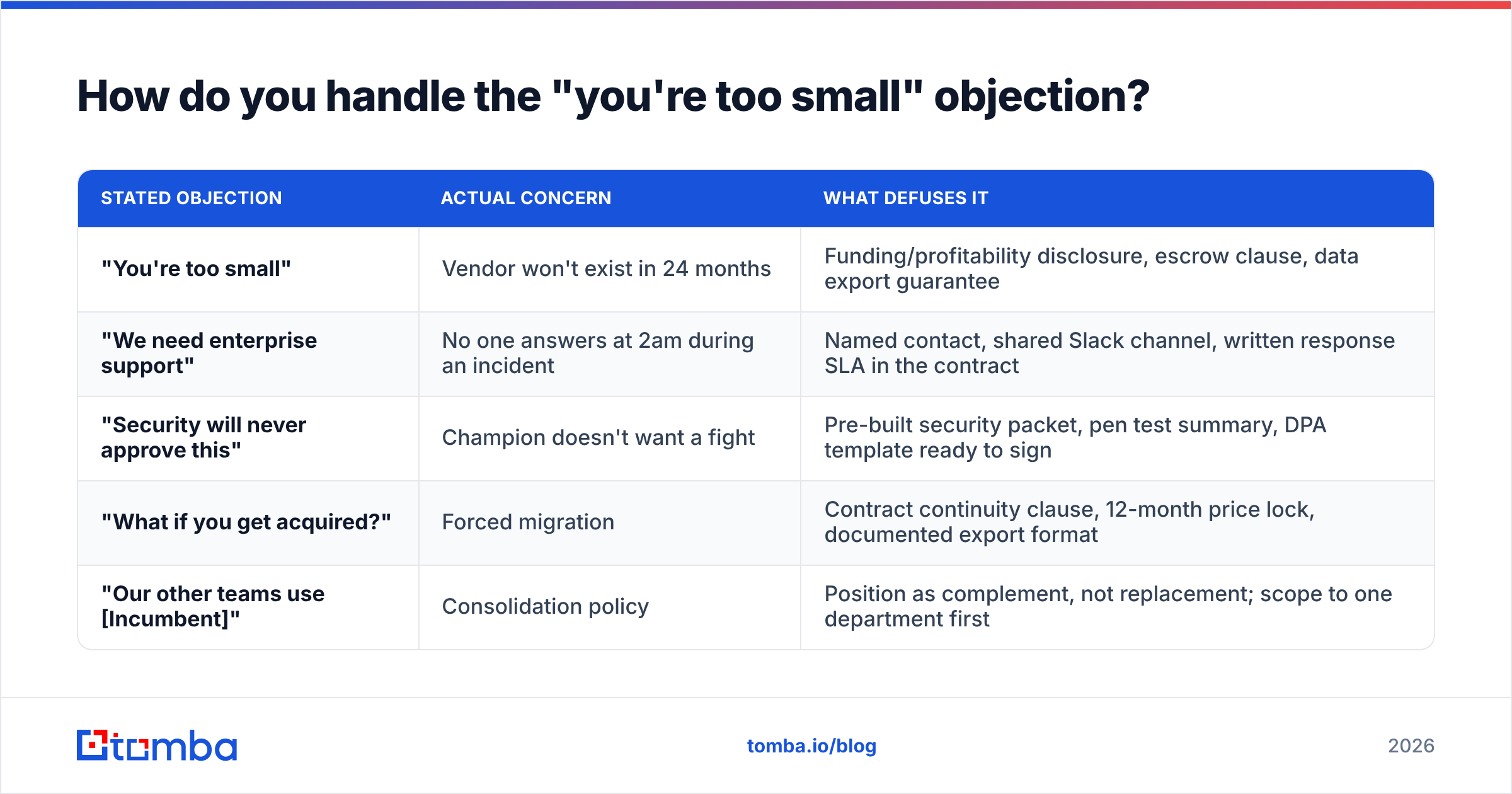
That last question is the important one. "Too small" is never the real objection. It decomposes into:
| Stated objection | Actual concern | What defuses it |
|---|---|---|
| "You're too small" | Vendor won't exist in 24 months | Funding/profitability disclosure, escrow clause, data export guarantee |
| "We need enterprise support" | No one answers at 2am during an incident | Named contact, shared Slack channel, written response SLA in the contract |
| "Security will never approve this" | Champion doesn't want a fight | Pre-built security packet, pen test summary, DPA template ready to sign |
| "What if you get acquired?" | Forced migration | Contract continuity clause, 12-month price lock, documented export format |
| "Our other teams use [Incumbent]" | Consolidation policy | Position as complement, not replacement; scope to one department first |
Notice that four of five answers are artifacts, not arguments. Build the artifacts once. Most challenger sales teams lose these deals because they improvise a response instead of sending a document.
How do you build proof that outweighs a bigger logo wall?#
Specificity beats volume. A buying committee reading a case study is asking one question: "is this us?"
Three assets are enough:
- The mirror case study. Same industry, same headcount band, same stack, with a number in the headline. One page. No design budget required.
- The live reference call. Not a quote — an actual customer on Zoom for 20 minutes. Your ability to arrange this in 72 hours is itself a differentiator; the incumbent's reference program takes two weeks and produces a stranger.
- The scoped pilot result. A two-week paid pilot against a metric the buyer chose. This converts an argument about capability into a measured fact.
Public review platforms matter here too. Buyers check G2 and Capterra before they check your website. Twenty recent, detailed reviews from your actual segment outperform 800 stale reviews spread across every use case — reviewers who look like the buyer are worth more than reviewers who are numerous.
How do you price against a company with ten times your budget?#
Do not race to the bottom. Discounting signals that your product is the cheap version of theirs, which is exactly the frame you're trying to escape.
Instead, change the shape of the deal:
- Shorten the commitment. Monthly or quarterly terms against their mandatory annual prepay. You're not cheaper per unit; you're cheaper to be wrong about.
- Align price to a metric the buyer controls. Usage, records processed, verified contacts — anything that grows with value rather than with headcount. Per-seat pricing is the incumbent's home field.
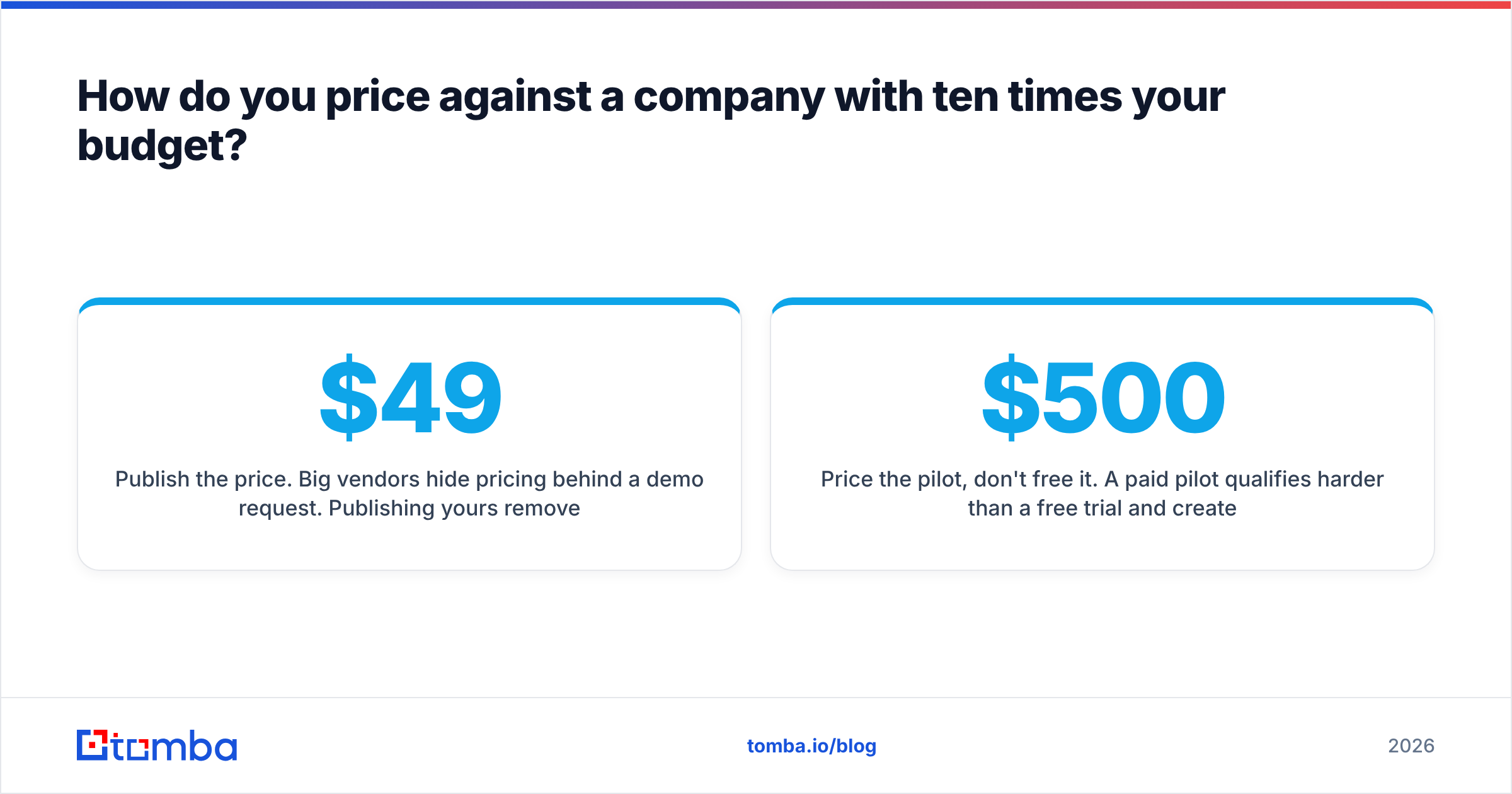
- Publish the price. Big vendors hide pricing behind a demo request. Publishing yours removes a full discovery cycle and pre-qualifies buyers. Tomba's approach is a case in point: a free tier at 25 searches a month, then Starter at $49/mo, Growth at $99/mo, and Pro at $249/mo, all visible on the Tomba pricing page with no gate.
- Price the pilot, don't free it. A $500 paid pilot qualifies harder than a free trial and creates a budget line the champion has already defended internally.
- Never discount without a trade. Multi-year term, case study rights, a reference commitment, or upfront payment. Free discounts teach the buyer your list price is fiction.
Gartner's B2B buying research has been consistent for years on this point: buyers spend most of their evaluation time not talking to any vendor. Transparent pricing puts you in the consideration set during that independent research phase, which is when the incumbent's sales process is completely absent.
How do you use speed as an actual sales weapon?#
Speed only counts if it's instrumented. Turn it into commitments you make out loud:
- Inbound reply in 60 minutes during business hours, with a real answer — not "when are you free for 30 minutes?"
- Scoped proposal in 48 hours of the discovery call, including implementation dates.
- Security questionnaire returned in 5 business days, with the standard packet attached preemptively.
- Go-live in 10 days or the first month is free. This is the strongest de-risking offer a small vendor can make, and the incumbent literally cannot match it.
Outbound speed matters just as much. When a trigger fires — a funding announcement, a new VP of Sales, a job posting that signals a tooling gap — the window is days, not weeks. That means your prospecting stack has to resolve a name into a working, verified contact immediately. Running new names through an email verifier before they hit your sequence protects your sender reputation while you're moving fast, which is the failure mode that kills most speed-based outbound programs by month three.
A note on tooling parity: the gap between a challenger's stack and an enterprise stack has mostly closed. A three-person team can assemble list building, enrichment, sequencing, and CRM sync for a few hundred dollars a month. Peers like BookYourData, along with data providers across the category, have made verified B2B contact data accessible at price points that were enterprise-only five years ago. Your disadvantage is headcount, not capability.
What metrics tell you the strategy is working?#
Track these four, monthly, segmented by whether the incumbent was in the deal:
- Win rate in competitive deals. If you're under 25% against the incumbent, your segment choice is wrong — you're fighting on their turf. Above 40% means you should expand the segment.
- Cycle length delta. Your competitive deals should close 30–50% faster than the incumbent's published average. If they don't, your speed advantage is theoretical.
- Loss reason distribution. "Too small / too risky" losses above 30% mean your de-risking artifacts are missing, not that your product is weak.
- Reference-call conversion. Deals where a reference call happened should convert at roughly double the ones where it didn't. If they don't, your references aren't matched tightly enough.
Also watch win rate by segment specifically. The pattern you're looking for is a narrow band where you win most of the time — that band is your beachhead, and expanding out of it prematurely is the most common way challenger sales teams stall. HubSpot's sales research reinforces this: focused ICPs consistently outperform broad ones on both win rate and cycle time.
Where should you start this week?#
Pick one segment where the incumbent's economics make defending irrational. Build the five de-risking artifacts — security packet, data export guarantee, named support contact, mirror case study, reference call list. Commit publicly to a response SLA you can actually hold. Then go fill the top of the funnel with contacts that are real on the first send.
That last part is where most challenger programs leak. Bad data makes fast outbound look like spam, and a burned domain takes months to recover. Start by resolving your target accounts into verified, deliverable contacts with the Tomba Email Finder — free tier included, $49/mo when you're ready to scale — so the speed advantage you're building on actually reaches a human inbox.
Related guides#
// get started
Find, verify and enrich your first contacts today
Start on the free plan with 25 searches a month, then scale when your team is ready.
Free plan · No credit card required · GDPR & CCPA
Get the Tomba newsletter
Product and data updates
// about the author