How to Contact CEOs of Companies: A 2026 Playbook
CEOs get hundreds of pitches a month and answer almost none. Here are the channels that actually get a reply, the exact research steps before you send, and the outreach math behind executive prospecting.
TL;DR
- CEO inboxes are guarded, not sealed. The ones that reply are reached through a verified personal address, a warm referral, or a LinkedIn message that took real research — rarely anything else.
- Skip
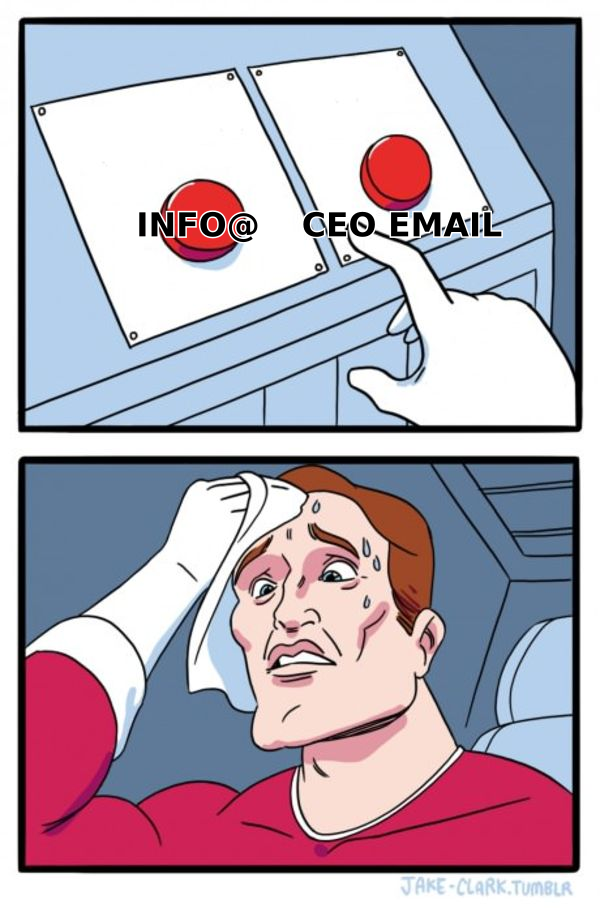
info@andcontact@. Those go to a shared queue, and a shared queue is where executive outreach dies. - Company size is the single biggest predictor of success: under 200 employees, the CEO usually reads their own email. Over 5,000, you're contacting the Chief of Staff whether you know it or not.
- Verify before you send. A hard bounce on a small domain can hurt your sender reputation for weeks and burns the one shot you had.
- Budget 20-40 minutes of research per CEO. At this level, volume outreach doesn't just underperform — it actively marks you as spam.
Why is contacting a CEO different from normal prospecting?#
Because the economics are inverted. A VP of Sales might get 40 cold emails a week. A CEO of a 500-person company gets that many before lunch, and the ratio of noise to signal has trained them to delete on pattern recognition alone — generic greeting, obvious merge tag, three paragraphs, calendar link.
The flip side is that CEOs are also the fastest decision-makers in any organization. When a CEO says yes, procurement, security review, and budget approval all collapse into a single forwarded email. That asymmetry is why executive outreach is worth the effort even at a 3-8% reply rate, when a mid-funnel campaign might hit 12%.
So treat it as a different discipline. Normal prospecting optimizes for throughput. CEO outreach optimizes for relevance per message. You are not running a campaign; you are running six to twelve individual plays.
What are the actual channels for reaching a CEO?#
There are six that work with any consistency. Ranked roughly by reply rate, from what most B2B teams report:
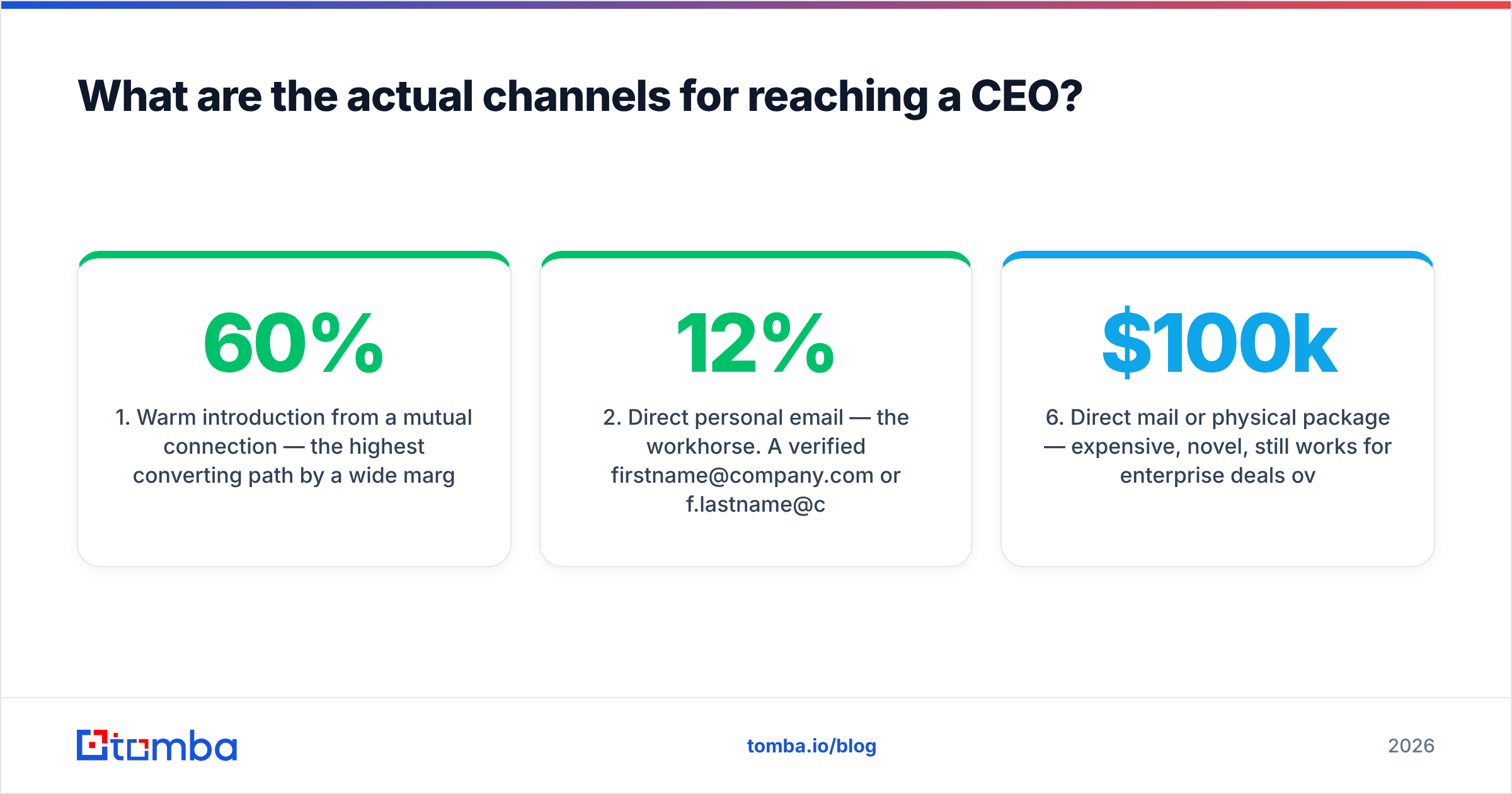
- Warm introduction from a mutual connection — the highest converting path by a wide margin. A forwarded intro from someone the CEO already trusts skips the credibility check entirely. Reply rates in the 40-60% range are normal because the CEO isn't deciding whether to trust you, only whether the topic is relevant now.
- Direct personal email — the workhorse. A verified
firstname@company.comorf.lastname@company.comlands in the CEO's own inbox rather than a gatekeeper queue. Expect 5-12% replies with strong research, 1-2% without. - LinkedIn direct message or connection note — strong for founders and CEOs under 1,000 employees, weak above that. Founders check LinkedIn; Fortune 500 CEOs have someone else running the account.
- Executive assistant or Chief of Staff — counterintuitively effective. Assistants are trained to route legitimate requests, and a short, specific, respectful email to an EA often gets forwarded internally with an implicit endorsement.
- Podcast, panel, or content engagement — slow but durable. Comment substantively on their posts for three weeks, then reach out. You're no longer a stranger.
- Direct mail or physical package — expensive, novel, still works for enterprise deals over $100k ACV where a $60 package is rounding error.
Two channels that reliably fail: the website contact form (routes to marketing ops) and cold calling the main switchboard (routes to a receptionist trained to block you).
Which channel should you use for which company size?#
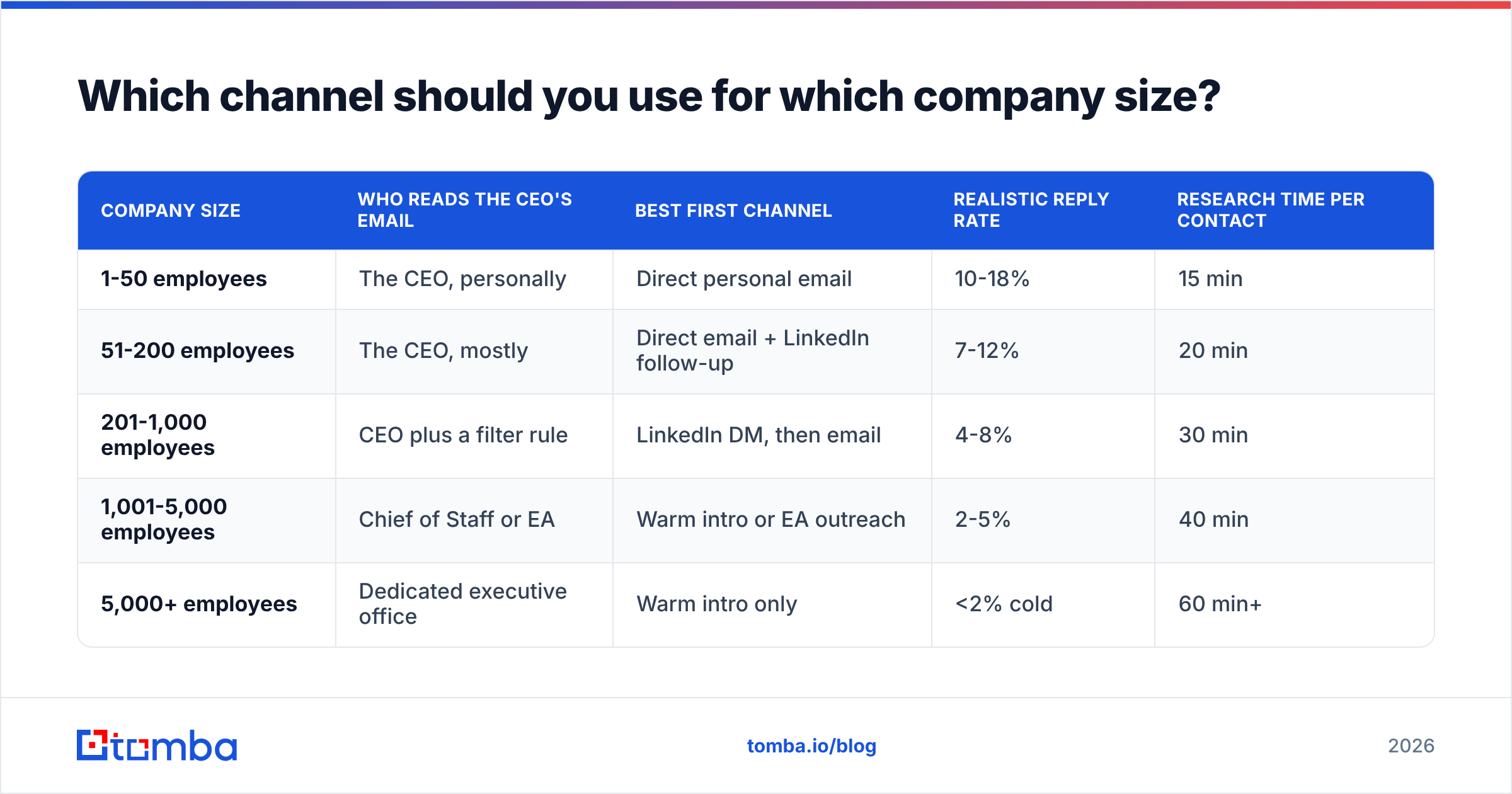
Company headcount changes the answer more than industry does. Here's how the channels map:
| Company size | Who reads the CEO's email | Best first channel | Realistic reply rate | Research time per contact |
|---|---|---|---|---|
| 1-50 employees | The CEO, personally | Direct personal email | 10-18% | 15 min |
| 51-200 employees | The CEO, mostly | Direct email + LinkedIn follow-up | 7-12% | 20 min |
| 201-1,000 employees | CEO plus a filter rule | LinkedIn DM, then email | 4-8% | 30 min |
| 1,001-5,000 employees | Chief of Staff or EA | Warm intro or EA outreach | 2-5% | 40 min |
| 5,000+ employees | Dedicated executive office | Warm intro only | <2% cold | 60 min+ |
The practical takeaway: below 200 employees, direct email is your default and it works. Above 1,000, cold email to the CEO is mostly a lottery ticket, and your time converts better into building the referral path.
How do you find a CEO's email address?#
Three methods, in order of reliability.
Method 1 — pattern discovery from the domain. Most companies use one consistent format across every employee. Find any two published addresses at the domain (press releases, support pages, GitHub commits, conference speaker pages) and you've derived the pattern. Then apply it to the CEO's name. A domain search returns the known addresses at a company along with the dominant format, which turns this from an afternoon of Googling into a ten-second lookup. If you only want the format itself, the company email pattern checker does exactly that.
Method 2 — direct lookup by name and domain. Give a first name, last name, and company domain to an email finder and get the address back with a confidence score. This is the fastest path when you already know who the CEO is, which for public-facing companies you almost always do.
Method 3 — manual sourcing. SEC filings for public companies, Companies House or equivalent registries for UK/EU entities, domain WHOIS records for smaller businesses (often the founder's personal address), conference speaker bios, and podcast show notes. Slow, but it surfaces addresses no database has indexed.

Whatever method you use, the accuracy question matters more here than anywhere else in prospecting. On a 50,000-employee domain, a bounce is invisible. On a 30-person startup domain, a bounce is a flagged sender and a burned account.
Should you verify a CEO email before sending?#
Yes, without exception. Three reasons, and they compound.
First, deliverability. Mailbox providers weigh bounce rate heavily in sender scoring. A campaign that bounces above 3-5% starts landing in spam for every recipient, not just the bad addresses. Google and Microsoft both tightened bulk sender requirements in 2024, and the enforcement has only gotten stricter since. The Google Postmaster Tools documentation spells out the thresholds directly.
Second, single-shot economics. You get one credible first impression with a CEO. If it bounces, you don't get a retry — you get a different, worse address next time, sent from a domain that now has a slightly worse reputation.
Third, executive turnover. CEO tenure at mid-market companies averages under five years, and databases lag reality by months. An address that was correct in a scrape from last quarter may point at someone who left in March. Running the address through an email verifier checks the mailbox in real time rather than trusting an old record.
A note on catch-all domains: a meaningful share of executive addresses sit behind catch-all configurations, where the server accepts everything and standard SMTP verification returns "unknown." A catch-all verifier uses secondary signals to score these instead of leaving you guessing. Treat a scored catch-all as "probably fine, send anyway"; treat an unscored one as a coin flip.
What should you actually write to a CEO?#
Short. Specific. About them, not you.
The structural rules that hold up across thousands of executive sends:
- Under 90 words total. CEOs read on mobile between meetings. If your email requires scrolling, it gets archived.
- Subject line of 3-5 words, lowercase, no punctuation. "quick question on your Q3 hiring" outperforms "Transform Your Revenue Operations Today" by a wide margin because it looks like internal mail, not marketing.
- Line one proves you did the work. Reference a specific decision, hire, product launch, funding round, or podcast comment. Not "I saw your company is growing" — that's a merge tag with extra steps.
- Line two connects that to a concrete outcome. One number, one comparable company, one sentence. No feature lists.
- Line three is a low-friction ask. "Worth a 10-minute call?" or better, "Is this something [name of the right person] handles?" — the second one gives the CEO an easy delegate-and-forward exit, which is a win.
- No calendar link in email one. It reads as presumptuous from a stranger and it's the single most common reason executive emails get deleted unread.
Follow-ups: two, maximum, spaced five and twelve days out. Each one adds new information rather than repeating the ask. A third follow-up to a CEO converts almost nothing and costs you the option of ever contacting them again. If you're building sequences at volume, the cold email templates library is a reasonable starting point to adapt rather than copy.
How do you build a warm path when you don't have one?#
Since warm intros outperform everything else by 5-10x, manufacturing one is often better use of your time than perfecting a cold email.
The reliable moves:
- Second-degree LinkedIn mapping. Check which of your existing contacts are connected to the CEO. Ask the strongest of those relationships for a soft intro, and give them a two-sentence forwardable blurb so the ask costs them 30 seconds.
- Investor and board paths. Portfolio companies of the same VC talk to each other. If you sell to a company backed by the same fund, that partner is a legitimate intro route.
- Customer overlap. If a shared customer already loves you, they are the highest-quality introducer available and they cost nothing.
- Alumni and community channels. Same university, same YC batch, same industry Slack, same former employer. These are weak ties, but weak ties are precisely what research on referral networks says drives new opportunities — the strength of weak ties finding has held up for fifty years.
- Public commenting, done seriously. Three or four substantive replies to their LinkedIn posts over a few weeks makes your name familiar before you ever hit send. This is the slowest path but the one most people skip.
What tools help with CEO-level prospecting?#
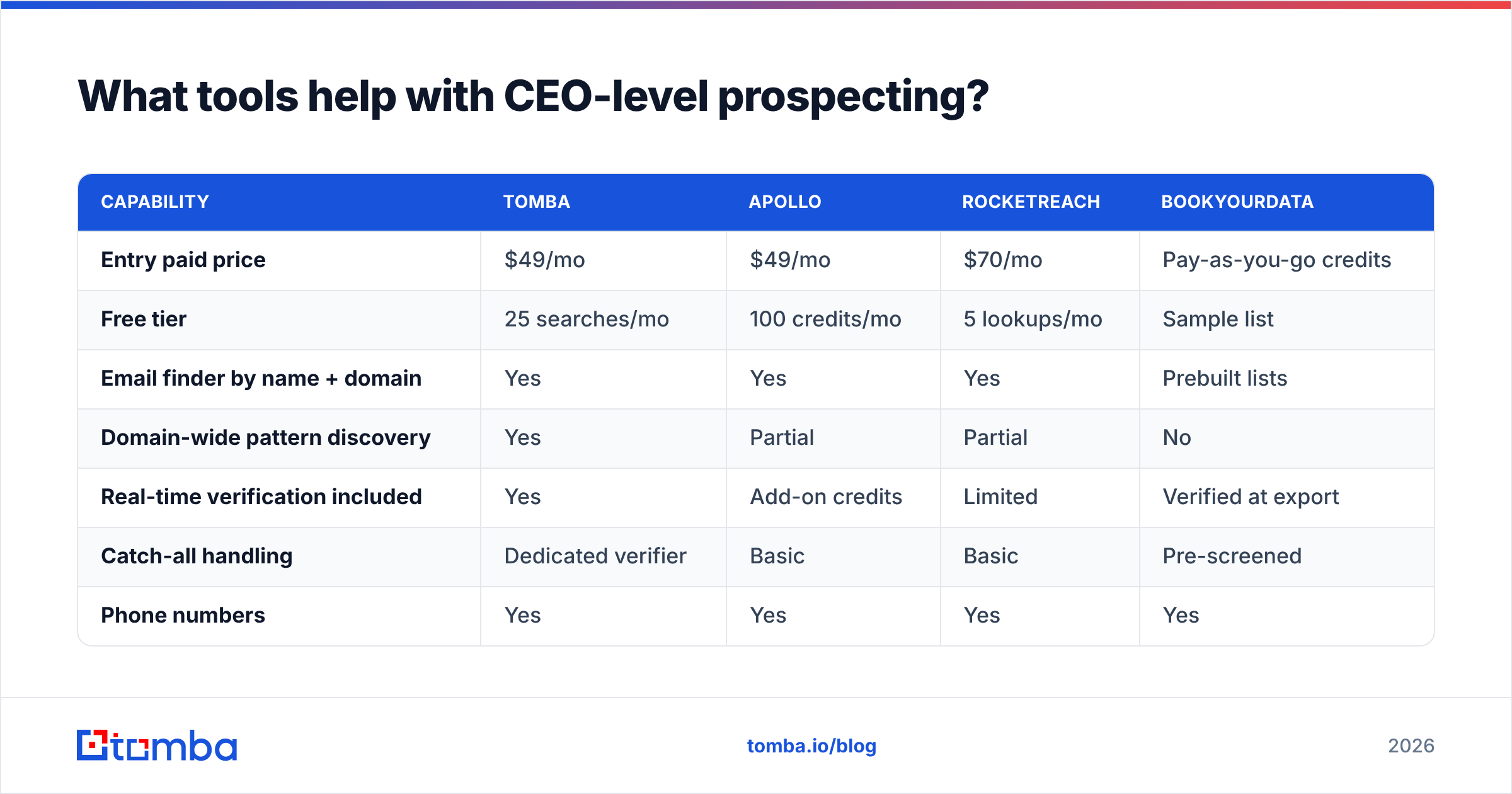
The stack for executive outreach is narrower than for general prospecting, because you need depth per contact rather than volume. Here's how the common options compare:
| Capability | Tomba | Apollo | RocketReach | BookYourData |
|---|---|---|---|---|
| Entry paid price | $49/mo | $49/mo | $70/mo | Pay-as-you-go credits |
| Free tier | 25 searches/mo | 100 credits/mo | 5 lookups/mo | Sample list |
| Email finder by name + domain | Yes | Yes | Yes | Prebuilt lists |
| Domain-wide pattern discovery | Yes | Partial | Partial | No |
| Real-time verification included | Yes | Add-on credits | Limited | Verified at export |
| Catch-all handling | Dedicated verifier | Basic | Basic | Pre-screened |
| Phone numbers | Yes | Yes | Yes | Yes |
| API for enrichment workflows | Yes | Yes | Yes | Limited |
| Best fit | Accuracy-first, low volume | All-in-one sequencing | Recruiter-style lookup | Buying prebuilt verified lists |

Each of these fits a different shape of team. Apollo makes sense when you want find, sequence, and dial in a single seat. BookYourData is a strong choice when you'd rather buy a pre-verified list than assemble one contact at a time — a genuinely different workflow, and a good one for teams without research bandwidth. RocketReach skews toward recruiting use cases. Tomba fits when accuracy per lookup matters more than list size, which describes executive outreach precisely. Independent user reviews on G2 are worth a scan before you commit to any of them, since the category shifts fast.
For enriching a list you already have — say, 200 CEOs from a conference attendee page with names but no contact details — a bulk email finder run followed by verification is the standard flow. Check Tomba pricing against your monthly contact volume before picking a tier; most teams doing executive outreach specifically need far fewer credits than they assume.
How many CEOs should you contact per week?#
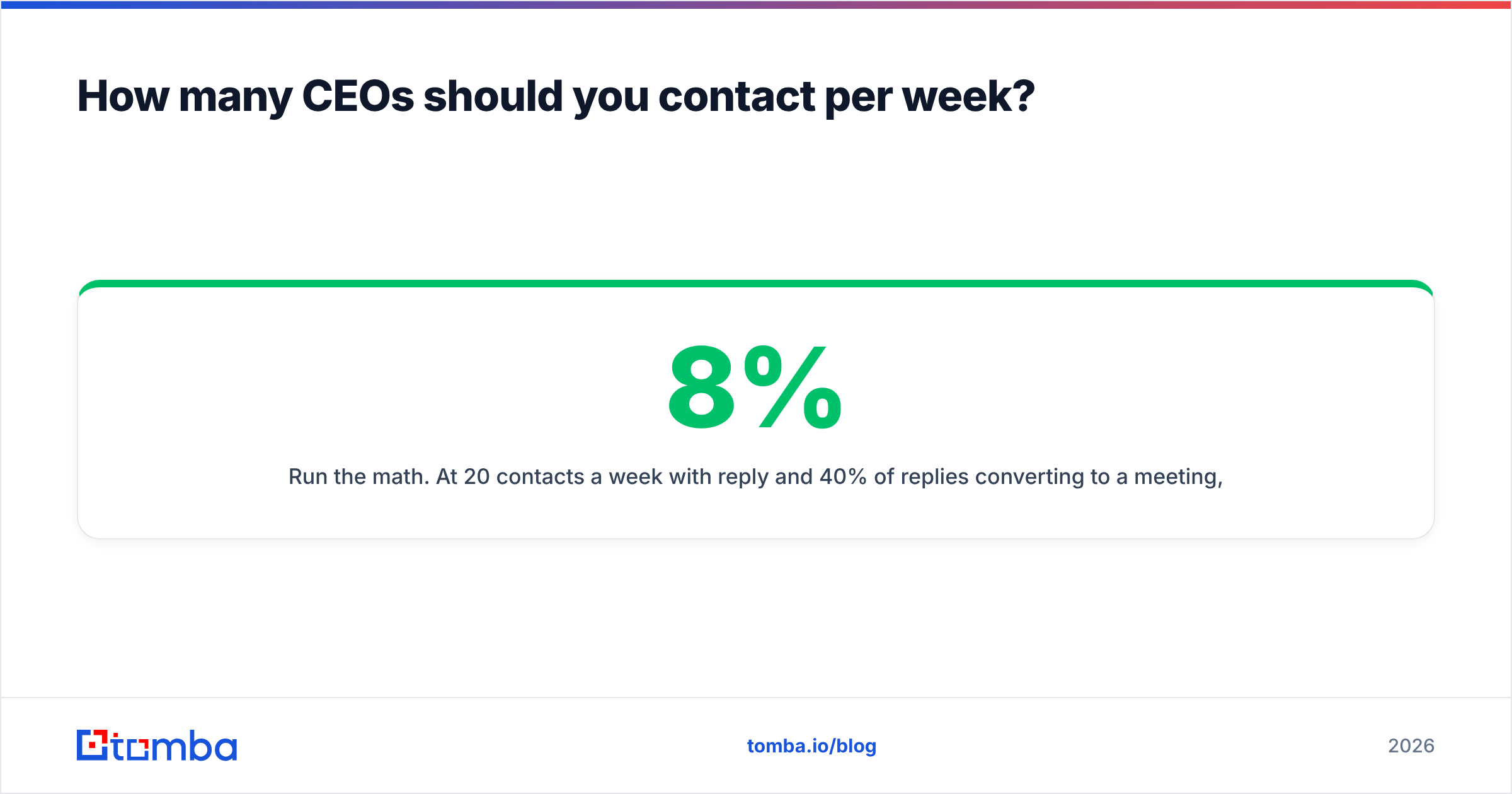
Fewer than you think. The realistic ceiling for one person doing genuine research is 15-25 CEO contacts per week, and that assumes you're not also handling demos.
Run the math. At 20 contacts a week with 8% reply and 40% of replies converting to a meeting, that's roughly 0.6 meetings per week from cold — call it 30 a year. Add a warm-intro track that produces even three intros a month at 50% reply, and you've roughly doubled the total from a fraction of the effort.
That ratio is the entire strategic point of executive prospecting. Cold email to CEOs is a floor, not a strategy. It keeps the pipeline warm while you build the referral paths that actually produce the meetings. Teams that invert this — 400 cold CEO emails a week, zero relationship work — burn their domains within two quarters and have nothing to show for it.
Track two numbers and ignore the rest: reply rate per channel, and meetings per hour of research invested. The second one will tell you faster than anything else whether a segment is worth pursuing at all.
Get the right address before you write the email#
Every tactic above rests on one thing: reaching the CEO's actual inbox rather than a shared queue or a dead mailbox. Research, copy, and timing are wasted effort if the address is wrong.
The Tomba Email Finder resolves a name and company domain into a verified professional address with a confidence score, so you know before you send whether you're writing to the CEO or to a bounce. Start on the free tier at 25 searches a month — enough to work through a first list of executive targets — and move up only when your volume actually demands it.
Related guides#
Ready to find emails that actually work?
Join 150,000+ professionals who stopped guessing and started sending. Free credits on signup — no credit card required.
Get the Tomba newsletter
Practical outbound tactics and product updates — once every two weeks.
About the author