How to Create a Sales Pitch That Actually Converts in 2026
A sales pitch is not a monologue about your product. Here is a 7-step framework for building one that survives the first 30 seconds, plus the templates and structures that work in 2026.
TL;DR
- A sales pitch is a structured argument for change, not a product tour. Lead with the buyer's problem, not your feature list.
- The 7-step framework below works for cold calls, discovery calls, demos, and written outreach — only the length changes.
- Pick one framework (Problem-Agitate-Solve, Challenger, or SPIN) and run it consistently. Switching frameworks per call is why teams cannot diagnose what is broken.
- Your pitch fails before it starts if the contact data is wrong. Pitching the right message to the wrong person still books zero meetings.
- Rehearse the first 30 seconds and the objection responses. Everything in between is easier than you think.
What is a sales pitch in 2026?#
A sales pitch is a short, structured argument that makes a specific buyer believe changing their current situation is worth the cost and risk of buying from you.
That definition rules out most of what gets called a pitch. A slide deck walkthrough is not a pitch. A feature list is not a pitch. A 12-minute company history starting with "founded in 2011 by two engineers" is definitely not a pitch.
What changed by 2026 is not the psychology — it is the attention budget. Buyers now arrive at your call having already read three competitor comparison pages and asked an AI assistant to summarize your category. According to Gartner's B2B buying research, buyers spend only about 17% of their total purchase journey meeting with potential suppliers, and when multiple vendors are involved, roughly 5% of total buying time goes to any single sales rep. Your pitch is competing against the buyer's own research, not against ignorance.
So the modern pitch has one job: replace the buyer's generic understanding of the category with a specific understanding of their own situation. You are not informing. You are reframing.
How do you create a sales pitch step by step?#
Seven steps. Do them in order — most bad pitches are bad because someone started at step five.
Define the single buyer, not the segment. "Mid-market SaaS" is not a buyer. "A VP of Sales at a 60-person SaaS company whose SDR team just missed quota two quarters running" is a buyer. Write the pitch for one person and it will land with a hundred.
Name the expensive problem. Pick the one problem that costs them money, headcount, or their own credibility. If you cannot attach a rough number to the problem, you do not understand it well enough to pitch against it.
Prove you understand the current workaround. Every prospect already solves this problem somehow — a spreadsheet, an intern, an unloved legacy tool, or ignoring it. Naming the workaround accurately is the fastest trust signal available to you.
State the change, not the product. "You stop losing three days a month reconciling lead lists" beats "our platform offers automated data reconciliation." Same fact, different subject of the sentence.
Give one specific proof point. One customer, one number, one timeframe. "A 40-person agency cut their bounce rate from 12% to under 2% in six weeks." Three proof points dilute; one lands.
Pre-answer the top objection. You know what it is. Price, switching cost, or "we already use X." Raise it yourself before they do and you control the framing.
Ask for a small, specific next step. Not "does that sound interesting?" Instead: "Can I send you a 12-lead sample from your ICP so you can check the accuracy yourself?"
Steps 1-3 are research. Steps 4-7 are delivery. Teams that skip research and rehearse delivery are polishing a message aimed at nobody.
Which sales pitch framework should you use?#
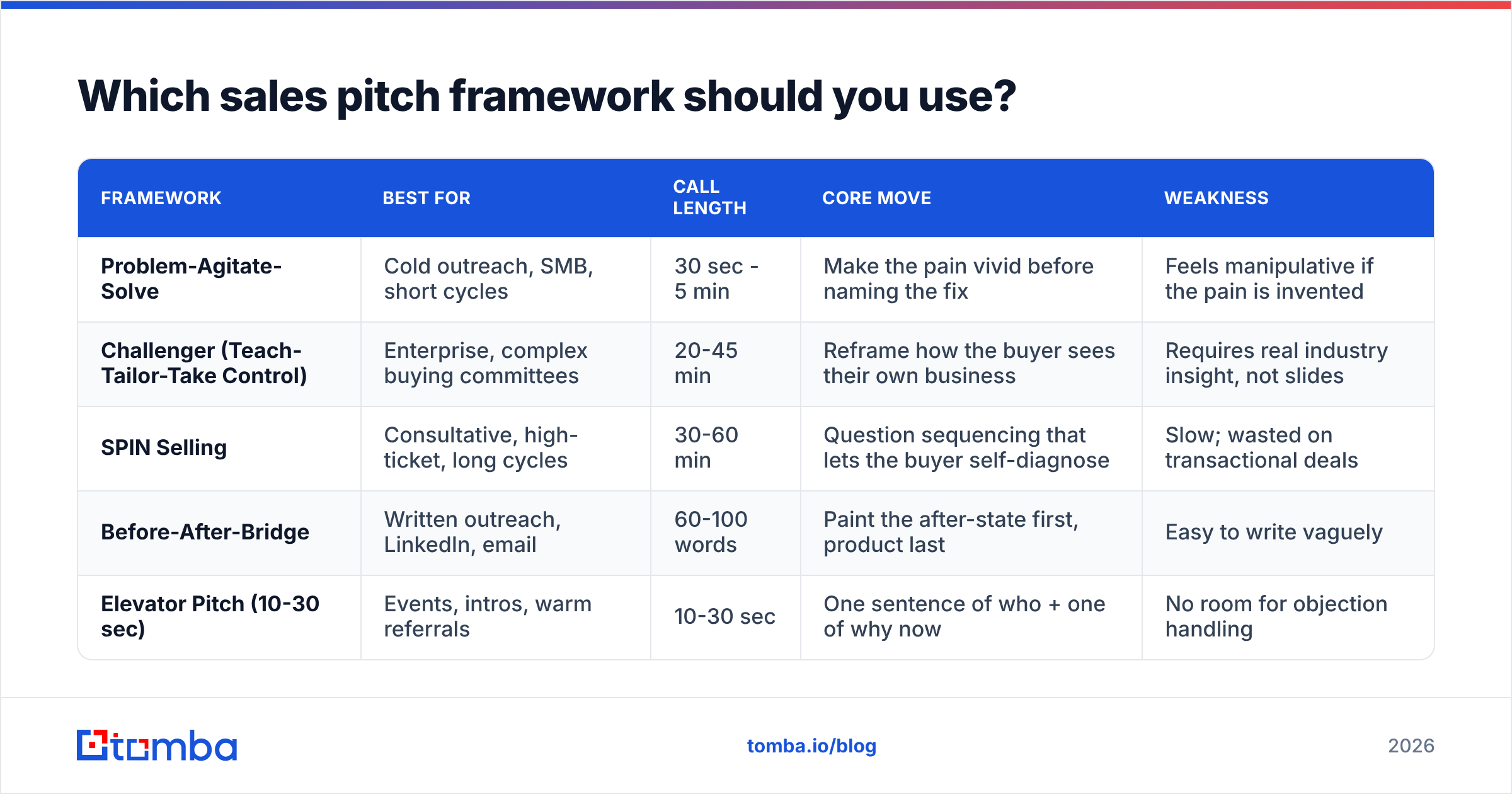
There is no universal winner. There is a right fit per deal size, sales cycle, and how much your buyer already knows.
| Framework | Best for | Call length | Core move | Weakness |
|---|---|---|---|---|
| Problem-Agitate-Solve | Cold outreach, SMB, short cycles | 30 sec - 5 min | Make the pain vivid before naming the fix | Feels manipulative if the pain is invented |
| Challenger (Teach-Tailor-Take Control) | Enterprise, complex buying committees | 20-45 min | Reframe how the buyer sees their own business | Requires real industry insight, not slides |
| SPIN Selling | Consultative, high-ticket, long cycles | 30-60 min | Question sequencing that lets the buyer self-diagnose | Slow; wasted on transactional deals |
| Before-After-Bridge | Written outreach, LinkedIn, email | 60-100 words | Paint the after-state first, product last | Easy to write vaguely |
| Elevator Pitch (10-30 sec) | Events, intros, warm referrals | 10-30 sec | One sentence of who + one of why now | No room for objection handling |
If you are running outbound at volume, start with Problem-Agitate-Solve for the first touch and graduate to SPIN or Challenger once a discovery call is booked. Mixing them mid-conversation is the most common cause of a pitch that "felt off" without anyone being able to say why.
What does a good sales pitch actually sound like?#
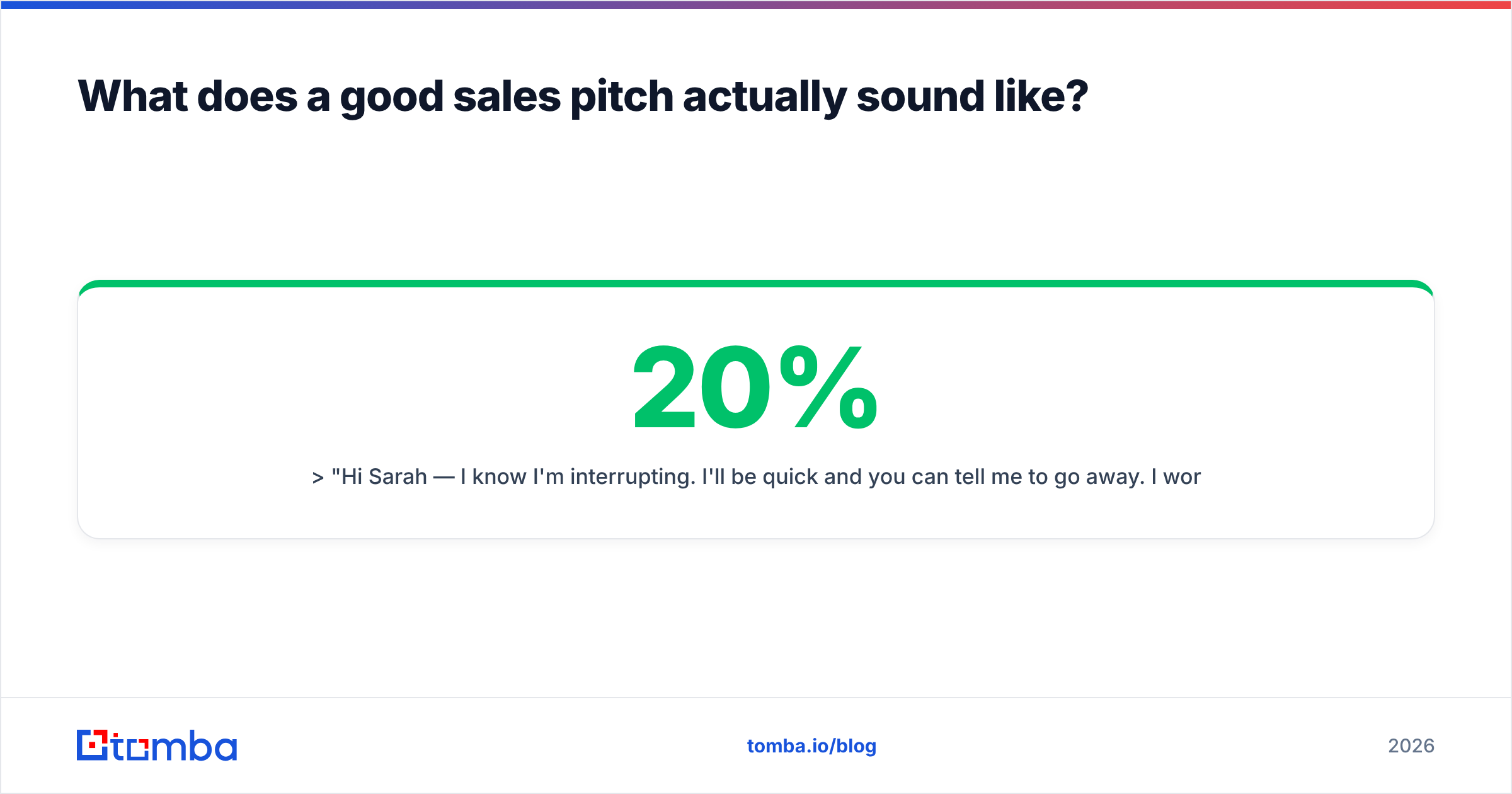
Here is a 45-second cold call opener built on the seven steps:
"Hi Sarah — I know I'm interrupting. I'll be quick and you can tell me to go away. I work with sales leaders at Series A SaaS companies, and the pattern I keep seeing is that SDR teams are burning about a day a week cleaning lead lists because the data they buy bounces at 15-20%. Usually people patch it with a verification tool bolted on afterward, which catches some of it. We had an agency in your space go from 12% bounce to under 2% in about six weeks by fixing it at the source instead. I don't know if that's your problem — it might not be. Worth ten minutes next Tuesday to find out?"
Count what is missing: no company history, no feature list, no "we're the leading platform for." The product is never named. The entire pitch is about the buyer's Tuesday.
Now the written version, using Before-After-Bridge, for cold email:
Subject: your SDRs' Monday morning
Sarah — most SDR teams I talk to start Monday by manually checking whether last week's lead list is still valid. Roughly a day a week, gone.
The teams that fixed it aren't verifying more. They're sourcing from a base that's verified before it ever hits the CRM, so the Monday cleanup disappears.
Happy to run 25 contacts from your exact ICP and send you the accuracy numbers — no call needed. Want them?
Under 90 words. One ask. The offer is a proof point, not a meeting.
Why do most sales pitches fail before the pitch?#
Because the pitch was delivered to a bad contact record.
This is the unglamorous half of pitch performance and it dwarfs wording tweaks. If 20% of your list bounces, your reply rate math is broken before your copy gets a vote. If the title on the record is stale, your carefully researched problem statement is aimed at someone who no longer owns that problem.
Three failure modes, in order of how much damage they do:
- Wrong person. You pitched the pain of a VP of Sales to a marketing ops manager. Perfect message, wrong ears. Fix this with role-level targeting before you write a word.
- Dead address. The email bounces or lands in a catch-all void. Nobody heard the pitch at all. Run addresses through an email verifier and use a catch-all verifier for domains that accept everything.
- Stale context. Your "I saw you just raised a Series B" opener refers to a funding round from 2023. Worse than no personalization, because it advertises that you did not check.
The order matters. Rewriting your value proposition while 18% of your sends bounce is optimizing the wrong variable. Get the list right, then optimize the words — and use a bulk email finder so the list work does not eat the week you were going to spend on messaging.
How do you handle objections inside the pitch?#
Fold the objection into the pitch instead of waiting for it. Four moves, in ascending order of difficulty:
- The pre-empt. "You're probably already using something for this — most teams are. The reason people still talk to me is..." You defused the objection by predicting it.
- The narrow ask. When price comes up early, do not defend price. Shrink the commitment: "Before price matters, let's see if the data is even accurate for your market. That part's free."
- The honest disqualifier. "If you're doing under 200 sends a month, honestly this is overkill — a free tool will do." Nothing buys credibility faster than turning away a bad fit, and it makes your positive claims believable.
- The reframe. Take "it's too expensive" and reprice it against the problem: "It's $99 a month. One rep spending a day a week on list cleanup costs about eight times that in salary alone."
HubSpot's sales research consistently finds that reps who address concerns early in the conversation convert better than reps who defer them to a "let me get back to you" — a pattern worth reading up on in HubSpot's sales resources. The mechanism is simple: an unspoken objection keeps running in the buyer's head, drowning out everything you say afterward.
How do you personalize a pitch at scale?#
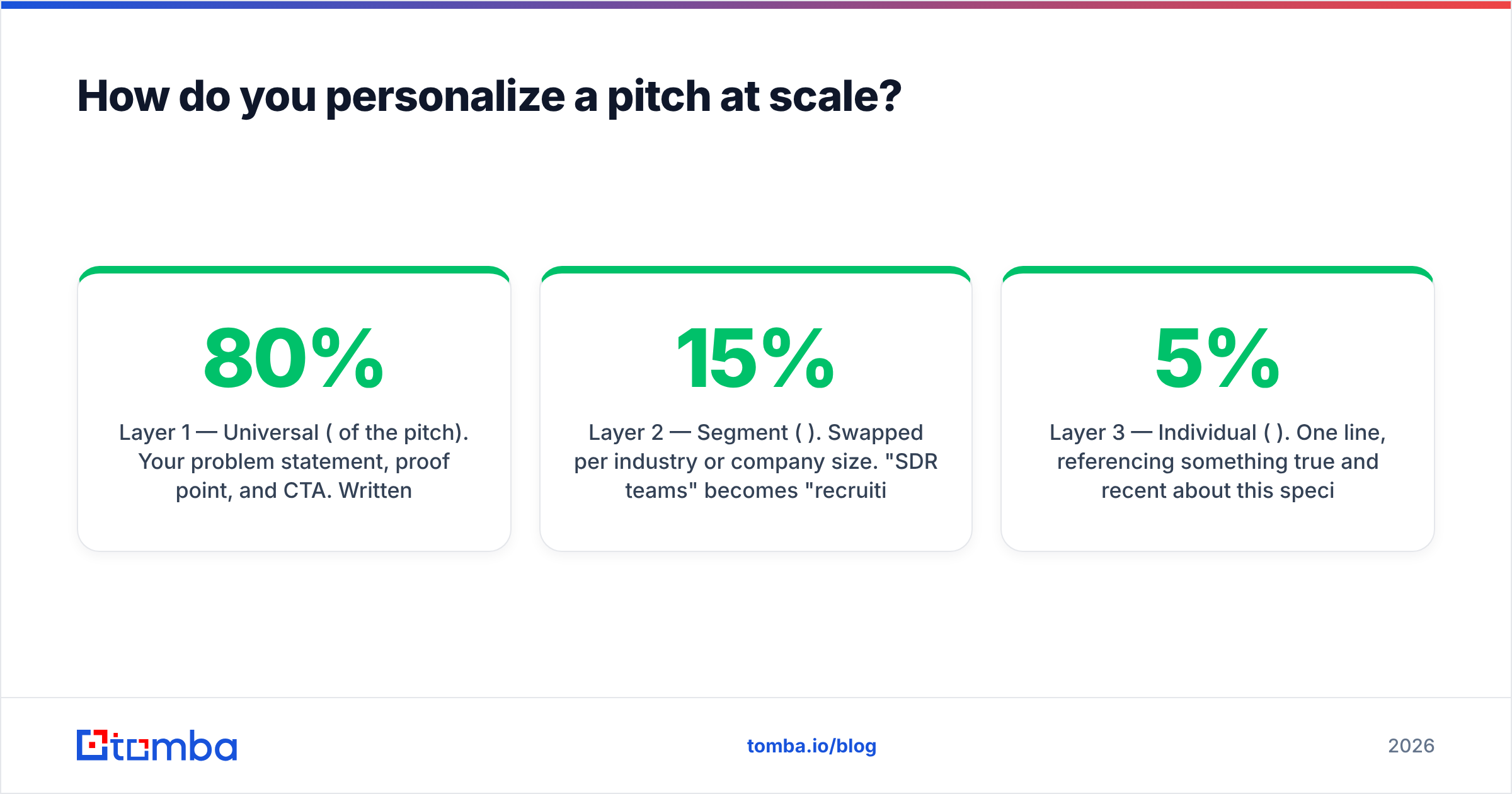
The tension: personalization works, and personalization does not scale. The resolution is to personalize the layer that matters and templatize the rest.
Split your pitch into three layers:
- Layer 1 — Universal (80% of the pitch). Your problem statement, proof point, and CTA. Written once, changed quarterly. This is the part that should be genuinely excellent because every prospect sees it.
- Layer 2 — Segment (15%). Swapped per industry or company size. "SDR teams" becomes "recruiting teams" becomes "agency account managers." Five variants covers most B2B ICPs.
- Layer 3 — Individual (5%). One line, referencing something true and recent about this specific person or company. A job posting, a product launch, a podcast appearance.
Layer 3 is where most teams either give up or fake it. The fix is data, not effort: pull the individual signal automatically. A domain search gives you the whole org chart at a company so you can pitch the person who owns the budget rather than the person whose email you happened to find. Data enrichment fills in title, seniority, and company size so Layer 2 selection is automatic rather than a manual judgment call.
One warning: never let Layer 3 contradict Layer 1. If your universal pitch says "you're probably drowning in manual work" and your personalized line says "congrats on the automation launch," the prospect notices the seam immediately.
How do you test and improve your pitch?#
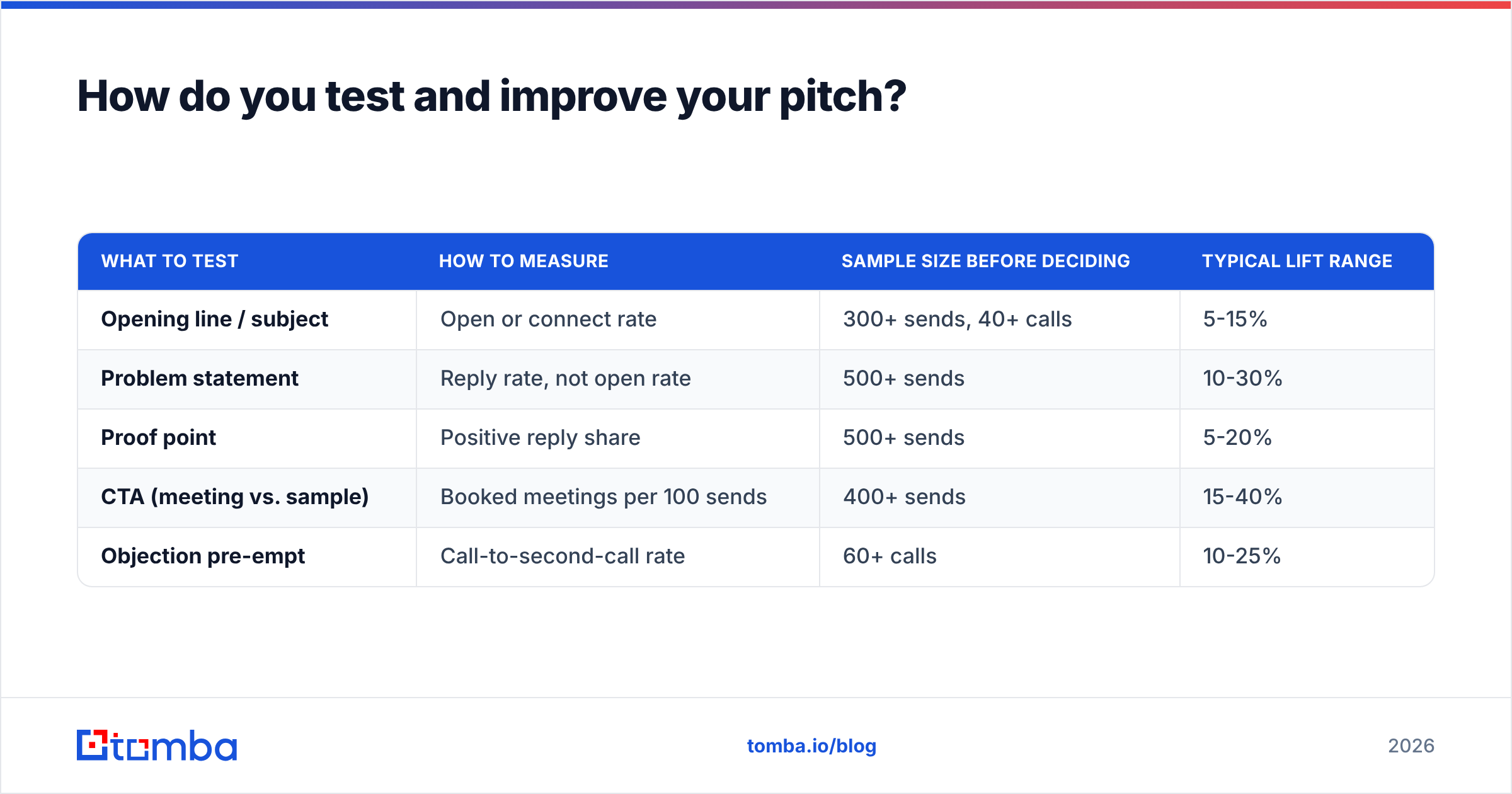
Treat the pitch as a hypothesis with one variable at a time.
| What to test | How to measure | Sample size before deciding | Typical lift range |
|---|---|---|---|
| Opening line / subject | Open or connect rate | 300+ sends, 40+ calls | 5-15% |
| Problem statement | Reply rate, not open rate | 500+ sends | 10-30% |
| Proof point | Positive reply share | 500+ sends | 5-20% |
| CTA (meeting vs. sample) | Booked meetings per 100 sends | 400+ sends | 15-40% |
| Objection pre-empt | Call-to-second-call rate | 60+ calls | 10-25% |
Two rules that save teams from fake conclusions. First, never test two variables at once — you will learn nothing and believe you learned something. Second, judge by the metric closest to revenue that has enough volume. Open rate is noisy and increasingly unreliable given privacy proxies; reply rate is the earliest honest signal.
Record your calls. Not for the manager — for you. The gap between the pitch you think you deliver and the one you actually deliver is usually 30 seconds of throat-clearing at the front. You will hear it in one listen and never do it again. G2's category reviews for sales engagement software are a decent starting point if you need a recording and analysis tool to make that habit stick.
What are the most common sales pitch mistakes?#
- Starting with your company. Nobody has ever bought because a vendor was founded in 2011. Cut the origin story entirely from the pitch and keep it for the case study.
- Stacking three proof points. Each additional customer example reduces the memorability of the first. Pick the one closest to the prospect's situation.
- Asking "does that make sense?" It signals doubt about your own clarity and invites a polite yes that means nothing. Ask a real question instead.
- Talking past the yes. When they agree, stop pitching and start scheduling. More reps lose deals by continuing after the buy signal than by pitching too little.
- Pitching to a list you did not check. Covered above, but it earns the last spot because it is the most expensive and the easiest to fix.
- No next step in the calendar. "I'll follow up next week" is not a next step. A calendar invite is.
Your pitch is only as good as who receives it#
The seven-step framework, the objection pre-empts, the three-layer personalization model — all of it assumes you are talking to the right person at a working address. That assumption is wrong more often than most teams measure.
Fix the input before you keep polishing the output. The Tomba Email Finder locates verified professional email addresses by name, company, or domain, so the pitch you spent a week refining actually reaches the VP who owns the problem — not a catch-all black hole or someone who left the company in 2024. The free tier gives you 25 searches a month to test accuracy against your own ICP before spending anything, and paid plans start at $49/mo with bulk and API access at higher tiers. Check the Tomba pricing page for the full breakdown.
Write the pitch once. Aim it correctly every time.
Related guides#
// get started
Find, verify and enrich your first contacts today
Start on the free plan with 25 searches a month, then scale when your team is ready.
Free plan · No credit card required · GDPR & CCPA
// about the author