How to Do B2B Telemarketing in 2026: A Practical Playbook
B2B telemarketing still books meetings in 2026 — but only when your list, timing, and openers are right. Here is the exact workflow, with scripts, benchmarks, and the numbers that decide whether it pays.
TL;DR
- B2B telemarketing works in 2026, but the connect rate is decided before you dial — 60% of your result comes from list quality, not script quality.
- Expect roughly 3-8% connect-to-meeting on a well-built list, 40-60 dials per meaningful conversation for mid-market, and worse for enterprise.
- Use a phone-plus-email pairing on every account. Calls alone waste 70% of the effort you already spent on research.
- Scripts matter less than the first 9 seconds. Open with permission, name the reason, then shut up.
- Track four numbers only: dials-to-connect, connect-to-conversation, conversation-to-meeting, meeting-to-opportunity. Everything else is vanity.
What is B2B telemarketing, and is it different from cold calling?#
B2B telemarketing is outbound phone contact with businesses to qualify, nurture, or book meetings with decision-makers. Cold calling is one tactic inside it. Telemarketing also covers warm follow-up on inbound leads, event follow-up, list qualification calls, data-cleaning calls, and win-back campaigns on churned accounts.
The distinction matters because the economics differ wildly. A cold dial into a net-new account might need 50+ attempts per booked meeting. A follow-up call to someone who downloaded your pricing page yesterday can convert at 20-30%. If you run both under one "telemarketing" KPI, you will fire the wrong rep and kill the wrong campaign.
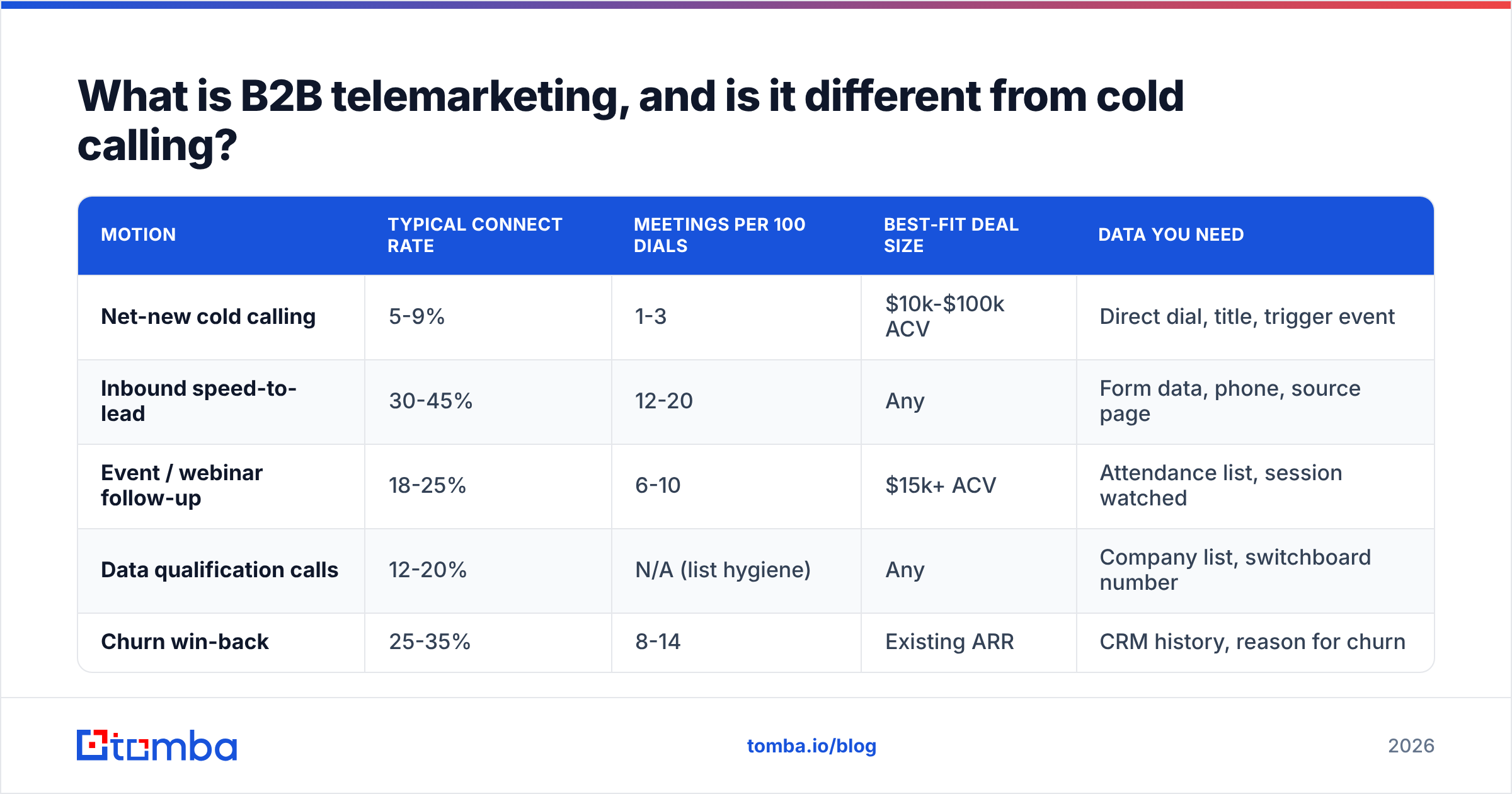
Here is how the main motions compare:
| Motion | Typical connect rate | Meetings per 100 dials | Best-fit deal size | Data you need |
|---|---|---|---|---|
| Net-new cold calling | 5-9% | 1-3 | $10k-$100k ACV | Direct dial, title, trigger event |
| Inbound speed-to-lead | 30-45% | 12-20 | Any | Form data, phone, source page |
| Event / webinar follow-up | 18-25% | 6-10 | $15k+ ACV | Attendance list, session watched |
| Data qualification calls | 12-20% | N/A (list hygiene) | Any | Company list, switchboard number |
| Churn win-back | 25-35% | 8-14 | Existing ARR | CRM history, reason for churn |
Notice the gap between line one and line two. Speed-to-lead is 10x more efficient per dial and yet most teams staff it last. Fix that before you scale cold volume.
Why does most B2B telemarketing fail before the first dial?#
Because the list is wrong. Three failure modes account for nearly all of it.
- Wrong numbers. Vendor-supplied "direct dials" that route to a switchboard, a former employee, or a disconnected line. Every bad number burns 45 seconds and a bit of morale.
- Wrong person. You reach a real human who genuinely cannot buy or influence the purchase. This is a targeting failure disguised as a rejection.
- No reason to call. The rep has a name and a number but no trigger, no context, and no hypothesis about why this company would care this quarter.
- No paired channel. The call is a one-shot. No email before, no email after, no LinkedIn touch. Roughly 20% of your prospects simply do not answer unknown numbers, ever — and you have no second path to them.
The fix for the first three is data. Before a rep dials, they should have: a verified direct dial or a verified mobile, a verified work email for the same person, a job title confirmed within the last 90 days, and one specific reason this account is on the list today.
That last item — the reason — is where most teams get lazy. "They're in our ICP" is not a reason. "They posted three SDR roles in the last month and their careers page mentions outbound" is a reason.
How do you build a B2B telemarketing list that actually connects?#
Work backwards from the conversation you want to have, not forward from a filter panel.
Step 1 — Define the trigger, not just the firmographics. Company size and industry get you a universe. A trigger tells you which 3% of that universe is worth a call this month. Useful triggers: new funding, a new VP in the buying function, a job posting for a role your product supports, a tech-stack change, an expansion into a new market, a compliance deadline in their industry.
Step 2 — Build the account list before the contact list. Pull 200-400 accounts that match the trigger. Do not skip to contacts. Account-first keeps your reps able to multi-thread when the first contact says "that's not me."
Step 3 — Map 2-4 contacts per account. One economic buyer, one user-level champion, one adjacent influencer. This is the single highest-leverage change most teams can make — multi-threaded accounts book meetings at roughly double the rate of single-contact accounts.
Step 4 — Enrich phone and email together. Get both channels for every contact. A phone finder gives you the dial; an email finder gives you the follow-up path. Running one without the other means half your research is stranded.
Step 5 — Verify before you load into the dialer. Run numbers through a phone validator and emails through an email verifier. A 15% bad-data rate on a 2,000-record list is 300 wasted dials — about a full day of one rep's calling time.
Step 6 — Deduplicate and suppress. Strip existing customers, open opportunities, and anyone contacted in the last 60 days. Nothing damages a brand faster than three reps calling the same CFO in one week.
Where should the data come from?#
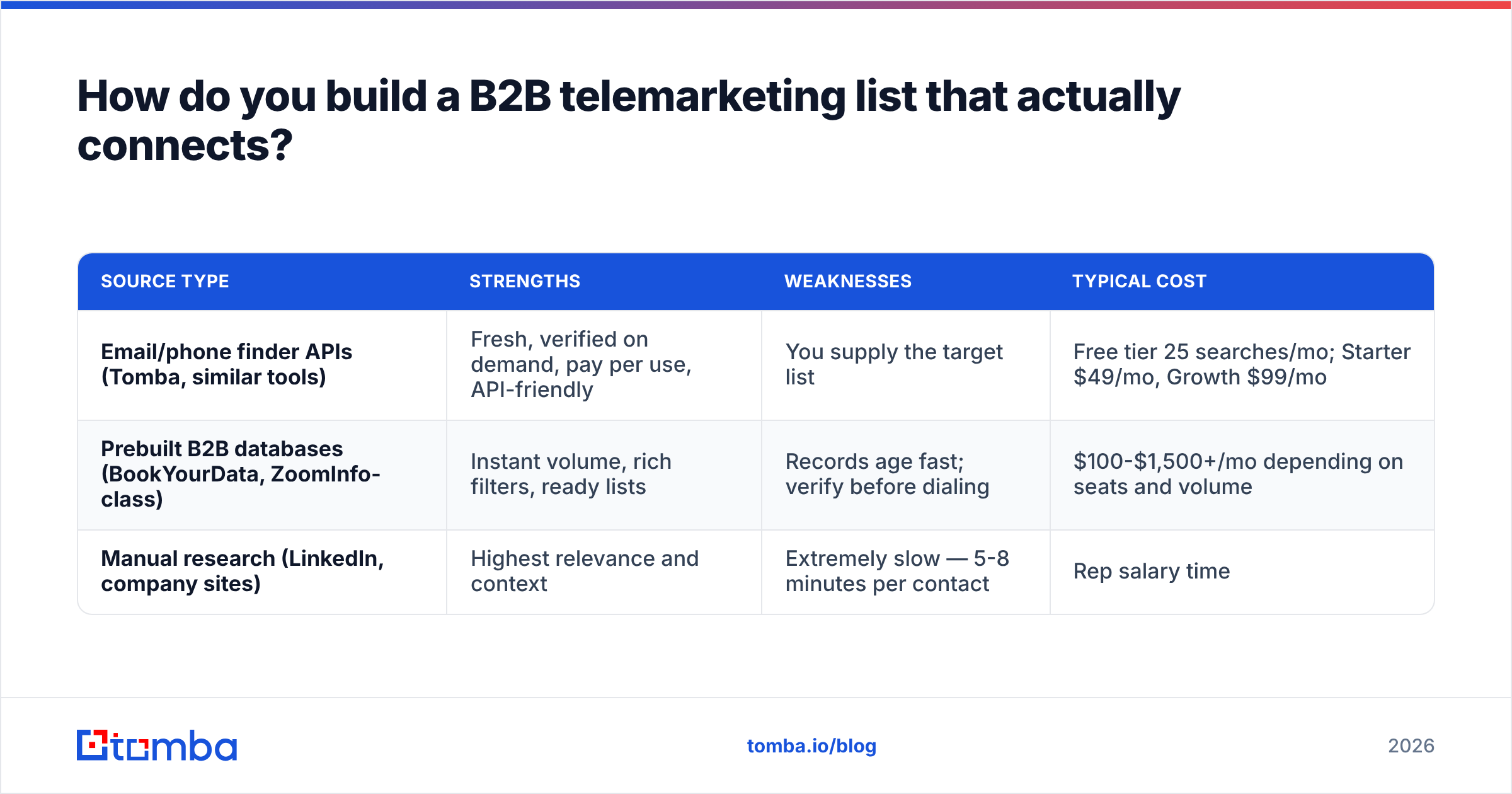
You have three broad options, and most serious teams use two of them at once.
| Source type | Strengths | Weaknesses | Typical cost |
|---|---|---|---|
| Email/phone finder APIs (Tomba, similar tools) | Fresh, verified on demand, pay per use, API-friendly | You supply the target list | Free tier 25 searches/mo; Starter $49/mo, Growth $99/mo |
| Prebuilt B2B databases (BookYourData, ZoomInfo-class) | Instant volume, rich filters, ready lists | Records age fast; verify before dialing | $100-$1,500+/mo depending on seats and volume |
| Manual research (LinkedIn, company sites) | Highest relevance and context | Extremely slow — 5-8 minutes per contact | Rep salary time |
BookYourData and similar list providers are genuinely useful when you need a broad universe fast — they hand you a filterable pool in minutes rather than hours. The practical pattern many teams land on: pull the account universe from a database, then re-verify and enrich contact-level phone and email through an API layer right before the campaign launches, since contact records decay at roughly 2-3% per month. Both approaches beat manual research on cost per usable record.
For a repeatable workflow, a bulk email finder plus a Google Sheets add-on lets an ops person refresh a 1,000-row list in under an hour without touching code. Teams with engineers usually go straight to the Tomba API and wire enrichment into the CRM on record creation.
What should you actually say on a B2B telemarketing call?#
The first 9 seconds decide the call. Everything after that is a negotiation you already won or lost.
The opener that works most consistently:
"Hi [Name], it's [You] from [Company]. I know I'm calling out of the blue — can I have 30 seconds to tell you why, and you can tell me to get lost?"
Why it works: it names the awkwardness before the prospect does, gives them explicit control, and asks for a tiny commitment. Permission-based openers consistently outperform "How are you today?" — the fake-rapport opener signals a script within two seconds.
The reason (10-20 seconds): state the trigger and the hypothesis. "You posted three SDR roles this month. Usually when teams scale outbound that fast, the data layer breaks before the headcount does. That's the only reason I called."
The question (one, then silence): "Is that anywhere near what's happening on your side?"
Then stop talking. The most common rep error at this point is filling silence with features. Count to four in your head.
Objection handling — the three you will actually hear:
- "Send me an email." → "Happy to. So I send something useful instead of generic — is [pain hypothesis] a real thing for you, or should I not bother?" Then actually send it, same day, referencing the call.
- "We already use [competitor]." → "Makes sense, they're solid. Most people I talk to who use them keep them for [X] and bolt something on for [Y]. Is [Y] handled?"
- "I'm not interested." → "Totally fair. Before I go — was it the timing, or is this just not your area?" This one question routes you either to a callback date or to the right contact.
Never: open with "Did I catch you at a bad time?" You are asking a stranger for permission to be an inconvenience. They will take it.
How many calls per day, and when should you dial?#
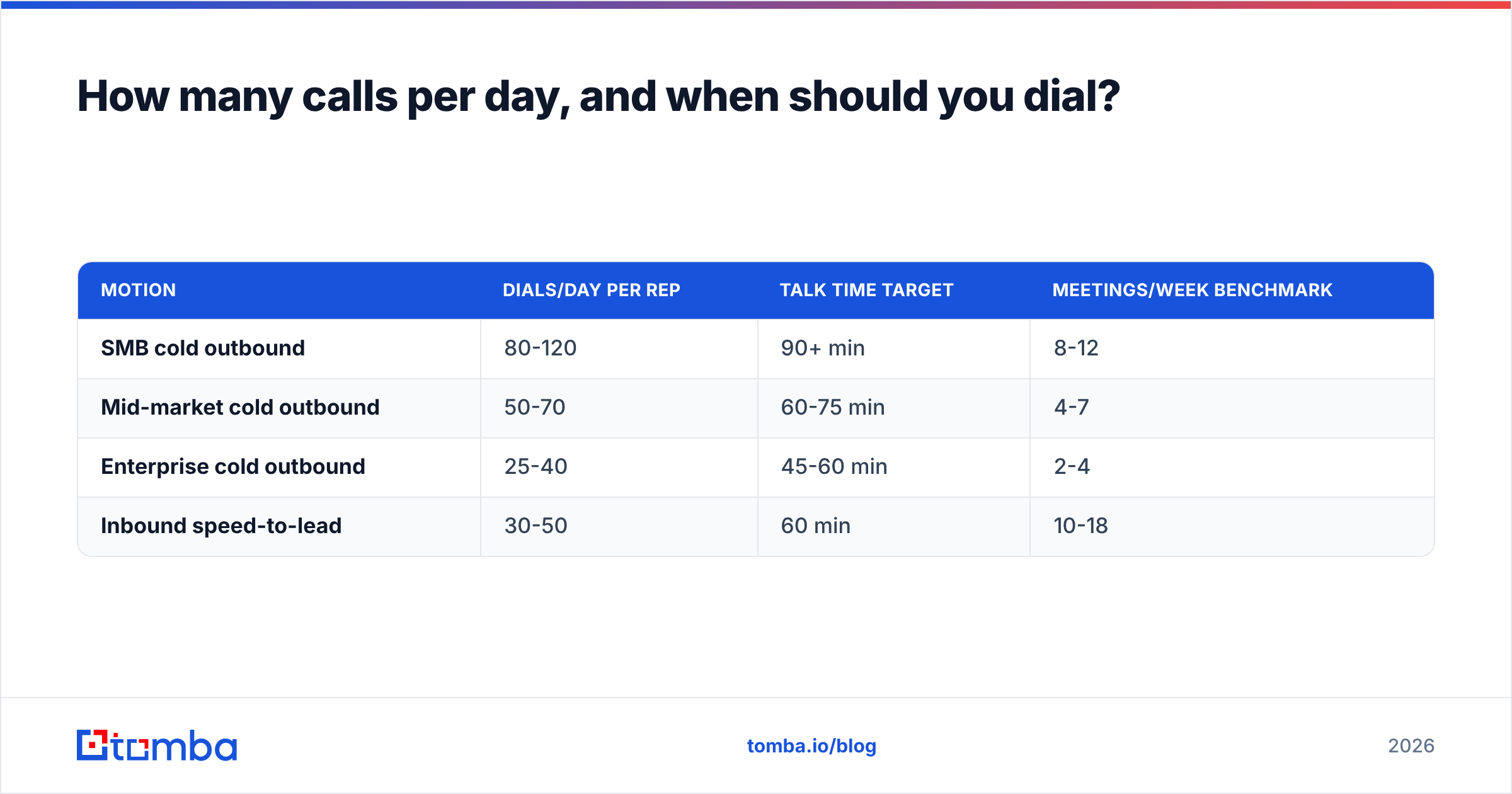
Volume targets depend on the motion, and blanket "100 dials a day" mandates produce dialing theater rather than pipeline.
| Motion | Dials/day per rep | Talk time target | Meetings/week benchmark |
|---|---|---|---|
| SMB cold outbound | 80-120 | 90+ min | 8-12 |
| Mid-market cold outbound | 50-70 | 60-75 min | 4-7 |
| Enterprise cold outbound | 25-40 | 45-60 min | 2-4 |
| Inbound speed-to-lead | 30-50 | 60 min | 10-18 |
Timing beats volume. Across most B2B datasets, the two strongest connect windows are early morning before calendars fill and late afternoon after the last meeting block. Midday connect rates run noticeably lower for calendar-heavy roles. Test in your own data — vertical differences are real, and field-heavy industries invert the pattern entirely.
Also: call the same person 6-8 times across 2-3 weeks before you retire them, and vary the time of day each attempt. Most reps quit after two attempts, which is precisely why the third through sixth attempts are where the uncontested connects live. HubSpot's sales research has documented this attempt-count gap for years, and it has not closed.
How do you combine telemarketing with email and LinkedIn?#
Phone-only sequences leave meetings on the table. The prospects who never answer unknown numbers are not unreachable — they are just reachable somewhere else.
A workable 14-day sequence:
- Day 1 — Email 1 (short, trigger-based, no attachments, one question).
- Day 2 — Call attempt 1, morning. Voicemail only if you have something specific to say.
- Day 4 — LinkedIn view + connection request, no pitch in the note.
- Day 6 — Call attempt 2, late afternoon.
- Day 8 — Email 2, referencing the call attempts openly ("I've tried you twice — probably bad timing").
- Day 11 — Call attempt 3, different time block.
- Day 14 — Break-up email, permission to close the file.
Two rules make this work. First, every channel references the others — pretending each touch is independent reads as spam. Second, the email side needs to actually land, which means the sending domain has to be healthy. If your email deliverability is broken, the "call plus email" plan collapses to "call only" and you never find out why the numbers dropped.
Worth noting: in most jurisdictions, B2B calling sits under different rules than B2C. In the US, business-to-business calls have carve-outs from parts of the TCPA, but state laws vary and recording consent is a separate question entirely. In the UK and EU, corporate subscriber rules and GDPR legitimate-interest tests apply. Check the FTC's telemarketing rules and get your own counsel's read before you scale. This is not legal advice.
What metrics prove B2B telemarketing is working?#
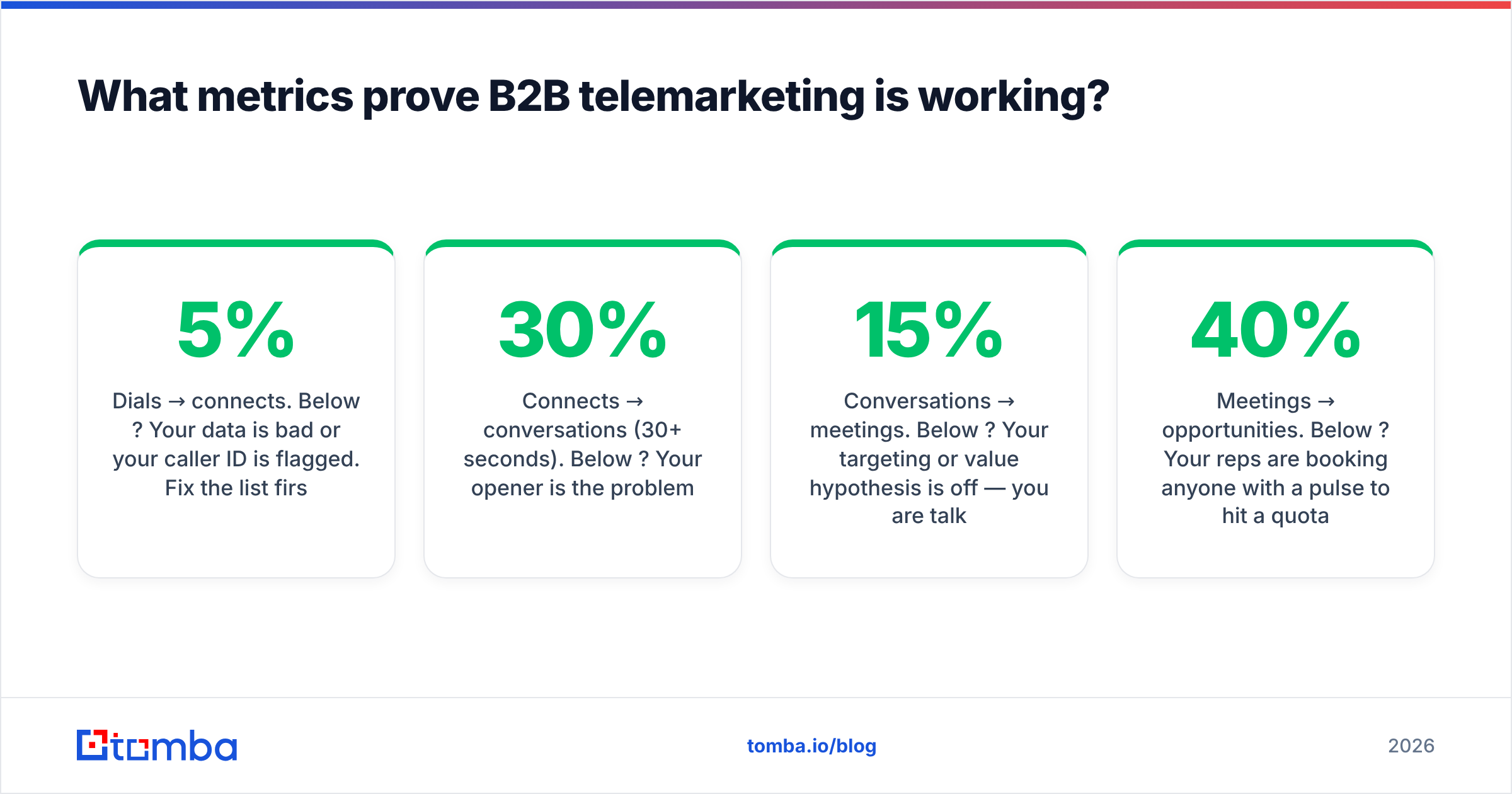
Track the funnel, not the activity. Four ratios tell you where the machine is broken:
- Dials → connects. Below 5%? Your data is bad or your caller ID is flagged. Fix the list first.
- Connects → conversations (30+ seconds). Below 30%? Your opener is the problem.
- Conversations → meetings. Below 15%? Your targeting or value hypothesis is off — you are talking to real people about the wrong thing.
- Meetings → opportunities. Below 40%? Your reps are booking anyone with a pulse to hit a quota. Change the incentive.
Cost per meeting is the number your CFO cares about. Take fully loaded rep cost plus tooling plus data, divide by meetings booked. A mid-market SDR at $70k loaded cost booking 5 meetings a week lands near $290 per meeting. If your average deal is $25k at a 20% close rate from meetings, each meeting is worth $5,000 in expected revenue. That math works. Run it with your own numbers before you add headcount.
One more diagnostic most teams skip: pull the recordings for every call that ran past four minutes but did not book. That's where you find the real objections — the ones your reps are losing to but not reporting.
What tools do you need to run this?#
Keep the stack small. Four categories cover it:
- Data and enrichment — verified direct dials and emails. This is the layer that decides everything downstream.
- Dialer — parallel or power dialing to remove manual entry. Anything that saves 20 seconds per dial pays for itself.
- Sequencer — to run the phone-plus-email cadence without a rep tracking it in a spreadsheet.
- CRM — one source of truth, with call dispositions that map to your four ratios.
Compare vendors on G2 or Capterra for the dialer and sequencer layers, where feature parity is high and pricing is where the difference shows up. On the data layer, ignore the review scores and run your own test: pull 100 records from two providers, dial both lists blind, and compare connect rates. That test costs one afternoon and settles the argument permanently.
If you also handle inbound, wire visitor identification into the same motion — website visitor reveal turns anonymous pricing-page traffic into a callable account list, and those calls convert closer to the inbound benchmarks than the cold ones.
Start with the list, not the script#
The highest-ROI change you can make to a B2B telemarketing program this quarter is not a new script, a new dialer, or a new coach. It is removing the bad records from your list and adding a verified second channel to every contact you keep.
Run your next campaign list through Tomba Email Finder to pair a verified work email with every direct dial you already have, then verify both before the first call goes out. The free tier covers 25 searches a month if you just want to sanity-check your current data quality; Tomba pricing starts at $49/mo for Starter and $99/mo for Growth when you are ready to run it at campaign volume. Clean the list first — the meetings follow.
Related guides#
// get started
Find, verify and enrich your first contacts today
Start on the free plan with 25 searches a month, then scale when your team is ready.
Free plan · No credit card required · GDPR & CCPA
Get the Tomba newsletter
Product and data updates
// about the author