How To Do Inside Sales in 2026: A Practical Rep Playbook
Inside sales is not cold calling with a laptop. Here is the full playbook: the stack, the daily cadence, the metrics that matter, and the ramp math that decides whether your team hits quota.
TL;DR
- Inside sales is a remote-first sales motion where reps run the full cycle by phone, email, and video — it is a process discipline, not a phone-only job.
- The three things that actually decide performance: contact data accuracy, a written cadence, and one owned metric per stage. Everything else is decoration.
- A working stack costs roughly $150–$400 per rep per month. Data quality is the line item you should never cut first.
- Expect 8–12 touches across 14–21 days per prospect. Reps who stop at three touches leave most of their pipeline unworked.
- Ramp a new inside sales rep in 30/60/90 blocks and measure activity in month one, conversion in month two, revenue in month three.
What is inside sales, and how is it different from outside sales?#
Inside sales means closing deals remotely — phone, email, video, LinkedIn — without traveling to the buyer. Outside sales means field visits, conferences, and steak dinners.
Think of it like a restaurant versus a delivery kitchen. The field rep runs a dining room: fewer covers, higher ticket, lots of atmosphere. The inside rep runs a delivery operation: more orders, tighter margins per order, and the whole thing lives or dies on logistics. Neither is inferior. They optimize for different constraints.
The practical differences that change how you work:
- Deal velocity — inside cycles run shorter because you are not scheduling around flights. A 30-day cycle inside can be a 90-day cycle in the field.
- Touch volume — an inside rep works 40–80 accounts actively; a field rep works 10–20.
- Cost per meeting — inside sales meetings cost a fraction of field meetings, which is exactly why the model exploded.
- Data dependency — you cannot walk into a lobby and ask reception. If your contact data is wrong, your day is wrong.
- Coachability — every call is recordable, every email is loggable. Managers can actually see the work.
- Deal size ceiling — inside sales handles most mid-market motions fine; six-figure enterprise deals still usually need in-person moments.
That last point matters. Most modern teams run a hybrid: inside reps source and qualify, field or senior AEs close the top decile.
What does an inside sales rep actually do all day?#
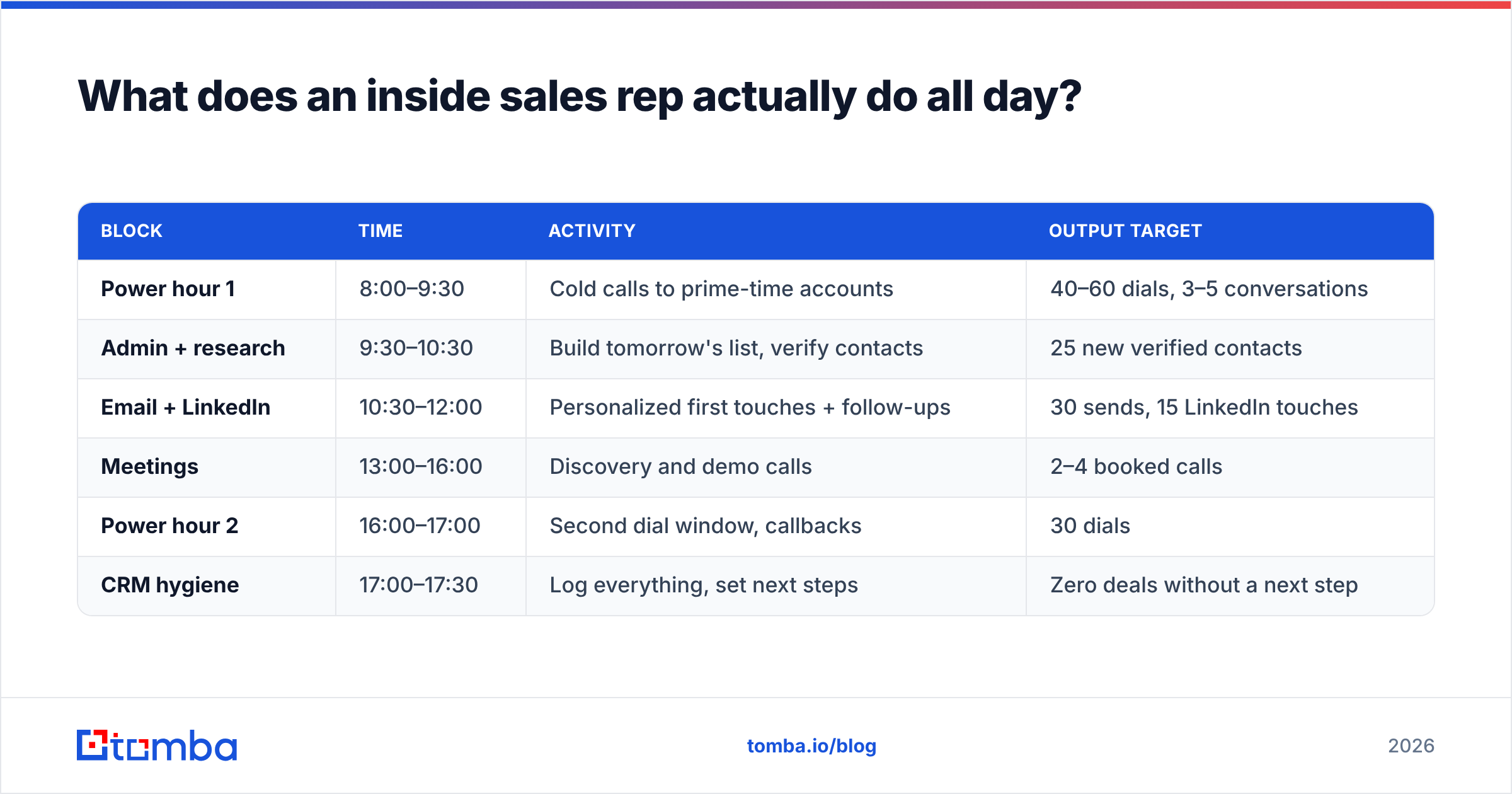
Here is the honest version of a productive day, not the LinkedIn version.
| Block | Time | Activity | Output target |
|---|---|---|---|
| Power hour 1 | 8:00–9:30 | Cold calls to prime-time accounts | 40–60 dials, 3–5 conversations |
| Admin + research | 9:30–10:30 | Build tomorrow's list, verify contacts | 25 new verified contacts |
| Email + LinkedIn | 10:30–12:00 | Personalized first touches + follow-ups | 30 sends, 15 LinkedIn touches |
| Meetings | 13:00–16:00 | Discovery and demo calls | 2–4 booked calls |
| Power hour 2 | 16:00–17:00 | Second dial window, callbacks | 30 dials |
| CRM hygiene | 17:00–17:30 | Log everything, set next steps | Zero deals without a next step |
The two power hours exist because connect rates cluster. Buyers pick up before their calendar fills and after it empties. Everything in the middle is asynchronous work.
Notice what is missing: no "check email all morning," no unstructured research rabbit holes. Research is timeboxed and batched. If you research one account at a time between calls, you will make 12 dials a day and wonder why the pipeline is empty.
How do you build the contact list that feeds all of this?#
Start with the account list, then find the people, then verify before you touch anything.
Step 1 — Define the account profile in filters, not adjectives. "Mid-market SaaS companies" is not a filter. "SaaS companies, 50–500 employees, US or UK, using HubSpot, funded in the last 24 months" is. Every criterion must map to something you can actually query.
Step 2 — Find the humans. For each account you need the economic buyer, the champion, and one adjacent user. Three contacts minimum per account. Single-threaded deals die when your one contact changes jobs.
Step 3 — Get working email addresses. This is where most inside sales programs quietly fail. Guessed patterns bounce, scraped lists rot at roughly 2–3% per month as people change jobs, and bounces damage your sending domain. Use a proper email finder against the domain, or run a domain search when you want the full contact map for an account rather than one person.
Step 4 — Verify before you send. Run every list through an email verifier and drop anything that comes back invalid. Catch-all domains need a separate call — a catch-all verifier tells you whether a catch-all address is actually deliverable or a black hole. Keep your bounce rate under 2%; Google and Microsoft both treat higher rates as a spam signal, and your sender reputation is far harder to rebuild than it is to protect.
Step 5 — Add phone coverage. Email books meetings; phone books them faster when the email lands. Pair each verified email with a mobile via a phone finder so your dialer has something better than a switchboard number.
Step 6 — Enrich for personalization. Title, tenure, tech stack, recent funding. You need one true, specific fact per prospect for the opening line. Generic personalization ("I saw you work at Acme") is worse than none.
A practical rule: never let an unverified address into your sending tool. Verification costs cents. A burned domain costs months.
What does the inside sales cadence look like?#
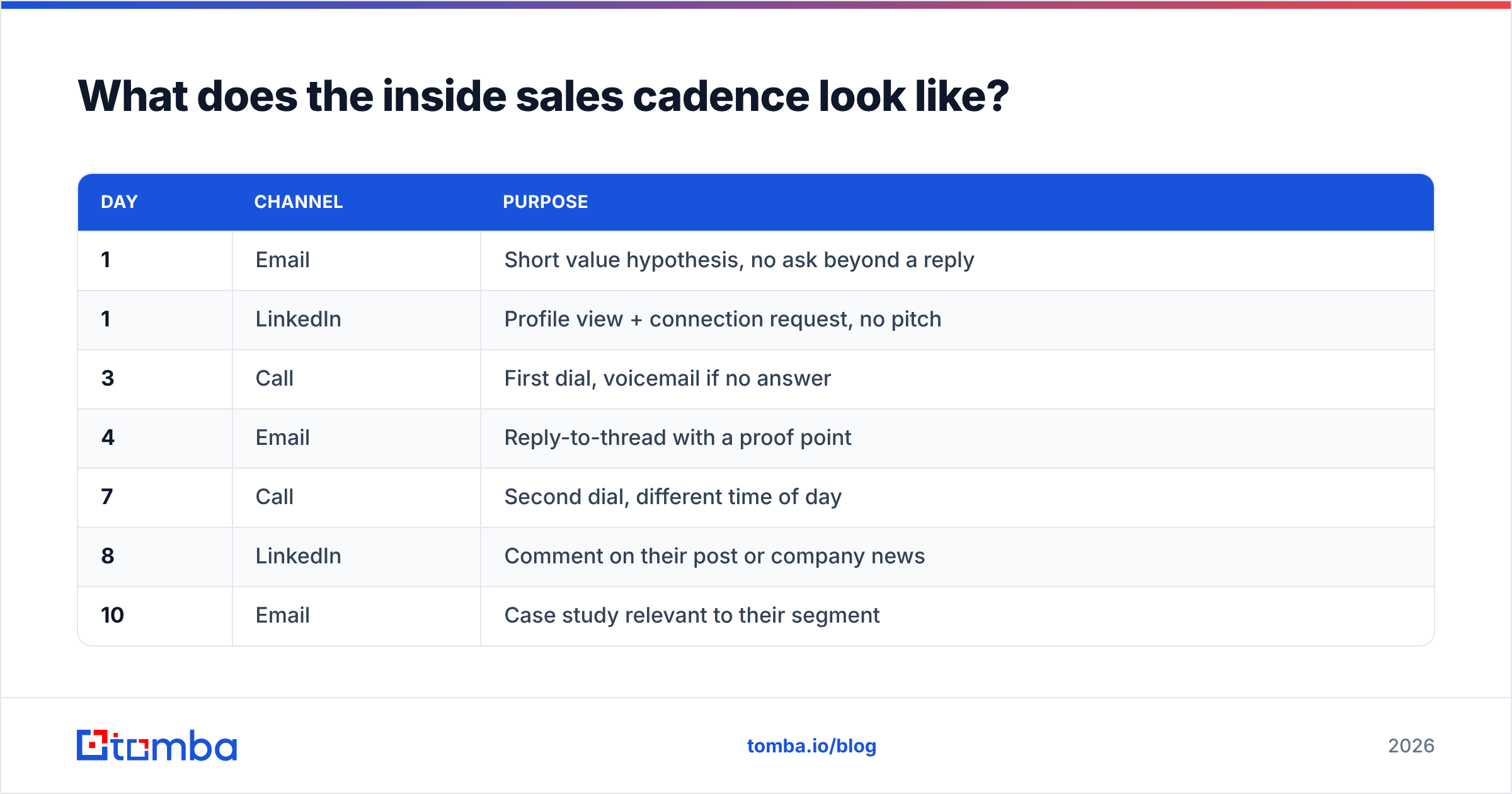
A cadence is a written sequence of touches across channels, on a schedule, that every rep follows until a prospect replies or exits. The written part is what makes it a cadence instead of a vibe.
Here is a 21-day, 12-touch structure that works for most mid-market B2B motions:
| Day | Channel | Purpose |
|---|---|---|
| 1 | Short value hypothesis, no ask beyond a reply | |
| 1 | Profile view + connection request, no pitch | |
| 3 | Call | First dial, voicemail if no answer |
| 4 | Reply-to-thread with a proof point | |
| 7 | Call | Second dial, different time of day |
| 8 | Comment on their post or company news | |
| 10 | Case study relevant to their segment | |
| 12 | Call | Third dial + voicemail referencing the emails |
| 15 | Direct ask: "worth 15 minutes or should I close the file?" | |
| 17 | Call | Fourth dial |
| 19 | Direct message, one sentence | |
| 21 | Breakup email, leave the door open |
Two rules make this work. First, vary the time of day on dials — calling the same person at 10 a.m. four times tests one hypothesis, not four. Second, thread your emails. Replying to your own earlier email raises reply visibility and gives the prospect context without a re-pitch.
If your reply rate is under 3% on this structure, the problem is almost always targeting or data, not copy. Check your response rate segment by segment before rewriting a single subject line.
Which tools do you actually need, and what do they cost?#
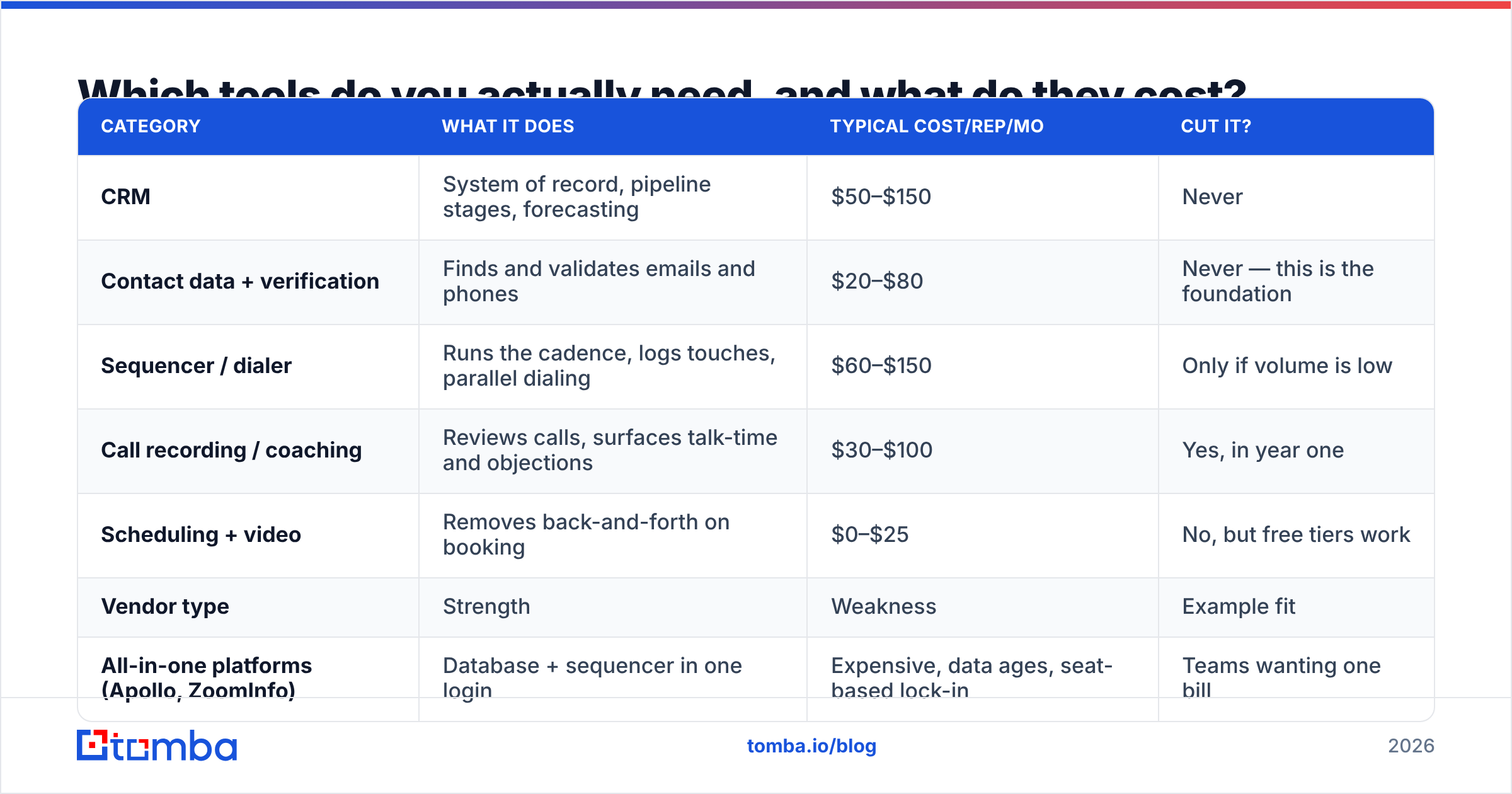
You need five categories. Anything beyond these is optimization, not infrastructure.
| Category | What it does | Typical cost/rep/mo | Cut it? |
|---|---|---|---|
| CRM | System of record, pipeline stages, forecasting | $50–$150 | Never |
| Contact data + verification | Finds and validates emails and phones | $20–$80 | Never — this is the foundation |
| Sequencer / dialer | Runs the cadence, logs touches, parallel dialing | $60–$150 | Only if volume is low |
| Call recording / coaching | Reviews calls, surfaces talk-time and objections | $30–$100 | Yes, in year one |
| Scheduling + video | Removes back-and-forth on booking | $0–$25 | No, but free tiers work |
Realistic total: $150–$400 per rep per month. Compare that to a fully loaded rep cost of $80,000–$140,000 and the stack is a rounding error. Teams still cut the data line item first, which is like buying a delivery van and skipping the GPS.
On data vendors specifically, the market splits into three shapes:
| Vendor type | Strength | Weakness | Example fit |
|---|---|---|---|
| All-in-one platforms (Apollo, ZoomInfo) | Database + sequencer in one login | Expensive, data ages, seat-based lock-in | Teams wanting one bill |
| Purchased list providers (BookYourData) | Instant volume, pay-per-record, no subscription | You own list hygiene after purchase | One-off campaigns, new territories |
| Precision finders + verifiers (Tomba, Findymail) | Real-time lookup, verified at query time, API-first | You bring your own sequencer | Teams that value accuracy per contact |
None of these is universally correct. If you need 5,000 contacts in a vertical this week and you will verify them yourself, a list provider like BookYourData is a legitimate fast path. If you are running a continuous, always-on motion where every bounce costs you domain reputation, real-time lookup and verification wins because the data is fresh at the moment you use it.
Tomba pricing starts at a free tier with 25 searches per month, then $49/mo for Starter, $99/mo for Growth, and $249/mo for Pro. For a two-rep team, Growth generally covers list building and verification for a full quarter of outbound.
If you already run outbound at scale, the Tomba API lets you verify inside your own workflow — enrich on form fill, verify before every sequence enrollment, and never push a bad address into your sending tool. Teams that automate that single check usually see bounce rates drop below 1% within a month.
How do you run discovery calls that convert?#
The meeting you booked is not the win. The next step you book on that meeting is.
Structure every discovery call in five parts and time-box each:
- Frame (2 min) — restate why you are here, confirm you have the full time, set the agenda, get agreement. "I've got 25 minutes on the calendar — still work?"
- Current state (8 min) — how do they do this today, with what tools, how many people, how often. No product talk. Ask "what happens after that?" three times and you will find the real friction.
- Cost of inaction (7 min) — quantify. Hours per week, deals lost, headcount spent. If they cannot quantify it, they will not fund a fix.
- Fit check (5 min) — show only the parts of the product that map to what they just said. Two features, not twelve.
- Next step (3 min) — book it live on the call. A deal without a calendared next step is not a deal.
The most common failure is spending 20 of 25 minutes in part four. If your demo is longer than your discovery, you are guessing at what they need and hoping something lands.
On qualification frameworks: MEDDIC, BANT, and SPICED all work. Pick one, put its fields in the CRM as required, and enforce them at the stage gate. The framework matters less than everyone using the same one. HubSpot's sales qualification guide is a solid neutral primer if your team needs a shared reference.
Which inside sales metrics actually predict revenue?#
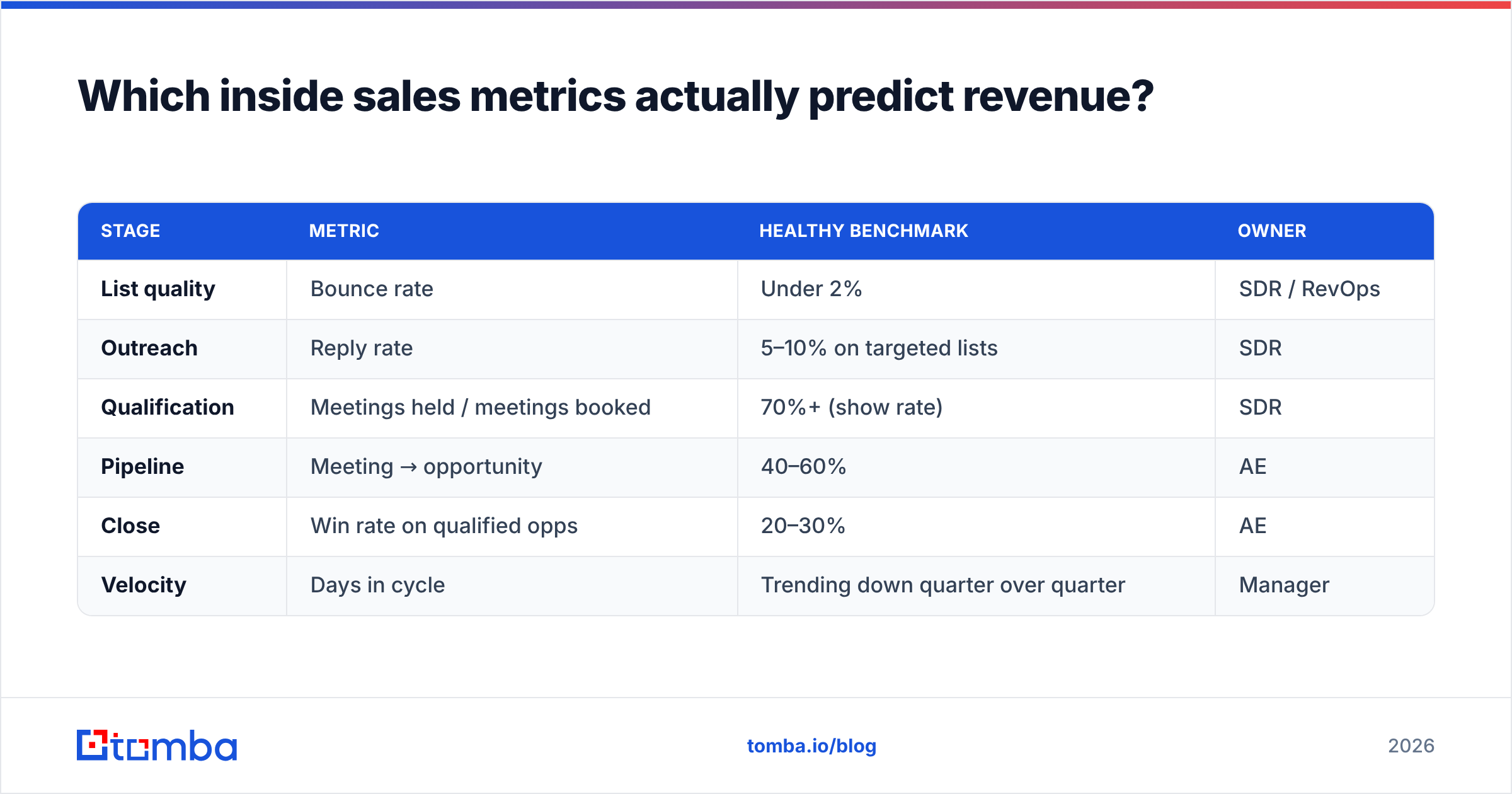
Track one metric per funnel stage, and make one person accountable for each. More than that and nobody owns anything.
| Stage | Metric | Healthy benchmark | Owner |
|---|---|---|---|
| List quality | Bounce rate | Under 2% | SDR / RevOps |
| Outreach | Reply rate | 5–10% on targeted lists | SDR |
| Qualification | Meetings held / meetings booked | 70%+ (show rate) | SDR |
| Pipeline | Meeting → opportunity | 40–60% | AE |
| Close | Win rate on qualified opps | 20–30% | AE |
| Velocity | Days in cycle | Trending down quarter over quarter | Manager |
Two diagnostics worth memorizing:
Low reply rate, low bounce rate means your targeting or message is wrong. Fix the list definition first, then the copy. Rewriting subject lines on a badly targeted list is rearranging deck chairs.
High bounce rate means your data source is stale, full stop. No amount of copywriting fixes a 20% bounce rate, and every bounce above 2% actively degrades the deliverability of the emails that would have landed.
Also watch show rate obsessively. A rep booking 20 meetings with a 50% show rate is doing worse than a rep booking 12 with a 90% show rate, and the first rep looks better on the activity dashboard. Confirm every meeting 24 hours ahead with a one-line email that includes the agenda.
For a broader benchmark set across the funnel, G2's sales software category data is useful for seeing what tooling comparable teams actually run.
How do you ramp a new inside sales rep?#
Thirty, sixty, ninety. Measure a different thing in each block.
Days 1–30 — Activity and product. The rep learns the product, shadows 20 calls, and hits activity targets only. Do not measure pipeline. Measure dials, emails sent, and CRM hygiene. Certification at day 30 is a mock discovery call with a manager playing a real prospect from a lost deal.
Days 31–60 — Conversion. Now measure meetings booked and show rate. The rep should be running their own discovery calls with a manager listening on at least three per week. This is where call recordings earn the subscription — reviewing two calls a week compounds faster than any training deck.
Days 61–90 — Revenue. Full quota expectations begin, usually at 50–70% of a ramped rep's number. By day 90 you know whether this hire works.
Two ramp accelerators that are cheap and underused. First, give new reps a pre-verified starter list — 200 contacts that you know are deliverable. Nothing kills a new rep's confidence like their first week bouncing. Second, make them write 20 first-touch emails and get them reviewed before sending any. Feedback on unsent drafts is free; feedback after a burned account is not.
What are the mistakes that kill inside sales teams?#
- Buying volume over accuracy. A 10,000-record list at 60% accuracy is worse than 2,000 records at 95%, because the bad 4,000 sends damage the domain that delivers the good ones.
- Single-threading every deal. One contact per account means one job change kills the deal. Three contacts minimum, always.
- Stopping at three touches. Most replies land on touches four through nine. Reps who quit early are paying full acquisition cost for a fraction of the yield.
- Measuring activity as an outcome. Dials are an input. If dials go up and meetings do not, more dials will not help — the list or the pitch is broken.
- No written cadence. If it lives in a rep's head, it cannot be coached, copied, or improved when that rep leaves.
- Skipping verification to save money. The cheapest line item in the stack protects the most expensive asset you have: your ability to reach an inbox at all.
Ready to build the list your cadence deserves?#
Every part of this playbook — the cadence, the dial windows, the discovery structure, the ramp plan — runs on top of one thing: contacts that are real and reachable. Get that wrong and the rest is theater.
Start with the Tomba Email Finder. Give it a name and a domain, or a domain alone, and get verified professional email addresses with a confidence score attached, so you know what you are sending into before you send it. The free tier gives you 25 searches a month to test your ICP hypothesis; Starter at $49/mo covers a solo rep's full pipeline build; Growth at $99/mo handles a small team. Verify before you enroll, keep bounces under 2%, and let your reps spend their power hours talking to people instead of apologizing to postmasters.
Related guides#
// get started
Find, verify and enrich your first contacts today
Start on the free plan with 25 searches a month, then scale when your team is ready.
Free plan · No credit card required · GDPR & CCPA
// about the author