How to Find Clients as a Financial Advisor in 2026
Referrals dried up? Here are 9 tested channels advisors use to book qualified prospect meetings in 2026 — with real cost-per-meeting math, compliance guardrails, and the outreach stack that makes cold contact work.
TL;DR
- Referrals still close best, but they are not a growth channel — they are a lagging indicator. You cannot forecast them, so you need two or three repeatable channels running alongside.
- The highest-ROI prospecting motion for most advisors in 2026 is a narrow niche (one industry, one liquidity event, one employer) plus direct outreach to a list you built yourself.
- Cost per booked meeting ranges from roughly $0 (referral) to $600+ (paid seminars). Direct outreach lands around $40-$90 once you count data and time.
- Compliance is not a reason to avoid outreach. SEC Rule 206(4)-1 permits testimonials and endorsements with disclosure, and cold email is legal under CAN-SPAM if you follow the rules.
- Bad contact data kills the whole thing. Anything above a 3% bounce rate puts your domain at risk before your message gets a fair test.
Why is finding clients harder for advisors in 2026 than it was five years ago?#
Three things changed at once.
First, the referral engine slowed. Client households are older, the wealth transfer is going to heirs who do not know you, and the average advisor's book has fewer natural introduction moments than it did when everyone was meeting in person.
Second, the field got crowded at the top of the funnel. Robo platforms, direct-to-consumer brokerages, and RIA aggregators all buy the same search terms you would. Cost per lead on "financial advisor near me" style keywords has climbed steadily, and a click is not a client.
Third, buyers self-educate. By the time a prospect with $2M in investable assets contacts you, they have read three comparison articles, checked your ADV, and looked at your LinkedIn. Your first touch is no longer your first impression.
The practical answer to how to find clients as a financial advisor is not one channel. It is a portfolio: one channel that compounds slowly (content, community, referrals), one that produces predictable volume (direct outreach), and one that catches demand you already earned (search, review sites, your website).
Which client acquisition channels actually work for financial advisors?#
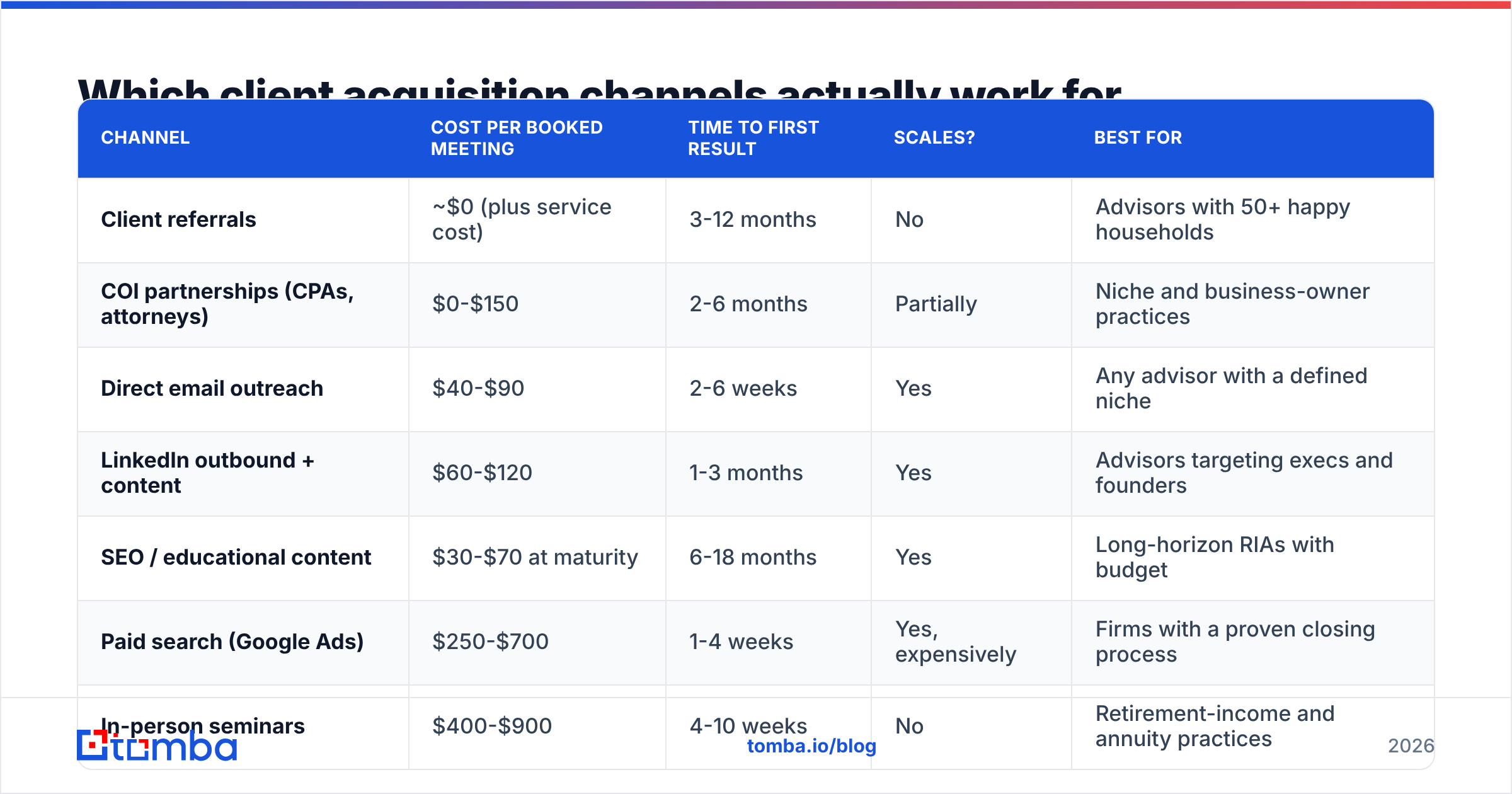
Here is the honest comparison. Cost per booked meeting is a blended estimate from advisor practice benchmarks and typical vendor pricing — your numbers will vary by market and average account size.
| Channel | Cost per booked meeting | Time to first result | Scales? | Best for |
|---|---|---|---|---|
| Client referrals | ~$0 (plus service cost) | 3-12 months | No | Advisors with 50+ happy households |
| COI partnerships (CPAs, attorneys) | $0-$150 | 2-6 months | Partially | Niche and business-owner practices |
| Direct email outreach | $40-$90 | 2-6 weeks | Yes | Any advisor with a defined niche |
| LinkedIn outbound + content | $60-$120 | 1-3 months | Yes | Advisors targeting execs and founders |
| SEO / educational content | $30-$70 at maturity | 6-18 months | Yes | Long-horizon RIAs with budget |
| Paid search (Google Ads) | $250-$700 | 1-4 weeks | Yes, expensively | Firms with a proven closing process |
| In-person seminars | $400-$900 | 4-10 weeks | No | Retirement-income and annuity practices |
| Webinars | $80-$200 | 3-8 weeks | Yes | Employer plan and equity-comp niches |
| Podcast / niche media | $20-$60 at maturity | 6-24 months | Slowly | Advisors with a genuine specialization |
Two takeaways. Direct outreach is the cheapest channel you can turn on this month. Everything cheaper than it takes six months or more to produce a meeting.
How do you pick a niche narrow enough to prospect?#
A niche is not "pre-retirees" or "high net worth individuals." Those are demographics, not niches. A niche is a group you can build a list of.
Test it with one question: can you name 200 specific people in it by tomorrow? If yes, it is a niche. If no, it is a market segment and you cannot prospect it directly.
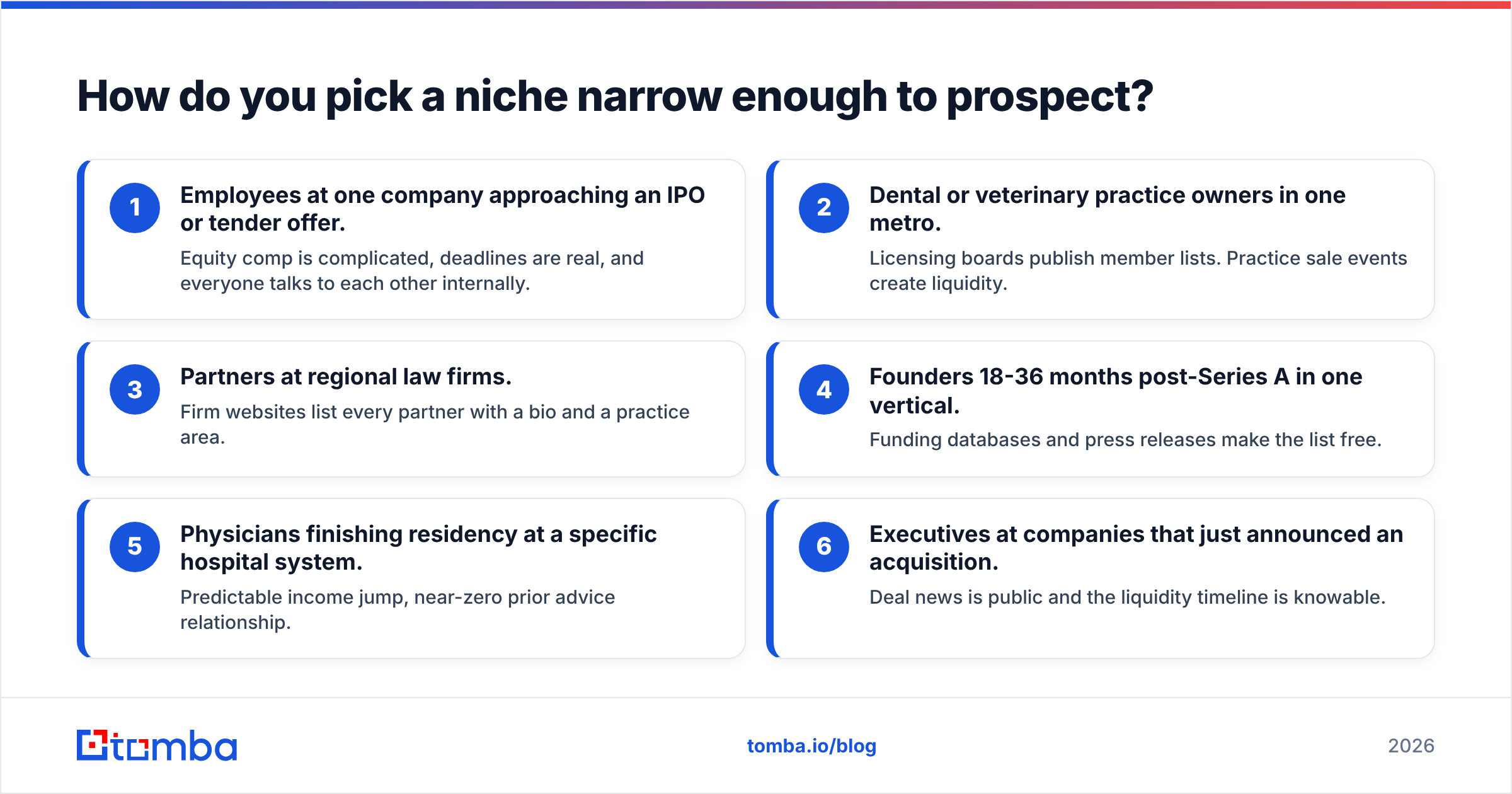
Workable examples:
- Employees at one company approaching an IPO or tender offer. Equity comp is complicated, deadlines are real, and everyone talks to each other internally.
- Dental or veterinary practice owners in one metro. Licensing boards publish member lists. Practice sale events create liquidity.
- Partners at regional law firms. Firm websites list every partner with a bio and a practice area.
- Founders 18-36 months post-Series A in one vertical. Funding databases and press releases make the list free.
- Physicians finishing residency at a specific hospital system. Predictable income jump, near-zero prior advice relationship.
- Executives at companies that just announced an acquisition. Deal news is public and the liquidity timeline is knowable.
The narrower the group, the more specific your first sentence can be — and specificity is the entire game in outbound. "I work with dermatologists leaving hospital employment for private practice" earns a reply. "I help people plan for retirement" does not.
How do you build a prospect list without buying a stale database?#
Buying a generic list is the most common mistake advisors make. Purchased consumer lists are frequently outdated, often non-compliant with your firm's marketing policy, and always shared with a hundred other buyers.
Build instead. The sequence looks like this:
Step 1 — Source the accounts. Association directories, licensing boards, chamber rosters, conference attendee lists, LinkedIn Sales Navigator saved searches, local business journals' annual lists. All public, all free or cheap.
Step 2 — Get the people. For each company or practice, identify decision makers by name and title. A domain search pulls every publicly indexed professional address on a company domain at once, which is faster than clicking through staff pages.
Step 3 — Find the addresses. Once you have a name and a domain, an email finder resolves the actual address rather than guessing at first.last@. If you already have LinkedIn profiles from a Sales Navigator search, a LinkedIn finder converts profile URLs into contactable addresses.
Step 4 — Verify before you send. This is not optional. Run every address through an email verifier and cut anything that comes back invalid or risky. A list that bounces at 8% will damage your sending domain in about two weeks.
Step 5 — Enrich for personalization. Job title, company size, tenure, and recent role changes are what let you write a first line that does not sound like a mail merge. Data enrichment fills those fields in bulk.
Two hundred verified, enriched contacts in a real niche beats 20,000 purchased records every single time. You will also sleep better when compliance asks where the data came from.
What does compliant outreach look like for a registered advisor?#
Short version: outreach is allowed, misleading outreach is not.
The rules that matter most:
- SEC Marketing Rule (206(4)-1). Since the 2021 amendments, testimonials and endorsements are permitted with required disclosures about compensation and conflicts. Read the SEC's own summary rather than a vendor's paraphrase of it.
- FINRA Rule 2210 governs communications with the public for broker-dealer reps — retail communications generally need principal approval before use, so get your templates pre-approved once and reuse them.
- CAN-SPAM requires accurate headers, a non-deceptive subject line, your physical mailing address, and a working opt-out honored within 10 business days. The FTC's compliance guide is short and worth 15 minutes.
- Telephone outreach is far more restricted than email. National and internal do-not-call lists apply. If you are cold calling, your compliance team should sign off on the process, not just the script.
- Archiving. Every outbound message is a business record. If your sequencer does not sync to your archive, you have a problem the day someone asks.
Get your outreach templates through compliance as a batch, once, with variable fields marked. Advisors who submit each email individually stop doing outreach within a month.
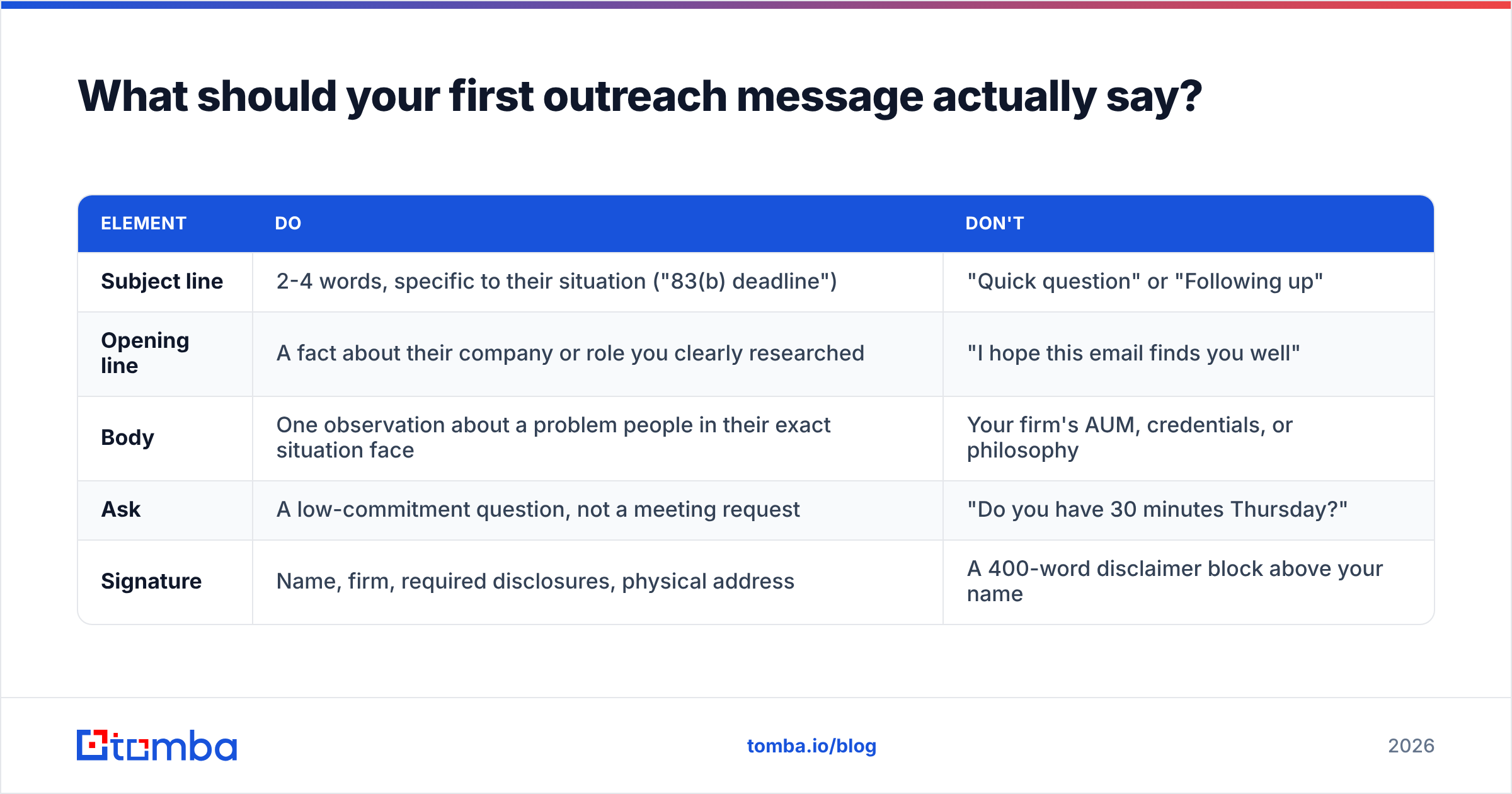
What should your first outreach message actually say?#
Four sentences. No attachments, no calendar link in email one, no "quick question" subject line.
The structure that works:
| Element | Do | Don't |
|---|---|---|
| Subject line | 2-4 words, specific to their situation ("83(b) deadline") | "Quick question" or "Following up" |
| Opening line | A fact about their company or role you clearly researched | "I hope this email finds you well" |
| Body | One observation about a problem people in their exact situation face | Your firm's AUM, credentials, or philosophy |
| Ask | A low-commitment question, not a meeting request | "Do you have 30 minutes Thursday?" |
| Signature | Name, firm, required disclosures, physical address | A 400-word disclaimer block above your name |
An example for the residency-graduate niche:
Subject: attending offer + student loans
Dr. Chen — saw you're finishing at Mount Sinai this June.
Most residents I talk to sign the attending offer before deciding whether PSLF or refinancing wins, and the two decisions interact more than the loan servicer explains.
Worth me sending the two-page comparison I built for the 2026 rules? No call required.
[Name, firm, address, disclosures]
The ask is for permission to send a document, not for a meeting. Reply rates on a permission ask run roughly two to three times higher than on a meeting request, and the reply is what starts the relationship.
Follow up three times over 12 days, then stop. Each follow-up should add something new — a rule change, a deadline, a relevant example — not "just bumping this up."

How do referrals, COIs, and content fit around outbound?#
Outbound fills the calendar. The other channels lower your cost of acquisition over time. Run them together.
Referrals. Stop asking "do you know anyone?" — it produces nothing because it requires the client to search their whole memory. Ask a specific question instead: "You mentioned your sister is selling her practice next year. Would it help if I walked her through the tax sequencing?" Specific asks convert several times better than open ones.
Centers of influence. CPAs and estate attorneys serving your niche are the highest-value partnerships in the business, and they are also prospected constantly. Lead with something useful — a written analysis of a rule change affecting their clients, a co-authored piece, a referral to them. Two or three real COI relationships can outproduce every ad you will ever buy.
Content. Write for the niche, not for the public. Ten articles about equity compensation at pre-IPO companies will outperform a hundred generic retirement posts, because the ten rank for queries with actual intent behind them. Check what people are asking on G2 and industry forums before you pick topics.
Search and review presence. Claim and complete every profile that shows up when someone Googles your name. Prospects check. A thin profile costs you meetings you never knew you had.
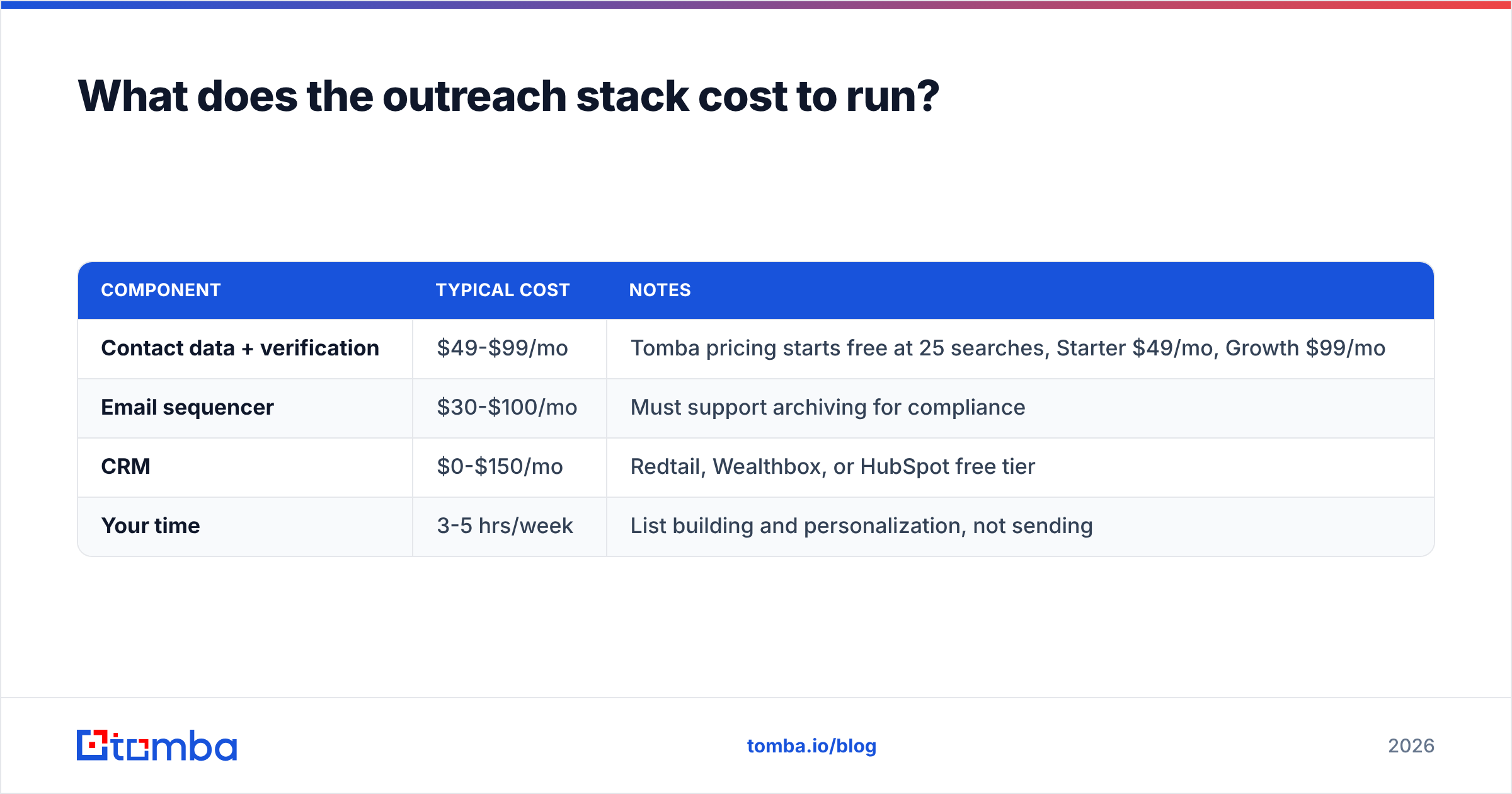
What does the outreach stack cost to run?#
You need four things: a data source, a verifier, a sending tool, and a CRM. Many advisors already have the last two.
| Component | Typical cost | Notes |
|---|---|---|
| Contact data + verification | $49-$99/mo | Tomba pricing starts free at 25 searches, Starter $49/mo, Growth $99/mo |
| Email sequencer | $30-$100/mo | Must support archiving for compliance |
| CRM | $0-$150/mo | Redtail, Wealthbox, or HubSpot free tier |
| Your time | 3-5 hrs/week | List building and personalization, not sending |
Call it $150-$250 a month plus a few hours a week. At a $90 cost per booked meeting and a 25% close rate on qualified meetings, one new household covers the year.
Two efficiency notes. If you are building lists in a spreadsheet, the Google Sheets add-on resolves and verifies addresses in place — no CSV round trips. And if you are processing a conference attendee list or an association directory export, bulk email finder handles a few thousand rows in one pass instead of one lookup at a time.
What is the 90-day plan?#
Days 1-15. Pick one niche and write it down as a sentence you would say out loud. Build a list of 200 named people in it. Get three outreach templates through compliance.
Days 16-30. Verify the list. Cut everything invalid. Send to the first 50 contacts, four-touch sequence over 12 days. Track replies, not opens — open tracking is increasingly unreliable and tells you nothing about intent anyway.
Days 31-60. Read the replies. Rewrite the observation sentence based on what people actually objected to or asked about. Send to the next 100. Start one content piece for the niche and reach out to two COIs who serve the same group.
Days 61-90. You should have 5-12 booked meetings from 200 contacts if the niche is real and the message is specific. If you have zero, the problem is almost always the niche being too broad — not the copy, not the tool, not the send time. Narrow it and rebuild.
Keep a simple record of your response rate by segment. After two cycles you will know which slice of the niche replies, and that is the slice you scale.
Where should you start?#
Start with the list, because everything else depends on it. A perfect message to a wrong or dead address is worth nothing, and a mediocre message to exactly the right person still gets a reply.
Tomba Email Finder is built for that first step — take the names and companies in your niche, get verified professional addresses back, and enrich them with the title and company detail you need to write a first line that sounds like a human wrote it. The free tier gives you 25 searches a month to test the workflow on a small slice of your list before you commit to anything. If it produces meetings at 25, it will produce meetings at 500.
Pick the niche. Build the 200. Send the first 50 this month.
Related guides#
// get started
Find, verify and enrich your first contacts today
Start on the free plan with 25 searches a month, then scale when your team is ready.
Free plan · No credit card required · GDPR & CCPA
// about the author