How To Find Real Estate Leads in 2026: 9 Proven Channels
Zillow leads cost $200+ each and convert at under 2%. Here are nine channels that actually fill a real estate pipeline in 2026 — with costs, conversion rates, and the exact stack to run them.
TL;DR
- Buying portal leads (Zillow, Realtor.com, Homes.com) costs $80–$400 per lead and converts at roughly 1–3%. It works, but it is the most expensive way to fill a pipeline.
- The cheapest reliable channels in 2026 are your own sphere, expired/FSBO listings, hyper-local content, and commercial/investor outreach — all of which need contact data you source yourself.
- For commercial, investor, and B2B-adjacent real estate (property managers, developers, relocation directors, PropTech buyers), an email finder plus a verifier beats any lead marketplace on cost per conversation.
- Lead capture and lead conversion are different problems. Most agents lose money on channel spend because their follow-up dies after two touches.
- Build one system: source contacts → verify → 8-touch sequence across email, phone, and social → CRM. Channels feed the system; they are not the system.
Finding real estate leads is not hard. Finding real estate leads that answer the phone, at a cost that leaves you a margin, is the actual job. This guide breaks down nine channels by real cost, realistic conversion rate, and how long they take to produce a closing — plus the data stack that makes the cheap channels work.
What counts as a real estate lead in 2026?#
A lead is a person with a name, a working contact method, and an identifiable property motive. Miss any of the three and you have a record, not a lead.
That distinction matters because the market is flooded with records. A scraped list of 40,000 homeowners in your county is a record set. Twelve expired listings whose owners you can reach by phone tomorrow morning is a lead set. The second one produces closings.
Real estate leads split into four buckets, and each has a completely different acquisition playbook:
- Residential buyer leads — high volume, low intent, long nurture. Portal ads and search dominate here.
- Residential seller leads — lower volume, far higher value. Expireds, FSBOs, absentee owners, and life-event triggers (divorce, probate, relocation).
- Commercial and investment leads — decision-makers at firms, not consumers. Sourced through professional data, not consumer ads.
- Referral and partner leads — lenders, attorneys, contractors, relocation managers. The lowest cost per closing of any channel, and the most neglected.
If you sell commercial space, manage multifamily portfolios, or work with investor buyers, you are running B2B sales with real estate inventory. Your prospecting looks more like a SaaS SDR's than a residential agent's, and your tooling should reflect that.
How much do real estate leads actually cost per channel?#
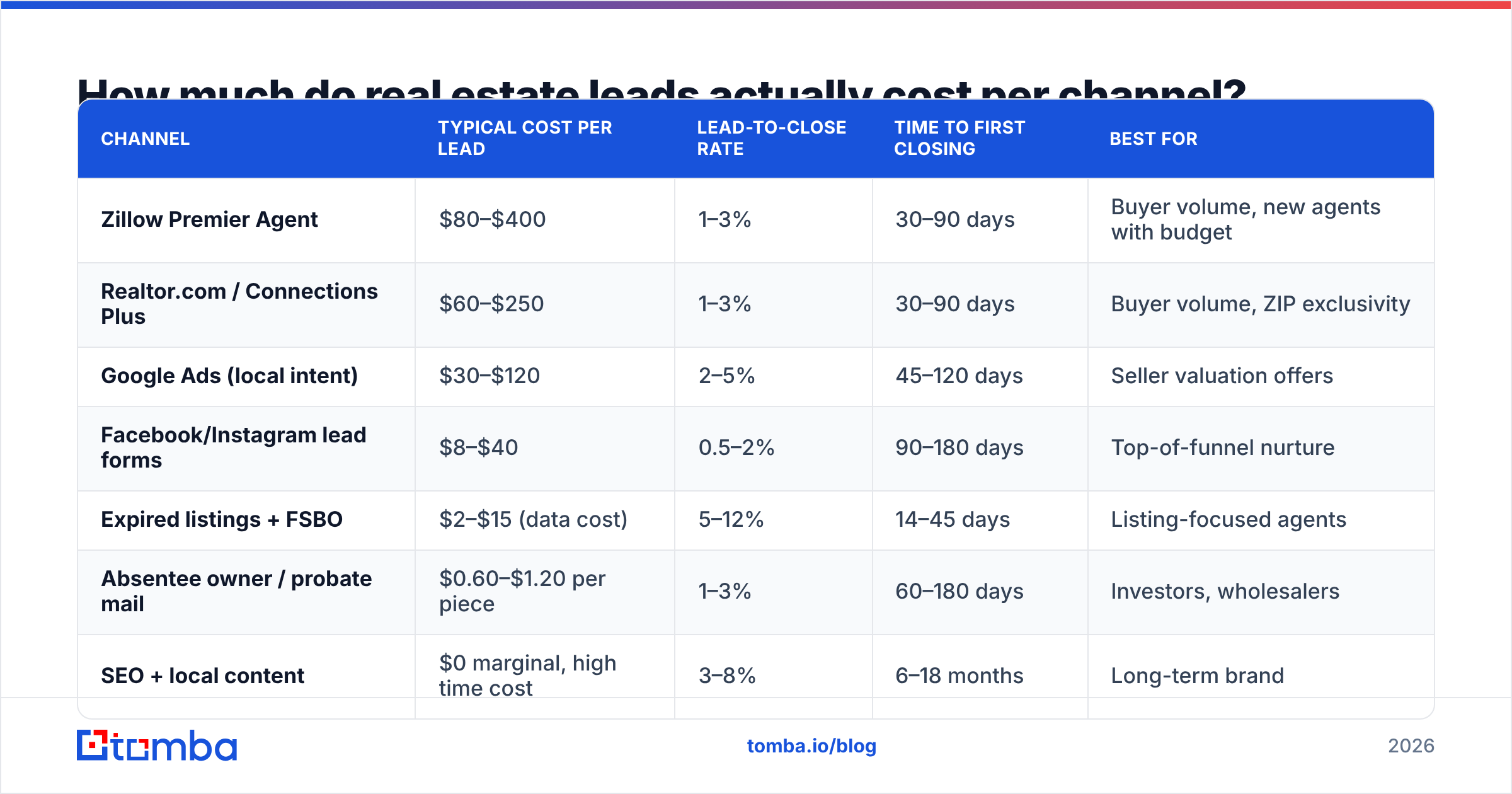
Here is the honest comparison. Cost-per-lead figures are 2025–2026 US market averages compiled from agent-reported spend and vendor pricing pages; conversion rates assume disciplined follow-up, which most agents do not have.
| Channel | Typical cost per lead | Lead-to-close rate | Time to first closing | Best for |
|---|---|---|---|---|
| Zillow Premier Agent | $80–$400 | 1–3% | 30–90 days | Buyer volume, new agents with budget |
| Realtor.com / Connections Plus | $60–$250 | 1–3% | 30–90 days | Buyer volume, ZIP exclusivity |
| Google Ads (local intent) | $30–$120 | 2–5% | 45–120 days | Seller valuation offers |
| Facebook/Instagram lead forms | $8–$40 | 0.5–2% | 90–180 days | Top-of-funnel nurture |
| Expired listings + FSBO | $2–$15 (data cost) | 5–12% | 14–45 days | Listing-focused agents |
| Absentee owner / probate mail | $0.60–$1.20 per piece | 1–3% | 60–180 days | Investors, wholesalers |
| SEO + local content | $0 marginal, high time cost | 3–8% | 6–18 months | Long-term brand |
| Sphere + past clients | Near $0 | 12–20% | Ongoing | Every agent, always |
| Commercial/investor outbound | $0.05–$0.50 per verified contact | 2–6% | 60–150 days | CRE, PropTech, portfolio deals |
Two things jump out. First, portal leads are 10–100x more expensive per lead than sourced contacts. Second, the cheap channels convert better, not worse — because a homeowner whose listing expired last Tuesday has more intent than someone who clicked a photo of a kitchen.
The catch: portal leads arrive in your inbox automatically. Sourced leads require you to build the list. That build step is where most agents quit, and it is exactly the step that has gotten cheap and fast since 2024.
How do you find seller leads without paying a portal?#
Seller leads are the profit center. A listing is a controllable asset — it generates buyer leads, sign calls, and open house traffic on its own. Here is the ranked stack.
Expired listings. Pull expireds daily from your MLS. Most agents call the first day and quit by day three. The owner has proven motivation and a recent disappointment with an agent. Skip-trace the phone, but also find the email — the National Association of Realtors' research on buyer and seller behavior consistently shows sellers researching agents online before responding to a call.
FSBOs. Same logic, more resistance. Lead with a specific, useful thing (a comp set, a photography referral) rather than a pitch. Convert at week three to six, not week one.
Absentee owners. County assessor records where the mailing address differs from the property address. High investor overlap. Mail plus a verified phone number outperforms mail alone by a wide margin.
Life-event triggers. Probate filings, divorce filings, tax delinquency, code violations. Public records, tedious to collect, and precisely why they stay uncompetitive.
Your own database. The single highest-converting source and the one most agents ignore. Twelve to twenty percent of past clients and sphere contacts transact within a five-year window. If your contact list has stale email addresses, you are silently losing that channel — run it through an email verifier before your next campaign so your sends actually land.
What does the data stack for sourced leads look like?#
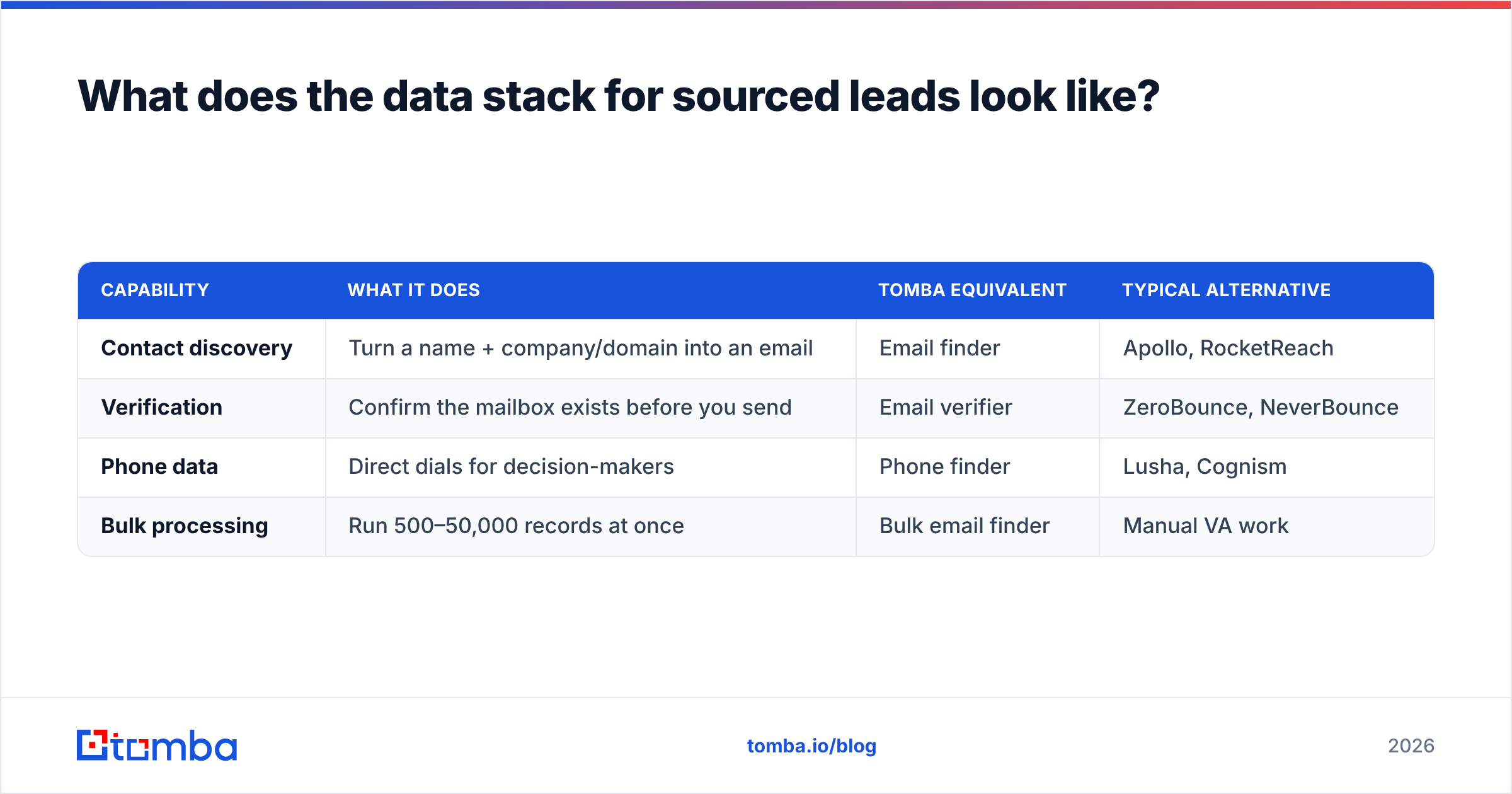
You need four capabilities, and they are cheaper than one month of Zillow spend.
| Capability | What it does | Tomba equivalent | Typical alternative |
|---|---|---|---|
| Contact discovery | Turn a name + company/domain into an email | Email finder | Apollo, RocketReach |
| Verification | Confirm the mailbox exists before you send | Email verifier | ZeroBounce, NeverBounce |
| Phone data | Direct dials for decision-makers | Phone finder | Lusha, Cognism |
| Bulk processing | Run 500–50,000 records at once | Bulk email finder | Manual VA work |
For residential seller prospecting, you are mostly working from MLS and county data, so skip-tracing is your discovery layer. For anything commercial, the picture flips entirely. If you are trying to reach the head of real estate at a 400-person company, the VP of facilities at a hospital system, or the acquisitions director at a REIT, consumer skip-trace data is useless — you need a professional B2B database and a domain-level search.
A concrete workflow for commercial and investor outreach:
- Build the target list. Pull 200 companies in your submarket by SIC/NAICS code, employee count, and lease expiration signal.
- Identify the right title. Facilities director, COO, or CFO depending on company size — under 50 employees, it is almost always the CEO.
- Find the contact. Run a domain search to surface everyone at the company with a matching title pattern, then find the specific address.
- Verify before sending. Bounce rates above 3% will damage your sender reputation and put your entire outreach domain at risk.
- Sequence across channels. Email on day 1, LinkedIn view day 2, call day 4, email day 8, call day 12, breakup day 21.
- Log everything in the CRM. No exceptions. Untracked outreach is unrepeatable outreach.
At roughly $0.10–$0.30 per verified contact on a mid-tier plan, a 200-company campaign costs less than $60 in data. One commercial lease commission covers a decade of that spend.
Is buying leads ever the right move?#
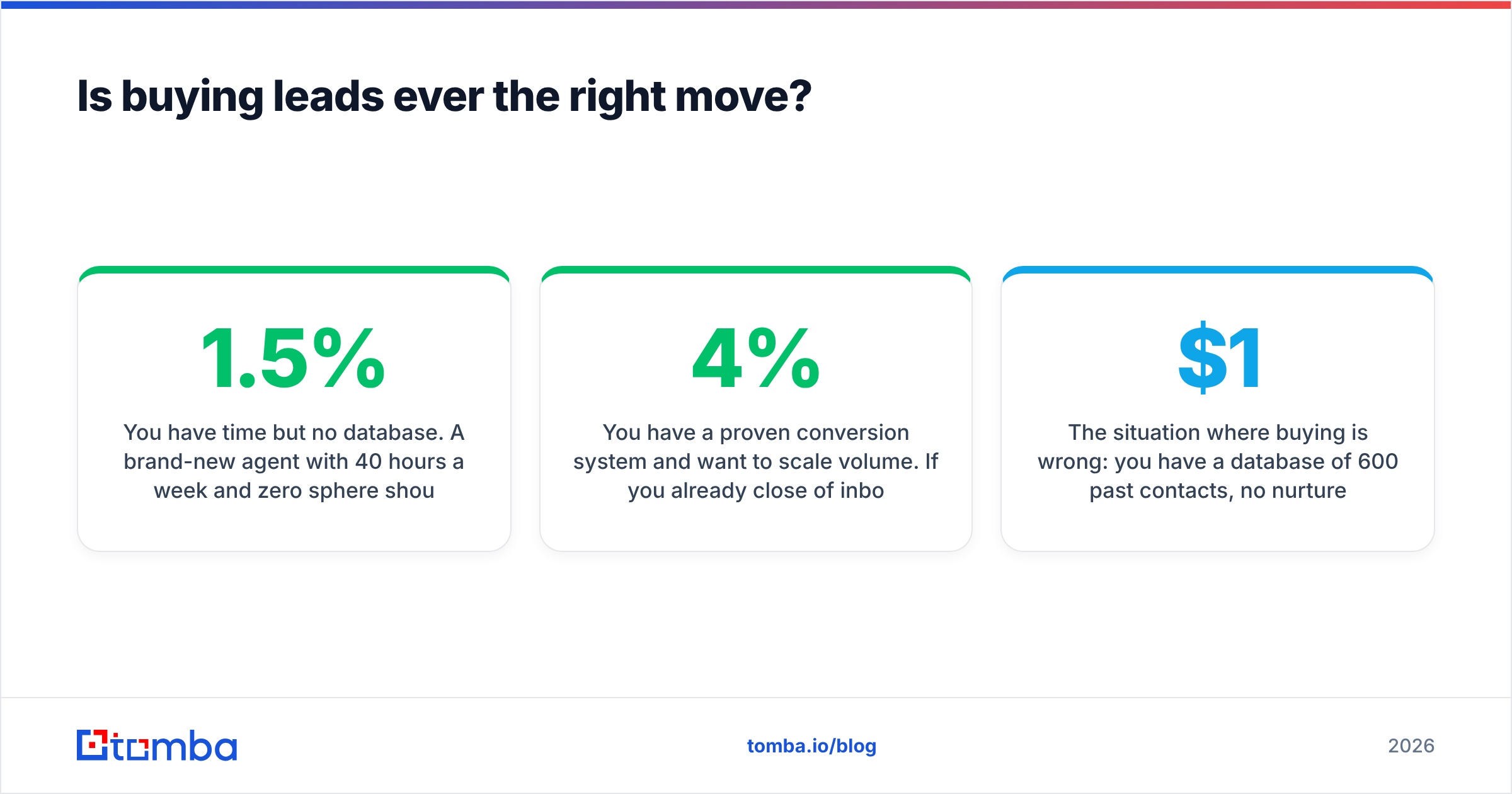
Yes — in two specific situations.
You have time but no database. A brand-new agent with 40 hours a week and zero sphere should buy leads. Portal leads are a way to convert money and time into transaction reps. The conversion rate is bad, but 1.5% of 300 leads is four or five deals in year one, which is a career.
You have a proven conversion system and want to scale volume. If you already close 4% of inbound leads with an ISA and a five-touch cadence, paid leads become a predictable machine. Cost per lead stops mattering once cost per closing is under your commission.
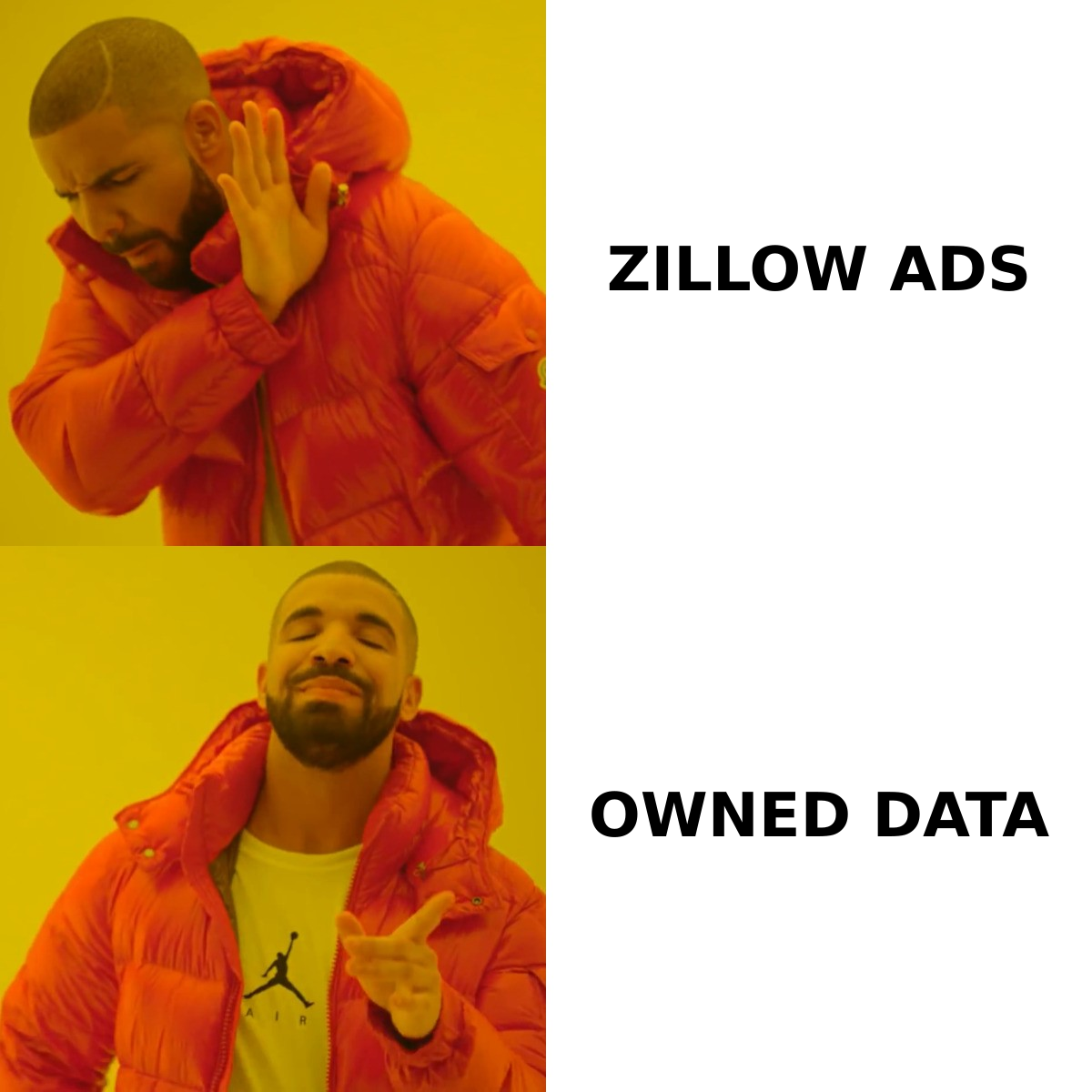
The situation where buying is wrong: you have a database of 600 past contacts, no nurture system, and you are paying $1,200 a month to Zillow. You are renting attention you already own. Fix the owned channel first.
For B2B-style real estate teams evaluating data vendors, sources like G2's lead intelligence category are worth reading for verified reviews before committing to an annual contract. Note that several vendors — including specialist B2B list providers like BookYourData — sell pre-built contact lists, which can be a legitimate shortcut when you need coverage in a vertical you have never worked before. Pre-built lists and on-demand finders solve different problems: lists give you breadth quickly, finders give you precision on named targets.
How do you convert the leads you find?#
Channel choice determines cost. Follow-up determines income. Industry data consistently shows the majority of agents stop after two contact attempts, while most conversions happen between attempts five and twelve.
Speed to lead. Respond in under five minutes to any inbound lead. Response inside five minutes versus thirty minutes changes contact rates by an order of magnitude. This is the single highest-ROI operational change available to a real estate team, and it costs nothing but discipline.
Multi-channel by default. Email alone gets 1–3% reply rates in real estate. Email plus phone plus a LinkedIn or Instagram touch gets 6–12%. For commercial work, add a physical touch — a market report mailed to the office still lands.
Sequence length. Eight to twelve touches over 21–30 days for outbound. For sphere and past clients, a quarterly cadence forever.
Segment your messaging. An expired listing owner needs a different first line than an absentee investor. Generic templates are why most outreach underperforms; if you need starting points, adapt from a library of cold email templates rather than writing from scratch.
Protect deliverability. If you are sending more than 50 cold emails a day, warm the domain, keep bounce rates under 2%, authenticate with SPF and DKIM, and never send from your primary transaction domain. HubSpot's guidance on email deliverability is a solid primer if this is new to you.
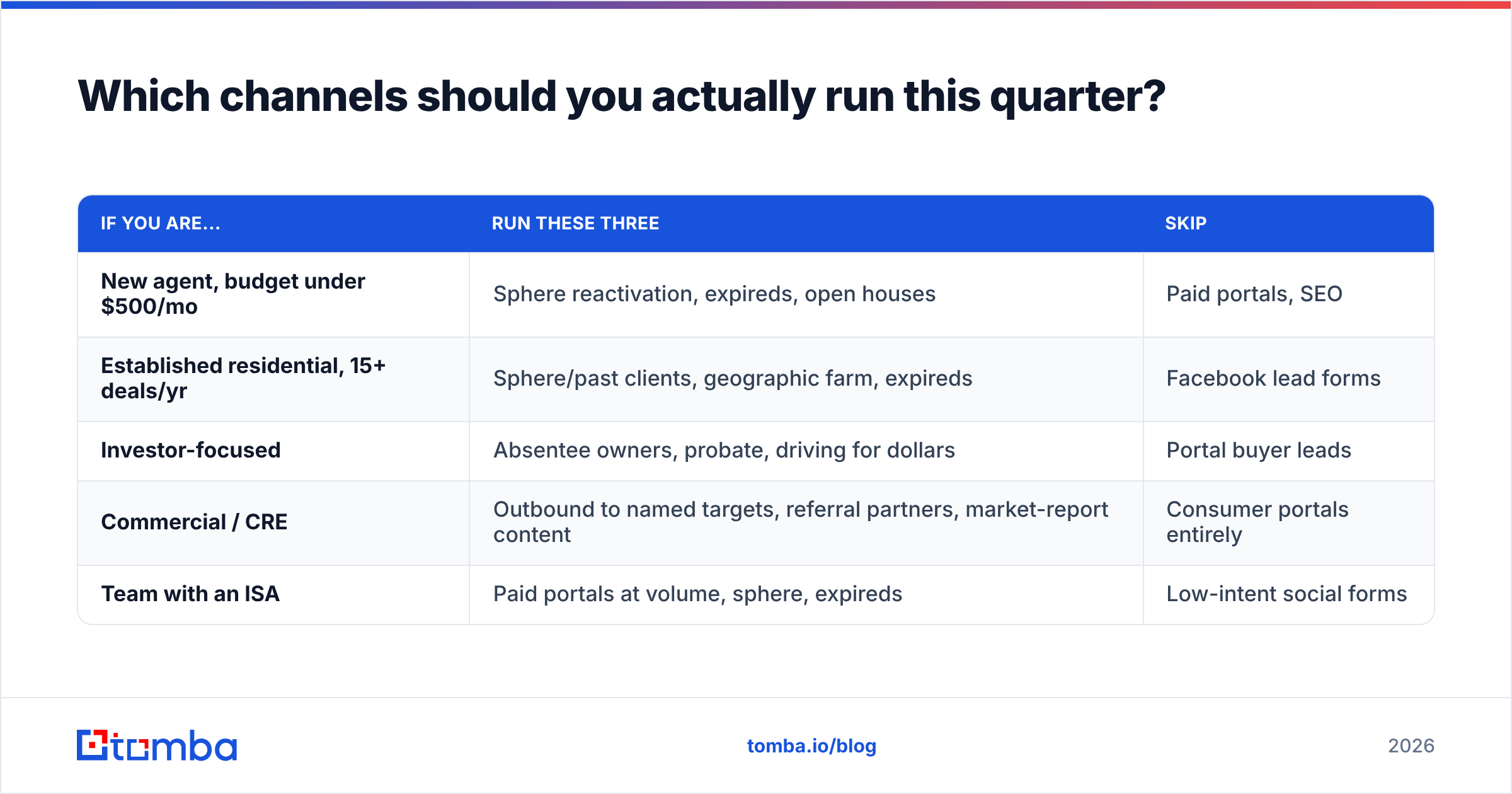
Which channels should you actually run this quarter?#
Pick three, not nine. Depth beats breadth in every real estate lead generation study worth reading.
| If you are... | Run these three | Skip |
|---|---|---|
| New agent, budget under $500/mo | Sphere reactivation, expireds, open houses | Paid portals, SEO |
| Established residential, 15+ deals/yr | Sphere/past clients, geographic farm, expireds | Facebook lead forms |
| Investor-focused | Absentee owners, probate, driving for dollars | Portal buyer leads |
| Commercial / CRE | Outbound to named targets, referral partners, market-report content | Consumer portals entirely |
| Team with an ISA | Paid portals at volume, sphere, expireds | Low-intent social forms |
The pattern: sphere appears in almost every row, and portals appear in almost none. That is not ideology, it is arithmetic. A past client converts at 12–20%. A portal lead converts at 1–3%. If you have 400 people who know you and you are not contacting them quarterly, no ad budget will fix your pipeline.
What should you do in the next seven days?#
Concrete, in order:
- Export your entire contact database — phone, CRM, email, Instagram followers who are local. Deduplicate it.
- Verify the emails. Anything older than 18 months has a 20–30% decay rate. Clean it before you send anything.
- Enrich the gaps. Missing emails, missing phone numbers, missing company data on your commercial targets.
- Write one 8-touch sequence for your single highest-value segment. Not five sequences. One.
- Block 90 minutes daily for outbound. Same time every day. This is the part nobody wants to hear and the part that determines the outcome.
- Track contact rate, conversation rate, and appointment rate separately. If you only track closings, you cannot diagnose what broke.
Where does Tomba fit?#
If your real estate business touches commercial, investor, PropTech, relocation, or any deal where the counterparty is a company rather than a consumer, the bottleneck is finding the decision-maker's actual email address — not finding companies.
Tomba's Email Finder turns a name and a company domain into a verified professional email, with domain search for mapping every relevant contact at a target firm and bulk processing for full campaign lists. The free tier gives you 25 searches a month to test it against your own target list; Starter runs $49/mo, Growth $99/mo, and Pro $249/mo when you scale — full Tomba pricing is public, no demo call required.
Run your next 50 target companies through it, send a real sequence, and compare the cost per conversation against whatever you are currently paying a portal. The arithmetic usually settles the argument.
Related guides#
// get started
Find, verify and enrich your first contacts today
Start on the free plan with 25 searches a month, then scale when your team is ready.
Free plan · No credit card required · GDPR & CCPA
// about the author