How to Generate Sales in 2026: A 7-Step Operator Playbook
Most sales advice tells you to work harder. This playbook shows the seven steps that actually move revenue in 2026 — from list build to close — with the math, tools, and benchmarks behind each one.
TL;DR
- Generating sales is a math problem before it is a talent problem: target × contact rate × reply rate × meeting rate × close rate = revenue. Fix the weakest multiplier, not all five.
- Bad contact data destroys the funnel at step one. A 30% bounce list caps your ceiling no matter how good the copy is.
- A focused list of 300 verified, well-researched accounts beats 10,000 scraped rows in almost every B2B motion under $50k ACV.
- Multi-channel (email + phone + LinkedIn) roughly doubles connect rates versus email alone, but only if the sequencing is deliberate.
- Track four numbers weekly: verified contacts added, meetings booked, pipeline created, and cost per meeting. Everything else is vanity.
What does "generate sales" actually mean in 2026?#
It means engineering a repeatable path from a stranger to a signed contract — and knowing the conversion rate at every step.
Most teams treat sales generation as an activity problem. Send more emails. Make more calls. Post more on LinkedIn. That works right up until it doesn't, which is usually around month four when your domain reputation is shot and your reps are burnt out.
The teams that generate sales consistently treat it as a system with five multipliers:
- Addressable targets — how many companies genuinely fit your ICP (not how many exist in a database)
- Contact rate — what percentage of those targets you can actually reach with a valid email or phone number
- Reply rate — how many respond to your first touch or follow-up
- Meeting rate — how many replies convert to a real conversation
- Close rate — how many conversations become revenue
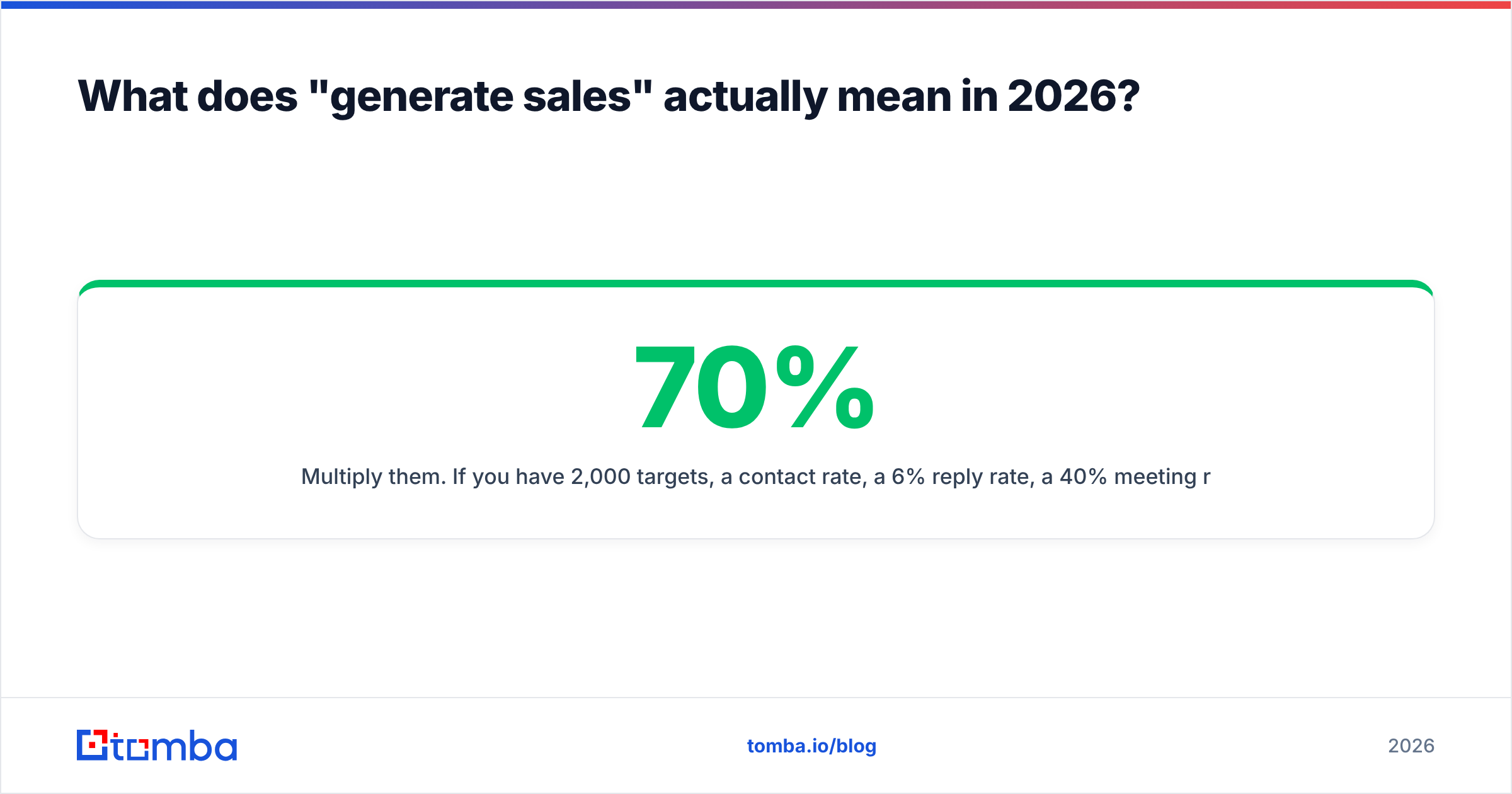
Multiply them. If you have 2,000 targets, a 70% contact rate, a 6% reply rate, a 40% meeting rate, and a 20% close rate, you get 6.7 deals. Change the contact rate to 92% and you get 8.8 deals — a 31% lift from data quality alone, with zero extra outreach.
That's the whole argument for starting with data.
Why does most sales generation advice fail?#
Because it optimizes the wrong multiplier.
Search "how to generate sales" and you'll get a hundred posts about writing better subject lines. Subject lines matter — but they sit at step three of five. If your list is 40% wrong, improving your open rate by 15% moves the final number by almost nothing.
Here's what actually breaks, ranked by how often we see it:
- Unverified lists. Scraped or aged data with 25–40% invalid addresses. Every bounce hurts your sender reputation, which drags down deliverability for the valid addresses too. It's a compounding tax.
- ICP drift. The list technically matches a filter ("SaaS, 50–200 employees") but ignores the actual buying trigger. You end up talking to people with no reason to change.
- Single-channel dependence. Email-only motions collapse when a domain gets throttled. Google and Yahoo's bulk sender requirements made this much less forgiving from 2024 onward.
- No follow-up structure. A large share of positive replies in B2B outbound come after touch three. Most teams stop at two.
- Measuring activity instead of outcomes. "We sent 8,000 emails" is not a result. "We booked 22 meetings at $180 cost per meeting" is.
How do you build a target list that converts?#
Start narrow, verify hard, then expand. Here's the sequence that works.
Step 1 — Define the trigger, not just the firmographics. A good ICP definition includes a reason to buy now: recent funding, a new VP hire, a job posting for a role your product replaces, a tech-stack change. Firmographics tell you who could buy; triggers tell you who might buy this quarter.
Step 2 — Source the accounts before the contacts. Build a list of 200–500 companies that hit the trigger. This is the step most teams skip, and it's why their outreach reads generic.
Step 3 — Find the right person, not the easiest person. The VP who owns the problem beats the SDR whose email you found first. Use a domain search to map who works where and what the company's email pattern is, then target by role.
Step 4 — Verify before you send. Non-negotiable. Run every address through an email verifier and drop anything that comes back invalid. Route catch-all domains to a separate, slower-warmed inbox rather than mixing them into your main sends.
Step 5 — Enrich for personalization. Job title, recent company news, tech stack, headcount trend. One specific, verifiable detail per prospect is worth more than three paragraphs of generic value prop.
Step 6 — Cap the list at what you can genuinely follow up on. One rep can run a real multi-touch sequence against roughly 300–500 contacts per month. Loading 5,000 into a tool guarantees that 4,500 get one lazy touch and nothing else.
What does accuracy actually cost you?#
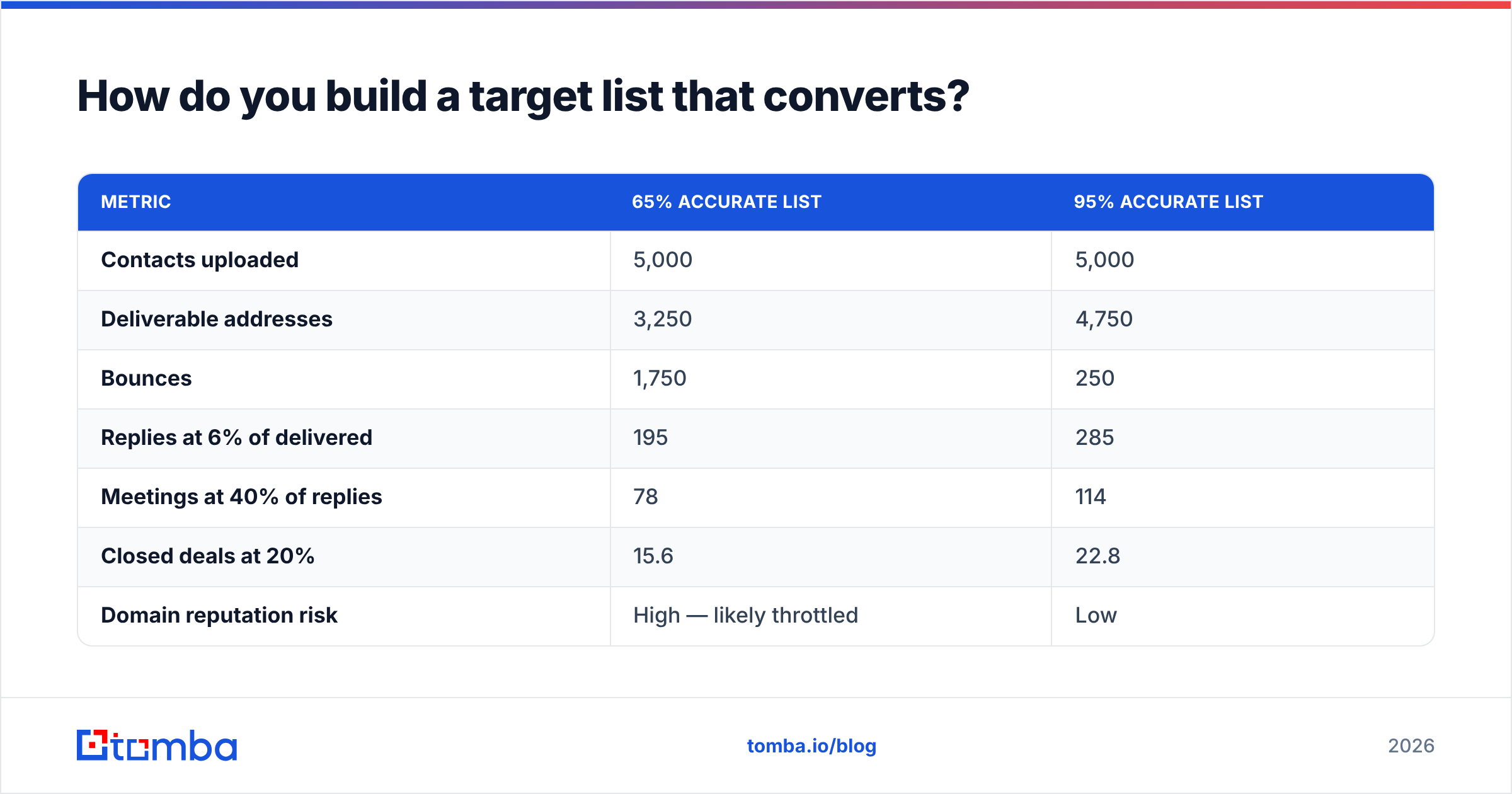
Run the numbers on a 5,000-contact list at two different accuracy levels:
| Metric | 65% accurate list | 95% accurate list |
|---|---|---|
| Contacts uploaded | 5,000 | 5,000 |
| Deliverable addresses | 3,250 | 4,750 |
| Bounces | 1,750 | 250 |
| Replies at 6% of delivered | 195 | 285 |
| Meetings at 40% of replies | 78 | 114 |
| Closed deals at 20% | 15.6 | 22.8 |
| Domain reputation risk | High — likely throttled | Low |
Same copy. Same rep. Same hours. A 46% difference in closed deals, driven entirely by whether the data was verified.

Which channel generates sales fastest?#
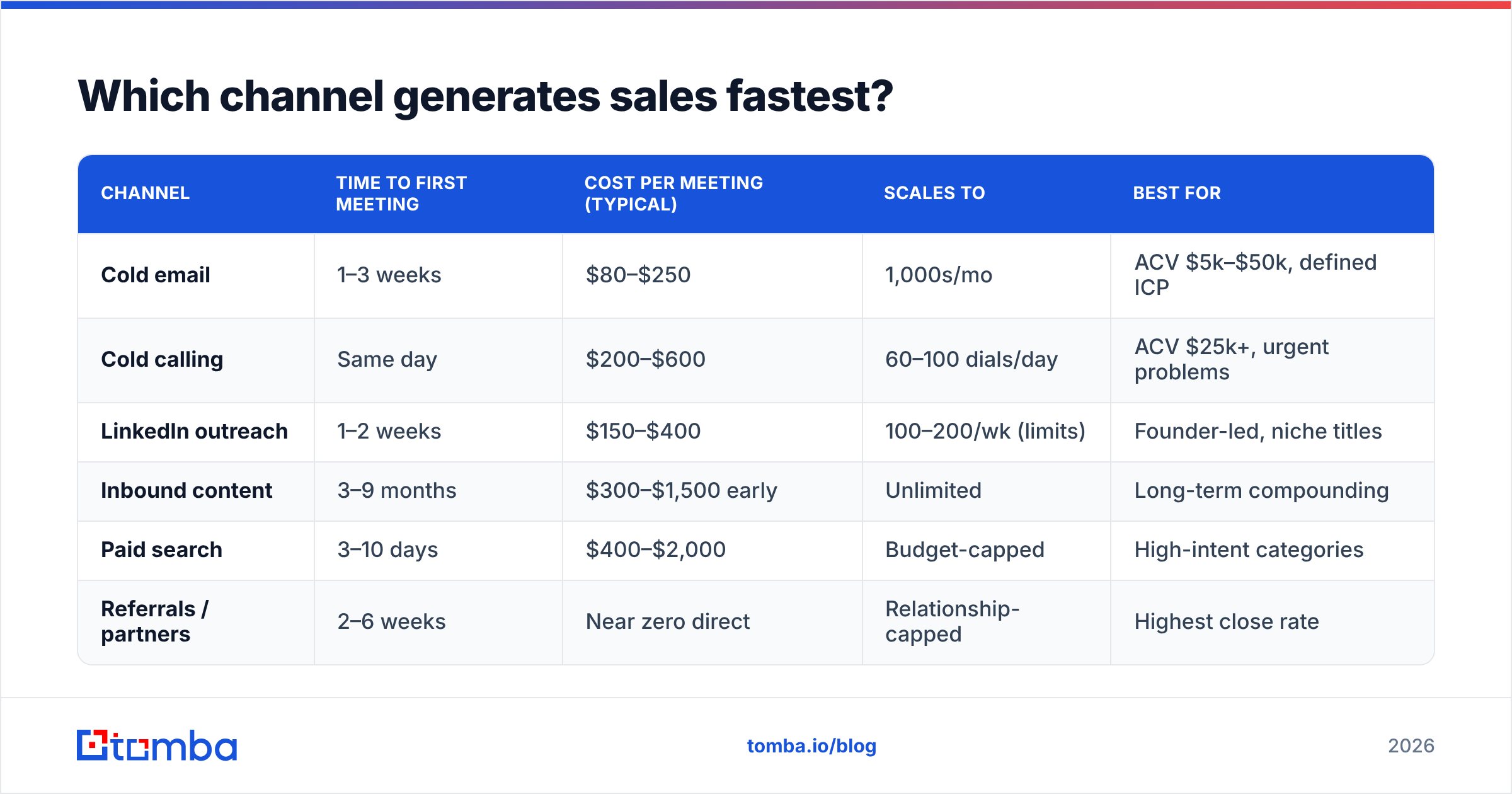
Depends on deal size and buyer. Here's how the main channels compare on the dimensions that matter when you're choosing where to spend the next 40 hours.
| Channel | Time to first meeting | Cost per meeting (typical) | Scales to | Best for |
|---|---|---|---|---|
| Cold email | 1–3 weeks | $80–$250 | 1,000s/mo | ACV $5k–$50k, defined ICP |
| Cold calling | Same day | $200–$600 | 60–100 dials/day | ACV $25k+, urgent problems |
| LinkedIn outreach | 1–2 weeks | $150–$400 | 100–200/wk (limits) | Founder-led, niche titles |
| Inbound content | 3–9 months | $300–$1,500 early | Unlimited | Long-term compounding |
| Paid search | 3–10 days | $400–$2,000 | Budget-capped | High-intent categories |
| Referrals / partners | 2–6 weeks | Near zero direct | Relationship-capped | Highest close rate |
The honest answer for most B2B teams under $10M ARR: email is the cheapest way to test messaging, phone is the fastest way to close, and referrals convert best but can't be scheduled. Run email as your volume engine, layer calls on accounts that engage, and build the inbound machine in parallel because it takes months to compound.
Two structural notes on channel choice. First, cold calling isn't dead — Gong's research on outbound consistently shows multi-threaded, multi-channel accounts outperform single-channel ones. Second, LinkedIn has tightened connection and messaging limits repeatedly; treat it as a warming and credibility channel rather than a volume channel, and pair it with email using a LinkedIn finder to get the work address behind the profile.
What does a sequence that books meetings look like?#
Six to eight touches over 18–21 days, mixing channels, with a real reason for each one.
- Day 1 — Email. Three sentences. One observation about their business, one specific problem it implies, one low-friction ask. No attachments, no calendar link in touch one.
- Day 3 — LinkedIn view + connect. No pitch in the connection note. You're just becoming a real person.
- Day 5 — Call. If they engaged with email one, this is a warm dial. If not, it's still context — you can reference the email.
- Day 8 — Email two. New angle, not a bump. Share a specific result from a comparable company, with a number.
- Day 12 — Call + voicemail. Voicemail under 20 seconds, referencing the email so the channels reinforce each other.
- Day 18 — Breakup email. "Assuming this isn't a priority — should I close the file?" This consistently pulls the highest single-touch reply rate in most sequences because it's genuinely easy to answer.
The mistake is sending the same message six times with escalating politeness. Each touch should be usable on its own. If a prospect only ever reads touch four, it should still make sense.
How do you know if it's working?#
Four numbers, reviewed weekly. Not fifteen.
- Verified contacts added — your fuel. If this drops, everything downstream drops 3 weeks later.
- Meetings booked — the only leading indicator of pipeline that can't be faked.
- Pipeline created (dollar value) — meetings with no budget behind them aren't progress.
- Cost per meeting — total spend (tools + rep time) divided by meetings. This is the number that tells you whether to scale or fix.
Add a fifth if you're running email at volume: bounce rate, which should stay under 2%. Above 3% and you're actively damaging your domain. Check it before you check anything else.
Benchmark honestly. Public data from G2's sales software category and vendor-reported figures both skew optimistic — reply rates published as "8–12%" usually come from tightly targeted campaigns of a few hundred contacts, not from 10,000-row blasts. For a cold, well-verified, well-targeted list in 2026, 3–6% reply and 1–2% meeting-booked rates are a realistic starting band. If you're above that, don't scale volume — scale the pattern that produced it.
Which tools do you actually need?#
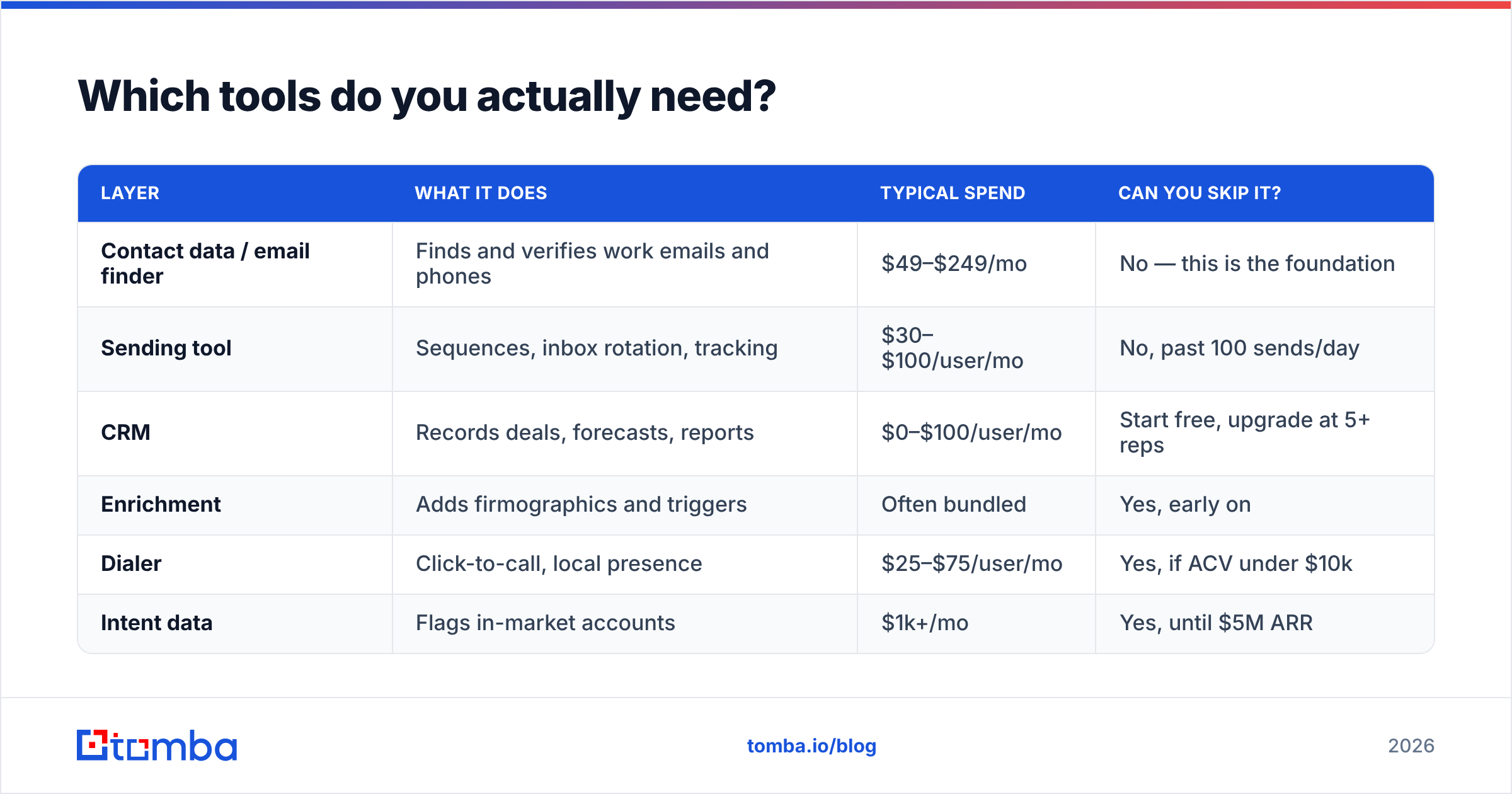
Less than you think. Here's the minimum viable stack for a team generating sales from scratch, and where the money goes.
| Layer | What it does | Typical spend | Can you skip it? |
|---|---|---|---|
| Contact data / email finder | Finds and verifies work emails and phones | $49–$249/mo | No — this is the foundation |
| Sending tool | Sequences, inbox rotation, tracking | $30–$100/user/mo | No, past 100 sends/day |
| CRM | Records deals, forecasts, reports | $0–$100/user/mo | Start free, upgrade at 5+ reps |
| Enrichment | Adds firmographics and triggers | Often bundled | Yes, early on |
| Dialer | Click-to-call, local presence | $25–$75/user/mo | Yes, if ACV under $10k |
| Intent data | Flags in-market accounts | $1k+/mo | Yes, until $5M ARR |
On the data layer specifically: pricing varies more than capability. Tomba's plans start with a free tier at 25 searches/month, then $49/mo (Starter), $99/mo (Growth), and $249/mo (Pro), with Enterprise custom. Competitors in the category run anywhere from $39 to $500+ per month for comparable volumes, and per-credit costs at the low end often hide poor verification, which reintroduces the bounce problem you were paying to avoid. Peers like BookYourData take a pay-as-you-go approach that suits teams with bursty, one-off list needs rather than continuous prospecting — worth a look if your volume is lumpy.
Whatever you pick, test it the same way: pull 100 contacts from a domain you know well, verify them independently, and measure the real hit rate. Vendor accuracy claims are marketing. Your own 100-row test is data.

How do you scale once something works?#
Only scale a motion you can explain. If you booked 14 meetings last month and can't articulate why, doubling volume just doubles the noise.
The scaling sequence that holds up:
- Isolate the winning segment. Which industry, size band, or trigger produced the most meetings? Usually it's narrower than you expected.
- Rebuild the list against that segment only. Use bulk email finder workflows to expand within the pattern rather than sideways into new verticals.
- Add a second inbox before adding volume. Sending domains have practical ceilings around 30–50 cold emails per day per mailbox. More volume means more mailboxes, not more sends per mailbox.
- Add a second channel before a second segment. Squeeze the segment you understand with phone and LinkedIn before opening a new one.
- Hire only when the process is documented. A new rep dropped into an undocumented motion will underperform for two quarters.
- Re-verify quarterly. B2B contact data decays roughly 25–30% per year through job changes. The list that worked in January is measurably worse by July.
That last point is the one teams forget. Generating sales isn't a project you finish — the underlying data actively rots. Building a quarterly re-verification pass into your operating rhythm is unglamorous and it protects every other number in this post.
Where should you start this week?#
Pick the single weakest multiplier in your funnel and fix only that.
If your bounce rate is above 3%, the answer is data — nothing else matters until that's fixed. If your reply rate is under 2% on a clean list, the answer is targeting or message. If replies are healthy but meetings aren't, the answer is your call-to-action. If meetings happen but nothing closes, the answer is qualification, and you should be disqualifying harder upstream.
Diagnose before you prescribe. Most teams do the reverse, buy another tool, and wonder why the number didn't move.
Ready to fix the foundation? Start with the Tomba Email Finder — find verified work emails by domain, name, or company, with catch-all detection and verification built in so your list is clean before the first send. The free tier gives you 25 searches a month to run the 100-row accuracy test described above, and paid plans start at $49/mo when you're ready to scale. Fix the contact rate first, and every downstream number in your funnel moves with it.
Related guides#
// get started
Find, verify and enrich your first contacts today
Start on the free plan with 25 searches a month, then scale when your team is ready.
Free plan · No credit card required · GDPR & CCPA
// about the author