How to Get Clients for Web Development: 9 Proven Channels
Referrals dry up. Upwork gets crowded. Here are nine channels that actually book web development clients in 2026, ranked by cost per signed contract and time to first reply.
TL;DR
- Referrals close fastest but you cannot scale them on demand — treat them as a bonus, not a pipeline.
- Targeted cold outreach to a narrow niche (say, Shopify stores on outdated themes) is the only channel where you control volume, timing, and message.
- Marketplaces like Upwork buy you speed at the cost of margin; expect 15-30% lower rates and heavy competition on every post.
- A build-in-public content loop plus a two-page niche site out-converts a generic portfolio because it filters for buyers who already believe you.
- The channel matters less than the list. Bad contact data kills a good pitch before it is read — verify before you send.
Most freelance web developers do not have a sales problem. They have a targeting problem. They pitch "web development" to anyone with a pulse and a domain name, get 2% replies, and conclude that outreach is dead. It is not. It is just that "we build websites" is the least differentiated sentence in B2B services.
This post walks through nine channels that actually book web development work in 2026, what each one costs in time and money, and how to run the two that scale.
Why is getting web development clients so hard right now?#
Three things changed since 2022.
First, AI site builders swallowed the bottom of the market. A local plumber who used to pay $3,500 for a five-page brochure site now pays $29/month to a tool. That segment is gone and it is not coming back. Chasing it is how developers end up doing $600 projects.
Second, the middle of the market got picky. Companies with $5M-$50M in revenue still hire developers, but they now expect specialists. "Full-stack developer" loses to "Shopify Plus checkout specialist" in every buying committee, every time.
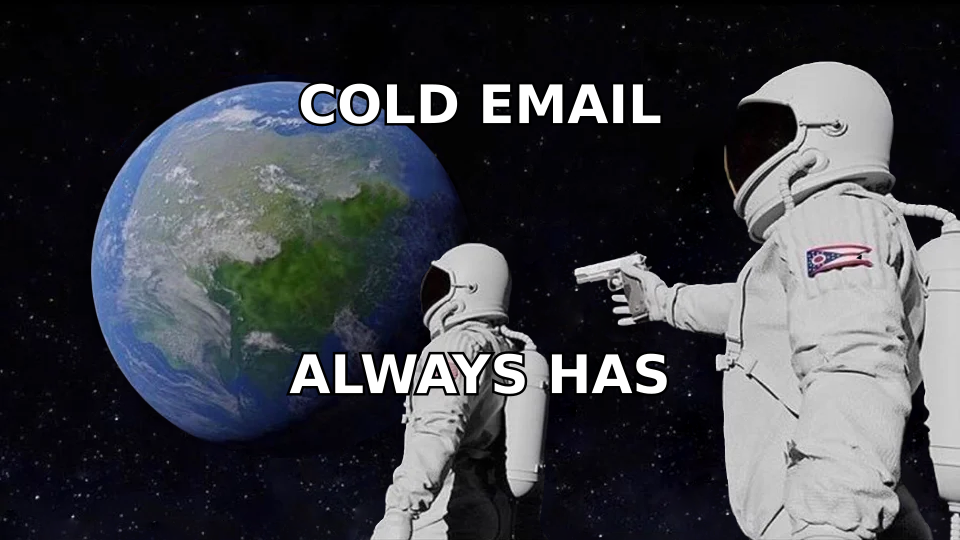
Third, everyone discovered outreach at the same time. Inbox volume is up, reply rates are down, and generic pitches get filtered before a human ever sees them. Which means the developers winning today are not the ones sending the most emails — they are the ones sending to the right 200 people with a message only those 200 could receive.
The good news: the work at the top of the market is more plentiful than ever. Headless commerce migrations, accessibility remediation, performance rescue projects, legacy PHP rewrites. These are $15K-$120K engagements and almost nobody is pitching for them properly.
What are the nine channels that actually work?#
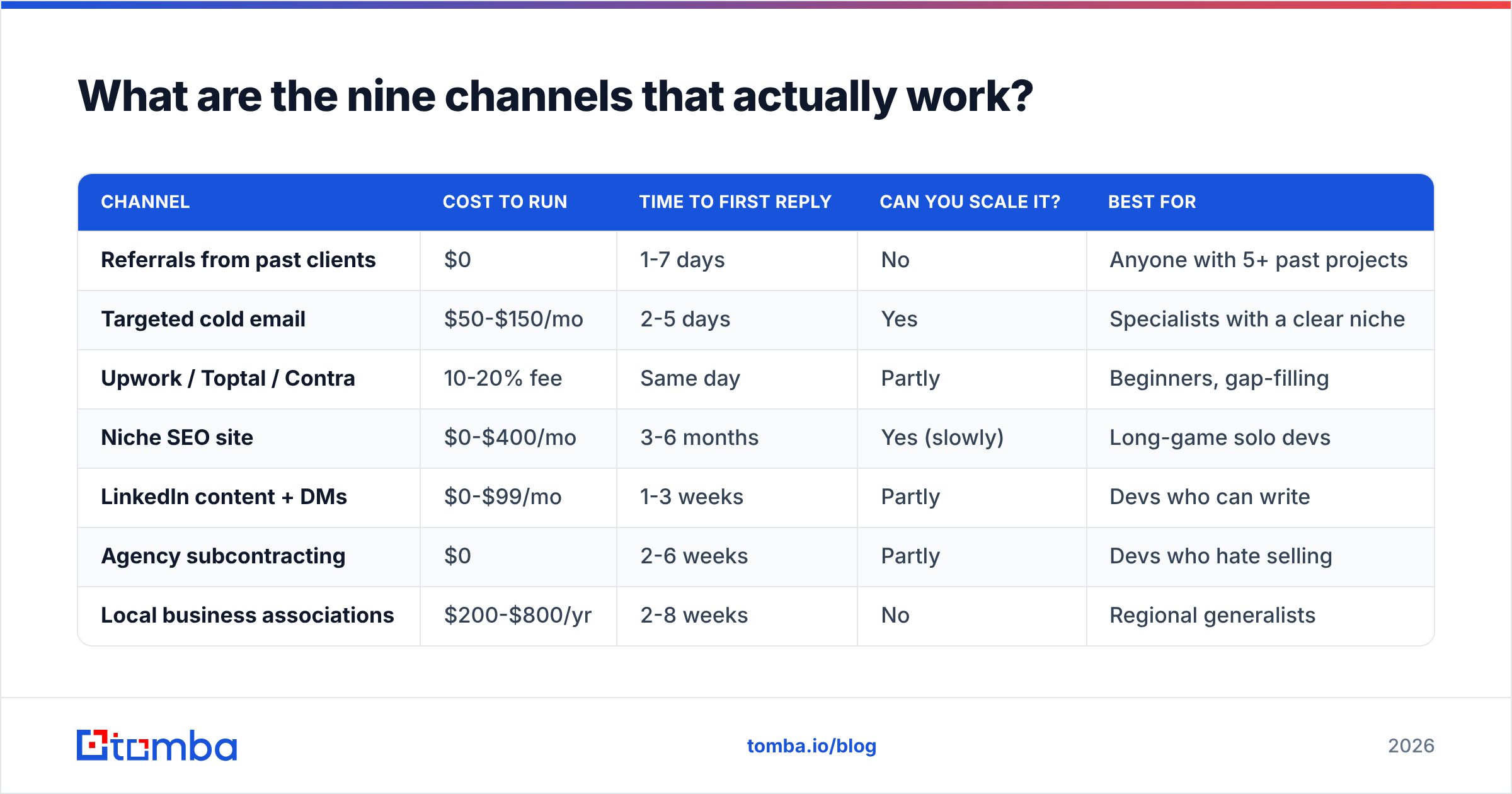
Here is the full landscape, scored on what matters: what it costs you, how long before you see a first reply, and whether you can turn the volume up when you need to.
| Channel | Cost to run | Time to first reply | Can you scale it? | Best for |
|---|---|---|---|---|
| Referrals from past clients | $0 | 1-7 days | No | Anyone with 5+ past projects |
| Targeted cold email | $50-$150/mo | 2-5 days | Yes | Specialists with a clear niche |
| Upwork / Toptal / Contra | 10-20% fee | Same day | Partly | Beginners, gap-filling |
| Niche SEO site | $0-$400/mo | 3-6 months | Yes (slowly) | Long-game solo devs |
| LinkedIn content + DMs | $0-$99/mo | 1-3 weeks | Partly | Devs who can write |
| Agency subcontracting | $0 | 2-6 weeks | Partly | Devs who hate selling |
| Local business associations | $200-$800/yr | 2-8 weeks | No | Regional generalists |
| Partner referrals (designers, SEO shops) | $0 + rev share | 1-4 weeks | Partly | Devs with a complementary skill |
| Open source / community presence | $0 | 3-12 months | No | Framework specialists |
Two of these deserve most of your attention: referrals because they close at 40-60% and targeted cold email because it is the only lever you can pull on a Tuesday when the pipeline is empty. Everything else is supplementary.
How do you pick a niche that actually pays?#
Before any outreach, narrow. Not because niching is fashionable, but because a narrow niche makes every downstream step cheaper: your list is findable, your message writes itself, your case studies compound.
Use these five filters:
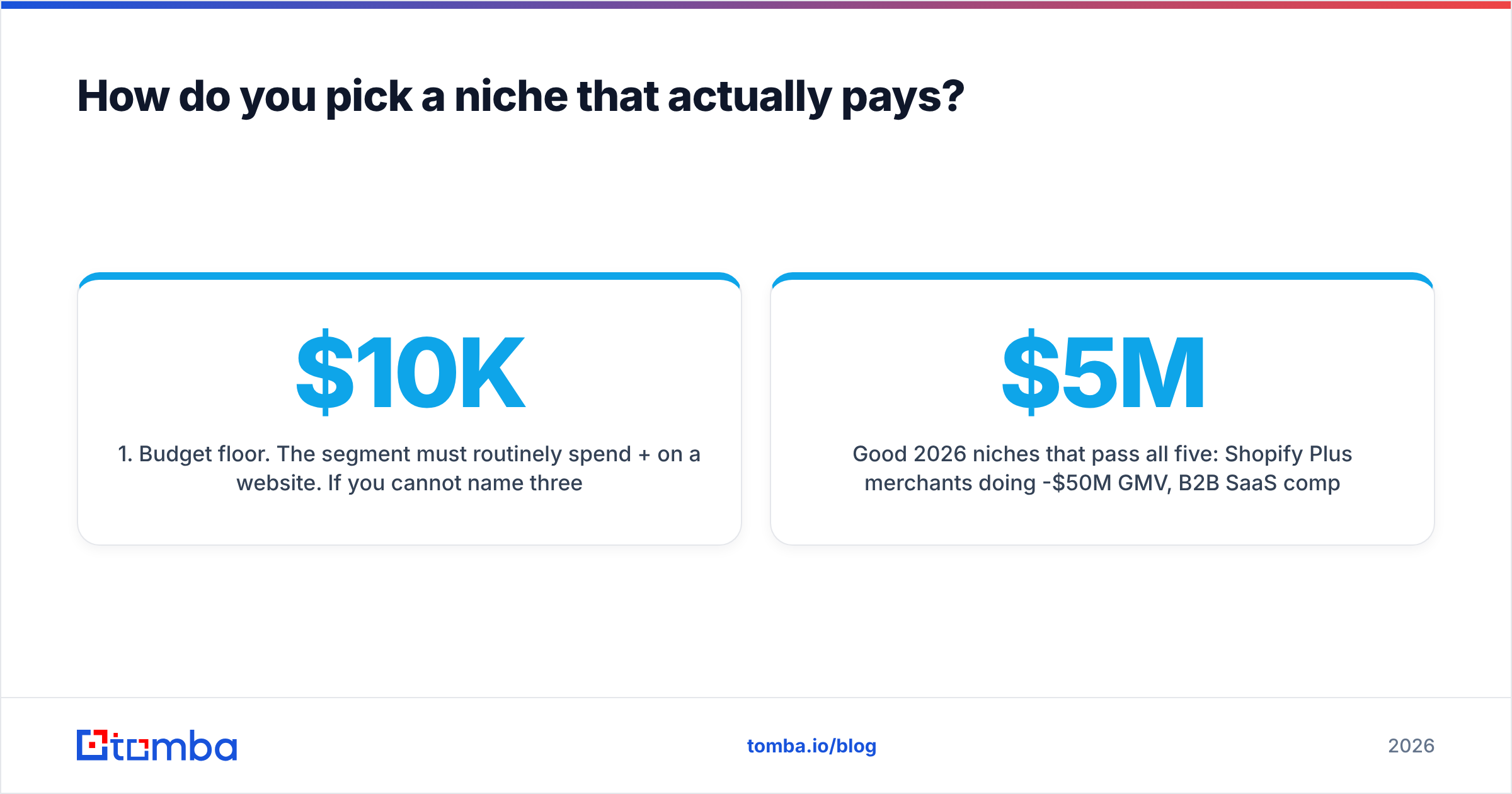
- Budget floor. The segment must routinely spend $10K+ on a website. If you cannot name three companies in it that have, skip it.
- A recurring trigger event. Funding rounds, rebrands, platform sunsets, Core Web Vitals failures, accessibility lawsuits. Triggers give you a reason to email today rather than "just checking in."
- Findable decision-makers. You need to be able to identify the Head of Ecommerce or VP Marketing by name at 300 companies. If the buyer is invisible, the niche is unworkable.
- A technical wedge you already own. Pick the stack you have shipped three times, not the one you want to learn.
- Proof of pain you can measure. "Your Largest Contentful Paint is 4.1s on mobile" beats "your site looks dated" because one is arguable and the other is not.
Good 2026 niches that pass all five: Shopify Plus merchants doing $5M-$50M GMV, B2B SaaS companies post-Series A rebuilding marketing sites, healthcare and fintech companies facing WCAG 2.2 compliance deadlines, and multi-location franchises with fragmented site infrastructure.
How do you build the contact list?#
This is where most developers give up, and it is genuinely the easiest part once you have a system.
Step 1 — Build the company list. Start from a source that reflects your trigger. BuiltWith for tech-stack filtering. Crunchbase for recent funding. Shopify's own merchant directories. Local chambers of commerce for regional plays. Aim for 200-400 companies, not 5,000. You will read every one of these.
Step 2 — Find the right person. Titles that sign web development contracts: VP/Director of Marketing, Head of Ecommerce, CTO at companies under 200 people, Head of Digital, and increasingly Head of Growth. Skip anyone with "Coordinator" in the title.
Step 3 — Get the email. You can guess patterns manually, or run the domain through a proper email finder and get the verified address plus the company's dominant email format in one call. If you already have a list of names and companies in a spreadsheet, a bulk email finder will process the whole file at once. For agencies working a specific target account, domain search returns every public email on the domain so you can see the org structure before you pick a contact.
Step 4 — Verify before you send. This is non-negotiable. A 6% bounce rate on a fresh sending domain will get you throttled by Google and Microsoft within two campaigns. Run the list through an email verifier and delete anything that comes back risky. It costs a few cents per contact and saves your domain.
Step 5 — Enrich for personalization. Company size, funding stage, current tech stack, recent job postings. You need one true, specific fact per prospect. Data enrichment can pull most of this automatically; the rest is 30 seconds on their site.
What does a cold email that books web development work look like?#
Short, specific, and about them. Here is the anatomy:
Subject line: Reference the observable problem. "checkout LCP on [brand].com" outperforms "Website redesign?" by a wide margin because it reads like a colleague, not a vendor.
Opening line: The specific observation. Not "I love what you're doing" — actually load their site, run it through PageSpeed Insights, and quote the number. Or note that they are on Magento 2 with support winding down. Or that they just posted a job for a frontend developer, which means the project is already funded.
Middle: One sentence of proof. "We cut mobile LCP from 4.2s to 1.6s for [similar company], which moved their mobile conversion rate 11%." Name a comparable company, not your biggest logo.
Close: A low-commitment ask. "Want me to send the 3-page audit I already ran on your checkout?" converts far better than "Do you have 15 minutes for a call?" — you are offering value, not asking for their calendar.
Keep it under 120 words. Send from a domain that is not your primary business domain if you are sending more than 30 a day, and warm it for at least two weeks first. Read up on email deliverability before you scale — the technical side (SPF, DKIM, DMARC) is 20 minutes of setup that prevents months of invisible failure.
Follow up three times over 12 days, then stop. Each follow-up should add something new — a relevant case study, a second observation, a competitor comparison — never "just bumping this."
Are marketplaces like Upwork worth it in 2026?#
They are worth it for exactly two situations: you have zero portfolio and need three projects to reference, or you have a gap in your calendar next month and need to fill it fast.
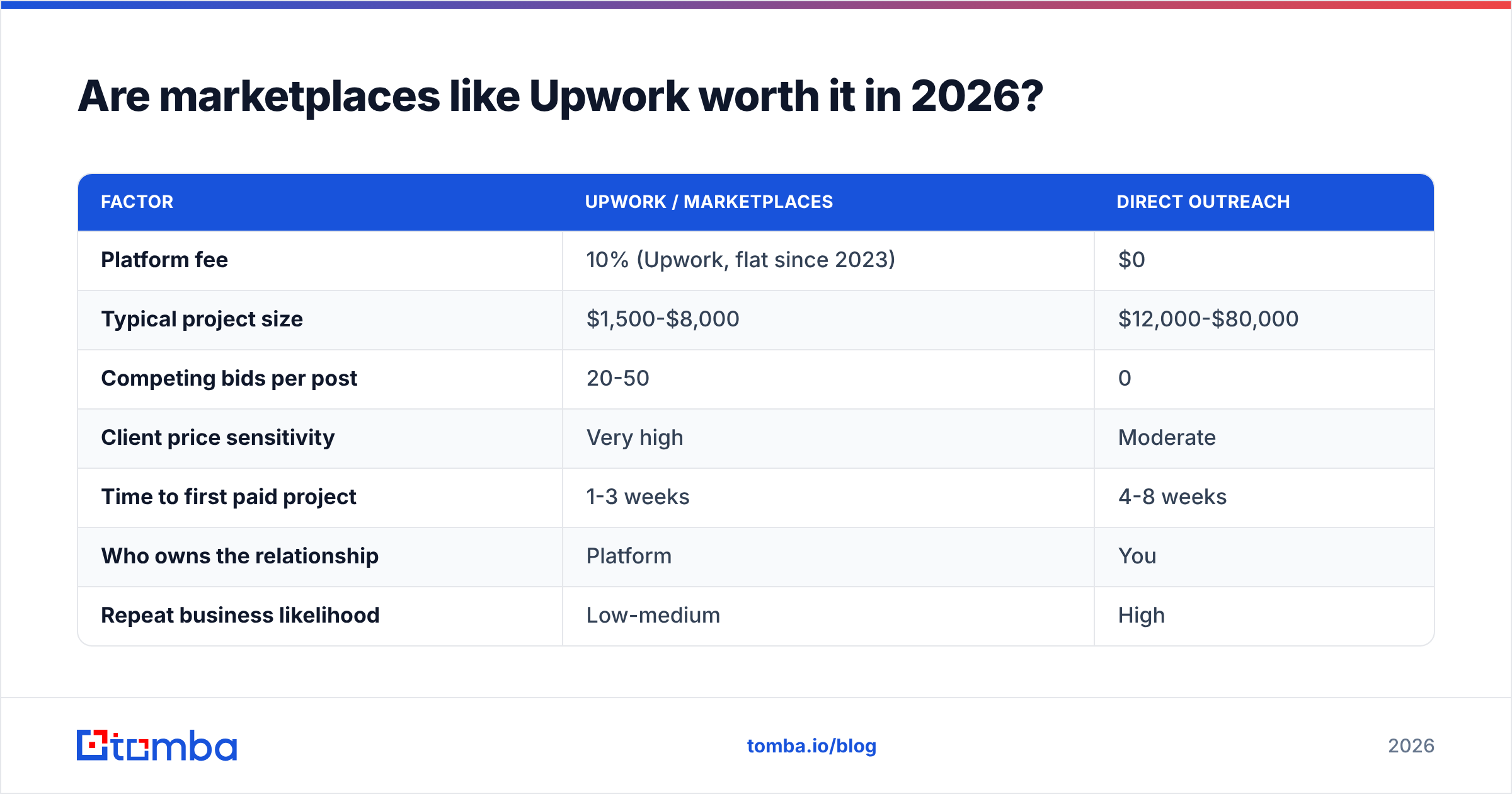
Beyond that the math turns against you. Here is the honest comparison:
| Factor | Upwork / marketplaces | Direct outreach |
|---|---|---|
| Platform fee | 10% (Upwork, flat since 2023) | $0 |
| Typical project size | $1,500-$8,000 | $12,000-$80,000 |
| Competing bids per post | 20-50 | 0 |
| Client price sensitivity | Very high | Moderate |
| Time to first paid project | 1-3 weeks | 4-8 weeks |
| Who owns the relationship | Platform | You |
| Repeat business likelihood | Low-medium | High |
The structural problem is not the fee — it is that marketplace buyers arrive with a fixed budget and a comparison table. Direct outreach buyers arrive with a problem and no price anchor. That difference is worth more than any percentage.
Use marketplaces as a floor, not a strategy. Take three projects, get three testimonials, then move the same energy to direct outreach. If you want a middle path, agency subcontracting through platforms like Toptal pays better than open marketplaces and skips the bidding entirely, at the cost of client ownership.
How do referrals and partnerships fit in?#
Referrals close at 40-60% versus 2-5% for cold outreach. The catch: you cannot schedule them. So the goal is not to "get more referrals" — it is to remove every reason someone would not refer you.
Three concrete moves:
- Ask at the delivery high point, not at invoice time. The moment the site goes live and the client is excited is the moment to ask, in one sentence, whether they know anyone else facing the same problem.
- Make the referral copy-pasteable. Send them two sentences they can forward. Most people want to help and are blocked purely by having to write something.
- Build partner loops with adjacent services. Design studios, SEO agencies, and fractional CMOs all encounter web development needs constantly and rarely want to handle them. A 10-15% referral fee, documented in writing, turns three of these relationships into a real pipeline. HubSpot's agency partner directory is a reasonable place to see how these relationships get structured formally.
Partnerships have a compounding property that outreach does not: each good delivery makes the next referral more likely, indefinitely.
What about inbound — content, SEO, and LinkedIn?#
Inbound is real but slow, and most developers do it wrong by writing tutorials. Tutorials attract other developers. Other developers do not hire you.
Write for the buyer instead. Practical formats that work:
- Teardowns. "We audited 40 Shopify Plus checkouts. 31 had the same three performance mistakes." This is a lead magnet disguised as a blog post.
- Cost transparency. "What a headless commerce migration actually costs in 2026." Buyers search this constantly and almost nobody answers honestly.
- Comparison content. "Webflow vs Next.js for a Series B marketing site." You rank for the exact query your buyer types before they hire anyone.
- Migration guides. "Moving off Magento 2 before support ends." Trigger-driven, high intent, low competition.
On LinkedIn, the format that works for developers is the project post-mortem: what the client's problem was, what you did, what the number moved to. Post it weekly. Connect with 15 targeted people a day. When someone in your niche engages, that is your warmest possible outreach signal — and you can pair it with a LinkedIn finder to get their work email and move the conversation off-platform where reply rates are higher.
Expect 3-6 months before inbound produces anything. Run it in parallel with outreach, never instead of it.
How do you know which channel is actually working?#
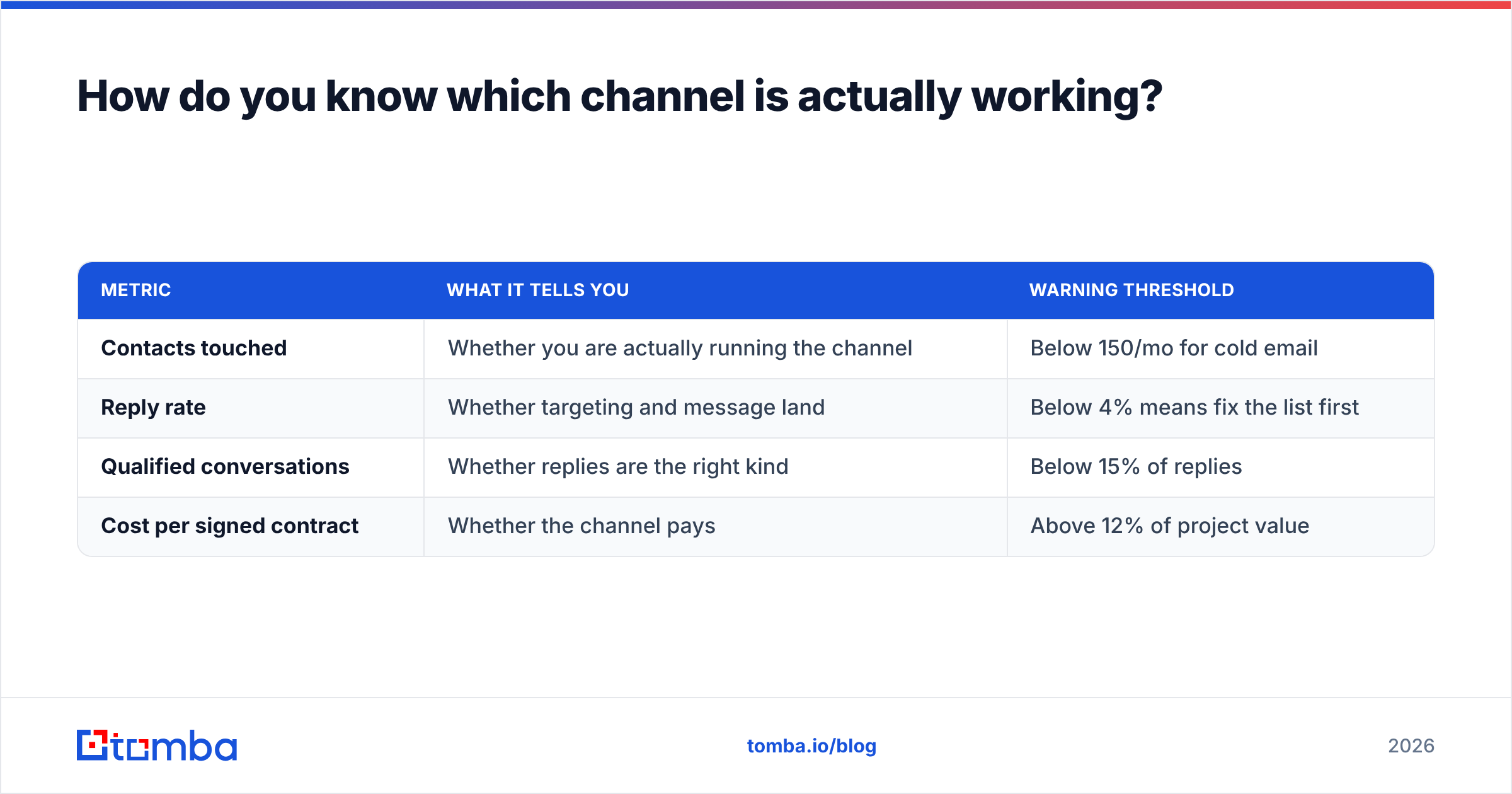
Track four numbers per channel, monthly:
| Metric | What it tells you | Warning threshold |
|---|---|---|
| Contacts touched | Whether you are actually running the channel | Below 150/mo for cold email |
| Reply rate | Whether targeting and message land | Below 4% means fix the list first |
| Qualified conversations | Whether replies are the right kind | Below 15% of replies |
| Cost per signed contract | Whether the channel pays | Above 12% of project value |
The most common mistake is fixing the message when the list is the problem. If your reply rate is under 2%, the message is almost never the culprit — you are emailing the wrong people, or the addresses are wrong, or you are landing in spam. Diagnose in that order: deliverability, then list quality, then copy. Checking your sender reputation takes five minutes and rules out the most expensive failure mode first.
Give any channel a fair trial: 90 days and at least 400 contacts for outreach, 6 months for content. Killing a channel at week three tells you nothing.
What should you do this week?#
If you are starting from zero:
- Pick one niche using the five filters above. Write it down as a single sentence.
- Build a list of 200 companies that fit. Spreadsheet is fine.
- Identify one decision-maker per company by name and title.
- Find and verify their email addresses.
- Write one email template, personalize the first line for each of the first 50, and send.
- Follow up three times. Track replies. Adjust.
That is a two-day setup for a channel you control permanently. Compare that to refreshing an Upwork feed for the same two days.
Ready to build your outreach list?#
The channel that scales — targeted cold outreach — lives or dies on contact data. Guessed addresses bounce, bounces hurt your domain, and a damaged domain quietly kills every campaign after it. Start with Tomba Email Finder to find verified work emails by name and domain, with a free tier at 25 searches per month to test your first niche before committing. Paid plans start at $49/month (Starter), $99/month (Growth), and $249/month (Pro) — full Tomba pricing is public if you want to model the cost per contract before you sign up.
Build the list properly once, and the pipeline stops being a mystery.
Related guides#
// get started
Find, verify and enrich your first contacts today
Start on the free plan with 25 searches a month, then scale when your team is ready.
Free plan · No credit card required · GDPR & CCPA
Get the Tomba newsletter
Product and data updates
// about the author