How to Get New Customers in 2026: A B2B Playbook
Referrals dried up and ads got expensive. Here are seven channels for getting new customers in 2026, ranked by cost per meeting, speed to first deal, and how much they actually scale.
Every growth plan runs into the same question: how to get new customers without burning cash on channels that never pay back. This guide ranks seven of them by what a booked meeting actually costs.
TL;DR
- There is no single best channel for getting new customers — there is a best channel for your deal size. Under $5k ACV, self-serve and content win. Above $25k ACV, outbound and partnerships win.
- Cost per meeting is the only metric that lets you compare channels fairly. Most teams track cost per lead, which hides the fact that 70% of "leads" never take a call.
- Outbound is not dead, but volume outbound is. In 2026 the working pattern is small, well-researched lists with verified contact data — 200 accounts done properly beats 10,000 scraped rows.
- Referrals and existing-customer expansion close 3-5x faster than cold channels and cost almost nothing. Almost nobody systematizes them.
- Pick two channels, not six. Two channels run properly for two quarters will out-produce six run casually.
Why is getting new customers harder in 2026 than it was in 2021?#
Three things changed at once, and they compounded.
Paid acquisition costs rose while conversion stayed flat. Buyers also got harder to reach. Gartner's research on B2B buying behavior finds that buyers spend only a small slice of their journey with any one vendor's rep. Most of the work happens on their own — web research, peer conversations, and internal consensus-building. Inbox volume exploded too, because generative AI made it easy for anyone to send 50,000 personalized-looking emails a month.
The net effect is simple. The cheap tactics got expensive, and the lazy ones stopped working. What still works is dull: narrow targeting, accurate data, a real reason to reach out, and the patience to run a channel long enough to read the results.
This post breaks down seven acquisition channels. For each one: what a booked meeting costs, how long it takes to land a first customer, and which businesses it fits. Then it covers the layer most teams skip — the data quality that decides whether any of it works.
How to get new customers: the seven channels, ranked#
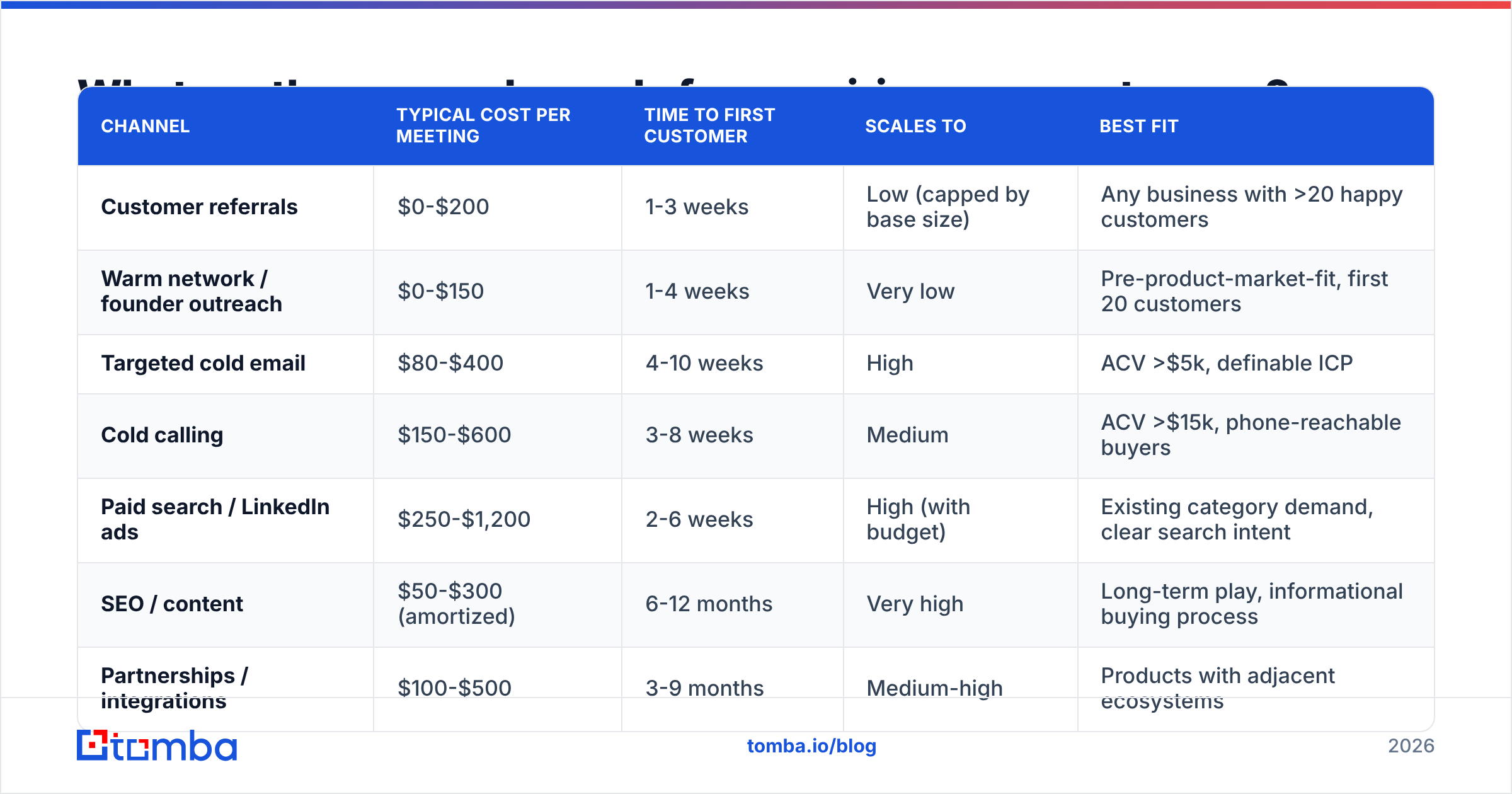
They are ranked by how fast they produce a first paying customer, not by how much volume they can deliver later. Those are different questions. Confusing them is why so many acquisition plans fail.
| Channel | Typical cost per meeting | Time to first customer | Scales to | Best fit |
|---|---|---|---|---|
| Customer referrals | $0-$200 | 1-3 weeks | Low (capped by base size) | Any business with >20 happy customers |
| Warm network / founder outreach | $0-$150 | 1-4 weeks | Very low | Pre-product-market-fit, first 20 customers |
| Targeted cold email | $80-$400 | 4-10 weeks | High | ACV >$5k, definable ICP |
| Cold calling | $150-$600 | 3-8 weeks | Medium | ACV >$15k, phone-reachable buyers |
| Paid search / LinkedIn ads | $250-$1,200 | 2-6 weeks | High (with budget) | Existing category demand, clear search intent |
| SEO / content | $50-$300 (amortized) | 6-12 months | Very high | Long-term play, informational buying process |
| Partnerships / integrations | $100-$500 | 3-9 months | Medium-high | Products with adjacent ecosystems |
Two observations from that table.
First, the two cheapest channels — referrals and warm network — are also the two that don't scale. That is not a reason to skip them. It's a reason to exhaust them completely before spending a dollar on the others. Most companies do this backwards: they buy ads before they've asked a single customer for an introduction.
Second, the gap between the fastest channel (referrals, weeks) and the highest-ceiling channel (SEO, 6-12 months) is enormous. You need one of each running in parallel. Fast channels pay the bills this quarter. Slow channels are why you won't still be grinding cold outreach in three years.
How do you decide which two channels to run?#
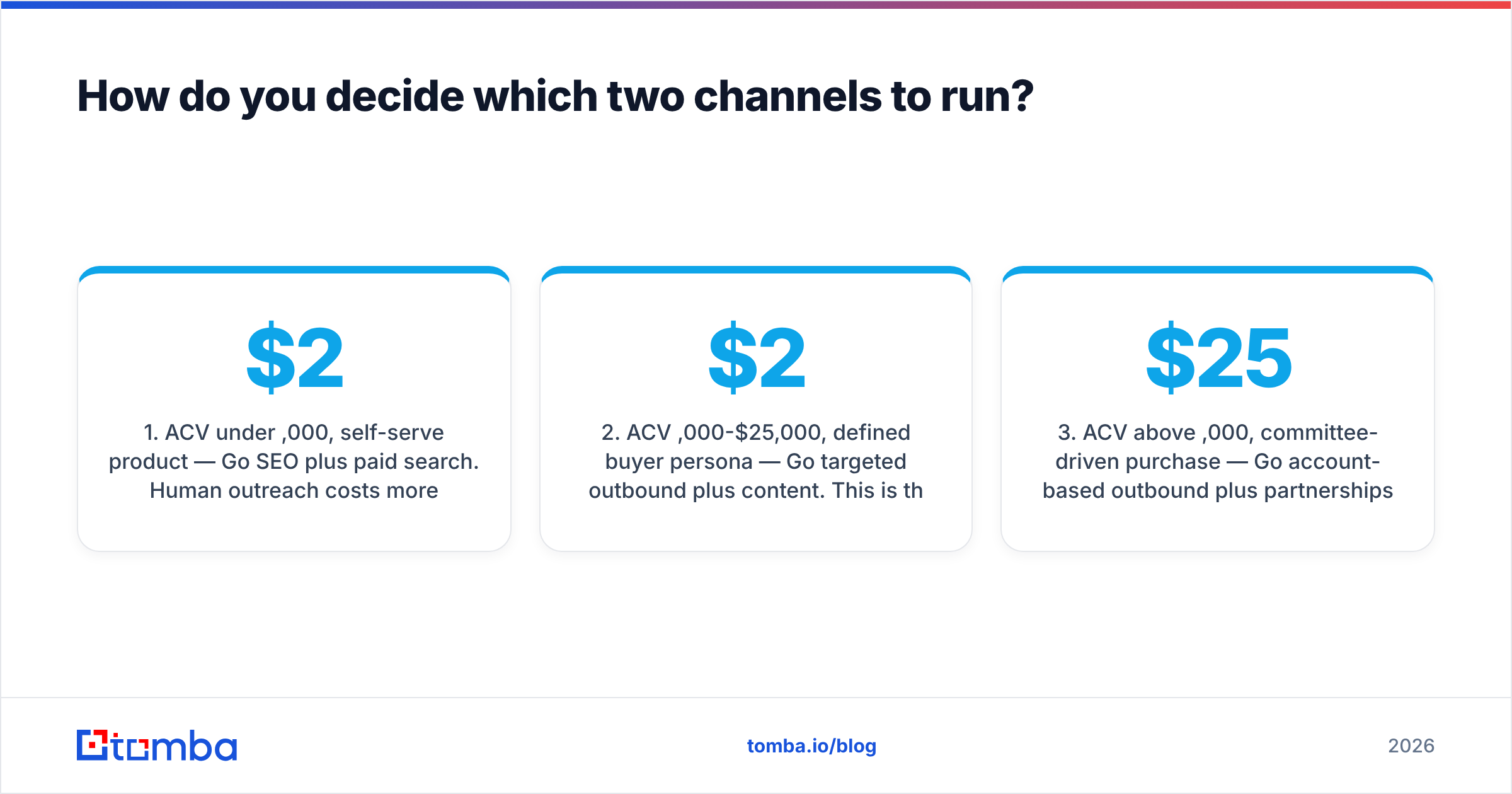
Use deal size and buying process as your filter. Five rules cover most cases:
ACV under $2,000, self-serve product — Go SEO plus paid search. Human outreach costs more than the deal is worth. Your job is to be findable at the moment of intent and to make signup frictionless. Sales-assisted anything is a margin killer at this price point.
ACV $2,000-$25,000, defined buyer persona — Go targeted outbound plus content. This is the sweet spot for cold email and calling. The deal justifies a human touch, and the buyer is identifiable by title and company attributes. Content supports outbound by giving prospects something to check when they Google you after your email lands.
ACV above $25,000, committee-driven purchase — Go account-based outbound plus partnerships. You're selling to 4-7 people, not one. Volume is irrelevant; depth per account is everything. A single well-worked account is worth 200 casual touches.
Local or geographically bounded service business — Go referrals plus local search. Paid social and cold email both underperform badly here relative to word of mouth and showing up in map results.
Brand new, no customers yet — Go warm network plus manual outreach. Your first ten customers should come from people who already know you or people you personally researched one at a time. Systematize nothing until you know what works.
The pattern across all five: pick one fast channel and one compounding channel. Never two of the same type.
What actually makes cold outreach work now?#
Precision, not volume. That's the whole answer, but it's worth unpacking because "personalization" has become a meaningless word.
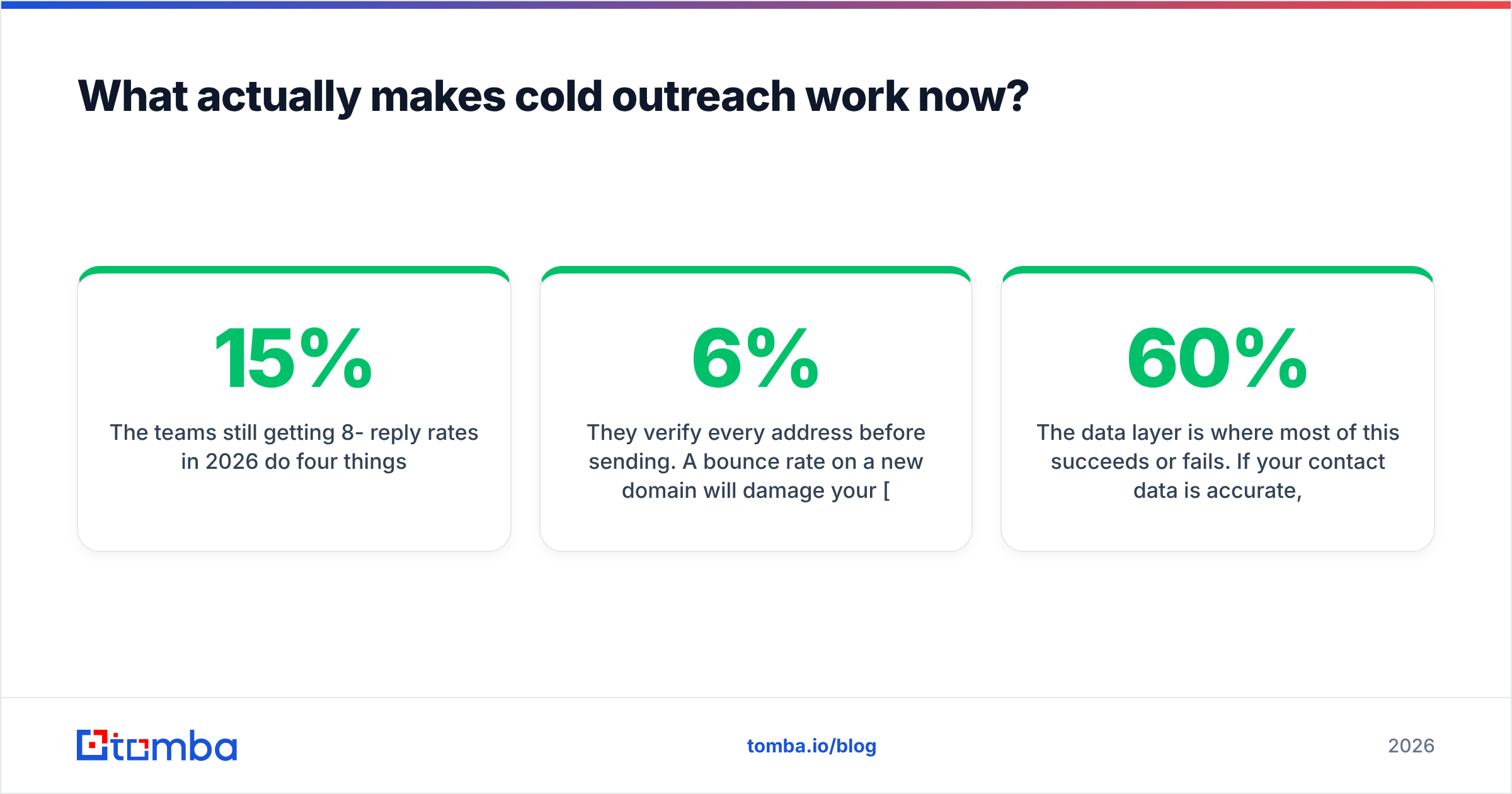
The teams still getting 8-15% reply rates in 2026 do four things. Two are about the list:
- They build lists from a hypothesis, not a filter. "Series A fintechs in the US" is a filter. "Companies that just posted a compliance job req, which means they're about to face SOC 2" is a hypothesis. The second one gives you a first line that couldn't have been sent to anyone else.
- They verify every address before sending. A 6% bounce rate on a new domain will damage your sender reputation badly enough that even your good emails stop landing. Run every list through an email verifier and drop anything that comes back risky or unknown.
Two are about the sending:
- They cap daily volume per mailbox. 30-50 sends per mailbox per day, with multiple domains and warmed inboxes. The instinct to push to 200 is the single most common way teams destroy their email deliverability in month two.
- They write for a reply, not a meeting. The first email's only job is to earn a response. Asking for a 30-minute call in email one converts far worse than asking a specific question the prospect can answer in a sentence.
The data layer is where most of this succeeds or fails. If your contact data is 60% accurate, perfect copy and perfect timing still won't save the campaign — four out of ten sends never reach a human. Using a bulk email finder to build verified lists from your target account list, rather than buying a generic database dump, changes the math on every downstream metric.
How small should the list actually be?#
Smaller than feels comfortable. A useful benchmark: if you can't name the specific reason each account is on the list, the list is too big.
For a team of two SDRs, 150-250 net-new accounts per month per rep is a realistic ceiling for genuine research-backed outreach, worked across email, phone, and LinkedIn. Anyone claiming 3,000 accounts per rep per month is running a volume play. Volume plays now produce spam complaints faster than they produce meetings.
How do you turn referrals into a repeatable channel?#
Referrals underperform their potential in almost every company because they're treated as luck rather than a process. They're a process. Three components:
Ask at the moment of demonstrated value, not at renewal. The right trigger is a support ticket resolved happily, a milestone hit inside your product, or a positive NPS response — not an arbitrary calendar date. HubSpot's research on customer loyalty consistently shows that satisfaction peaks are short-lived. Asking two months after the win converts far worse than asking the same day.
Make the ask specific. "Do you know anyone who'd find this useful?" gets nothing. "You mentioned your old colleague moved to Acme — would an intro make sense?" gets a yes or a no, which is progress either way. Do the research before you ask, so the customer only has to approve, not think.
Close the loop. Tell the referrer what happened. People who see that their introduction produced something make second introductions at dramatically higher rates than people who hear nothing.
A related and badly underused channel: your churned and closed-lost accounts. Champions move companies. When someone who liked your product lands somewhere new, that's the warmest cold lead available. A reverse email lookup on an old contact whose email has started bouncing will usually tell you where they went — and a "congrats on the new role" email to a former champion outperforms any cold sequence you will ever write.
Should you invest in content and SEO if you need customers this quarter?#
No — and yes.
You should not expect content to produce customers this quarter. Ranking for anything commercially valuable takes 6-12 months of consistent publishing. Treating it as a short-term lever leads to abandoning it at month four, right before it would have started working. If your runway depends on Q1 revenue, put your effort into outbound and referrals.
You should still start content this quarter, at low intensity, precisely because it takes so long. Two useful pieces a month, aimed at problems your buyers actually search for, compounds into a channel that eventually delivers meetings at a fraction of paid cost. Companies that reach the point where inbound covers half of pipeline almost always started two to three years earlier.
The practical compromise: write content that serves outbound today and search tomorrow. A detailed teardown of a problem your ICP has is something you can link in a cold email now, and something that ranks later. One asset, two jobs.
What does the operational layer look like?#
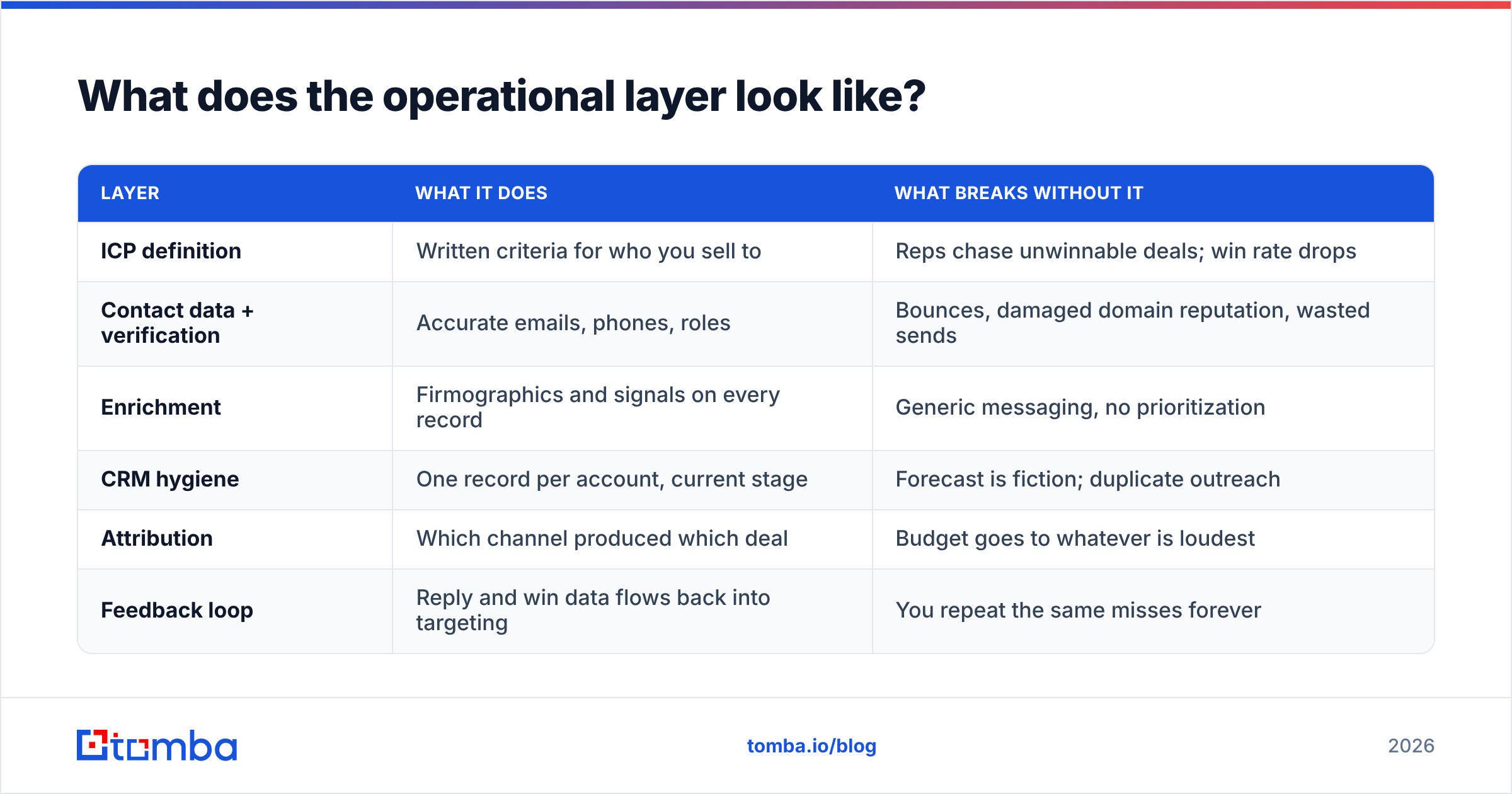
Here's what separates teams that grow steadily from teams that have one good quarter and then stall. The channels are the visible part; the plumbing is what makes them repeatable.
| Layer | What it does | What breaks without it |
|---|---|---|
| ICP definition | Written criteria for who you sell to | Reps chase unwinnable deals; win rate drops |
| Contact data + verification | Accurate emails, phones, roles | Bounces, damaged domain reputation, wasted sends |
| Enrichment | Firmographics and signals on every record | Generic messaging, no prioritization |
| CRM hygiene | One record per account, current stage | Forecast is fiction; duplicate outreach |
| Attribution | Which channel produced which deal | Budget goes to whatever is loudest |
| Feedback loop | Reply and win data flows back into targeting | You repeat the same misses forever |
The one most teams skip is the second row. It's unglamorous, and it's the foundation for everything else. Every wrong email address costs you twice: once in the wasted send, and once more in the deliverability damage that makes your correct sends less likely to arrive.
If you're building lists from a set of target companies, domain search is the fastest path — feed it a company domain and get back the people, roles, and email patterns without touching a scraper. For enriching records you already have, contact enrichment fills in the fields your CRM is missing so your segmentation is based on something real.
On attribution: keep it simple. First-touch and last-touch, tracked in the CRM, is enough for the first few years. Multi-touch models are for companies spending seven figures on ads. For everyone else they are a distraction. What you need to know is this: for each closed deal, where did the account first come from? Answer that consistently for 12 months and you'll know where to put next year's budget.
What are the most common mistakes when figuring out how to get new customers?#
Most of them come from spreading effort too thin:
- Running six channels at 20% effort. Every channel has a threshold below which it produces nothing. Four half-run channels produce zero; two fully-run channels produce a business.
- Optimizing cost per lead instead of cost per customer. A $20 lead that never converts is infinitely more expensive than a $400 lead that closes. Measure at the bottom of the funnel or don't measure.
- Buying a database and calling it a strategy. Static B2B databases decay at roughly 20-30% per year as people change jobs. Fresh, verified lookups against a target list beat a stale bulk export every time — check any vendor's data sources before you commit.
The rest come from misreading the results:
- Judging a channel too early. Outbound needs 6-8 weeks to produce readable data. Content needs 6-9 months. Killing a channel at week three tells you nothing except that you're impatient.
- No follow-up discipline. A large share of replies come after the first message in a sequence. Teams that send one email and stop leave most of their results on the table.
- Ignoring the customers you already have. Expansion revenue is usually cheaper than new logos by an order of magnitude, and it's the only growth lever that doesn't require finding a stranger first.
How do you build a 90-day plan from this?#
Weeks 1-2: define the ICP in writing and build a target account list of 200-300 companies that fit it. Not 3,000. Get contact data for the 2-3 relevant roles at each account and verify every address.
Weeks 3-4: set up sending infrastructure — separate domains, warmed mailboxes, correct SPF record, DKIM, and DMARC. At the same time, list every current customer and identify which ones you can ask for an introduction and what specific introduction you'd ask for.
Weeks 5-10: run outbound at controlled volume and work referrals in parallel. Track replies, meetings booked, and — critically — which segments respond and which don't. Publish two content pieces that support the same message your outbound is making.
Weeks 11-13: read the data. Which segment replied at double the average? That's your real ICP; narrow toward it. Which channel produced meetings at the lowest cost? That's where next quarter's incremental effort goes.
At the end of 90 days you should have a defensible answer to one question: what does it cost us to acquire a customer, by channel? Almost no early-stage company can answer that. The ones that can are the ones that scale predictably.
For deeper reading on structuring an outbound motion, G2's category research is a reasonable place to compare tooling against real user reviews rather than vendor claims. And if you're formalizing your process for the first time, HubSpot's sales resources cover pipeline stages and qualification without requiring you to buy anything.
Getting started#
The bottleneck in almost every plan for how to get new customers is the same: you know who you want to reach, and you have no reliable way to reach them. Scraped lists bounce, purchased databases decay, and manual research eats the hours you needed for actual selling.
The Tomba Email Finder closes that gap — give it a name and a company domain, or just a domain, and get back verified professional email addresses with confidence scoring and source attribution, so you know what you're sending to before you send it. The free tier covers 25 searches a month if you want to test accuracy against contacts you already know; paid plans start at $49/mo on Starter and $99/mo on Growth. Full Tomba pricing is public, and there's an email finder API if you'd rather wire lookups directly into your CRM or enrichment workflow.
Build the list properly, verify it, then send. Everything downstream gets easier.
Related guides#
// get started
Find, verify and enrich your first contacts today
Start on the free plan with 25 searches a month, then scale when your team is ready.
Free plan · No credit card required · GDPR & CCPA
// about the author