How To Get Warm Leads: 7 Ways To Warm Up Cold Prospects
Warm leads close 3-5x more often than cold ones. Here are seven repeatable ways to manufacture warmth before you ever hit send, plus the tools and data that make each one work.
TL;DR
- A warm lead is anyone who has shown a behavioral, relational, or contextual signal before you reach out — not just anyone who fits your ICP.
- The seven reliable warming plays: website visitor reveal, content engagement, trigger events, community and social touch, referral chains, review-site intent, and re-engaging closed-lost.
- Warmth without contact data is useless. Most teams fail at step two, not step one — they spot the signal and cannot reach the human behind it.
- Response rates on signal-based outreach typically run 3-5x cold outbound, but volume drops hard. Plan for a blended motion, not a replacement.
- Start with visitor reveal plus verified contact data; it is the shortest path from anonymous traffic to a named person you can email today.
What Is a Warm Lead, Really?#
A warm lead is a prospect who has done something before you contacted them. That is the whole definition. The "something" can be small — reading two pricing pages, following your CEO on LinkedIn, hiring a Head of RevOps, leaving a review of your competitor — but it has to exist and it has to be observable.
This matters because most teams use "warm" as a mood word. They call a lead warm because it matches the ICP, or because the account is big, or because the rep feels good about it. None of that is warmth. Fit is not intent. A perfect-fit company that has never heard of you is a cold lead wearing a nice suit.
The practical test: can you name the specific action, event, or relationship that justifies your outreach? If you can write it into the first line of your email without sounding like you are stretching, it is warm. If you have to invent a reason ("I saw you're in SaaS and thought..."), it is cold.
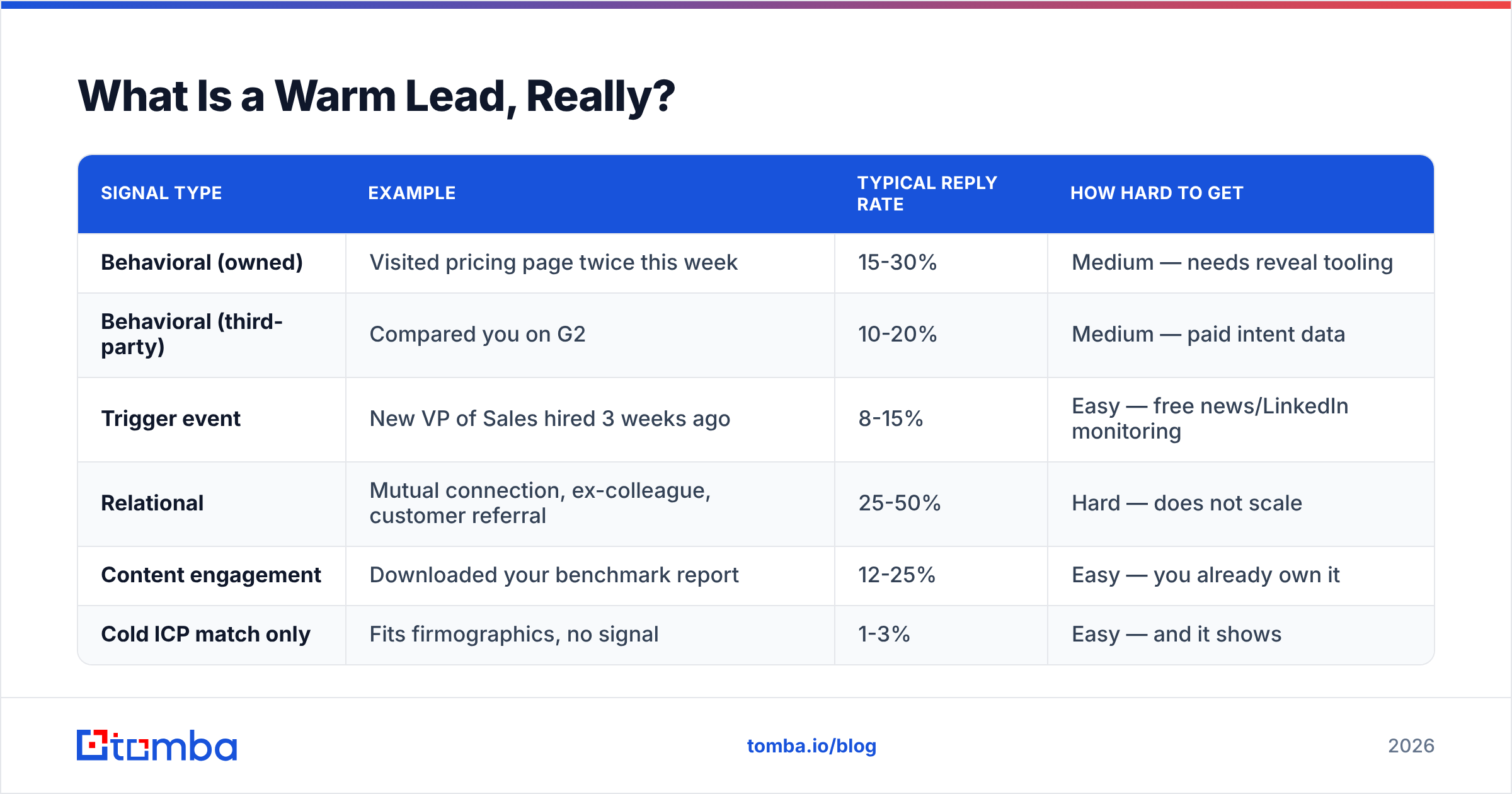
| Signal type | Example | Typical reply rate | How hard to get |
|---|---|---|---|
| Behavioral (owned) | Visited pricing page twice this week | 15-30% | Medium — needs reveal tooling |
| Behavioral (third-party) | Compared you on G2 | 10-20% | Medium — paid intent data |
| Trigger event | New VP of Sales hired 3 weeks ago | 8-15% | Easy — free news/LinkedIn monitoring |
| Relational | Mutual connection, ex-colleague, customer referral | 25-50% | Hard — does not scale |
| Content engagement | Downloaded your benchmark report | 12-25% | Easy — you already own it |
| Cold ICP match only | Fits firmographics, no signal | 1-3% | Easy — and it shows |
Read that last row honestly. Cold ICP-only outbound still works at volume, and plenty of pipeline gets built that way. But every row above it does more with less list.

Why Do Cold Lists Underperform Warm Ones?#
Three reasons, and only one of them is about the message.
Timing. Roughly 3% of any market is actively buying at a given moment. Cold lists sample randomly across that distribution, so 97% of your effort lands on people who are not in-market. Warm signals are, by construction, a filter for the 3%.
Permission. A prospect who downloaded your guide has an implicit context for hearing from you. One who has never touched your brand experiences the same email as an interruption. The copy can be identical; the received meaning is not.
Deliverability compounding. This is the one people miss. Cold lists have higher bounce and spam-complaint rates, which degrades your sending domain, which lowers inbox placement for everyone you email afterward — including warm leads. A bad cold list does not just fail; it taxes the rest of your program. Keeping bounces under 2% via an email verifier is not hygiene theater, it is what protects your email deliverability for the outreach that would have worked.
How Do You Get Warm Leads From Your Own Website?#
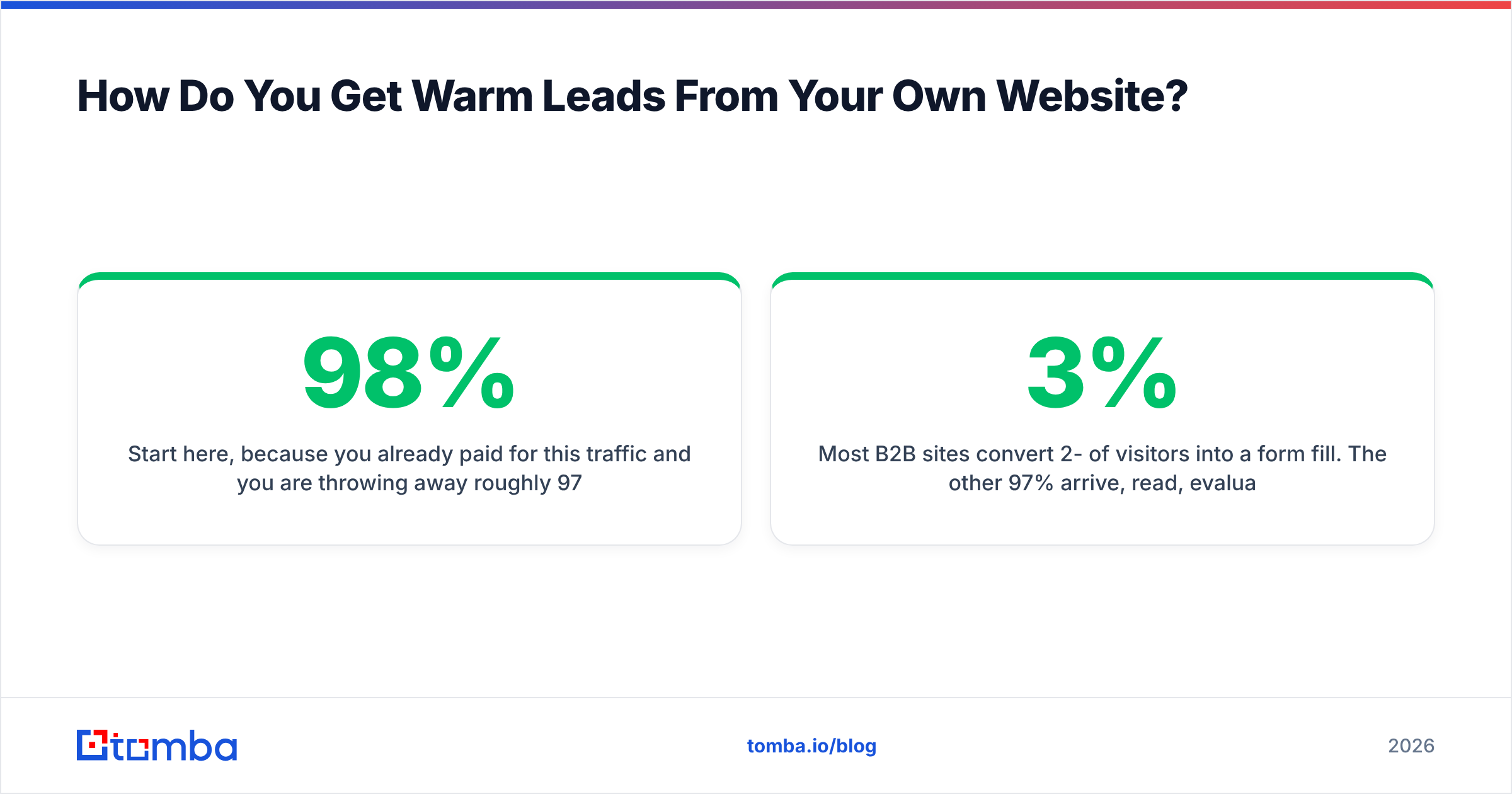
Start here, because you already paid for this traffic and you are throwing away roughly 97-98% of it.
Most B2B sites convert 2-3% of visitors into a form fill. The other 97% arrive, read, evaluate, and leave anonymously. Visitor identification closes part of that gap by matching IP and device signals to company records, so you learn which accounts are researching you even when nobody fills anything in.
The workflow that actually produces meetings:
- Install reveal tracking on high-intent pages only — pricing, comparison pages, docs, integration pages. Homepage visits are noise. A website visitor reveal setup that fires on pricing tells you something a homepage hit never will.
- Set a threshold, not an alert on everything. Two or more sessions, or three or more pages, within seven days. Single-page bounces are researchers and job seekers.
- Resolve the company to a person. This is the step that breaks most stacks. You know Acme Corp read your pricing page; you do not know who. Use domain search to pull the people at that company in the relevant department, then filter by title against your buyer persona.
- Verify before you send. Reveal-sourced accounts often produce guessed addresses. Run them through verification so a warm signal does not turn into a hard bounce.
- Reference the behavior obliquely. Do not write "I saw you visited our pricing page" — it reads as surveillance. Write about the problem that page solves.
- Give it 48 hours max. Intent decays fast. A pricing-page visit is warm on day one and room temperature by day ten.
Realistic yield: if you get 5,000 monthly visitors, expect maybe 300-600 identified companies, of which 50-100 clear an intent threshold, of which 20-40 are ICP-fit. That is 20-40 genuinely warm accounts a month from traffic you already had.
Which Trigger Events Actually Predict Buying?#
Trigger events are free warmth. Someone else generates the signal; you just have to notice it.
Not all triggers are equal. Ranked roughly by how reliably they precede a purchase:
- New executive in your buyer's seat — a new VP of Sales, Head of Marketing, or RevOps lead has 90-180 days to show change and an explicit mandate to evaluate tools. This is the strongest non-behavioral trigger in B2B.
- Funding round closed — budget exists and a board expects deployment. Series A and B are best; late-stage rounds often go to headcount rather than tooling.
- Tech stack change — they just added a CRM, a sequencer, or a data warehouse. Adjacent tools follow within a quarter.
- Job postings for roles that use your product — hiring three SDRs means they will need data, sequencing, and enablement for three SDRs.
- Public complaint about a competitor — a G2 review or LinkedIn post griping about a rival's pricing or support is an open door.
- Expansion signals — new office, new market, new product line.
The mechanical part: monitoring triggers is easy, acting on them is where teams stall. You spot a new VP of Sales at a target account on Monday, and by Thursday you still have not found her email. That lag kills the play. Wire the lookup into the same step as the detection — a LinkedIn finder turns the profile you found the trigger on into a reachable address in one move, rather than a research task you queue and forget.
Is Content Engagement Better Than Intent Data?#
Depends on what you can afford and how patient you are.
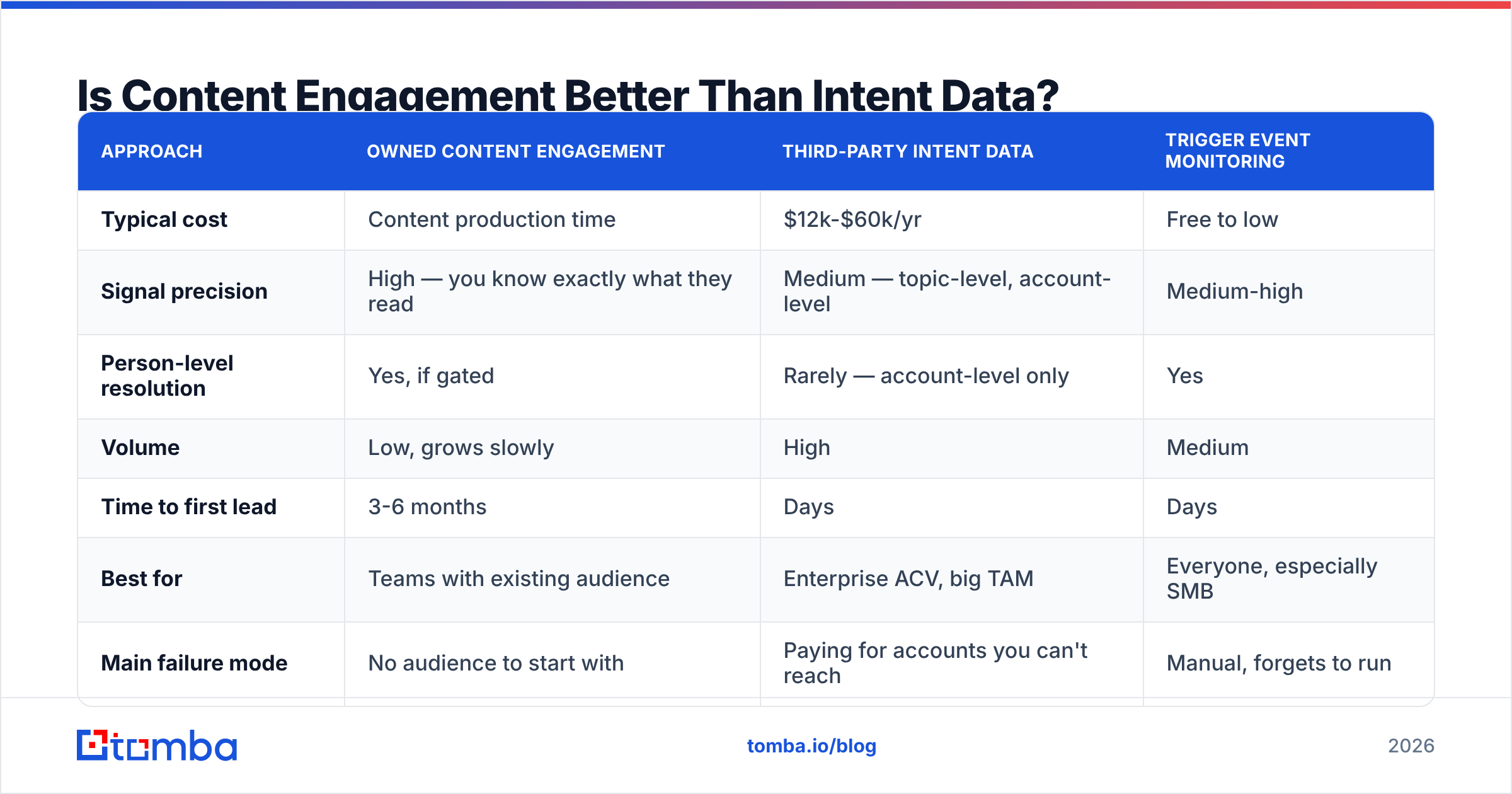
| Approach | Owned content engagement | Third-party intent data | Trigger event monitoring |
|---|---|---|---|
| Typical cost | Content production time | $12k-$60k/yr | Free to low |
| Signal precision | High — you know exactly what they read | Medium — topic-level, account-level | Medium-high |
| Person-level resolution | Yes, if gated | Rarely — account-level only | Yes |
| Volume | Low, grows slowly | High | Medium |
| Time to first lead | 3-6 months | Days | Days |
| Best for | Teams with existing audience | Enterprise ACV, big TAM | Everyone, especially SMB |
| Main failure mode | No audience to start with | Paying for accounts you can't reach | Manual, forgets to run |
Third-party intent data gets sold as the shortcut, and for enterprise deals with $80k+ ACV it often pays back. For teams under that, the math is brutal: you pay five figures to learn that "Acme is researching sales engagement software," then still have to figure out who at Acme, get their email, and beat six competitors who bought the same signal. Account-level intent without person-level contact data is an expensive hint.
Owned content is slower and better. A prospect who read your teardown of pricing models told you more about their situation than any intent vendor can, and they told you as a named individual.
How Do You Turn a Warm Signal Into an Actual Conversation?#
The gap between "signal detected" and "reply received" is where most warm lead programs die. Four things close it.
Speed. Harvard Business Review's classic response-time study found firms that responded within an hour were nearly seven times more likely to qualify a lead than those who waited two hours, and more than 60 times more likely than those who waited 24 hours or more. That research covered inbound form fills, but the decay curve applies to any behavioral signal. Warmth is a perishable good.
Contact accuracy. A warm lead you cannot reach is worth exactly as much as a cold one you cannot reach — zero, minus the time you spent. This is the unglamorous half of warm lead generation. Build the verify step into the workflow rather than treating it as cleanup, and route bulk lists through a bulk email finder so enrichment happens at list level rather than one tab at a time.
Signal-appropriate framing. Match the message to the signal strength. A pricing-page visitor can handle a direct "worth a 15-minute look?" A funding-round trigger needs more context-setting. A cold-adjacent signal like a job posting needs the most groundwork.
Multi-channel, not multi-email. A warm signal justifies showing up in more than one place. Email plus a LinkedIn view plus a comment on their post reads as attentive when there is a real reason; it reads as stalking when there is not. That is precisely the difference warmth buys you.
What About Referrals and Closed-Lost?#
These two are the highest-converting and most neglected sources in B2B, and both are free.
Referral chains. A warm introduction converts at 25-50% to meeting. Nothing else comes close. The problem is that most teams ask for referrals once, awkwardly, after a deal closes. Better: build a standing motion. Every quarter, ask each happy customer for one specific introduction — not "know anyone who'd benefit," but "you mentioned you came from Datadog; is there anyone on that team still there who owns this?" Specificity multiplies yield.
Closed-lost revival. Deals lost 9-18 months ago are warmer than anything on a cold list. They know your product, they had budget, and something changed. Common reasons for losing — no budget, wrong timing, chose a competitor — all expire. The play: pull every closed-lost from the last 24 months, check whether the original contact is still there (they often are not, which is itself a trigger), re-verify the email since roughly 25-30% of B2B contact data decays annually, and reach out referencing the specific objection from last time.
Champion tracking. When a customer or engaged contact changes jobs, you have a warm lead at a brand-new account. They already know your product works. This is the single most underused source of warm pipeline in B2B, and the only hard part is noticing the move and finding the new address. Both are solvable — a reverse email lookup or a fresh domain search at the new company reconnects the thread.
How Do the Tools Compare for Warm Lead Sourcing?#
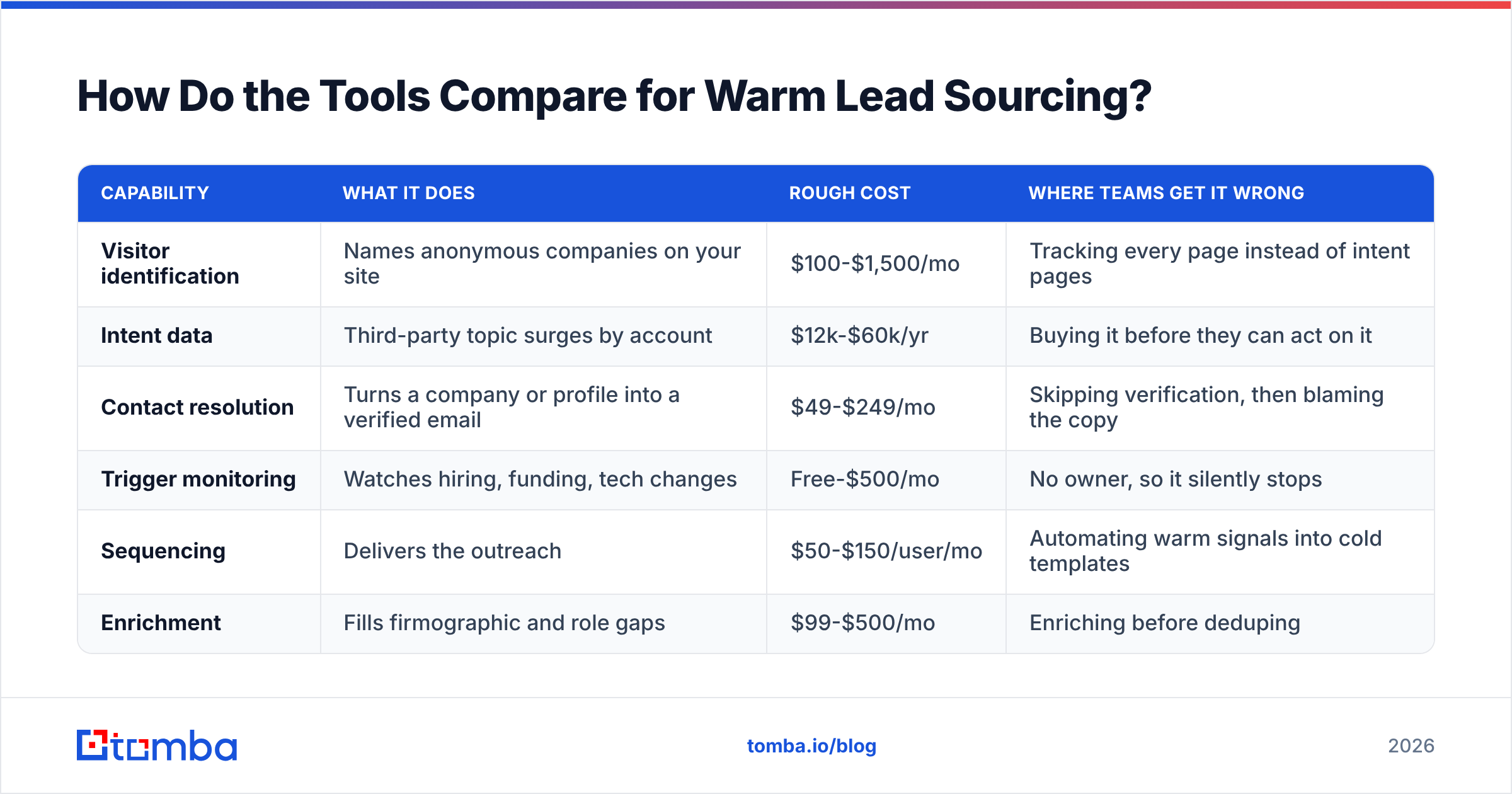
Warm lead work touches three tool categories: signal detection, contact resolution, and outreach. Most teams over-invest in the first and under-invest in the second, then wonder why their reply rates are flat.
| Capability | What it does | Rough cost | Where teams get it wrong |
|---|---|---|---|
| Visitor identification | Names anonymous companies on your site | $100-$1,500/mo | Tracking every page instead of intent pages |
| Intent data | Third-party topic surges by account | $12k-$60k/yr | Buying it before they can act on it |
| Contact resolution | Turns a company or profile into a verified email | $49-$249/mo | Skipping verification, then blaming the copy |
| Trigger monitoring | Watches hiring, funding, tech changes | Free-$500/mo | No owner, so it silently stops |
| Sequencing | Delivers the outreach | $50-$150/user/mo | Automating warm signals into cold templates |
| Enrichment | Fills firmographic and role gaps | $99-$500/mo | Enriching before deduping |
On contact resolution specifically, the market splits between all-in-one platforms (Apollo, ZoomInfo) that bundle a database with sequencing, specialist finders that focus on accuracy and API access, and verification-first vendors. BookYourData is a solid option if you want pay-as-you-go prepaid lists with a verification guarantee rather than a subscription, which suits campaign-based teams. Tomba sits on the finder-plus-verifier side: Tomba pricing runs a free tier at 25 searches a month, Starter at $49/mo, Growth at $99/mo, and Pro at $249/mo, with the same lookups exposed through the Tomba API if you would rather wire resolution into your own trigger workflow than click through a UI.
Whatever you pick, judge it on one thing: what percentage of the warm signals you detect end in a deliverable, correct address. Everything else is secondary. You can read vendor accuracy claims on G2 and cross-check them against your own bounce logs, which is the only benchmark that matters for your list.
What Does a Working Warm Lead System Look Like?#
Put together, here is a system that runs in about four hours a week:
Monday — detection. Pull last week's identified visitors above threshold. Pull trigger events from your monitoring list (new hires in buyer roles, funding, job posts). Pull any closed-lost hitting a 12-month anniversary. Target: 30-60 accounts.
Monday — resolution. For each account, find the two or three right people by title. Verify every address. Anything unverifiable gets dropped, not guessed. Target: 60-120 verified contacts.
Tuesday through Thursday — outreach. Signal-specific first lines, three touches over ten days, multi-channel where the signal is strong. No shared template across signal types.
Friday — accounting. Track reply rate by signal type, not in aggregate. Within a quarter you will know that, say, pricing-page visits reply at 22% and job-posting triggers at 6%, and you will reallocate accordingly.
The measurement discipline is what separates a system from a habit. Blended reply rate tells you nothing actionable. Reply rate segmented by signal tells you exactly which detection method to spend more on next quarter.
Two failure modes to watch. First, treating warm as a volume channel — it is not, and forcing volume dilutes it back into cold. Second, letting the contact data step become a bottleneck that quietly drops warm accounts because nobody had time to look up an email. That second one is the more common death.
Where Should You Start?#
Pick the source where you already have signal and cannot yet act on it. For most teams, that is website traffic — the intent is already arriving, it is just anonymous.
The bottleneck is almost never detection. It is turning "this company is interested" into "here is a verified address for the person who owns this decision." That step is what the Tomba Email Finder exists for: give it a domain and a name, or a domain and a role, and get back a deliverable address with a confidence score and sources. Start on the free tier at 25 searches a month, run it against last week's identified visitors, and see how many warm accounts you were losing to a missing email field.
Related guides#
// get started
Find, verify and enrich your first contacts today
Start on the free plan with 25 searches a month, then scale when your team is ready.
Free plan · No credit card required · GDPR & CCPA
// about the author