How to Handle Sales Rejection: A Rep's Field Guide
Rejection is the default outcome in B2B sales. Here is a concrete, repeatable system for reading no, salvaging the deal, and protecting your pipeline math.
TL;DR
- Most "rejection" in B2B sales is not rejection of you or your product — it is a timing, budget, authority, or trust gap that has a specific fix.
- Build a rejection taxonomy (soft no, hard no, no-decision, ghost) and route each type to a different follow-up sequence instead of treating them all the same.
- A meaningful share of what reps call rejection never reached a human: bad contact data, spam-foldered mail, and wrong-role targeting all look identical to a "no reply."
- Fix the emotional loop with process, not willpower — rejection logs, weekly loss reviews, and activity-based goals beat pep talks.
- The reps who last are the ones who make no cheap: fast disqualification, clean data, and a 90-day re-engagement calendar.
Why does sales rejection hit so hard?#
Because you are paid on outcomes but you experience inputs. You send 60 emails and make 20 calls, and the only feedback loop that arrives the same day is silence or a curt "not interested." The wins arrive weeks later. That asymmetry is why rejection feels heavier than the math says it should.
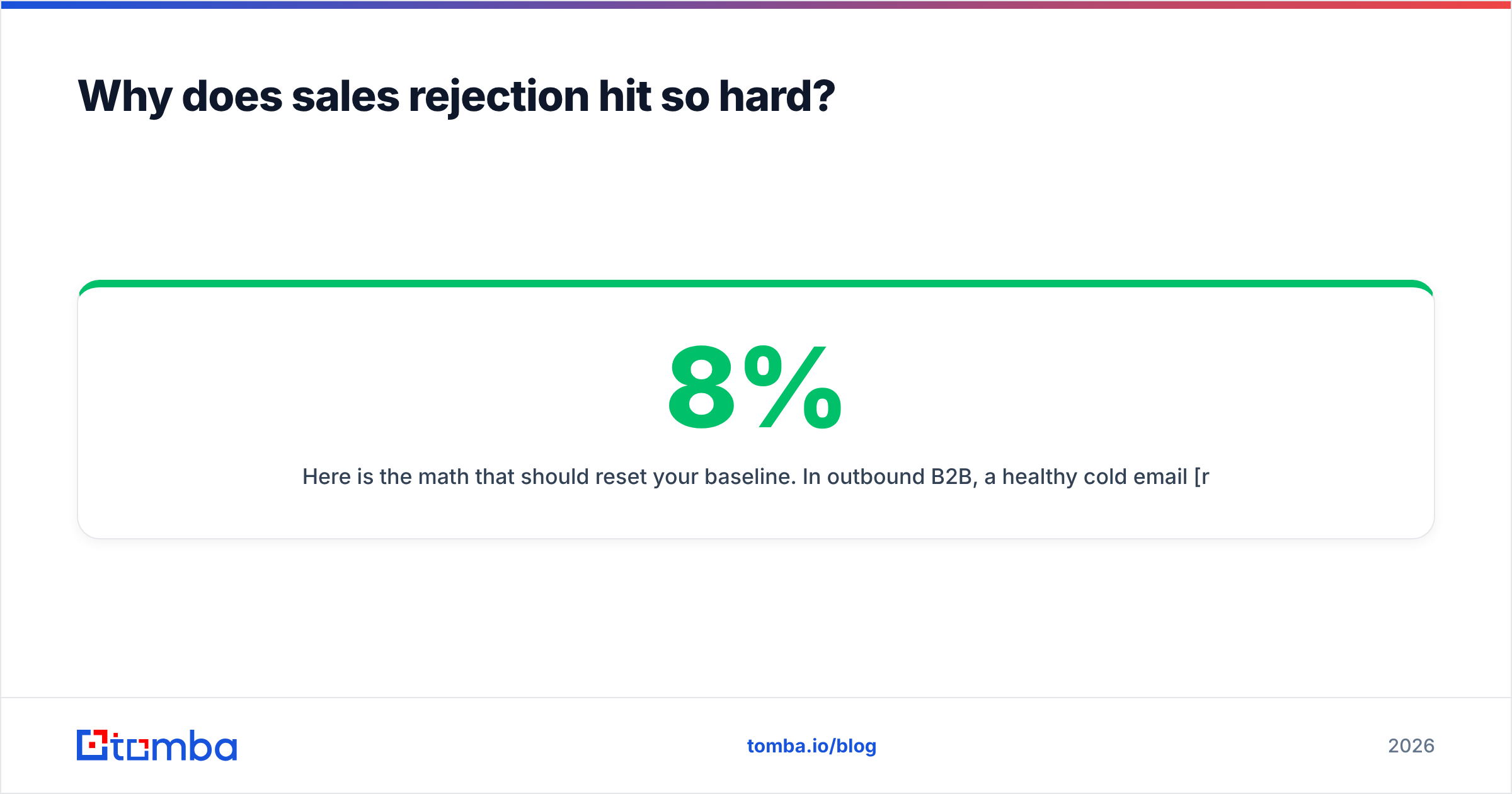
Here is the math that should reset your baseline. In outbound B2B, a healthy cold email response rate sits in the 3-8% range for a well-targeted list, and a positive-reply rate of 1-3% is a good campaign. That means 92 to 97 out of every 100 correctly executed touches produce no. Not "you did it wrong" no — structural no. If your emotional model assumes a 50% hit rate, you will burn out by month four regardless of how good you are.
Rejection is also not one thing. Treating "we already have a vendor," "email address does not exist," and "your pricing is triple our budget" as the same event is what makes it feel personal. They are three completely different signals, and only one of them is even about you.
What are the four types of sales rejection?#
Sort every no you get into one of four buckets before you react to it. The bucket determines the play.
- The soft no (timing). "Circle back in Q3," "we just renewed," "not a priority right now." This is the most common and the most misread. It is not a rejection of value — it is a rejection of the calendar. Roughly half of all closed-lost deals in most CRMs are actually this.
- The hard no (fit). "We are a 12-person shop and you sell to enterprise." "We are legally not allowed to use a US-hosted tool." This is a gift. It is a disqualification you did not have to pay for. Log it, thank them, and remove them from the sequence permanently.
- The no-decision. The deal went to three calls, a demo, a pricing conversation — and then stalled. Nobody said no. According to research popularized by Gartner, a substantial share of B2B deals end in no-decision rather than a competitive loss. This is the most expensive rejection because you already spent the hours.
- The ghost (contact failure). No open, no click, no bounce message you noticed, no reply. This is often not rejection at all. It is a delivery or data failure wearing rejection's coat.
- The competitive loss. They picked someone else. Painful, but it is the only bucket with a clean, actionable postmortem: you know who won and usually roughly why.
Most reps have one follow-up cadence and fire it at all five. That is the core error.
How should you respond to each rejection type?#
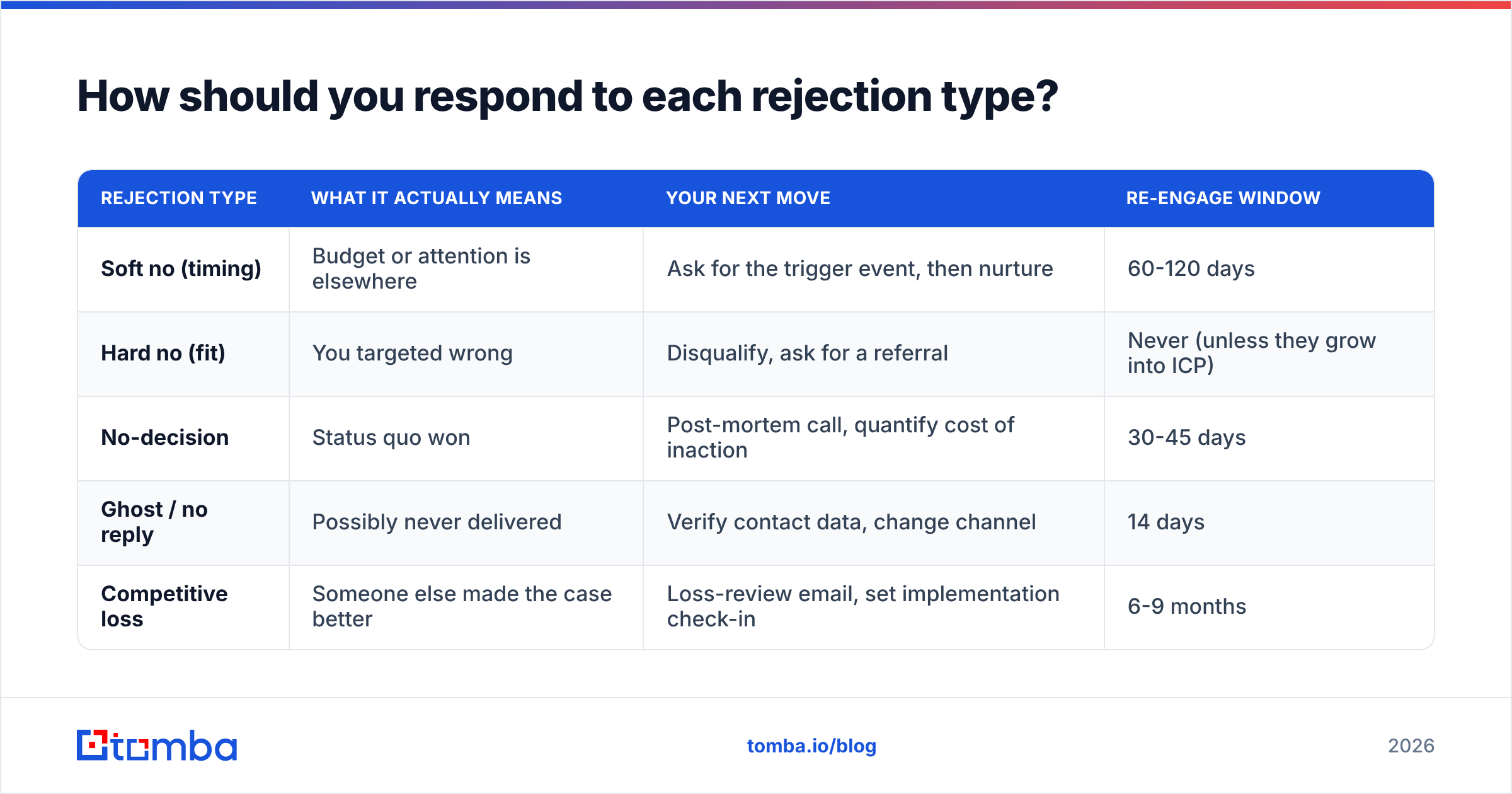
| Rejection type | What it actually means | Your next move | Re-engage window |
|---|---|---|---|
| Soft no (timing) | Budget or attention is elsewhere | Ask for the trigger event, then nurture | 60-120 days |
| Hard no (fit) | You targeted wrong | Disqualify, ask for a referral | Never (unless they grow into ICP) |
| No-decision | Status quo won | Post-mortem call, quantify cost of inaction | 30-45 days |
| Ghost / no reply | Possibly never delivered | Verify contact data, change channel | 14 days |
| Competitive loss | Someone else made the case better | Loss-review email, set implementation check-in | 6-9 months |
The re-engage window column is the part reps skip. A no with no date attached is just a deleted record. A no with a date is a scheduled pipeline entry.
Two scripts worth stealing:
For the soft no: "Totally fair. So I stop guessing — what would have to be true for this to become a priority? A budget cycle, a headcount change, a specific number moving?" You are asking for the trigger, not the meeting. Reps who capture the trigger convert re-engagement at multiples of those who just set a 90-day task.
For the no-decision: "I would rather get a clean no than a slow maybe. Is this a not-now, or is it a not-us? Either answer is genuinely useful to me." Giving the buyer explicit permission to reject you is the fastest way to unstick a stalled deal — and it recovers your time either way.
Is your rejection actually a data problem?#
This is the question almost nobody asks, and it is where a surprising amount of "rejection" evaporates.
A no-reply outcome has at least six possible causes, and only one of them is a real no:
- The address never existed. Guessed patterns like first.last@ fail on a meaningful share of domains that use flast@ or first@.
- The person left the company. B2B contact data decays at roughly 25-30% per year — that is the widely cited industry figure, and it compounds.
- You hit a catch-all domain. The server accepts everything, so your verifier said "risky," you sent anyway, and it landed in a black hole.
- You hit the spam folder. Perfect targeting, perfect copy, zero delivery. Your sender reputation did the rejecting, not the buyer.
- Wrong role. You emailed a manager who has no budget authority and no incentive to reply.
- They genuinely are not interested. The real one.
Run this diagnostic before you conclude your messaging is broken. Pull 100 no-reply records from last quarter and re-verify the addresses. If more than 10-15% come back invalid or risky, your rejection rate is inflated by data rot, not by your pitch. Use an email verifier on the batch, and run the ambiguous ones through a catch-all verifier rather than guessing.
Then check the other end of the pipe. If deliverability is the suspect, a spam checker and an SPF/DKIM review will tell you more in ten minutes than a week of rewriting subject lines will.
How do you build a rejection log that actually changes behavior?#
Feelings are not data. A rejection log turns a demoralizing stream of noes into a diagnosable pattern. Keep it stupid-simple — five columns, filled in within 24 hours of the loss:
- Account and contact role — so you can spot whether you are consistently losing to the same title.
- Stage lost — first touch, discovery, demo, proposal, procurement. Losses cluster, and the cluster tells you which skill to fix.
- Stated reason — verbatim, in their words, not your paraphrase.
- Suspected real reason — your honest read. These two columns diverging is the single most useful signal in the whole log.
- Re-engage date and trigger — the specific event that makes this worth reopening.
Review it weekly, alone, for fifteen minutes, and monthly with your manager. What you are hunting for is concentration. If 60% of your losses happen at the pricing conversation, that is a discovery problem — you did not establish enough value earlier, and no amount of resilience training fixes it. If 60% happen at first touch, it is a targeting or data problem, and the fix lives in your list build, not your mindset.
One rule: the log records losses, not self-criticism. "Rambled on the demo, lost the room at minute 12" is a log entry. "I am bad at demos" is not.
How do you stay motivated without pretending rejection is fine?#
Skip the "rejection is a gift" posturing. It is not a gift; it is the cost of doing the job. What actually works is changing what you measure and what you control.
Set activity goals, not outcome goals, at the daily level. You control 40 quality touches a day. You do not control whether three of them convert. Grade yourself daily on the input, weekly on the pipeline, monthly on the revenue. Reps who grade themselves daily on revenue quit.
Decide your rejection budget in advance. If your model says you need 200 touches to book 8 meetings, then 192 noes is not failure — it is the plan executing correctly. Writing that number on a sticky note sounds silly and works anyway.
Separate the person from the process, out loud. "This buyer's procurement cycle rejected this proposal at this price" is accurate. "They rejected me" is not, and the second version is the one that costs you your fifth call of the day.
Compress the feedback loop. The reason rejection hurts is delay. Shorten it with same-day micro-wins: a clean discovery call, a referral collected, a stalled account finally giving you a firm no. Track those.
Protect the first hour. Do your hardest prospecting when your resilience is highest. Nobody has good judgment about a no at 4:45pm on a Thursday.
For a broader framing on managing the emotional side of quota-carrying roles, HubSpot's sales blog has consistently practical material on rep burnout and cadence design.
Can better prospecting reduce rejection in the first place?#
Yes — and this is the highest-leverage lever, because it is upstream of everything else. Rejection volume is mostly a function of list quality, not of persuasion skill.
Three concrete changes that reduce the raw number of noes you have to absorb:
- Tighten ICP before you tighten copy. Pull your last 20 closed-won accounts and find the three attributes they share — headcount band, tech stack, funding stage, whatever. Then build lists that only include those. Fewer prospects, fewer rejections, higher hit rate. A website tech stack checker is a fast way to filter on the technographic attribute.
- Verify before you send, always. Every invalid address is a guaranteed no that also damages your sending domain. Bulk-verify at the list level, not after the bounces roll in. Tomba's bulk email finder handles list-level find-and-verify in one pass.
- Target the role with budget. Use domain search to see the full org chart of email patterns at an account, then pick the person who owns the problem and the budget — not whoever was easiest to find on LinkedIn.
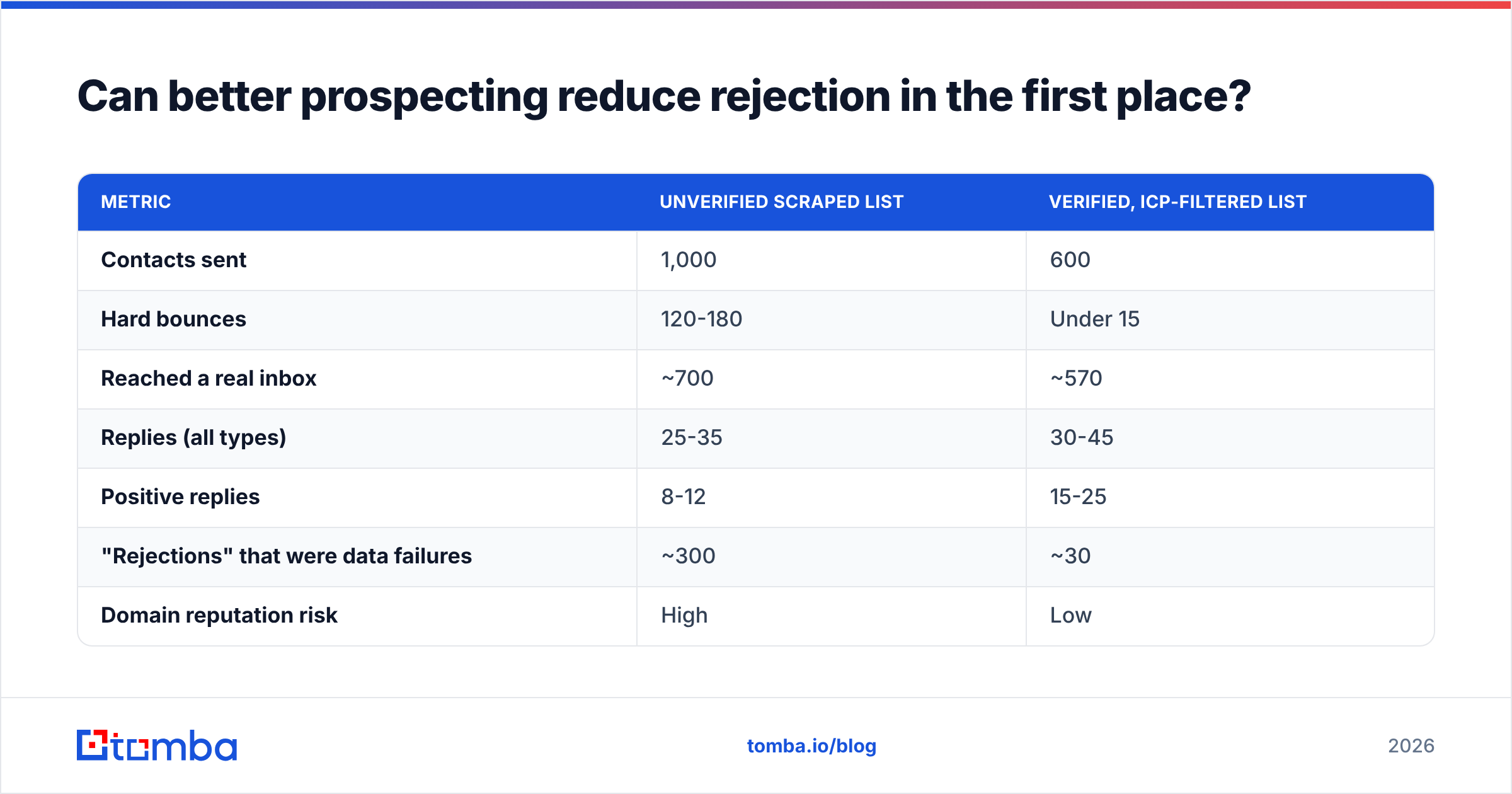
Here is what the two approaches cost in practice on a 1,000-contact outbound month:
| Metric | Unverified scraped list | Verified, ICP-filtered list |
|---|---|---|
| Contacts sent | 1,000 | 600 |
| Hard bounces | 120-180 | Under 15 |
| Reached a real inbox | ~700 | ~570 |
| Replies (all types) | 25-35 | 30-45 |
| Positive replies | 8-12 | 15-25 |
| "Rejections" that were data failures | ~300 | ~30 |
| Domain reputation risk | High | Low |
The second column sends 40% fewer emails and produces more meetings. It also produces far fewer of the ambiguous, morale-draining noes that were never really noes.
What tools help you handle rejection systematically?#
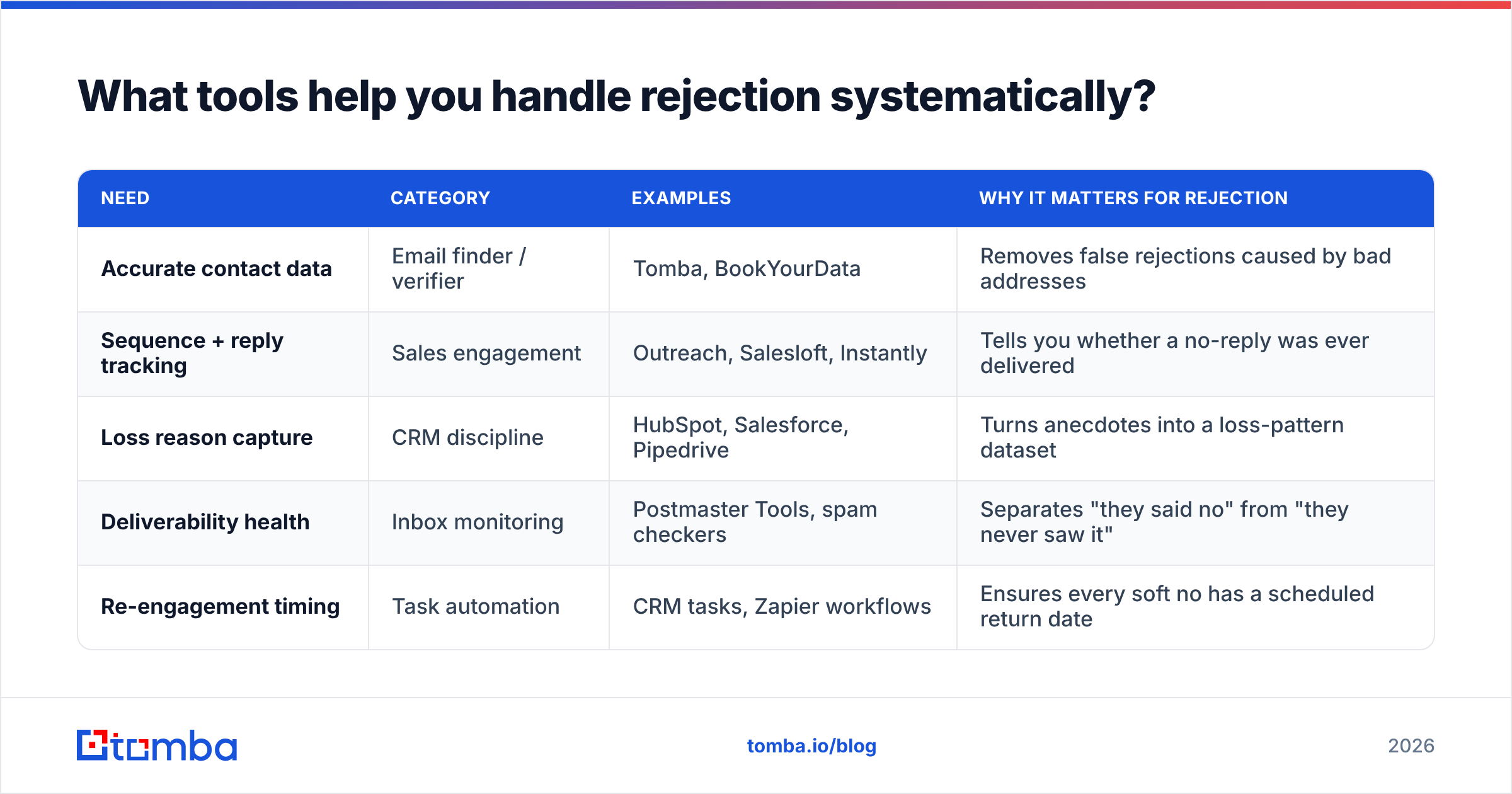
Rejection management is half process, half tooling. Here is how the categories line up.
| Need | Category | Examples | Why it matters for rejection |
|---|---|---|---|
| Accurate contact data | Email finder / verifier | Tomba, BookYourData | Removes false rejections caused by bad addresses |
| Sequence + reply tracking | Sales engagement | Outreach, Salesloft, Instantly | Tells you whether a no-reply was ever delivered |
| Loss reason capture | CRM discipline | HubSpot, Salesforce, Pipedrive | Turns anecdotes into a loss-pattern dataset |
| Deliverability health | Inbox monitoring | Postmaster Tools, spam checkers | Separates "they said no" from "they never saw it" |
| Re-engagement timing | Task automation | CRM tasks, Zapier workflows | Ensures every soft no has a scheduled return date |
Two honest notes. First, no tool fixes a targeting problem — if you sell to the wrong companies, better data just gets you rejected faster. Second, contact-data vendors differ mostly in coverage by region and by company size, not in headline accuracy claims. BookYourData, for instance, is strong on pre-built, verified list purchase when you want volume without running your own enrichment pipeline; Tomba leans toward on-demand, per-domain discovery and verification with a usable free tier and an API for teams that want to build the workflow into their own stack. Both are defensible depending on whether you want a list handed to you or want to build it continuously.
If you are evaluating on cost, Tomba pricing starts with a free tier at 25 searches per month, then Starter at $49/mo, Growth at $99/mo, and Pro at $249/mo, with custom enterprise terms above that. Check independent reviews on G2 before committing to any vendor in this category — coverage claims vary a lot by vertical.
What should you do in the first 48 hours after a big loss?#
A structured 48-hour protocol beats stewing. Run these five steps in order:
- Send the gracious close within 4 hours. Short, no guilt, no last-ditch discount. "Appreciate you running a fair process. If the rollout hits friction in month three, my line is open." You are buying an option on the competitive loss re-entry.
- Ask for the loss review within 24 hours. "Would you give me ten minutes to understand what tipped it? I am not going to pitch you." Roughly a third of buyers say yes, and their answer is worth more than any internal debrief.
- Log it the same day. Stated reason and suspected reason, both columns.
- Set the re-engage date. For a competitive loss, 6-9 months out — right when the honeymoon with the new vendor ends and renewal anxiety starts.
- Get one small win before end of day. A booked meeting, a referral, a clean disqualification. The point is to close the emotional loop with something you controlled.
Then stop thinking about it. The loss review captured what was learnable; rumination past that point costs you the next three calls.
Where do you go from here?#
Rejection stops being a morale problem the moment it becomes a measurement problem. Sort your noes into types. Attach a date and a trigger to every soft one. Re-verify your no-reply pile before you blame your pitch. Grade yourself on the inputs you control and let the outcome math do its work over the quarter, not the day.
And fix the upstream cause first. If a meaningful chunk of your rejection is really bounced mail and wrong-role targeting, no amount of resilience training will move your number — clean data will. Start with the Tomba Email Finder to build lists where every contact is real, verified, and actually holds the budget you are asking about. Free tier is 25 searches a month, which is enough to audit your last quarter's no-reply list and find out how many of those rejections were never rejections at all.
Related guides#
// get started
Find, verify and enrich your first contacts today
Start on the free plan with 25 searches a month, then scale when your team is ready.
Free plan · No credit card required · GDPR & CCPA
Get the Tomba newsletter
Product and data updates
// about the author