How to Identify Buying Signals in 2026: A Practical Guide
Most reps chase accounts that were never in-market. Here is how to identify buying signals across job posts, tech changes, product usage, and intent data — and the 48-hour playbook for acting on them.
TL;DR
- A buying signal is any observable event that shifts an account from "someday" to "now." Most teams confuse fit signals (company size, industry) with timing signals — only timing signals predict a reply this quarter.
- The highest-yield signals in 2026 are hiring posts, funding events, tech-stack changes, leadership hires, and first-party site behavior. Third-party intent data ranks lower than vendors claim.
- Signals decay fast. A job post is worth roughly 10x more in week one than in week six, so your capture-to-outreach loop matters more than your signal source.
- A signal is worthless without a contact. Roughly half of all "signal-based" programs stall because nobody can find a verified email for the person the signal points to.
- Build the stack in this order: capture → qualify → resolve contact → send within 48 hours. Skip any step and you're back to spray-and-pray with extra software.
What is a buying signal, exactly?#
A buying signal is a piece of observable evidence that an account's status quo just changed in a way that creates a problem you solve.
Think of it like a leaking roof. A homeowner who has had the same roof for 15 years is a good fit for a roofer — but the one who just had water come through the ceiling is a buyer. Same house, same roof, completely different conversation. Fit tells you who could buy. Signals tell you who is about to.
That distinction gets lost constantly. Your ICP filter (200-500 employees, SaaS, US) is fit. It does not move. A signal moves — it appears, it peaks, and it disappears, usually within 30 to 60 days. Every serious outbound program in 2026 is built on the second thing, not the first.
Three properties separate a real buying signal from noise:
- It is observable from outside the account. If you need a customer to tell you, it's not a prospecting signal — it's discovery.
- It implies urgency or budget. "They exist" is not a signal. "They just posted three RevOps roles" is.
- It points at a person. A company-level signal you can't route to a named human is a report, not a play.

Which buying signals actually predict revenue?#
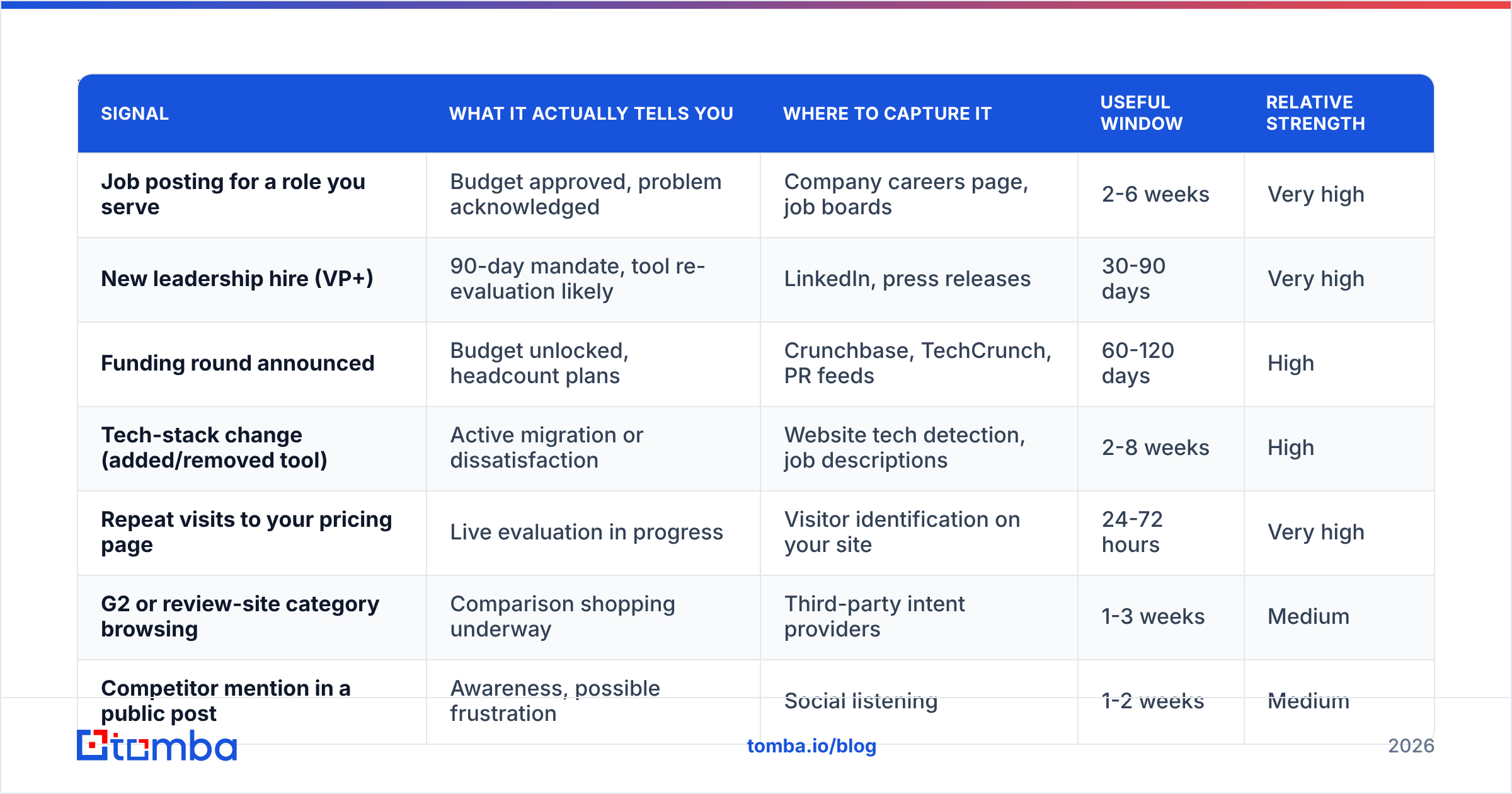
Not all signals are equal, and the gap between the best and worst is enormous. Here's the honest ranking based on how most B2B teams report signal-to-meeting conversion:
| Signal | What it actually tells you | Where to capture it | Useful window | Relative strength |
|---|---|---|---|---|
| Job posting for a role you serve | Budget approved, problem acknowledged | Company careers page, job boards | 2-6 weeks | Very high |
| New leadership hire (VP+) | 90-day mandate, tool re-evaluation likely | LinkedIn, press releases | 30-90 days | Very high |
| Funding round announced | Budget unlocked, headcount plans | Crunchbase, TechCrunch, PR feeds | 60-120 days | High |
| Tech-stack change (added/removed tool) | Active migration or dissatisfaction | Website tech detection, job descriptions | 2-8 weeks | High |
| Repeat visits to your pricing page | Live evaluation in progress | Visitor identification on your site | 24-72 hours | Very high |
| G2 or review-site category browsing | Comparison shopping underway | Third-party intent providers | 1-3 weeks | Medium |
| Competitor mention in a public post | Awareness, possible frustration | Social listening | 1-2 weeks | Medium |
| Content download / webinar attendance | Interest, not necessarily authority | Your MAP | 1-2 weeks | Medium-low |
| Generic "surging" third-party intent | Someone at the company googled something | Intent vendors | Unclear | Low |
Two things stand out. First, first-party signals beat third-party signals almost every time. Someone hitting your pricing page three times in two days is a stronger indicator than an anonymized IP-level intent score. Second, the strongest signals are free. Job posts and leadership announcements are public. You do not need a $30,000 platform to see them — you need a process for reading them consistently.
Gartner's research on the B2B buying journey has been making the same point for years: buyers spend the overwhelming majority of the cycle doing independent research. By the time they raise a hand, most of the evaluation has already happened. Signals are how you show up before the hand goes up.
How do you identify buying signals step by step?#
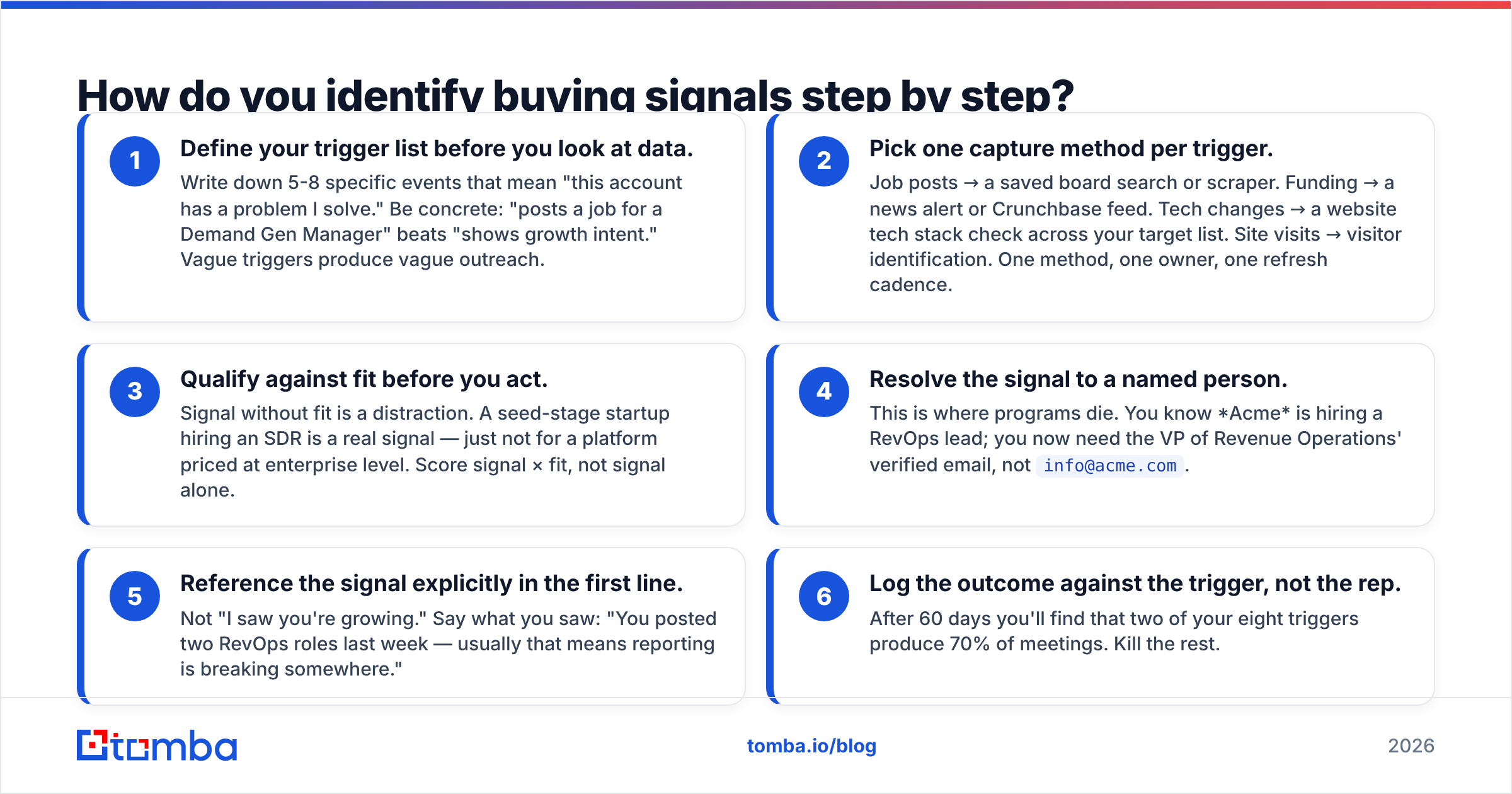
Here's the operational loop. It has four stages, and most teams do stage one well and the other three badly.
- Define your trigger list before you look at data. Write down 5-8 specific events that mean "this account has a problem I solve." Be concrete: "posts a job for a Demand Gen Manager" beats "shows growth intent." Vague triggers produce vague outreach.
- Pick one capture method per trigger. Job posts → a saved board search or scraper. Funding → a news alert or Crunchbase feed. Tech changes → a website tech stack check across your target list. Site visits → visitor identification. One method, one owner, one refresh cadence.
- Qualify against fit before you act. Signal without fit is a distraction. A seed-stage startup hiring an SDR is a real signal — just not for a platform priced at enterprise level. Score signal × fit, not signal alone.
- Resolve the signal to a named person. This is where programs die. You know Acme is hiring a RevOps lead; you now need the VP of Revenue Operations' verified email, not
info@acme.com. - Reference the signal explicitly in the first line. Not "I saw you're growing." Say what you saw: "You posted two RevOps roles last week — usually that means reporting is breaking somewhere."
- Log the outcome against the trigger, not the rep. After 60 days you'll find that two of your eight triggers produce 70% of meetings. Kill the rest.
That fourth step deserves emphasis. A buying signal is an address without a name on the mailbox. Turning "this company is in-market" into "this person, this inbox, this week" is the entire difference between a signal program that books meetings and one that produces a nice dashboard. Tools like data enrichment and a domain search exist precisely to close that gap — you feed in the company the signal came from, and you get back the people who own the problem.
What tools do you need to capture buying signals?#
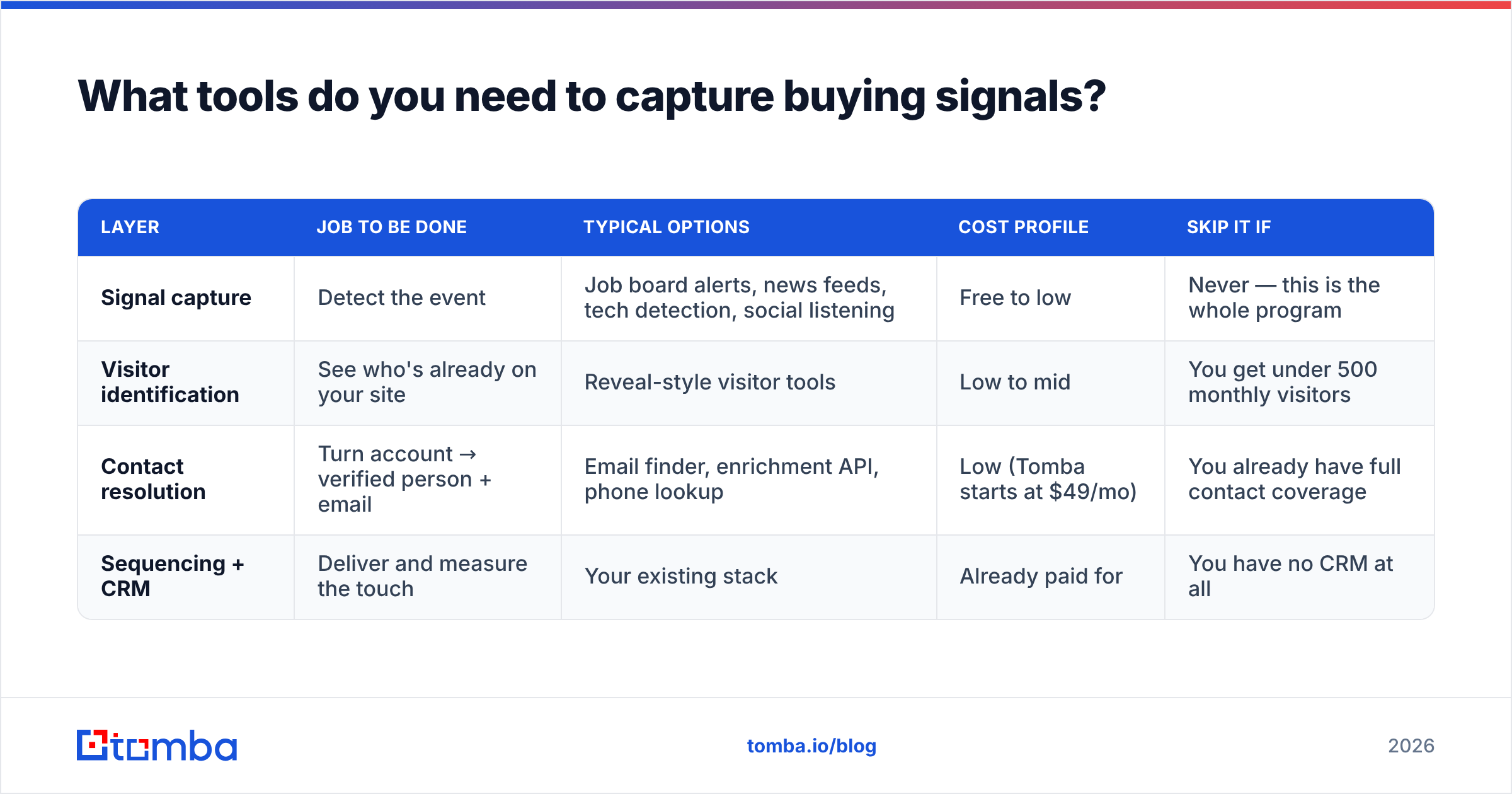
You need four layers, and you can build the first version of this for under $200 a month. Here's how the layers compare:
| Layer | Job to be done | Typical options | Cost profile | Skip it if |
|---|---|---|---|---|
| Signal capture | Detect the event | Job board alerts, news feeds, tech detection, social listening | Free to low | Never — this is the whole program |
| Visitor identification | See who's already on your site | Reveal-style visitor tools | Low to mid | You get under 500 monthly visitors |
| Contact resolution | Turn account → verified person + email | Email finder, enrichment API, phone lookup | Low (Tomba starts at $49/mo) | You already have full contact coverage |
| Sequencing + CRM | Deliver and measure the touch | Your existing stack | Already paid for | You have no CRM at all |
A note on cost discipline: the contact-resolution layer is where teams overspend. Large all-in-one platforms bundle a mediocre database with a sequencer and charge enterprise money for both. Specialist providers do one job better. Tomba pricing starts free at 25 searches a month, moves to $49/mo Starter, $99/mo Growth, and $249/mo Pro — which means you can test a signal program on real contacts before committing to an annual platform contract. BookYourData is a solid option too if you'd rather buy pre-built lists by title and geography instead of resolving contacts account-by-account; the two approaches complement each other more than they compete.
For site-side signals, a website visitor reveal tool answers a question no third-party intent vendor can: which companies are already reading your pricing page right now. That's the shortest path from signal to meeting in the entire stack, and most teams ignore it because it's unglamorous.
Are third-party intent signals worth paying for?#
Sometimes — but with sharper expectations than the category markets.
Third-party intent works by tracking anonymized research behavior across a publisher network and reporting when an account's activity "surges" for a topic. The mechanic is real. The problems are practical:
- Resolution is coarse. You usually get a company and a topic, not a person and a need. At a 3,000-person company, "surging on CRM" tells you almost nothing actionable.
- Latency is real. Data is often aggregated weekly. Your signal is already stale by the time you see it.
- Everyone gets the same list. If four vendors buy the same intent feed, the in-market account gets four near-identical emails in the same week. Your differentiation evaporates.
- Attribution is murky. Teams routinely credit intent data for meetings that a rep would have booked anyway from a job post they read that morning.
Where it earns its keep: large target-account lists where you genuinely cannot monitor every account manually, and enterprise motions where a broad "this account is awake" hint helps prioritize an existing named-account list. If you have 200 accounts and two reps, skip it. Read the job boards instead.
Public review platforms occupy a middle ground worth knowing about. Buyer activity on sites like G2 is closer to a bottom-funnel signal than generic topic surging, because someone comparing two vendors in your category is, by definition, evaluating. It's still account-level, so you still need contact resolution — but the intent is far less ambiguous.
How do you act on a buying signal without sounding creepy?#
There's a line between "I noticed your job post" and "I noticed you visited page 4 of our pricing page at 9:42pm." Cross it and you kill the deal.
The rule: reference only what a well-informed stranger could plausibly have seen. Public job posts, funding announcements, LinkedIn hires, conference talks, and product launches are all fair game. Individual browsing behavior is not — use it to prioritize and time your outreach, never to open with it.
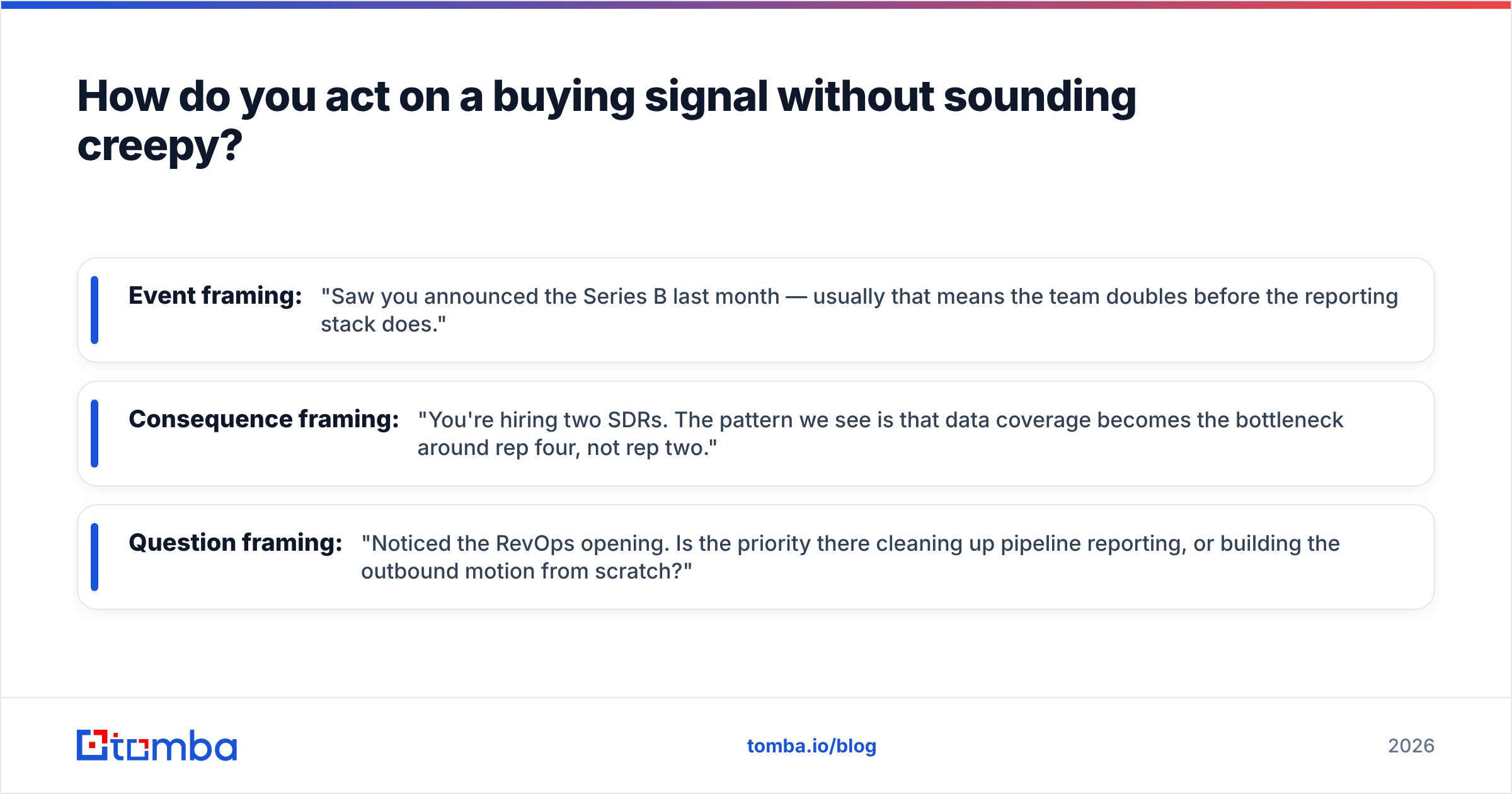
Three openers that work, in ascending order of specificity:
- Event framing: "Saw you announced the Series B last month — usually that means the team doubles before the reporting stack does."
- Consequence framing: "You're hiring two SDRs. The pattern we see is that data coverage becomes the bottleneck around rep four, not rep two."
- Question framing: "Noticed the RevOps opening. Is the priority there cleaning up pipeline reporting, or building the outbound motion from scratch?"
All three cite something public, connect it to a problem, and leave room for the prospect to correct you. None of them mention that you've been watching. Speed matters as much as wording: signal-triggered emails sent within 48 hours consistently outperform the same message sent two weeks later, largely because you arrive before the account has shortlisted anyone. If you want the mechanics of what a strong reply rate looks like once you're timing things properly, the fundamentals of email response rate benchmarking are a good baseline to measure against.
One more discipline: verify before you send. Signal-based outreach is high-value and low-volume, which means bounces hurt disproportionately — you burn both sender reputation and your one shot at a genuinely in-market account. Run every signal-sourced address through an email verifier before it enters a sequence. HubSpot's sales resources cover the deliverability side of this well if you want to go deeper on the hygiene piece.
What does a working signal program look like after 90 days?#
Here's the realistic maturity path, based on how most teams actually get there:
- Days 1-30 — one trigger, done manually. Pick your single strongest signal (usually job posts). One rep checks it every Monday, resolves contacts, sends 20 emails. Track reply rate against your baseline cold list.
- Days 31-60 — add contact resolution automation. Feed the signal list into an email finder API so account names become verified contacts without manual lookup. This is usually where volume triples with no extra headcount.
- Days 61-90 — add a second trigger and start pruning. Layer in funding or tech-stack changes. Compare per-trigger conversion. Kill anything below your cold baseline — some triggers genuinely underperform, and that's useful information.
- Ongoing — instrument the decay. Measure days-from-signal-to-first-touch. If that number climbs above five, fix the pipeline before you add another data source.
The teams that win at this aren't the ones with the most exotic signals. They're the ones whose loop from "event happened" to "email landed" takes two days instead of two weeks. Signal quality is a data problem. Signal speed is an operations problem — and it's the one that actually compounds.
Where should you start this week?#
Start with the cheapest signal you're currently ignoring. For most B2B teams that's job postings, because they're free, public, and directly encode budget approval. Pull 50 accounts from your ICP, check which ones posted a relevant role in the last 21 days, and work only those.
Then close the gap between the signal and the inbox. That's the step where good intent programs quietly fall apart — you know the account is in-market, you know the title you need, and you still can't reach the person. Run those accounts through the Tomba Email Finder to turn a company and a role into a verified, deliverable contact in seconds, and start on the free tier's 25 searches before you spend anything. If the reply rate on those 50 signal-sourced emails beats your standard list — and it usually does by a wide margin — you've just found the highest-leverage change available to your outbound team this quarter.
Related guides#
// get started
Find, verify and enrich your first contacts today
Start on the free plan with 25 searches a month, then scale when your team is ready.
Free plan · No credit card required · GDPR & CCPA
Get the Tomba newsletter
Product and data updates
// about the author