How to Increase Sales in 2026: 9 Tactics That Actually Work
Most sales advice is vague. This is the concrete version: nine tactics with the math behind each one, a pipeline audit you can run today, and where tooling actually moves the number.
TL;DR
- There are only four levers that move revenue: more qualified conversations, higher win rate, bigger deals, and faster cycles. Everything else is a tactic hanging off one of those.
- Adding volume to a broken funnel is the most expensive mistake in B2B. Fix conversion first — it is usually cheaper and faster.
- Bad contact data quietly taxes every other improvement. If 25% of your outbound bounces, you lose a quarter of every dollar spent on copy, sequencing, and rep time.
- The fastest wins for most teams in 2026: tighten your ICP, clean your list, add a second and third follow-up touch, and stop discounting to close.
- Run the 30-minute pipeline audit at the end of this post before you buy another tool.
What does "increase sales" actually mean in practice?#
Revenue is not a mystery. It decomposes into four variables, and every tactic you have ever read about attaches to one of them.
Revenue = (number of qualified conversations) × (win rate) × (average deal size) ÷ (sales cycle length, as a velocity factor)
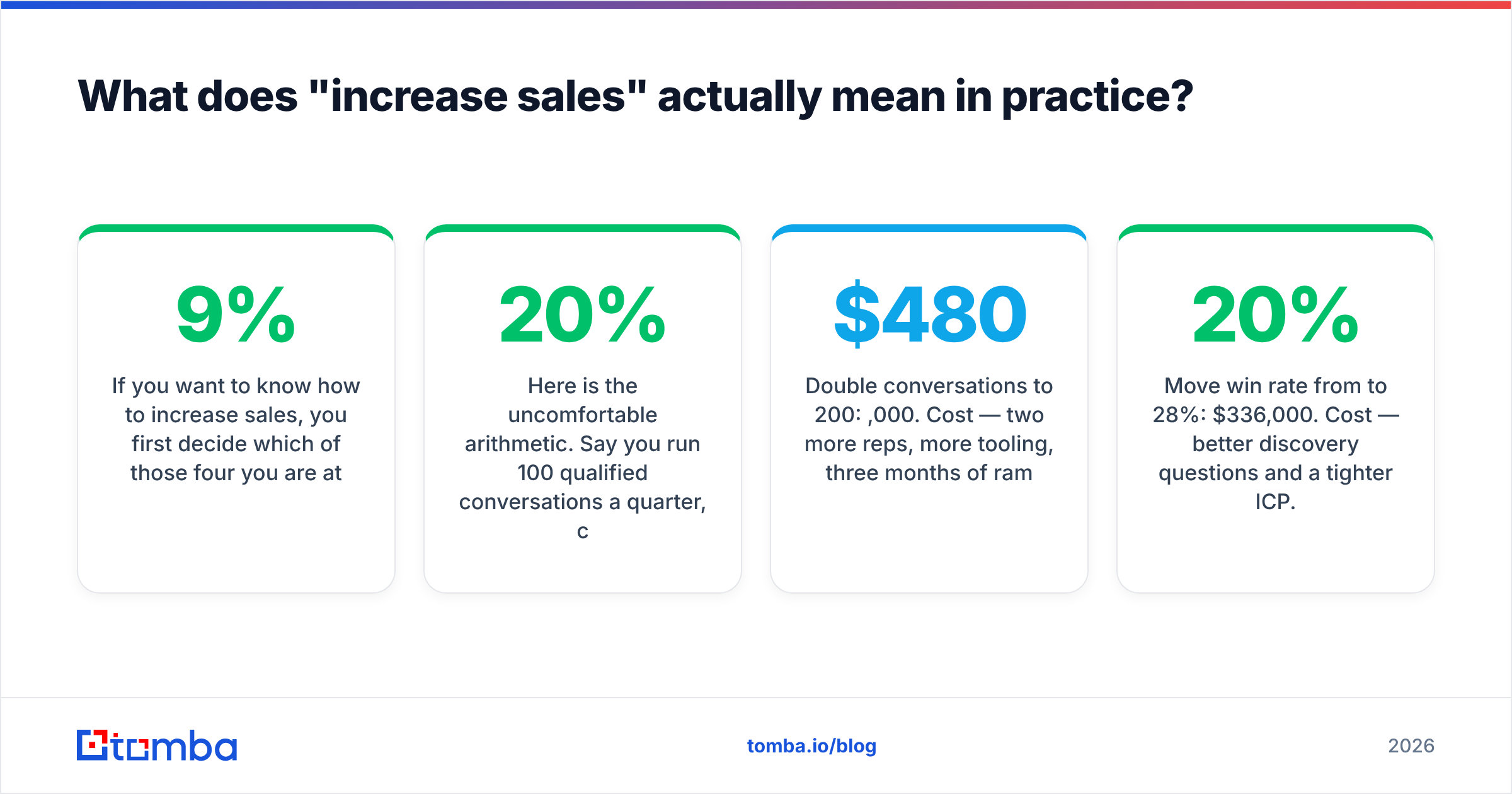
If you want to know how to increase sales, you first decide which of those four you are attacking. Teams that skip this step buy a sequencer when their problem was targeting, or hire two SDRs when their problem was a 9% win rate on inbound demos.
Here is the uncomfortable arithmetic. Say you run 100 qualified conversations a quarter, close 20%, at $12,000 average contract value. That is $240,000. Now:
- Double conversations to 200: $480,000. Cost — two more reps, more tooling, three months of ramp.
- Move win rate from 20% to 28%: $336,000. Cost — better discovery questions and a tighter ICP. Roughly zero dollars.
- Raise ACV from $12,000 to $15,000: $300,000. Cost — a packaging change and the nerve to stop discounting.
The volume lever looks biggest because it is the one you can buy. It is almost never the cheapest. Start with the levers that cost time and judgment rather than headcount.
Which lever should you pull first?#
Use this ranking. It is ordered by payback speed for a typical B2B team doing between $500K and $10M ARR.
- Fix your ICP definition. Pull your last 20 closed-won deals and your last 20 closed-lost. Look for the attributes that actually separate them — company size, tech stack, trigger event, who signed. Most teams discover their real ICP is narrower than their stated one. Narrowing it lifts win rate and shortens cycles at the same time.
- Clean and verify your contact data. Every bounced email is wasted rep time plus deliverability damage that suppresses your good sends too. This is the highest-leverage boring task in sales.
- Add follow-up touches. Most reps stop at two. The majority of positive replies in cold outbound arrive on touch three through six. Adding four touches to an existing sequence costs nothing and typically lifts reply volume meaningfully.
- Rebuild discovery. Win rate is decided in the first call, not the last. If your reps cannot articulate the prospect's cost of inaction in dollars, you are heading for a "no decision" close.
- Kill discounting as a closing tool. Discount to close and you train the market to wait for the discount. Trade concessions instead — longer term, case study rights, faster payment.
- Then, and only then, add volume. More leads into a fixed funnel is a multiplier on whatever conversion rate you already have. Multiply a bad number and you get a bigger bad number.
Why does data quality gate every other tactic?#
Because bad data multiplies against everything downstream. Consider two teams running identical sequences to identical ICPs.
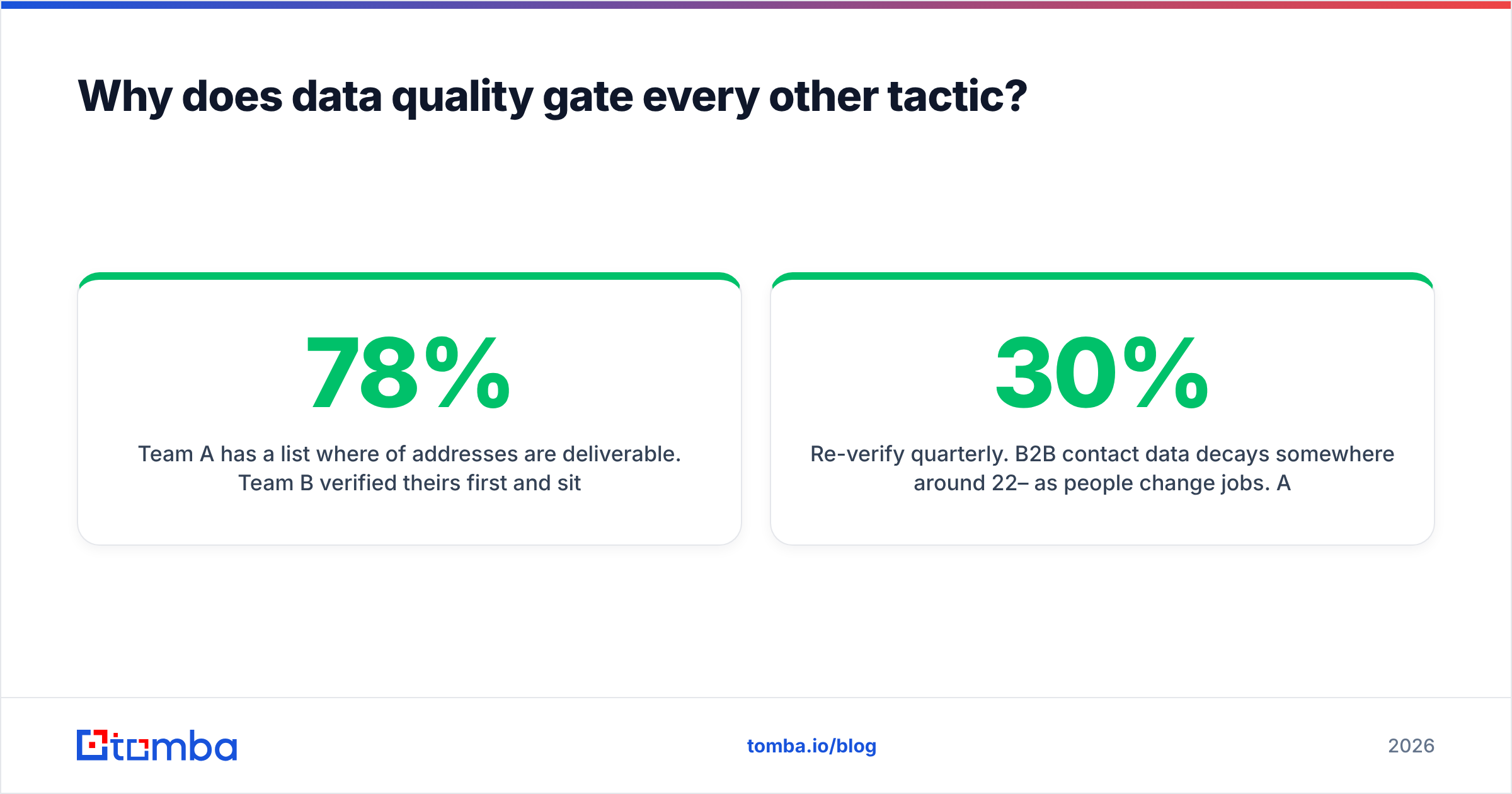
Team A has a list where 78% of addresses are deliverable. Team B verified theirs first and sits at 96%. Both send 5,000 emails. Team A lands 3,900 in an inbox, Team B lands 4,800. That gap alone is worth roughly 23% more pipeline — before you account for the second-order damage: a high bounce rate drags down sender reputation, and mailbox providers then start routing your good messages to spam. The penalty compounds.
This is why email deliverability belongs in a sales post and not just a marketing one. Your reply rate is a function of how many messages a human actually sees, not how many you sent.
Practical sequence:
- Define the account list first, then find contacts — not the reverse. Use domain search to pull every published address at a target company, then filter by role.
- Verify before sending. Run the list through an email verifier and drop anything flagged invalid. Handle catch-all domains separately; they need a catch-all verifier rather than a standard SMTP check.
- Re-verify quarterly. B2B contact data decays somewhere around 22–30% per year as people change jobs. A list you bought in January is measurably worse by June.
- Enrich what survives. Job title, seniority, and headcount let you personalize at the segment level instead of the individual one, which is the only way personalization scales past a few hundred prospects.

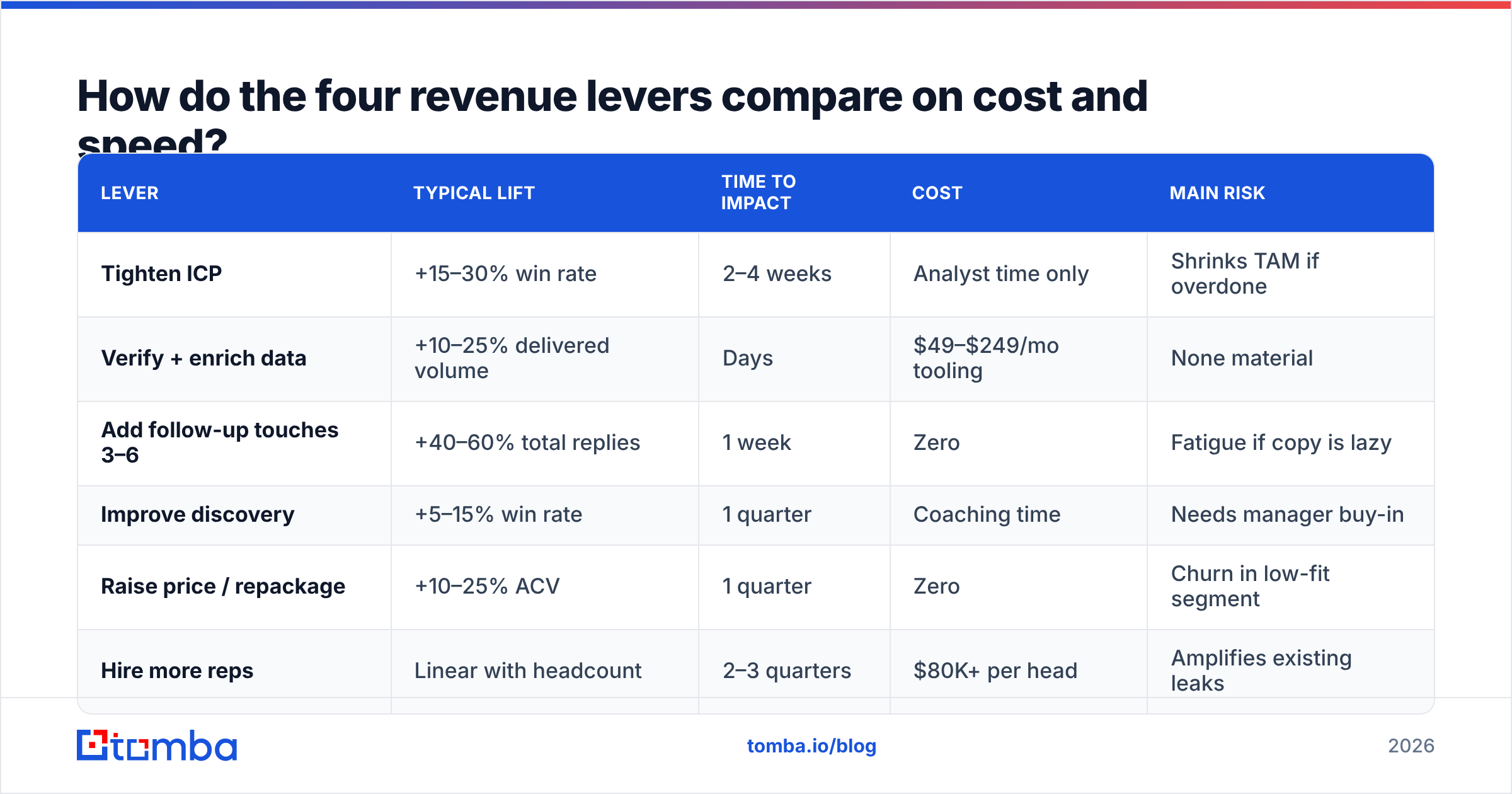
How do the four revenue levers compare on cost and speed?#
| Lever | Typical lift | Time to impact | Cost | Main risk |
|---|---|---|---|---|
| Tighten ICP | +15–30% win rate | 2–4 weeks | Analyst time only | Shrinks TAM if overdone |
| Verify + enrich data | +10–25% delivered volume | Days | $49–$249/mo tooling | None material |
| Add follow-up touches 3–6 | +40–60% total replies | 1 week | Zero | Fatigue if copy is lazy |
| Improve discovery | +5–15% win rate | 1 quarter | Coaching time | Needs manager buy-in |
| Raise price / repackage | +10–25% ACV | 1 quarter | Zero | Churn in low-fit segment |
| Hire more reps | Linear with headcount | 2–3 quarters | $80K+ per head | Amplifies existing leaks |
Read that table as a priority list, not a menu. The top four rows are cheap and fast. The bottom row is expensive and slow — and it is the one most teams reach for first when the board asks how to increase sales next quarter.
What does a high-converting outbound motion look like in 2026?#
The mechanics have shifted. Reply rates on generic cold email have fallen as volume rose and inbox filtering tightened. What still works is narrower and more deliberate.
Segment lists to 50–200 accounts. Below 50 you cannot learn anything statistically. Above 200 you cannot personalize meaningfully. Build one segment around a single shared trigger — new funding, a job posting for a role your product supports, a specific technology in their stack.
Lead with the trigger, not your product. "Saw you're hiring three RevOps analysts" beats "we help companies like yours." The first proves you looked. The second proves you have a mail merge.
Keep the first email under 90 words. One observation, one claim, one question. No attachments, no images, no calendar link in email one.
Sequence across channels. Email, then LinkedIn, then phone, then email again. Single-channel sequences underperform multi-channel ones consistently. Pull B2B phone numbers for tier-one accounts so the call step is real rather than aspirational.
Measure at the account level. Reply rate per contact is a vanity metric when you are targeting six people at one company. Track account engagement instead: did anyone at this account respond, visit, or book?
For a benchmark on what "good" looks like, HubSpot's annual sales trends research is a reasonable public reference point, and vendor reviews on G2 will tell you more about tool reality than vendor sites will.
How do you raise win rate without changing anything else?#
Win rate is the cheapest lever because it requires no new spend. Three changes account for most of the movement.
Qualify out faster. The biggest drag on win rate is deals that should never have entered the pipeline. A deal that sits for four months and closes lost costs more than a deal you disqualified on call one — it consumed rep hours, forecast credibility, and the opportunity cost of accounts you did not work. Give reps explicit permission to walk away.
Quantify the cost of inaction. Buyers do not compare you to competitors nearly as often as they compare you to doing nothing. If a prospect cannot state what staying still costs them per month, the deal will stall at procurement. Make that number an exit criterion for discovery.
Multithread early. Single-threaded deals die when your champion changes jobs — which, in 2026, happens more than it used to. Get a second contact into the conversation by call two. Use a LinkedIn finder to map the rest of the buying committee before you need them, not after your champion goes dark.
Sell the next step, not the close. Every call ends with a specific, calendared next action with named attendees. "I'll follow up next week" is where pipeline goes to die.
What tools actually help, and where do they overlap?#
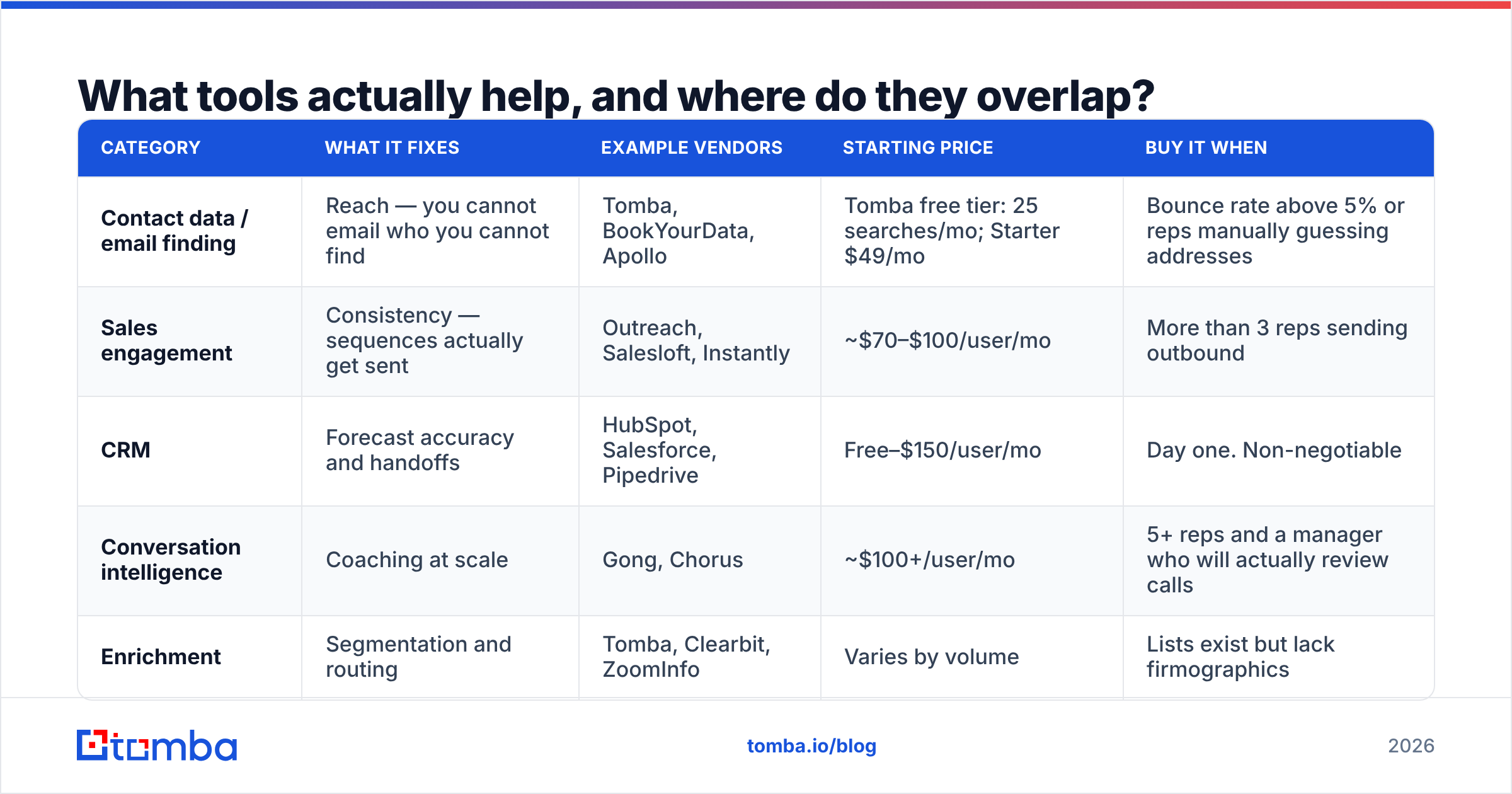
Tooling is not the answer to how to increase sales, but the wrong stack actively slows you down. Here is how the main categories compare on what they are genuinely for.
| Category | What it fixes | Example vendors | Starting price | Buy it when |
|---|---|---|---|---|
| Contact data / email finding | Reach — you cannot email who you cannot find | Tomba, BookYourData, Apollo | Tomba free tier: 25 searches/mo; Starter $49/mo | Bounce rate above 5% or reps manually guessing addresses |
| Sales engagement | Consistency — sequences actually get sent | Outreach, Salesloft, Instantly | ~$70–$100/user/mo | More than 3 reps sending outbound |
| CRM | Forecast accuracy and handoffs | HubSpot, Salesforce, Pipedrive | Free–$150/user/mo | Day one. Non-negotiable |
| Conversation intelligence | Coaching at scale | Gong, Chorus | ~$100+/user/mo | 5+ reps and a manager who will actually review calls |
| Enrichment | Segmentation and routing | Tomba, Clearbit, ZoomInfo | Varies by volume | Lists exist but lack firmographics |
A note on sequencing your purchases: data comes before engagement. A sequencer pointed at a bad list sends bad emails faster. If your budget only covers one, buy the data layer.
Tomba sits in the data layer specifically — Tomba pricing runs from a free tier at 25 searches/month through Starter at $49/mo, Growth at $99/mo, and Pro at $249/mo, with the email finder, verifier, domain search, and enrichment sharing one credit pool. BookYourData takes a different approach with prepaid list purchasing, which suits teams that want a bulk contact drop rather than ongoing lookup; both are reasonable depending on whether your motion is campaign-batch or always-on.

How do you increase deal size without losing deals?#
Average contract value is the most neglected lever, largely because raising it feels riskier than it is.
- Anchor higher in the first pricing conversation. Present the mid or top tier first. Prospects negotiate down from your anchor, so a low anchor caps your outcome before discovery even finishes.
- Bundle instead of discounting. When a prospect pushes on price, add scope rather than subtracting dollars. A 12-month term at full price with two extra seats beats a 20% discount on both revenue and renewal economics.
- Sell to the budget holder, not the user. The user cares about features and asks for a discount. The budget holder cares about outcome and asks about implementation risk. Different conversation, different number.
- Segment your pricing to fit. If your enterprise deals and your SMB deals close at the same price, one of those segments is wrong. Usually both.
- Raise prices on new logos only, first. You get a clean read on conversion impact without touching your base. If win rate holds within a few points, the increase was overdue.
How do you know it is working?#
Track leading indicators weekly and lagging ones monthly. The list is short on purpose.
Weekly (leading): verified contacts added, sequences started, first meetings booked, multithreaded deals as a share of pipeline.
Monthly (lagging): win rate by segment, average cycle length, ACV, no-decision rate.
The single most diagnostic number is no-decision rate — the share of deals that end in neither won nor lost. High no-decision means weak qualification or weak cost-of-inaction framing, and no amount of extra volume will fix it. It is the metric that tells you whether your problem is at the top of the funnel or the middle.
Also track bounce rate as a sales metric, not an IT one. It is the earliest signal that your data layer is degrading, and it moves before pipeline does.
The 30-minute pipeline audit#
Run this before you spend another dollar.
- Export your last 40 closed opportunities. Split won and lost. Note company size, source, cycle length, and number of contacts involved.
- Compute win rate by source. If inbound converts at 3x outbound, your outbound targeting is off — not your outbound copy.
- Compute win rate by contact count. Single-threaded versus multithreaded. The gap is usually large and immediately actionable.
- Check your bounce rate over the last 90 days. Above 3% means your data layer needs work before anything else does.
- Count follow-ups on your last 20 lost cold outbound sequences. If the median is under four, you have free upside sitting there.
- Pick exactly one fix. Ship it. Measure for 30 days. Then pick the next one.
Most teams find the answer to how to increase sales sitting in step 3 or step 4 — a structural leak, not a motivation problem.
Where to start this week#
Pick the cheapest lever with the fastest payback: make sure the emails you send actually arrive at people who match your ICP. That single change lifts every downstream metric — deliverability, reply rate, meetings, pipeline — without adding headcount or changing your messaging.
Start by rebuilding one segment properly. Use the Tomba Email Finder to pull verified addresses for a 100-account target list, check them against the verifier, and enrich with title and seniority so your segmentation is real. The free tier covers 25 searches if you want to test the accuracy on accounts you already know, and Starter at $49/mo handles a typical monthly prospecting volume. Then run your existing sequence against the clean list and compare the reply rate to last month's. That comparison will tell you more about your funnel than another quarter of guessing.
Related guides#
Ready to find emails that actually work?
Join 150,000+ professionals who stopped guessing and started sending. Free credits on signup — no credit card required.
Get the Tomba newsletter
Practical outbound tactics and product updates — once every two weeks.
About the author