How to Increase Sales Volume in 2026: A Practical Playbook
Sales volume is math, not motivation. Here are the seven levers that actually move units sold — pipeline coverage, list quality, cycle time, ACV mix — and how to pull each one this quarter.
TL;DR
- Sales volume is an output of four inputs: contacts reached, connect rate, win rate, and cycle time. Fix the weakest input, not the loudest one.
- Adding headcount is the slowest and most expensive lever. It usually takes two to three quarters to pay back — and it multiplies whatever inefficiency you already have.
- List quality is the cheapest lever with the fastest payback. A 12% bounce rate does not just waste sends; it degrades sender reputation and suppresses every subsequent campaign.
- Shortening cycle time increases annual volume without touching top-of-funnel. Cutting a 60-day cycle to 45 days raises throughput per rep by roughly 33%.
- Volume and margin trade off. Decide up front whether you're buying units at a lower ACV or holding price and buying reach.
What actually determines sales volume?#
Sales volume is units sold in a period. It is not revenue, and confusing the two is how teams end up celebrating a quarter where they sold more and made less.
The formula that matters:
Volume = Contacts Reached × Connect Rate × Opportunity Rate × Win Rate
Every tactic you have ever read about maps to one of those four terms. That is useful, because it converts a vague ask ("sell more") into a diagnostic. Run your last 90 days through it and one term will be visibly worse than benchmark. That is your bottleneck. Everything else is a distraction until it's fixed.
Think of it like a four-stage water pipeline. Widening the first pipe does nothing if the third one is half-clogged — you just build pressure and waste effort upstream. Most teams instinctively widen pipe one (more prospecting, more reps) because it's the most visible, and then wonder why output barely moved.
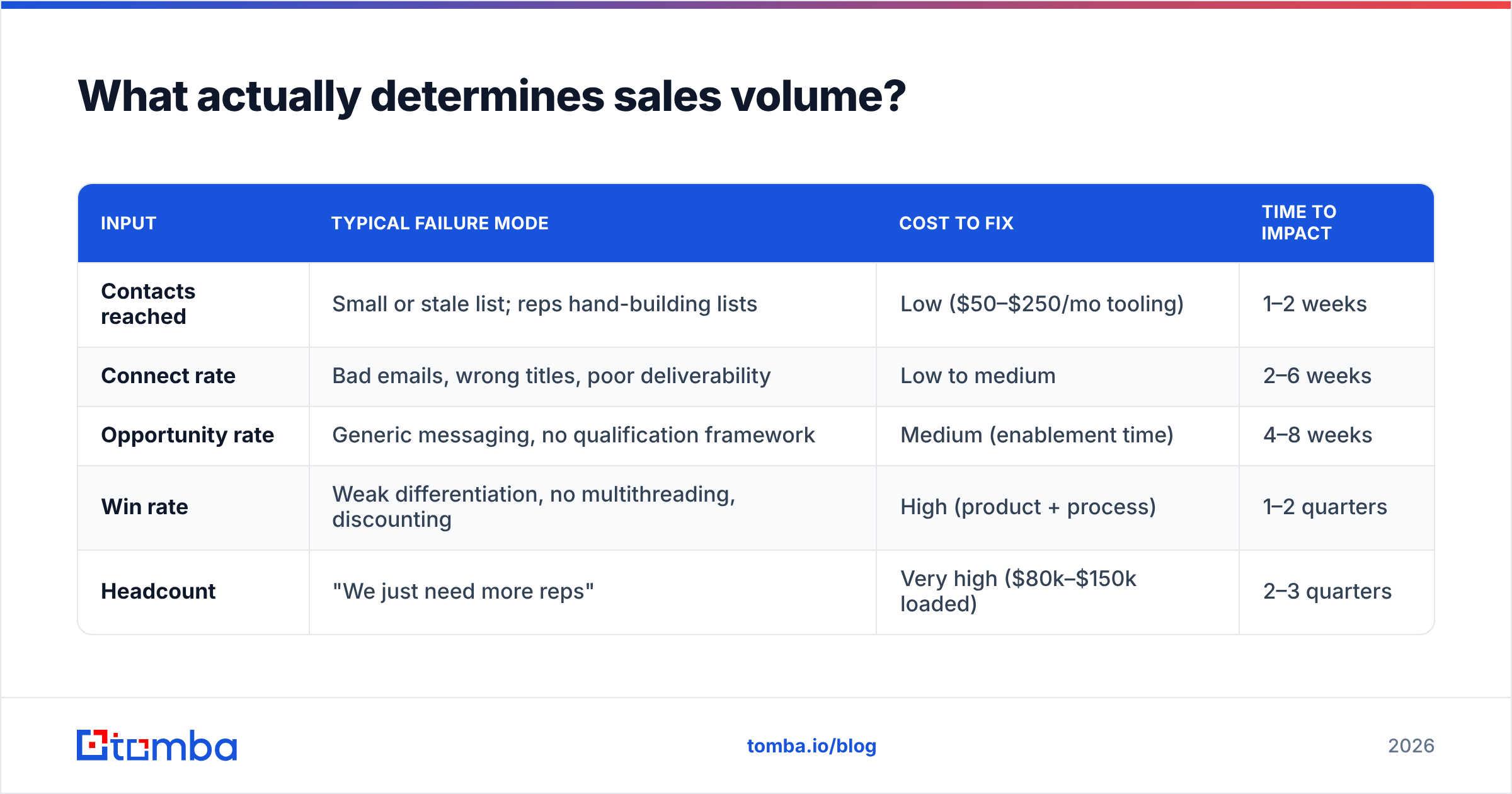
Here's how the four inputs typically break, and what fixing each one costs:
| Input | Typical failure mode | Cost to fix | Time to impact |
|---|---|---|---|
| Contacts reached | Small or stale list; reps hand-building lists | Low ($50–$250/mo tooling) | 1–2 weeks |
| Connect rate | Bad emails, wrong titles, poor deliverability | Low to medium | 2–6 weeks |
| Opportunity rate | Generic messaging, no qualification framework | Medium (enablement time) | 4–8 weeks |
| Win rate | Weak differentiation, no multithreading, discounting | High (product + process) | 1–2 quarters |
| Headcount | "We just need more reps" | Very high ($80k–$150k loaded) | 2–3 quarters |
Note the pattern: the cheapest, fastest levers sit at the top of the funnel and the most expensive at the bottom. That is the opposite of where most sales-improvement energy goes.
Why does adding reps rarely increase sales volume?#
Because headcount multiplies your current efficiency — including the bad parts.
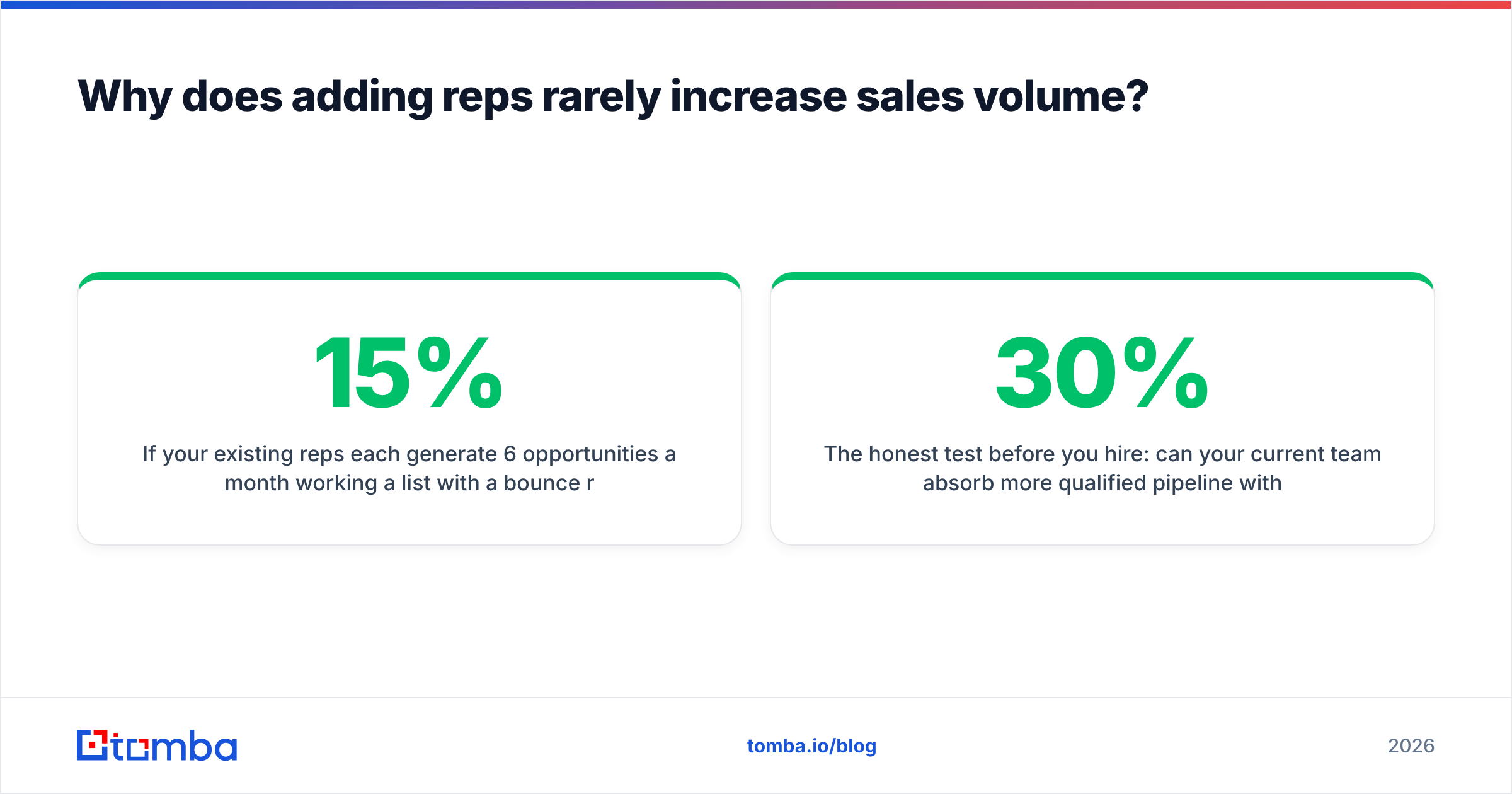
If your existing reps each generate 6 opportunities a month working a list with a 15% bounce rate and a 4% reply rate, a new rep will generate roughly 6 opportunities a month too, minus a ramp period of three to six months. You have not fixed anything. You have paid $110,000 loaded to duplicate a mediocre process, and you now have one more person to manage.
Gartner's sales research has repeatedly found that rep productivity variance within a team is far wider than the variance between teams. Translation: your top rep and your median rep are running different processes on the same tooling. Closing that internal gap is almost always cheaper than hiring.
The honest test before you hire: can your current team absorb 30% more qualified pipeline without dropping balls? If yes, your bottleneck is lead supply and you should fix data and targeting first. If no, your bottleneck is capacity and hiring is legitimate.

How do you increase contacts reached without burning your domain?#
Volume at the top of the funnel is a data problem before it is an effort problem.
The failure sequence is predictable. A rep scrapes a list, uploads it, and sends. Twelve percent bounce. Mailbox providers register that pattern, and by campaign three the inboxing rate has fallen — meaning even the valid addresses stop landing. Now the rep sends more to compensate, which accelerates the damage. Sending volume went up; delivered volume went down.
Four things break this cycle:
- Source contacts from a verified provider rather than scraping. A quality email finder returns a confidence score alongside the address, so you can suppress anything below threshold before it ever enters a sequence.
- Verify at the point of import, not at the point of send. Running an email verifier against your list catches role accounts, disposables, and dead mailboxes while the list is still small enough to fix.
- Segment catch-all domains separately. Catch-all servers accept everything, so standard verification returns "unknown." Route these through a catch-all verifier and hold them in a lower-priority segment rather than mixing them into your primary sends.
- Cap daily volume per mailbox and scale across mailboxes. Thirty to fifty sends per mailbox per day, spread across several domains, outperforms 300 from one domain — every time.
For account-based motions, start from the company rather than the person: a domain search returns the full addressable contact set at a target account, which is how you multithread instead of betting the deal on one champion who might leave.
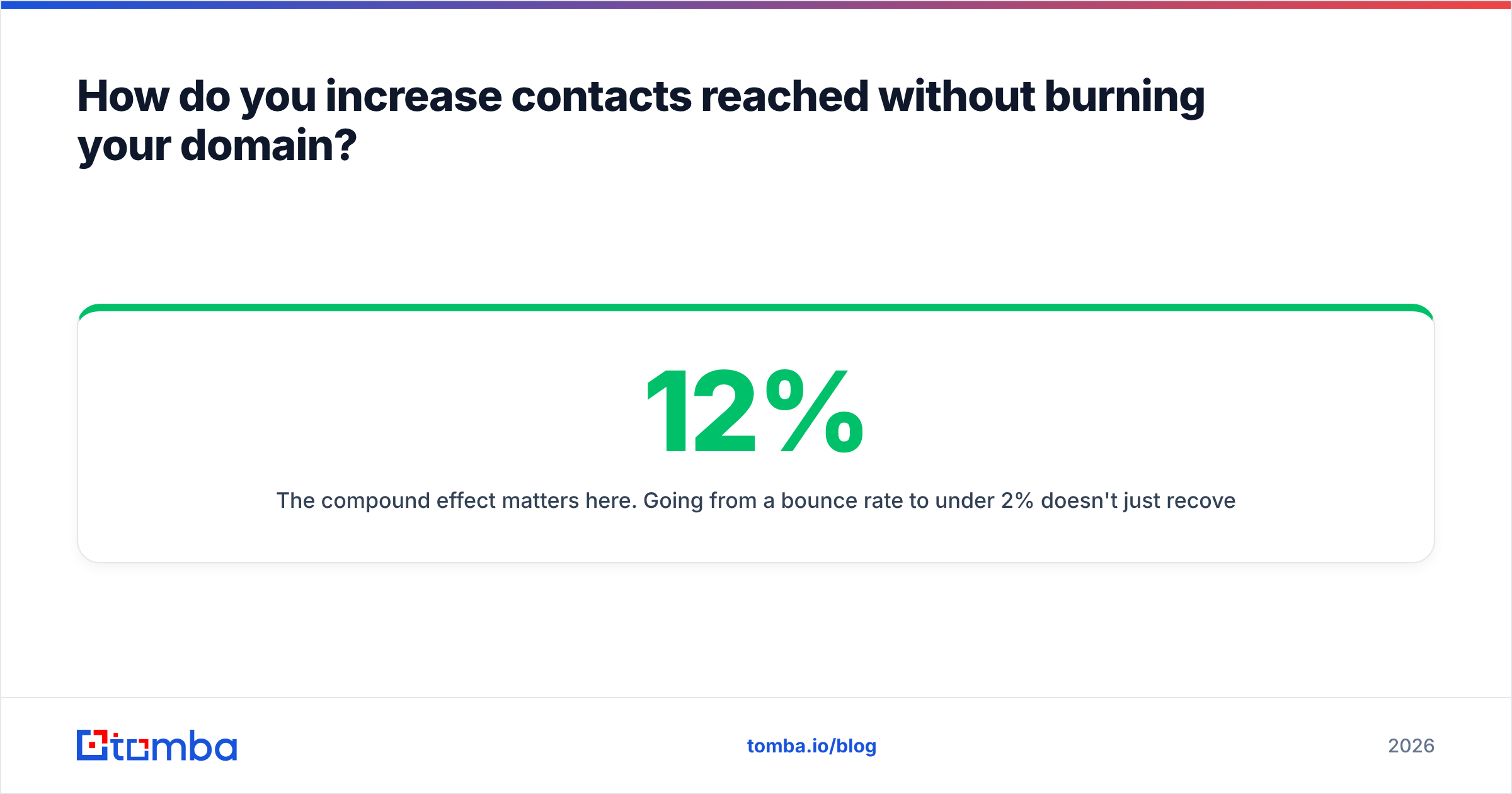
The compound effect matters here. Going from a 12% bounce rate to under 2% doesn't just recover 10% of your sends — it protects email deliverability for the other 88%, which is where the real volume lives.
Which lever gives the fastest payback?#
Cycle time compression, if you already have reasonable top-of-funnel supply. It's the lever nobody talks about because it isn't a purchase.
The arithmetic is unforgiving in your favor. A rep working a 60-day average cycle with 20 active opportunities turns that pipeline roughly six times a year. Cut the cycle to 45 days and the same rep turns it eight times — a 33% volume increase with zero new leads, zero new headcount, and zero new tools.
Where the days actually hide:
- Scheduling gaps. Three days between "sounds good, let's talk" and the actual call. Send a booking link in the same message that gets the yes.
- Single-threading. One contact goes on vacation and the deal stalls two weeks. Add a second and third stakeholder by call two.
- Sequential discovery. Asking for security review, procurement contact, and budget confirmation one at a time across three calls instead of surfacing all three in call one.
- Silent proposal periods. A proposal sits for eight days because nobody set a decision date when it was sent.
None of these require a budget approval. All of them are habits, which means they respond to manager inspection and a mandatory next-step field in your CRM.
How should you compare the main volume levers?#
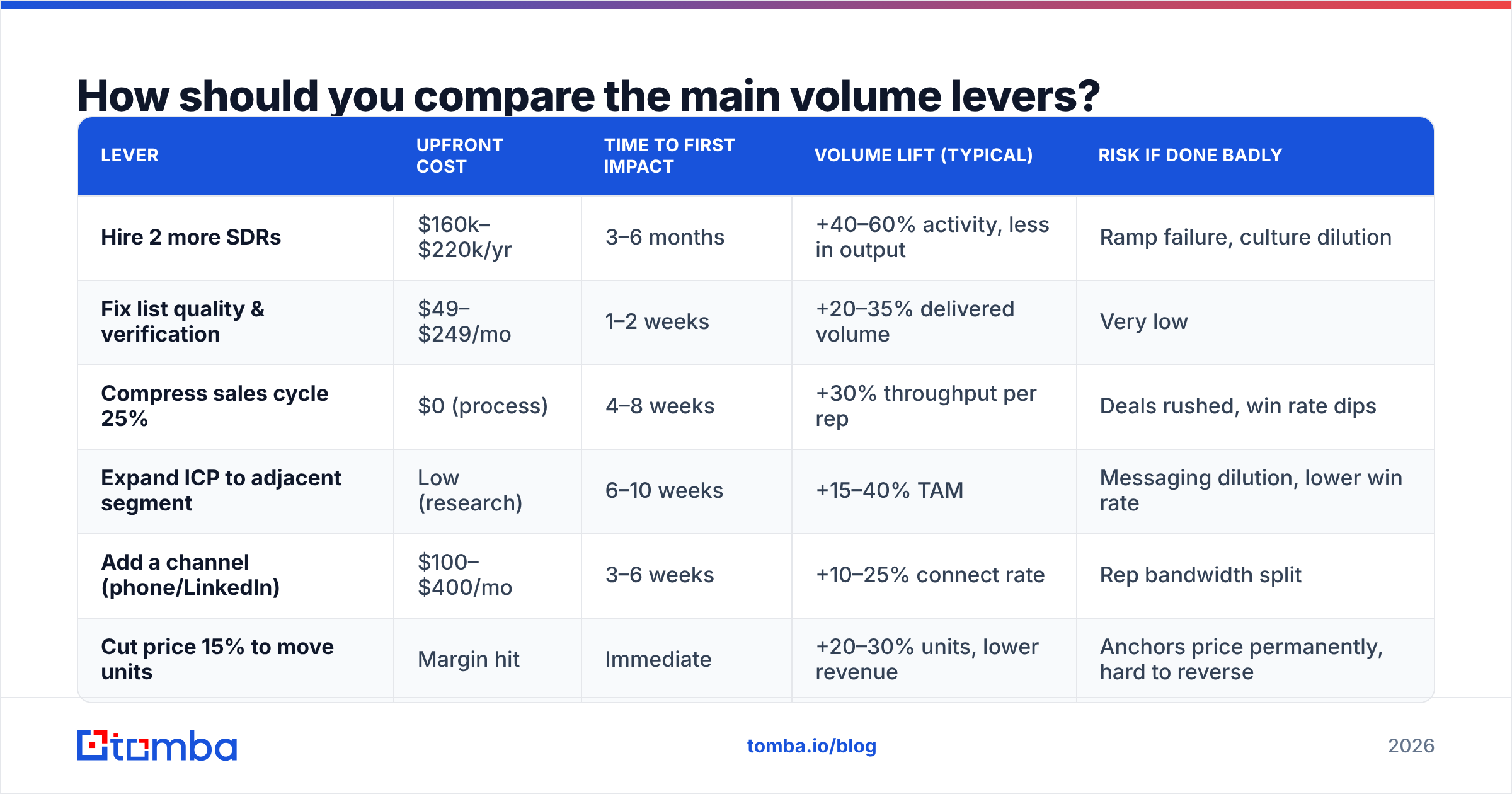
Here's the same set of options scored against what a growth-stage B2B team actually cares about.
| Lever | Upfront cost | Time to first impact | Volume lift (typical) | Risk if done badly |
|---|---|---|---|---|
| Hire 2 more SDRs | $160k–$220k/yr | 3–6 months | +40–60% activity, less in output | Ramp failure, culture dilution |
| Fix list quality & verification | $49–$249/mo | 1–2 weeks | +20–35% delivered volume | Very low |
| Compress sales cycle 25% | $0 (process) | 4–8 weeks | +30% throughput per rep | Deals rushed, win rate dips |
| Expand ICP to adjacent segment | Low (research) | 6–10 weeks | +15–40% TAM | Messaging dilution, lower win rate |
| Add a channel (phone/LinkedIn) | $100–$400/mo | 3–6 weeks | +10–25% connect rate | Rep bandwidth split |
| Cut price 15% to move units | Margin hit | Immediate | +20–30% units, lower revenue | Anchors price permanently, hard to reverse |
The last row is the trap. Price cuts move units faster than anything else on the list and are the only lever that can reduce revenue while increasing volume. If someone proposes discounting to hit a volume target, ask what revenue looks like at the new price and new unit count before agreeing.
Does adding a second channel actually help?#
Yes, but only after your primary channel is healthy — and the ordering matters more than people expect.
Adding cold calling to a broken email motion doesn't fix the email motion; it just splits rep attention across two underperforming channels. Fix email first because it's the cheapest to diagnose and the easiest to instrument.
Once email is landing consistently, a second channel raises connect rate rather than contact volume, which is a different term in the formula. Phone is the strongest addition for mid-market and enterprise: a phone finder plus a validated direct-dial list turns the "no reply" segment into a live conversation segment. LinkedIn works well for lower ACV and for personas that ignore email entirely — see LinkedIn outreach for the sequencing patterns that don't get accounts restricted.
The practical rule: sequence channels around a single account within the same week, not in isolation. An email, a connection request, and a call in a 5-day window read as one coordinated effort. The same three touches spread over six weeks read as three unrelated strangers.

What breaks when you scale volume too fast?#
Four things, in a reliable order.
Deliverability goes first. Send volume climbs faster than domain reputation can support it. Google's Postmaster Tools will show the spam complaint rate creeping past 0.3% about two weeks before reply rates visibly collapse — watch it as a leading indicator, not a postmortem tool.
Qualification goes second. When reps are measured purely on meetings booked, meeting quality drops. You'll see it as a widening gap between opportunities created and opportunities that reach stage two. If that gap grows for two consecutive months, your volume gain is fictional.
Win rate goes third. More top-of-funnel with unchanged capacity means less time per deal. Salesforce's sales research consistently shows reps spending under a third of their time actually selling; volume programs that add admin overhead make that worse, not better.
Data hygiene goes last, and hurts longest. Duplicate accounts, stale titles, and unverified contacts accumulate silently. Six months later nobody trusts the CRM, forecasting degrades, and territory disputes start. Continuous data enrichment on existing records is unglamorous and prevents all of it.
Set a guardrail metric alongside every volume target. If the target is "40% more opportunities," the guardrail is "stage-two conversion stays above X%." Without the guardrail, the team will hit the number in a way you don't want.
What does a realistic 90-day plan look like?#
Days 1–15 — Diagnose. Pull last quarter's numbers into the four-term formula. Calculate bounce rate, reply rate, meeting-to-opportunity rate, and median cycle time. Compare each against a benchmark. One will be clearly worst.
Days 16–30 — Fix the data layer. Verify the entire active list. Suppress anything unverified. Rebuild your ICP contact set from a verified source. This is where a bulk email finder earns its cost — it turns a two-week manual list build into an afternoon.
Days 31–60 — Attack cycle time. Mandate a scheduled next step on every open opportunity. Require a second stakeholder by the second call. Audit every deal older than 1.5x your median cycle and either advance or close it.
Days 61–90 — Add capacity or channel. Only now, with clean data and a tighter process, does adding reps or a second channel compound rather than dilute. Whatever inefficiency remained at day 1 has been removed, so new capacity multiplies a better number.
Teams that run this order typically see volume move in weeks four through six — from the data fix, not from anything heroic. Teams that reverse the order and hire first usually see nothing until month five, and then can't tell whether the hire or the eventual process fix caused it.
Start with the input you can fix this week#
The single highest-leverage thing most teams can do to increase sales volume isn't a new methodology or a bigger team — it's making sure the contacts they already send to are real, current, and reachable. Bad data caps every downstream metric simultaneously, which is exactly why fixing it lifts everything at once.
Tomba's Email Finder returns verified professional emails by domain, name, or company, with a confidence score on every result so you can suppress low-quality contacts before they touch a sequence. The free tier gives you 25 searches a month to test accuracy against a list you already know; paid plans start at $49/month, with Growth at $99/month for teams running real outbound volume. Full Tomba pricing is public — no demo call required to see it.
Verify your list before you scale your sends. It's the cheapest 30% you'll ever add.
Related guides#
// get started
Find, verify and enrich your first contacts today
Start on the free plan with 25 searches a month, then scale when your team is ready.
Free plan · No credit card required · GDPR & CCPA
Get the Tomba newsletter
Product and data updates
// about the author