How to Increase Win Rates in Sales: A 2026 Playbook
Win rates stall because of who you talk to, not how you close. Here are seven diagnostics and fixes that move B2B win rates 5-15 points in a quarter.
TL;DR
- Win rate is a pipeline-quality metric before it is a closing-skill metric. Most teams that "can't close" are actually working deals they never should have opened.
- Median B2B win rates sit around 20-25% of qualified opportunities. Teams above 35% almost always share three traits: strict entry criteria, multithreaded deals, and a documented next step on every open opp.
- Single-threaded deals lose at roughly twice the rate of deals with three or more engaged contacts. Adding contacts is the cheapest win-rate lever you have.
- Fix your definition of "qualified" first, then measure by stage, then coach. Coaching a bad-fit pipeline just makes reps better at losing slowly.
- Contact data quality is upstream of everything: you cannot multithread a deal if you cannot reach the other four people in the buying committee.
What is a sales win rate, and how do you calculate it?#
Win rate is the percentage of qualified opportunities that end in closed-won revenue over a defined period.
The formula everyone uses:
Win rate = Closed-won deals / (Closed-won + Closed-lost) × 100That looks simple and it hides three decisions that change the number by 20 points:
- What counts as an opportunity. If every discovery call becomes an opp, your denominator inflates and your win rate collapses. If only deals with a verbal commitment become opps, you'll report 60% and learn nothing.
- When you count the deal. Cohort by creation date (honest, slow) or by close date (fast, distorted by long cycles). Pick one and never mix them in the same report.
- Whether "no decision" counts as a loss. It should. Deals that die in silence are your largest and most fixable loss bucket — typically 25-40% of all closed opportunities.
A team reporting 45% win rate that excludes no-decisions and only counts opps after a proposal is sent is a team with no idea how it's performing. Get the definition boring and consistent before you try to improve the number.
Why are your win rates actually dropping?#
Because buying committees grew and your contact coverage didn't.
Gartner's B2B buying research has consistently put the average enterprise buying group at six to ten decision-makers, each arriving with their own independently gathered information. Meanwhile most reps still work one champion, one email thread, one calendar invite. When that champion changes jobs — and roughly one in five B2B contacts changes role every year — the deal doesn't slow down. It disappears.
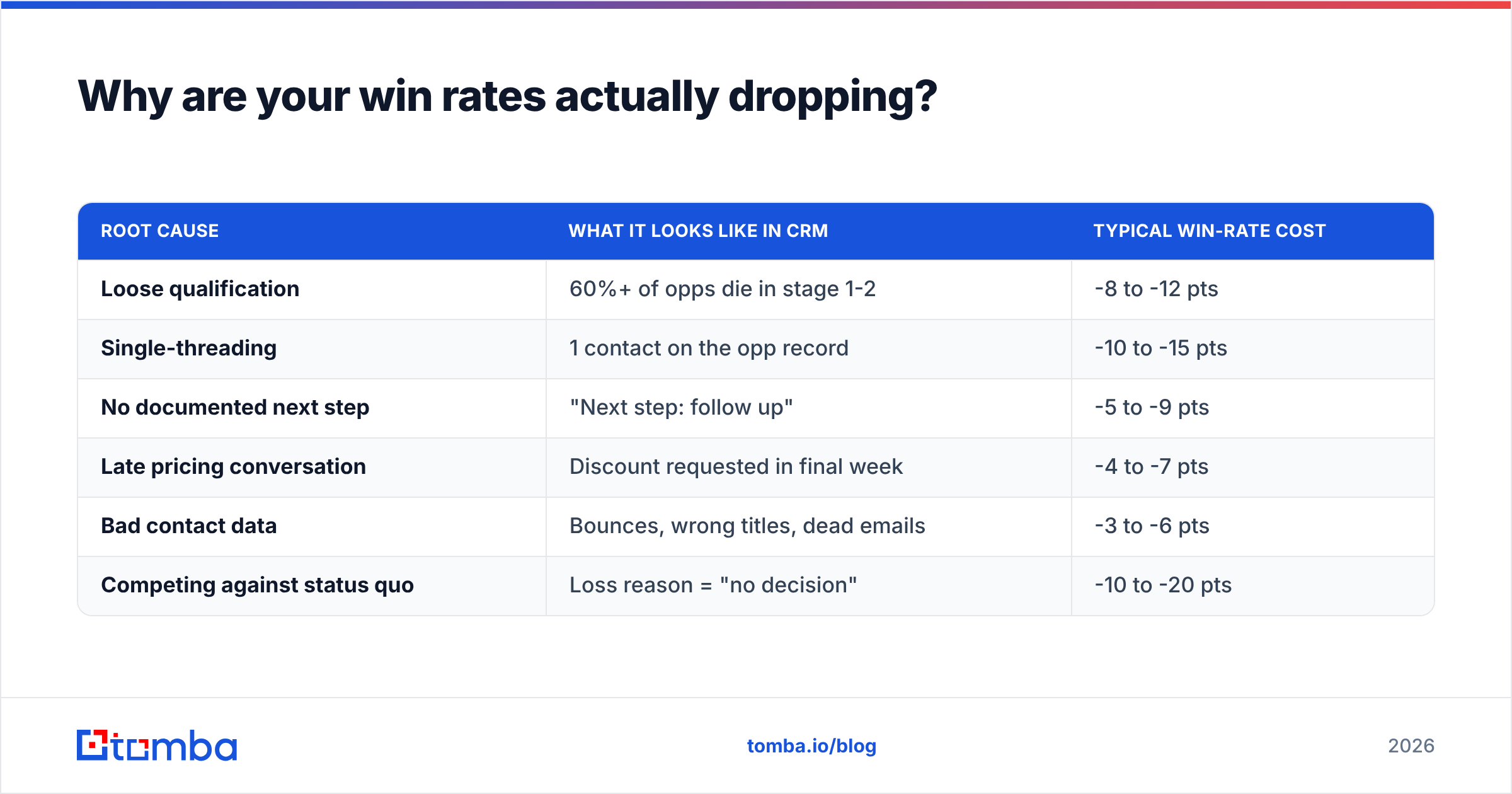
The other causes, ranked by how often they show up in win/loss reviews:
| Root cause | What it looks like in CRM | Typical win-rate cost |
|---|---|---|
| Loose qualification | 60%+ of opps die in stage 1-2 | -8 to -12 pts |
| Single-threading | 1 contact on the opp record | -10 to -15 pts |
| No documented next step | "Next step: follow up" | -5 to -9 pts |
| Late pricing conversation | Discount requested in final week | -4 to -7 pts |
| Bad contact data | Bounces, wrong titles, dead emails | -3 to -6 pts |
| Competing against status quo | Loss reason = "no decision" | -10 to -20 pts |
Notice that none of these are "the rep isn't persuasive enough." Persuasion is the last 10% of a win rate. Process and data are the first 90%.
How do you increase win rates in sales? The seven-lever playbook#
Work these in order. Levers 1-3 change your number within one quarter; 4-7 compound over two or three.
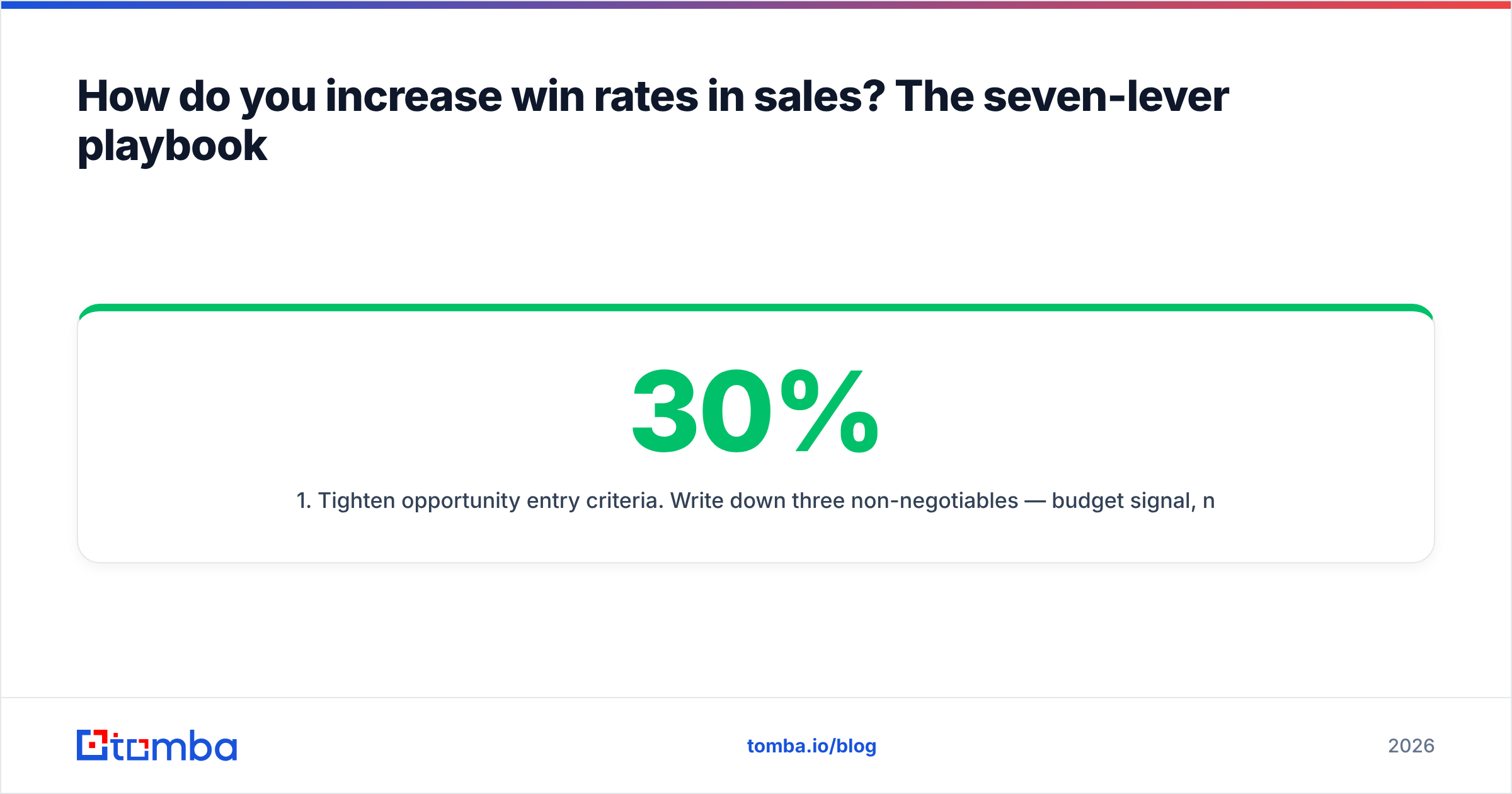
- Tighten opportunity entry criteria. Write down three non-negotiables — budget signal, named problem, access to at least one economic influencer. Anything missing stays a lead, not an opp. Expect pipeline to drop 20-30% and win rate to jump immediately. That is the point.
- Multithread every deal above your average deal size. Target four contacts minimum: champion, economic buyer, technical evaluator, and one skeptic. The skeptic matters most — unheard objections become no-decisions.
- Enforce a documented next step with a date. No open opportunity survives a pipeline review without a calendar-confirmed next action. Deals without one are forecast fiction.
- Run win/loss interviews on 10 deals a quarter. Not surveys — 20-minute calls, ideally by someone who wasn't on the deal. You'll hear the real loss reason within four questions.
- Score and route leads by fit, not by activity. A marketing qualified lead that downloaded an ebook is not the same as one whose company just hired a VP in your buyer persona. Fit-scored pipeline converts 2-3x better.
- Kill zombie deals on a clock. Anything with no buyer-initiated activity for 2x your average stage duration goes to closed-lost or nurture. Zombie deals don't just distort forecasts — they eat the hours that would have won something else.
- Fix the data layer. Verified emails and direct phone numbers for the whole committee, refreshed quarterly. This is the unglamorous lever that makes lever 2 physically possible.
Is multithreading really the biggest lever?#
Yes — and the arithmetic is what makes it convincing, not the anecdotes.
Take a deal with one contact. That contact leaves, gets reassigned, loses internal capital, or simply goes quiet. Any one of those ends the deal outright. Now take a deal with four engaged contacts. All four have to fail for you to lose access. If each contact has an independent 20% chance of going dark in a quarter, single-threaded gives you an 80% survival rate; four-threaded gives you 99.8%.
Real deals aren't independent events, so the true gap is smaller. But every serious win/loss dataset — from vendor-published benchmarks on G2 to internal RevOps studies — points the same direction: deal survival scales with contact count, and it scales fastest between one and three contacts.
The practical blocker is not willingness. It's reach. Reps know they should email the CFO and the head of IT; they don't have those addresses, and the CRM record has one contact because that's who filled out the form. Closing that gap is a data problem with a data solution — run the account through a domain search to pull the full contact map for the company, then verify before you send.
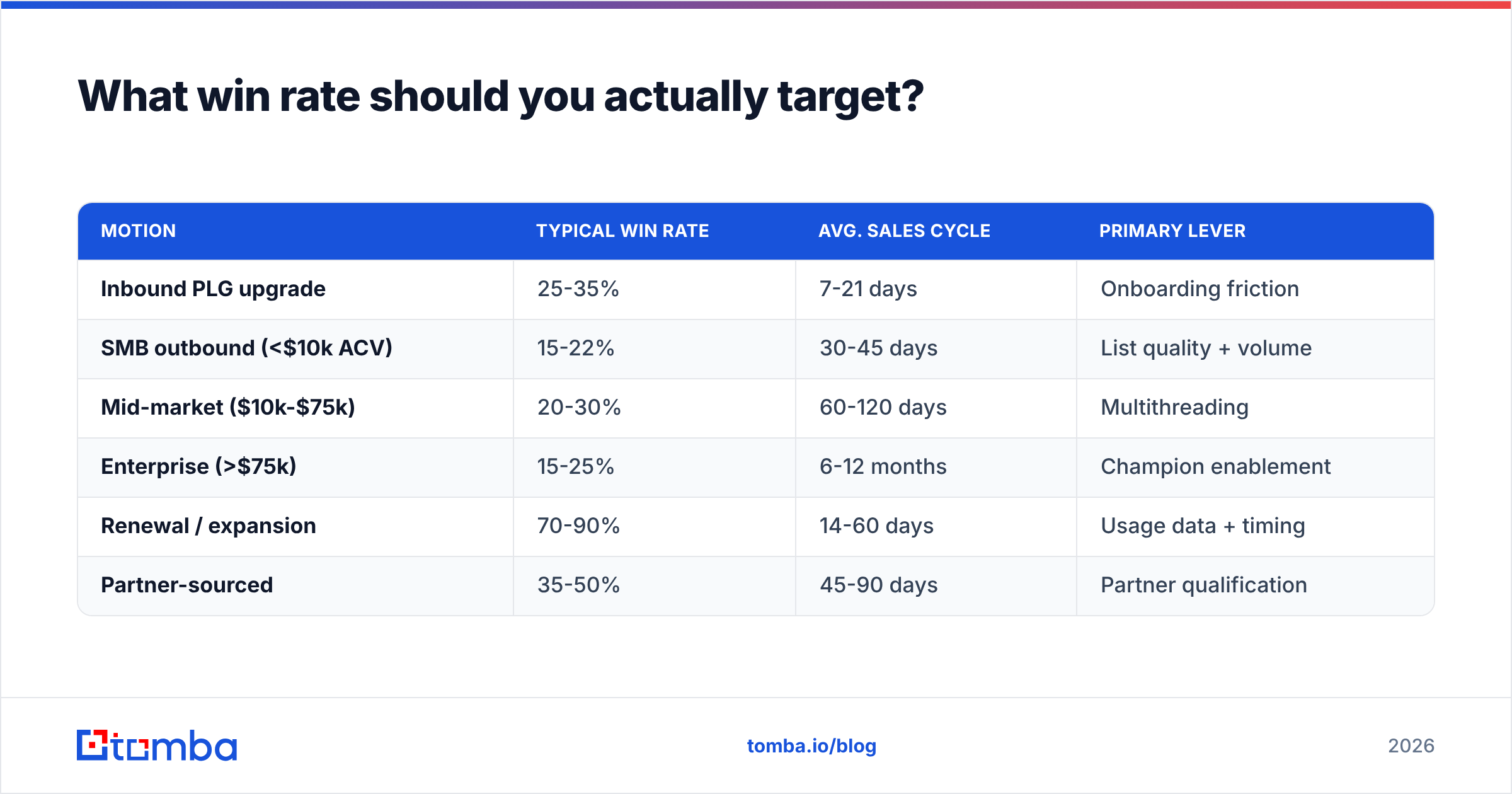
What win rate should you actually target?#
Depends on motion, and the honest answer is that benchmarks are a sanity check, not a goal.
| Motion | Typical win rate | Avg. sales cycle | Primary lever |
|---|---|---|---|
| Inbound PLG upgrade | 25-35% | 7-21 days | Onboarding friction |
| SMB outbound (<$10k ACV) | 15-22% | 30-45 days | List quality + volume |
| Mid-market ($10k-$75k) | 20-30% | 60-120 days | Multithreading |
| Enterprise (>$75k) | 15-25% | 6-12 months | Champion enablement |
| Renewal / expansion | 70-90% | 14-60 days | Usage data + timing |
| Partner-sourced | 35-50% | 45-90 days | Partner qualification |
Two rules for reading this table. First, compare yourself to your own trailing four quarters before comparing to the industry. Second, a rising win rate paired with falling pipeline volume is often a worse business outcome than a flat win rate with growing pipeline — always read win rate next to total closed-won revenue.
How does contact data quality change your win rate?#
It changes the denominator and the numerator at once.
Bad data inflates the denominator: opportunities created against companies that were never a fit, contacts with titles from three jobs ago, emails that bounce and quietly damage your sender reputation so that even your good prospects stop seeing you. And it suppresses the numerator: you can't multithread without addresses, you can't reach the economic buyer, and you lose deals to competitors who simply got in front of more of the committee.
A workable data hygiene routine for a sales team:
- Verify before every sequence. Run the list through an email verifier so bounces stay under 2%. Above 3%, deliverability degrades for everyone on your domain.
- Refresh open-opportunity contacts quarterly. Titles and employers change constantly; a stale champion record is a silent deal-killer.
- Enrich on opportunity creation, not on lead capture. Enriching every inbound form fill is expensive; enriching the 15% that become opps is not. Add firmographics and the rest of the buying committee at the moment the deal gets real via data enrichment.
- Add direct phone numbers for the top two contacts. Email books the meeting; a phone call saves the deal when email goes dark. A phone finder covers the gap.
- Deduplicate before every quarterly review. Duplicate opportunity records are the fastest way to report a win rate that isn't real.
How do you run win/loss analysis that actually changes behavior?#
Interview the buyer, not the rep, and do it within 30 days of the decision.
Reps report loss reasons that protect their forecast credibility: "price" and "timing" account for something like two-thirds of CRM-logged losses and are almost never the actual reason. Buyers, asked directly and neutrally, describe something different — usually that a competitor made the internal business case easier to sell, or that the rep never reached the person who had to approve it.
A four-question script that gets you 80% of the value:
- "Walk me through how the decision actually got made internally — who had to sign off?"
- "At what point did you feel confident about your choice?"
- "What did the other vendor do that we didn't?"
- "If you were advising us, what would you change about how we ran this?"
Record the answers in a shared doc with a tag for the loss category. After 10-15 interviews, one or two patterns dominate — and those patterns are where you spend your enablement budget next quarter. HubSpot's sales research library is a reasonable starting point if you want structured comparison data alongside your own interviews.
The failure mode here is treating win/loss as a report. It's a coaching input. If nothing in your call reviews, playbooks, or ICP definition changes after the interviews, skip the exercise and save the hours.
Which tools help most, and where do they overlap?#
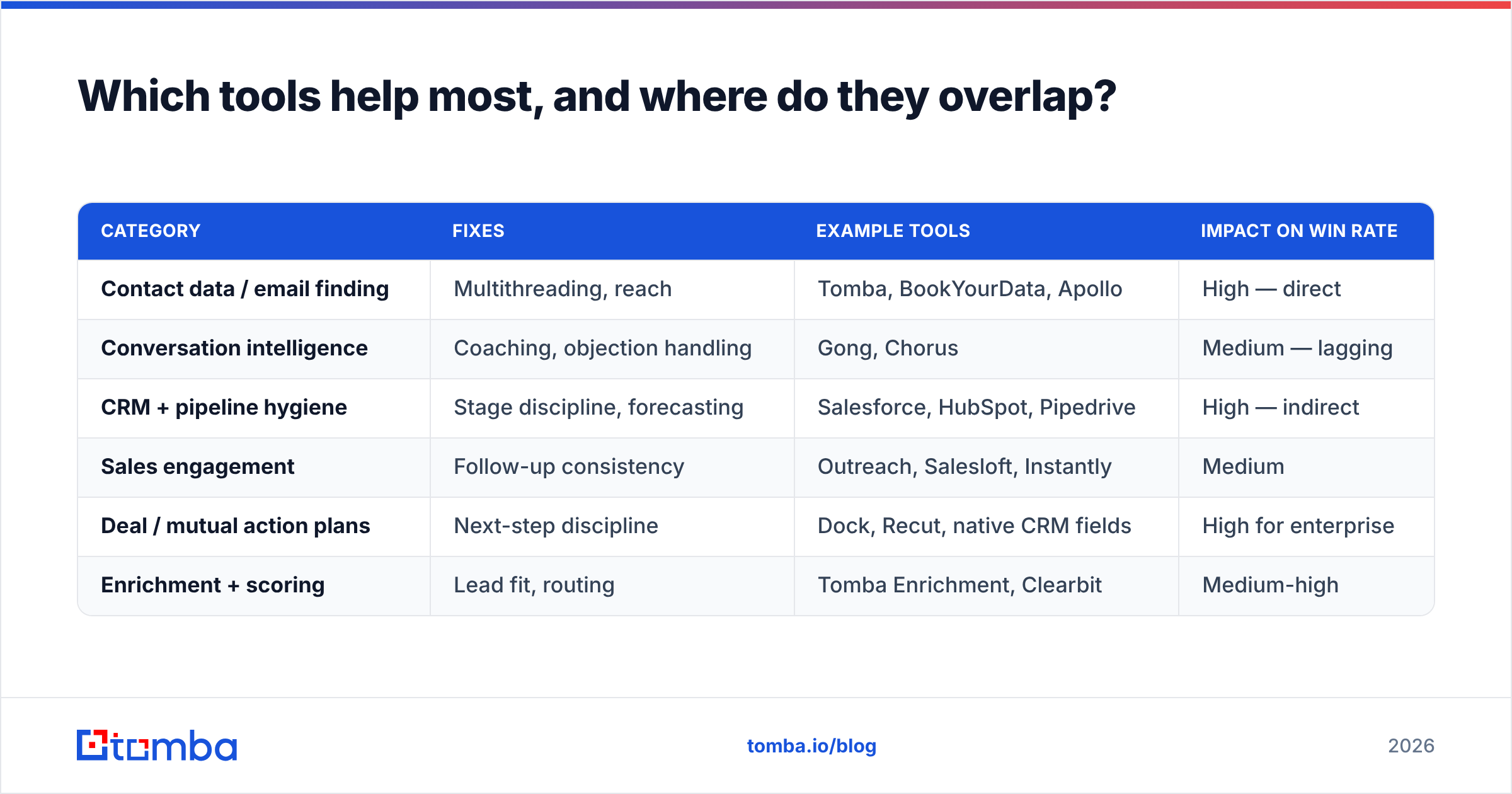
Categories matter more than brands here, so line them up by what they actually fix:
| Category | Fixes | Example tools | Impact on win rate |
|---|---|---|---|
| Contact data / email finding | Multithreading, reach | Tomba, BookYourData, Apollo | High — direct |
| Conversation intelligence | Coaching, objection handling | Gong, Chorus | Medium — lagging |
| CRM + pipeline hygiene | Stage discipline, forecasting | Salesforce, HubSpot, Pipedrive | High — indirect |
| Sales engagement | Follow-up consistency | Outreach, Salesloft, Instantly | Medium |
| Deal / mutual action plans | Next-step discipline | Dock, Recut, native CRM fields | High for enterprise |
| Enrichment + scoring | Lead fit, routing | Tomba Enrichment, Clearbit | Medium-high |
A caution most vendor content skips: tools do not raise win rates on their own. Conversation intelligence recorded 400 calls last quarter and nobody watched them. The sequence tool sent 12,000 emails to a list nobody verified. Buy the tool that fixes your specific diagnosed root cause from the table in section two, and ignore the rest until that lever is exhausted.
If contact coverage is your bottleneck — and for most mid-market teams it is — Tomba pricing starts free at 25 searches/month, with Starter at $49/mo and Growth at $99/mo, which is usually enough to fully map every open opportunity's buying committee before you commit to anything bigger. Peers like BookYourData take a database-first approach that suits teams buying large static lists; a finder-plus-verifier approach suits teams that build lists account by account. Both are legitimate — match the tool to how your reps actually work.
How long before win rates move?#
Faster than most leaders expect, if you sequence it right.
- Weeks 1-2: Redefine opportunity entry criteria. Re-audit open pipeline against them. Expect an uncomfortable purge.
- Weeks 3-6: Contact-map every surviving opportunity. Verify emails, add phones, log four contacts minimum per deal.
- Weeks 7-12: Enforce documented next steps in every pipeline review. Start win/loss interviews.
- Quarter 2: Read the new win rate on the cohort created after the changes. Not before — mixing cohorts is how teams talk themselves out of a working change.
The most common mistake is measuring too early on the wrong cohort, concluding nothing worked, and reverting. Deals created under the old criteria will keep losing at the old rate. Judge the new process only on deals it created.
Where should you start this week?#
Pull a list of every open opportunity with exactly one contact on the record. For most teams that's 40-60% of the pipeline, and it is the single most concentrated pocket of avoidable losses you own.
Then fill those records. Use the Tomba Email Finder to find verified addresses for the economic buyer, the technical evaluator, and the skeptic on each of those accounts — by name if you know it, by domain if you don't. Verify before you send, add the direct dials for your top two contacts, and give every one of those deals a real second thread by the end of the month. It's the fastest, least political win-rate lever available to you, and unlike coaching, it works the same week you do it.
Related guides#
// get started
Find, verify and enrich your first contacts today
Start on the free plan with 25 searches a month, then scale when your team is ready.
Free plan · No credit card required · GDPR & CCPA
// about the author