How to Keep Your Sales Team Motivated in 2026: A Manager's Playbook
Motivation is not a pizza party. It is a system of comp design, pipeline quality, coaching cadence, and removed friction. Here is the playbook that actually holds when quota gets hard.
TL;DR
- Motivation collapses for structural reasons, not emotional ones: unfair comp, bad pipeline, unclear expectations, and admin drag. Fix the structure and the mood follows.
- The single fastest morale lever most managers ignore is data quality. A rep working a list with 30% bounce rates is being punished for your CRM hygiene.
- Compensation should reward behaviors reps control. Pure new-logo commission on a market with a 9-month cycle produces burnout by month four.
- Run a weekly 1:1 with a fixed structure (pipeline, one skill, one blocker) instead of ad-hoc pep talks. Cadence beats charisma.
- Recognition works when it is specific, public, and fast. "Great job team" does nothing. "Maya's discovery question on the Acme call — steal it" does.
Why do sales teams actually lose motivation?#
Because the job stops feeling winnable.
Salespeople are unusually tolerant of hard work and unusually intolerant of unfairness. A rep will make 80 calls a day if they believe the math works out. The moment they conclude the math does not work out — the territory is dead, the quota moved mid-year, marketing's leads are recycled trade show badges from 2023 — effort drops fast, and no amount of enthusiasm from you reverses it.
Gallup's long-running engagement research consistently finds that the manager accounts for roughly 70% of the variance in team engagement. That is not a compliment. It means when a team goes flat, the diagnosis usually starts with the operating system the manager built, not with the individuals inside it.
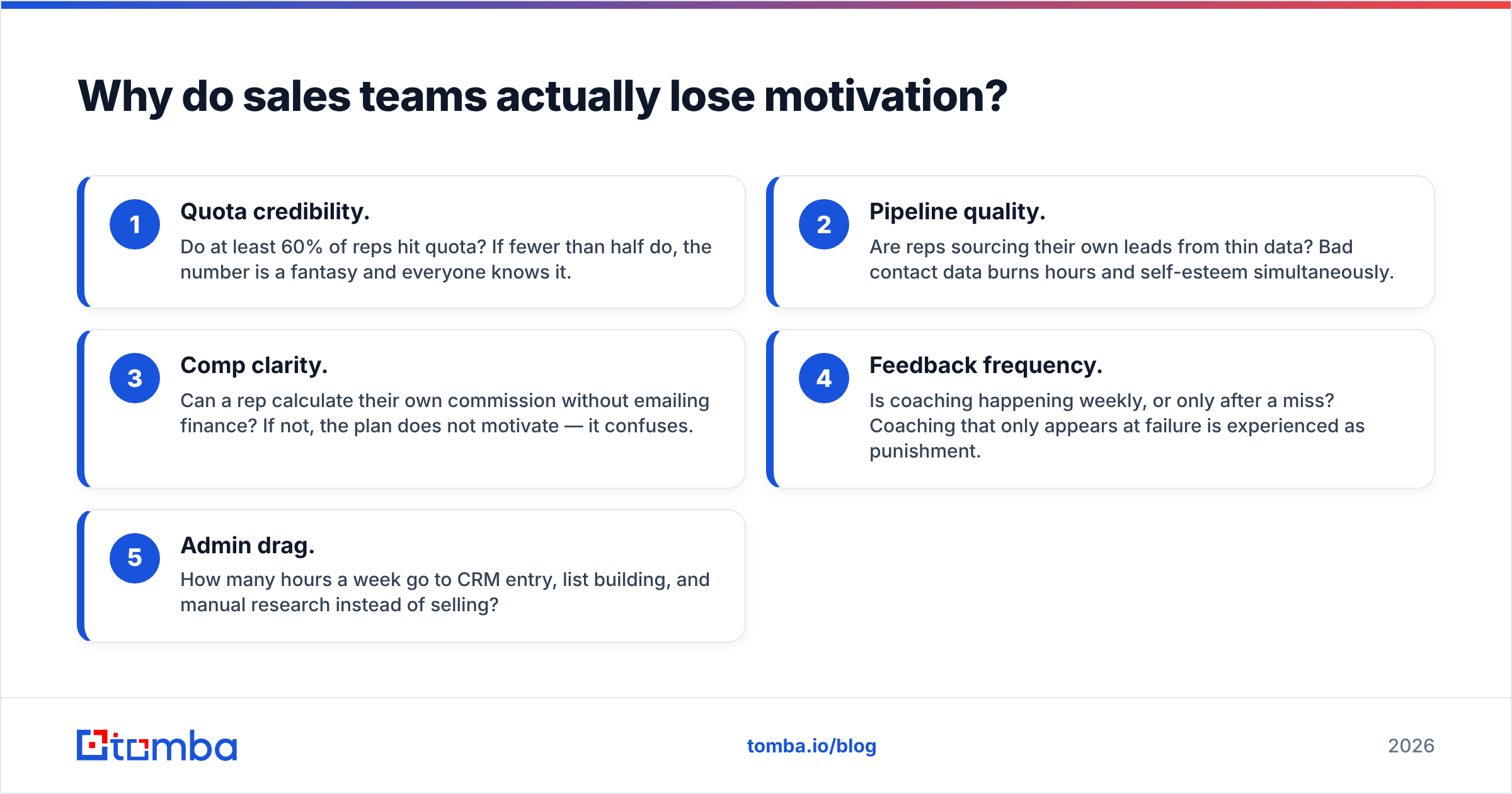
Here are the five root causes worth checking before you plan an offsite:
- Quota credibility. Do at least 60% of reps hit quota? If fewer than half do, the number is a fantasy and everyone knows it.
- Pipeline quality. Are reps sourcing their own leads from thin data? Bad contact data burns hours and self-esteem simultaneously.
- Comp clarity. Can a rep calculate their own commission without emailing finance? If not, the plan does not motivate — it confuses.
- Feedback frequency. Is coaching happening weekly, or only after a miss? Coaching that only appears at failure is experienced as punishment.
- Admin drag. How many hours a week go to CRM entry, list building, and manual research instead of selling?
How does data quality affect sales motivation?#
More than any incentive plan. This is the least discussed and most consequential item on the list.
Run the arithmetic on a rep working a poorly sourced list. Say they send 400 emails a week. A list with a 28% bounce rate means 112 of those never land, the sending domain takes reputation damage, and the reps who follow the same list get progressively worse inbox placement. The rep sees a falling reply rate and concludes they are bad at cold email. They are not. They were handed broken inputs.
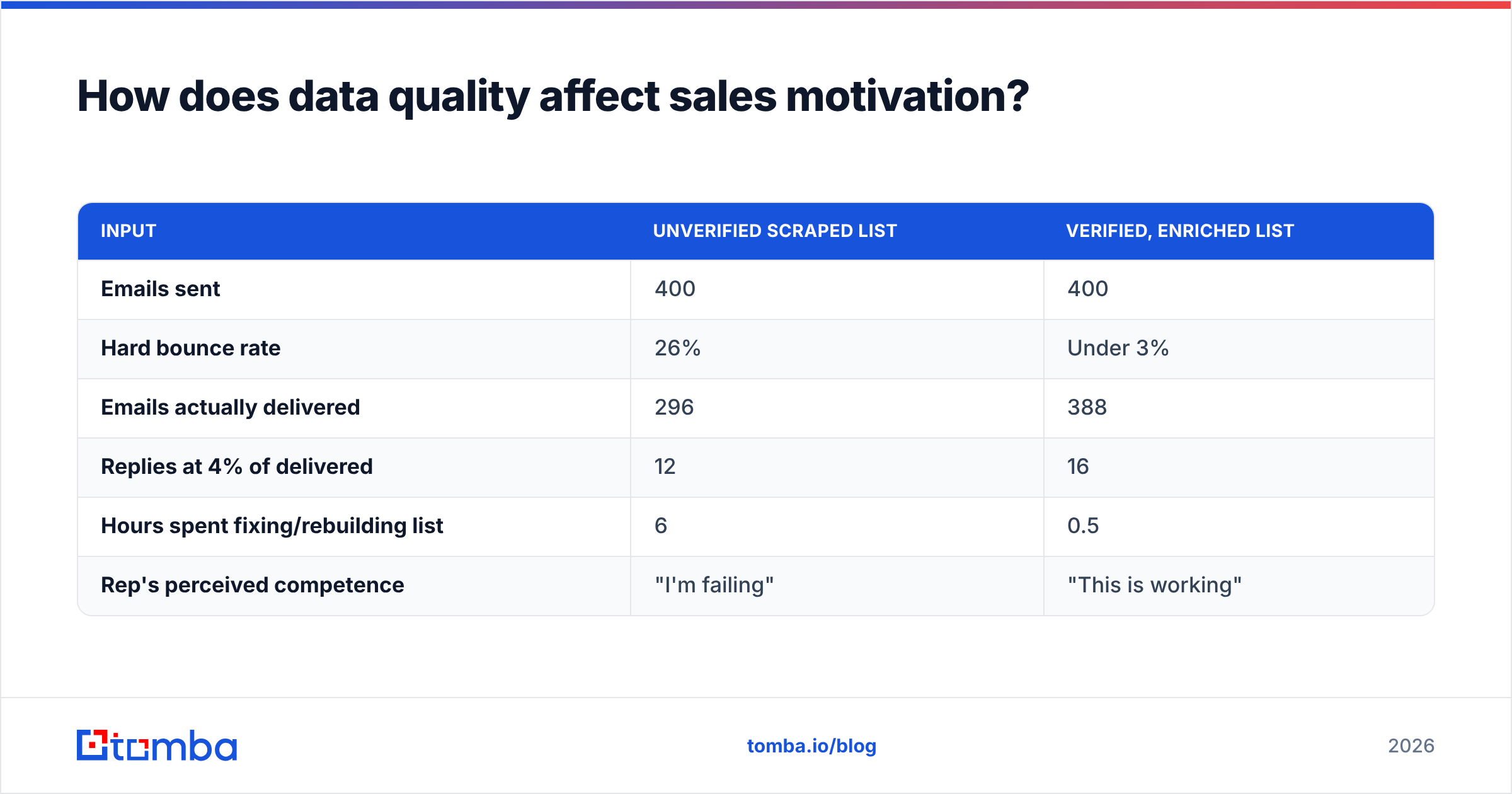
Compare two weeks of the same rep's work:
| Input | Unverified scraped list | Verified, enriched list |
|---|---|---|
| Emails sent | 400 | 400 |
| Hard bounce rate | 26% | Under 3% |
| Emails actually delivered | 296 | 388 |
| Replies at 4% of delivered | 12 | 16 |
| Hours spent fixing/rebuilding list | 6 | 0.5 |
| Rep's perceived competence | "I'm failing" | "This is working" |
Same person. Same script. Same effort. Completely different psychological experience of the week.
If your team sources their own contacts, give them tooling that does not make them feel stupid. A proper email finder plus an email verifier pass before any send removes the most demoralizing failure mode in outbound: sending great messages into the void. Protecting email deliverability is a morale intervention disguised as an ops task.
Practical rule: no list goes into a sequence without verification. Make it a policy, not a suggestion. Reps should never be the ones absorbing the cost of dirty data.
What compensation structure keeps reps motivated?#
One where the rep can trace effort to earnings within a single quarter.
The classic mistake is a plan that only pays on closed-won revenue in a market with a long sales cycle. New reps ramping into a nine-month cycle spend two quarters earning base salary while watching veterans collect. They leave in month five. You then pay 30-50% of a first-year salary to replace them, per most SHRM turnover estimates.
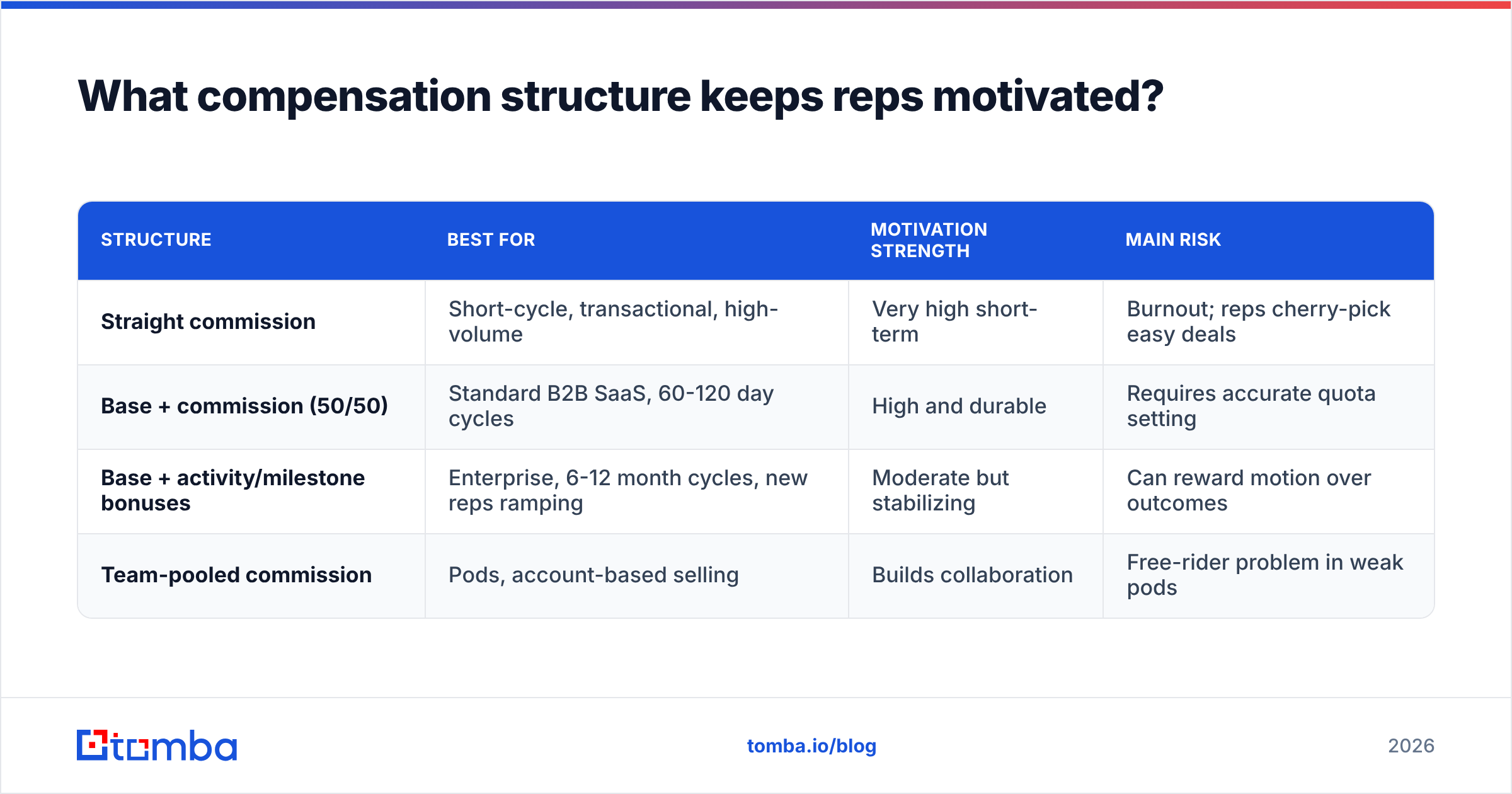
Three structures, honestly compared:
| Structure | Best for | Motivation strength | Main risk |
|---|---|---|---|
| Straight commission | Short-cycle, transactional, high-volume | Very high short-term | Burnout; reps cherry-pick easy deals |
| Base + commission (50/50) | Standard B2B SaaS, 60-120 day cycles | High and durable | Requires accurate quota setting |
| Base + activity/milestone bonuses | Enterprise, 6-12 month cycles, new reps ramping | Moderate but stabilizing | Can reward motion over outcomes |
| Team-pooled commission | Pods, account-based selling | Builds collaboration | Free-rider problem in weak pods |
For most B2B teams, base + commission with milestone accelerators is the right default. Add two refinements:
- Pay on milestones, not just close. Give partial credit for a qualified opportunity reaching stage 3 with a documented champion. It keeps long-cycle reps solvent and emotionally attached.
- Uncapped upside above 100%. Capping commission is the fastest way to teach your best rep to sandbag deals into next quarter. Every top performer has done this at a capped company.
Publish the plan in plain language with worked examples. If a rep needs a spreadsheet and a call with RevOps to model their own paycheck, the plan is a demotivator regardless of its generosity.
How often should you coach, and what should coaching look like?#
Weekly, 30 minutes, same slot, same structure. Consistency matters more than brilliance.
Ad-hoc coaching has a fatal flaw: it correlates with bad news. If your rep only hears from you when the number slips, your attention becomes an alarm signal. A fixed weekly cadence decouples coaching from crisis.
A structure that works:
- Pipeline review (10 min). Not "what's your number" — that is a dashboard question. Ask "which deal are you least sure about and why?" You are hunting for the deals dying quietly.
- One skill (10 min). Pick a single thing: discovery depth, multithreading, pricing conversations. Review one real call recording. One skill per month, not five per week.
- One blocker (5 min). What is in your way that I can remove? Then actually remove it before next week's meeting. This is where managers lose credibility fastest.
- Personal check-in (5 min). Not performative. Reps who feel known stay longer.
Record the blocker and its resolution somewhere visible. Nothing rebuilds trust like a rep watching their complaint from last Tuesday get fixed by Friday.
What non-monetary incentives actually work?#
Autonomy, mastery, and visible progress — the framework Daniel Pink popularized, and one that holds up reasonably well in sales environments where money is already on the table.
Concretely, ranked by effect per dollar spent:
- Specific public recognition. Post the exact line, question, or objection handle that worked. Naming the behavior teaches the team and rewards the individual at once. Generic praise does neither.
- Territory and account choice. Letting a consistent performer pick their next 20 target accounts is free and enormously motivating.
- Skill investment. Paying for a negotiation course signals you intend to keep them. Reps read training budget as a retention signal.
- Removing a task they hate. Automating CRM data entry or list building buys back both hours and goodwill.
- Career mapping. A written path from AE to senior AE to team lead, with criteria. Vagueness about promotion is a top-three exit reason in most exit interviews.
- Schedule flexibility on results. If a rep hits quota, stop policing their calendar.
Notice what is missing: pizza, trophies, and generic "culture" spend. Those are fine as garnish and useless as strategy. G2 and other review platforms are full of teams with great swag and 40% annual attrition.
How do you keep a team motivated during a bad quarter?#
Change what you measure, temporarily and transparently.
When the market goes quiet, revenue-only scoreboards guarantee that the whole team spends 90 days feeling like failures. Shift the visible scoreboard toward leading indicators the team can still control: qualified meetings booked, new accounts multithreaded, response rate on outbound, pipeline created. Keep revenue as the real target — just stop making it the only thing on the wall.
Three moves for a hard quarter:
- Name it out loud. "The market softened, our win rates dropped 6 points, here is what we are doing." Reps already know. Pretending otherwise costs you credibility you will need later.
- Shrink the horizon. Weekly goals instead of quarterly ones. Small, achievable wins restore momentum; a distant impossible number does not.
- Protect the top of funnel. The instinct in a bad quarter is to squeeze existing pipeline harder. That is how Q4 becomes two bad quarters. Fund prospecting first — use bulk email finder workflows or data enrichment so reps can rebuild list volume without burning their week on manual research.
How do you measure whether motivation is improving?#
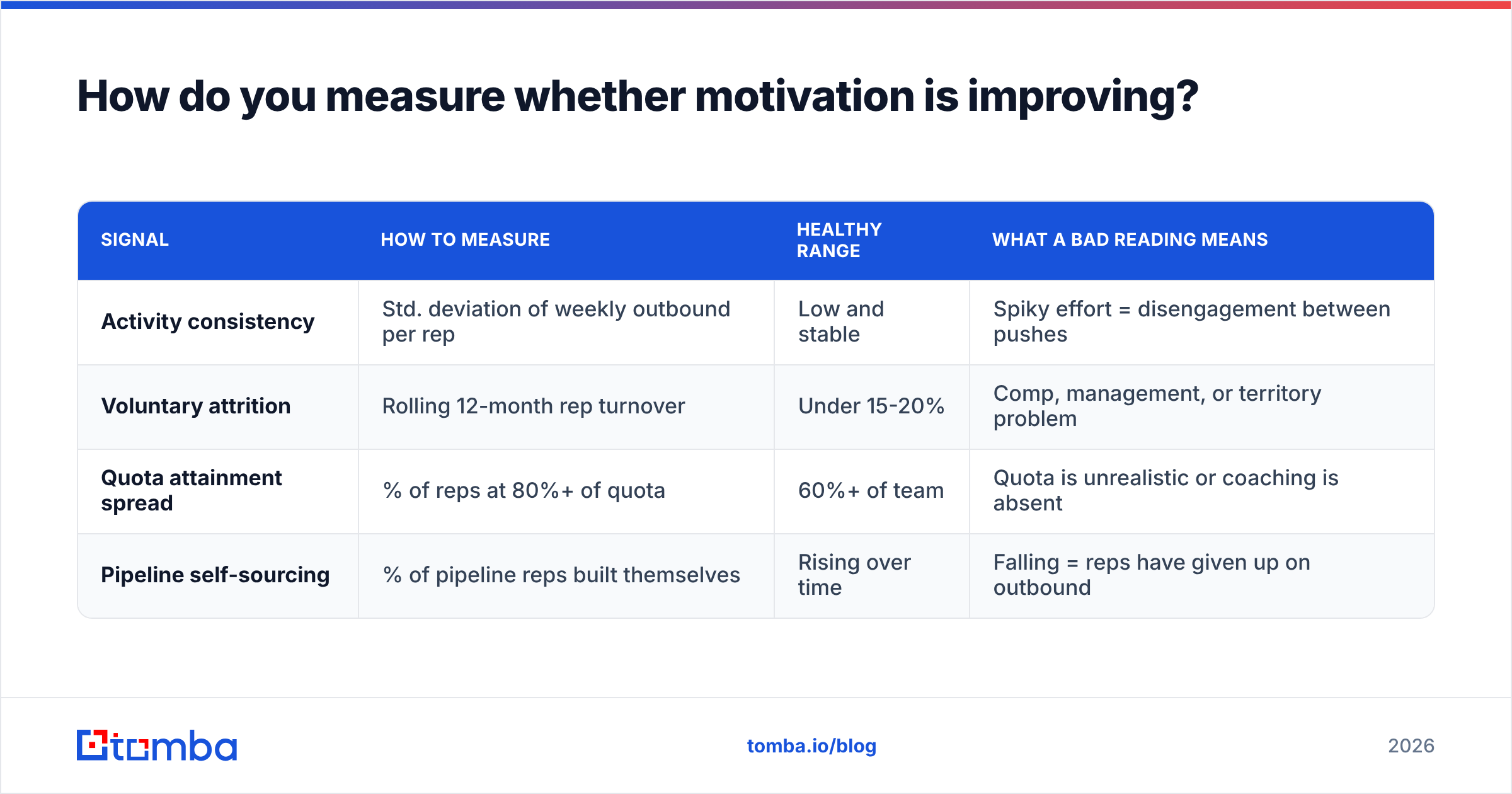
Stop relying on vibes. Four measurable proxies:
| Signal | How to measure | Healthy range | What a bad reading means |
|---|---|---|---|
| Activity consistency | Std. deviation of weekly outbound per rep | Low and stable | Spiky effort = disengagement between pushes |
| Voluntary attrition | Rolling 12-month rep turnover | Under 15-20% | Comp, management, or territory problem |
| Quota attainment spread | % of reps at 80%+ of quota | 60%+ of team | Quota is unrealistic or coaching is absent |
| Pipeline self-sourcing | % of pipeline reps built themselves | Rising over time | Falling = reps have given up on outbound |
Add a quarterly anonymous three-question pulse: Do you believe the quota is achievable? Do you have what you need to hit it? Would you recommend this team to a friend? Track the trend, not the absolute score. A drop of two points quarter-over-quarter is more actionable than any single reading.
Look at industry benchmarks when you set targets — HubSpot's sales research and Gartner's sales practice both publish attainment and turnover data worth calibrating against. And check what reps say about the tools you make them use on G2 before you buy another seat license they will resent.
What should you stop doing immediately?#
A short list of things that reliably drain motivation:
- Mid-year quota increases without a corresponding change in territory or support. This single move destroys more trust than any other management action.
- Reassigning accounts from a rep who sourced them. Do it once and every rep on the team starts hiding their pipeline from the CRM.
- Public shaming leaderboards that only show the bottom. Show the top; coach the bottom privately.
- Meetings during prime calling hours. If your 10am-noon block is full of internal syncs, you are structurally preventing the behavior you are demanding.
- Asking for CRM hygiene without giving tools. If updating a contact record takes eight manual steps, reps will not do it, and then you will blame them for the data quality problem you created.
Each of these is free to stop. Most managers know they should and do them anyway because the alternative requires a harder conversation upstream.
Putting it together#
Motivation is downstream of design. Set a quota the majority can hit, pay on things reps control, coach weekly on a fixed cadence, recognize specific behaviors publicly, and — above all — stop making your team fight their own tooling. The rep who spends Monday morning manually hunting for email addresses and Tuesday cleaning bounces is not unmotivated. They are correctly responding to a broken system.
Start with the input layer, because it is the fastest fix with the most visible payoff. Give your team a reliable way to find and verify prospect contacts, and you remove the most common source of daily, grinding, morale-eroding failure. Tomba's Email Finder finds verified professional emails by name, domain, or company, with a free tier at 25 searches a month and paid plans starting at $49/mo — see Tomba pricing for the full breakdown. Let your reps spend their week selling instead of guessing at email formats.
Related guides#
// get started
Find, verify and enrich your first contacts today
Start on the free plan with 25 searches a month, then scale when your team is ready.
Free plan · No credit card required · GDPR & CCPA
Get the Tomba newsletter
Product and data updates
// about the author