How to Manage a Large Sales Territory Without Burning Out
Big territories fail on coverage math, not effort. Here is the segmentation, routing, and data workflow reps use to work a 4,000-account patch without missing the accounts that matter.
TL;DR
- A large territory is a coverage math problem, not a work-ethic problem. If you have 3,000 accounts and 40 selling hours a week, you can meaningfully touch roughly 5% of them per quarter — so the only question that matters is which 5%.
- Tier accounts into A/B/C before you send a single email. A-tier gets multi-threaded human effort, B-tier gets light-touch sequences, C-tier gets marketing and inbound capture only.
- Build a coverage calendar, not a to-do list. Rotate through the patch on a fixed cadence so no segment goes 90 days dark.
- Bad contact data quietly eats 20-40% of a big territory. Verify before you sequence, and enrich in bulk instead of one record at a time.
- Review the tier map quarterly. Territories drift — companies hire, get funded, churn, and change ICP fit faster than most reps update their lists.
What actually makes a large sales territory hard?#
Size isn't the problem. Undifferentiated size is.
Think of a large territory like a national park with one ranger. The ranger can't patrol every trail every day. What separates a good ranger from a burned-out one is knowing which three trails carry 80% of the traffic and which forty can be checked once a season. Reps who fail in big patches usually treat all 3,000 accounts as equally deserving of attention, then work themselves into exhaustion covering 12% of them badly.
Here's the arithmetic. Assume a 3,000-account territory and 25 hours of genuine selling time per week after internal meetings, admin, and CRM hygiene. A real account touch — research, personalized outreach, follow-up, a call attempt — costs 20-30 minutes end to end. That's roughly 50-60 quality touches per week, or about 700 per quarter. If you're multi-threading three contacts per account, you've covered 230 accounts. Under 8% of the patch.
So the strategy is not "work harder." It's "be right about the 8%."
Three failure modes show up over and over in large territories:
- Recency bias — you work whatever account emailed you most recently, which correlates poorly with deal size.
- Geographic clustering — you over-serve the metro you live in and let the rest of the region go cold for two quarters.
- Data rot — you build a list once, and by month four a third of the emails bounce and half the titles have changed.

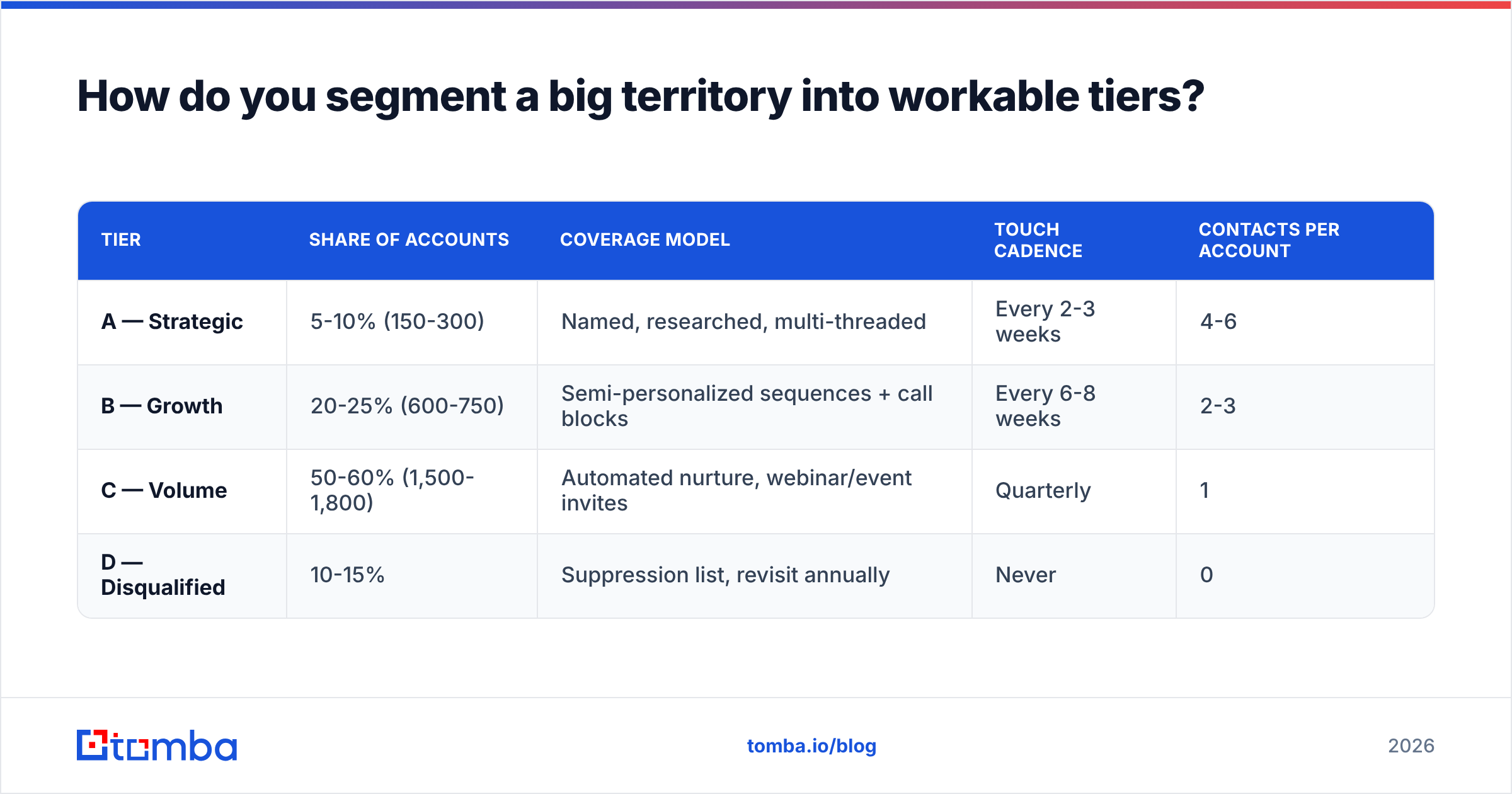
How do you segment a big territory into workable tiers?#
Score every account on two axes: fit (does this company look like your best customers?) and timing (is something happening right now?). Then assign a tier and a service level. Do this in a spreadsheet before you touch your CRM — it forces you to be honest about volume.
| Tier | Share of accounts | Coverage model | Touch cadence | Contacts per account |
|---|---|---|---|---|
| A — Strategic | 5-10% (150-300) | Named, researched, multi-threaded | Every 2-3 weeks | 4-6 |
| B — Growth | 20-25% (600-750) | Semi-personalized sequences + call blocks | Every 6-8 weeks | 2-3 |
| C — Volume | 50-60% (1,500-1,800) | Automated nurture, webinar/event invites | Quarterly | 1 |
| D — Disqualified | 10-15% | Suppression list, revisit annually | Never | 0 |
The tier boundaries matter less than the discipline of holding them. The most common mistake is letting A-tier balloon to 600 accounts because everything looks promising in a spreadsheet. If your A-tier is bigger than what you can personally touch every three weeks, it isn't an A-tier — it's a wish list.
Use these signals to sort:
- Firmographic fit — headcount, industry, tech stack, and revenue band matched against your closed-won profile, not your total addressable market.
- Trigger events — funding rounds, leadership hires, office openings, job postings for roles that imply your problem.
- Existing footprint — a current customer in the same corporate family or a champion who moved to a new company.
- Historical engagement — anyone who has opened, replied, demoed, or churned in the past 24 months belongs one tier higher than their firmographics suggest.
- Competitive displacement window — renewal timing on an incumbent tool, when you can find it.
Gartner's research on B2B buying consistently shows buying groups of six to ten people. That's why the contacts-per-account column exists: single-threading an enterprise account in a large territory is the same as not covering it at all.
How do you build a coverage calendar that actually holds?#
Stop planning your week around a task list. Plan it around segments.
A coverage calendar assigns each block of your week to a slice of the territory, then rotates. It looks boring. It works because it makes gaps visible — if Wednesday afternoon is always "West region B-tier," you notice immediately when you've skipped it three weeks running.
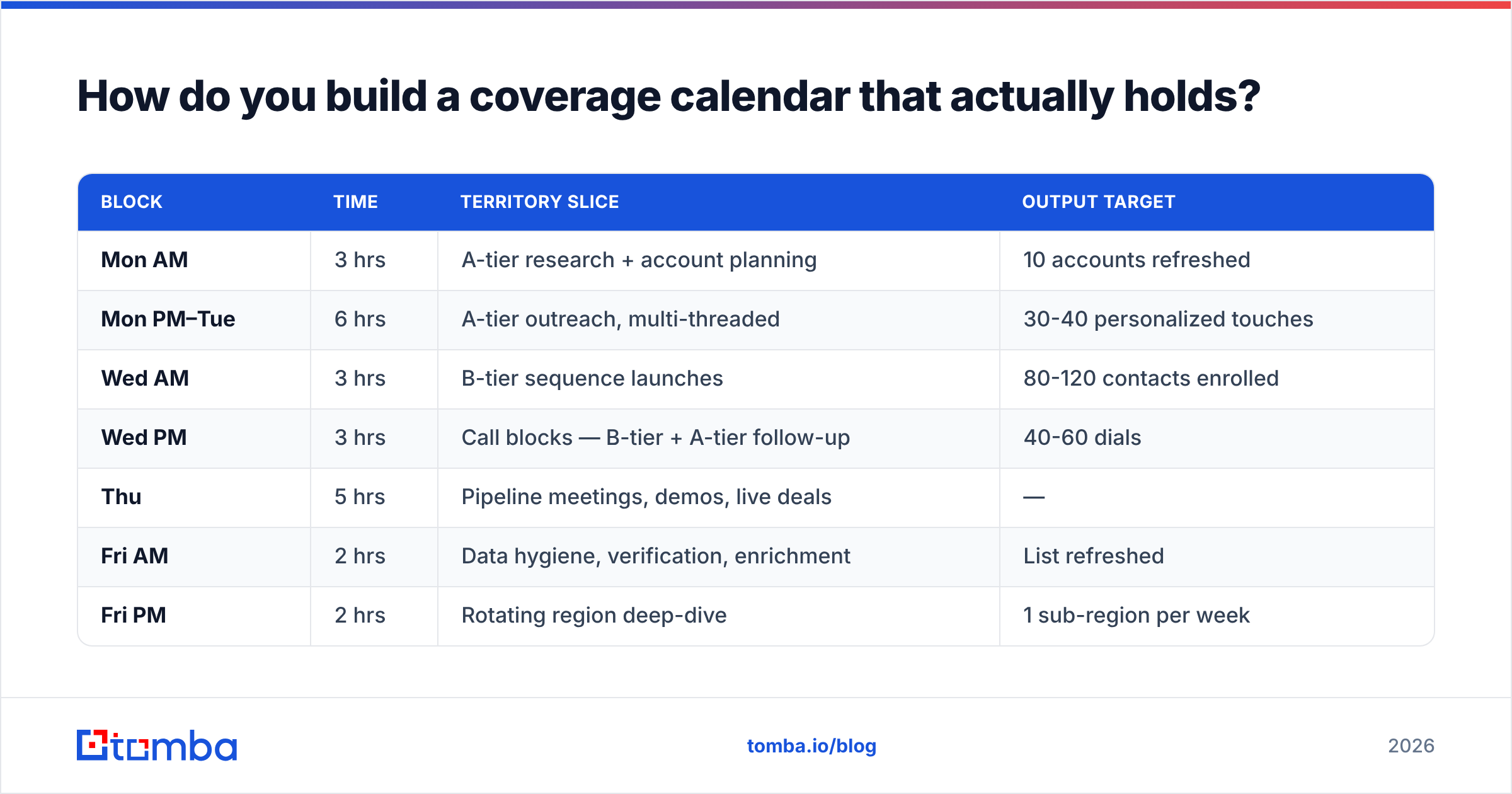
A workable weekly template for a 3,000-account patch:
| Block | Time | Territory slice | Output target |
|---|---|---|---|
| Mon AM | 3 hrs | A-tier research + account planning | 10 accounts refreshed |
| Mon PM–Tue | 6 hrs | A-tier outreach, multi-threaded | 30-40 personalized touches |
| Wed AM | 3 hrs | B-tier sequence launches | 80-120 contacts enrolled |
| Wed PM | 3 hrs | Call blocks — B-tier + A-tier follow-up | 40-60 dials |
| Thu | 5 hrs | Pipeline meetings, demos, live deals | — |
| Fri AM | 2 hrs | Data hygiene, verification, enrichment | List refreshed |
| Fri PM | 2 hrs | Rotating region deep-dive | 1 sub-region per week |
The Friday morning block is the one everyone cuts first and shouldn't. In a large territory, list maintenance is selling. A stale list means your Wednesday sequence launch quietly burns 25% of its volume on dead addresses, which pushes bounce rates past the thresholds mailbox providers care about and drags down email deliverability for everything you send afterward.
The rotating Friday afternoon block handles geographic clustering. Pick one sub-region per week — a metro, a state, a country — and go deep on just that slice. Over a quarter you'll have covered 12 sub-regions, none of which went fully dark.
Is territory management different for inbound-heavy vs outbound-heavy patches?#
Yes, and mixing them up wastes quarters.
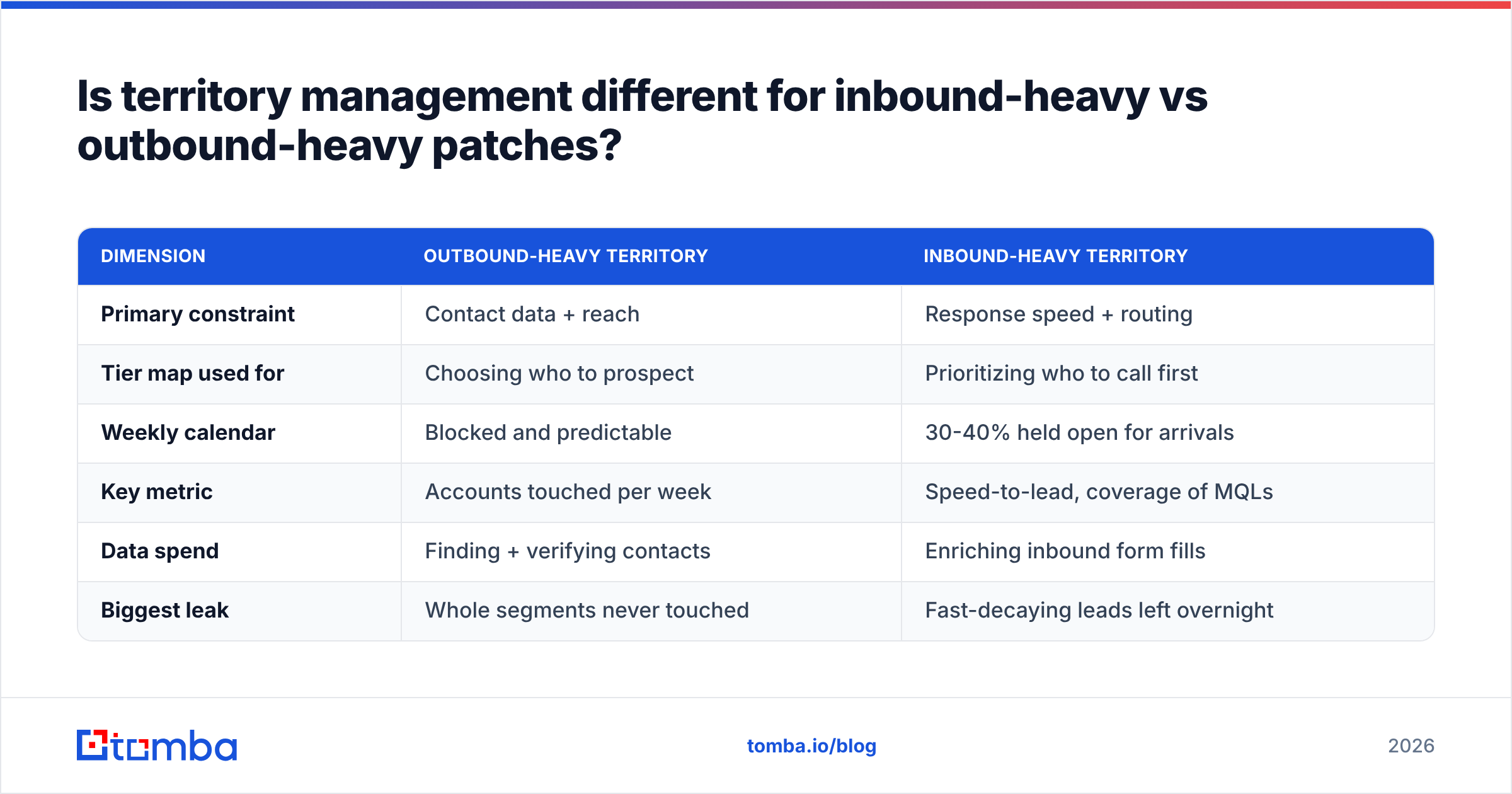
In an outbound-heavy territory, your constraint is contact discovery. You know who you want; you don't have their details. Time goes into list building, verification, and sequence throughput. Your tier map should be aggressive at the top — a smaller A-tier worked harder.
In an inbound-heavy territory, your constraint is routing and speed. Leads arrive unpredictably, and the difference between a five-minute and a five-hour response is measured in win rate. Your tier map should be a scoring model, applied to arriving leads, and your calendar needs standing gaps for immediate response rather than fully packed blocks.
| Dimension | Outbound-heavy territory | Inbound-heavy territory |
|---|---|---|
| Primary constraint | Contact data + reach | Response speed + routing |
| Tier map used for | Choosing who to prospect | Prioritizing who to call first |
| Weekly calendar | Blocked and predictable | 30-40% held open for arrivals |
| Key metric | Accounts touched per week | Speed-to-lead, coverage of MQLs |
| Data spend | Finding + verifying contacts | Enriching inbound form fills |
| Biggest leak | Whole segments never touched | Fast-decaying leads left overnight |
Most real territories are 70/30 one way or the other. Decide which, and stop trying to run both playbooks at equal intensity.
What does the data workflow look like at territory scale?#
This is where large territories break silently.
At 200 accounts you can find contacts one at a time and it feels fine. At 3,000 accounts, one-at-a-time lookup is a full-time job you don't have. The workflow has to be batch-oriented:
- Define the account list first. Pull companies from your CRM, a B2B database, or a list build — but freeze the account list before you go looking for people. Chasing contacts without an account thesis produces noise.
- Map the roles, not the names. Decide you need "VP Revenue Ops, Director of Sales Ops, and one SDR manager" per account. Role-based targeting survives job changes; name-based lists don't.
- Find contacts in bulk. Run the account list through a bulk email finder rather than searching profile by profile. On a 600-account B-tier, this is the difference between an afternoon and two weeks.
- Verify before you sequence. Every address goes through an email verifier before it enters a sending tool. Catch-all domains need separate handling — treat them as "risky," not "valid," and route them to a lower-volume, higher-personalization track.
- Enrich for prioritization. Headcount, funding, and tech-stack signals let you re-rank tiers without manual research. Contact enrichment applied to the whole list once beats researching 40 accounts by hand.
- Re-run quarterly. B2B contact data decays roughly 2-3% per month, per HubSpot's database decay research. Over four quarters that's a third of your list.
Step four is the one reps skip when they're behind on quota, and it's the most expensive skip on the list. Bounce rates above 2-3% start attracting filtering attention. Once your domain reputation slips, even your perfectly-targeted A-tier outreach lands in spam — and you've now broken the part of the territory you can least afford to lose.

How do you know if your territory coverage is actually working?#
Track coverage, not just activity. Activity metrics (calls made, emails sent) tell you how busy you were. Coverage metrics tell you whether the territory is being worked.
The four numbers worth reviewing monthly:
- Coverage rate — percentage of A-tier accounts touched in the last 30 days. Target: 100%. Anything below 85% means your A-tier is oversized.
- Dark accounts — count of B-tier accounts with zero touches in 90 days. This is the number that exposes clustering. It should trend down quarter over quarter.
- Tier conversion — what share of your pipeline comes from each tier. If 60% of pipeline comes from C-tier, your tiering model is wrong and needs rebuilding, not more effort.
- Data health — bounce rate and verified-contact percentage across the active list. Above 3% bounces, stop sending and clean.
A useful sanity check: pull a random sample of 20 accounts from your B-tier and check the last activity date on each. If more than five have nothing in six months, your calendar isn't holding and the territory is quietly shrinking to whatever you touched most recently.
Also watch your response rate by tier. A-tier should meaningfully outperform B-tier. If it doesn't, your fit scoring is decorative — you've sorted accounts by something that doesn't predict interest, and the whole tier structure is theater.
How should territory management change over a full year?#
Territories drift. Companies you disqualified in January raise a Series B in June. Your best A-tier account gets acquired and disappears. New competitors enter and change who's in play.
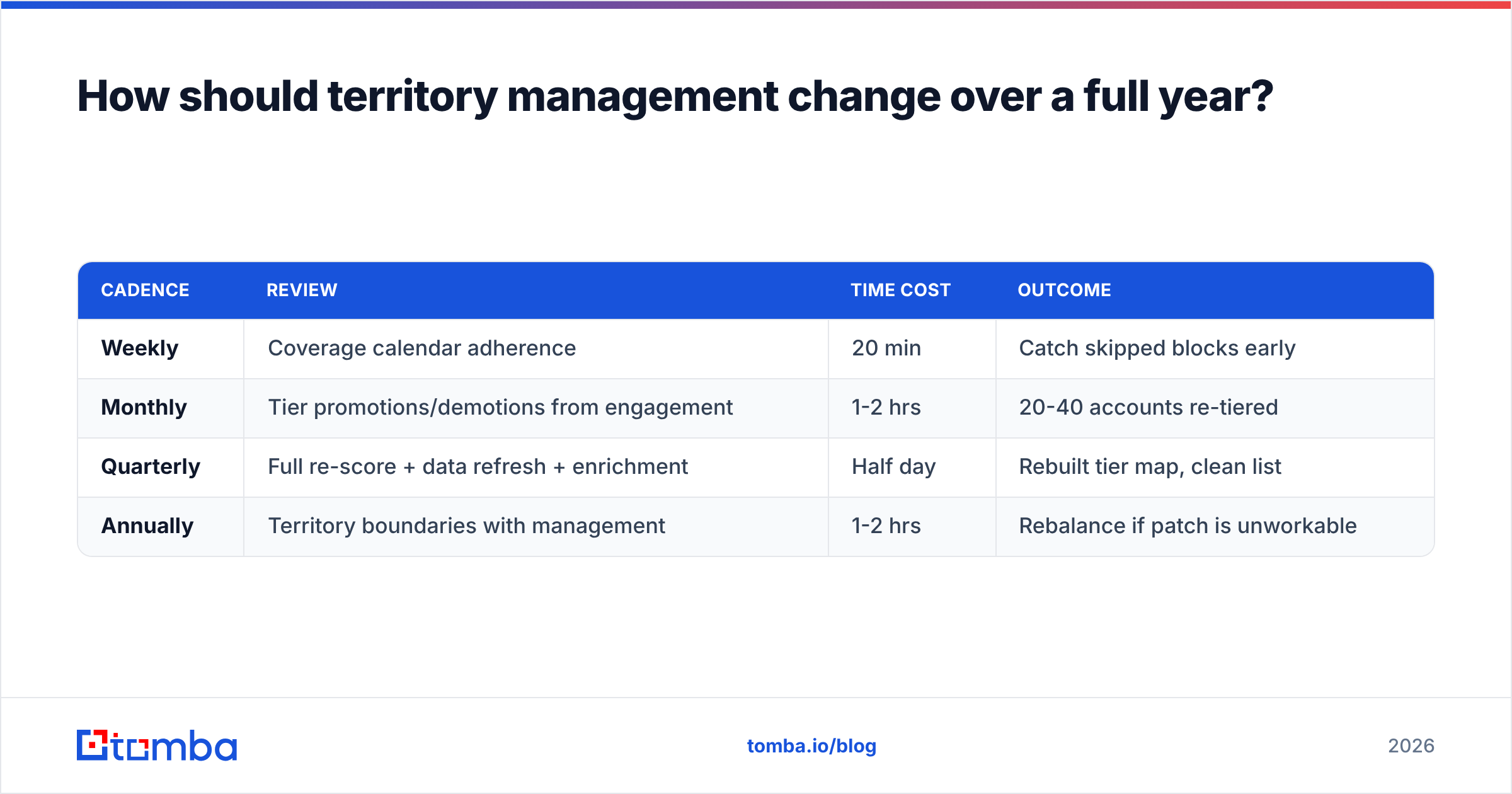
Build in three review rhythms:
| Cadence | Review | Time cost | Outcome |
|---|---|---|---|
| Weekly | Coverage calendar adherence | 20 min | Catch skipped blocks early |
| Monthly | Tier promotions/demotions from engagement | 1-2 hrs | 20-40 accounts re-tiered |
| Quarterly | Full re-score + data refresh + enrichment | Half day | Rebuilt tier map, clean list |
| Annually | Territory boundaries with management | 1-2 hrs | Rebalance if patch is unworkable |
The annual conversation is the one reps avoid and shouldn't. If your patch genuinely cannot be covered — if the A-tier alone exceeds what one person can touch on cadence — that's a management problem, not a personal-productivity problem. Bring the coverage math, not a complaint. "I have 480 accounts that meet A-tier criteria and capacity for 200" is a conversation about headcount or splitting the territory. "I'm overwhelmed" is not.
Peer benchmarks help here too. Vendor-neutral review sites like G2's sales tools categories are useful for seeing what tooling comparable teams run, which often reveals whether your patch is under-resourced relative to similar orgs.
What tooling stack supports a large territory?#
Keep it thin. Every additional tool is another sync to maintain and another place your data goes stale.
The functional minimum:
- CRM — the source of truth for tier, last touch, and owner. Everything else feeds it.
- Contact data — finding and verifying the people behind your account list. This is the piece most likely to be under-invested at scale.
- Sequencer — for B-tier volume. A-tier outreach should mostly be manual.
- Enrichment — applied in batches to keep tier scoring current without manual research.
- A dialer or call blocks — for the tier that responds to phone.
On cost: contact data pricing scales with volume, so map your quarterly lookup needs before committing to a plan. If your B-tier refresh is 600 accounts × 2.5 contacts × 4 quarters, that's 6,000 lookups a year — enough that per-credit pricing matters. Compare Tomba pricing tiers (Free at 25 searches/month, Starter $49/mo, Growth $99/mo, Pro $249/mo) against your actual quarterly volume rather than guessing. Peers like BookYourData take a different approach with pre-built list purchasing, which suits teams that want a static list handed over rather than an ongoing lookup workflow — worth evaluating against how often your territory actually needs refreshing.
If you're running the territory out of a spreadsheet before it graduates to the CRM, a Google Sheets workflow keeps lookup and verification in the same place as your tier map, which removes one export/import cycle per week.
Where should you start this week?#
Do these four things in order and you'll have a working territory system in about six hours:
- Export your full account list and add three columns: fit score (1-5), timing signal (yes/no), last touch date.
- Sort and cut into A/B/C/D using the volume guidelines above. Force yourself to keep A-tier under what you can touch every three weeks.
- Verify the contact data on your A and B tiers before anything gets sequenced. Suppress the bounces, flag the catch-alls.
- Block next week's calendar by segment, not by task. Protect the Friday hygiene block.
Then run it for four weeks before you change anything. Territory systems fail more often from constant tinkering than from a slightly wrong tier boundary.
Coverage math only works if the contacts behind your account list are real. If verifying and finding the people in a 3,000-account territory is currently a manual grind, Tomba Email Finder handles it at batch scale — search by domain, name, or company, verify before you sequence, and refresh the whole tier map each quarter without rebuilding it by hand. The free tier gives you 25 searches a month to test it against your own patch before you commit to a plan.
Related guides#
Ready to find emails that actually work?
Join 150,000+ professionals who stopped guessing and started sending. Free credits on signup — no credit card required.
Get the Tomba newsletter
Practical outbound tactics and product updates — once every two weeks.
About the author