How to Market to CEOs in 2026: A Practical B2B Playbook
CEOs read less, delegate more, and buy on risk — not features. Here is a concrete playbook for reaching chief executives in 2026, with channel comparisons, message templates, and the data work that makes it land.
TL;DR
- CEOs do not buy features. They buy reduced risk, faster revenue, and fewer things to worry about. Every asset you put in front of one must map to a number on their P&L.
- The chief executive is rarely the first toucher and almost always the final approver. Market to the CEO and to the person who briefs them — usually a VP or Chief of Staff.
- Channel priority for 2026: peer referral > targeted direct email > executive-level events > LinkedIn > everything else. Paid social to CEOs is mostly waste.
- Short beats long. A 90-word email with one specific claim outperforms a 400-word "value narrative" by a wide margin in the executive segment.
- None of this works on stale data. Bad addresses, wrong titles, and shared inboxes kill CEO campaigns before the copy ever gets read.
Why is marketing to CEOs different from marketing to anyone else?#
Because the constraint is attention, not interest.
A VP of Marketing has a budget line and a problem they own. A CEO has forty problems and owns all of them. When you market to a director, you are competing against other vendors. When you market to a CEO, you are competing against a board meeting, an investor call, a resignation, and a product outage — all happening the same morning.
That changes three things concretely:
- Your message must be pre-qualified for them. A CEO does not read to decide whether something is relevant. They scan to confirm it is irrelevant so they can delete it. Give them the disqualifier early: company size, industry, the specific outcome.
- Your proof must be peer-shaped. "Used by 4,000 companies" means nothing. "Three Series B fintechs in your market cut onboarding cost 30%" means something, because the CEO can picture the person who made that call.
- Your ask must be small and reversible. "Book a 45-minute demo" is a commitment. "Worth a 12-minute call, or should I send this to your VP of Ops?" is an off-ramp — and off-ramps get answered.
The other structural difference is company size. In a 20-person company, the CEO is the buyer, the evaluator, and the user. In a 2,000-person company, the CEO is a ratifier who hears about you third-hand. Same title, completely different campaign. Segment on headcount before you segment on anything else.
What do CEOs actually care about in 2026?#
Four things, in roughly this order:
- Revenue durability — not growth in the abstract, but whether next year's number is defensible. Net revenue retention, pipeline coverage, concentration risk.
- Cost of delivery — margin pressure has been the defining executive conversation since 2023. Anything that reduces headcount-per-unit-of-output gets read.
- Risk exposure — security incidents, compliance drift, key-person dependency, AI governance. CEOs are personally accountable here in a way they are not for, say, campaign attribution.
- Talent leverage — can the team they already have do more? This is why AI tooling gets executive attention while incremental SaaS does not.
Notice what is missing: your feature roadmap, your integration count, your UI. Those matter to the evaluator, not the approver. Gartner's research on B2B buying groups has consistently found that enterprise purchases involve six to ten decision-makers, and that the executive sponsor's role is mostly to validate the business case others assembled. Write for that role.
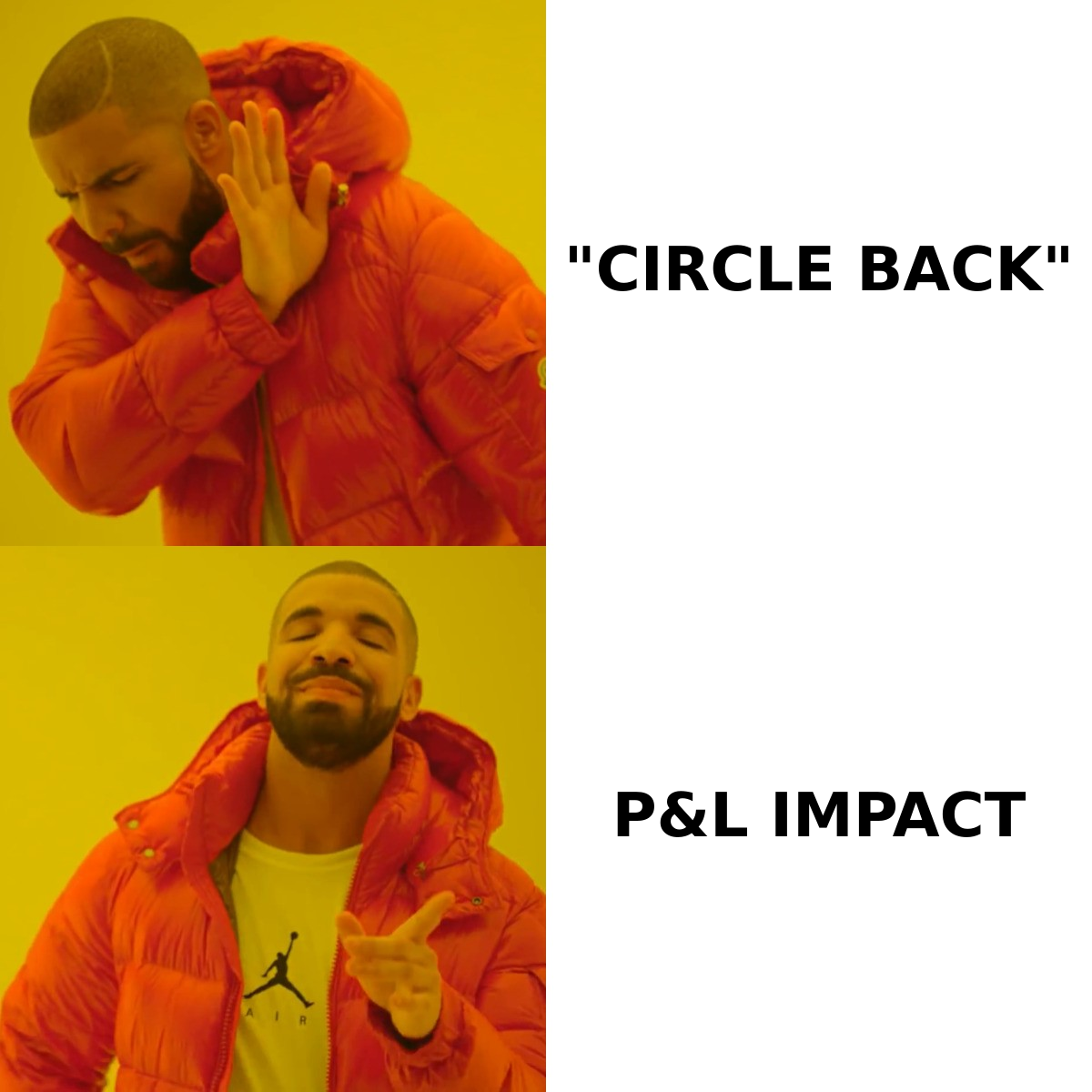
A useful test before you send anything: can the CEO forward it to their CFO without editing it? If the answer is no — if it needs translation from product language into money language — you have written it for the wrong person.
Which channels actually reach chief executives?#
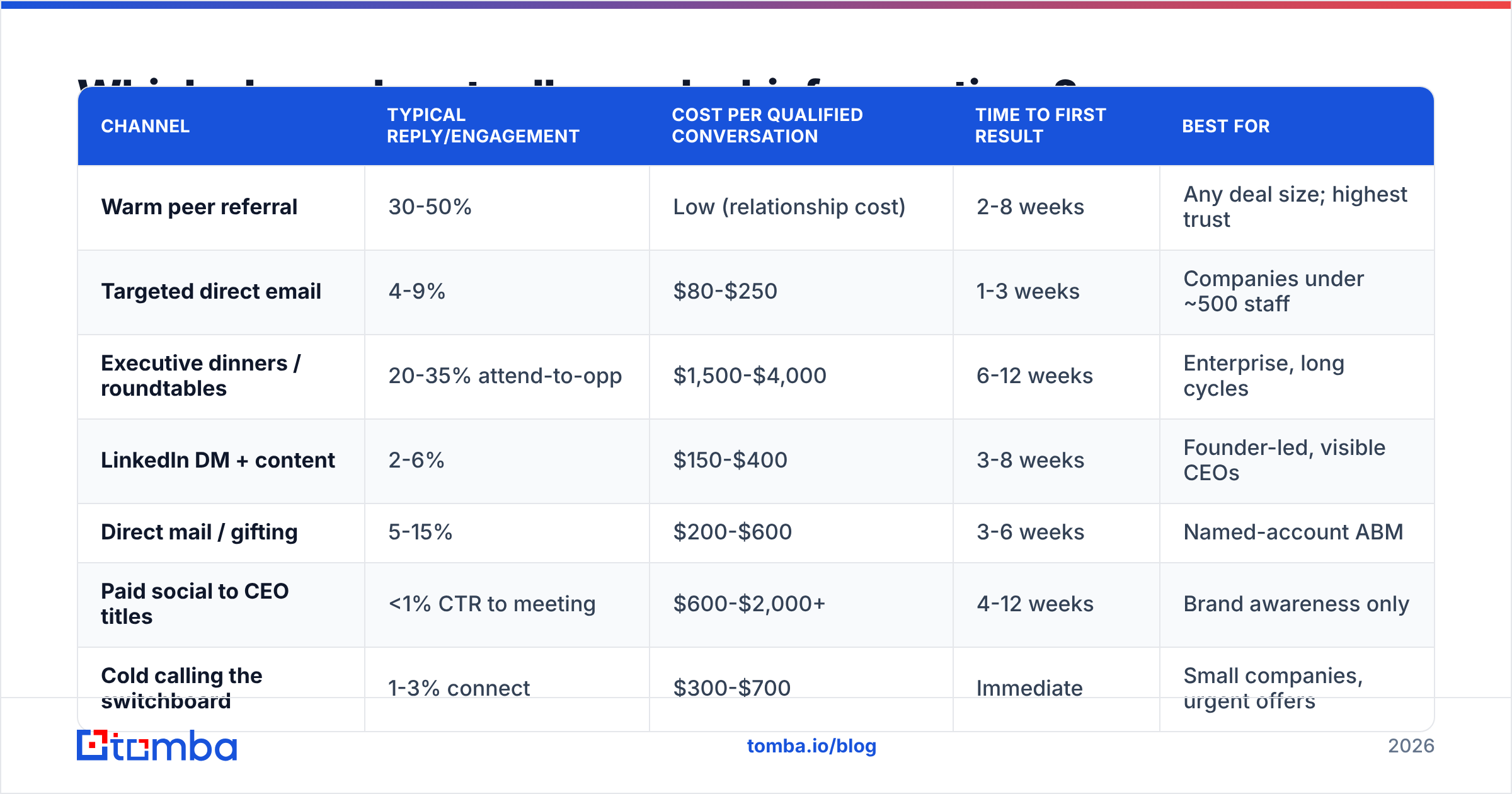
Here is how the realistic options compare. Costs are directional 2026 US B2B mid-market figures; your mileage varies by vertical.
| Channel | Typical reply/engagement | Cost per qualified conversation | Time to first result | Best for |
|---|---|---|---|---|
| Warm peer referral | 30-50% | Low (relationship cost) | 2-8 weeks | Any deal size; highest trust |
| Targeted direct email | 4-9% | $80-$250 | 1-3 weeks | Companies under ~500 staff |
| Executive dinners / roundtables | 20-35% attend-to-opp | $1,500-$4,000 | 6-12 weeks | Enterprise, long cycles |
| LinkedIn DM + content | 2-6% | $150-$400 | 3-8 weeks | Founder-led, visible CEOs |
| Direct mail / gifting | 5-15% | $200-$600 | 3-6 weeks | Named-account ABM |
| Paid social to CEO titles | <1% CTR to meeting | $600-$2,000+ | 4-12 weeks | Brand awareness only |
| Cold calling the switchboard | 1-3% connect | $300-$700 | Immediate | Small companies, urgent offers |
Two takeaways from that table. First, the cheapest scalable channel is still direct email — but only when the list is genuinely CEO-level and the addresses resolve. Second, paid social targeting "CEO" as a job title is the single most-wasted line item in B2B budgets, because the title field on ad platforms is self-reported and stale, and because CEOs do not click ads during work hours.
The channel most teams under-invest in is the peer path. Ask your three happiest customers who else they'd want in a room. That is a better list than anything you can buy.
How do you build a CEO list that isn't garbage?#
This is the unglamorous part that determines everything downstream. A perfect email to the wrong inbox is a zero.
Four rules:
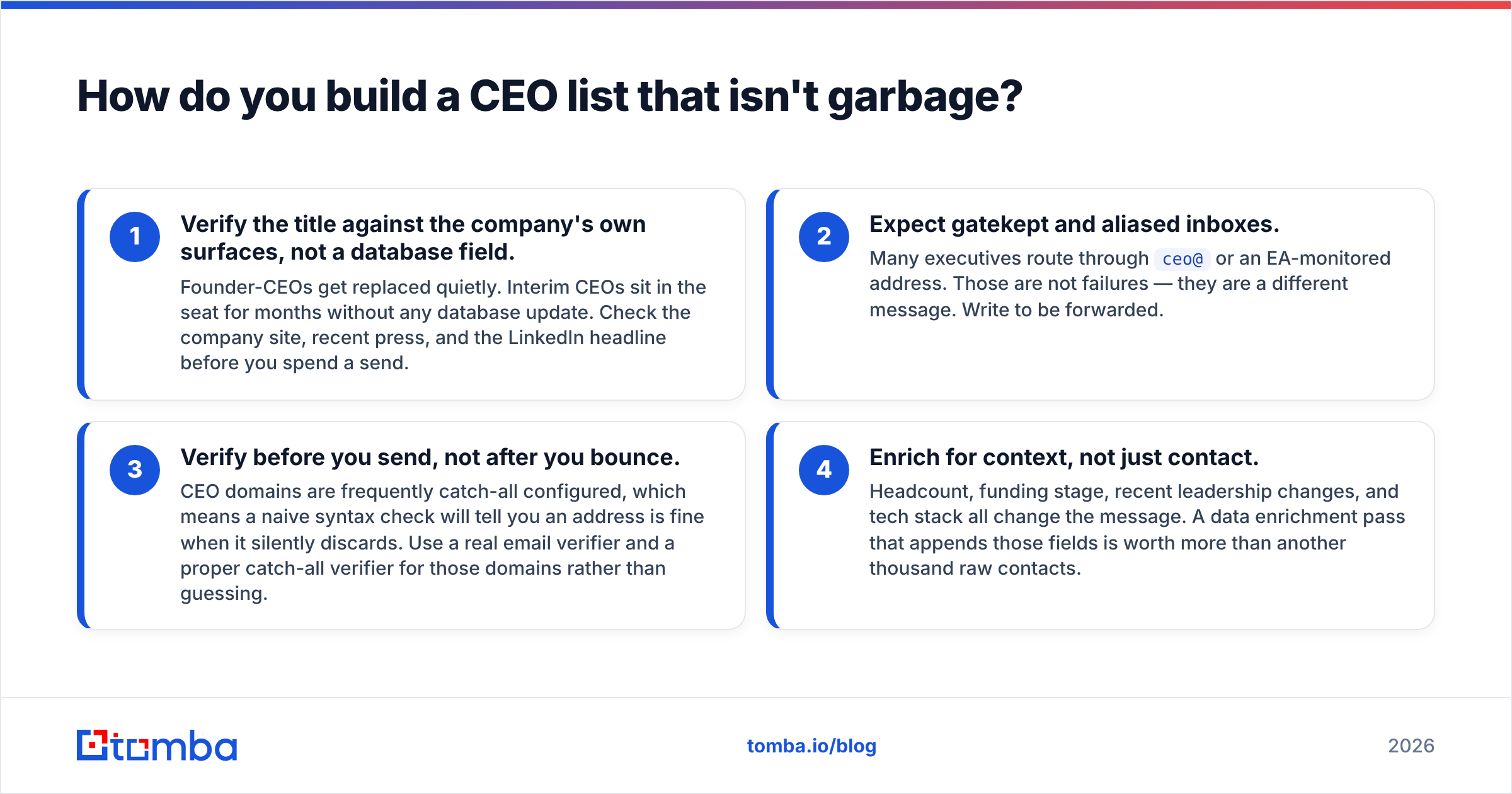
- Verify the title against the company's own surfaces, not a database field. Founder-CEOs get replaced quietly. Interim CEOs sit in the seat for months without any database update. Check the company site, recent press, and the LinkedIn headline before you spend a send.
- Expect gatekept and aliased inboxes. Many executives route through
ceo@or an EA-monitored address. Those are not failures — they are a different message. Write to be forwarded. - Verify before you send, not after you bounce. CEO domains are frequently catch-all configured, which means a naive syntax check will tell you an address is fine when it silently discards. Use a real email verifier and a proper catch-all verifier for those domains rather than guessing.
- Enrich for context, not just contact. Headcount, funding stage, recent leadership changes, and tech stack all change the message. A data enrichment pass that appends those fields is worth more than another thousand raw contacts.
For sourcing itself, a domain search against a target account list is usually faster than person-by-person lookups: pull every public address pattern at the company, identify the executive naming convention, then confirm the specific individual. Companies that use first.last@ for everyone use it for the CEO too.
Vendors worth knowing in this space cluster into three groups — pattern-based finders like Tomba, aggregated contact databases such as BookYourData, and enrichment layers that sit on top of your CRM. Most mature teams run two of the three, because coverage on executive titles varies sharply by region and company size. Cross-checking two sources on your top 100 named accounts is cheap insurance.
What should a CEO-facing email actually say?#
Ninety words. One claim. One number. One small ask.
Structure that works:
- Line 1 — the disqualifier. "You're the only company on our list doing X at Y scale" or "This only applies to teams running Z." It proves you did work and lets them exit fast.
- Line 2 — the peer proof. One named or narrowly described comparable, with an outcome expressed in money or time.
- Line 3 — the mechanism, compressed. How the outcome happened, in one sentence. Not the feature list.
- Line 4 — the reversible ask. A short call, or an explicit offer to route to the right lieutenant.
What to cut: your company boilerplate, the phrase "I wanted to reach out," any sentence containing "solutions," calendar links in the first email, and attachments. Attachments to executives get quarantined more often than they get opened.
Subject lines to CEOs should read like internal mail, not marketing. Four to six words, lowercase is fine, no brackets, no emoji. "question on your Q3 hiring plan" beats "Unlock 40% More Pipeline 🚀" every single time. If you want to pressure-test variants before sending, run them through a subject line tester rather than arguing about it in Slack.
One more thing that matters more at this level than any other: your sending infrastructure. Executive inboxes sit behind the most aggressive filtering in the organization. If your SPF record and DMARC alignment are sloppy, you never get the chance to be judged on copy. HubSpot's research on email engagement reinforces the same point across segments — technical delivery is upstream of everything creative.
Should you market to the CEO or to their team?#
Both, sequenced. This is where most programs fail — they pick one and hope.
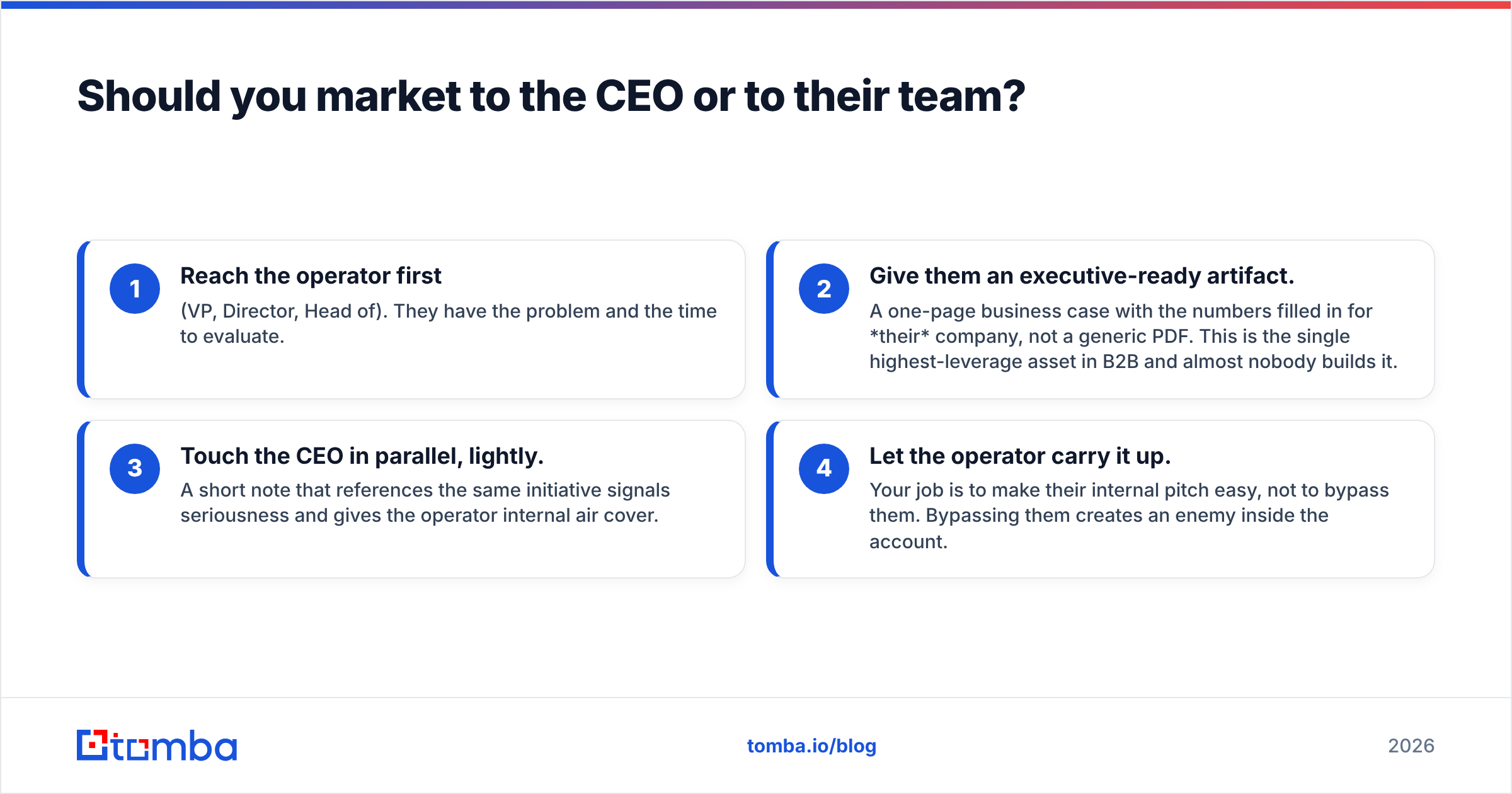
The pattern that works in 2026:
- Reach the operator first (VP, Director, Head of). They have the problem and the time to evaluate.
- Give them an executive-ready artifact. A one-page business case with the numbers filled in for their company, not a generic PDF. This is the single highest-leverage asset in B2B and almost nobody builds it.
- Touch the CEO in parallel, lightly. A short note that references the same initiative signals seriousness and gives the operator internal air cover.
- Let the operator carry it up. Your job is to make their internal pitch easy, not to bypass them. Bypassing them creates an enemy inside the account.
The exception is companies under roughly 50 people, where the CEO is the operator. There, go direct and skip the choreography entirely.
Track this properly in your pipeline. If your CRM only records one contact per opportunity, you are blind to whether the executive touch is doing anything. Multi-threaded deals close at meaningfully higher rates, and you cannot improve what you do not log.
How do you measure whether CEO marketing is working?#
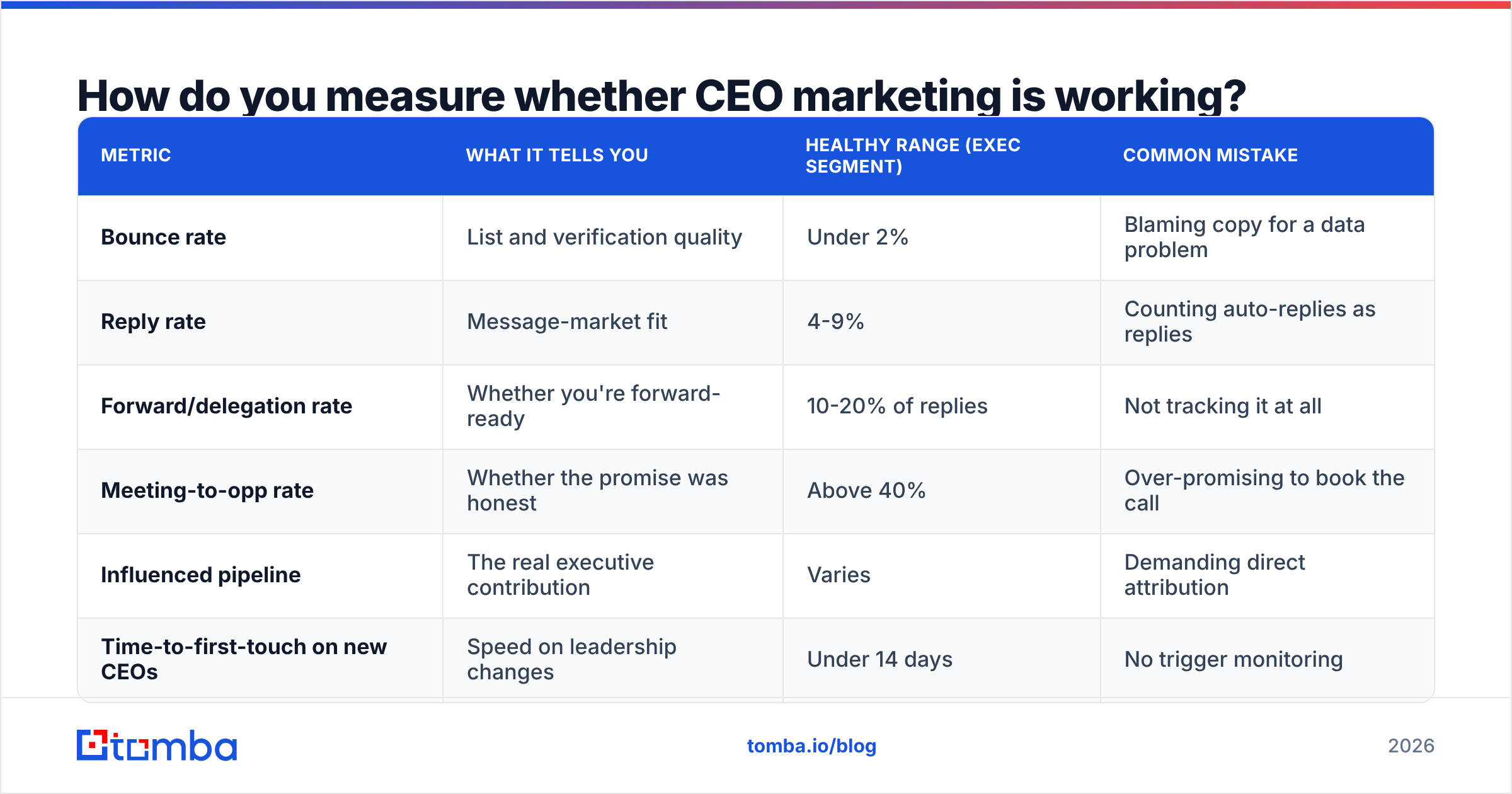
Not by reply rate alone. Executive campaigns have long, indirect payoffs, and judging them on the same dashboard as your SMB motion will get them killed prematurely.
| Metric | What it tells you | Healthy range (exec segment) | Common mistake |
|---|---|---|---|
| Bounce rate | List and verification quality | Under 2% | Blaming copy for a data problem |
| Reply rate | Message-market fit | 4-9% | Counting auto-replies as replies |
| Forward/delegation rate | Whether you're forward-ready | 10-20% of replies | Not tracking it at all |
| Meeting-to-opp rate | Whether the promise was honest | Above 40% | Over-promising to book the call |
| Influenced pipeline | The real executive contribution | Varies | Demanding direct attribution |
| Time-to-first-touch on new CEOs | Speed on leadership changes | Under 14 days | No trigger monitoring |
That last row deserves emphasis. New CEOs and newly promoted executives are the highest-intent segment in B2B, full stop. A leader in their first 120 days is explicitly looking to change things and has political capital to spend. Monitoring for leadership changes across your target accounts and reaching out within two weeks converts several times better than the same message sent in month eighteen.
Set up the trigger, keep the list current, and act fast. That is most of the game.
What mistakes kill CEO campaigns?#
- Writing for the buying committee and sending to the CEO. Different documents. Do not reuse.
- Leading with your company. They have not heard of you and will not be persuaded that they should have. Lead with their situation.
- Volume as a strategy. A 5,000-contact executive blast damages your domain and your brand simultaneously. Two hundred well-researched contacts outperform it.
- Ignoring the EA. The executive assistant is not an obstacle; they are the routing layer. Being straightforward with them works far better than trying to slip past.
- Never following up. Two to three touches spread over three weeks. Executives miss things constantly, and a polite second note gets a real share of the total replies.
- Skipping verification. This is the quiet killer. Sending 500 unverified executive addresses to build a "quick list" can tank your sender reputation for months — and you will spend that time debugging copy instead of data.
Where should you start this quarter?#
Pick 100 accounts. Not 1,000.
For each: confirm the CEO's name and tenure, find and verify a working address, identify the operator one level down, and write one company-specific line you could not have written about anyone else. That last requirement is what separates a campaign from spam, and it is also the reason 100 is the right number.
Then run the sequence: operator first, executive-ready artifact second, light CEO touch in parallel, follow up twice. Measure forwards as seriously as you measure replies.
When you are ready to build that list, start with the data layer — the Tomba Email Finder resolves executive addresses by name and domain with verification built into the same call, so you are not stitching two tools together. The free tier covers 25 searches a month if you want to sanity-check your top accounts first, and paid plans start at $49/mo on Starter with Growth at $99/mo for teams running full named-account programs. Full Tomba pricing is on the site. Get the addresses right, and the rest of this playbook actually has a chance to work.
Related guides#
// get started
Find, verify and enrich your first contacts today
Start on the free plan with 25 searches a month, then scale when your team is ready.
Free plan · No credit card required · GDPR & CCPA
// about the author