How To Master Sales in 2026: The 7-Skill Operating System
Most reps don't lose deals at the close — they lose them at list-building and discovery. Here's the 7-skill system for mastering sales in 2026, plus a 90-day plan and the metrics that prove you're improving.
TL;DR
- Mastering sales is not a personality trait. It is seven repeatable skills — territory building, contact data hygiene, first-touch relevance, discovery, multithreading, objection handling, and forecast discipline — practiced in that order.
- The two skills that move quota fastest are the two most reps skip: building a tight, verified list and running a structured discovery call.
- Precision beats volume at almost every deal size above $5k ACV. A 400-contact verified list usually outperforms a 4,000-contact scraped one.
- Track leading indicators (meetings booked per 100 verified contacts, discovery-to-proposal rate) rather than lagging ones (closed revenue). Lagging metrics tell you what happened; they don't tell you what to fix.
- Give it 90 days with a written plan. Skill acquisition in sales follows a rep-count curve, not a calendar.
What Does It Actually Mean to Master Sales?#
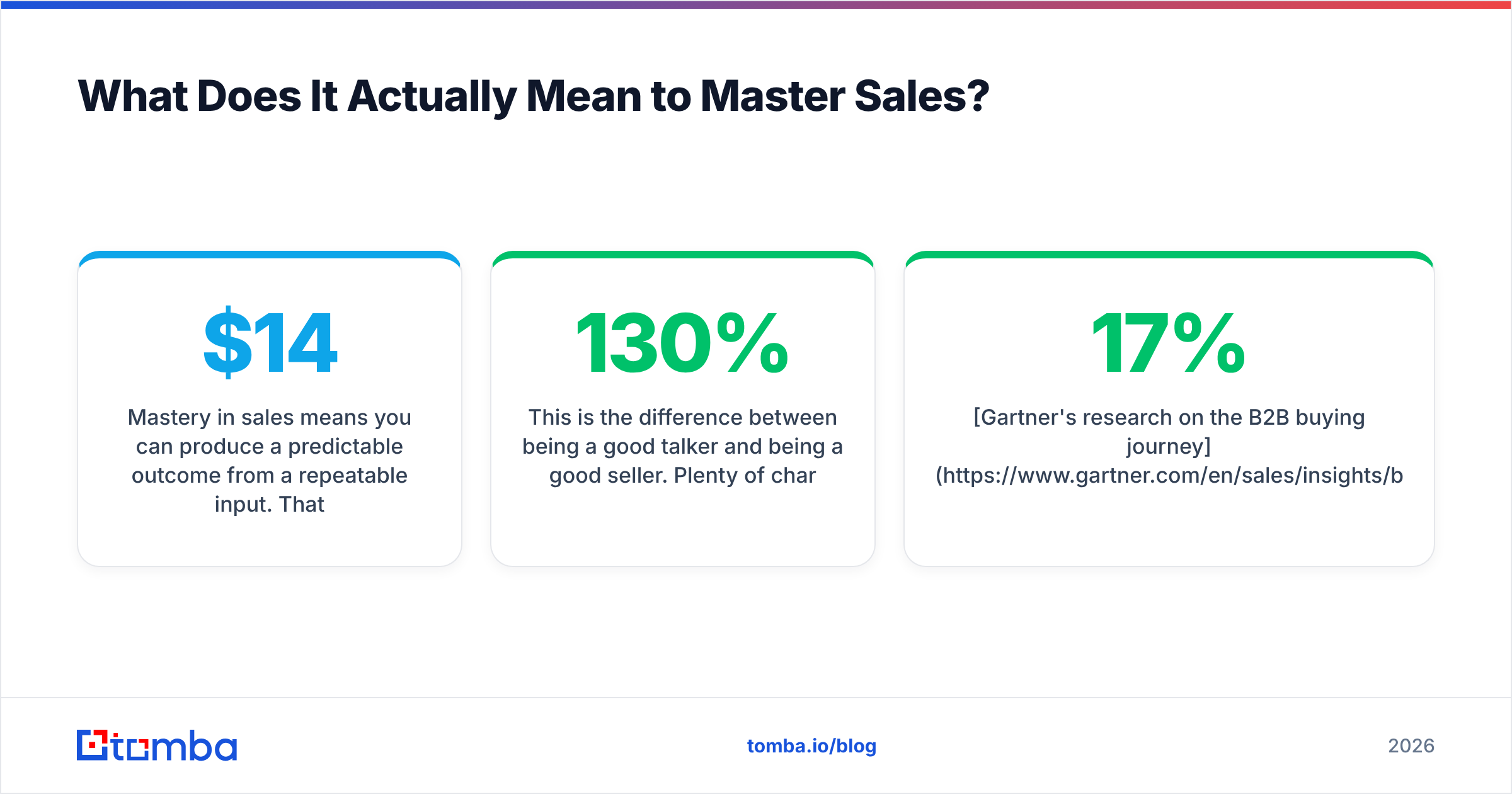
Mastery in sales means you can produce a predictable outcome from a repeatable input. That's it. If you can say "for every 100 verified contacts I work with this sequence, I book 6 meetings, and 2 of those become opportunities worth an average of $14,000," you have mastered your motion. If your good months come from a big logo that happened to reply, you haven't — you got lucky, and luck does not scale.
This is the difference between being a good talker and being a good seller. Plenty of charismatic people miss quota every quarter because their pipeline is built on chance encounters. Plenty of quiet, methodical reps hit 130% because they built a system and stopped improvising.
Think of it like a restaurant kitchen. A home cook can produce one excellent dinner. A line cook produces the same excellent dinner 200 times a night because everything is prepped, portioned, and sequenced before service starts. Sales mastery is the prep work — the mise en place — not the flourish at the table.
Gartner's research on the B2B buying journey makes the point bluntly: buyers spend only about 17% of their purchase process with sales reps, and that time is split across all vendors. You do not get many at-bats. Mastery is about making each one count.

Which Sales Skills Actually Compound?#
Not all sales skills are equal. Some give you a one-time bump; others compound because every deal you run makes the next one easier. Here are the seven that compound, in the order you should build them.
Territory construction. Deciding who you sell to is a higher-leverage decision than anything you say to them. A rep with a well-defined ICP and 300 accounts beats a rep with 3,000 random ones. Write down firmographic filters (headcount, industry, tech stack, funding stage) and a disqualifier list before you touch a single contact.
Contact data hygiene. Bad data quietly destroys more pipeline than bad copy. Every bounced send damages your domain, and every wrong contact wastes a slot in your sequence. Verification is not optional infrastructure — it is the floor everything else stands on.
First-touch relevance. Your opening message has one job: earn ten more seconds. That requires a specific, checkable observation about the prospect's business. Not "I saw you're in fintech." Something like "you posted three AE roles in Austin last month."
Structured discovery. The best reps do not wing discovery calls. They run a consistent frame — current state, cost of the problem, decision process, timeline — and take notes against it. Structure is what makes discovery coachable.
Multithreading. Single-threaded deals slip. Modern B2B purchases involve six to ten stakeholders, so a deal with one champion and no second contact is a deal with a single point of failure. Aim for three named contacts per opportunity by the second call.
Objection handling as diagnosis. Objections are data, not obstacles. "Too expensive" means one of three things: no perceived value, wrong buyer, or bad timing. Master reps ask which one it is before they respond.
Forecast discipline. Calling your number honestly — including the deals you're going to lose — is the skill that gets you promoted. It also forces you to look at your pipeline with clear eyes, which improves everything upstream.
Notice that five of the seven happen before anyone says the word "pricing." That is the point. Most sales problems are prospecting problems wearing a costume.
How Do You Build a Territory You Can Actually Work?#
Start narrow. A territory you can work properly is one where you can name the top 50 accounts from memory and know something specific about each one.
The practical sequence:
Define the ICP with hard filters. Headcount range, geography, industry, and — most usefully — a technology or process signal. If your product replaces a spreadsheet workflow, your ICP is companies that still run that workflow in spreadsheets. Write the disqualifiers too: too small, wrong region, no budget authority in-market.
Map accounts before contacts. Build the account list first, then find people. Reps who go contact-first end up with a pile of unrelated titles at companies they can't explain a reason to call.
Find the right people at those accounts. For each target account, identify the economic buyer, the likely champion, and one technical or operational stakeholder. A domain search run against the company website returns the published email patterns and named contacts far faster than manual LinkedIn scraping, and it gives you the pattern to extrapolate from.
Verify before you send. This is the step that separates a working list from an expensive liability. Run every address through an email verifier and drop anything that comes back invalid. Catch-all domains need their own handling — treat them as "risky," not "valid," and send to them in small, separated batches.
Cap the list. 300–500 contacts per rep per month is a workable ceiling for a considered B2B sale. Beyond that you cannot personalize, and un-personalized volume is what killed most 2023-era outbound programs.
Is Volume or Precision the Better Path to Quota?#
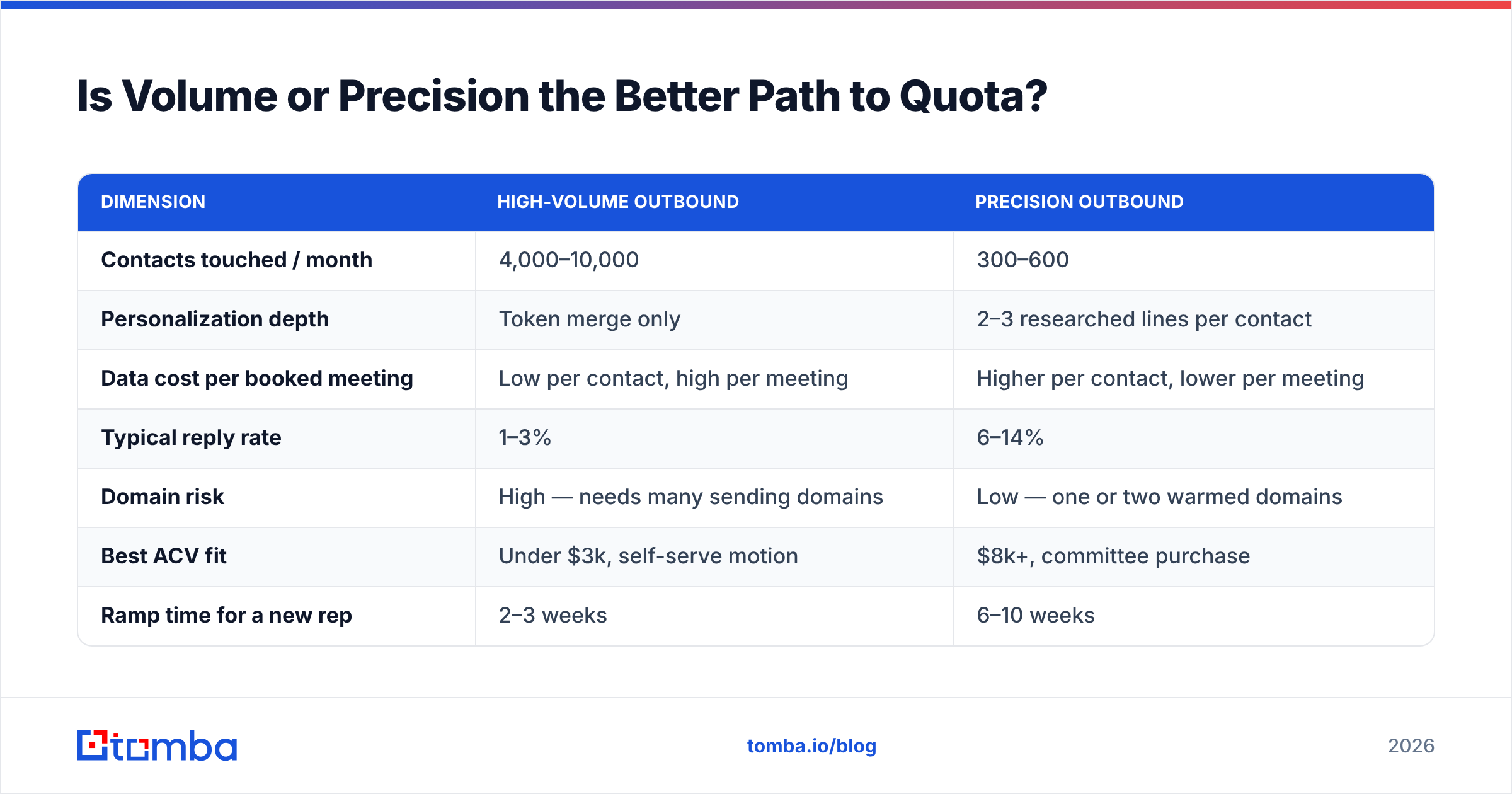
Both work in theory. In practice they demand entirely different infrastructure, and most teams pick volume because it feels like progress. Here's the honest comparison.
| Dimension | High-volume outbound | Precision outbound |
|---|---|---|
| Contacts touched / month | 4,000–10,000 | 300–600 |
| Personalization depth | Token merge only | 2–3 researched lines per contact |
| Data cost per booked meeting | Low per contact, high per meeting | Higher per contact, lower per meeting |
| Typical reply rate | 1–3% | 6–14% |
| Domain risk | High — needs many sending domains | Low — one or two warmed domains |
| Best ACV fit | Under $3k, self-serve motion | $8k+, committee purchase |
| Ramp time for a new rep | 2–3 weeks | 6–10 weeks |
| Fails when | Data quality drops or filters tighten | Rep skips research to hit activity targets |
Precision wins for most B2B teams selling anything with a committee behind it. Volume still works for transactional, low-ACV products with a genuinely broad market — but it now requires serious deliverability engineering, and the tolerance from inbox providers keeps shrinking. If you're choosing between hiring another SDR and improving your data quality, improve the data first. It's cheaper and it lifts every rep at once.
One caveat worth stating plainly: precision outbound fails loudly when reps are measured on activity counts. If your comp plan rewards 80 sends a day, you will get 80 sends a day and zero research. Change the metric before you change the motion.
What Does a Repeatable Discovery Call Look Like?#
A discovery call has four jobs, and you should be able to name them out loud before you dial.
Job one: confirm the problem is real and expensive. Ask what happens today, then ask what it costs. "How many hours a week does the team spend on that?" is a better question than "is that a priority for you?" — the first produces a number, the second produces politeness.
Job two: understand the decision process. Who else touches this? What has to be true for a purchase to happen this quarter? Has the company bought anything in this category before, and how did that go? Reps who skip this are the reps whose deals die in legal in December.
Job three: establish the cost of inaction. If nothing changes, what breaks? If the honest answer is "nothing," you do not have a deal — you have a nice conversation. Disqualify and move on.
Job four: agree on a concrete next step, on the call. Not "I'll send some information." A calendar invite with a named attendee and a stated agenda, booked before you hang up.
Write these four into a template and fill it in during every call. HubSpot's sales blog has a large library of discovery frameworks worth adapting, but the specific framework matters far less than using the same one every time. Consistency is what makes your notes comparable across deals, and comparable notes are what let you spot patterns.

What Does a 90-Day Plan to Master Sales Look Like?#
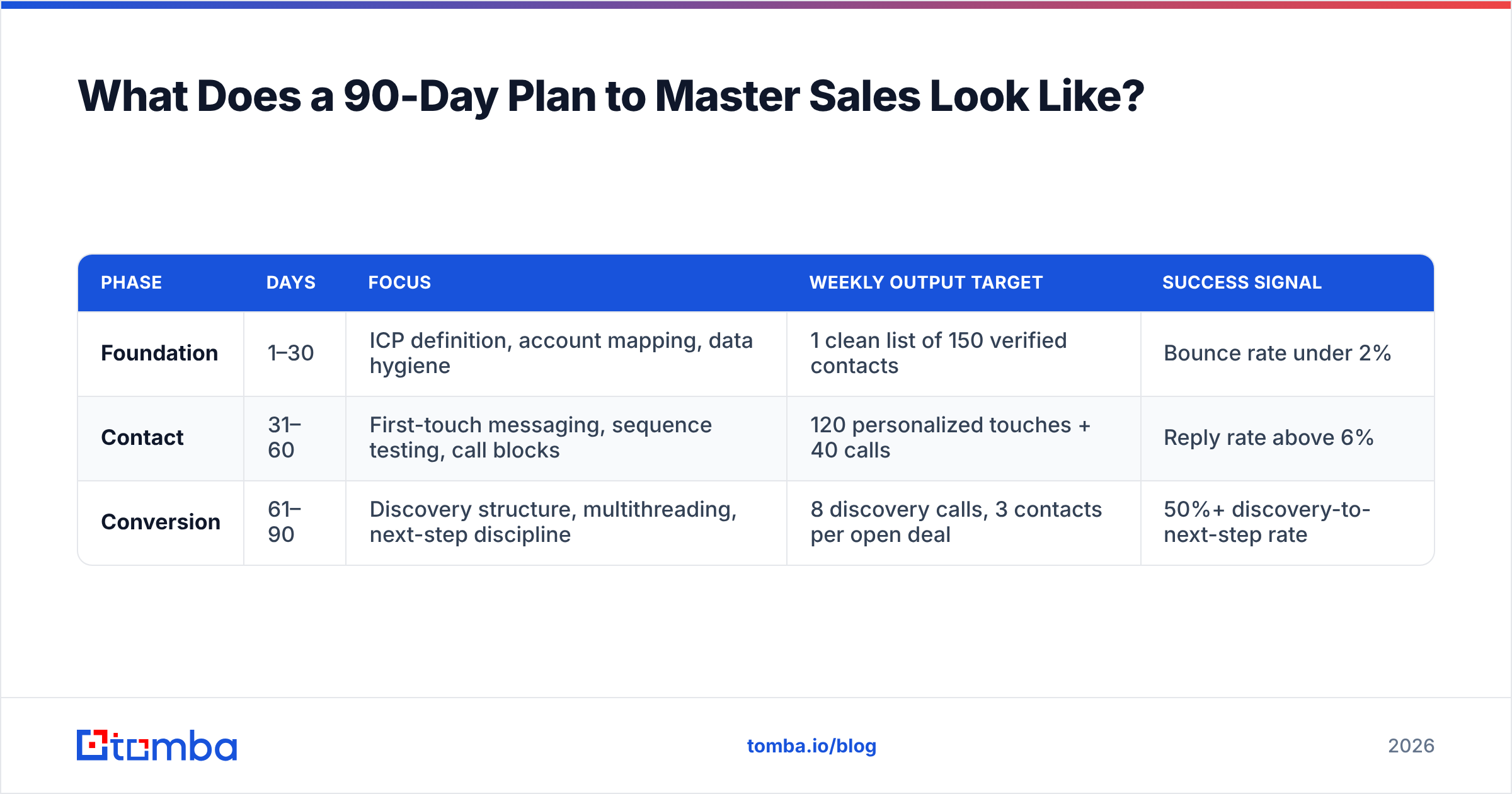
Skills develop through repetitions, not through time passing. Structure the reps deliberately.
| Phase | Days | Focus | Weekly output target | Success signal |
|---|---|---|---|---|
| Foundation | 1–30 | ICP definition, account mapping, data hygiene | 1 clean list of 150 verified contacts | Bounce rate under 2% |
| Contact | 31–60 | First-touch messaging, sequence testing, call blocks | 120 personalized touches + 40 calls | Reply rate above 6% |
| Conversion | 61–90 | Discovery structure, multithreading, next-step discipline | 8 discovery calls, 3 contacts per open deal | 50%+ discovery-to-next-step rate |
Two rules make this plan work. First, do not advance to the next phase until the previous phase's success signal is met — a rep practicing discovery on a garbage list learns nothing transferable. Second, record and review. Listening back to two of your own calls a week is the highest-return hour in your calendar, and it costs nothing.
If you're managing a team, resist the urge to compress this. A rep who ramps in six weeks on activity metrics and stalls at 60% of quota for three quarters is more expensive than a rep who ramps in twelve weeks and holds 110%.
Which Metrics Tell You You're Improving?#
Revenue is a lagging indicator. By the time it moves, the decisions that caused it are 90 days old. Track the leading ones instead:
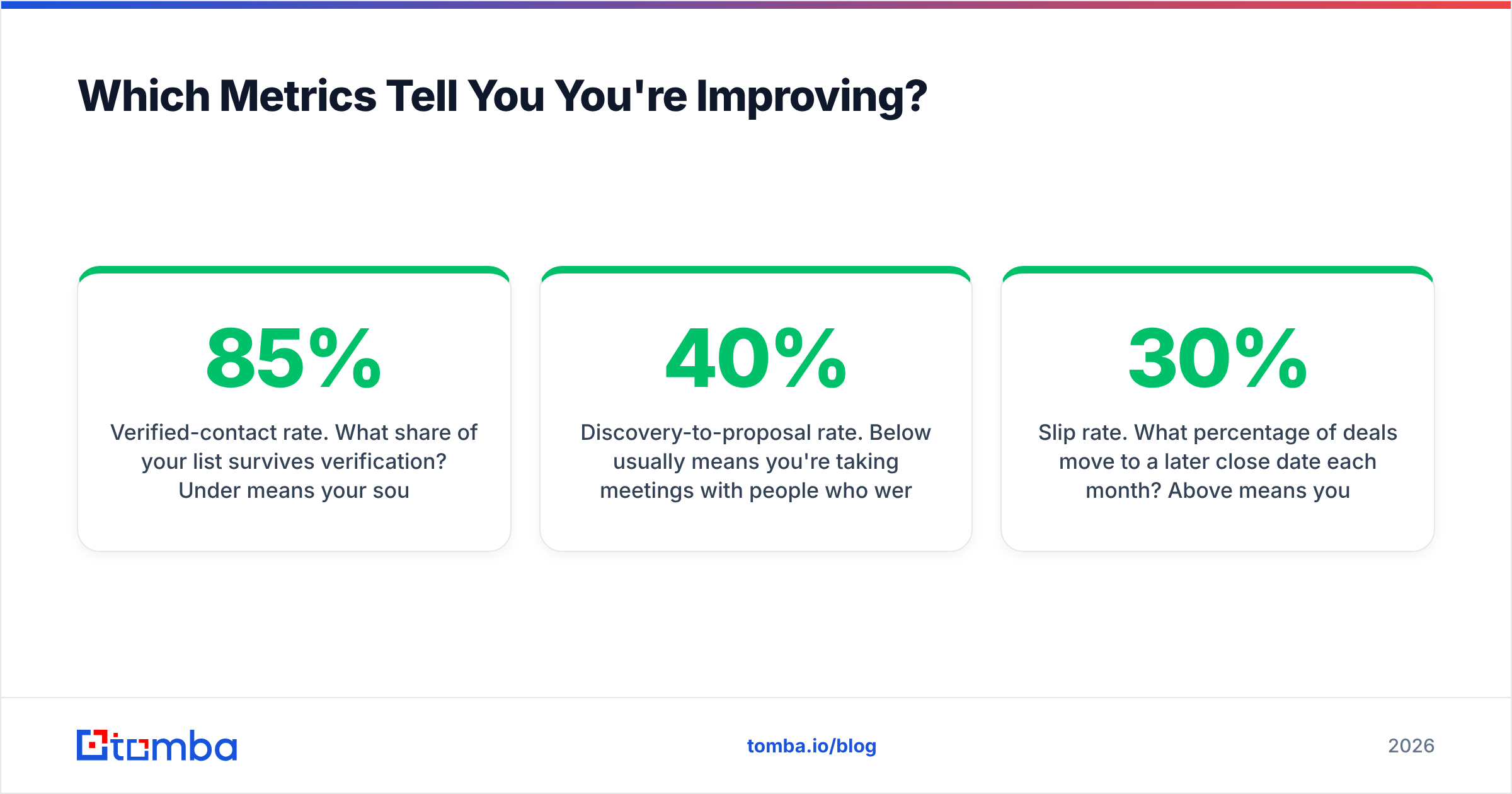
- Verified-contact rate. What share of your list survives verification? Under 85% means your sourcing is weak.
- Meetings per 100 verified contacts. The single cleanest measure of outbound quality. Improving this from 4 to 7 is worth more than doubling your send volume.
- Reply-to-meeting rate. If replies are high but meetings are low, your messaging is interesting but your ask is wrong.
- Discovery-to-proposal rate. Below 40% usually means you're taking meetings with people who were never going to buy — a qualification problem, not a closing problem.
- Average contacts per open opportunity. Below two, and your forecast is fiction.
- Slip rate. What percentage of deals move to a later close date each month? Above 30% means your discovery isn't surfacing the real decision process.
Compare your response rate month over month against your own baseline, not against benchmarks you read on LinkedIn. Public benchmarks are self-reported by people with something to sell.
What Are the Most Common Mistakes to Avoid?#
Buying a bigger list instead of a better one. More contacts do not fix a positioning problem — they just distribute it more widely and burn your domain in the process.
Confusing activity with progress. 100 sends to unverified addresses is worse than 20 sends to verified ones, because the first one also costs you future deliverability.
Pitching in the first message. The opening touch sells the reply, not the product. Nothing else.
Treating every objection as a closing challenge. Some objections are legitimate disqualification signals. Recognizing those early is a skill, not a failure.
Skipping the CRM. Notes you didn't write are deals you can't forecast. Whatever your CRM is, use it the same way every time — comparing tools on G2's sales software categories is useful, but consistency beats feature count.
Working alone. The fastest learning loop in sales is a peer who will listen to your calls and tell you the truth. Find one.
Where Should You Start This Week?#
Pick the narrowest slice you can execute end to end. Fifty accounts. Three contacts each. Verify all 150 addresses, write one genuinely specific opening line per contact, and run one sequence for two weeks. Then look at your meetings-per-100 number and fix the weakest step.
That single loop, repeated, is what mastery looks like from the inside. It's unglamorous and it works.
The part most reps get wrong is step two — the contacts. If you want a list that doesn't bounce and doesn't waste your sequence slots, start with the Tomba Email Finder. It finds professional addresses by domain, name, or company and returns confidence scores and sources so you know what you're sending to before you hit go. The free tier gives you 25 searches a month to test it against your own accounts, and paid plans start at $49/mo on Starter — check Tomba pricing for the Growth and Pro tiers if you're building lists at team scale.
Build the list right, and the rest of the system finally has something solid to stand on.
Related guides#
// get started
Find, verify and enrich your first contacts today
Start on the free plan with 25 searches a month, then scale when your team is ready.
Free plan · No credit card required · GDPR & CCPA
Get the Tomba newsletter
Product and data updates
// about the author