How to Motivate a Sales Team in 2026: A Manager's Playbook
Cash bonuses stop working faster than most managers admit. Here is what actually moves quota attainment in 2026 — with a side-by-side breakdown of incentive models, rep archetypes, and the metrics worth tracking.
TL;DR
- Motivation problems are usually input problems. Reps with bad lists, unclear quotas, or 40% of their week in admin do not get fixed by a spiff.
- Money works — but only up to the point where compensation feels fair. Past that, autonomy, mastery, and visible progress drive more incremental effort.
- The highest-leverage motivational act most managers ignore: give reps data they can trust. Nothing kills a rep faster than 300 bounced emails.
- Run motivation on a cadence — weekly 1:1s on skill, monthly on pipeline, quarterly on career. Ad-hoc pep talks decay in 48 hours.
- Measure it: activity-to-meeting ratio, ramp time, voluntary attrition, and quota attainment distribution. If those don't move, your program didn't work.
Why do most sales motivation programs fail?#
Because they treat a systems problem as an attitude problem.
A rep who has stopped picking up the phone is rarely lazy. Usually one of four things is true: the territory is worked out, the data they're dialing is stale, the quota math no longer feels achievable, or they've stopped believing the product wins. A leaderboard TV in the corner does not solve any of those.
Think of it like a restaurant kitchen. If tickets are backing up, you don't motivate the line cooks with a poster. You check whether the walk-in is stocked, whether the prep list was done, and whether the POS is firing orders in a sane sequence. Sales motivation works the same way — clear the operational grit first, then apply incentive.
The research backs this up. Gartner's sales research has repeatedly found that seller burnout and low engagement correlate more strongly with process friction and unclear expectations than with compensation levels. Reps quit managers and systems, not comp plans.
So before you design a contest, audit three inputs:
- List quality — what percentage of contacts your reps work are reachable and correctly titled?
- Time allocation — how many hours per week go to selling versus CRM hygiene, list building, and internal meetings?
- Quota realism — what share of the team hit number last quarter? If it's under 40%, the quota is the demotivator.
What actually motivates salespeople in 2026?#
Four things, roughly in this order of durability.
1. Perceived fairness of compensation. This is a hygiene factor, not a motivator. Once reps believe the plan is fair, transparent, and paid on time, more money produces diminishing returns on effort. Below that line, nothing else you do matters.
2. Winnable work. Reps push hardest when they believe the next call could convert. That belief is built from data quality, ICP clarity, and recent proof — a closed deal in the same segment last month is worth more than any speech.
3. Visible progress. Humans are motivated by movement, not by endpoints. A rep who can see "14 of 20 meetings booked" works differently than one staring at "$420K to go."
4. Status and mastery. Peer recognition, deal-review spotlights, and skill certification. Cheap to run, surprisingly sticky.
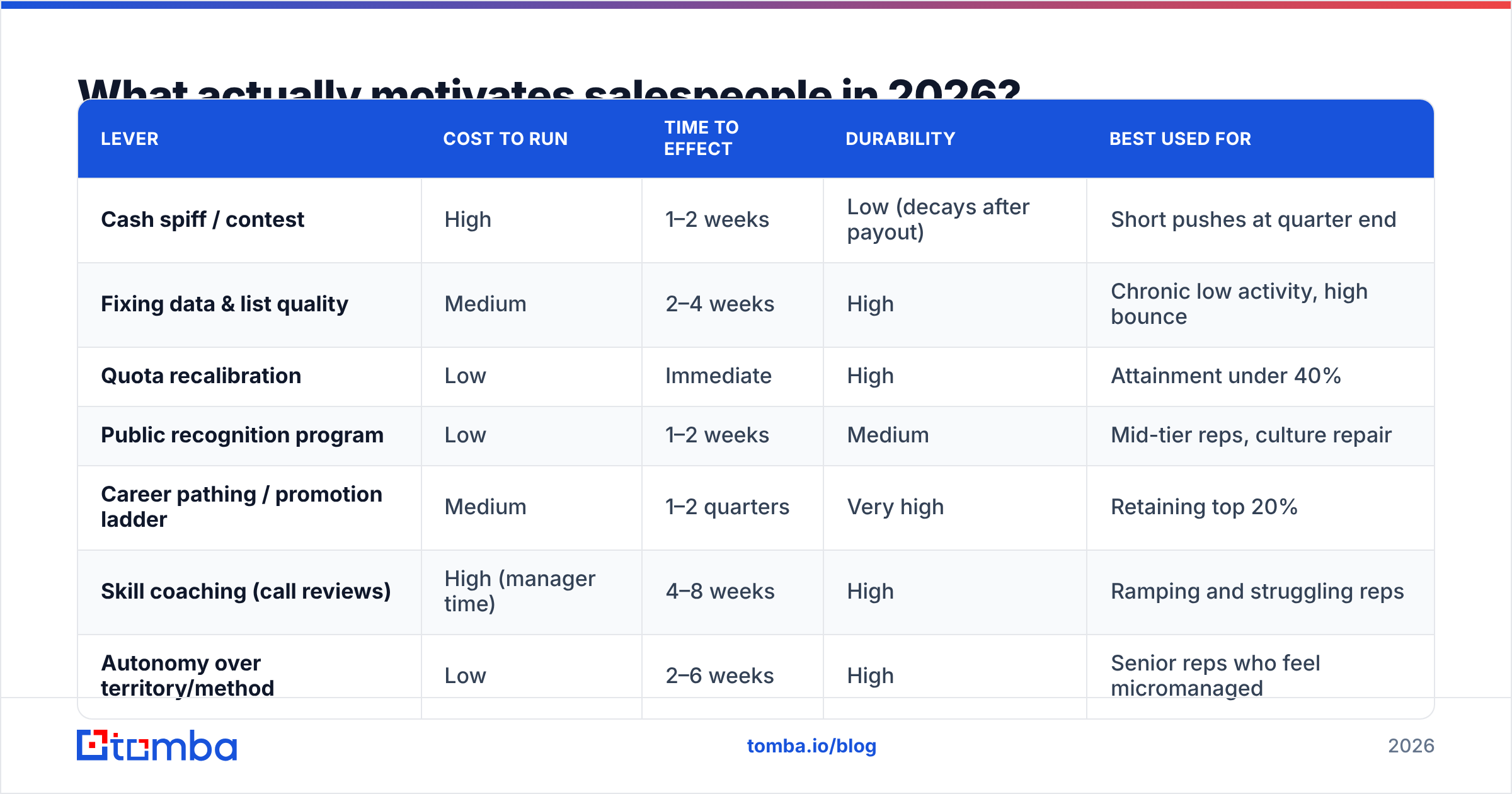
Here's how the common motivational levers actually compare:
| Lever | Cost to run | Time to effect | Durability | Best used for |
|---|---|---|---|---|
| Cash spiff / contest | High | 1–2 weeks | Low (decays after payout) | Short pushes at quarter end |
| Fixing data & list quality | Medium | 2–4 weeks | High | Chronic low activity, high bounce |
| Quota recalibration | Low | Immediate | High | Attainment under 40% |
| Public recognition program | Low | 1–2 weeks | Medium | Mid-tier reps, culture repair |
| Career pathing / promotion ladder | Medium | 1–2 quarters | Very high | Retaining top 20% |
| Skill coaching (call reviews) | High (manager time) | 4–8 weeks | High | Ramping and struggling reps |
| Autonomy over territory/method | Low | 2–6 weeks | High | Senior reps who feel micromanaged |
Notice what's expensive and short-lived versus what's cheap and durable. Most teams over-invest in the top row.
How do you motivate different rep archetypes?#
Blanket motivation fails because a sales floor contains at least four distinct psychologies. Treat them the same and you'll energize one group while alienating the rest.
- The Closer — motivated by competition and money. Give them leaderboards, accelerators, and the biggest accounts. They will burn out if you also load them with admin.
- The Craftsman — motivated by mastery. They want call recordings, objection frameworks, and product depth. Recognition of how they won matters more than the commission.
- The Grinder — motivated by clear, achievable daily targets. They thrive with visible progress bars and defined activity floors. Vague strategic goals demotivate them.
- The Relationship Builder — motivated by customer outcomes and long-term account trust. Short contests actively annoy them. Give them expansion targets and customer-success wins.
- The Ramping Rep — motivated by early proof they can do the job. Their first booked meeting inside week two is worth more than any onboarding deck.
Map your team against these five before designing anything. A contest that suits Closers and Grinders will land with maybe half your floor.
Does money actually motivate a sales team?#
Yes — conditionally, and less than most VPs assume.
Compensation motivates behavior change when three conditions hold: the target is achievable, the payout is proximate, and the rep can trace their action to the reward. Break any of the three and cash stops working.
Where cash reliably fails:
- Annual bonuses. Too distant. Nobody makes a Tuesday-afternoon dialing decision based on a December payout.
- Team-wide pools where individual contribution is invisible. Free-rider dynamics kick in fast.
- Contests with one winner and twelve participants. After week one, ten people have mentally checked out. Tiered prizes fix this.
- Spiffs layered on a broken quota. If attainment is already 25%, adding a spiff reads as mockery.
HubSpot's sales research on compensation design consistently points the same direction: plan simplicity correlates with performance more than plan generosity. If a rep can't calculate their own commission on a napkin, the plan isn't motivating anyone.
A practical rule: keep variable comp at 40–50% of OTE for full-cycle AEs, pay monthly where possible, and cap the number of plan components at three. Anything more and reps optimize for whichever line item they understand.
How does data quality affect sales motivation?#
More than almost anything else in your control, and it's the lever managers systematically overlook.
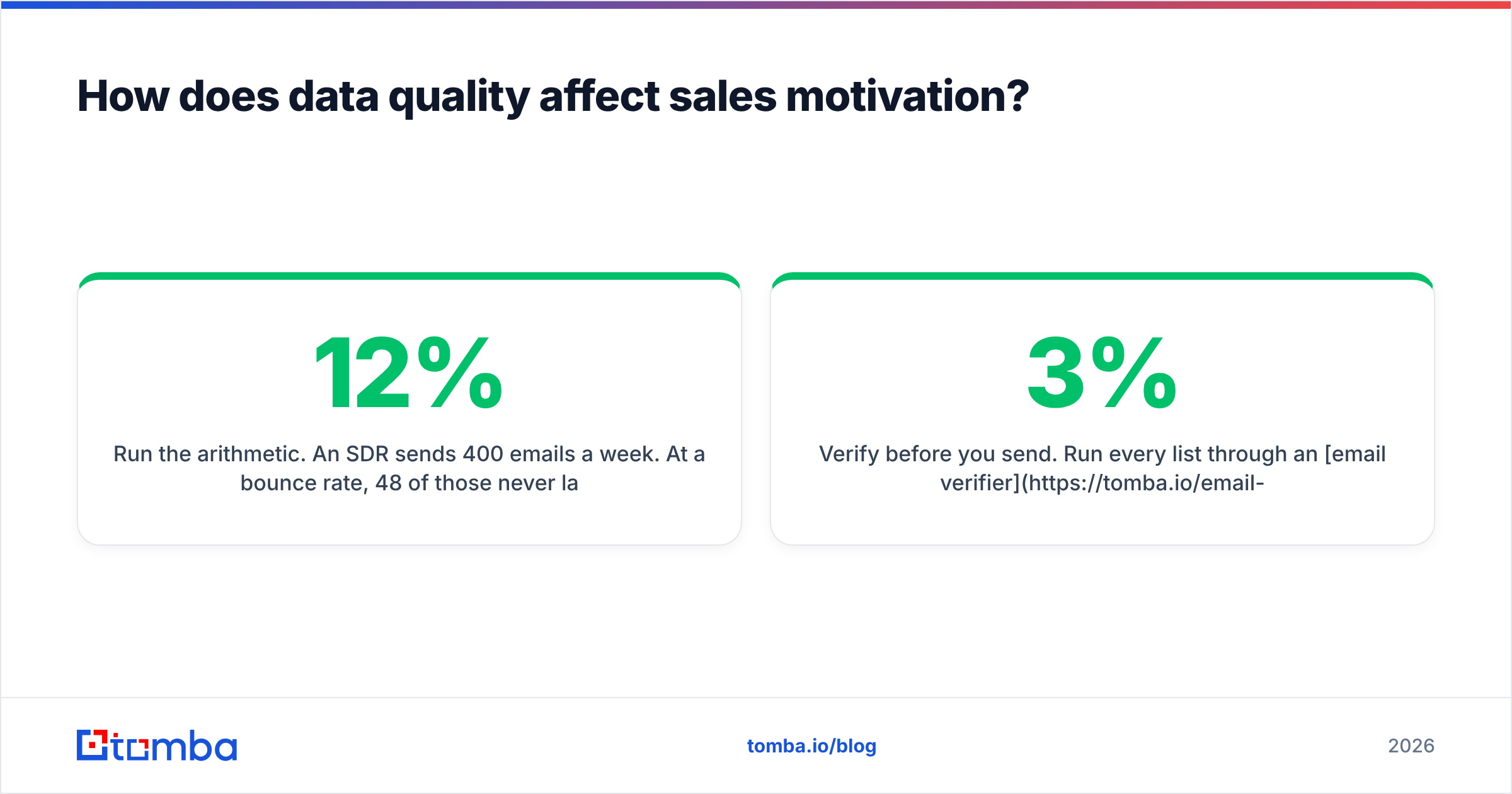
Run the arithmetic. An SDR sends 400 emails a week. At a 12% bounce rate, 48 of those never land, and the mailbox reputation damage suppresses deliverability on the rest. That rep sees a reply rate of 1.2% instead of 3%, concludes the market is dead, and starts sending 250 emails a week instead. Motivation collapsed — but the root cause was a contact list, not a mindset.
The same dynamic plays out with wrong-title contacts, disconnected phone numbers, and duplicate records. Every one of them teaches the rep that effort doesn't pay.
Fixing it is unglamorous and effective:
- Verify before you send. Run every list through an email verifier so bounces stay under 3%. Protect your sender reputation and reply rates hold up.
- Enrich before you assign. Give reps job title, seniority, company size, and tech stack up front. Data enrichment means less time researching, more time selling.
- Stop making reps build lists. Prospect-list construction is the single biggest theft of selling time. Centralize it, or use a bulk email finder so a rep gets a working list in minutes instead of an afternoon.
- Deduplicate ruthlessly. Nothing torches morale like two reps calling the same account.

If you want a single Monday-morning action from this post: pull last month's bounce rate and wrong-number rate per rep. If either is ugly, you found your motivation problem, and it isn't psychological.
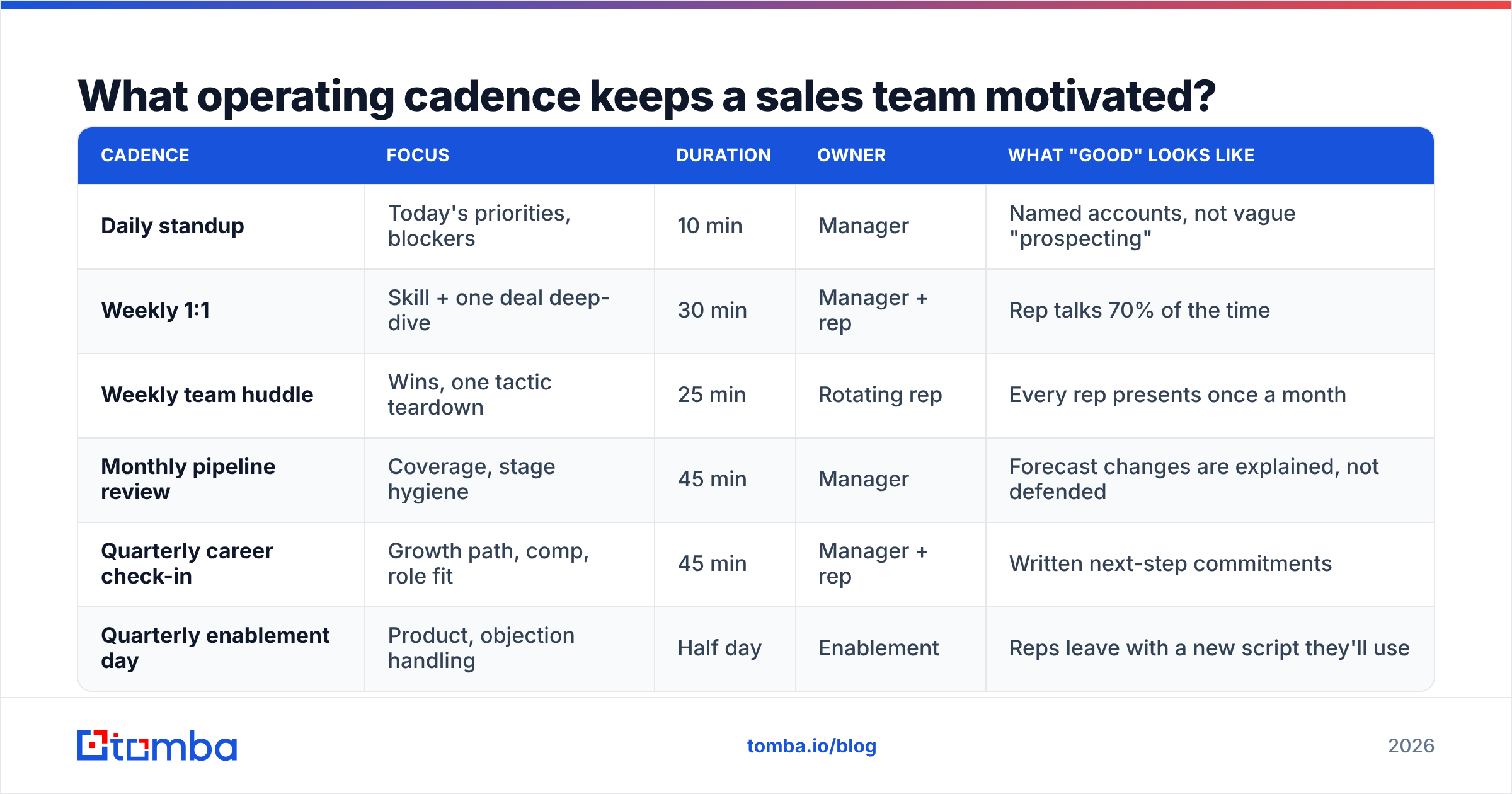
What operating cadence keeps a sales team motivated?#
Motivation is not an event. It decays with a half-life of roughly one week, which means it needs a rhythm.
| Cadence | Focus | Duration | Owner | What "good" looks like |
|---|---|---|---|---|
| Daily standup | Today's priorities, blockers | 10 min | Manager | Named accounts, not vague "prospecting" |
| Weekly 1:1 | Skill + one deal deep-dive | 30 min | Manager + rep | Rep talks 70% of the time |
| Weekly team huddle | Wins, one tactic teardown | 25 min | Rotating rep | Every rep presents once a month |
| Monthly pipeline review | Coverage, stage hygiene | 45 min | Manager | Forecast changes are explained, not defended |
| Quarterly career check-in | Growth path, comp, role fit | 45 min | Manager + rep | Written next-step commitments |
| Quarterly enablement day | Product, objection handling | Half day | Enablement | Reps leave with a new script they'll use |
Two rules make this work. First, never cancel the 1:1 — cancelling it signals the rep is optional. Second, keep coaching separate from forecasting. The moment a rep believes the coaching session is really a pipeline interrogation, they stop being honest, and honest is where coaching happens.
How do you rebuild motivation after a bad quarter?#
A bad quarter creates a specific failure mode: reps stop believing the number is reachable, so they stop trying, which guarantees the next quarter is also bad. Break the loop deliberately.
Week 1 — Name it honestly. Do not spin. Say the number, say what caused it, say what leadership is changing. Reps can survive bad news; they cannot survive being managed by people who pretend.
Week 2 — Shrink the goal. Replace the quarterly number with a 30-day team target that is genuinely achievable. Rebuild the habit of winning before you rebuild the quota.
Week 3 — Fix one input publicly. Kill a report nobody reads. Buy the data tool reps have asked for twice. Reassign a dead territory. Visible action beats any speech.
Week 4 — Spotlight process wins, not just closed revenue. In a rebuild quarter, celebrate the best discovery call, the sharpest objection handle, the cleanest CRM notes. Revenue is lagging; behavior is leading.
Ongoing — Protect the top performers. Attrition contagion is real. A single high-status departure can trigger three more. Have the career conversation with your top 20% before they have it with a recruiter.
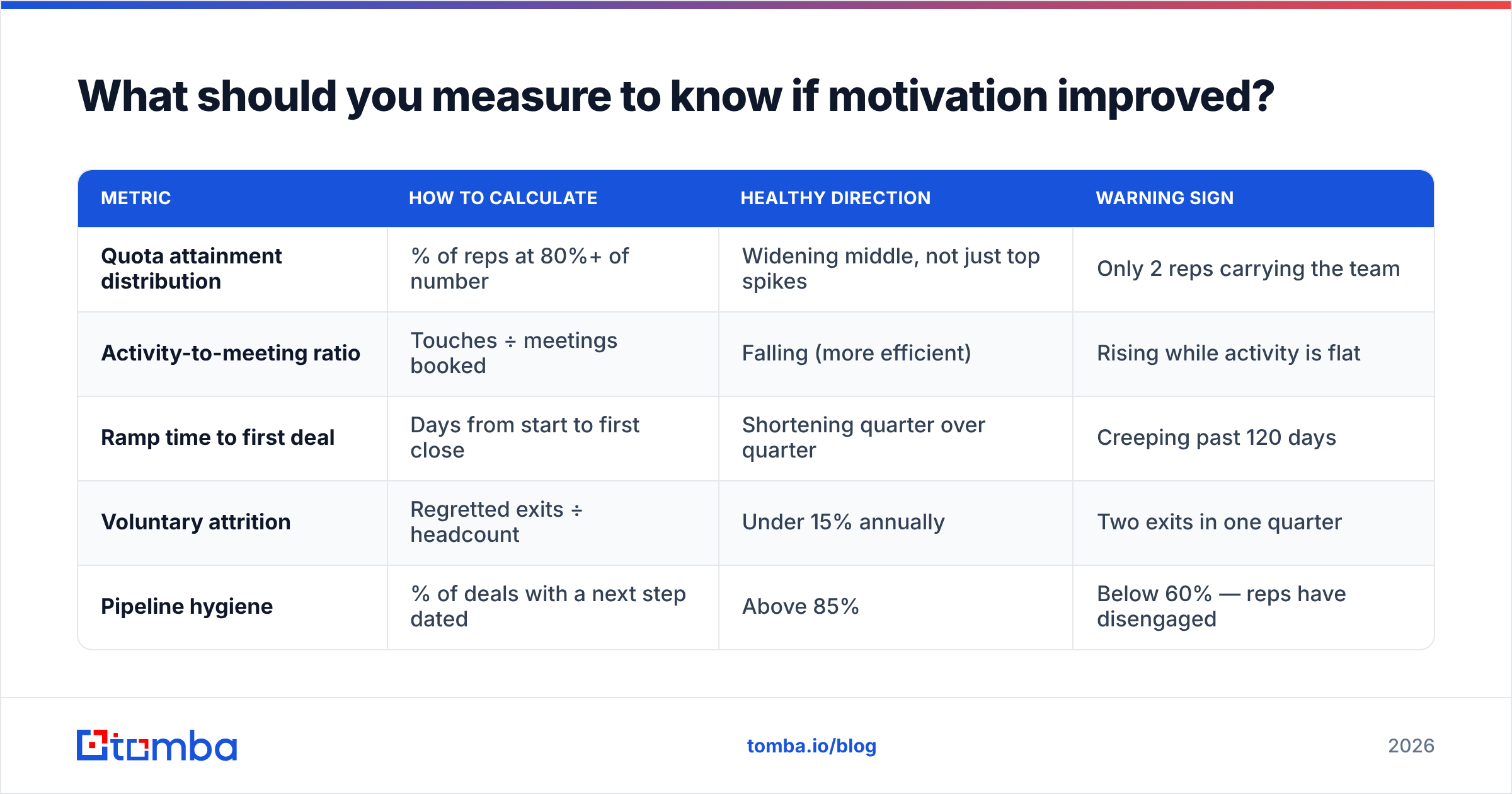
What should you measure to know if motivation improved?#
If you can't measure it, you're guessing. These five hold up:
| Metric | How to calculate | Healthy direction | Warning sign |
|---|---|---|---|
| Quota attainment distribution | % of reps at 80%+ of number | Widening middle, not just top spikes | Only 2 reps carrying the team |
| Activity-to-meeting ratio | Touches ÷ meetings booked | Falling (more efficient) | Rising while activity is flat |
| Ramp time to first deal | Days from start to first close | Shortening quarter over quarter | Creeping past 120 days |
| Voluntary attrition | Regretted exits ÷ headcount | Under 15% annually | Two exits in one quarter |
| Pipeline hygiene | % of deals with a next step dated | Above 85% | Below 60% — reps have disengaged |
Track the distribution, not the average. A team average of 92% attainment sounds healthy right up until you notice two reps at 180% and six at 45%. That's not a motivated team, that's two motivated people and a retention problem.
For context on how these connect to revenue outcomes, it's worth reviewing how win rate and response rate shift alongside motivation programs — they tend to move before quota attainment does, which makes them useful early signals.
What mistakes should you avoid?#
- Motivating with fear. It produces a short activity spike followed by sandbagging, inflated forecasts, and your best rep leaving.
- Running contests that the same person always wins. Tier prizes by improvement, not just absolute output.
- Confusing enthusiasm with motivation. A loud floor is not a productive one.
- Adding tools instead of removing friction. Every new tool costs the rep attention. Consolidate before you buy.
- Ignoring the middle 60%. Most revenue upside lives there, not in the top 10% who are already maxed out.
- Skipping recognition for non-closers. SDRs, sales engineers, and ops people notice when only closers get applause.
External benchmarks help sanity-check your program. Peer reviews on G2 are a reasonable way to see how comparable teams rate the tools they actually rely on, and Salesforce's State of Sales research publishes cross-industry data on where selling time actually goes — useful ammunition when you need to justify removing admin work.
Where should you start this week?#
Pick one thing, not seven.
If attainment is under 40%, fix the quota. If bounce rates are over 5%, fix the data. If your top rep hasn't had a career conversation in six months, book it today. If reps spend more than a quarter of their week on list building and CRM entry, automate that first — it's the fastest morale win available to most managers.
Motivation follows evidence. Give a rep clean data, a reachable number, and a manager who removes obstacles, and the enthusiasm takes care of itself.
Give your team lists worth working. Most motivation problems trace back to reps burning hours on contacts that bounce or were never the right buyer. Tomba's Email Finder returns verified professional email addresses by name, domain, or company — so your reps open the week with a list they can trust instead of one they have to build. Start free with 25 searches a month, or check Tomba pricing — Starter runs $49/mo and Growth $99/mo when your team outgrows the free tier.
Related guides#
// get started
Find, verify and enrich your first contacts today
Start on the free plan with 25 searches a month, then scale when your team is ready.
Free plan · No credit card required · GDPR & CCPA
// about the author