How to Motivate a Sales Team When Sales Are Down in 2026
Slumps kill morale faster than quotas do. Here are seven manager-tested moves — activity resets, pipeline audits, and comp tweaks — that pull a sales team out of a down quarter without fake pep talks.
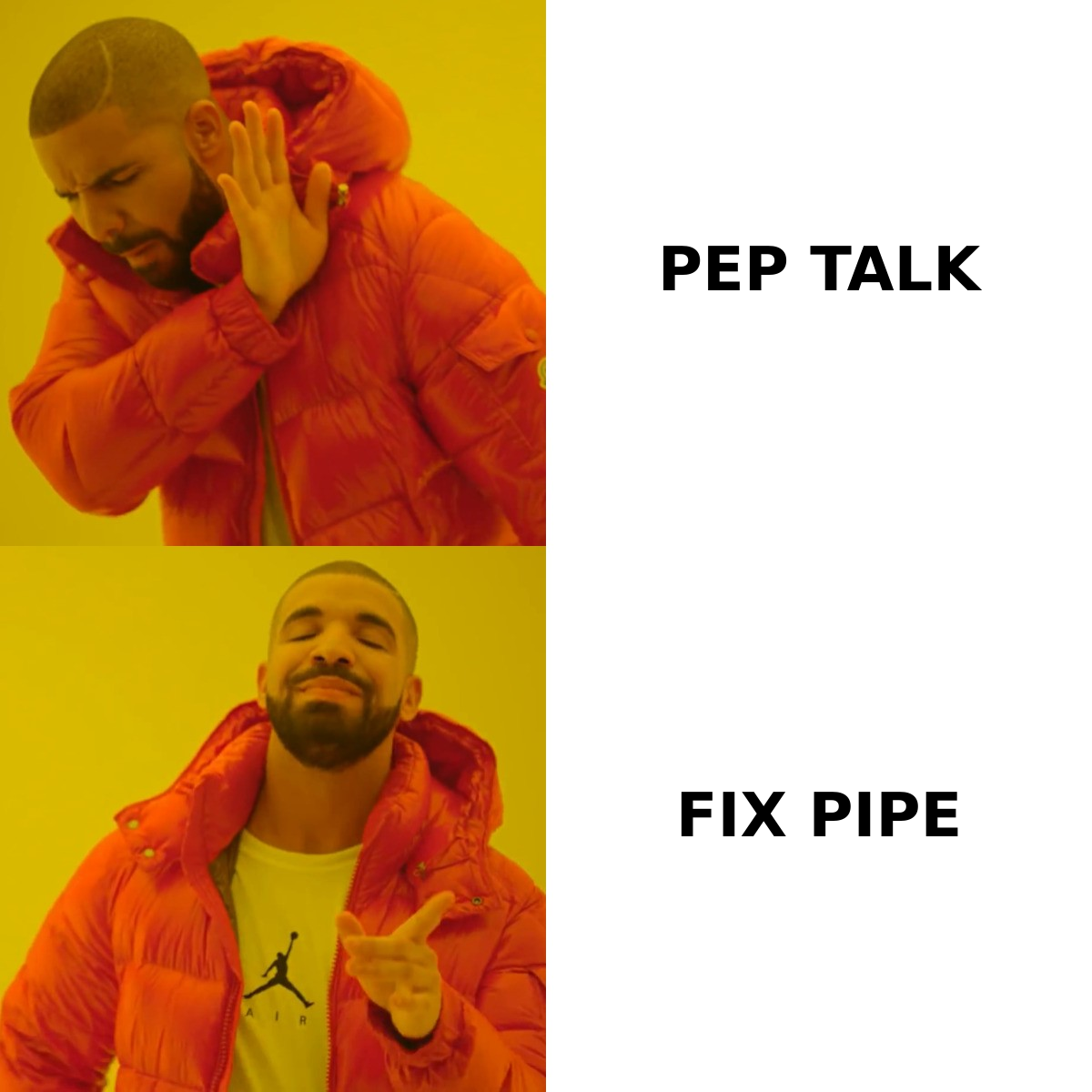
Sales are down, morale is down, and someone wants a speech. Don't give one. The real answer to how to motivate a sales team when sales are down is mechanical, not emotional: fix the inputs, change the scoreboard, and let the wins do the talking.
TL;DR
- Motivation follows evidence, not speeches. Reps get demoralized when effort stops producing results — so fix the input problem (list quality, targeting, messaging) before you fix the mood.
- Switch the scoreboard from revenue to controllable leading indicators for 30–60 days. Reps can't control a closed-won number in a frozen market; they can control 40 verified contacts a day.
- Run a pipeline amnesty: let reps kill dead deals without penalty. A pipeline full of zombies is the single biggest silent morale killer.
- Change comp mechanics temporarily (accelerator resets, activity SPIFFs, team-based bonuses) rather than lowering quota, which signals you've given up.
- Coach on one skill at a time per rep, tied to one recorded call per week. Broad "work harder" feedback produces nothing.
Why do sales teams lose motivation when numbers drop?#
Because the feedback loop breaks. A working sales team runs on a simple loop: effort in, results out, dopamine, repeat. When the market tightens or the lead source degrades, the same effort produces fewer results. The loop inverts: effort in, silence out, dread, avoidance. Within three weeks you'll see it in the activity data — fewer dials, later starts, and a sudden enthusiasm for "account research."
The mistake most managers make is treating this as an attitude problem. It's usually a math problem wearing an attitude costume. If a rep needed 100 emails to book 5 meetings last year and now needs 260, they are not lazy — their inputs got 2.6x more expensive. Yelling at them changes nothing. Fixing the input economics changes everything.
Gartner's research on seller effectiveness has a consistent finding. Sellers who lack confidence in their data and their process disengage faster than those under pure quota pressure. The stressor isn't hard targets. It's targets that feel unreachable through any action the rep controls.
That's why every practical answer to how to motivate a sales team when sales are down starts with diagnosis, not a speech. The sequence matters:
- Diagnose the input — is the list, the ICP, or the message broken?
- Reset the scoreboard — measure what reps control this quarter.
- Clean the pipeline — remove zombie deals that fake progress.
- Adjust the incentives — short-cycle rewards over annual accelerators.
- Coach narrowly — one skill, one rep, one week.
- Restore small wins — engineer them deliberately.
- Communicate honestly — including the parts that suck.
What should you check before you try to motivate anyone?#
Check whether your reps are working a broken list. This is the least glamorous diagnosis and the most common cause.
Run this audit in one afternoon:
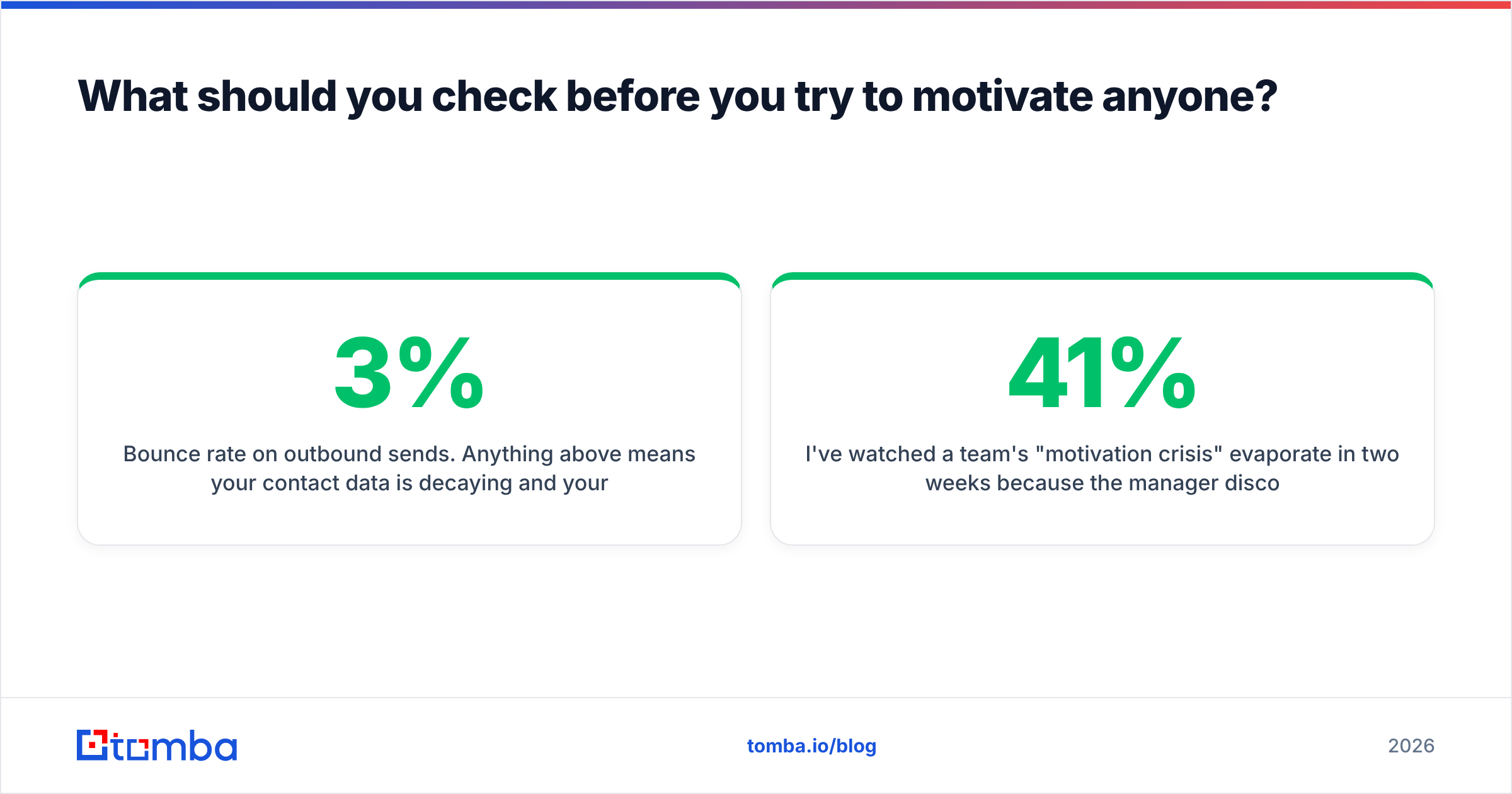
- Bounce rate on outbound sends. Anything above 3% means your contact data is decaying and your domain reputation is bleeding with it. Push that list through an email verifier before you blame the reps.
- Meeting-to-contact ratio by source. Split it by data vendor, scraped list, inbound form, and event. One source is almost always dragging the average into the floor.
- ICP drift. Pull the last 20 closed-won deals and the last 60 no-replies. If the no-replies skew 3x smaller in headcount, your reps are prospecting a segment that never buys.
- Message age. If your top sequence has been running unchanged for nine months, reply rate decay is expected, not a rep failure.
I've watched a team's "motivation crisis" evaporate in two weeks. The manager found that 41% of their purchased contact list was invalid or role-based. The reps weren't unmotivated. They were emailing a graveyard. Once the list was rebuilt with verified contacts pulled by domain search, reply rates tripled and the mood fixed itself.
Say this out loud to the team when you find something: "This was a systems failure, not your failure." That sentence buys more discretionary effort than any offsite.
Which metrics should you put on the board during a slump?#
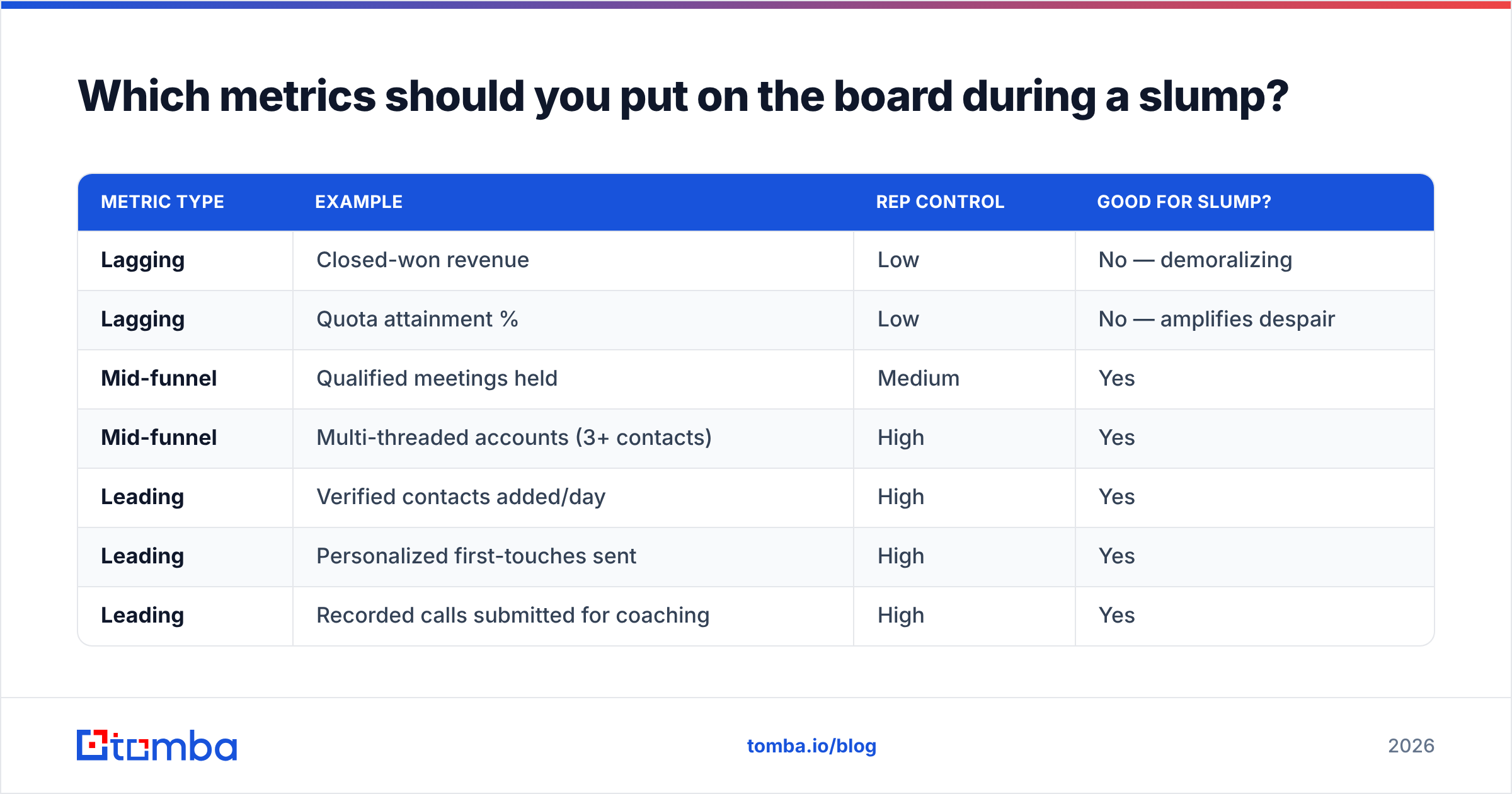
Controllable leading indicators. Revenue is a lagging, partly-luck metric. In a down quarter it punishes good behavior and rewards whoever happened to sit on a renewal.
| Metric type | Example | Rep control | Good for slump? |
|---|---|---|---|
| Lagging | Closed-won revenue | Low | No — demoralizing |
| Lagging | Quota attainment % | Low | No — amplifies despair |
| Mid-funnel | Qualified meetings held | Medium | Yes |
| Mid-funnel | Multi-threaded accounts (3+ contacts) | High | Yes |
| Leading | Verified contacts added/day | High | Yes |
| Leading | Personalized first-touches sent | High | Yes |
| Leading | Recorded calls submitted for coaching | High | Yes |
| Quality | Reply rate per sequence | Medium | Yes — diagnostic |
The rule: during a slump, publicly celebrate the high-control rows and review the low-control rows privately. Public revenue leaderboards in a bad quarter are a resignation machine. The bottom half stops trying, because the gap is too big to close.
One caveat: activity metrics rot if you don't pair them with a quality gate. "200 emails a day" without a verification step produces spam, bounces, and a wrecked sender reputation. Tie every activity target to a quality threshold — verified contacts only, personalization line required, no sends to catch-all domains that failed validation.
How do you run a pipeline amnesty?#
You give reps permission to delete deals with no consequences, once, in a single meeting.
Here's the format that works:
- Announce it a week ahead. "Next Tuesday we're killing dead deals. Nobody gets judged for what they remove. You will get judged for what you keep."
- Define dead objectively. No stakeholder response in 21 days, no next step scheduled, or no confirmed budget owner identified. Two of three = dead.
- Do it live, together. Screen-share the CRM. Rep by rep. Fifteen minutes each.
- Record the new number without flinching. If pipeline drops 45%, say "good, now we know what we're actually working with."
- Rebuild immediately. Block the following two days entirely for prospecting. Nothing else on the calendar.
Why this works psychologically: a bloated pipeline is a lie a rep tells themselves every morning, and they know it's a lie. Carrying that is exhausting. Clearing it converts vague dread into a concrete, solvable problem. "I need 18 new opportunities" is something a person can act on. "My pipeline is fake" is not.
The rebuild step is non-negotiable. Amnesty without a rebuild is just bad news. Pair it with a concrete sourcing sprint: give each rep a target account list, have them pull decision-maker contacts with an email finder, and set a floor — 50 verified, in-ICP contacts each by Thursday. Tools like Apollo, BookYourData, and Tomba all handle this sourcing step well. The important part is that the output is verified before it enters a sequence.
Should you lower quota when sales are down?#
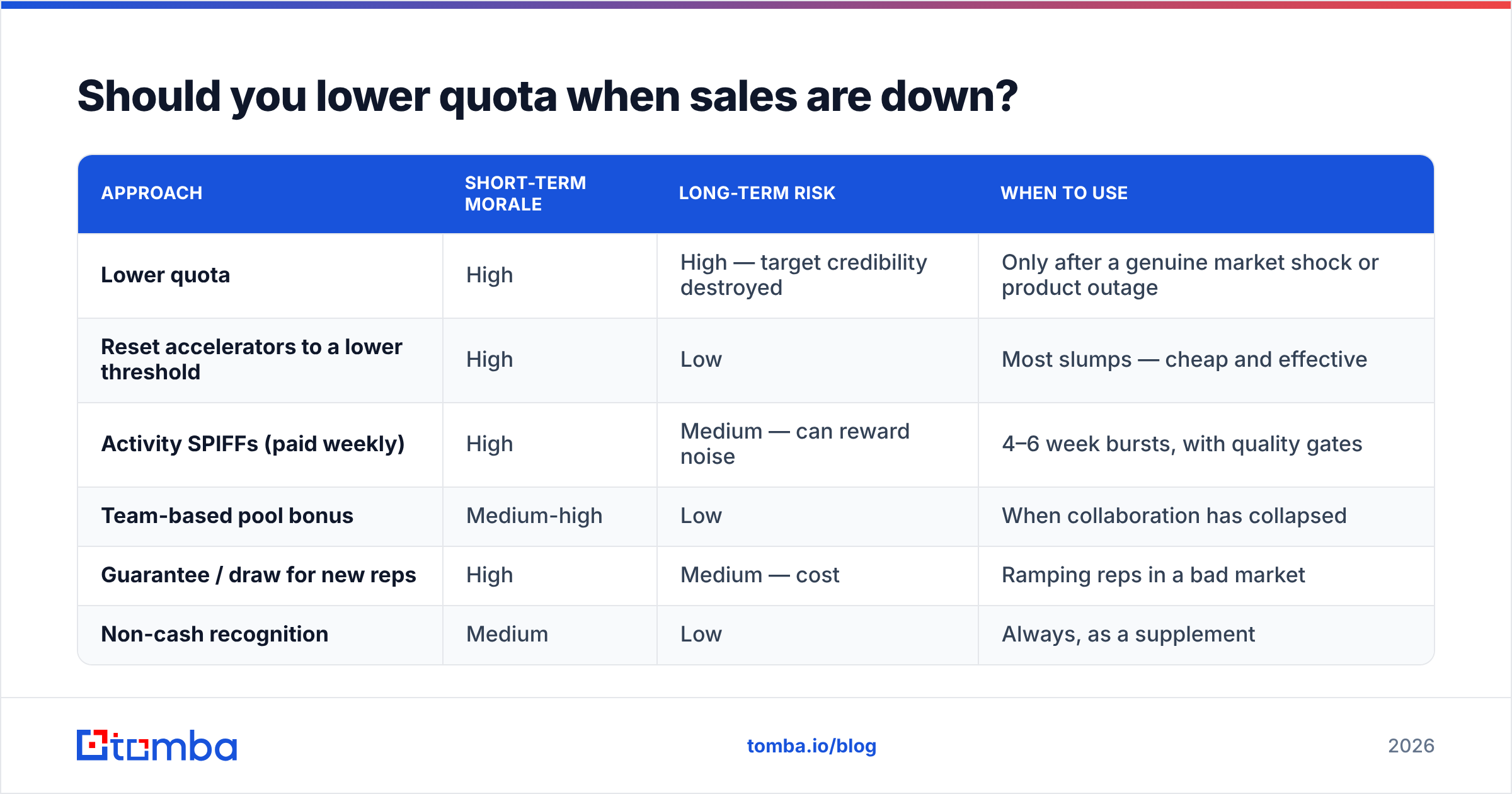
Usually no — change the mechanics instead. Lowering quota mid-year tells your best reps the number is negotiable. That quietly devalues every future target and every past win.
| Approach | Short-term morale | Long-term risk | When to use |
|---|---|---|---|
| Lower quota | High | High — target credibility destroyed | Only after a genuine market shock or product outage |
| Reset accelerators to a lower threshold | High | Low | Most slumps — cheap and effective |
| Activity SPIFFs (paid weekly) | High | Medium — can reward noise | 4–6 week bursts, with quality gates |
| Team-based pool bonus | Medium-high | Low | When collaboration has collapsed |
| Guarantee / draw for new reps | High | Medium — cost | Ramping reps in a bad market |
| Non-cash recognition | Medium | Low | Always, as a supplement |
The highest-leverage move on that list is usually resetting accelerators. If accelerators kick in at 100% of quota and nobody will get near 100%, your comp plan has no motivational force for 80% of the team. Drop the accelerator trigger to 70% for the quarter. The number stays intact; the incentive becomes live again. It costs you far less than a quota reset and preserves the integrity of the target.
Weekly-paid activity SPIFFs work because slumps stretch the reward horizon painfully long. If a deal takes 90 days and half of them die, the gap between "work" and "payoff" becomes intolerable. A $200 Friday payout for the rep with the most qualified multi-threaded accounts collapses that distance. Keep them short — six weeks max — or reps start optimizing for the SPIFF instead of the business.
How do you coach reps without crushing them further?#
One skill, one rep, one week, one recorded call. That's the whole method.
The failure mode in a slump is scattershot feedback: a manager listens to a call, hears eight problems, and lists all eight. The rep now has eight things to fix while already feeling incompetent. So they fix zero. Pick the single highest-leverage gap and ignore the rest until it's closed.
A workable weekly cadence per rep:
- Monday, 15 min — pick the week's one skill (discovery questions, pricing objection, multi-threading ask, opener).
- Midweek — rep submits one recorded call where they attempted it. Not their best call. The attempt.
- Friday, 15 min — review only that skill. Score it 1–5. Nothing else gets mentioned.
- Next Monday — same skill if score < 4, new skill if ≥ 4.
Add a group element that isn't a meeting about how bad things are: a 30-minute weekly "what worked" call where each rep brings exactly one thing that produced a response. One line of copy, one trigger event, one referral path. This does two jobs — it spreads tactics, and it forces the team to look at evidence that the market isn't fully closed. In a slump, reps stop believing anyone is winning. Showing them peers winning small is more persuasive than any manager assertion.
HubSpot's sales research on coaching frequency is clear. Teams with weekly one-on-one coaching beat those on monthly cadences by a wide margin. The effect widens under pressure, not narrows. Coaching is the thing to protect when time is scarce, not the first thing to cut. You can read more on their sales blog.
How do you engineer small wins on purpose?#
You deliberately lower the difficulty of the next reward, then raise it back.
Concrete tactics that manufacture legitimate wins in a bad quarter:
- Reactivation lists. Closed-lost from 12–18 months ago, filtered for a champion who changed jobs. Job-change plays convert at multiples of cold outbound. A reverse email lookup or a LinkedIn-sourced contact refresh gets you the new address in minutes.
- Existing-customer expansion. Warm, faster-closing, and it reminds reps they can still win.
- Referral asks from happy accounts. Scripted, targeted at two specific named companies, not "know anyone?"
- Down-market motion. Smaller deals close faster. Three $6k wins do more for a rep's confidence than one $60k deal stuck in legal.
- Micro-goals with same-day feedback. "Book two meetings today" beats "book 20 this month."
The mechanism here is straightforward. Confidence is built from recent evidence of personal effectiveness, not from encouragement. Give reps a slightly easier target that still counts, let them hit it, then move the target back up. Every strength coach on earth uses this progression. Sales managers rarely do.
Also — and this is underrated — protect prospecting time like it's a customer meeting. In slumps, calendars fill with pipeline reviews, forecast calls, and "alignment" syncs, all of which discuss the problem instead of solving it. Cut your internal meeting load by half and give that time back as blocked, no-exception prospecting blocks. Reps notice when a manager sacrifices their own visibility rituals to give the team room to work.
What should you actually say to the team?#
Tell them the truth, including the parts that are bad, then tell them the specific plan.
Reps have working eyes. They see the empty pipeline board and the quiet Slack channel. A manager who performs relentless optimism becomes untrustworthy. Once a rep decides you are spinning them, every later message gets discounted. Instead:
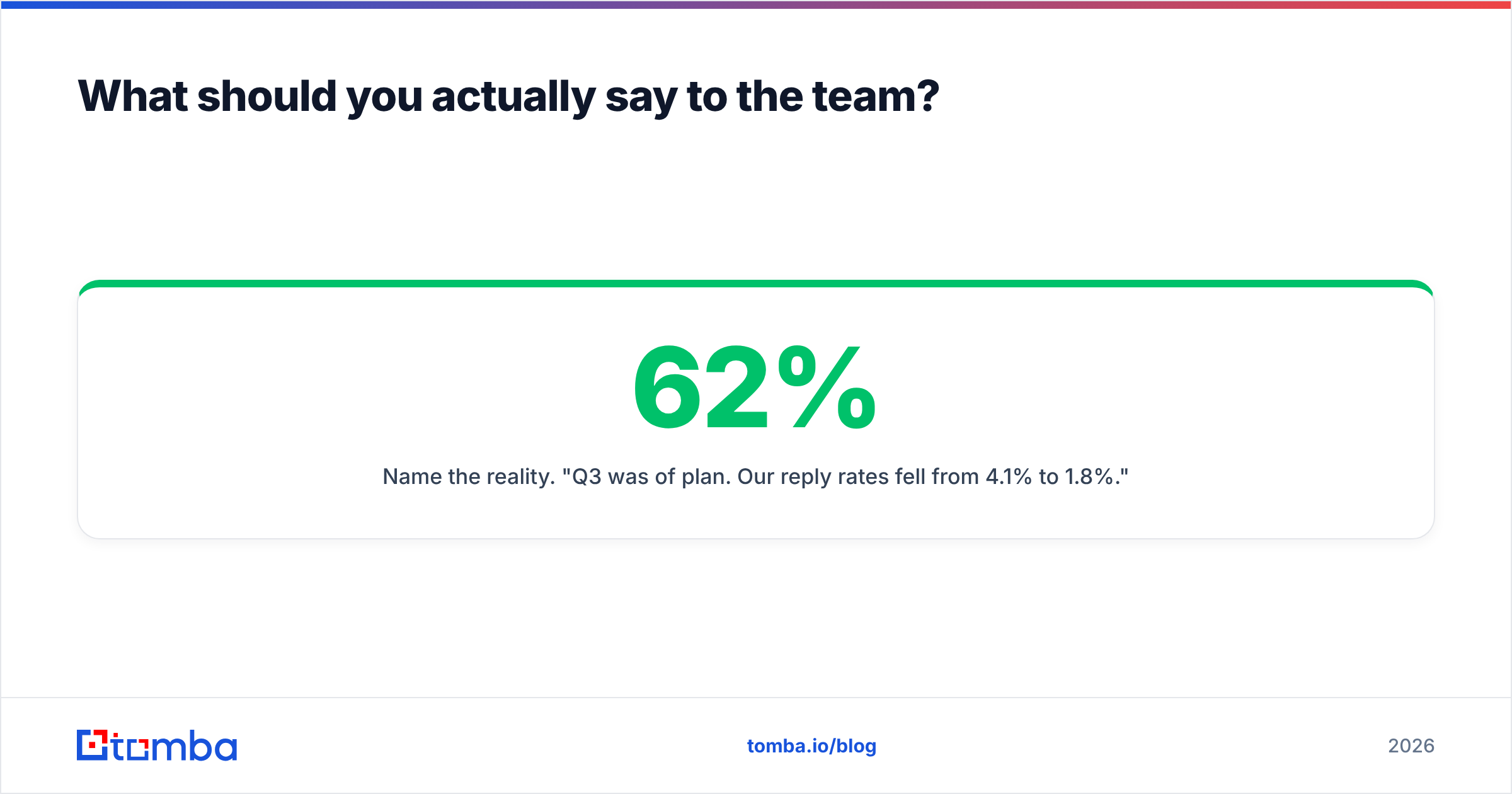
- Name the reality. "Q3 was 62% of plan. Our reply rates fell from 4.1% to 1.8%."
- Name the cause you've diagnosed. "Two-thirds of that is list decay from our old data source. That's on me, not on you."
- Name the fix and the date. "New verified lists land Monday. We're measuring meetings held, not revenue, until the end of October."
- Name what you need. "I need 40 verified in-ICP contacts per rep per day, and one recorded call a week."
- Name what you'll protect. "No layoffs planned this quarter. If that changes you'll hear it from me first."
That last one matters more than the other four combined. Unspoken job insecurity is the largest single drain on effort in a down quarter. Reps quietly start interviewing instead of dialing. If you can commit to stability, say it plainly. If you can't, say that plainly too. Ambiguity is worse than bad news, because people fill silence with their worst assumptions.
And avoid the "we just need to want it more" speech. Effort was never the constraint. Treating it as one insults everyone in the room who has been grinding through rejection for eleven weeks.
How to motivate a sales team when sales are down: where to start Monday#
Start with the data. It's the fastest fix, and it's the one thing entirely under your control. A team working a verified, in-ICP, correctly-targeted list will out-produce a "highly motivated" team working a decayed one, every single time.
Rebuild the source of contacts first, then reset the scoreboard, then clear the pipeline, then adjust comp. That's the short version of how to motivate a sales team when sales are down. Motivation isn't the first domino — it's the last one, and it falls on its own once the earlier ones land.
If bad contact data is throttling your team's output, that's a one-week fix, not a one-quarter one. Tomba's Email Finder lets reps pull verified decision-maker emails by domain, name, or company. Verification is built into the same flow, so the list your team works on Monday is one they can trust. The free tier gives you 25 searches a month to test it against your current source. Paid plans start at $49/mo on Starter, with Growth at $99/mo; see Tomba pricing for the full breakdown. Run your existing list and a Tomba-built list side by side for two weeks, compare bounce and reply rates, and let the numbers decide. Your reps will notice the difference before you finish the analysis.
Related guides#
// get started
Find, verify and enrich your first contacts today
Start on the free plan with 25 searches a month, then scale when your team is ready.
Free plan · No credit card required · GDPR & CCPA
Get the Tomba newsletter
Product and data updates
// about the author