How to Propose a Business Collaboration That Gets a Reply
A partnership pitch fails on the first 40 words, not the deck. Here is the exact research, contact-sourcing, and email structure that gets collaboration proposals answered in 2026.
TL;DR
- Most collaboration proposals die because they reach the wrong inbox, not because the idea is bad. Fix contact targeting before you touch the copy.
- Lead with what the other company gets in the first two sentences. Your company background belongs in paragraph three, if anywhere.
- Use a five-part structure: specific observation, proposed collaboration, value split, proof, one small ask.
- Send to a named decision-maker (partnerships, BD, or the relevant function head) at a verified address —
info@andpartnerships@aliases convert at a fraction of the rate. - Follow up three times over 14 days with new information each time, then close the loop cleanly.
What Actually Counts as a Business Collaboration Proposal?#
A business collaboration proposal is a written pitch asking another company to create shared value with you — not to buy from you. That distinction changes everything about how you write it.
Sales emails ask for money. Collaboration emails ask for effort, reputation, and audience access. The second is a harder ask, because your recipient is risking something that cannot be refunded. A bad vendor gets churned in 30 days. A bad partner ends up in a joint webinar recording that lives on YouTube forever.
The common formats:
- Co-marketing — joint webinar, co-authored report, newsletter swap, or a bundled offer. Lowest friction, fastest to say yes to.
- Integration or technical partnership — your product connects to theirs. Higher effort, but usually the most durable.
- Reseller or referral agreement — one side sends deals, the other pays out. Requires a commercial conversation, not just a friendly one.
- Content or research collaboration — shared data, a co-branded benchmark, a guest column swap. Cheap to run, strong for SEO on both sides.
- Distribution or channel deal — bundling into an existing motion (agency, consultancy, marketplace). Slowest cycle, biggest ceiling.
- Event or community co-hosting — shared booth, joint meetup, community AMA. Good entry point when you have no relationship history.
Pick the format before you write. A vague "let's explore synergies" email gets ignored because the recipient has to do the work of imagining what you want. Name the shape of the deal in the first paragraph.
Why Do Most Collaboration Proposals Get Ignored?#
Four failure modes, in order of how often they kill the pitch.
It reached a shared inbox. hello@, partnerships@, and info@ are triage queues. At most companies under 500 people, nobody owns them. A named human with a verified address is the difference between a 1% and a 15% reply rate.
It opened with you. "We're a Series A company building X" is a paragraph the reader has no reason to finish. Open with something only someone who studied their business would write.
The value split was undefined. If the recipient cannot tell within 20 seconds who does what and who gets what, the mental cost of replying exceeds the perceived upside. They archive it.
The ask was enormous. "Would you be open to a 45-minute call to discuss a strategic partnership?" is a big commitment for a stranger. "Worth a look at the outline? I'll send it — no call needed" is not.
There's also a boring technical cause. If your domain has weak authentication, your carefully researched proposal may never render in an inbox at all. Check your SPF record and run a spam checker on the draft before you blame the copy. Google and Yahoo's bulk-sender requirements, documented in Google's sender guidelines, now apply to volumes far lower than most teams assume.
How Do You Research a Partner Before You Pitch?#
Spend 15 minutes per target. Not 90 seconds, not two hours.
You are looking for one specific, recent, verifiable fact that creates a reason for the collaboration to happen now. Candidates:
- A product launch or feature release in the last 90 days that creates an obvious adjacency to what you do.
- A content piece where they took a position you can extend, quantify, or supply data for.
- A hiring pattern — three partnerships roles posted means someone is being measured on partner count this quarter.
- A shared customer or shared integration you can name.
- A gap in their ecosystem page that you happen to fill.
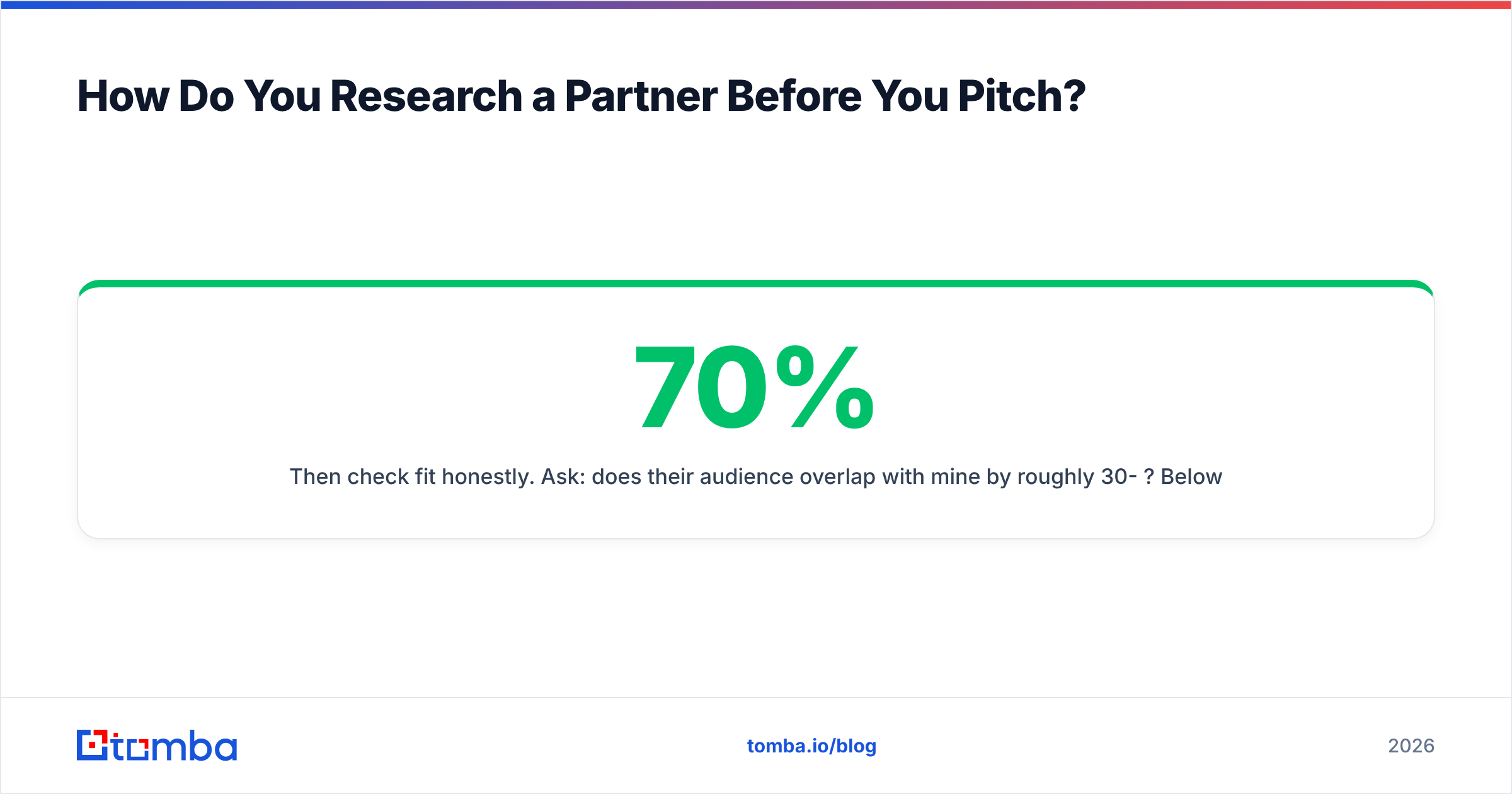
Then check fit honestly. Ask: does their audience overlap with mine by roughly 30-70%? Below 30% and the collaboration produces nothing for either side. Above 70% and you are competitors dressed as partners, which makes legal nervous and makes the deal slow.
Write the answer down in one sentence before drafting. If you cannot finish "This makes sense for them because ___" without hand-waving, you have picked the wrong target.
Who Should You Send the Proposal To?#
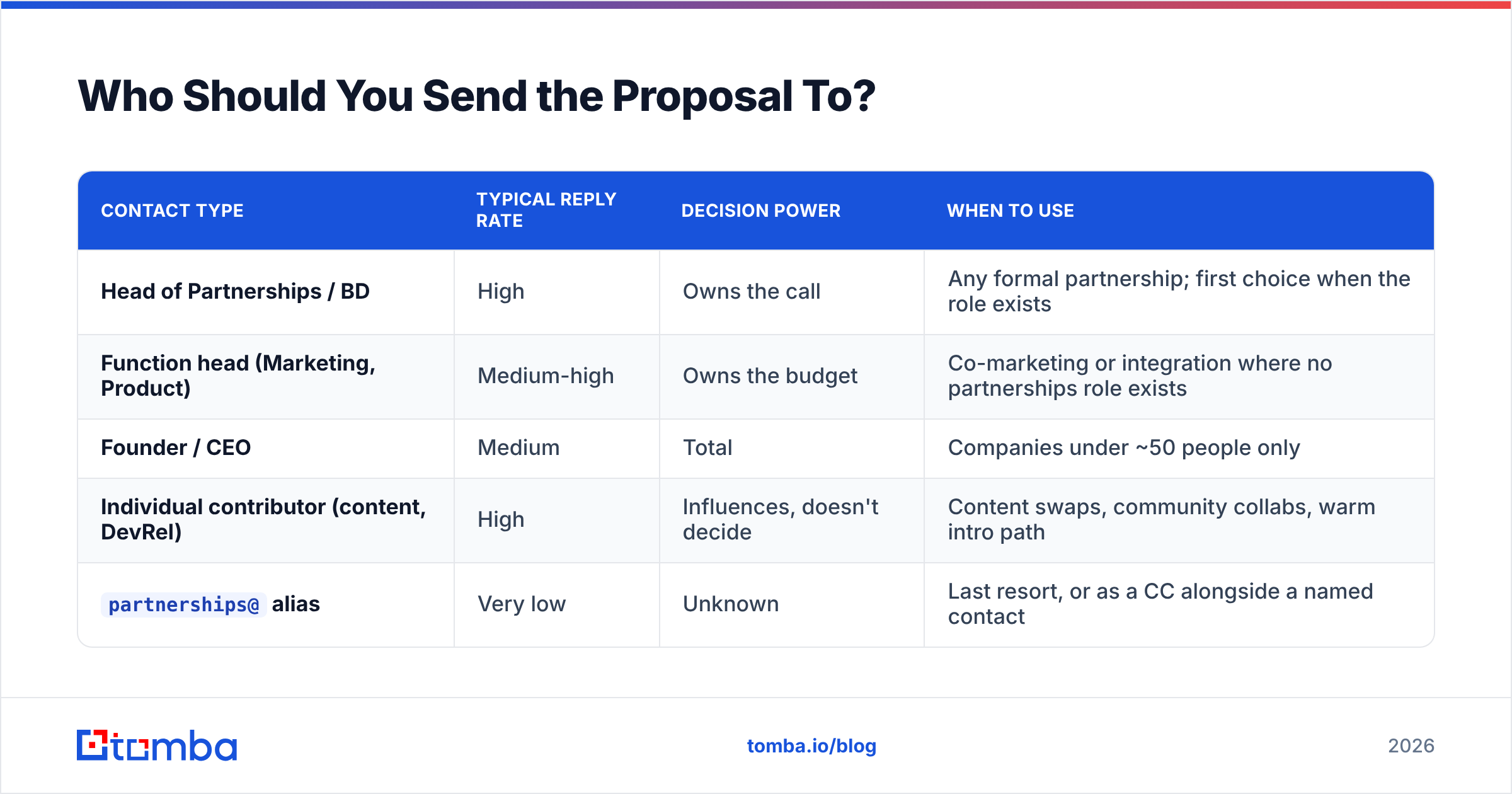
Rank your target contacts like this:
| Contact type | Typical reply rate | Decision power | When to use |
|---|---|---|---|
| Head of Partnerships / BD | High | Owns the call | Any formal partnership; first choice when the role exists |
| Function head (Marketing, Product) | Medium-high | Owns the budget | Co-marketing or integration where no partnerships role exists |
| Founder / CEO | Medium | Total | Companies under ~50 people only |
| Individual contributor (content, DevRel) | High | Influences, doesn't decide | Content swaps, community collabs, warm intro path |
partnerships@ alias |
Very low | Unknown | Last resort, or as a CC alongside a named contact |
At companies under 50 people, go to the founder. Between 50 and 300, find the function head. Above 300, there is almost certainly a partnerships team and going around them creates friction you don't want.
Once you know the name, you need the address. Use a domain search to pull the company's known email patterns and existing contacts, then run the specific person through an email finder to get the exact address. Verify it before sending — a bounce on a cold partnership email damages your sender reputation and costs you the next twenty pitches too. For teams pitching dozens of partners a quarter, bulk verify the whole list in one pass.
If the collaboration is content-driven, the author finder approach works well: pitch the person who actually wrote the article you're referencing, not a generic marketing address. They have a personal stake in the topic and they reply.

What Does a Collaboration Proposal Email Look Like?#
Five parts. Under 150 words. No attachment on the first touch.
1. The specific observation (1 sentence). Prove you did the work. "Your integrations page lists 40 tools but nothing for email verification — and your G2 reviews mention list quality four times in the last quarter."
2. The proposed collaboration (1-2 sentences). Name the format. "Proposing a co-authored benchmark: your deliverability data, our verification data, one report, both logos."
3. The value split (1-2 sentences). Who does what, who gets what. Be concrete about effort. "We handle the writing and design. You review for accuracy. Both lists get it, both sites host it."
4. The proof (1 sentence). One credibility marker, not three. A named prior partner, a traffic number, an audience size.
5. The ask (1 sentence). Make it tiny. "Want the one-page outline? Happy to send it over — no call required."
Sign off with your name and role. Skip the signature block full of social icons on a cold send; it adds image loads and spam signal for nothing.
Here's the shape in practice:
Subject: your integrations page + a data idea
Hi Maria — your integrations page lists 40 tools but nothing covering list quality, and four of your last-quarter G2 reviews mention bounce rates.
Proposal: a co-authored 2026 deliverability benchmark. Your send-side data, our verification-side data, one report under both logos.
We write and design it, you review for accuracy, and it goes to both lists. We ran the same format with [partner] last year — 4,100 downloads, 190 shared leads.
Want the one-page outline? I'll send it over, no call needed.
— Sam, Partnerships
Two notes on that draft. The subject line is lowercase and specific, because it reads like a colleague rather than a campaign. And the ask costs Maria roughly four seconds of thought.
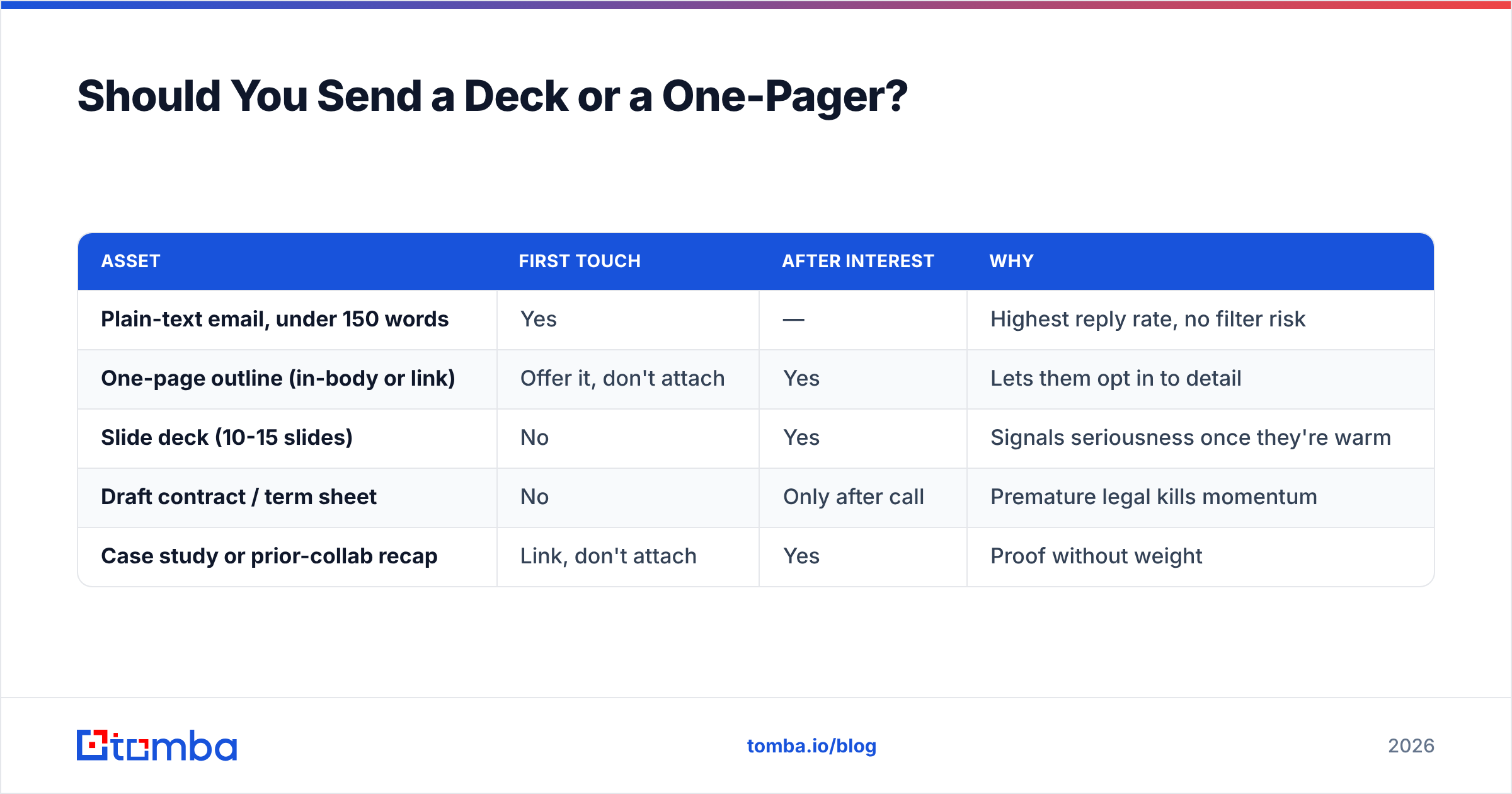
Should You Send a Deck or a One-Pager?#
Not on the first email. Ever.
Attachments on cold sends trigger filters, and a 14-slide deck signals that replying means reading 14 slides. Send the deck on touch two, after they express interest — at which point it converts because they asked for it.
| Asset | First touch | After interest | Why |
|---|---|---|---|
| Plain-text email, under 150 words | Yes | — | Highest reply rate, no filter risk |
| One-page outline (in-body or link) | Offer it, don't attach | Yes | Lets them opt in to detail |
| Slide deck (10-15 slides) | No | Yes | Signals seriousness once they're warm |
| Draft contract / term sheet | No | Only after call | Premature legal kills momentum |
| Case study or prior-collab recap | Link, don't attach | Yes | Proof without weight |
The pattern generalizes: every asset should be one step behind the level of commitment the recipient has already shown. Research from HubSpot on email length consistently points the same direction — shorter first touches out-perform long ones, and the effect is stronger for unsolicited sends.
How Should You Follow Up Without Being Annoying?#
Three follow-ups over 14 days, each carrying new information. Never "just bumping this."
- Day 3 — Add a detail you left out. A specific date you could run the collab, or a piece of data that strengthens the case. Two sentences.
- Day 7 — Change the channel. Reply to something they posted on LinkedIn, or engage with their content genuinely, then reference the email lightly. Don't copy-paste your pitch into a DM.
- Day 14 — The clean close. "Assuming this isn't a fit right now — I'll stop here. If the timing changes, the outline's yours." This one gets replies surprisingly often, because it removes the obligation.
Then actually stop. Re-approach in two quarters with a genuinely new angle, not the same email.
Track everything in your CRM with a partnership-specific stage set. Partnership cycles run longer than sales cycles and the same contact may be right for a different proposal in six months. Losing that history is the most expensive mistake in the whole process.
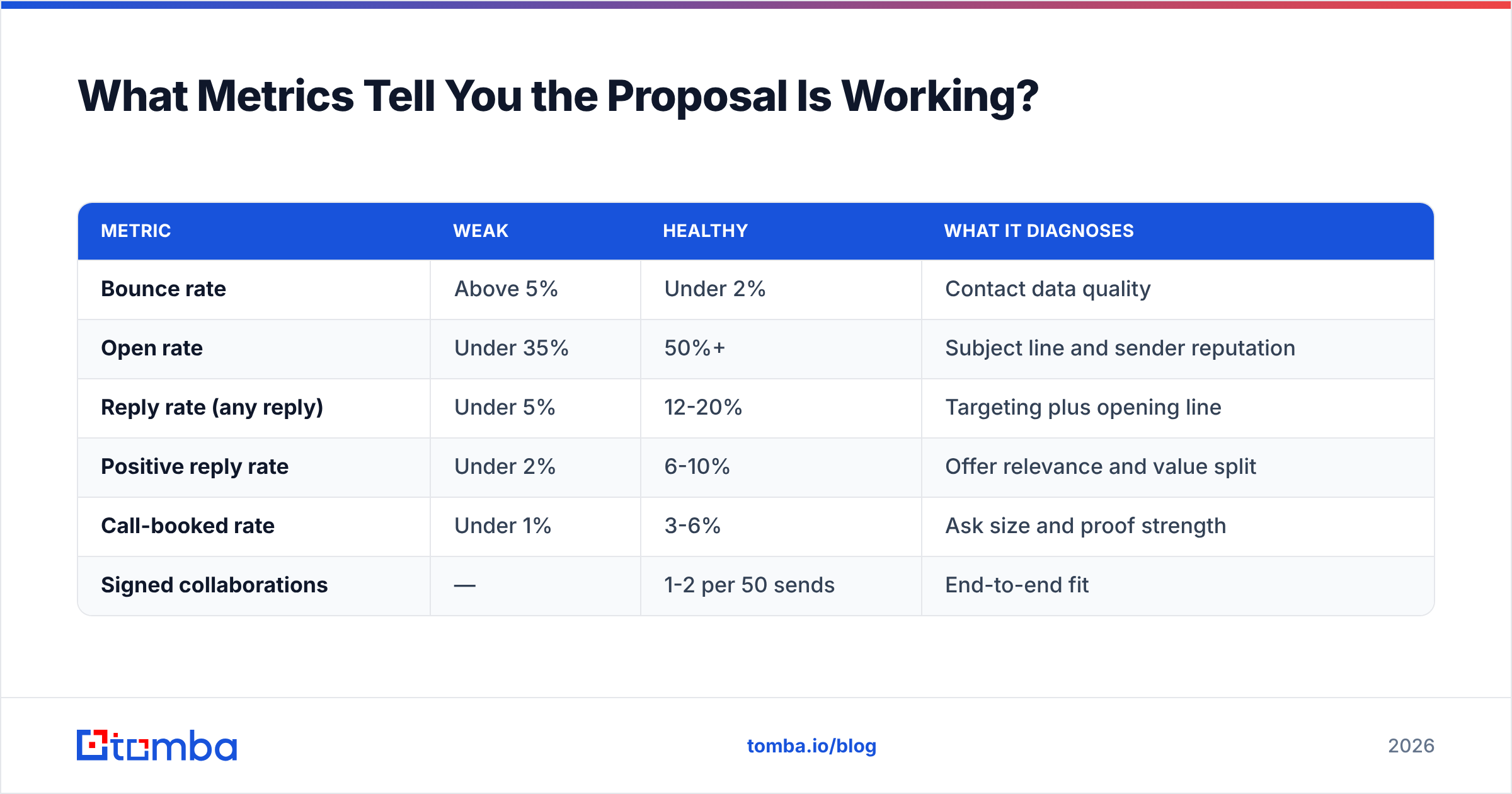
What Metrics Tell You the Proposal Is Working?#
Judge the process, not the outcome, for the first 50 sends.
| Metric | Weak | Healthy | What it diagnoses |
|---|---|---|---|
| Bounce rate | Above 5% | Under 2% | Contact data quality |
| Open rate | Under 35% | 50%+ | Subject line and sender reputation |
| Reply rate (any reply) | Under 5% | 12-20% | Targeting plus opening line |
| Positive reply rate | Under 2% | 6-10% | Offer relevance and value split |
| Call-booked rate | Under 1% | 3-6% | Ask size and proof strength |
| Signed collaborations | — | 1-2 per 50 sends | End-to-end fit |
If bounces are high, the problem is data, not writing — fix that first with an email verifier before touching a single word of copy. If opens are fine but replies are near zero, your first sentence is about you. If positive replies are fine but nothing closes, your value split is vague or your ask was too big.
One caution on comparisons: partnership reply rates are not sales reply rates. A 12% reply rate on a well-targeted partnership list is normal, while the same number on a cold sales sequence would be exceptional. Don't benchmark yourself against the wrong curve.
How Do You Scale This Without Making It Spam?#
The tension is real. Personalized partnership outreach does not batch well, and the moment it feels templated, it stops working.
Three things that scale honestly:
- Tier your list. Ten dream partners get fully bespoke, hand-researched emails. Fifty second-tier targets get a structured template with two genuinely researched variables. Everyone else gets nothing — a bad partnership is worse than no partnership.
- Templatize the structure, not the content. The five-part skeleton stays fixed. The observation, the value split, and the proof are written fresh every time.
- Automate the data layer only. Finding, verifying, and enriching contacts should be automatic. Use the Tomba API or the Google Sheets add-on to keep your target list clean, then write the emails yourself.
Peer platforms like BookYourData take a database-first approach that works well when you need broad coverage of a market segment fast, while pattern-based finders are stronger when you already know exactly which 60 companies you want. Most partnership teams end up using both: a database to build the universe, a finder to nail the specific human at each account. Check the vendor listings on G2 if you want side-by-side user feedback before committing.
What Should You Do Next?#
Pick ten companies where the collaboration case writes itself. Spend 15 minutes each on research. Find the named decision-maker, verify the address, and send ten 150-word emails using the five-part structure. Measure bounces, replies, and positive replies. Then adjust one variable at a time.
The part most teams get wrong is the boring part — the contact data. If you want your partnership pitches read by the person who can actually say yes, start with the Tomba Email Finder to get the right name and a verified address at every target company. The free tier gives you 25 searches a month to test the workflow, and paid plans start at $49/mo on Starter with 5x the volume on Growth. See full Tomba pricing for the tier that matches your partner list size.
Good proposals get ignored when they land in the wrong inbox. Fix that first, and the copy starts doing its job.
Related guides#
// get started
Find, verify and enrich your first contacts today
Start on the free plan with 25 searches a month, then scale when your team is ready.
Free plan · No credit card required · GDPR & CCPA
// about the author