How To Reach Small Businesses: A 2026 Outreach Playbook
Small business owners ignore enterprise-style outreach. Here are seven channels, real cost-per-reply math, and the exact data workflow that gets SMB decision-makers to answer.
TL;DR
- Small business owners are not mini-enterprises. They have no procurement process, no committee, and roughly four minutes of attention per day for anything that isn't revenue or payroll.
- The single biggest failure point is data:
info@,contact@, andhello@addresses go to a shared inbox nobody reads. You need the owner's or manager's direct address. - Ranked by cost per reply in 2026, the order is roughly: warm referral > local in-person > direct phone > personalized email > LinkedIn > paid social > direct mail.
- A working SMB list costs about $0.02–$0.08 per verified contact if you build it yourself, versus $0.30–$1.50 per record from a prepackaged database.
- The winning message is short, specific to their location or trade, priced in the first three lines, and asks for a 10-minute call — not a demo.
Why is reaching small businesses harder than reaching enterprises?#
Because the gatekeeper and the decision-maker are the same overworked person, and they have already been burned.
An enterprise buyer expects vendor outreach. It's part of the job. A 12-person HVAC company's owner does not have a job description that includes "evaluate SaaS." She's dispatching techs, chasing an unpaid invoice, and covering the front desk. Your email lands next to a payroll notice and three other cold pitches that all opened with "I noticed your company is growing."
There are roughly 33 million small businesses in the US according to the SBA Office of Advocacy, and the vast majority have fewer than 20 employees. That scale is why SMB outreach looks tempting — huge TAM, short sales cycles, low ACV. It's also why it's brutal. You need volume, and volume punishes sloppiness: bad data burns your domain, generic copy burns your brand, and a $600 ACV means you can't afford six touches from an SDR earning $65K.
The mechanics that make enterprise outbound work — multi-threading, account research, exec sponsorship — mostly don't apply. What replaces them is precision on three things: the right person, the right channel, and a message that reads like it came from a human who has actually seen their storefront.
Which channels actually work for small business outreach?#
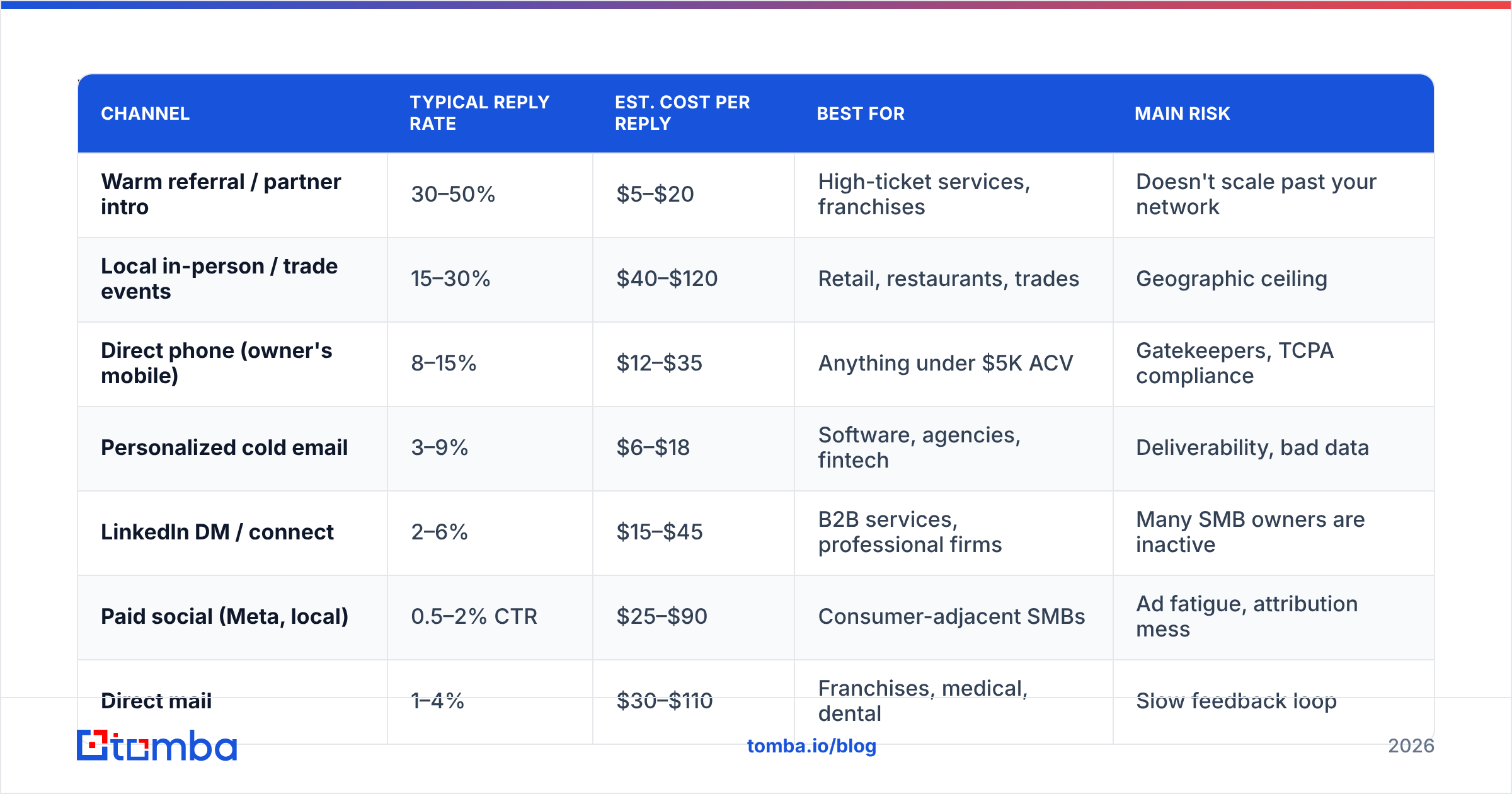
Here's the honest ranking, based on what SMB-focused teams report and what the unit economics allow. "Cost per reply" assumes a blended cost of tooling plus rep time.
| Channel | Typical reply rate | Est. cost per reply | Best for | Main risk |
|---|---|---|---|---|
| Warm referral / partner intro | 30–50% | $5–$20 | High-ticket services, franchises | Doesn't scale past your network |
| Local in-person / trade events | 15–30% | $40–$120 | Retail, restaurants, trades | Geographic ceiling |
| Direct phone (owner's mobile) | 8–15% | $12–$35 | Anything under $5K ACV | Gatekeepers, TCPA compliance |
| Personalized cold email | 3–9% | $6–$18 | Software, agencies, fintech | Deliverability, bad data |
| LinkedIn DM / connect | 2–6% | $15–$45 | B2B services, professional firms | Many SMB owners are inactive |
| Paid social (Meta, local) | 0.5–2% CTR | $25–$90 | Consumer-adjacent SMBs | Ad fatigue, attribution mess |
| Direct mail | 1–4% | $30–$110 | Franchises, medical, dental | Slow feedback loop |
Three things jump out.
Phone still wins on cost per reply for low-ACV SMB sales. Owners answer their mobiles because customers call them. That's the whole trick — you're arriving on a channel they can't afford to ignore. It also means you must respect it: identify yourself in the first six seconds, and never call the same number twice in a day.
Email is the only channel that scales past a few hundred accounts per rep per month. It's third on cost per reply but first on throughput, which is why almost every SMB motion has email at the core with phone layered on top.
LinkedIn is overrated for true small business. A 400-person tech company's VP lives there. A 9-person plumbing outfit's owner logged in twice in 2024. Check activity before you invest in a LinkedIn-first sequence — if her last post was three years ago, the DM is a dead letter.
How do you find small business owner contact details?#
This is where most SMB campaigns quietly die, so it deserves the most space.
The problem is structural. Big companies publish org charts, have LinkedIn pages with 500 tagged employees, and appear in every B2B database. A small business has a website with one contact form, a Google Business Profile, and maybe a Facebook page. The owner's name might appear in an "About Us" paragraph or nowhere at all.
Here's the workflow that actually produces usable contacts, in order:
Start from a source list with real domains, not just business names. Google Maps exports, state business registries, trade association member directories, chamber of commerce lists, and BBB listings all work. Reject any row without a website domain — you can't do anything with "Joe's Auto, Akron OH."
Pull every published address on the domain. A domain search returns the addresses tied to a company along with the pattern the company uses —
first.last@,finitial+last@, and so on. For a 6-person business you'll often get two or three named addresses plus the generic ones. Discardinfo@,sales@, andhello@for cold outreach; keep them only as a fallback for follow-up.Get the owner's name from a second source. Google Business Profile owner responses, the state's Secretary of State registry (public and free in most states), LinkedIn, or the site's About page. Name accuracy is the input everything else depends on.
Construct and verify the personal address. With a name and the domain pattern, an email finder resolves the likely address and returns a confidence score. Then run it through an email verifier before it ever touches a sending tool.
Handle catch-all domains separately. A huge share of SMB domains sit on catch-all mail servers — often GoDaddy or a reseller host — which accept every address and tell you nothing. Standard verification returns "unknown." A catch-all verifier uses additional signals to separate real mailboxes from noise. If you can't resolve it, don't send blind; route that account to phone instead.
Add the phone number as a parallel path. Since phone outperforms email on reply rate at this segment, running a phone finder against the same list doubles your surface area for roughly the same list-build effort.
Steps 2 through 6 are all API-callable, which matters at SMB volume. A 5,000-row list built by hand takes weeks; scripted through an email finder API, it's an overnight job.
What about buying a prebuilt SMB list?#
It's a legitimate shortcut with a real trade-off. Prepackaged databases like BookYourData sell verified SMB records with a bounce guarantee, which is genuinely useful when you need to test a segment this week rather than next month. You pay a premium per record for that speed and the coverage curation.
Build-your-own wins on cost and freshness. SMB data decays fast — owners sell, businesses close, and email addresses churn faster than at enterprises. A list you assembled and verified yesterday beats a list assembled six months ago at any price.
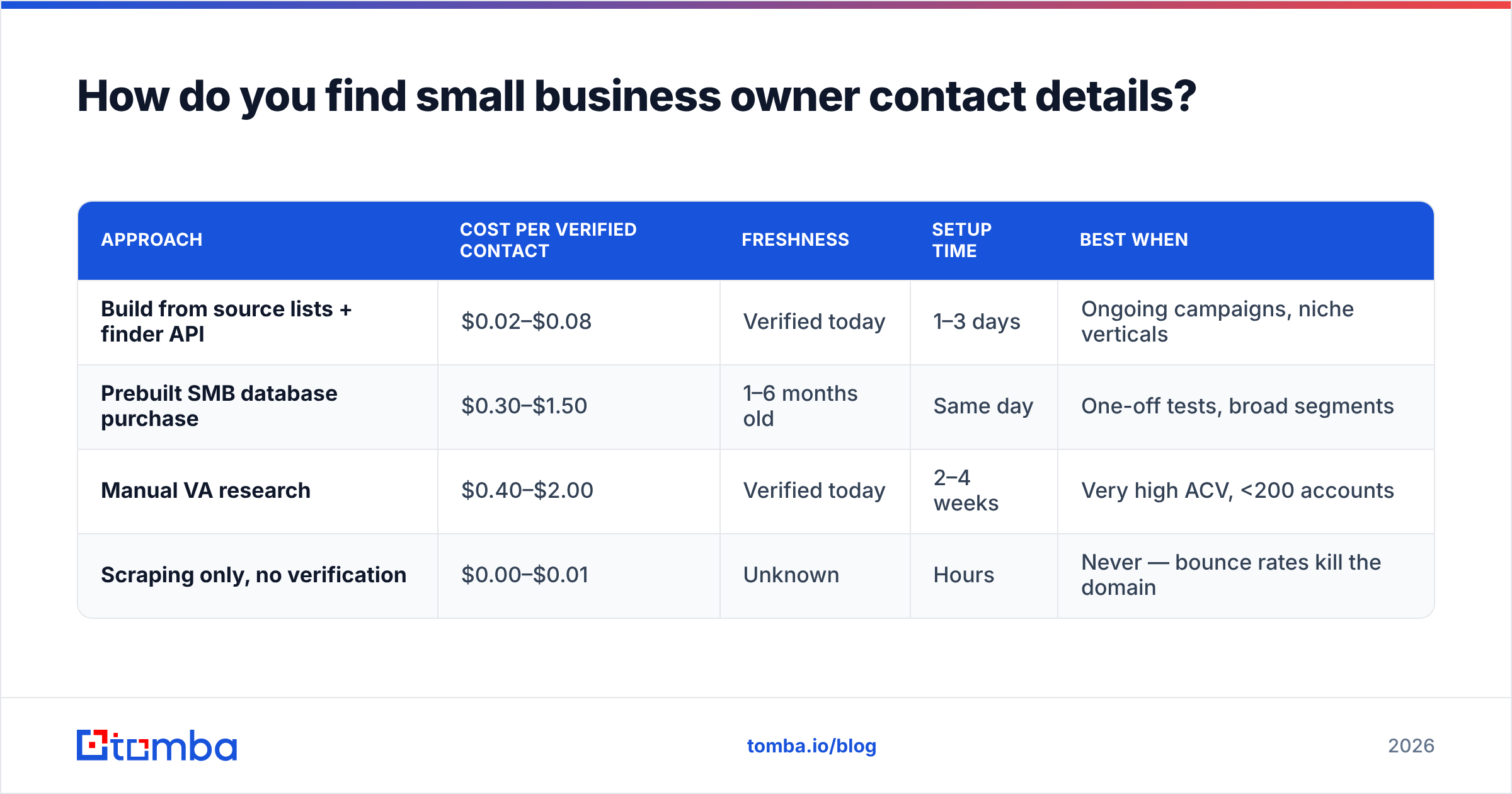
| Approach | Cost per verified contact | Freshness | Setup time | Best when |
|---|---|---|---|---|
| Build from source lists + finder API | $0.02–$0.08 | Verified today | 1–3 days | Ongoing campaigns, niche verticals |
| Prebuilt SMB database purchase | $0.30–$1.50 | 1–6 months old | Same day | One-off tests, broad segments |
| Manual VA research | $0.40–$2.00 | Verified today | 2–4 weeks | Very high ACV, <200 accounts |
| Scraping only, no verification | $0.00–$0.01 | Unknown | Hours | Never — bounce rates kill the domain |
That last row is not a joke. Sending to an unverified scrape is the fastest way to end up with a burned sending domain, and for a small team that domain is your business. Verification is not an optional polish step; it's the thing standing between you and a Google spam folder.
What should your first message to a small business actually say?#
Short. Specific. Priced. That's the whole formula.
SMB owners aren't evaluating a vendor landscape — they're deciding in about eight seconds whether this is worth another eight. Every enterprise convention you learned works against you here.
Cut these:
- "I hope this email finds you well"
- Anything about "synergies," "solutions," or "digital transformation"
- A calendar link in the first email
- Any paragraph longer than two lines
- Attachments or images (they hurt deliverability and read as bulk)
Keep these:
- A proof of location or trade in line one. "Saw you're the only certified Trane dealer in Boulder County" beats any personalization token.
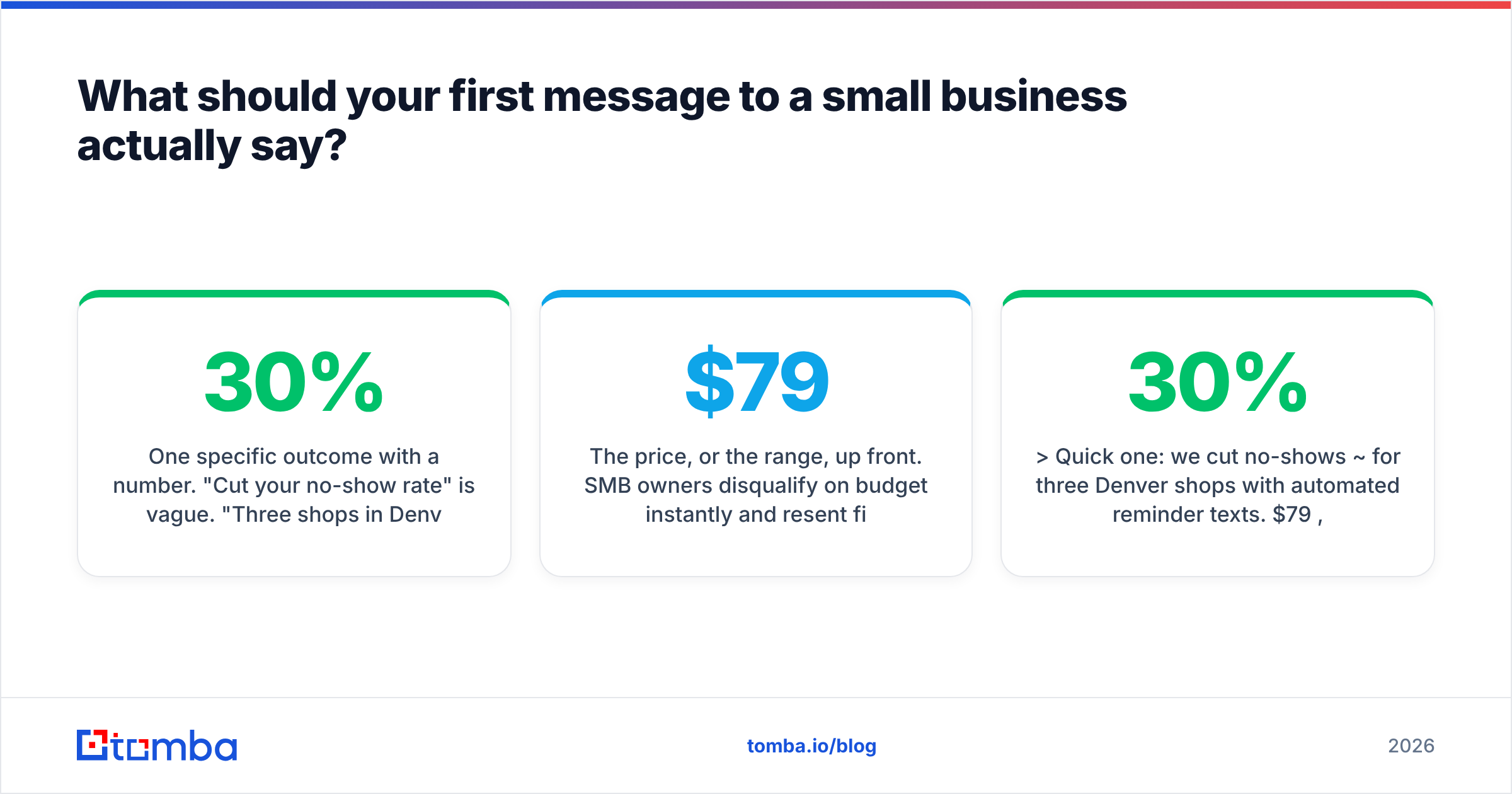
- One specific outcome with a number. "Cut your no-show rate" is vague. "Three shops in Denver cut no-shows about 30% with reminder texts" is concrete.
- The price, or the range, up front. SMB owners disqualify on budget instantly and resent finding out on call two. Saying "$79/month" in email one saves everyone a week.
- A tiny ask. Ten minutes, not a demo. Or better — a yes/no question they can answer in four words.
A working template shape:
Subject: no-shows at [Shop Name]?
Hi Dana — saw the 4.8 rating on the Colfax location, that's rare for a 3-bay shop.
Quick one: we cut no-shows ~30% for three Denver shops with automated reminder texts. $79/mo, no contract.
Worth 10 minutes Thursday, or is scheduling already handled?
— Sam
Sixty-two words. Names their city, their business type, their number. Prices itself. Offers an easy out, which counterintuitively raises reply rates because it costs nothing to say "already handled" — and about a quarter of those replies turn into "actually, tell me more."
If you want a starting point to adapt, the cold email templates library has SMB-appropriate variants, and running a draft through a spam checker before launch catches the phrasing that trips filters — "free," "guaranteed," "act now," and excessive exclamation.
How many touches does an SMB sequence need?#
Fewer than you think, spread wider than you think.
Enterprise sequences run 12–16 touches over six weeks because the buying committee needs time. An SMB owner makes the call herself. If she's interested, she replies by touch three. If she isn't, touch eleven just annoys her and raises your spam complaint rate.
The structure that performs:
- Day 1 — Email. The 60-word pitch above.
- Day 3 — Phone. Reference the email in the first sentence. "Sent you a note Monday about no-shows, is that a real problem for you or am I off?" Do not leave a voicemail on the first call.
- Day 6 — Email reply in-thread. Two sentences, add one new proof point, no re-pitch.
- Day 10 — Phone + voicemail. The voicemail is 15 seconds and says you'll follow up once more, then stop.
- Day 15 — Breakup email. One line: "Closing the loop — should I check back in the spring?" This gets a surprising number of replies.
Five touches, two channels, fifteen days. Then out of the sequence and into a quarterly nurture. Anything longer burns sender reputation for diminishing returns.
Volume-wise, keep each sending mailbox under 40–50 cold emails a day and warm the domain for at least two weeks before you start. Deliverability guidance from Google's bulk sender rules tightened again for high-volume senders, and SMB campaigns are exactly the profile that gets flagged: many recipients, low engagement, similar templates. Authenticate SPF, DKIM, and DMARC before your first send — no exceptions.
What are the most common SMB outreach mistakes?#
Treating an industry as a segment. "Restaurants" is not a segment. "Independent full-service restaurants, 2–4 locations, using Toast, in metros over 500K" is. Small businesses vary wildly within a vertical, and the tighter your segment, the more your one message can be specific to all of it.
Selling to the business instead of the owner. SMB purchases are personal. She's buying back her Saturday, not "optimizing operational efficiency." Frame the outcome in hours and stress, not percentages and platforms.
Ignoring seasonality. Accountants are unreachable February through April. Landscapers are unreachable in spring. Retail is unreachable in December. Build your calendar around the trade, not your quarter.
Sending from a fresh domain. New domain, 500 emails on day one, dead by day four. Use a separate sending domain from your primary, warm it gradually, and monitor with a blacklist checker weekly.
Over-automating the personalization. A merge field that says "I loved your work in {{industry}}" reads worse than no personalization at all. If your variable can produce a nonsense sentence in any row, cut it.
Not verifying because "it's just a small list." A 3% bounce rate is the informal ceiling before mailbox providers start throttling you. Unverified SMB lists routinely bounce at 12–20%. Run the bulk email finder and verification pass — it costs less than one lost domain.
How do you measure whether SMB outreach is working?#
Track four numbers weekly and ignore the rest for the first 90 days:
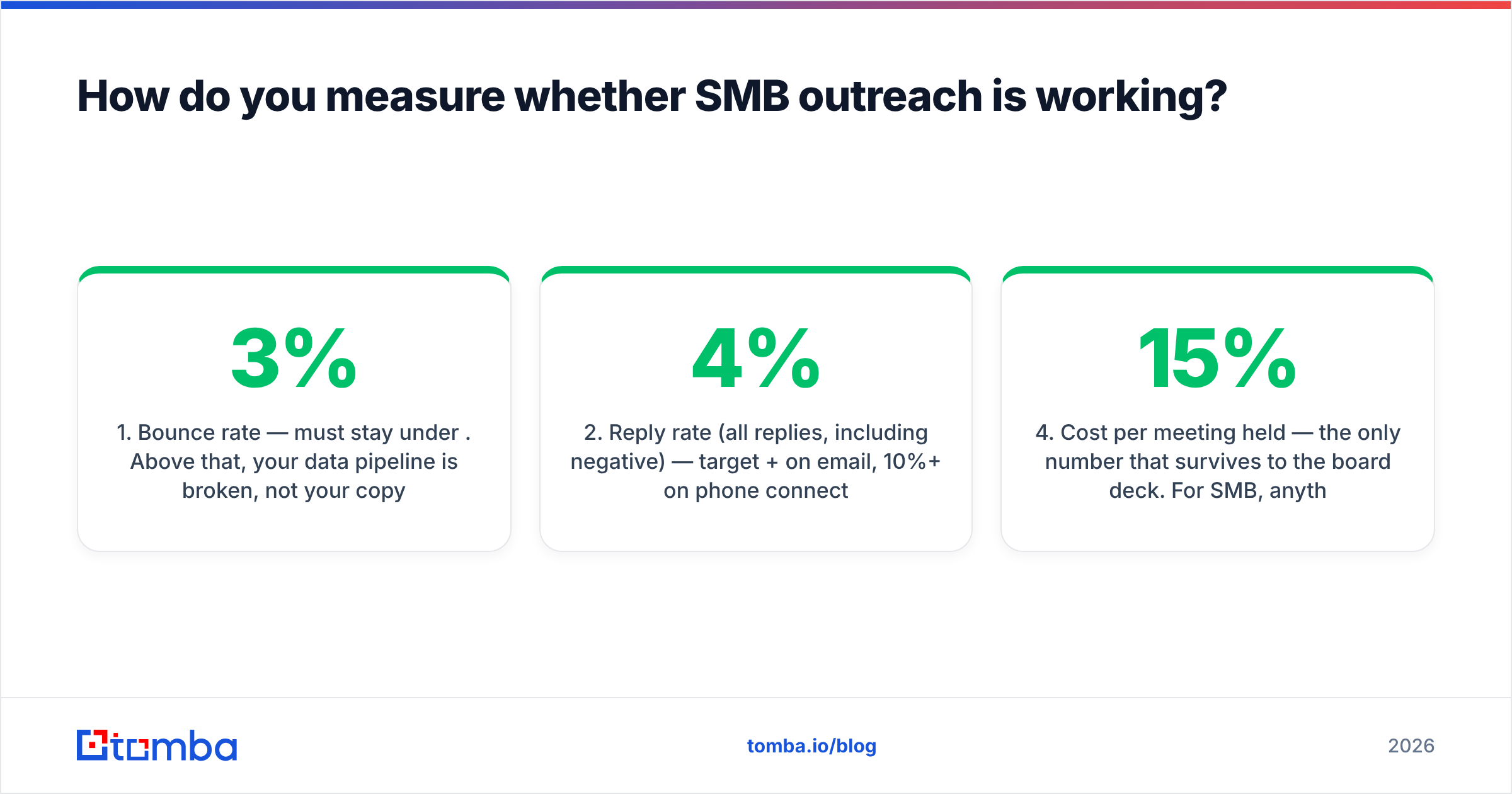
- Bounce rate — must stay under 3%. Above that, your data pipeline is broken, not your copy.
- Reply rate (all replies, including negative) — target 4%+ on email, 10%+ on phone connects. Below that, your segment or your offer is wrong.
- Positive reply rate — target one-third of all replies. If replies are high but positives are low, your targeting is fine and your offer isn't.
- Cost per meeting held — the only number that survives to the board deck. For SMB, anything under about 15% of first-year contract value is healthy.
Deliberately not on that list: open rate. Apple Mail Privacy Protection and similar features have made it noise. If you're still optimizing subject lines by open rate in 2026, you're optimizing against a random number generator. Review third-party category comparisons on G2 if you want a sense of how tools in this space are actually evaluated by practitioners rather than by vendor claims.
Segment every one of these by source list. You'll usually find that one source — a specific trade association directory, one metro from Google Maps — outperforms the rest by 3–4x. Then you stop buying breadth and start buying more of that.
Where should you start this week?#
Pick one vertical, one metro, and 200 accounts. Not 2,000. Build the list properly: domains first, owner names second, verified personal addresses third, phone numbers fourth. Write one message that would be embarrassing to send to a different vertical — that's how you know it's specific enough. Run the five-touch sequence. Measure the four numbers.
If the numbers hold at 200, scale to 2,000 with the same workflow. If they don't, the fix is almost always upstream in the data or the segment, not in the subject line.
The list-build is the part worth automating first, because it's the part that determines everything downstream. Tomba's Email Finder resolves owner and manager addresses from a name plus domain, returns a confidence score and the sources behind it, and handles the catch-all domains that make SMB data so painful — all through the same API you'd script your list pipeline against. The free tier gives you 25 searches a month to test the workflow on a handful of accounts, and paid plans start at $49/month; full Tomba pricing scales with volume rather than seats, which matters when SMB outreach means a lot of contacts and a small team. Build 200 clean records, send five touches, and let the reply rate tell you whether the segment is real.
Related guides#
// get started
Find, verify and enrich your first contacts today
Start on the free plan with 25 searches a month, then scale when your team is ready.
Free plan · No credit card required · GDPR & CCPA
// about the author