How to Sell Technology Solutions: A 2026 Field Guide
Selling tech in 2026 means surviving a 9-person buying committee, a procurement gate, and a security review. Here is the process that actually closes deals — plus the qualification and outreach mechanics behind it.
TL;DR
- Technology sales fails at the top of the funnel more often than at the close — you cannot run a good process against the wrong 200 accounts or a stale contact list.
- The modern B2B tech deal involves 6–10 stakeholders. Your job is not to convince one champion; it's to arm that champion to convince six other people while you're not in the room.
- Lead with a diagnosed problem and a quantified cost of inaction. Demos that start with features lose to demos that start with the buyer's own workflow.
- Budget for two gates most reps ignore: security/IT review and procurement. Deals stall there, not in discovery.
- Your pipeline math is downstream of data quality. Verified contact data at the prospecting stage is the cheapest performance lever in the whole motion.
What does "selling technology solutions" actually mean in 2026?#
Solution selling means you sell the outcome and the change, not the software. That distinction used to be a sales-training platitude. Now it's structural, because the buyer has changed.
Three things happened. First, buying committees expanded — most enterprise software purchases now involve high single digits of stakeholders, each with veto power and none with unilateral buying power. Second, buyers self-educate; by the time someone books a call, they've already read your G2 page, three competitor comparisons, and a Reddit thread. Third, budget scrutiny hardened. "Nice to have" doesn't survive a CFO review anymore.
So "how to sell technology solutions" in practice means running a repeatable process that does four jobs:
- Find accounts with an active, expensive problem — not accounts that merely fit your ICP demographics.
- Reach the right humans inside them with accurate contact data and a message tied to their specific role in the decision.
- Diagnose before you demo, so the demo becomes proof rather than a product tour.
- Navigate the committee, security review, and procurement without losing momentum.
Miss any one and the deal dies quietly. Most reps only get graded on step 3.
Why do most technology sales processes break down?#
Here's the uncomfortable pattern in underperforming tech sales teams: the process is fine, the inputs are garbage.
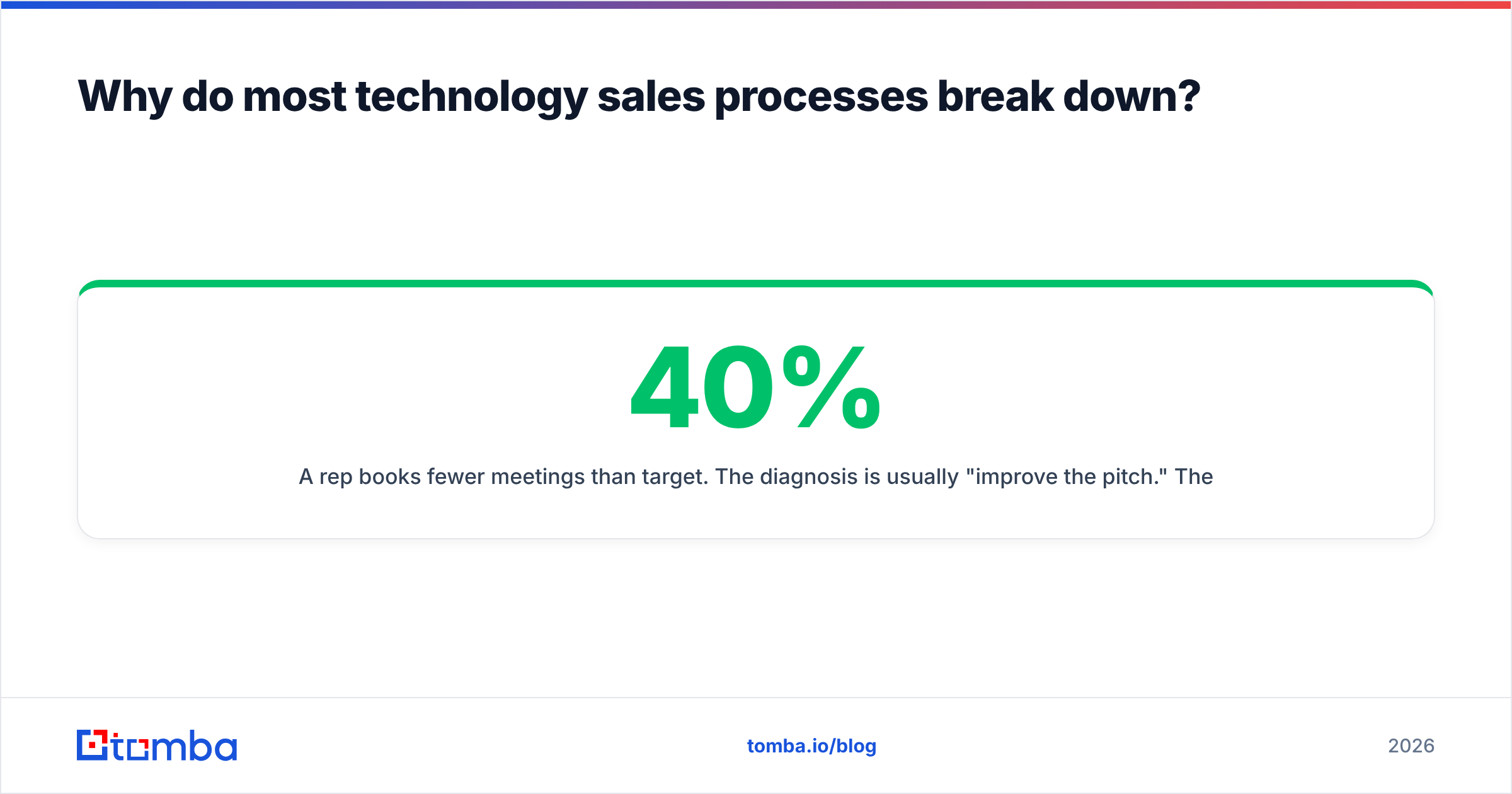
A rep books 40% fewer meetings than target. The diagnosis is usually "improve the pitch." The actual cause is often that 28% of the contact list bounced, another 15% went to people who left the company nine months ago, and the remaining sends hit a domain whose sender reputation was already damaged by the first two problems.
The failure modes stack in a predictable order:
- Bad data → bounces → deliverability damage → even good emails stop landing.
- Wrong persona → your message about developer productivity lands on a procurement manager.
- Feature-first pitch → prospect can't map your product to their problem, so they benchmark you on price.
- Single-threaded deal → your champion changes jobs, and the deal evaporates.
- Late-stage surprise → SOC 2 questionnaire arrives in week 9 of a 10-week cycle.

Fix them in that order. There is no messaging framework that rescues a list where a third of the addresses don't exist.
How do you find and qualify the right technology buyers?#
Start with a trigger, not a title list. Technology purchases are almost always caused by something: a funding round, a new VP hire, a compliance deadline, a migration, a competitor's outage, a headcount spike in a specific function.
Build your target list around those signals, then layer on firmographics. A 200-account list built from triggers outperforms a 5,000-account list built from "SaaS, 50–500 employees, US" by a wide margin — and it costs less to work.
Once you have accounts, you need people. That's where most teams leak time. Practical sequence:
- Map the committee before outreach. For a mid-market tech deal, assume an economic buyer, a technical evaluator, an end-user champion, a security reviewer, and a procurement contact. Name them.
- Resolve contact data at the account level. A domain search returns the addresses and patterns for a company in one pass, which beats guessing formats one person at a time.
- Verify before you send. Run the list through an email verifier so bounces don't taint your sending domain.
- Enrich for context. Role, seniority, tenure, tech stack. A prospect who joined eight weeks ago is a different conversation than one who's been there six years.
- Multi-thread from day one. Three contacts per account minimum. Single-threaded deals are the number one cause of late-stage stalls.
Qualification frameworks compared#
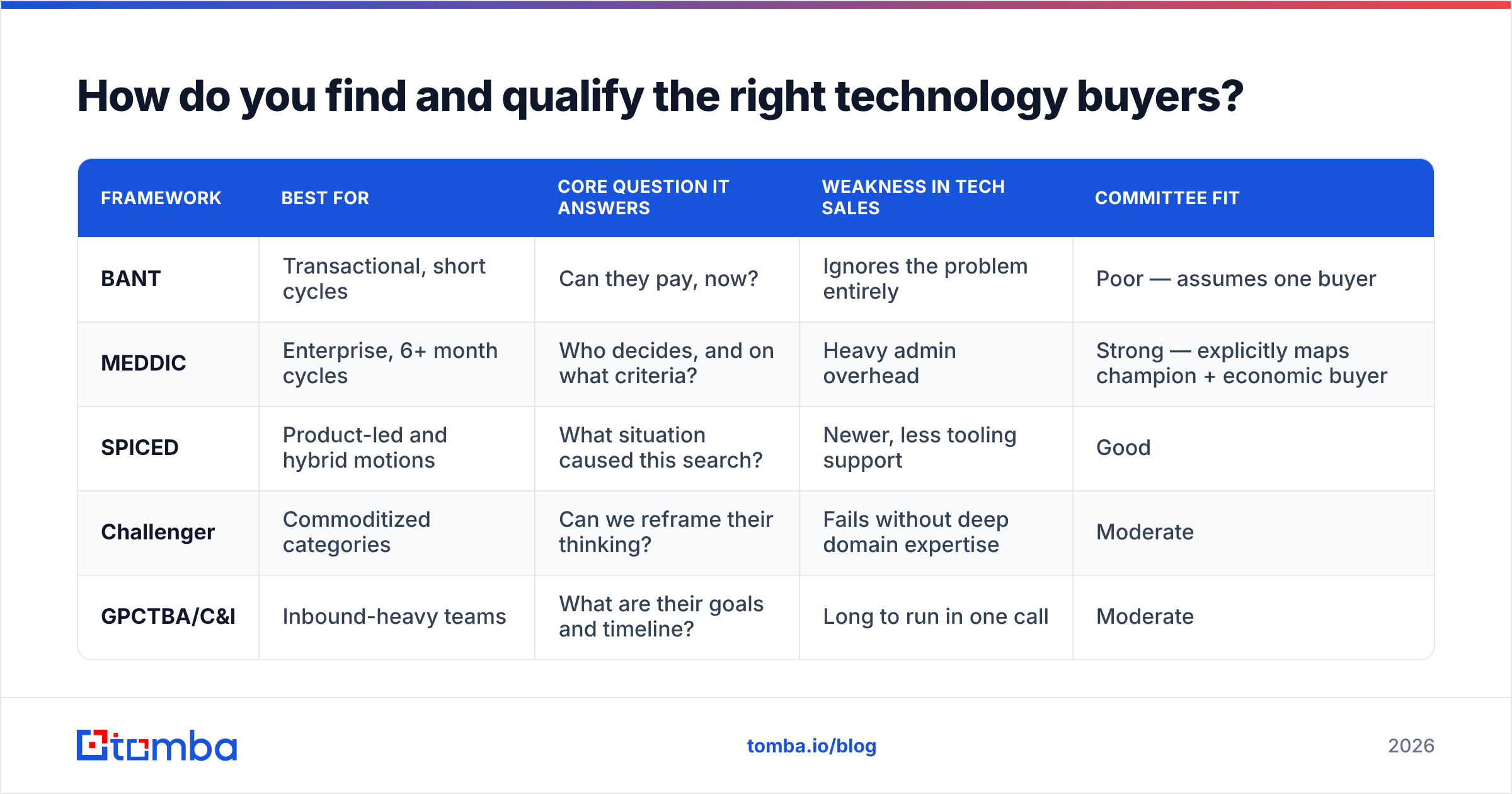
You need a qualification framework, but the popular ones optimize for different things. Pick based on deal complexity, not on what your last company used.
| Framework | Best for | Core question it answers | Weakness in tech sales | Committee fit |
|---|---|---|---|---|
| BANT | Transactional, short cycles | Can they pay, now? | Ignores the problem entirely | Poor — assumes one buyer |
| MEDDIC | Enterprise, 6+ month cycles | Who decides, and on what criteria? | Heavy admin overhead | Strong — explicitly maps champion + economic buyer |
| SPICED | Product-led and hybrid motions | What situation caused this search? | Newer, less tooling support | Good |
| Challenger | Commoditized categories | Can we reframe their thinking? | Fails without deep domain expertise | Moderate |
| GPCTBA/C&I | Inbound-heavy teams | What are their goals and timeline? | Long to run in one call | Moderate |
For most technology solution sales above $20K ACV, MEDDIC or a lightweight variant wins because it forces you to identify the economic buyer and the decision criteria early — the two things that kill deals in month three.
What does an effective technology sales process look like step by step?#
Seven steps. Each has an exit criterion; if you can't meet it, you don't advance the deal, you fix the gap.
1. Research and trigger identification. Exit criterion: you can state in one sentence why this account has a problem now. Not "they're in our ICP." Something like "they hired three security engineers in Q1 and their careers page lists SOC 2 as a 2026 objective."
2. Multi-threaded outreach. Exit criterion: verified contact data for at least three roles, with a role-specific message for each. The CTO cares about architecture and risk. The VP Ops cares about time saved. The CFO cares about a number. Same product, three different first lines. If you're building lists at scale, a bulk email finder removes the manual step.
3. Discovery. Exit criterion: you have a quantified cost of inaction. "This is annoying" is not a business case. "Our team spends 11 hours a week on manual data entry, at a loaded cost of roughly $62K a year" is. Ask for numbers explicitly; buyers rarely volunteer them.
4. Tailored demonstration. Exit criterion: the prospect saw their own workflow, with their own terminology, solving the problem they described in step 3. Kill the 40-slide product tour. Show three things, all tied to stated pain.
5. Business case and ROI model. Exit criterion: your champion has a one-page document they can forward without you. This is the single highest-leverage artifact in tech sales. Include current-state cost, projected savings, implementation effort, and payback period. Be conservative — a model your CFO-side buyer can poke holes in destroys credibility faster than a modest number.
6. Technical and security validation. Exit criterion: security questionnaire returned, integration path confirmed, and any pilot scoped with success metrics defined in advance. Start this in parallel with step 5, not after. Ask in week two: "who runs your security review, and what's their typical turnaround?"
7. Procurement and close. Exit criterion: signature. Procurement will ask for a discount because that's their job. Trade concessions — longer term, case study rights, faster payment terms — rather than giving pure price relief.

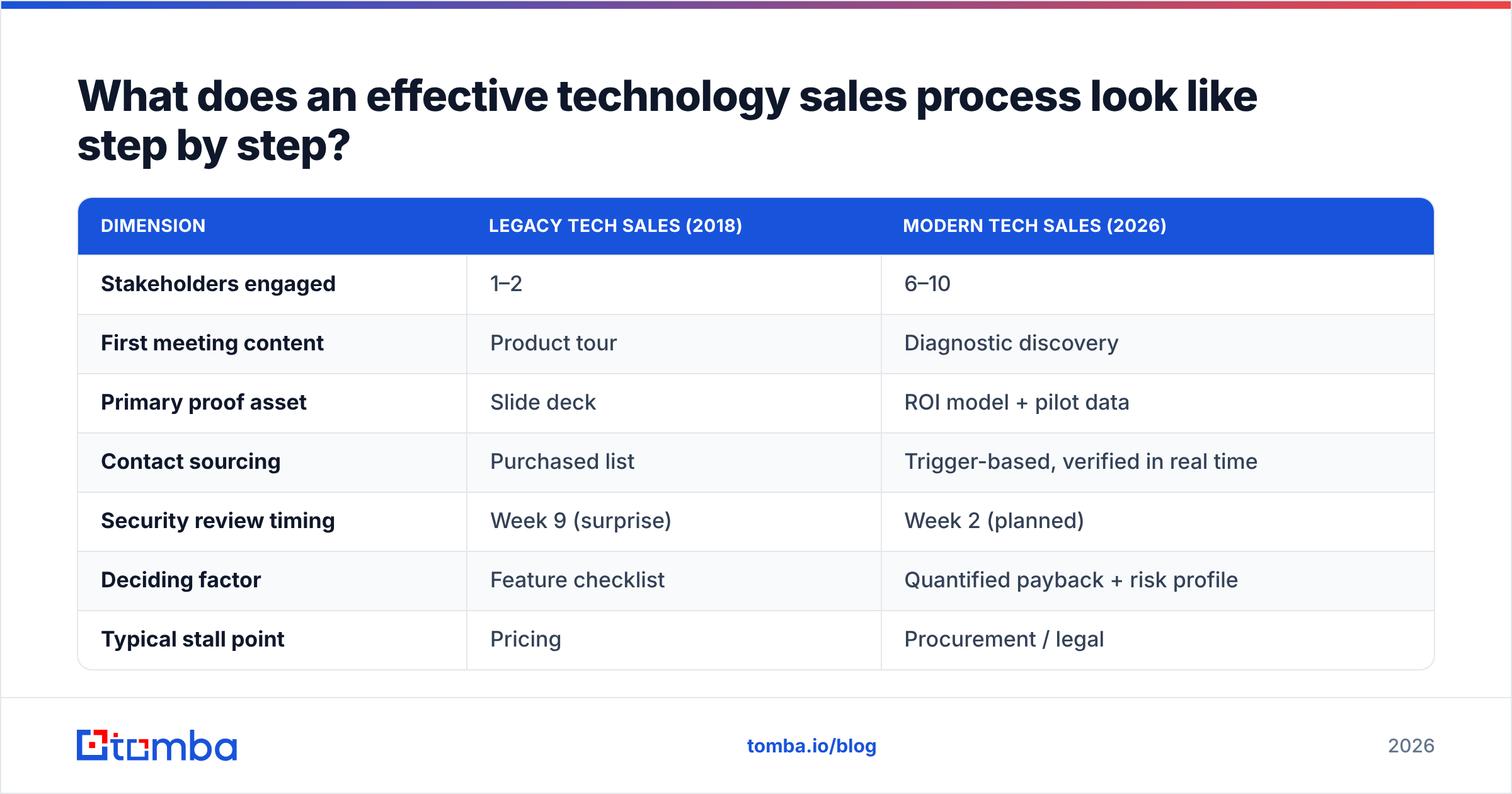
Old motion vs. modern motion#
| Dimension | Legacy tech sales (2018) | Modern tech sales (2026) |
|---|---|---|
| Stakeholders engaged | 1–2 | 6–10 |
| First meeting content | Product tour | Diagnostic discovery |
| Primary proof asset | Slide deck | ROI model + pilot data |
| Contact sourcing | Purchased list | Trigger-based, verified in real time |
| Security review timing | Week 9 (surprise) | Week 2 (planned) |
| Deciding factor | Feature checklist | Quantified payback + risk profile |
| Typical stall point | Pricing | Procurement / legal |
The right-hand column isn't aspirational. It's what your competitors who win are already doing.
How do you sell to a buying committee instead of a single buyer?#
You don't sell to a committee. You equip one person to sell for you.
Your champion attends internal meetings you'll never see. If the only thing they carry into those meetings is a memory of your demo, you lose to whichever vendor gave their champion better ammunition.
What to give them:
- A one-page business case. Current cost, proposed cost, delta, payback period, implementation timeline. One page. Forwardable.
- A security summary. SOC 2 status, data residency, subprocessors, SSO support. Pre-empt the questions IT will ask.
- A comparison sheet that's honest. Include where a competitor genuinely fits better. Champions trust vendors who admit limits, and buying committees smell one-sided sheets instantly.
- An objection cheat-sheet. "What if we just build it?" "What about vendor X?" "Why now instead of next fiscal year?" Give them the answers in their words.
Then map the committee explicitly. For each name: what they care about, what they fear, and what would make them a blocker. If you can't fill that in for the economic buyer, you don't have a deal — you have a conversation.
Research from Gartner has consistently pointed at the same finding: buyers who feel confident in their own decision-making process close faster than buyers who merely like the product. Confidence is manufactured by giving the committee a clear, low-risk path — pilot scope, rollback plan, phased rollout — not by adding features.
How do you prove ROI without inflating the numbers?#
Build the model with the buyer, not for them. A number you calculated alone is a marketing claim. A number they helped derive is their own commitment.
Structure it in four lines:
- Current state cost. Hours × loaded hourly rate, plus tool spend being replaced, plus quantified error/rework cost.
- Expected improvement. Use the conservative end of your own customer data. If your range is 30–60% time savings, model 30%.
- Total cost of the change. License + implementation + training + internal time. Include the internal time; buyers notice when you don't.
- Payback period. Months until cumulative savings exceed cumulative cost.
Two rules. Never model a benefit the buyer didn't confirm they care about. And attach every assumption to a source — "you told me 11 hours a week on the March 3rd call" beats an unsourced figure every time.
If your payback period is longer than 12 months in a tight budget environment, expect to lose to "do nothing" unless there's a compliance or risk driver. That's not a pitch problem; it's a segment problem. Sell to the accounts where the math works.
What tools support a technology sales motion?#
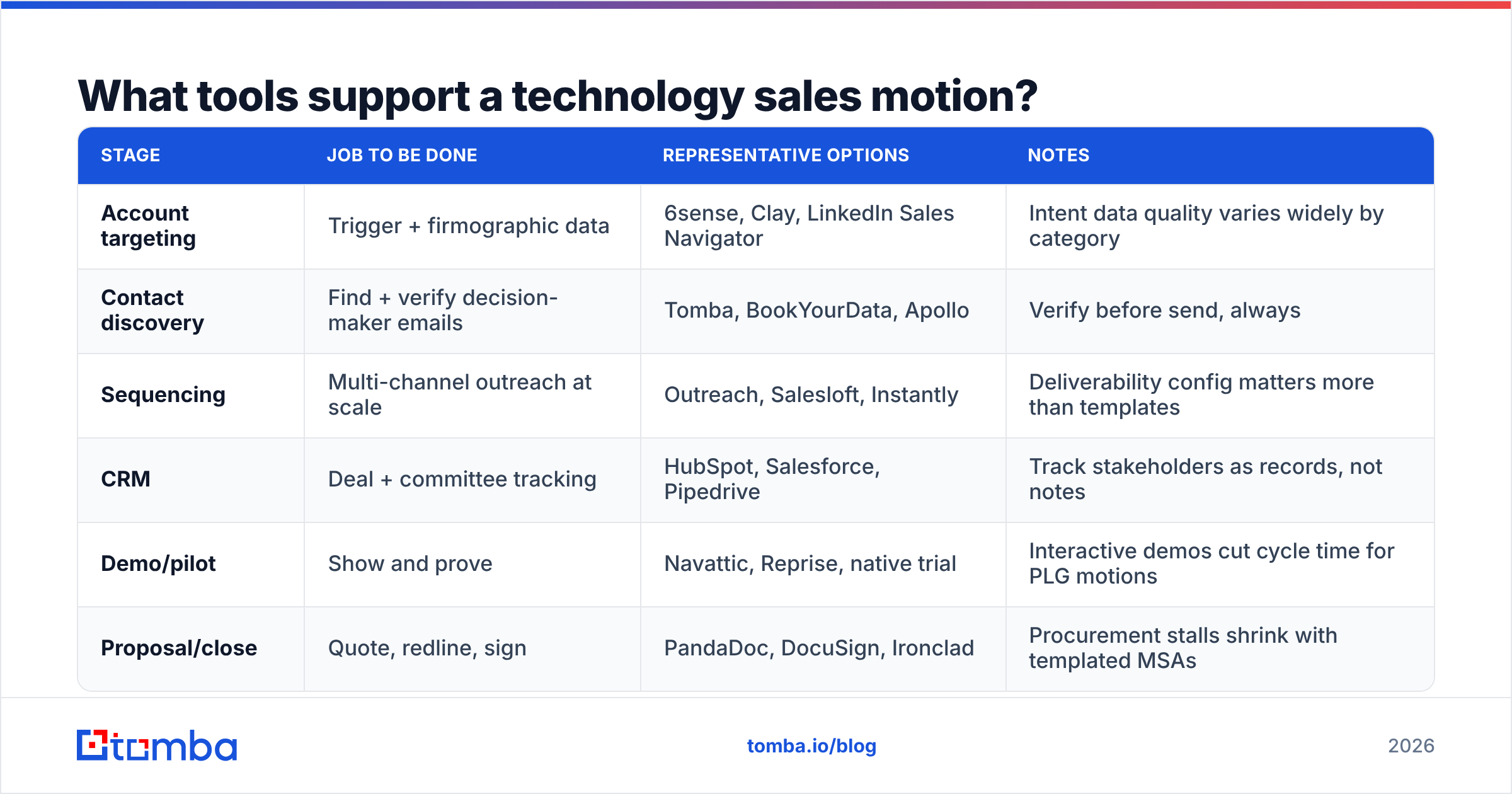
Tooling should map to the process stages, not the other way around. A representative stack for a mid-market tech sales team:
| Stage | Job to be done | Representative options | Notes |
|---|---|---|---|
| Account targeting | Trigger + firmographic data | 6sense, Clay, LinkedIn Sales Navigator | Intent data quality varies widely by category |
| Contact discovery | Find + verify decision-maker emails | Tomba, BookYourData, Apollo | Verify before send, always |
| Sequencing | Multi-channel outreach at scale | Outreach, Salesloft, Instantly | Deliverability config matters more than templates |
| CRM | Deal + committee tracking | HubSpot, Salesforce, Pipedrive | Track stakeholders as records, not notes |
| Demo/pilot | Show and prove | Navattic, Reprise, native trial | Interactive demos cut cycle time for PLG motions |
| Proposal/close | Quote, redline, sign | PandaDoc, DocuSign, Ironclad | Procurement stalls shrink with templated MSAs |
Costs differ sharply at the data layer, which is where most teams over- or under-spend. For reference, Tomba pricing runs a free tier at 25 searches/month, Starter at $49/mo, Growth at $99/mo, and Pro at $249/mo — with an email finder API if you're wiring enrichment directly into your CRM or an internal scoring model.
The point isn't the specific vendors. It's that a tool without a corresponding process step is shelfware, and a process step without tooling is a rep doing manual work that doesn't scale. Audit both columns quarterly.
Compare shortlists on real user evidence rather than vendor claims — G2's software categories are useful for spotting where a tool's ratings diverge from its marketing, particularly on data accuracy and support responsiveness.
How do you handle the objections that actually kill tech deals?#
Four objections account for most losses. Prepare exact responses.
"We can build this internally." Don't argue capability — argue opportunity cost and maintenance. Ask what else that engineering team would ship in those two quarters, and who owns the system in year three when the person who built it leaves.
"Your competitor is cheaper." Reframe on total cost: implementation time, data quality rework, seat minimums, overage pricing. If they're genuinely cheaper and equivalent, you have a positioning problem, not an objection.
"Not in this budget cycle." Find out whether it's a real freeze or a priority ranking. If it's ranking, your job is to raise the cost of inaction. If it's a hard freeze, agree a specific re-engagement date and stay useful in between — send relevant data, not check-ins.
"Security won't approve it." This is often a proxy for "I don't want to run the internal process." Make it cheap: pre-filled questionnaire, existing SOC 2 report, a named security contact on your side. Remove the friction and the objection dissolves.
Across all four, the underlying move is the same: convert a vague blocker into a specific, dated, ownable next step.
Where should you start this week?#
Pick the stage with the largest leak, not the stage you enjoy most.
If your meeting rate is low, the problem is upstream — targeting, data quality, or message-to-role fit. If meetings convert to opportunities but stall after the demo, your discovery isn't producing quantified pain. If opportunities die in month three, you're single-threaded or you skipped the security conversation.
Diagnose with your own numbers before you change anything. Then fix one stage, measure for a full cycle, and move to the next.
For most teams reading this, the first fix is the boring one: the contact list. If a meaningful share of your outbound never reaches a real inbox, every downstream improvement is measured against noise. Start there — verified addresses, mapped committees, three contacts per account — and the rest of the process gets easier to evaluate.
Get the top of your funnel right first. Tomba's Email Finder pulls verified professional email addresses by domain, name, or company, so your outreach reaches the CTO, the VP Ops, and the economic buyer instead of bouncing. Start free with 25 searches a month, then scale to Starter at $49/mo when the pipeline math proves out. Pair it with contact enrichment to know who you're talking to before you write the first line.
Related guides#
// get started
Find, verify and enrich your first contacts today
Start on the free plan with 25 searches a month, then scale when your team is ready.
Free plan · No credit card required · GDPR & CCPA
// about the author