How to Send a Gentle Follow Up Email That Gets Replies
Most follow-ups fail because they nag instead of adding value. Here are the timing rules, templates, and sequence structure that turn a polite nudge into a booked meeting.
TL;DR
- A gentle follow-up works when it adds something new — a resource, a data point, an easier ask — not when it repeats "just checking in."
- The highest-reply window is 3 business days after the first email, then 5, then 7. Sending daily reads as pressure; waiting three weeks reads as indifference.
- Keep follow-ups under 90 words, with one question and one clear next step. Long "gentle" emails are still long emails.
- Reply to your original thread rather than starting a new one for follow-ups 2 and 3 — context matters more than a fresh subject line.
- None of this matters if the address is wrong. Verify before you send, or your polite nudge becomes a bounce that damages your sender reputation.
What Makes a Follow-Up "Gentle" Instead of Pushy?#
A gentle follow-up removes pressure from the recipient and puts the effort on you. That is the whole distinction. "Just bumping this up" pushes work onto them — they have to remember your last email, decide, and reply. "I saw your team just opened a Berlin office, so I pulled the three benchmarks most relevant to a DACH expansion — want them?" does the work for them.
Three mechanics separate the two:
- New information in every send. If a follow-up contains nothing the previous email did not, it is a nag. Add a case study, a stat, an industry change, a new integration, or a shorter version of your original ask.
- A downgraded ask. If the first email asked for a 30-minute call, the second should ask for a reply of "yes/no," and the third for permission to close the loop. Each step lowers the cost of responding.
- An explicit exit. "If this isn't a priority right now, tell me and I'll stop" reads as respect and — counterintuitively — often triggers a reply. People answer to end obligations.
What makes it feel pushy is almost never the frequency by itself. It is frequency without value. Four emails that each teach something land better than two that each say "circling back."

How Many Follow-Ups Should You Send, and When?#
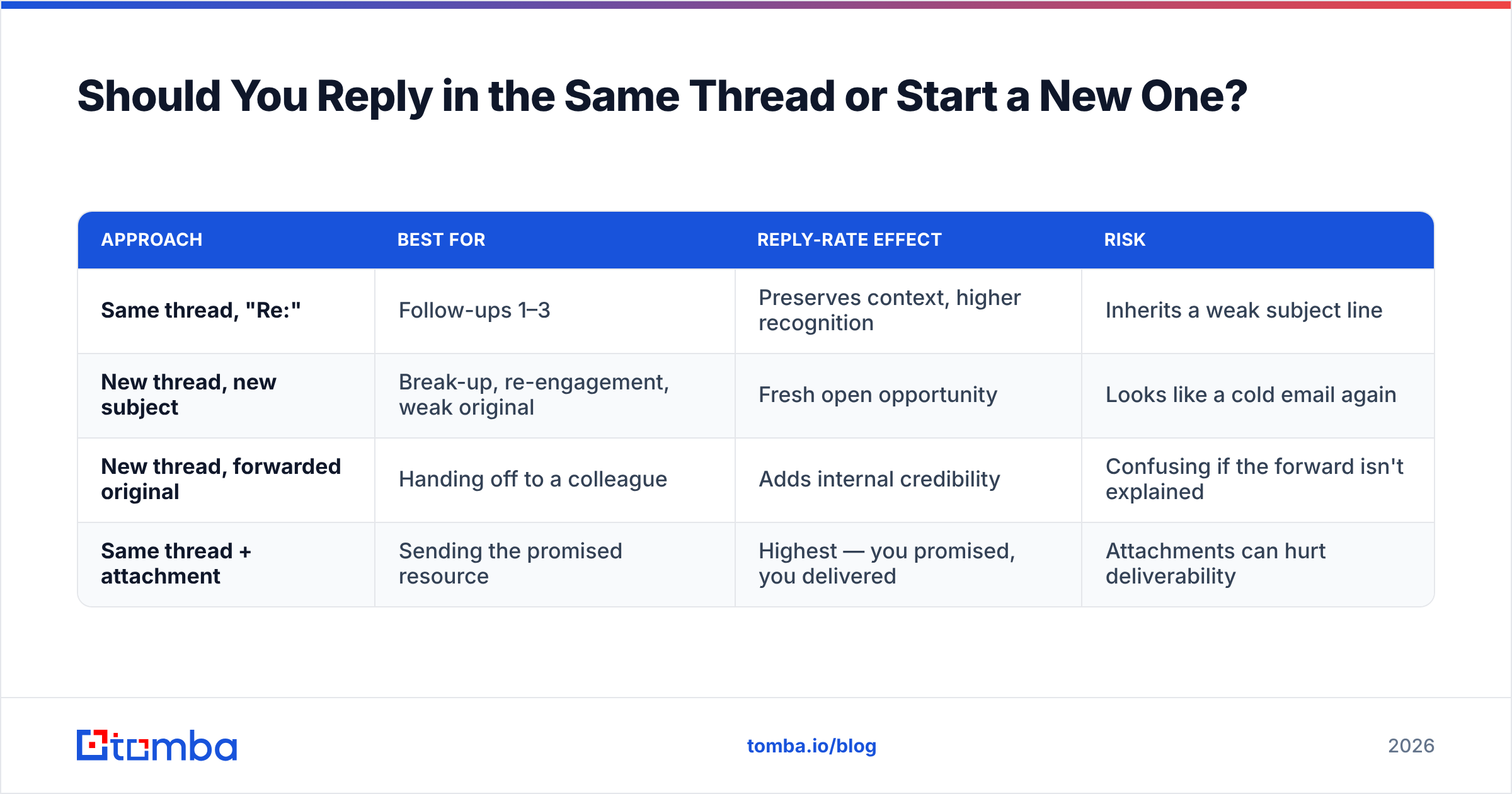
Send three to four follow-ups across roughly 18 business days, then stop and re-enter the contact in a nurture track months later.
The cadence that consistently performs for B2B outbound:
| Touch | Timing | Purpose | Ask level |
|---|---|---|---|
| Email 1 | Day 0 | Original pitch, one clear value hook | Meeting request |
| Follow-up 1 | Day 3 | Add a resource or proof point | Same ask, softer wording |
| Follow-up 2 | Day 8 | New angle — different pain, different persona benefit | Yes/no reply |
| Follow-up 3 | Day 15 | Social proof: a named customer with a similar profile | One-line reply |
| Break-up | Day 22 | Permission to close the file | Reply only if interested |
Two timing rules matter more than the exact days. First, never follow up on the same day — you look automated even when you are not. Second, respect the recipient's calendar reality: Tuesday through Thursday mornings in the prospect's timezone outperform Monday (inbox triage) and Friday (checked-out) in almost every dataset published by major sending platforms, including HubSpot's send-time research.
If you are running this manually across dozens of accounts, the timing decays fast. Sequencing tools handle the scheduling; your job is to make sure each email in the sequence earns its place.
What Should a Gentle Follow-Up Email Actually Say?#
Here are five templates mapped to real situations. Each is under 90 words on purpose — a gentle email that takes two minutes to read is not gentle.
1. The resource add (follow-up 1)
Subject: Re: [original subject]
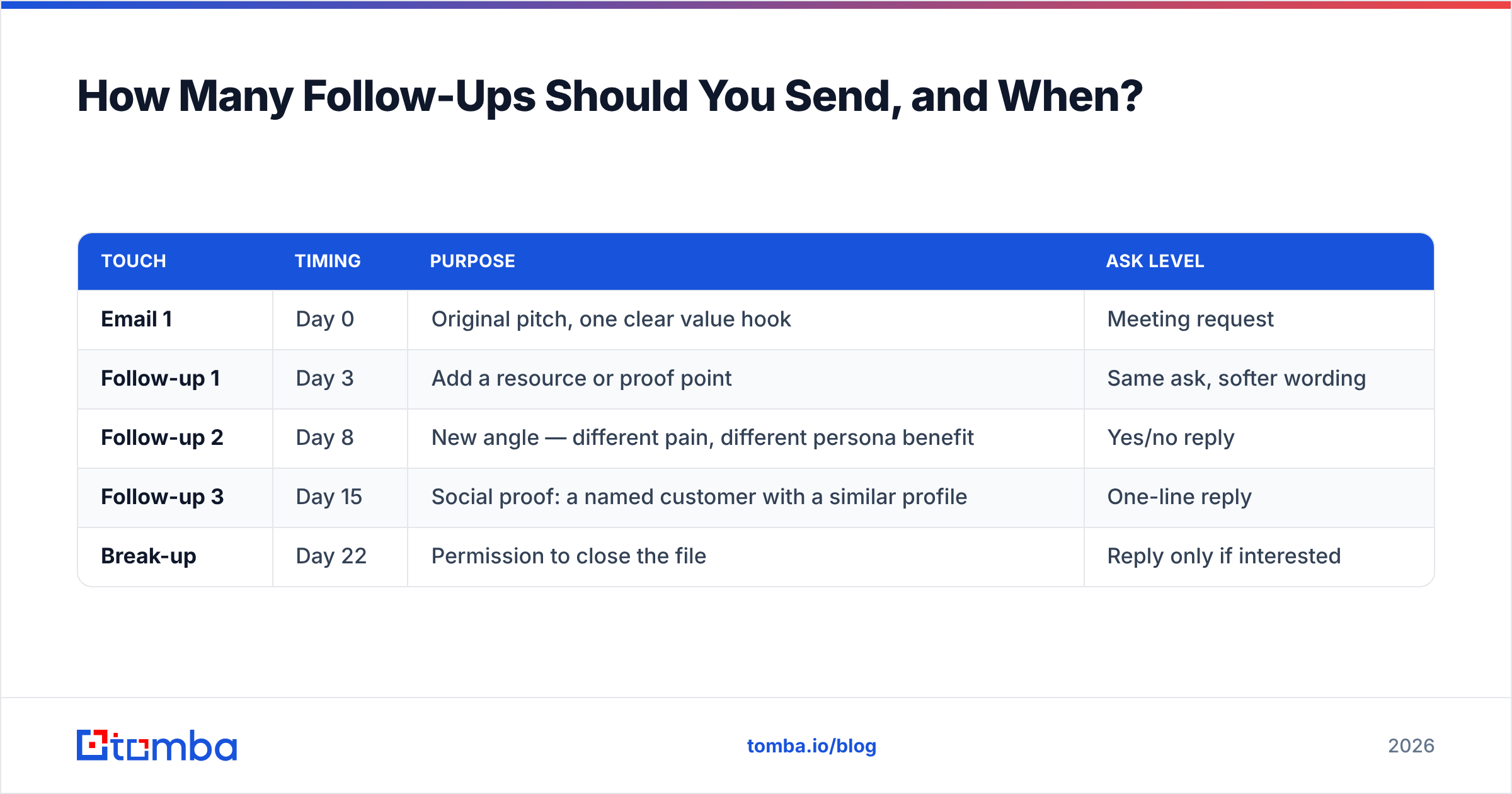
Hi [Name] — following up with something more useful than a bump. We benchmarked reply rates across 40 [industry] teams last quarter; the median was 4.1% and the top decile hit 11%. The gap came down to one thing: list hygiene, not copy.
Happy to send the one-page summary — want it?
[Your name]
2. The new-angle nudge (follow-up 2)
Hi [Name], my first email led with cost savings. That may not be your problem. The teams I talk to at [Company]'s stage usually care more about ramp time for new reps.
If that's closer to the mark, I'll send the 3-step onboarding playbook we use. Yes or no is a fine answer.
3. The trigger-event follow-up
Hi [Name] — saw [Company] announced [funding/product/hire]. That usually means the outbound team doubles in six months.
When that happened at [Similar Company], their bad-data rate went from 8% to 22% because nobody owned list quality. Worth a 15-minute conversation before you scale?
4. The social-proof follow-up (follow-up 3)
Hi [Name], last note with something concrete. [Named customer], same size and same market as you, cut bounce rate from 9% to 1.4% in one quarter.
I can send the two-paragraph breakdown of what they changed. Interested?
5. The break-up email
Hi [Name] — I've sent a few notes and haven't heard back, which usually means one of three things: wrong timing, wrong person, or not a priority.
Any of those is a fine answer. If it's "wrong person," a name would help. If it's timing, tell me when to come back and I'll go quiet until then.
The break-up email is the highest-reply message in most sequences, which tells you something: people respond to closure. Use it, but mean it — do not send a "break-up" and then email again on day 25.
If writing variants at scale is the bottleneck, a cold email AI drafter and a subject line generator cover the mechanical part so you can spend your time on the research that makes the email specific.
Should You Reply in the Same Thread or Start a New One?#
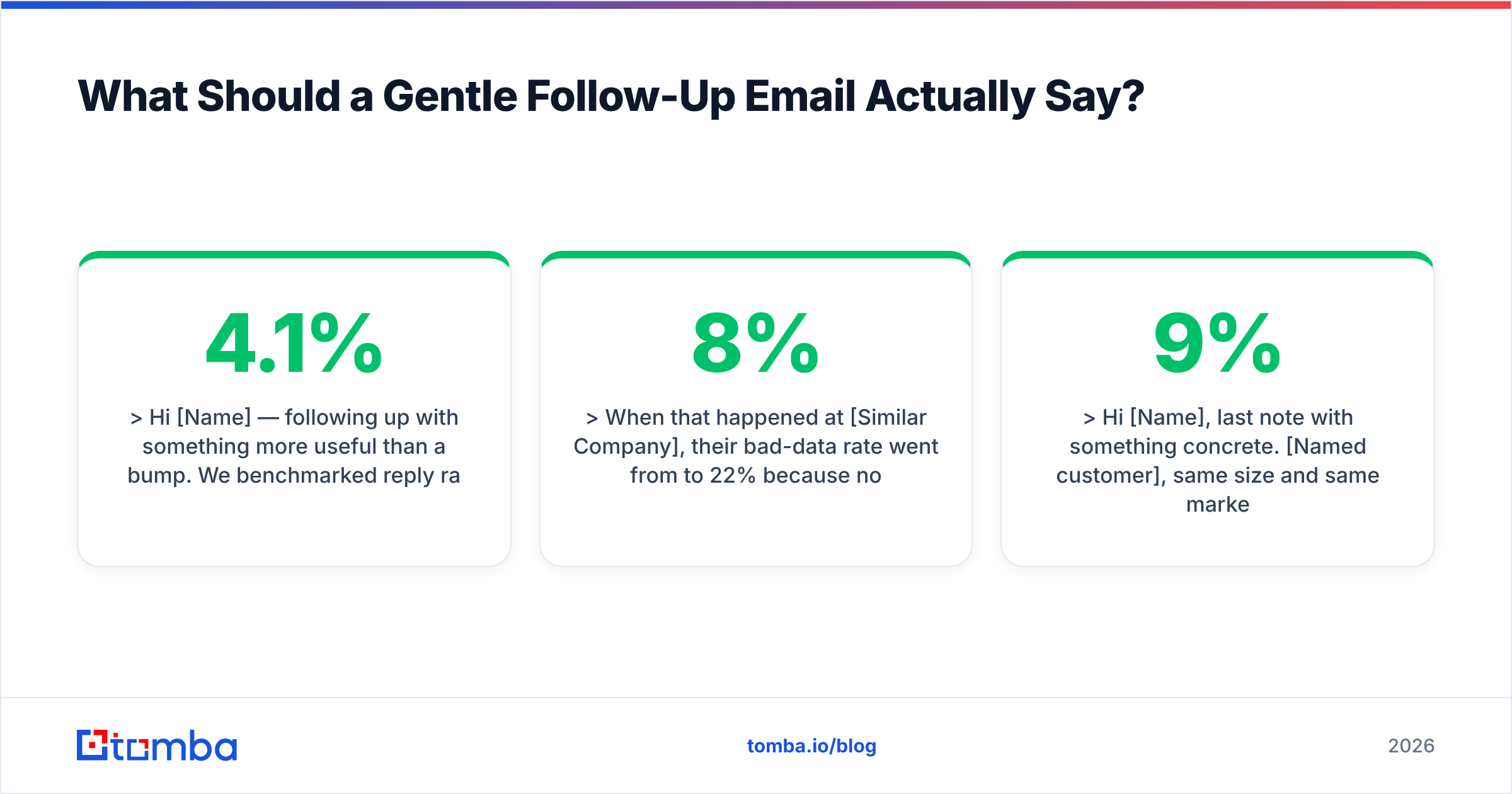
Reply in the same thread for follow-ups 1 through 3. Start a fresh thread only for the break-up or a re-engagement months later.
Same-thread replies preserve context: the recipient sees your original pitch directly below the nudge, so they do not have to reconstruct anything. They also keep the conversation visually shorter in inbox previews, which raises open rates on the second and third touches.
There is one exception worth knowing. If your original subject line was weak, threading inherits the weakness — the prospect who ignored "Quick question about [Company]" on day 0 sees the same words on day 3. In that case, break the thread once, with a subject line drawn from the new angle itself ("Ramp time for your next 5 reps"), and treat it as a restart rather than a nudge.
| Approach | Best for | Reply-rate effect | Risk |
|---|---|---|---|
| Same thread, "Re:" | Follow-ups 1–3 | Preserves context, higher recognition | Inherits a weak subject line |
| New thread, new subject | Break-up, re-engagement, weak original | Fresh open opportunity | Looks like a cold email again |
| New thread, forwarded original | Handing off to a colleague | Adds internal credibility | Confusing if the forward isn't explained |
| Same thread + attachment | Sending the promised resource | Highest — you promised, you delivered | Attachments can hurt deliverability |
Why Do Polite Follow-Ups Still Get No Replies?#
Because a well-written email to a wrong or dead address is still a bounce. Before you blame the copy, check the four failure points in this order.
- Bad address. Role accounts, departed employees, and typo'd domains eat a shocking share of outbound. Run the list through an email verifier before the sequence starts, not after touch three.
- Deliverability, not persuasion. If your email deliverability is degraded, your gentle nudge is sitting in Promotions or Spam. Check your SPF, DKIM, and DMARC alignment, and watch your bounce rate — anything above 2% is a warning sign, above 5% is an emergency.
- Wrong person. Follow-ups do not fix a bad ICP match. If you are emailing an IC about a budget decision, three polite nudges will not change the answer.
- Volume without warmup. A new domain sending 200 emails a day will burn itself down in a week. Ramp slowly and monitor placement.
The order matters. Teams routinely rewrite copy five times when the actual problem was a 14% bounce rate. Fix the plumbing first.

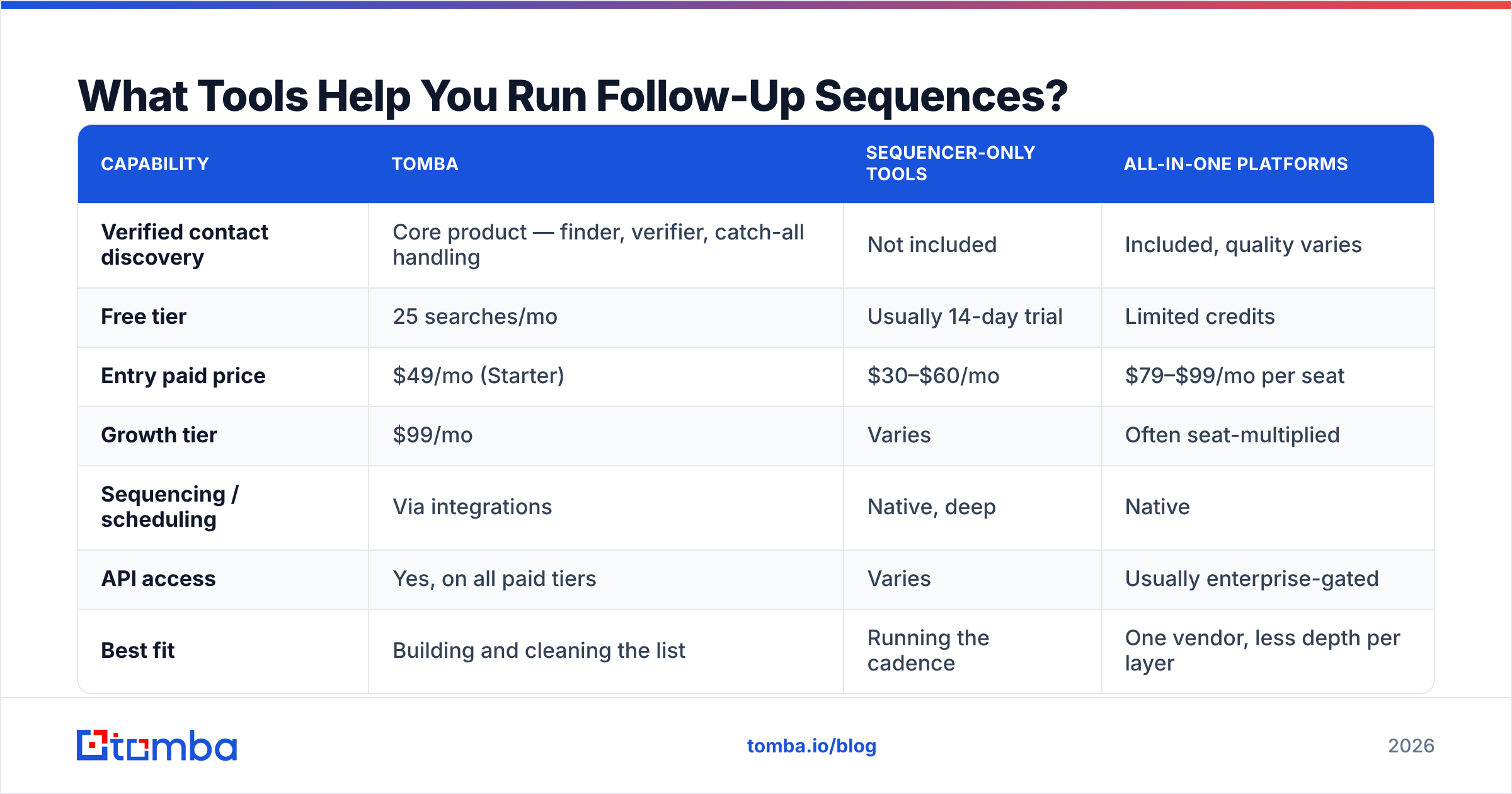
What Tools Help You Run Follow-Up Sequences?#
You need three things: accurate contact data, a sequencer, and a way to measure what happened. Here is how the common stacks compare.
| Capability | Tomba | Sequencer-only tools | All-in-one platforms |
|---|---|---|---|
| Verified contact discovery | Core product — finder, verifier, catch-all handling | Not included | Included, quality varies |
| Free tier | 25 searches/mo | Usually 14-day trial | Limited credits |
| Entry paid price | $49/mo (Starter) | $30–$60/mo | $79–$99/mo per seat |
| Growth tier | $99/mo | Varies | Often seat-multiplied |
| Sequencing / scheduling | Via integrations | Native, deep | Native |
| API access | Yes, on all paid tiers | Varies | Usually enterprise-gated |
| Best fit | Building and cleaning the list | Running the cadence | One vendor, less depth per layer |
Most teams end up combining layers rather than buying one box. A data layer feeds a sequencer; the sequencer feeds the CRM. If you want to see how the data layer prices out, the full breakdown is on the Tomba pricing page, and the Tomba API covers the case where you want verification to happen inside your own workflow rather than in a UI.
For teams evaluating alternatives, G2's sales engagement category is a reasonable neutral starting point, and Google's bulk sender guidelines are mandatory reading before you scale any follow-up cadence past a few hundred sends a day.
How Do You Measure Whether Your Follow-Ups Are Working?#
Track reply rate per touch, not just sequence-level totals. Sequence totals hide the fact that follow-up 2 might be doing all the work while follow-up 1 does nothing.
Four numbers to watch weekly:
- Reply rate by touch number. If touch 3 outperforms touch 1 by 3x, your opener is the problem — rewrite it using touch 3's angle.
- Positive vs. total reply rate. A high reply rate full of "unsubscribe" is a targeting failure wearing a success costume.
- Bounce rate per campaign. Above 2%, pause and re-verify. This is the single fastest way to protect sender reputation.
- Time-to-first-reply. If most replies land within 48 hours of a touch, your gaps are too long; if they trickle in over 10 days, you are following up too fast.
Benchmark against your own history, not against blog averages. A 6% reply rate in enterprise security software and a 6% reply rate in SMB e-commerce mean completely different things.
What Should You Do Next?#
Rewrite one sequence this week using the structure above: three follow-ups, each with new information, each with a smaller ask, ending in a real break-up email. Then check the list underneath it, because the best copy in the world cannot reach an address that does not exist.
Start with the data layer. Tomba Email Finder locates verified professional addresses by name, domain, or company, so your follow-up sequence lands in a real inbox instead of a bounce log. The free tier gives you 25 searches a month to test your list quality before you commit to anything — run your next 25 target accounts through it and see how many of your current addresses were wrong.
Related guides#
// get started
Find, verify and enrich your first contacts today
Start on the free plan with 25 searches a month, then scale when your team is ready.
Free plan · No credit card required · GDPR & CCPA
Get the Tomba newsletter
Product and data updates
// about the author