How to Start a Follow Up Email After No Response in 2026
Most follow-ups die in the first line. Here are the opening formats that actually get replies after silence, the ones that kill your thread, and a copy-paste framework for your next four touches.
How to start a follow up email after no response: open with something new. A trigger event, a fresh fact, or an easy way to say no. Never open by pointing back at your last email.
TL;DR
- "Just following up" and "circling back" are the two most common follow-up openers, and among the weakest. They announce that you have nothing new to say.
- The strongest first line does one of three things: delivers new information, references a specific trigger event, or makes it effortless to say no.
- Silence usually means low priority, not rejection. Your opener should lower the cost of replying, not raise the guilt of not replying.
- Follow-ups 2 through 4 generate a large share of cold-email replies. The opener is not a throwaway line. It's the whole email in miniature.
- Before you blame your copy, confirm the address is real. A bounced follow-up looks identical to being ignored.
Why does your follow-up email get ignored?#
Because most follow-ups open by talking about the sender's feelings instead of the recipient's problem.
Think of it like knocking on a neighbor's door. The first knock is fine. The second knock is annoying if all you say is "I knocked earlier" — you've given them nothing new to open the door for. But say "your package got delivered to my house" and they open it immediately. Same knock, different opening line.
Silence after a cold email almost never means "no." It usually means one of four things:
- Timing — your email landed during a quarter-close, a launch, or a vacation.
- Priority — you're competing with 120 other unread messages, not with a competitor.
- Clarity — the recipient couldn't tell in three seconds what you wanted from them.
- Delivery — the email never reached the inbox at all, or the address was wrong.
That fourth reason matters more than people admit. If you follow up on emails that bounced or landed in spam, you're writing copy for an audience that never existed. Run your list through an email verifier before you blame your opening line.
How to start a follow up email after no response (7 openers)#
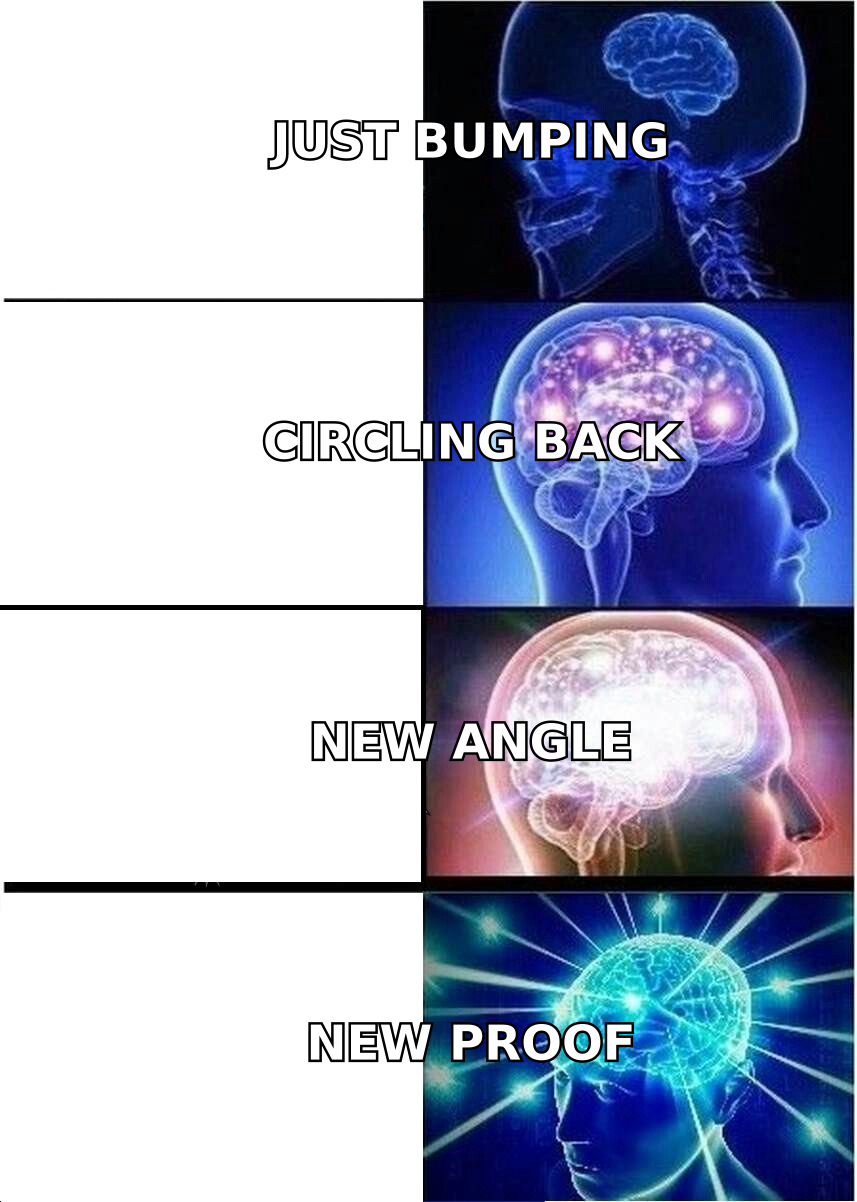
Open with something the recipient did not already have. That's the whole rule. Everything below is a variation on it.
Here are the seven opening patterns that beat generic bumps, ranked roughly by how much new value they carry:
The new-information open — "Since I emailed, [Company] published its Q3 hiring plan: 14 SDR roles. That's the exact scenario I mentioned." You've given them a reason this email exists today.
The trigger-event open — "Congrats on the Series B. Most teams in your position hit a data-hygiene wall about 60 days after the raise." Ties your ask to something that changed on their side.
The one-question open — "Quick one: is list quality actually a priority this quarter, or should I close the loop?" Single question, binary answer, ten seconds of effort.
The permission-to-decline open — "If this isn't a fit, just reply 'no' and I'll stop. No hard feelings." This produces replies because it removes the social cost.
The resource open — "No reply needed. Here's the teardown of your current email patterns I mentioned." You give first, with nothing attached.
The reframe open — "I think I pitched this wrong. The real problem isn't finding emails, it's the 22% that bounce." Admitting a miss reads as human, not needy.
The forward-to-the-right-person open — "You may not own this. If [Name] on your ops team is a better fit, I'll take it there." Gives them an easy action that isn't buying.
Notice what none of them do: none open with "I" plus a feeling. "I wanted to check in," "I was hoping," "I know you're busy" — all of these spend the most valuable line in your email on your own state of mind.
Which follow-up openers should you never use?#
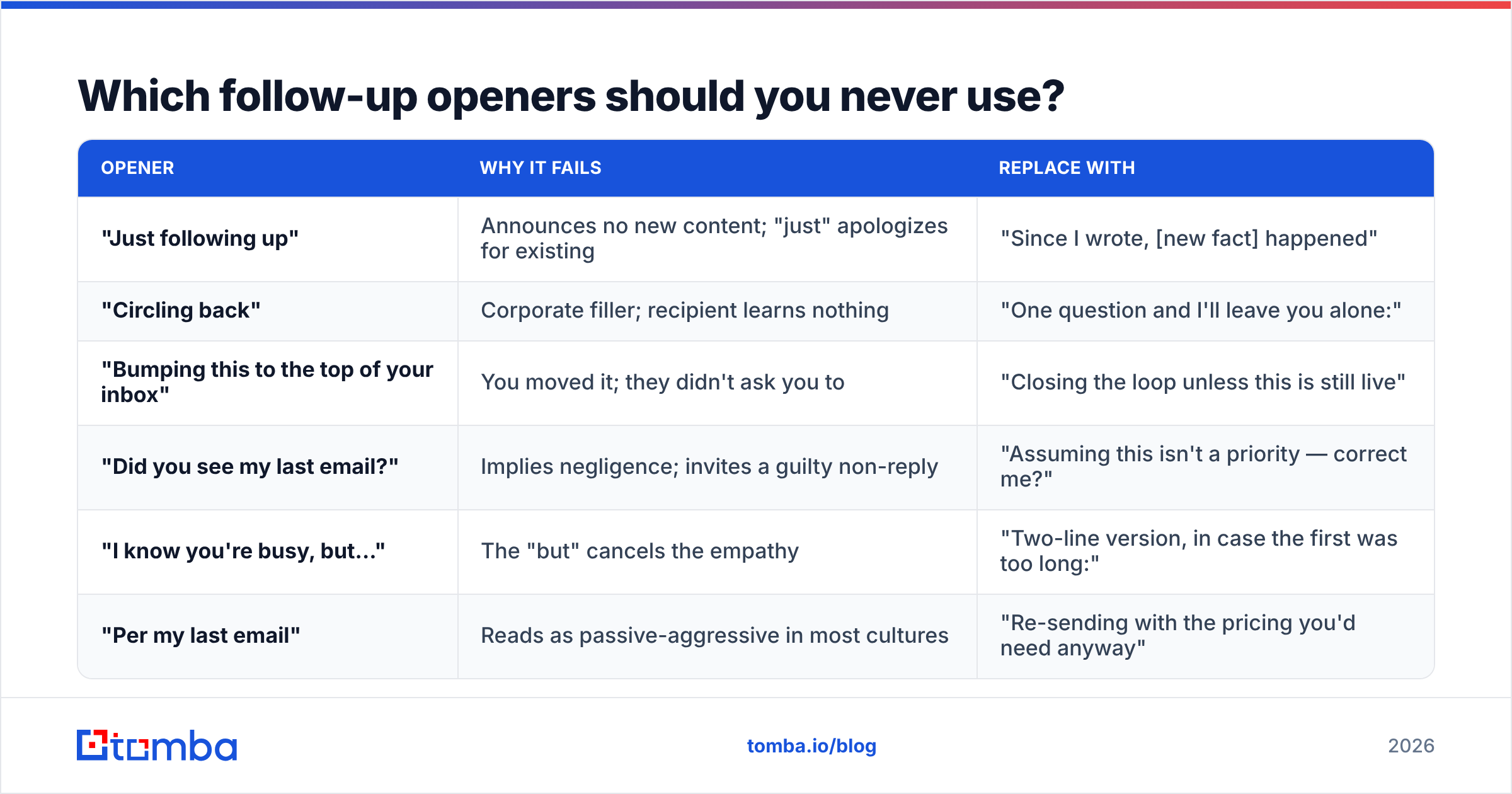
Three categories, all of which signal that the email contains nothing new.
| Opener | Why it fails | Replace with |
|---|---|---|
| "Just following up" | Announces no new content; "just" apologizes for existing | "Since I wrote, [new fact] happened" |
| "Circling back" | Corporate filler; recipient learns nothing | "One question and I'll leave you alone:" |
| "Bumping this to the top of your inbox" | You moved it; they didn't ask you to | "Closing the loop unless this is still live" |
| "Did you see my last email?" | Implies negligence; invites a guilty non-reply | "Assuming this isn't a priority — correct me?" |
| "I know you're busy, but..." | The "but" cancels the empathy | "Two-line version, in case the first was too long:" |
| "Per my last email" | Reads as passive-aggressive in most cultures | "Re-sending with the pricing you'd need anyway" |
The pattern: every failing opener is about the previous email. Every winning opener is about the recipient's world.
What should your follow-up sequence look like?#
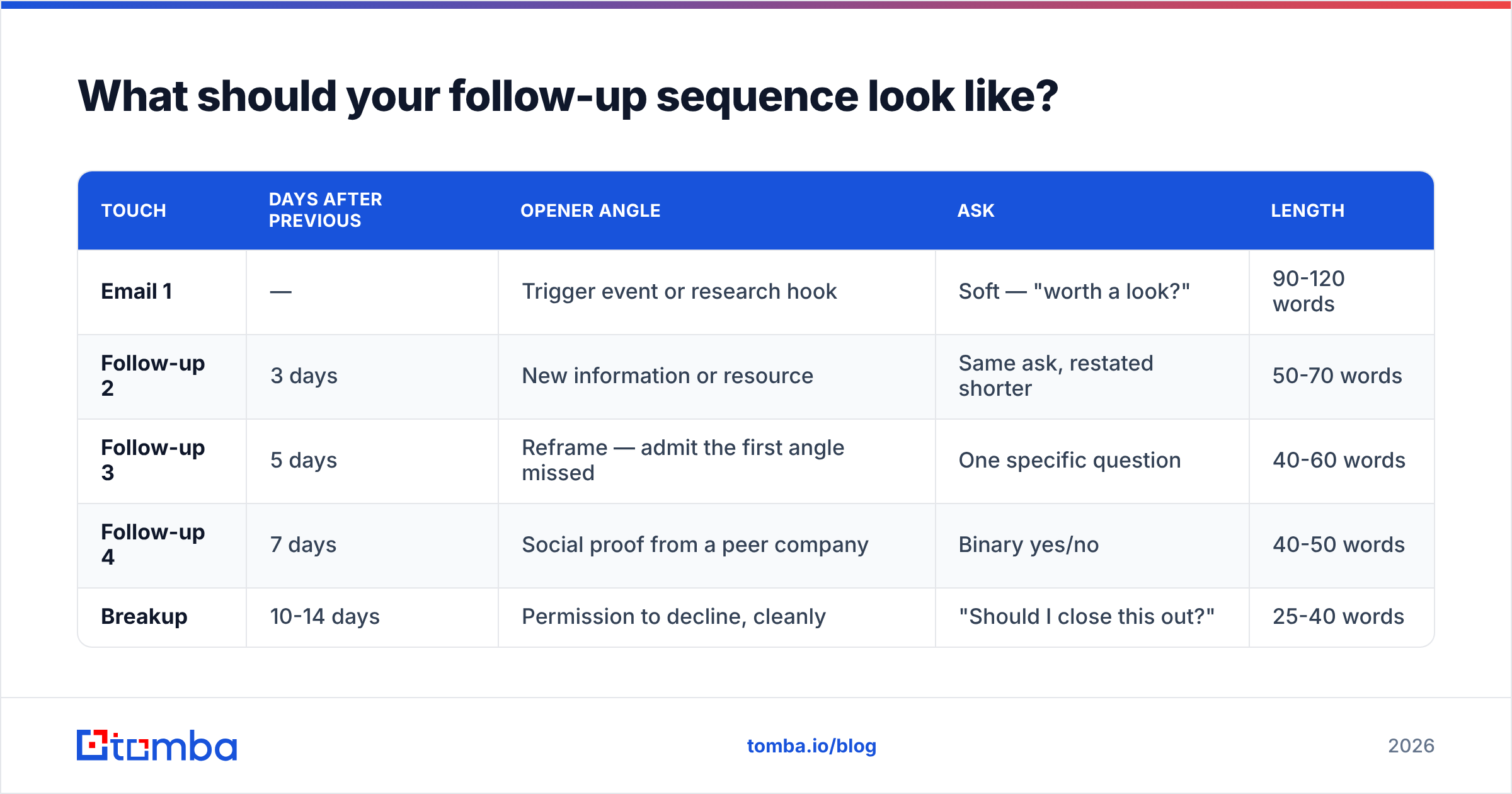
Different touches need different openers. Sending the same "just checking in" four times is why sequences flatten out after the second email.
| Touch | Days after previous | Opener angle | Ask | Length |
|---|---|---|---|---|
| Email 1 | — | Trigger event or research hook | Soft — "worth a look?" | 90-120 words |
| Follow-up 2 | 3 days | New information or resource | Same ask, restated shorter | 50-70 words |
| Follow-up 3 | 5 days | Reframe — admit the first angle missed | One specific question | 40-60 words |
| Follow-up 4 | 7 days | Social proof from a peer company | Binary yes/no | 40-50 words |
| Breakup | 10-14 days | Permission to decline, cleanly | "Should I close this out?" | 25-40 words |
A few notes on the table:
- Spacing beats frequency. Three follow-ups over two weeks beat five over five days. Spacing also protects your sender reputation.
- Emails get shorter, not longer. If touch 4 is longer than touch 1, you've inverted the funnel.
- Never send a follow-up with zero new content. If you can't find a new angle, that's your signal to send the breakup email instead.
- The breakup email is not a threat. "I'll assume the timing is off and stop here" works. "This is my last attempt" reads as a sulk.
HubSpot's sales research has long found that a meaningful share of deals need five or more touches. Most reps stop after two. The gap between those two numbers is where most of the pipeline sits. See HubSpot's sales follow-up research for the underlying benchmarks.
How do you personalize the opener without spending 20 minutes per email?#
Anchor to something machine-findable, then write one human sentence about it.
Personalization at scale fails when reps write a custom paragraph per prospect. It works when you pick one repeatable data point and vary a single clause. Practical anchors:
- A hiring signal — job posts reveal priorities before press releases do.
- A recent post or article — if they wrote it, they care about it. An author finder pulls the byline contact straight from the article URL.
- A tech-stack change — new analytics tag, new CRM, new email provider.
- A funding or leadership event — the 30-90 day window after either is the highest-intent period you'll get.
- A shared connection or customer — one degree of trust beats three lines of flattery.
Then the sentence: "Saw you're hiring three RevOps analysts — usually that means the data side got messy before the headcount did." That's ten seconds of writing on top of a data point you already pulled.
Building these anchors from a list of companies rather than people? Domain search gets you the named contacts and email patterns for a company in one pass. That's the input the whole personalization step depends on.
Should the subject line change on a follow-up?#
Keep the same thread for touches 2 and 3, then break it once.
Replying in the existing thread gives the recipient context for free. They can scroll down and see what you asked, which is usually worth more than a fresh subject line. But by touch 4, the thread has become visually familiar in a bad way and the eye skips it. That's the moment to start a new thread with a different subject and a different angle.
When you break the thread, follow the same rule as the opener: the subject must carry new information. "Following up (3)" carries none. "The 22% bounce number" carries a reason to click.
One factor has nothing to do with copy and everything to do with whether the follow-up gets seen: authentication. If your SPF, DKIM, and DMARC records aren't clean, your fourth touch is more likely to be filtered than your first. Volume to a non-responder is a spam signal. Google's Postmaster Tools documentation is the authoritative reference for what Gmail measures, and it's worth reading before you scale any sequence. Tomba's guide to email deliverability covers the same ground in sales terms.
How do you know whether it's your copy or your data?#
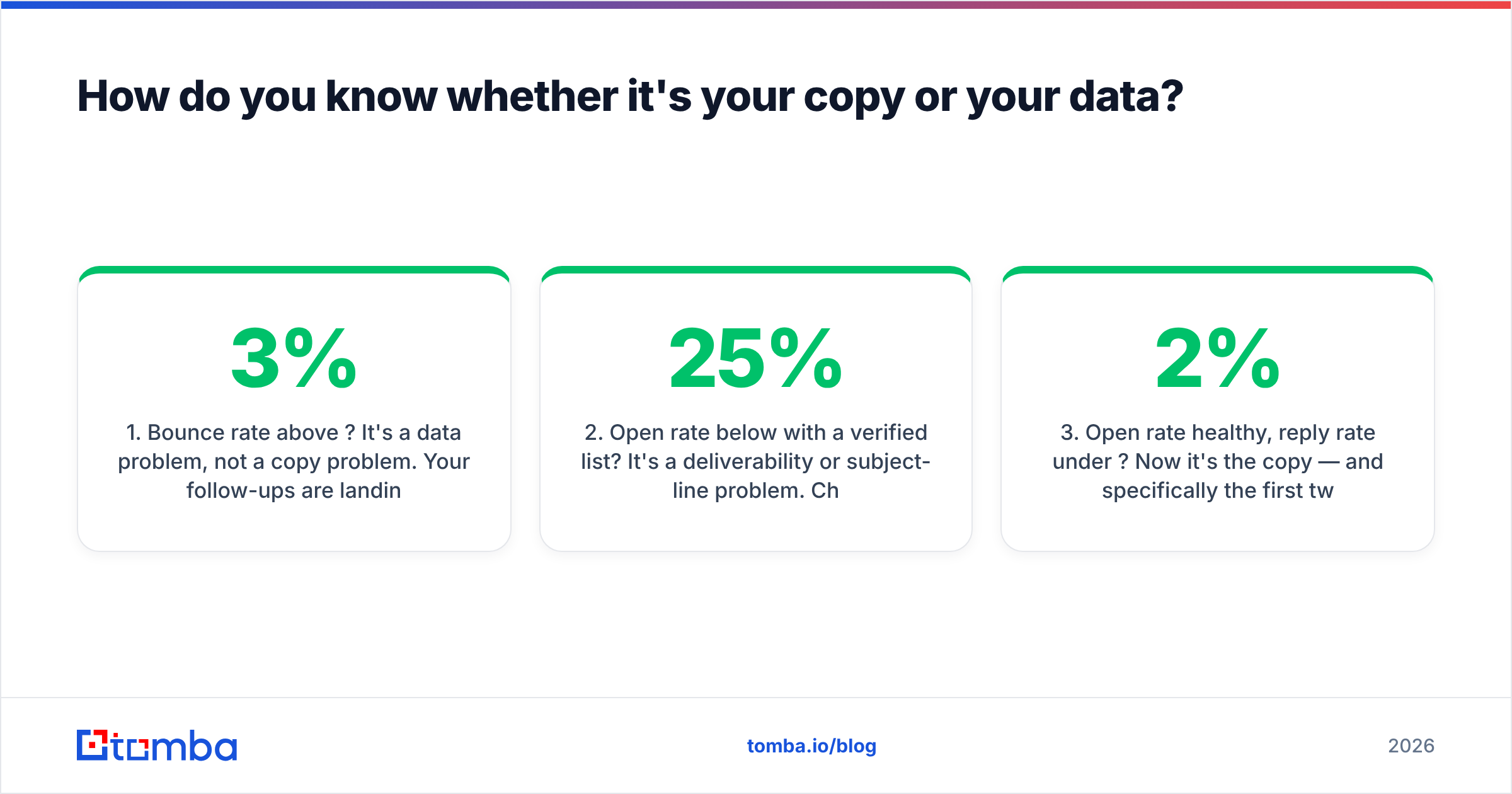
Check the bounce rate and the open rate before you rewrite a single word.
Here's the diagnostic order, because reps almost always start at the wrong end:
- Bounce rate above 3%? It's a data problem, not a copy problem. Your follow-ups are landing on dead addresses. Verify the list, then resume.
- Open rate below 25% with a verified list? It's a deliverability or subject-line problem. Check authentication and sending volume first.
- Open rate healthy, reply rate under 2%? Now it's the copy, and specifically the first two lines. That's all most people read in the preview pane.
- Replies coming in but all negative? Targeting problem. Your opener is working; your ICP definition isn't.
Catch-all domains distort this diagnostic badly. A catch-all server accepts everything, so your bounce rate looks clean while a chunk of your sends go nowhere. A catch-all verifier separates the real mailboxes from the accept-anything ones. That's the difference between "they ignored me" and "nobody received it."
What does a good follow-up sequence actually look like?#
Here are four openers for the same prospect, showing how the angle shifts each time.
Touch 2 (day 3) — new information:
"Since I wrote, your careers page added two SDR roles. That's usually when list quality stops being a nice-to-have."
Touch 3 (day 8) — reframe:
"I think I led with the wrong thing. The pitch isn't 'find more emails' — it's 'stop paying for the 20% that bounce.'"
Touch 4 (day 15) — peer proof, binary ask:
"A team roughly your size cut bounce rate from 19% to 4% doing one thing differently. Worth two minutes, yes or no?"
Breakup (day 25) — permission to decline:
"Sounds like the timing isn't right. I'll close this out unless you say otherwise — no reply needed."
Four emails, four distinct reasons to exist, zero instances of "just checking in." Each one is shorter than the last, and each ends with a lower-effort ask than the one before it.
How do tools change the follow-up equation?#
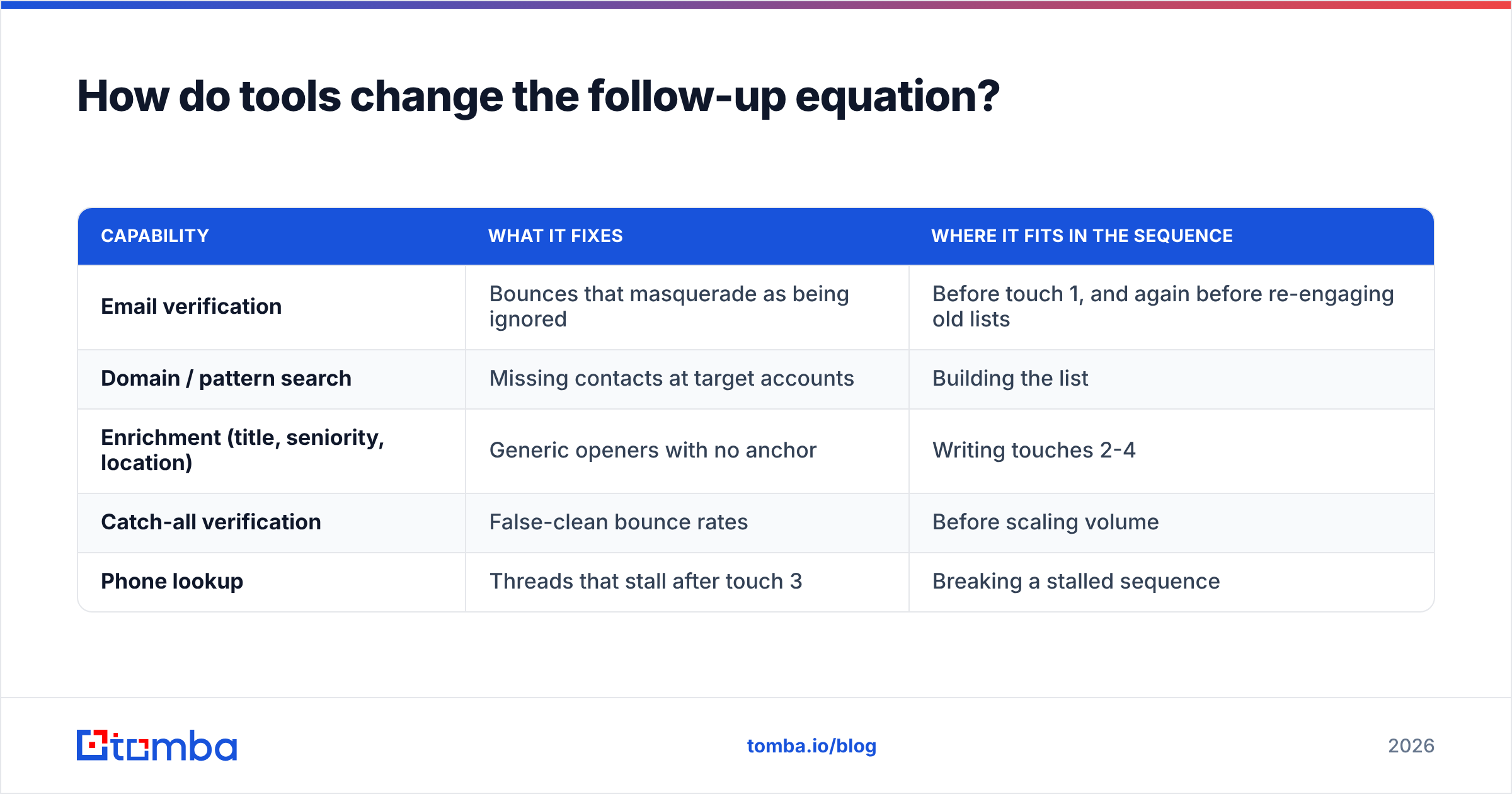
They don't write better openers. They make sure the openers reach a real person, and they give you the raw material for personalization.
| Capability | What it fixes | Where it fits in the sequence |
|---|---|---|
| Email verification | Bounces that masquerade as being ignored | Before touch 1, and again before re-engaging old lists |
| Domain / pattern search | Missing contacts at target accounts | Building the list |
| Enrichment (title, seniority, location) | Generic openers with no anchor | Writing touches 2-4 |
| Catch-all verification | False-clean bounce rates | Before scaling volume |
| Phone lookup | Threads that stall after touch 3 | Breaking a stalled sequence |
On pricing: most teams in this category compare per-credit costs across Tomba pricing (free tier at 25 searches/month, Starter at $49/mo, Growth at $99/mo, Pro at $249/mo) and peers like BookYourData. BookYourData sells pre-built verified lists rather than on-demand lookups. That's a genuinely different model, and it suits teams who want volume without building the search step themselves. Independent reviews on G2 are a reasonable sanity check before you commit budget.
What's the one-sentence version?#
Never open a follow-up with a reference to your last email. Open with something that happened since. That single sentence is the whole of how to start a follow up email after no response.
The constraint forces you to find a new angle each time, which is the same thing as forcing you to write an email worth reading. Can't find a new angle for touch 4? The honest move is to send the breakup email and spend the effort on a prospect where you can.
Follow-ups fail for two reasons, and only one of them is copy. Fix the copy with the openers above. Fix the other half by making sure every address in the sequence belongs to a real, reachable human. Start with Tomba Email Finder to build the list from company domains and names, verify it before touch one, and spend your energy on the opening line instead of on people who were never going to receive it.
Related guides#
// get started
Find, verify and enrich your first contacts today
Start on the free plan with 25 searches a month, then scale when your team is ready.
Free plan · No credit card required · GDPR & CCPA
// about the author