How to Write a Persuasive Email That Actually Gets Replies
Persuasion in email is not about clever words. It is about relevance, proof, and one easy ask. Here is the structure, the psychology, and the templates that get replies in 2026.
TL;DR
- Persuasive email is 80% targeting and 20% wording. A perfect sentence sent to the wrong person converts at zero.
- Use a five-part structure: relevance trigger, problem framing, specific proof, one small ask, easy exit.
- Cut every sentence that serves your ego instead of the reader's decision. Most cold emails lose the reply in the second paragraph.
- Ask for the smallest possible next step. "Worth a 12-minute call Thursday?" outperforms "Let me know if you'd like to learn more."
- Deliverability is part of persuasion. A verified, correctly-formatted address is the difference between a reply and a bounce that damages your domain.
What actually makes an email persuasive?#
Persuasion is not a vocabulary problem. It is an evidence problem.
Think of it like knocking on a stranger's door. You have about four seconds before they decide whether to open it. Nothing you say inside the house matters if the first four seconds sound like a pitch. The same is true in an inbox: your reader scans the sender name, the subject line, and the first visible line of preview text, then makes a keep-or-kill decision. Everything you consider "your copy" only gets read after that gate.
Robert Cialdini's six principles — reciprocity, commitment, social proof, authority, liking, scarcity — still describe why people say yes, and you can read the original framework summary if you want the academic version. But in B2B email, only three of them are practical at cold-contact scale:
- Social proof — a named peer company who got a specific result, not "trusted by thousands."
- Authority — a data point, benchmark, or observation the reader could not have produced themselves.
- Commitment — a first ask so small that saying yes costs nothing.
Scarcity and reciprocity mostly backfire in cold email. Fake deadlines ("this offer expires Friday") are transparent to anyone who has bought software before. A free audit you offer to 4,000 strangers is not a gift; it is a chore you are assigning them.
The working definition: a persuasive email is one where the reader concludes, in under fifteen seconds, that replying costs them less than not replying.
Why do most emails fail before the first sentence?#
Because they are written from the sender's calendar, not the reader's.
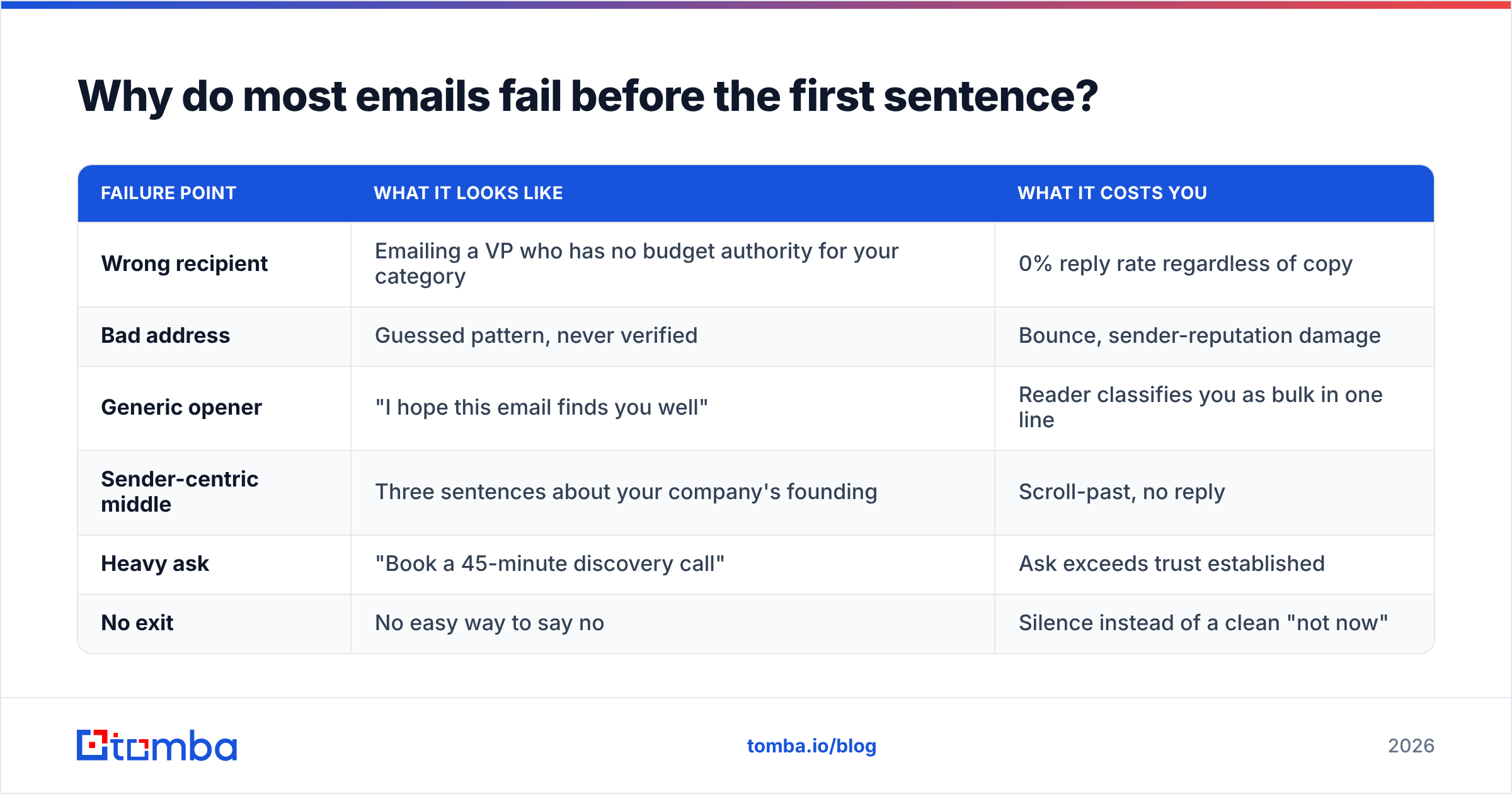
Here is the failure sequence you can see in almost any underperforming sequence:
| Failure point | What it looks like | What it costs you |
|---|---|---|
| Wrong recipient | Emailing a VP who has no budget authority for your category | 0% reply rate regardless of copy |
| Bad address | Guessed pattern, never verified | Bounce, sender-reputation damage |
| Generic opener | "I hope this email finds you well" | Reader classifies you as bulk in one line |
| Sender-centric middle | Three sentences about your company's founding | Scroll-past, no reply |
| Heavy ask | "Book a 45-minute discovery call" | Ask exceeds trust established |
| No exit | No easy way to say no | Silence instead of a clean "not now" |
Notice that four of six failures happen before the writing even matters. That is why teams who obsess over subject-line A/B tests while sending to a stale list see no movement. Fix targeting and data quality first; you will get a bigger lift from a clean list than from any headline formula.
The other structural killer is length. Emails over roughly 150 words see reply rates fall off sharply in most B2B benchmarks, and the drop is steeper on mobile where over half of first opens happen. Every paragraph you add is another chance for the reader to decide this is not worth finishing.
What is the five-part structure of a persuasive email?#
Use this skeleton. It works for cold outreach, follow-ups, internal asks, and partnership pitches — the proportions change, the order does not.
- Relevance trigger (1 sentence) — Why this person, why now. A funding round, a job posting, a product launch, a change in their tech stack, a comment they made publicly. It must be something they know is true about themselves.
- Problem framing (1–2 sentences) — Name the consequence of the trigger in their language. Not "we help companies scale," but "hiring four SDRs in Q1 usually means your data spend triples before pipeline does."
- Specific proof (1–2 sentences) — One named example with a number and a timeframe. Vague proof is worse than no proof because it signals you have none.
- One small ask (1 sentence) — Single, concrete, low-cost. A question they can answer with one word beats a calendar link.
- Easy exit (optional, 1 short line) — "If this is not your area, happy to stop here." This raises replies because it removes the social cost of declining.
Here is that skeleton filled in:
Subject: your Q1 SDR hires
Saw the three AE roles you posted in Boston last week.
Most teams that add headcount that fast end up paying for the same contact record twice — once in the CRM enrichment plan, once in whatever the reps buy on their own cards.
Vertice consolidated theirs last spring and cut per-verified-contact cost from $0.31 to $0.09 in about six weeks.
Worth a look at your current cost per verified contact?
— If procurement owns this, point me at them and I'll stop cluttering your inbox.
Ninety-one words. One trigger, one consequence, one number, one question, one exit. Nothing about the sender's company history, no adjectives, no calendar link.
Which words and phrases quietly kill replies?#
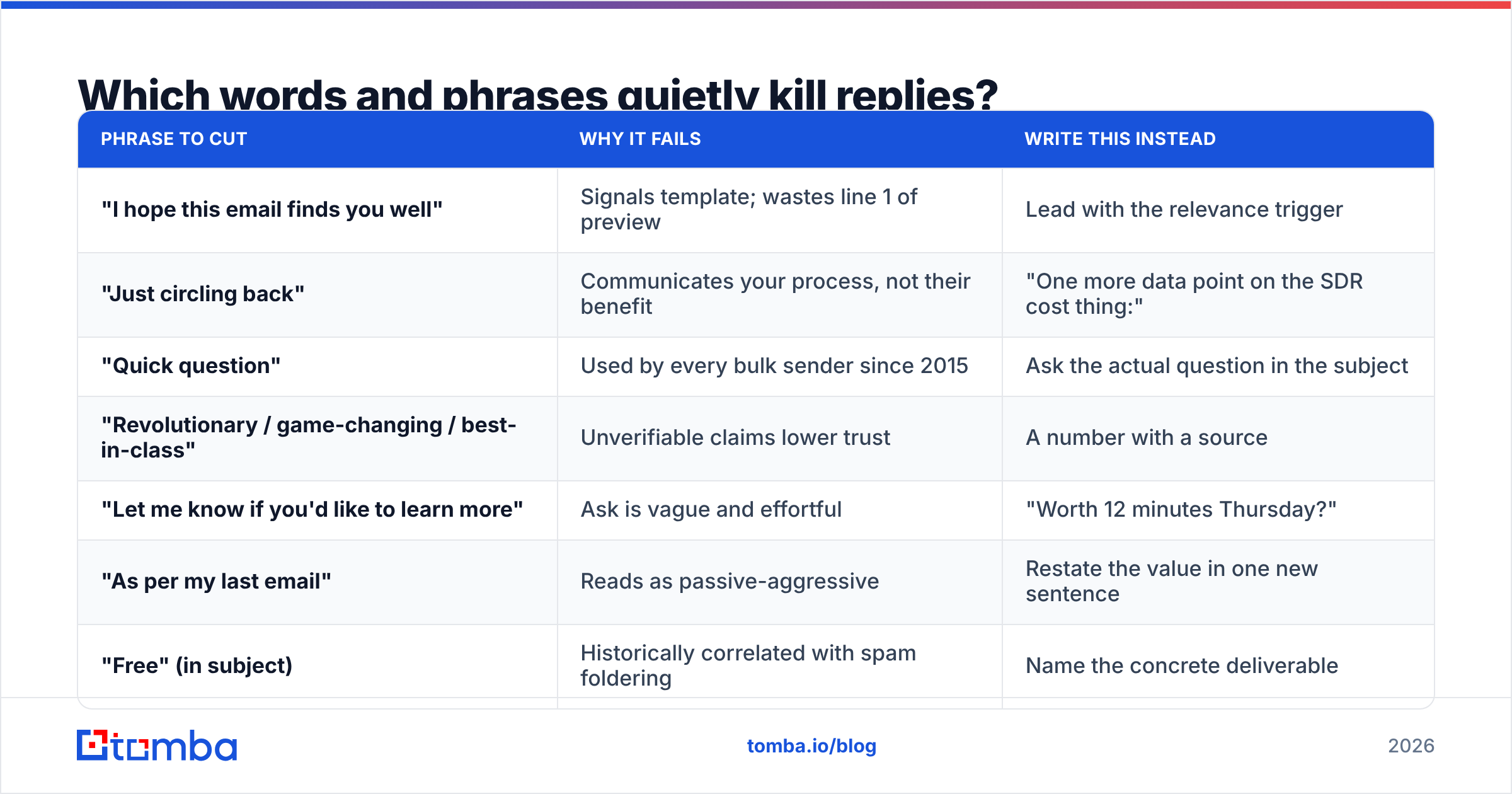
Some phrases are so common in bulk mail that spam filters and humans both flag them. Others just waste the reader's scan budget.
| Phrase to cut | Why it fails | Write this instead |
|---|---|---|
| "I hope this email finds you well" | Signals template; wastes line 1 of preview | Lead with the relevance trigger |
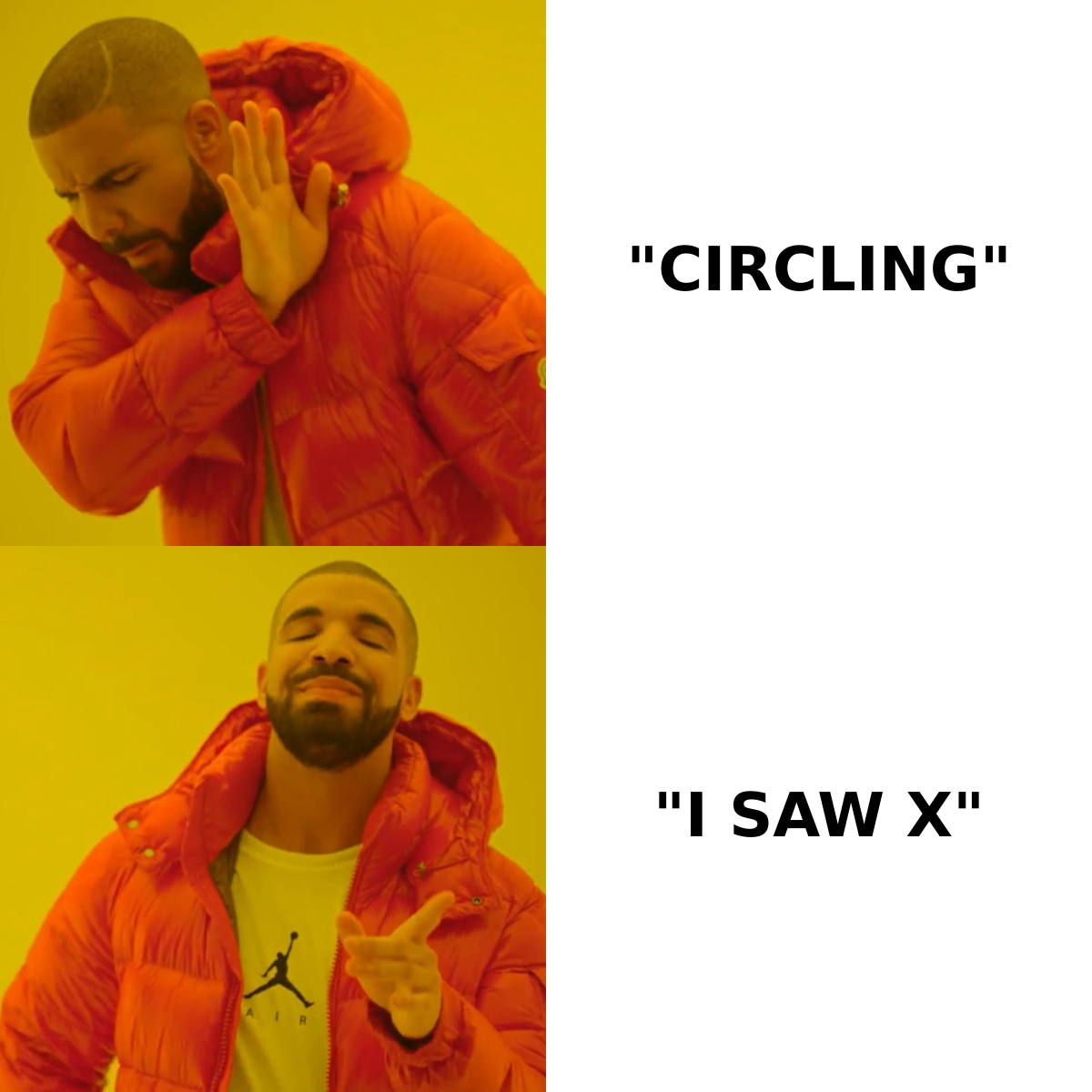
| "Just circling back" | Communicates your process, not their benefit | "One more data point on the SDR cost thing:" |
| "Quick question" | Used by every bulk sender since 2015 | Ask the actual question in the subject |
| "Revolutionary / game-changing / best-in-class" | Unverifiable claims lower trust | A number with a source |
| "Let me know if you'd like to learn more" | Ask is vague and effortful | "Worth 12 minutes Thursday?" |
| "As per my last email" | Reads as passive-aggressive | Restate the value in one new sentence |
| "Free" (in subject) | Historically correlated with spam foldering | Name the concrete deliverable |
Run a draft through a spam checker before you scale a sequence — it catches the filter-triggering language you stopped noticing. And if your subject line is where you are losing opens, a subject line tester will tell you whether it reads as human or as bulk.
One more habit worth building: read the draft aloud. Anything you would not say to a person at a conference should not survive to send. That single filter removes most corporate throat-clearing.
How do you write a subject line people actually open?#
Short, lowercase-ish, and specific to them.
The best-performing cold subject lines in B2B fall into four shapes:
- The trigger reference — "your Boston SDR roles"
- The direct question — "who owns enrichment spend?"
- The number — "$0.09 per verified contact"
- The mutual reference — "Priya suggested I write"
What they share: none of them describes your product. A subject line is an envelope, not a billboard. Its only job is to earn the open, and specificity earns opens because it signals a human wrote it for one person.
Avoid title case ("Improve Your Outbound Efficiency Today") — it reads like a newsletter header, and newsletters are what people archive in bulk. Avoid emoji in B2B cold contexts; response data has been consistently unkind to them outside consumer lifecycle mail.
Keep it under about 45 characters so it does not truncate on mobile. If you need a starting set, the subject line generator will produce variants you can then cut down by hand.
Does persuasion survive if the email never arrives?#
No — and this is the part most copy advice skips.
Think of deliverability as the road and copy as the car. A brilliant car on a closed road goes nowhere. Three mechanics decide whether your persuasive email is ever seen:
- Address validity. A guessed address that bounces tells mailbox providers you are sending to lists you did not verify. Bounce rates above roughly 2–3% start to move your sender reputation in the wrong direction, and reputation damage is slow to undo.
- Authentication. SPF, DKIM, and DMARC must be aligned. Google and Yahoo both tightened bulk-sender enforcement in recent years; their sender guidelines are the canonical reference, not blog folklore.
- Volume shape. New domains that jump to hundreds of daily sends get throttled. Ramp gradually.
The practical workflow: find the address, verify it, then write. Not the reverse. Use an email verifier on every list before it enters a sequence, and treat catch-all domains as a separate risk bucket — they accept everything at SMTP time and tell you nothing, which is why a dedicated catch-all verifier matters if you sell into enterprise where catch-all is common.

The uncomfortable arithmetic: a 1,000-contact list with 12% bad addresses does not just lose 120 sends. It suppresses inbox placement for the other 880, so your best-written email lands in Promotions for people who would have replied.
How should you handle follow-ups without being annoying?#
Add new information every time, and stop at four.
The single biggest follow-up mistake is the content-free bump — "just following up on my last note." It gives the reader nothing new to react to, and it signals that your interest is procedural rather than genuine.
A working four-touch cadence:
- Touch 1 (day 0) — The full five-part email above.
- Touch 2 (day 3) — One new proof point or a relevant link. Two sentences. No re-pitch.
- Touch 3 (day 8) — Reframe the problem from a different angle. Maybe they do not have the cost problem; maybe they have the accuracy problem.
- Touch 4 (day 15) — The clean close. "I'll assume the timing is off and stop here. If it changes, reply with a one-liner and I'll pick it back up."
That last message reliably produces replies, because it removes the obligation to engage while leaving a door open. People answer doors that are already closing.
Track response rate per touch, not just per sequence. If touch 1 is at 4% and touches 2–4 are at 0.2%, your problem is not persistence — it is that your follow-ups carry no new value.
What tools help you write and send persuasive email?#
Persuasion has three dependencies: correct contact data, clean copy, and deliverable sending. Different tools own different parts of that chain.
| Capability | What it solves | Tomba | Typical alternative |
|---|---|---|---|
| Find the address | Guessed patterns bounce | Email finder, domain search | Apollo, RocketReach |
| Verify before send | Protects sender reputation | Email verifier + catch-all verifier | ZeroBounce, Debounce |
| Buy a ready list | Fast list build for a defined ICP | Tomba database | BookYourData — strong for pay-as-you-go verified lists |
| Draft and tighten copy | Cuts filler, tests subject lines | Cold email AI, subject line tester | Copy.ai, Lavender |
| Send + sequence | Cadence, throttling, warmup | Integrations with your sending tool | Instantly, Smartlead |
| Free entry point | Test before committing | 25 searches/mo free | Varies |
Pricing matters when you are testing a motion rather than committing to one. Tomba's pricing starts free at 25 searches per month, with Starter at $49/mo, Growth at $99/mo, and Pro at $249/mo — the Growth tier is where most two-to-five-person outbound teams land once they are sending daily. Compare that against per-seat platforms where a second rep doubles your bill before it doubles your pipeline.
A note on stacking: you do not need six tools. You need one reliable source of verified contacts, one place to draft, and one place to send. Most teams over-buy on the data layer and under-invest in verification, which is exactly backwards — verification is the cheap step that protects everything downstream.
For fair comparison shopping, G2's email marketing category is a reasonable place to read practitioner reviews rather than vendor claims.
How do you know if your email was actually persuasive?#
Measure replies, not opens.
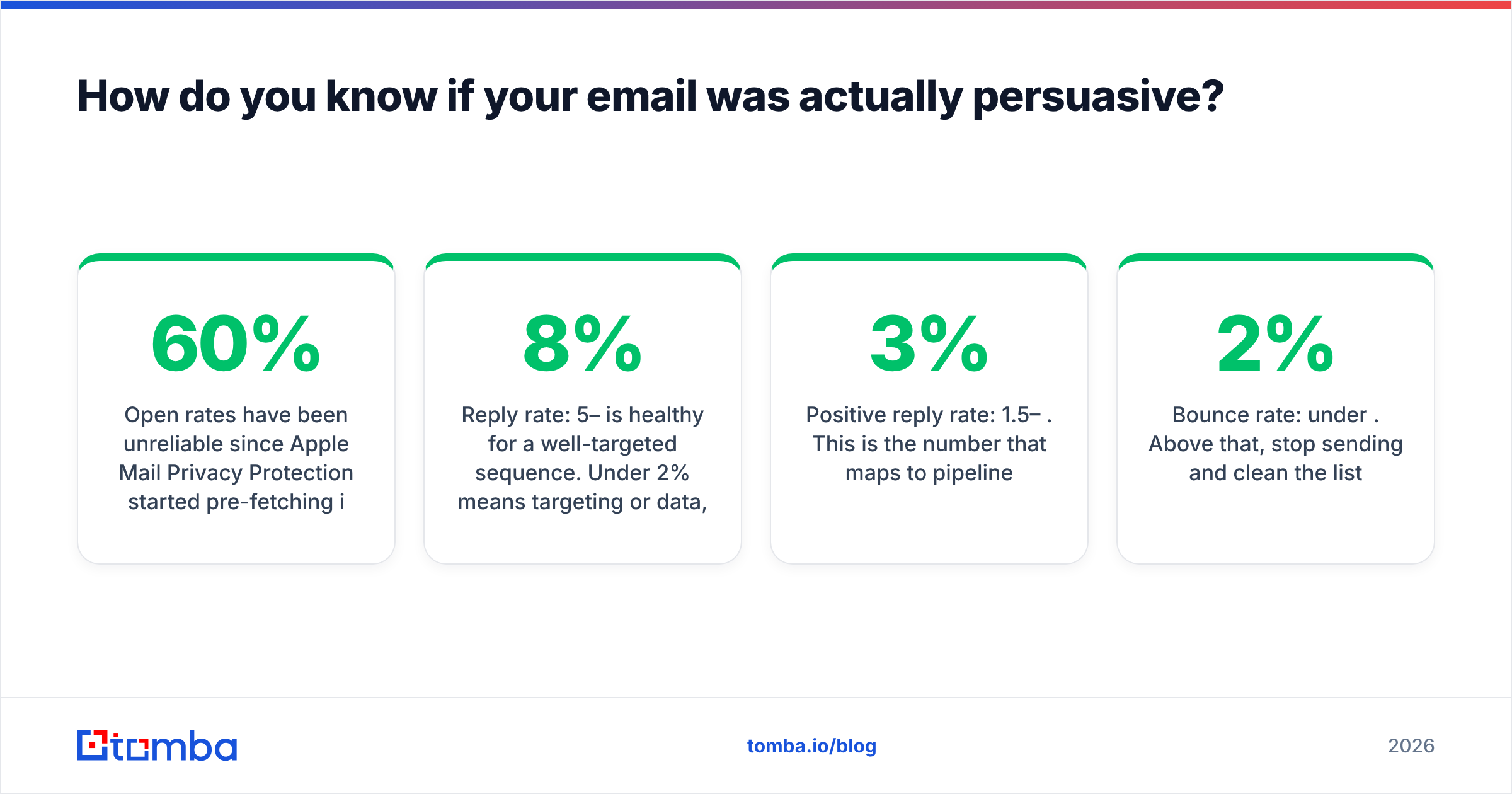
Open rates have been unreliable since Apple Mail Privacy Protection started pre-fetching images in 2021. A 60% open rate on an Apple-heavy list may be mostly machines. Reply rate and positive-reply rate are the only numbers that survive that distortion.
Benchmarks worth holding yourself to on cold B2B outbound in 2026:
- Reply rate: 5–8% is healthy for a well-targeted sequence. Under 2% means targeting or data, not copy.
- Positive reply rate: 1.5–3%. This is the number that maps to pipeline.
- Bounce rate: under 2%. Above that, stop sending and clean the list.
- Unsubscribe / opt-out: under 1%. Higher means your relevance trigger is fake.
Run one variable at a time. Change the subject line for a week, hold everything else. Then change the ask. Changing four things at once means you learn nothing, and most teams do exactly that because it feels faster.
Your next step#
Persuasion collapses the moment the address is wrong. Before you rewrite a single subject line, make sure the emails you are sending exist and belong to the person you researched.
Start with the Tomba Email Finder — find verified professional addresses by name, company, or domain, then run them through verification before they enter your sequence. The free tier gives you 25 searches a month to test the workflow on your next twenty prospects. Write the five-part email, send it to twenty people who genuinely match the trigger, and measure replies. That sample will teach you more than another month of reading about persuasion.
Related guides#
Ready to find emails that actually work?
Join 150,000+ professionals who stopped guessing and started sending. Free credits on signup — no credit card required.
Get the Tomba newsletter
Practical outbound tactics and product updates — once every two weeks.
About the author