HubSpot Breeze Assistant Alternatives: 9 Tools Compared
Breeze only works as well as the CRM data underneath it. Here are 9 HubSpot Breeze Assistant alternatives — AI copilots, data providers, and hybrid stacks — with real pricing and honest trade-offs.
TL;DR
- HubSpot Breeze Assistant is a CRM-native AI copilot, not a data provider. It drafts, summarizes, and researches inside HubSpot — but it can only reason over records you already have.
- Breeze Intelligence credits are consumed per enriched record and per identified visitor, which is where most teams get surprised by the bill.
- If your gap is writing and summarizing, the closest alternatives are Apollo AI, Clay, Regie.ai, and ChatGPT Enterprise wired into your CRM.
- If your gap is contact data — missing emails, stale titles, no direct dials — an AI assistant will not fix it. A dedicated finder/verifier like Tomba, Findymail, or BookYourData does.
- Best-value combo for most sub-100-seat teams in 2026: keep HubSpot as CRM, use a dedicated data layer for contacts, and buy AI writing separately instead of paying CRM-vendor margins on it.
What is HubSpot Breeze Assistant, exactly?#
Breeze is HubSpot's AI layer, launched at INBOUND 2024 and expanded steadily since. It bundles several things that people casually lump into one name:
- Breeze Assistant — the chat/copilot surface. Drafts emails, summarizes records, generates content, answers questions about your CRM data.
- Breeze Agents — task-scoped agents (prospecting agent, customer agent, content agent) that run multi-step work.
- Breeze Intelligence — the data layer. Enrichment of company and contact records, buyer intent, and form shortening. This is the credit-metered part.
- Breeze Copilot — the in-app assistant embedded across Hubs.
The distinction matters because most "Breeze is disappointing" complaints are actually complaints about Breeze Intelligence coverage, not about the assistant's writing. The assistant is fine at writing. It cannot invent a VP of Engineering's email address that HubSpot never had.
Think of it like a very capable chef working from whatever's in your fridge. Great technique, but if the fridge is half-empty the meal is still thin. Swapping chefs does not restock the fridge.
Why do teams look for HubSpot Breeze Assistant alternatives?#
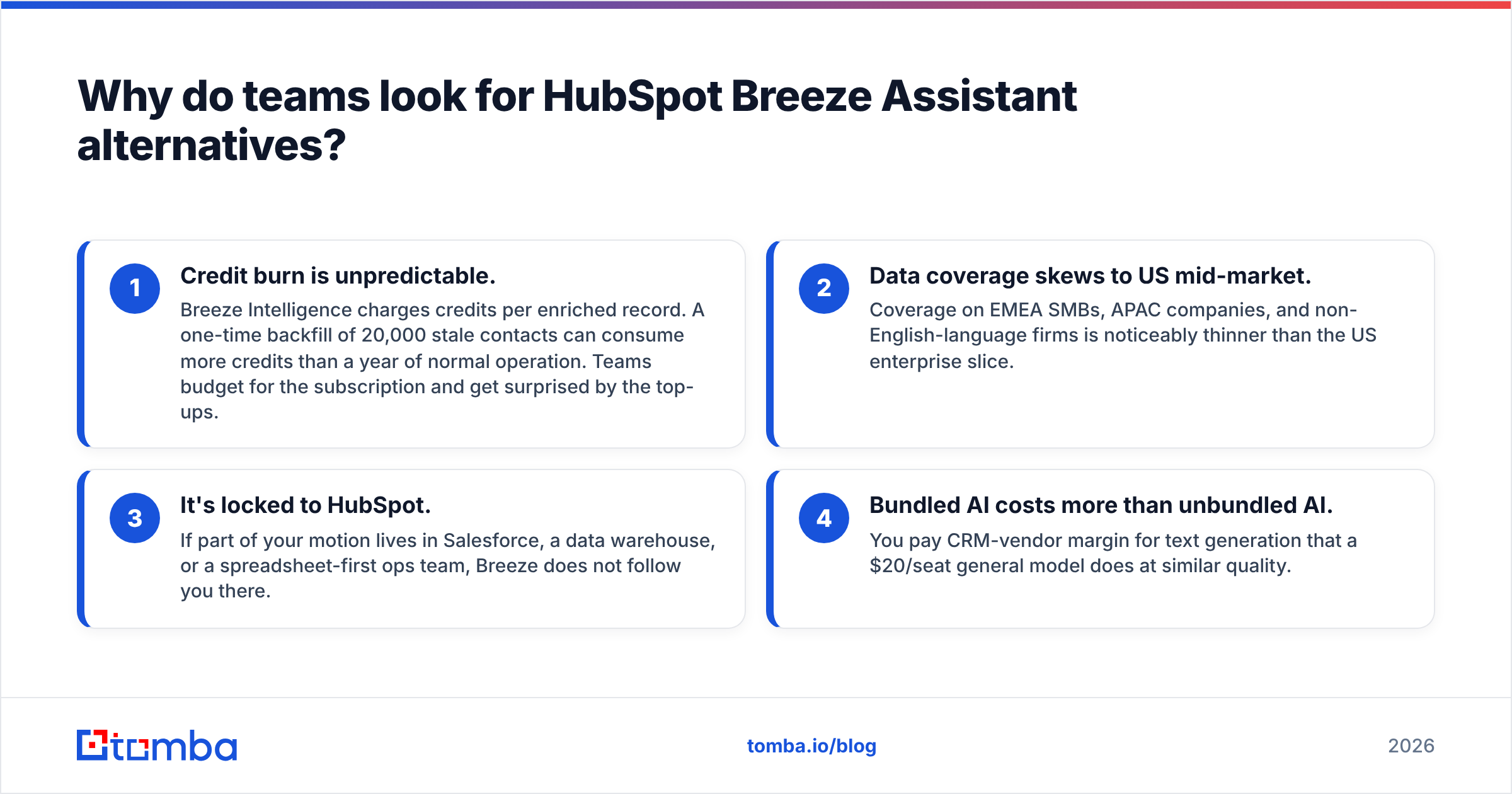
Four recurring reasons, in rough order of how often they come up:
- Credit burn is unpredictable. Breeze Intelligence charges credits per enriched record. A one-time backfill of 20,000 stale contacts can consume more credits than a year of normal operation. Teams budget for the subscription and get surprised by the top-ups.
- Data coverage skews to US mid-market. Coverage on EMEA SMBs, APAC companies, and non-English-language firms is noticeably thinner than the US enterprise slice.
- It's locked to HubSpot. If part of your motion lives in Salesforce, a data warehouse, or a spreadsheet-first ops team, Breeze does not follow you there.
- Bundled AI costs more than unbundled AI. You pay CRM-vendor margin for text generation that a $20/seat general model does at similar quality.
None of those make Breeze a bad product. They make it a narrow product priced as a broad one.
How do the main HubSpot Breeze Assistant alternatives compare?#
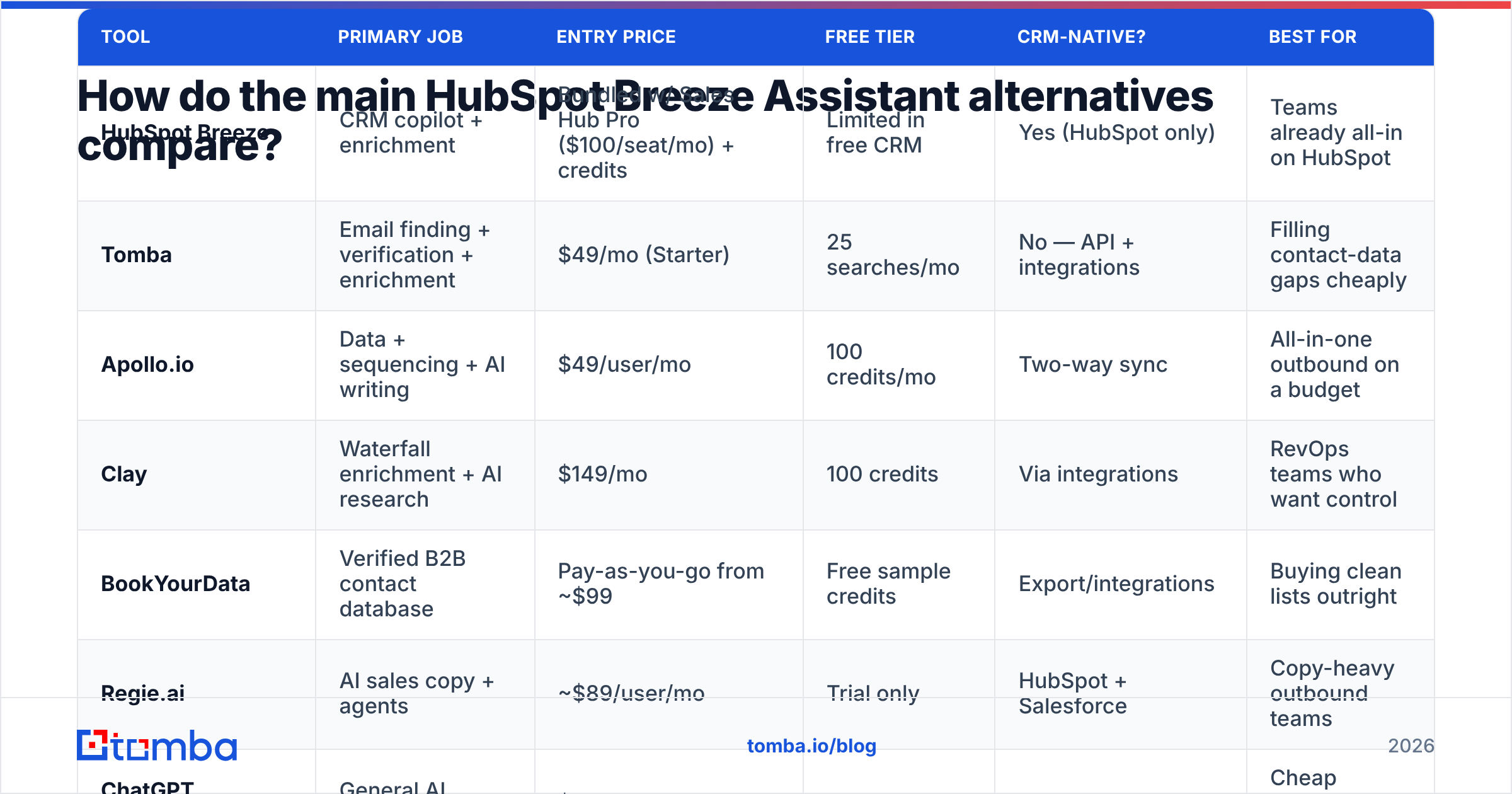
Here's the honest landscape. Note that these tools are not interchangeable — three different jobs are hiding in this table.
| Tool | Primary job | Entry price | Free tier | CRM-native? | Best for |
|---|---|---|---|---|---|
| HubSpot Breeze | CRM copilot + enrichment | Bundled w/ Sales Hub Pro ($100/seat/mo) + credits | Limited in free CRM | Yes (HubSpot only) | Teams already all-in on HubSpot |
| Tomba | Email finding + verification + enrichment | $49/mo (Starter) | 25 searches/mo | No — API + integrations | Filling contact-data gaps cheaply |
| Apollo.io | Data + sequencing + AI writing | $49/user/mo | 100 credits/mo | Two-way sync | All-in-one outbound on a budget |
| Clay | Waterfall enrichment + AI research | $149/mo | 100 credits | Via integrations | RevOps teams who want control |
| BookYourData | Verified B2B contact database | Pay-as-you-go from ~$99 | Free sample credits | Export/integrations | Buying clean lists outright |
| Regie.ai | AI sales copy + agents | ~$89/user/mo | Trial only | HubSpot + Salesforce | Copy-heavy outbound teams |
| ChatGPT Team/Enterprise | General AI assistant | $25-30/user/mo | Free tier | Via API/Zapier | Cheap drafting + analysis |
| Common Room | Signal capture + AI | Custom (mid-4 figures/mo) | Free tier | Yes | PLG and community-led motions |
| Gong Engage | Conversation AI + engagement | Custom (enterprise) | No | Yes | Enterprise teams already on Gong |
The trap in this table is treating rows 1, 2, and 7 as competitors. They aren't. Breeze writes, Tomba finds, ChatGPT reasons. Most teams replacing Breeze end up buying two of the three, not one of them.
Which alternative fits which problem?#
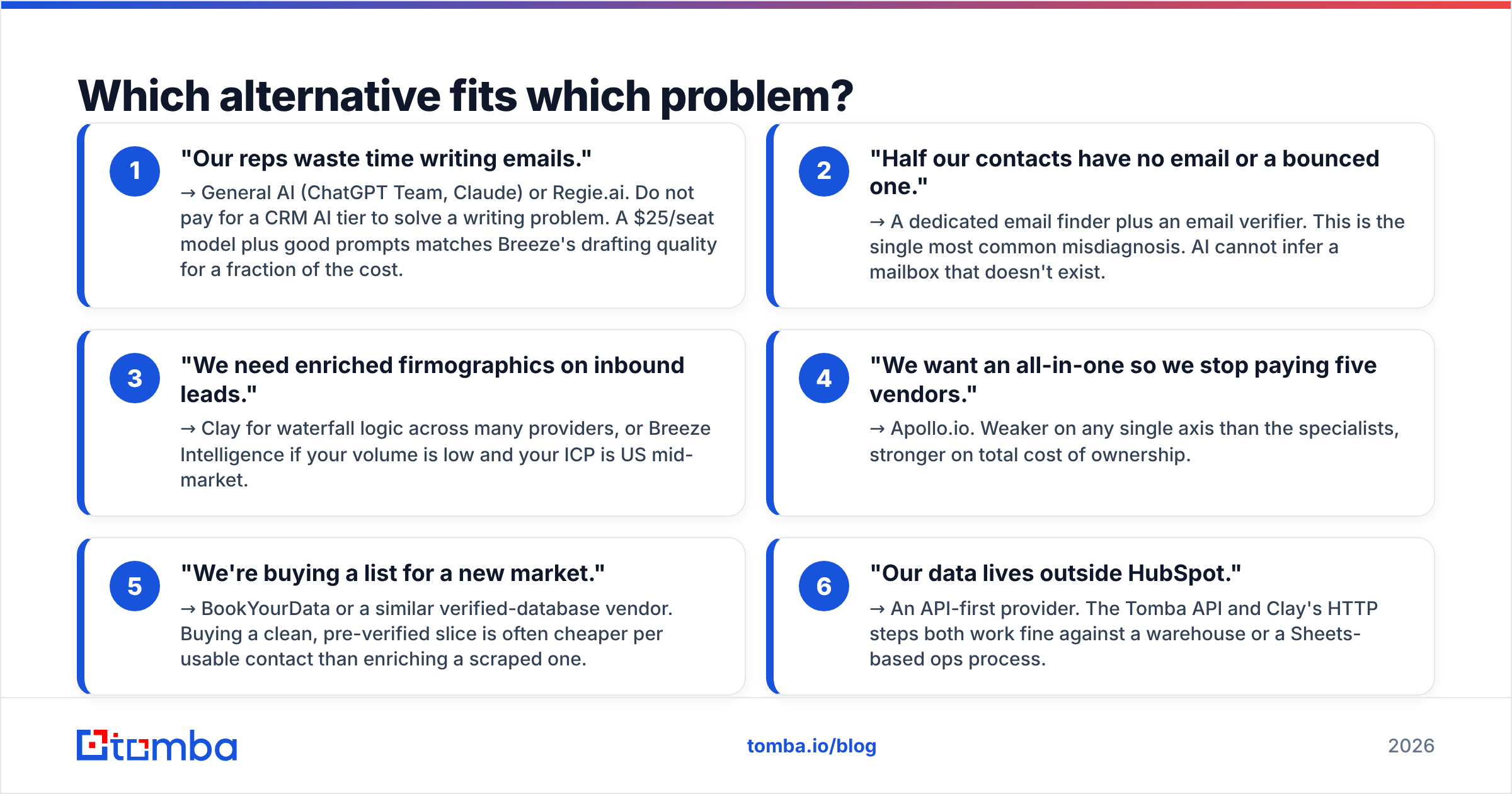
Match the tool to the actual gap:
- "Our reps waste time writing emails." → General AI (ChatGPT Team, Claude) or Regie.ai. Do not pay for a CRM AI tier to solve a writing problem. A $25/seat model plus good prompts matches Breeze's drafting quality for a fraction of the cost.
- "Half our contacts have no email or a bounced one." → A dedicated email finder plus an email verifier. This is the single most common misdiagnosis. AI cannot infer a mailbox that doesn't exist.
- "We need enriched firmographics on inbound leads." → Clay for waterfall logic across many providers, or Breeze Intelligence if your volume is low and your ICP is US mid-market.
- "We want an all-in-one so we stop paying five vendors." → Apollo.io. Weaker on any single axis than the specialists, stronger on total cost of ownership.
- "We're buying a list for a new market." → BookYourData or a similar verified-database vendor. Buying a clean, pre-verified slice is often cheaper per usable contact than enriching a scraped one.
- "Our data lives outside HubSpot." → An API-first provider. The Tomba API and Clay's HTTP steps both work fine against a warehouse or a Sheets-based ops process.
Is Breeze Intelligence's enrichment good enough on its own?#
Depends entirely on your ICP geography and company size band.
For US companies with 200+ employees and a real web presence, Breeze Intelligence enrichment is solid — firmographics, tech signals, and company-level data land accurately most of the time. That's the slice HubSpot's own customer base skews toward, and the data reflects it.
For everything else, expect gaps. EMEA SMBs under 50 employees, agencies, and non-English sites are where coverage thins out. And Breeze is weakest at exactly the field most outbound teams need most: a verified, deliverable email address for a specific named person.
That's a structurally different problem than firmographic enrichment. Firmographics come from public web crawling and are relatively stable — a company's headcount band doesn't change weekly. Person-level email requires pattern inference, source triangulation, and live SMTP-level validation, and it decays at roughly 2-3% per month as people change jobs.
If you're pairing Breeze with a data layer, the useful test is not "does it return an email" but "does it return a verified one, and does it tell you when it isn't sure." Catch-all domains are the specific failure mode here — a naive tool marks them valid and you find out at send time. A dedicated catch-all verifier resolves that class of address instead of guessing.
What does replacing Breeze actually cost?#
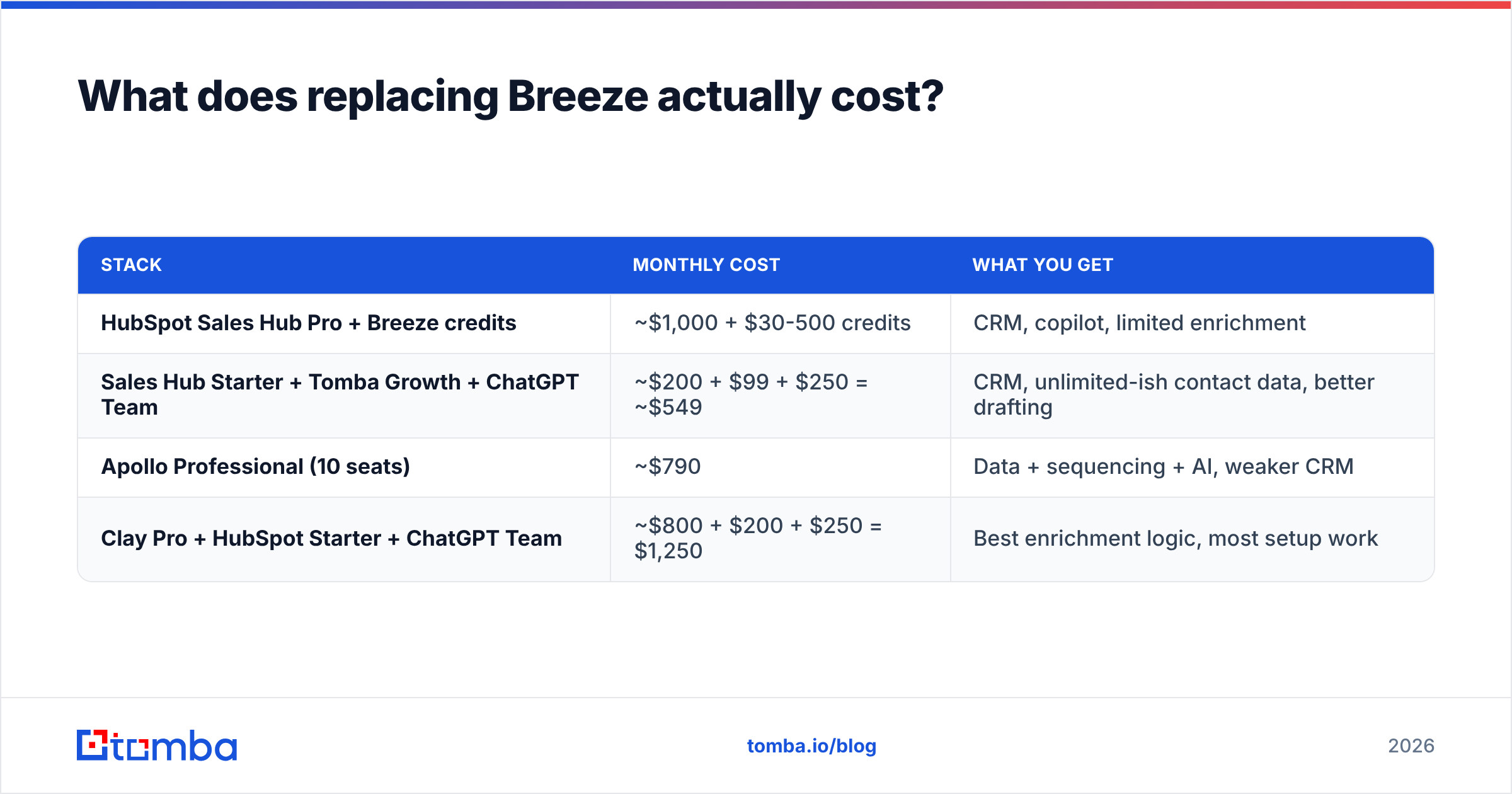
Run the math for a 10-seat sales team doing standard outbound:
| Stack | Monthly cost | What you get |
|---|---|---|
| HubSpot Sales Hub Pro + Breeze credits | ~$1,000 + $30-500 credits | CRM, copilot, limited enrichment |
| Sales Hub Starter + Tomba Growth + ChatGPT Team | ~$200 + $99 + $250 = ~$549 | CRM, unlimited-ish contact data, better drafting |
| Apollo Professional (10 seats) | ~$790 | Data + sequencing + AI, weaker CRM |
| Clay Pro + HubSpot Starter + ChatGPT Team | ~$800 + $200 + $250 = $1,250 | Best enrichment logic, most setup work |
The middle row is where most 5-25 person teams land in 2026. You keep HubSpot for what it's genuinely best at — pipeline, workflows, reporting — and stop paying CRM margins on commodity AI and commodity data. See Tomba pricing for the exact tier breakdown; Starter is $49/mo, Growth $99/mo, Pro $249/mo.
The row that surprises people is Clay. It's the most powerful option here and the most expensive in practice, because credit consumption scales with how many waterfall steps you chain. Teams that love Clay have a dedicated RevOps person. Teams that don't, don't.

How should you actually structure the replacement?#
Three layers, bought separately:
Layer 1 — Data. Contact discovery and verification. This is the foundation and the layer most teams underinvest in. Whether you use domain search to map an account's contacts, bulk enrichment for list building, or a purchased database, the output must be verified before it enters the CRM. Garbage here poisons every layer above it, including the AI.
Layer 2 — Intelligence. Signals, intent, scoring. Breeze Intelligence, Common Room, or Clay sit here. Optional for teams under ~$5M ARR; genuinely valuable above that.
Layer 3 — Execution AI. Drafting, summarizing, research. General models are cost-competitive and improving faster than CRM-embedded ones. Keep this layer swappable — it's the fastest-moving category and you do not want a two-year contract on it.
The mistake is buying an all-in-one that's mediocre at all three, then discovering the data layer was the bottleneck the whole time. G2's sales intelligence category reviews consistently surface the same complaint pattern: teams rate AI features highly and data accuracy poorly on the same product.
Does Breeze work well alongside an external data provider?#
Yes, and this is the setup we'd actually recommend for most HubSpot shops.
Breeze Assistant is genuinely good at CRM-context tasks: "summarize this deal's last six months," "draft a follow-up referencing the objection from the call notes," "which of my open deals haven't been touched in 14 days." Those tasks depend on data HubSpot already owns, and Breeze does them without a separate tool.
Where you supplement is at the top of the funnel. Push verified contacts into HubSpot from a dedicated provider, then let Breeze work on records that are actually complete. The HubSpot integration pattern is straightforward: find and verify externally, sync in, let the CRM AI do CRM work.
This also solves the credit-burn complaint. You stop spending Breeze Intelligence credits on enrichment and only pay for the assistant capabilities you're actually using. HubSpot's own Breeze documentation is clear that credits meter enrichment and visitor identification specifically — the assistant's drafting is included in your Hub tier.
What about the AI-agent alternatives?#
2026's crop of "AI SDR" products — 11x, Artisan, AiSDR, Regie's agents — position against Breeze Agents rather than Breeze Assistant. Fair warning based on what's actually shipping:
- Reply rates are down across the board. The 2026 outbound benchmarks show buyers pattern-matching AI-written outreach faster than the tools improve. Volume without differentiation is a losing trade.
- Agent products are priced like headcount ($1,500-5,000/mo) but perform like tooling. The ROI math only works if you were genuinely going to hire.
- They all depend on the same data layer problem. An autonomous agent emailing bad addresses is a deliverability liability, not a productivity gain. Sender reputation damage from a bad agent run takes weeks to repair.
If you're evaluating agents, evaluate the data underneath them first. Ask the vendor which provider they source contacts from and what their bounce guarantee is. Many resell a third-party API with a markup — you can often buy that layer directly for less.
Which HubSpot Breeze Assistant alternative should you pick?#
Short version:
- Stay with Breeze if you're deep in HubSpot, sell to US mid-market, and your enrichment volume is modest. It's the lowest-friction option and the integration tax of leaving is real.
- Add a data layer if bounce rates are above 3% or reps are hand-hunting emails. This is the highest-ROI change on the list and it doesn't require leaving HubSpot.
- Switch to Apollo if you want one bill and can accept "good enough" on every axis.
- Switch to Clay if you have RevOps capacity and complex enrichment logic worth automating.
- Unbundle the AI to a general model regardless of what else you pick. That part is close to commoditized.
The pattern across every team that got this right: they fixed the data before they bought more AI. An assistant reasoning over complete, verified records outperforms a better assistant reasoning over gaps — every single time.
Start with the layer that's actually broken. If your CRM is full of contacts missing emails, or emails that bounce, the Tomba Email Finder fixes that for $49/mo on the Starter plan, with 25 free searches to test coverage against your own ICP before you spend anything. Run 50 of your worst records through it, compare against what Breeze Intelligence returned, and let the hit rate decide.
Related guides#
// get started
Find, verify and enrich your first contacts today
Start on the free plan with 25 searches a month, then scale when your team is ready.
Free plan · No credit card required · GDPR & CCPA
// about the author