HubSpot vs RD Station: Which CRM Wins in 2026?
HubSpot and RD Station both promise all-in-one marketing and CRM, but they win on different terms. Here is the honest pricing, feature, and data-quality breakdown before you sign an annual contract.
TL;DR
- HubSpot is the deeper platform: better CRM object model, a far larger app marketplace, and reporting that survives a Series B. It also gets expensive fast once you cross the Professional tier and contact-tier thresholds.
- RD Station is the pragmatic choice for Brazil and Latin America: Portuguese-first support, local payment methods, WhatsApp-native flows, and pricing that lands well under HubSpot for comparable marketing automation.
- Neither tool finds contact data for you. Both bill you per contact stored, so importing an unverified list is the single fastest way to burn your budget.
- Choose HubSpot if you need a real sales CRM with forecasting, custom objects, and an ecosystem. Choose RD Station if marketing automation for a LATAM buyer is 80% of the job.
- Verify and enrich before import either way — a 22% bounce list inside a contact-priced platform costs you twice: once in credits, once in sender reputation.
What are HubSpot and RD Station?#
Both platforms sell the same headline: one place for marketing, sales, and customer data. They arrived there from opposite directions.
HubSpot started as an inbound marketing tool in 2006 and grew into a full CRM suite — Marketing Hub, Sales Hub, Service Hub, Content Hub, Operations Hub, and Commerce Hub, all sitting on a shared free CRM. It is a public company with roughly 250,000 customers across 135+ countries, and its app marketplace has well over 1,500 integrations.
RD Station launched in Florianópolis, Brazil in 2011 and became the dominant marketing automation platform in Latin America. It sells RD Station Marketing (automation, landing pages, lead scoring), RD Station CRM (pipeline management), and RD Station Conversas (a WhatsApp/chat inbox). It was acquired by Totvs in 2021, which tightened its grip on the Brazilian mid-market.
The practical difference: HubSpot is a platform you build a revenue operation on. RD Station is a marketing engine with a competent CRM attached, tuned hard for one region.
How do HubSpot and RD Station compare on pricing and features?#
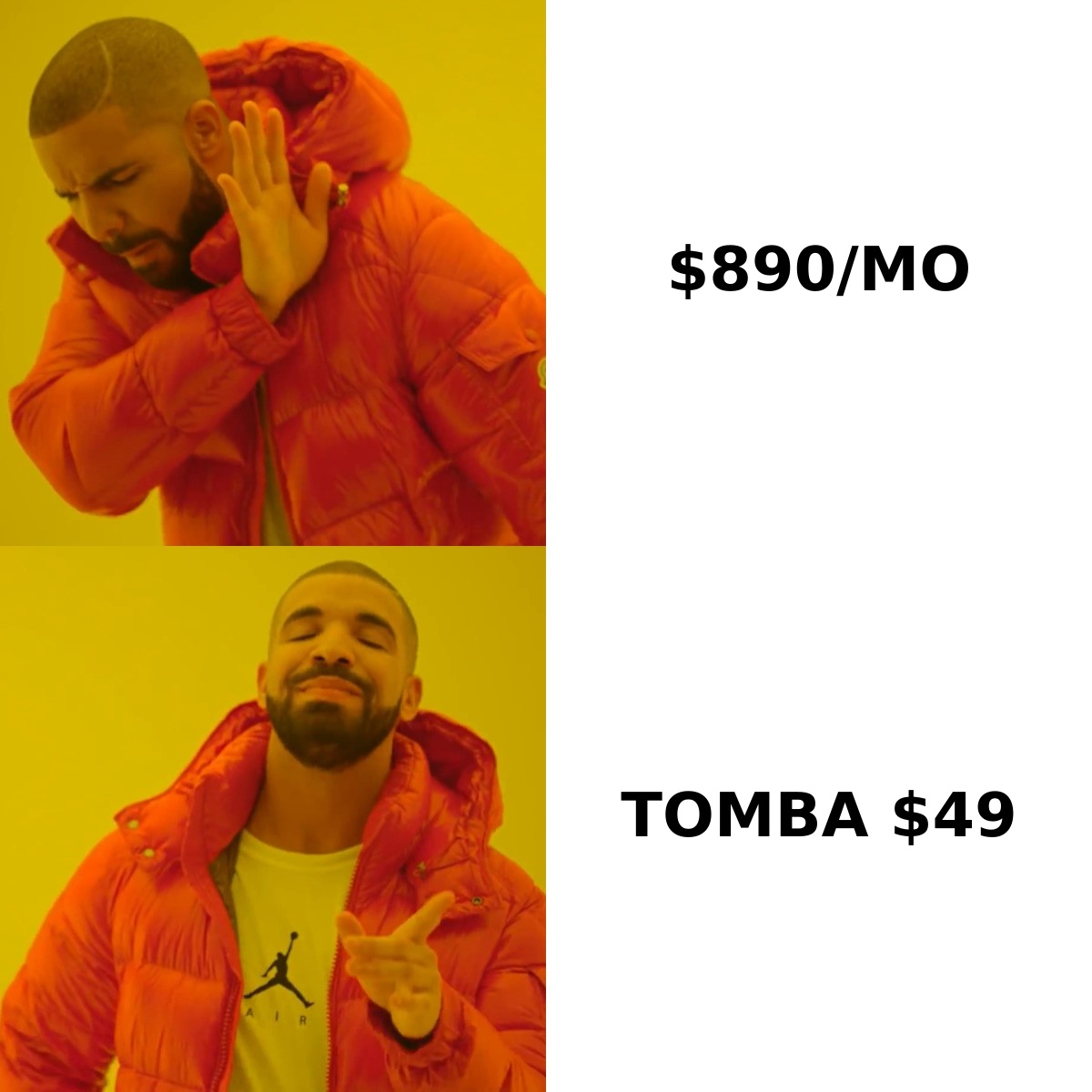
Pricing is where most evaluations end, so start there. Both vendors price by contact volume, which means your list hygiene is a line item, not a nice-to-have.
| Dimension | HubSpot | RD Station |
|---|---|---|
| Free tier | Free CRM, unlimited users, 1M contacts stored (marketing tools capped) | Free CRM (limited); Marketing has no permanent free plan |
| Entry paid tier | Marketing Hub Starter from ~$20/mo (1,000 contacts) | RD Station Marketing Light from |
| Mid tier | Marketing Hub Professional from ~$890/mo (2,000 contacts) | RD Station Marketing Pro from |
| Contact overage | Steep — priced in blocks of 1,000–5,000 | Cheaper per block, capped tiers |
| CRM depth | Custom objects, forecasting, sequences, quotes, playbooks | Pipelines, tasks, basic automations, no custom objects |
| Native WhatsApp | Via integrations / paid add-ons | Native (RD Station Conversas) |
| Marketplace | 1,500+ apps, mature API | ~100 integrations, strong local ERP/payment coverage |
| Support language | English-first, PT/ES available on higher tiers | Portuguese-first, Spanish; deep local partner network |
| Onboarding fee | $3,000+ for Professional, $7,000+ for Enterprise | Typically bundled or partner-delivered |
| Best fit | Global B2B, 10–500 employees, sales-led | Brazilian/LATAM SMB, marketing-led |
Two things jump out. First, RD Station's mid tier costs roughly a quarter of HubSpot Professional for a comparable automation feature set. Second, HubSpot's onboarding fee is real money that never shows up in a comparison chart the vendor writes.
The counter-argument for HubSpot: the free CRM is genuinely free and genuinely useful, and the seat model changed in 2024 to separate "core seats" from "view-only seats," which lowered the entry cost for teams where only two or three people actually work deals.
Which one has the better CRM?#
HubSpot, and it is not close.
RD Station CRM is a competent pipeline tool. You get deals, stages, tasks, email logging, and simple automations. For a five-person sales team selling one product, that is enough. What you do not get: custom objects, revenue forecasting with weighted pipeline math, sequence enrollment logic tied to lifecycle stage, or the reporting depth that a RevOps hire will demand in month three.
HubSpot Sales Hub gives you all of that, plus a workflow engine that touches every object in the system. If you are running a revenue operations motion with multiple products, territories, and a defined win rate target you actually report on, HubSpot's data model will hold. RD Station's will start to strain.
The honest caveat: most teams evaluating these two are not running that motion yet. Buying HubSpot Professional to prepare for a forecasting need you will have in 18 months is how companies end up paying $10,000+ a year for a glorified email sender.
Which one wins for marketing automation?#
Closer than the CRM question, and it depends entirely on your market.
RD Station Marketing's strengths:
- WhatsApp as a first-class channel. In Brazil, WhatsApp is not a nice-to-have — it is the primary business channel. RD Station Conversas puts it in the same inbox as email and chat, with automation triggers. HubSpot requires third-party connectors or the WhatsApp integration on higher tiers.
- Local compliance and payments. LGPD tooling, Boleto and PIX-friendly integrations, and native connections to Brazilian ERPs like Bling and Omie.
- Portuguese-language everything. Support, docs, templates, the partner ecosystem, and the certification program. If your marketing team works in Portuguese, this removes a real friction tax.
- Lead scoring that is simple enough to actually configure. RD Station's scoring UI is less powerful than HubSpot's but ships faster.
HubSpot Marketing Hub's strengths:
- Workflow branching depth. If/then logic across any property on any object, including custom ones. RD Station's automation canvas is linear by comparison.
- Attribution reporting. Multi-touch revenue attribution on Professional and above — RD Station has nothing equivalent.
- Content Hub and SEO tooling. Topic clusters, on-page recommendations, and blog hosting that plug into the same contact record.
- Ecosystem gravity. Every ABM tool, enrichment vendor, and outbound sequencer builds a HubSpot connector first. Many never build an RD Station one.
Verified independently: HubSpot holds a substantially higher review volume on G2, while RD Station's ratings concentrate in Latin American reviewer segments. Read the review geography before you read the score.
What about data quality — the part neither vendor solves?#
Here is the gap that determines whether either platform earns its price: both charge you by contact, and neither one finds or validates those contacts.
Import a 20,000-row list you scraped or bought, and you are paying HubSpot's or RD Station's contact tier on rows that will never open anything. Worse, if 15–25% of those addresses are dead — which is typical for an unverified B2B list — your first campaign torches your sender reputation before the platform has a chance to prove itself.
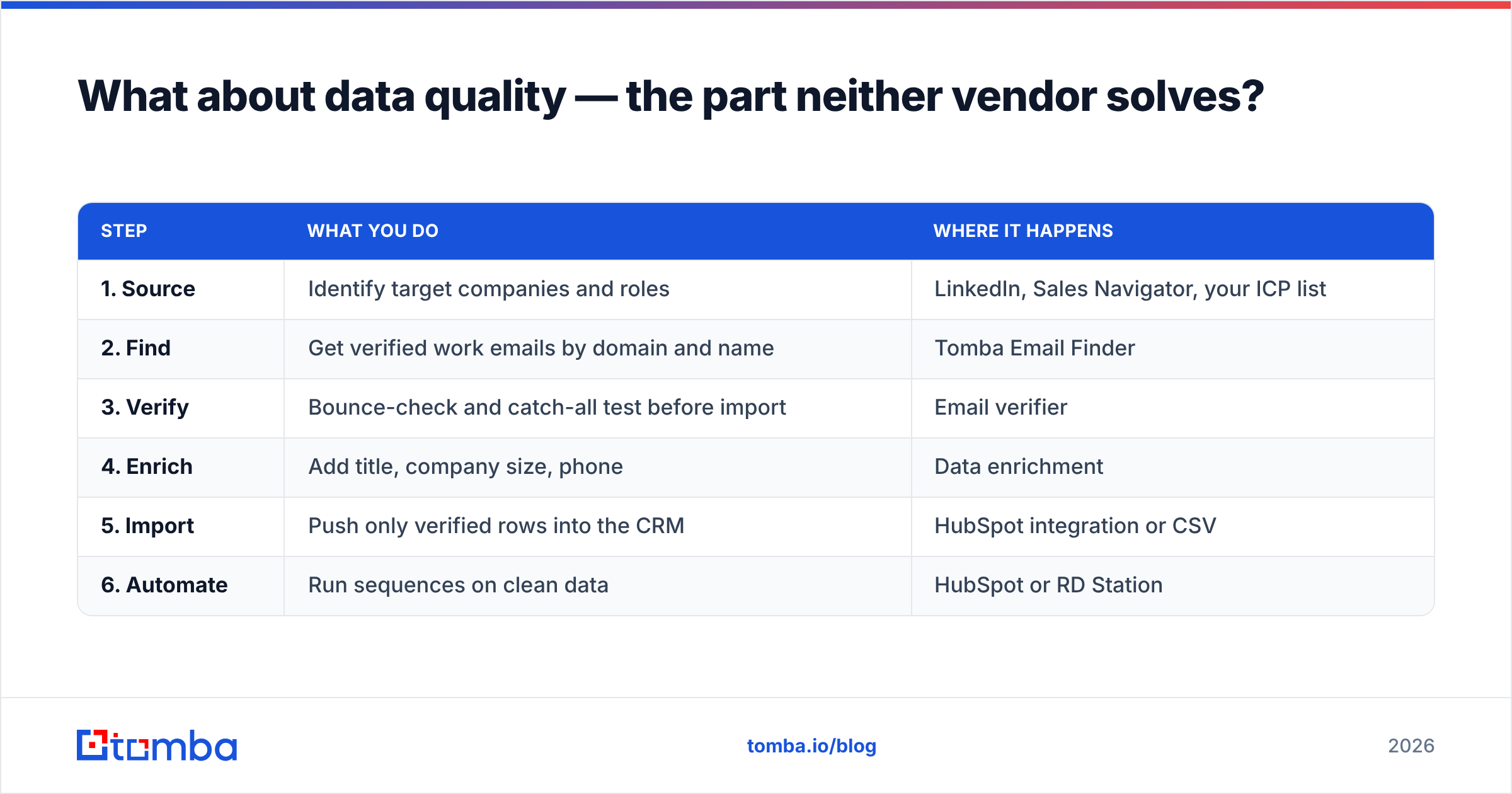
The workflow that actually works:
| Step | What you do | Where it happens |
|---|---|---|
| 1. Source | Identify target companies and roles | LinkedIn, Sales Navigator, your ICP list |
| 2. Find | Get verified work emails by domain and name | Tomba Email Finder |
| 3. Verify | Bounce-check and catch-all test before import | Email verifier |
| 4. Enrich | Add title, company size, phone | Data enrichment |
| 5. Import | Push only verified rows into the CRM | HubSpot integration or CSV |
| 6. Automate | Run sequences on clean data | HubSpot or RD Station |
Doing steps 2–4 outside the CRM keeps your billable contact count honest. A 20,000-row raw list that verifies down to 14,200 deliverable addresses saves you roughly 5,800 contacts of tier pressure — which on HubSpot Professional can be the difference between one pricing block and three.

Is RD Station a real HubSpot alternative outside Brazil?#
Mostly no, and you should be suspicious of anyone who says otherwise.
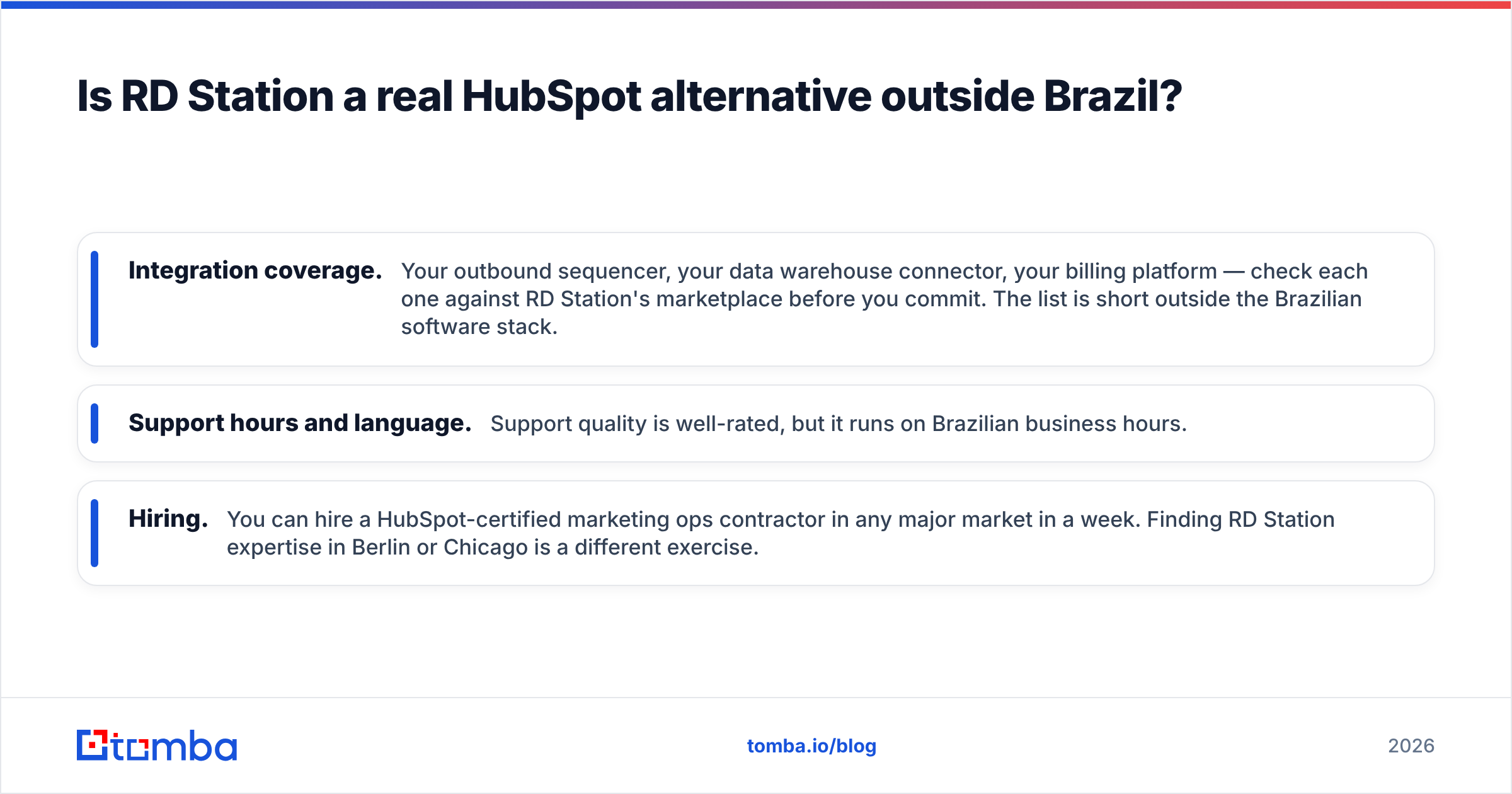
RD Station has expanded into Spanish-speaking Latin America and has customers in Portugal, but the product's center of gravity remains Brazilian. Outside LATAM you hit friction in three places:
- Integration coverage. Your outbound sequencer, your data warehouse connector, your billing platform — check each one against RD Station's marketplace before you commit. The list is short outside the Brazilian software stack.
- Support hours and language. Support quality is well-rated, but it runs on Brazilian business hours.
- Hiring. You can hire a HubSpot-certified marketing ops contractor in any major market in a week. Finding RD Station expertise in Berlin or Chicago is a different exercise.
If you are a European or North American company, the real comparison is HubSpot versus Pipedrive, ActiveCampaign, Brevo, or Zoho — not HubSpot versus RD Station. If you are Brazilian and selling to Brazilians, RD Station's cost advantage and local fit are difficult to argue against, and plenty of teams run RD Station Marketing alongside a separate CRM.
Can you run both?#
Yes, and some teams should — but only in one direction.
The pattern that works: RD Station Marketing for top-of-funnel and nurture in Portuguese, syncing qualified leads into HubSpot's free or Starter CRM for the sales team. You pay RD Station's cheaper contact tiers for the large nurture database and HubSpot's cheaper seat pricing for the small sales team.
The pattern that fails: running both as systems of record. You get duplicate contacts, conflicting lifecycle stages, and an attribution report nobody trusts. Pick one system of record on day one and make the other a spoke.
If you go this route, define what a marketing qualified lead means in writing before you build a single sync rule. The handoff definition, not the integration, is what breaks.
Which should you choose?#
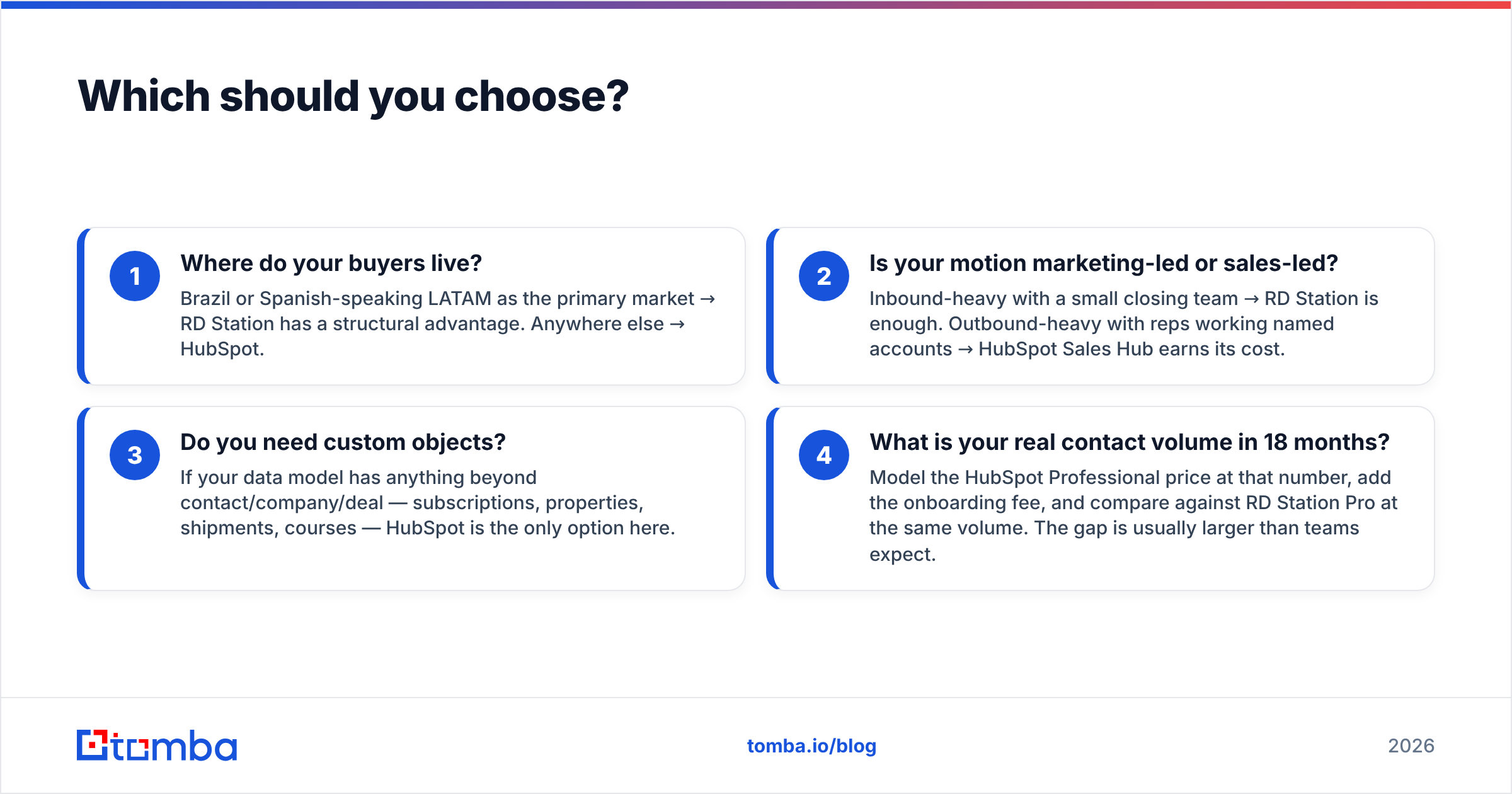
Decide on these four questions, in order:
- Where do your buyers live? Brazil or Spanish-speaking LATAM as the primary market → RD Station has a structural advantage. Anywhere else → HubSpot.
- Is your motion marketing-led or sales-led? Inbound-heavy with a small closing team → RD Station is enough. Outbound-heavy with reps working named accounts → HubSpot Sales Hub earns its cost.
- Do you need custom objects? If your data model has anything beyond contact/company/deal — subscriptions, properties, shipments, courses — HubSpot is the only option here.
- What is your real contact volume in 18 months? Model the HubSpot Professional price at that number, add the onboarding fee, and compare against RD Station Pro at the same volume. The gap is usually larger than teams expect.
For most global B2B companies with a sales team, HubSpot is the right long-term bet despite the price. For Brazilian SMBs running an inbound engine, RD Station delivers most of the outcome at a fraction of the cost, and switching later is a solved problem.
Get the contact data both platforms assume you already have#
Whichever platform you land on, your results are capped by the quality of the contacts inside it. HubSpot will not tell you that the email you imported bounces. RD Station will not tell you the domain is a catch-all.
Start with Tomba Email Finder to build verified, deliverable contact lists before they ever touch your CRM billing tier. Find work emails by domain, name, or company, verify them in the same workflow, and push only clean rows into HubSpot or RD Station. The free tier gives you 25 searches a month to test the accuracy against a list you already have; paid plans start at $49/mo — see full Tomba pricing for volume tiers and API access.
Clean data first, platform second. That order is the whole game.
Related guides#
// get started
Find, verify and enrich your first contacts today
Start on the free plan with 25 searches a month, then scale when your team is ready.
Free plan · No credit card required · GDPR & CCPA
// about the author