HubSpot vs SugarCRM 2026: Which CRM Fits Your Team?
HubSpot sells simplicity and speed; SugarCRM sells control and predictable cost. We break down pricing, customization, data quality, and which one actually fits your sales motion in 2026.
HubSpot vs SugarCRM is a choice between speed and control. HubSpot gets you live in a week. SugarCRM bends to fit an unusual sales process. Here is the short version.
TL;DR
- HubSpot wins on speed to value, UI, and ecosystem. It is the default for teams under ~200 people. You get a CRM running this week, and you don't need to hire an admin.
- SugarCRM wins on deep customization and hosting choice. Pick it when your sales process is genuinely non-standard. Pick it too if your data can't sit in a US SaaS tenant.
- Pricing splits as you grow. HubSpot's Sales Hub Professional runs about $100/seat/mo plus a required onboarding fee. SugarCRM Sell sits near $85/seat/mo, with a 3-seat minimum and no forced onboarding charge.
- Neither one finds contacts for you. Both CRMs store data. They don't source it. Budget for a contact-data layer, or your pipeline stays empty.
- Decision shortcut: marketing-led inbound motion → HubSpot. Complex B2B, manufacturing, or regulated sales with heavy config → SugarCRM.
HubSpot vs SugarCRM: what are they, really?#
Think of it like buying a kitchen. HubSpot is the fitted kitchen. It arrives assembled, everything matches, and you cook dinner the day it lands. You also accept the layout the maker chose. SugarCRM is the custom build: a cabinetmaker, a floor plan, three weeks of work, and a kitchen shaped around how you actually cook.
HubSpot began as a marketing automation platform and grew a CRM underneath it. That history still shows. The contact record is built around lifecycle stages, email engagement, and form fills. Sales Hub, Marketing Hub, Service Hub, and Content Hub all read from one contact object. It is the cleanest unified record in the mid-market.
SugarCRM came from the other direction. It started as an open-source CRM in 2004. For a decade it was the customizable alternative to Salesforce. Today it ships three products: Sugar Sell, Sugar Serve, and Sugar Market. Its edge is module-level customization. You can reshape objects, workflows, and relationships without hitting a paywall.
The practical split in 2026: HubSpot builds for the user, SugarCRM builds for the administrator.
HubSpot vs SugarCRM: how do price and features compare?#
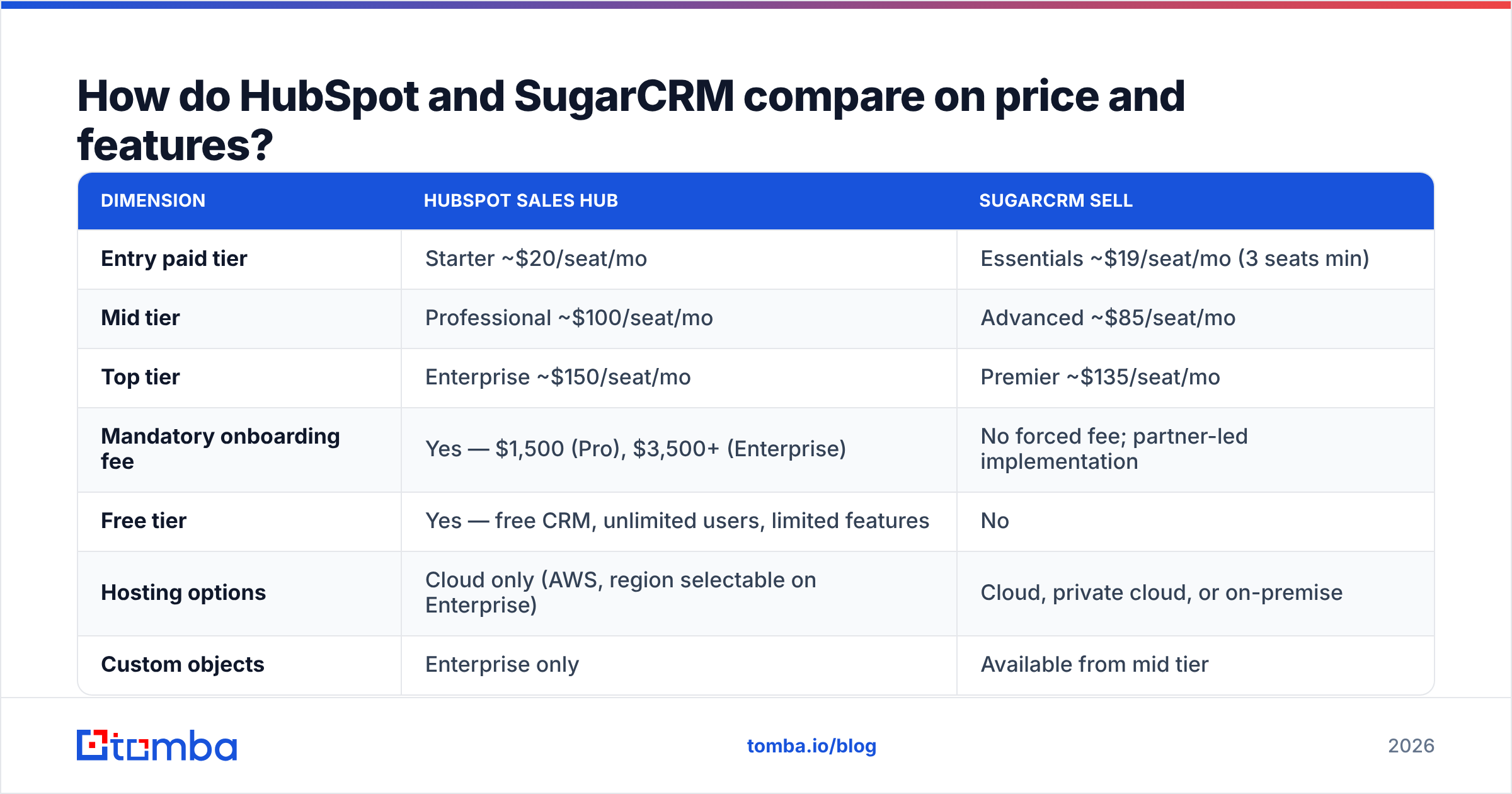
Pricing decides most of these evaluations. And both vendors publish numbers that don't survive a real deployment.
| Dimension | HubSpot Sales Hub | SugarCRM Sell |
|---|---|---|
| Entry paid tier | Starter ~$20/seat/mo | Essentials ~$19/seat/mo (3 seats min) |
| Mid tier | Professional ~$100/seat/mo | Advanced ~$85/seat/mo |
| Top tier | Enterprise ~$150/seat/mo | Premier ~$135/seat/mo |
| Mandatory onboarding fee | Yes — $1,500 (Pro), $3,500+ (Enterprise) | No forced fee; partner-led implementation |
| Free tier | Yes — free CRM, unlimited users, limited features | No |
| Hosting options | Cloud only (AWS, region selectable on Enterprise) | Cloud, private cloud, or on-premise |
| Custom objects | Enterprise only | Available from mid tier |
| Workflow automation | Professional+ | Advanced+ |
| Native marketing automation | Marketing Hub (separate SKU) | Sugar Market (separate SKU) |
| Reporting | Strong out of the box, dashboards limited by tier | SugarBPM + custom reports, steeper learning curve |
| Ecosystem / app marketplace | 1,700+ integrations | ~100 listed, plus REST API |
| Typical time to production | 2-6 weeks | 8-16 weeks |
Two line items deserve emphasis.
First, HubSpot's onboarding fee is not negotiable at Professional and above for most new customers. That is a real $1,500-$3,500 to model in year one. SugarCRM doesn't charge it directly. But you will almost certainly pay an implementation partner, and that bill often lands in the same range or higher.
Second, HubSpot's seat model has teeth. Core seats and view-only seats are priced separately. Marketing Hub contact tiers climb as your database grows, too. A company at 50,000 marketing contacts pays far more than one at 5,000, whatever its headcount. SugarCRM's pricing is flatter and easier to forecast, which finance teams like at 50+ seats.
Which CRM handles customization better?#
SugarCRM, without much argument.
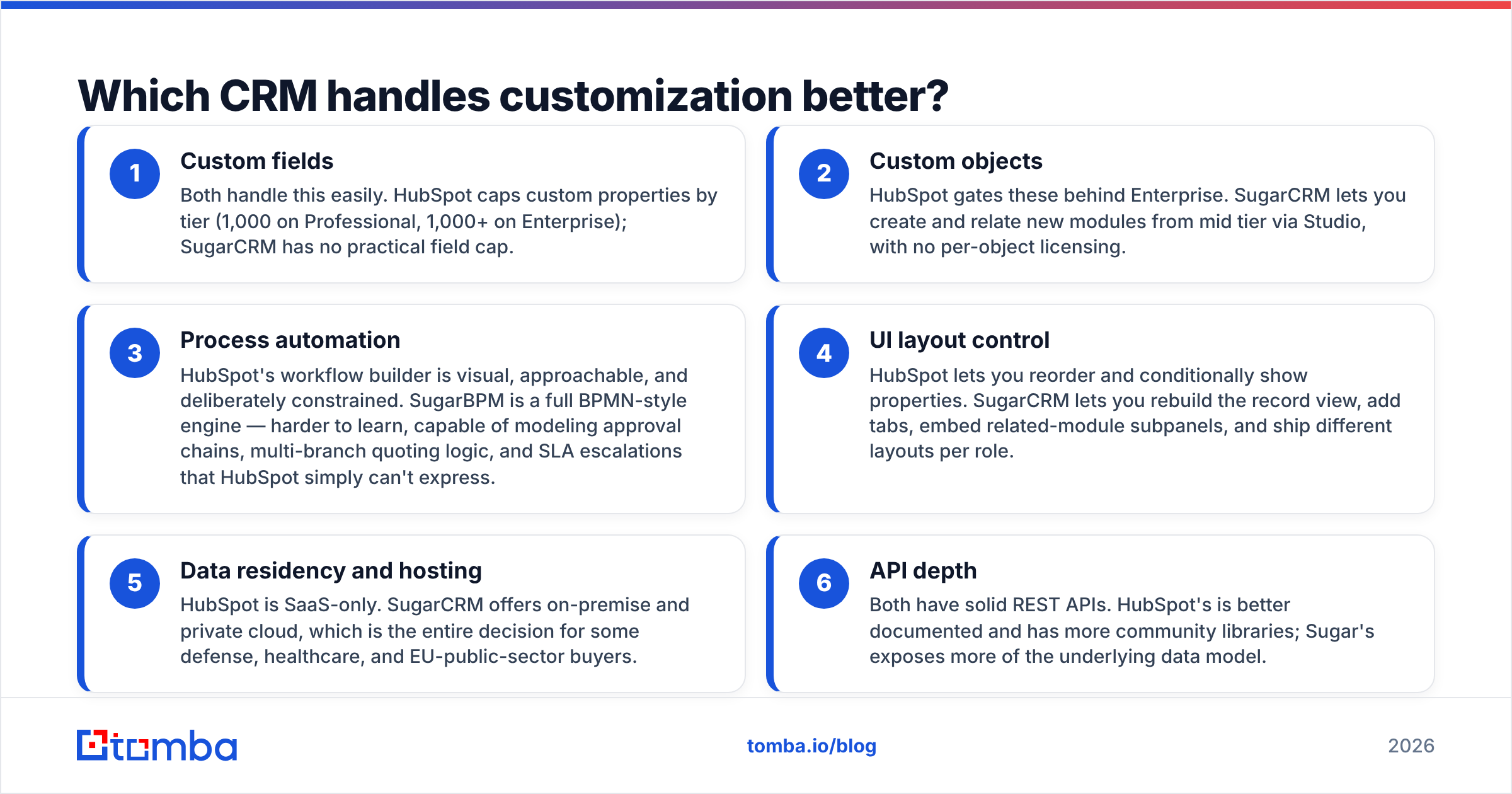
Here is what customization really breaks into, and where each vendor lands:
- Custom fields — Both handle this easily. HubSpot caps custom properties by tier. SugarCRM has no practical field cap.
- Custom objects — HubSpot gates these behind Enterprise. SugarCRM lets you build and relate new modules from mid tier via Studio, with no per-object licensing.
- Process automation — HubSpot's workflow builder is visual and deliberately limited. SugarBPM is a full BPMN-style engine. It is harder to learn, but it can model approval chains, multi-branch quoting, and SLA escalations that HubSpot simply can't express.
- UI layout control — HubSpot lets you reorder properties and show them conditionally. SugarCRM lets you rebuild the record view, add tabs, embed subpanels, and ship a different layout per role.
- Hosting and data residency — HubSpot is SaaS only. SugarCRM offers on-premise and private cloud. For some defense, healthcare, and EU public-sector buyers, that one point decides it.
- API depth — Both have solid REST APIs. HubSpot's is better documented and has more community libraries. Sugar's exposes more of the underlying data model.
Does your sales process fit a standard lead → MQL → opportunity → closed-won funnel? Then HubSpot's limits are a feature. They stop your ops team from building a bespoke monster nobody can maintain later. Do you sell configured industrial equipment through a two-tier distributor channel with regional approval matrices? HubSpot will fight you. SugarCRM will not.
Is HubSpot better than SugarCRM for small teams?#
Yes. For teams under roughly 30 reps with a conventional sales motion, HubSpot is the better buy, and it isn't close.
The reasons are unglamorous. HubSpot's free CRM is genuinely usable, so you can seed data and prove adoption before you spend a cent. Onboarding a new rep takes an hour, not a training day. The G2 category data shows HubSpot leading on ease of use and ease of setup, and trailing on customization depth. That is exactly the trade a small team should want to make.
SugarCRM's three-seat minimum and partner-led implementation are friction for a five-person team. You would spend the first quarter configuring instead of selling.
The inflection point sits near 50-75 seats. It arrives sooner if any of these are true:
- You need on-premise or specific data residency
- Your quote-to-cash process has more than three approval branches
- You're paying HubSpot for 100k+ marketing contacts you don't actively email
- You have a dedicated CRM administrator on payroll
- Your ARR per customer is high enough that a 12-week rollout is a rounding error
What about data quality — the part neither CRM solves?#
Most comparison posts skip this section. It is the one that decides whether your CRM investment returns anything.
Both HubSpot and SugarCRM are systems of record. They store what you put in them. Neither one finds the VP of Operations at a 400-person logistics company in Rotterdam, confirms her email is deliverable, and drops her into your pipeline. That is a separate job. Skip it, and you end up with a beautifully configured CRM holding 3,000 stale rows from a 2023 conference list.
HubSpot's Breeze Intelligence (formerly Clearbit) does enrich records. But it is credit-metered, priced separately, and coverage skews toward US tech companies. SugarCRM leans on third-party connectors instead. Either way you are buying a data layer. The only question is whether you buy it on purpose, or discover the gap in month four.
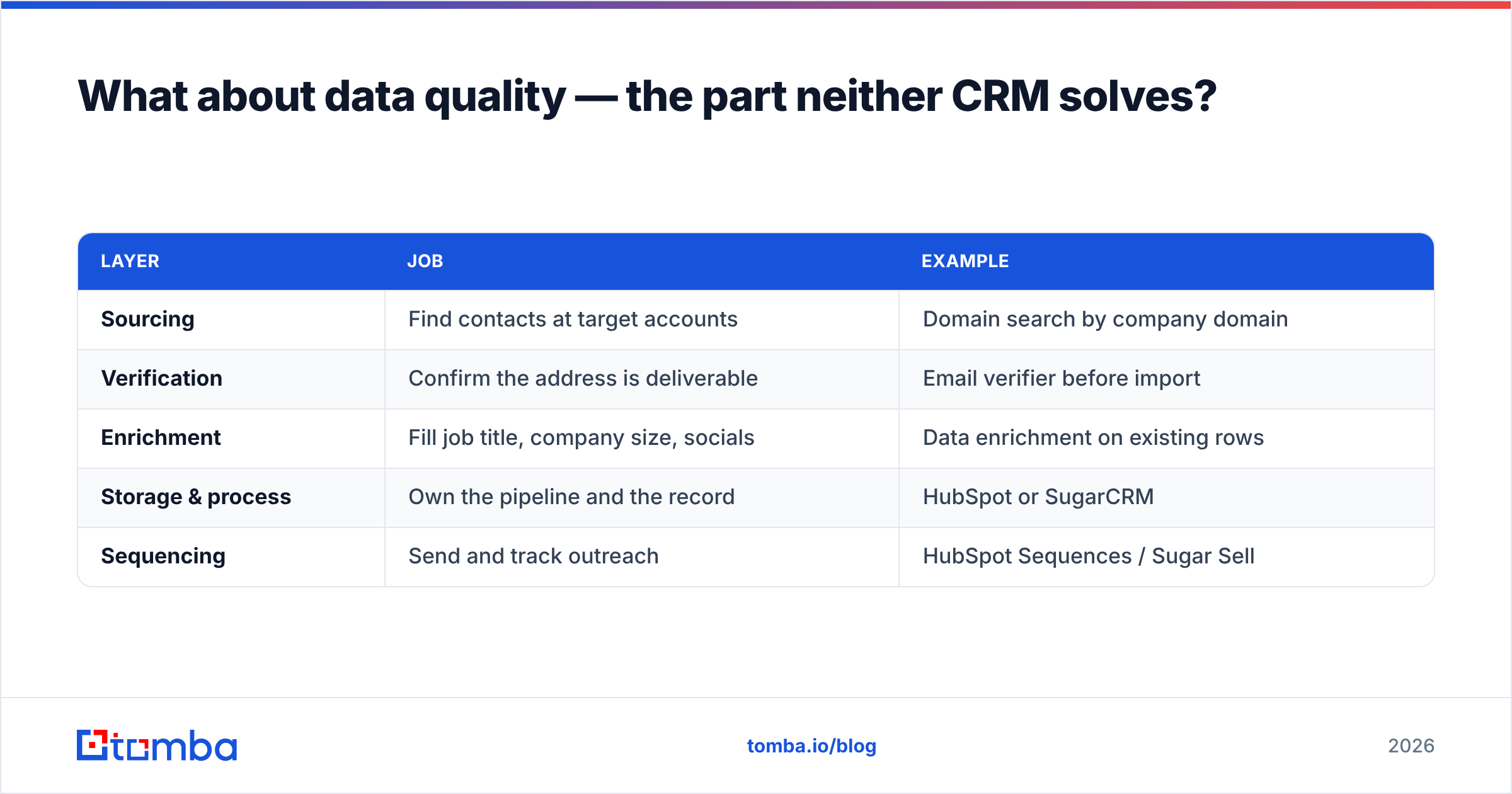
A workable stack looks like this:
| Layer | Job | Example |
|---|---|---|
| Sourcing | Find contacts at target accounts | Domain search by company domain |
| Verification | Confirm the address is deliverable | Email verifier before import |
| Enrichment | Fill job title, company size, socials | Data enrichment on existing rows |
| Storage & process | Own the pipeline and the record | HubSpot or SugarCRM |
| Sequencing | Send and track outreach | HubSpot Sequences / Sugar Sell |
The verification step matters more than teams expect. Unverified addresses inflate your HubSpot marketing-contact count, and you are billed on that count. Hard bounces also damage the sender reputation of the domain you send from. Cleaning a list before it hits the CRM is cheaper than cleaning it after.
Both platforms accept enriched data over API, so this layer is CRM-agnostic. You can switch CRMs later without rebuilding your sourcing pipeline. That is a decent argument for keeping data acquisition outside whichever CRM you pick.
How do integrations and the ecosystem compare?#
HubSpot wins on breadth. SugarCRM wins on depth per integration.
HubSpot's marketplace lists over 1,700 apps. Almost every SaaS tool your team already uses has a maintained HubSpot connector, usually built and supported by the vendor. Two-way sync with Gmail, Outlook, Slack, Zoom, Stripe, and every major ad platform ships out of the box. Want HubSpot connected to a contact-data source? It takes a few clicks.
SugarCRM's marketplace is smaller: roughly 100 listed integrations plus a well-documented REST API. The trade-off is depth. Sugar integrations tend to be built by partners for one vertical, so a manufacturing connector maps to your actual objects instead of a generic contact schema.
For most buyers, HubSpot's ecosystem advantage is decisive. For buyers with an existing ERP (SAP, Infor, Epicor) that must sync both ways with custom objects, the Sugar partner network is often the shorter path.
Middleware closes part of the gap in both directions. Zapier and Make connect to both, though Sugar's Zapier coverage is thinner than HubSpot's.
HubSpot vs SugarCRM: which one should you buy in 2026?#
Pick HubSpot if:
- Your team is under ~75 people and growing
- Marketing and sales need to share one contact record
- You don't have a dedicated CRM administrator
- Inbound and content are meaningful lead sources
- You want the system live in under a month
Pick SugarCRM if:
- You need on-premise, private cloud, or non-US data residency
- Your sales process has real structural complexity (channel, quoting, approvals)
- You're at 75+ seats and HubSpot's per-seat plus per-contact math is compounding
- You have — or will hire — someone who owns CRM configuration
- You've been burned by a SaaS vendor's pricing changes and want more control
Pick neither yet if you don't have a repeatable process to encode. A CRM is a mirror. It will faithfully reflect a broken pipeline back at you at $100/seat/month. Write the process down first, in a spreadsheet if necessary, then buy the tool that fits it.
One honest note on migration. Moving off HubSpot is harder than moving off SugarCRM. HubSpot's marketing data, forms, landing pages, and email history are tangled into the CRM, and they don't export cleanly. Sugar's data model is more portable. Weigh that over five years, not just year one.
Fill whichever CRM you pick#
The HubSpot vs SugarCRM debate is worth having. But it sits downstream of a bigger problem: an empty pipeline costs the same in either one.
Start with the contacts. Tomba's Email Finder finds verified professional email addresses by domain, name, or company. The records you push into HubSpot or SugarCRM are then deliverable on day one, instead of bouncing in week three.
The free tier gives you 25 searches a month, enough to test coverage against your real target accounts. Paid plans start at $49/mo, Growth is $99/mo, and Pro is $249/mo — see Tomba pricing for the full breakdown. Would you rather pipe enriched contacts straight into your CRM on a schedule? Use the Tomba API.
Buy the CRM that fits your process. Then feed it data worth storing.
Related guides#
// get started
Find, verify and enrich your first contacts today
Start on the free plan with 25 searches a month, then scale when your team is ready.
Free plan · No credit card required · GDPR & CCPA
Get the Tomba newsletter
Product and data updates
// about the author