Human Verified Contact Data: What It Is and When to Pay
Human verified contact data promises accuracy machines can't match — but it costs 5-10x more per record. Here's when the premium pays back, when it doesn't, and how to test any vendor's claim in 30 minutes.
TL;DR
- "Human verified contact data" means a person — not just an algorithm — confirmed at least one attribute of a record, usually the email, title, or employment status. There is no industry standard for how much human involvement earns the label.
- The accuracy gap is real but smaller than the price gap. Good automated verification lands at 95-98% on standard mailboxes; heavily human-reviewed lists claim 97-99%. You often pay 5-10x more for 2-3 points.
- Human review wins on three things machines still handle badly: job-change detection, catch-all domains, and small/private companies with no web footprint.
- For high-volume outbound, an automated email finder plus a verification pass gets you to the same inbox rate for a fraction of the cost. For 200 named enterprise accounts, manual review is cheap insurance.
- Always test before you buy. A 100-record sample, sent through an independent verifier and a real send, tells you more than any vendor accuracy page.
What Is Human Verified Contact Data?#
Human verified contact data is a B2B record where a real person confirmed at least one field before it shipped to you. In practice that means a researcher opened LinkedIn, the company's team page, or a filing, and checked that the name, title, company, and sometimes the email still line up.
Think of it like a restaurant health inspection. The kitchen has automated systems — thermometers, timers, alarms. Those catch most problems. But an inspector walking through the walk-in cooler finds the thing no sensor was pointed at. Human verification is that walkthrough. It doesn't replace the sensors; it catches the class of error the sensors don't detect.
Technically, "human verified" is a marketing claim with no shared definition. Vendors use it to describe wildly different processes:
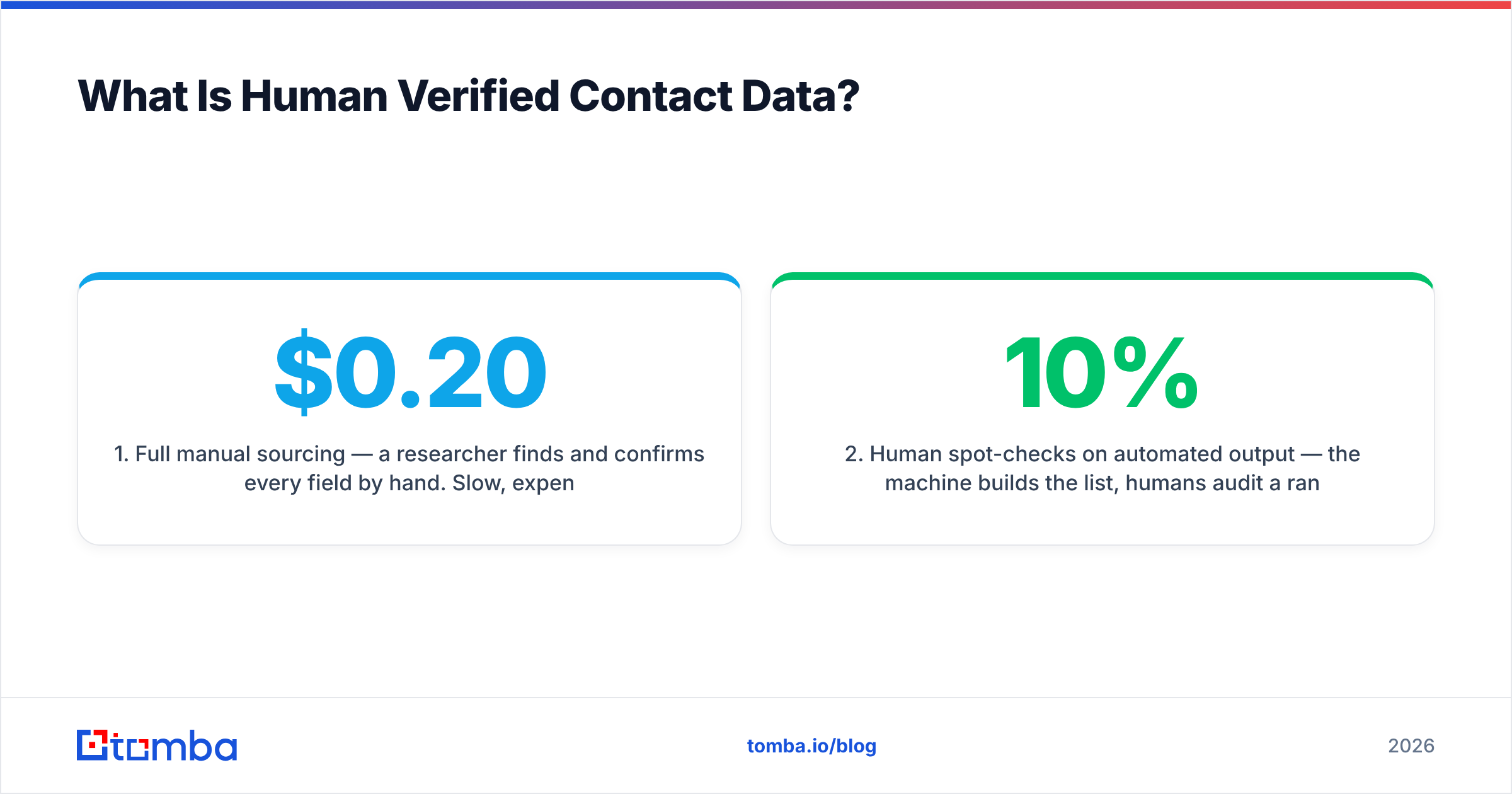
- Full manual sourcing — a researcher finds and confirms every field by hand. Slow, expensive, typically $0.20-$1.00 per record, and mostly used for custom list-building projects.
- Human spot-checks on automated output — the machine builds the list, humans audit a random 2-10% sample, and the whole batch inherits the "verified" label if the sample passes.
- Human-in-the-loop exception handling — automation handles the clean cases, humans only touch records the system flags as ambiguous (catch-all domains, common names, recently changed roles). This is the most honest version and increasingly the standard.
- Human-curated seed data, machine-scaled — researchers verify email patterns per company, then the system applies the pattern across the org chart. One human check covers dozens of records.
- Community/contributor verified — users report bounces and corrections back into the database, so real humans are correcting records, just not on payroll.
When a vendor says "human verified," ask which of those five they mean. The answer changes the price you should be willing to pay by an order of magnitude.
Why Does Automated Verification Fail Where Humans Succeed?#
Automated verification is excellent at answering "does this mailbox exist?" and terrible at answering "is this the right person to email?" Those are different questions, and only one of them is machine-checkable over SMTP.
Here is where automation hits a wall:
- Catch-all domains. Roughly 15-20% of B2B domains accept mail to any address, so SMTP validation returns "accepted" for
asdfgh@company.comjust as readily as for the real CEO. A machine can guess at the pattern; a human can confirm the person exists at the company. This is exactly why dedicated catch-all verification tooling exists as a separate step rather than being folded into standard validation. - Job changes. Someone who left six months ago may still have an active forwarding mailbox. The email validates green. The record is worthless. LinkedIn or a press mention resolves it in seconds; SMTP never will.
- Title drift. "VP Marketing" becomes "CMO" becomes "Chief Growth Officer" without any signal a scraper can reliably catch. If your targeting or personalization depends on title, stale titles quietly ruin both.
- Small and private companies. A 12-person manufacturer with no LinkedIn presence and a WordPress site from 2019 has almost no machine-readable signal. A researcher can call reception. A crawler cannot.
- Role vs. person mailboxes.
sales@validates perfectly and reaches nobody who will reply to a cold pitch.

Automated verification also has a failure mode people forget: greylisting and rate-limiting produce false "unknown" results. Large providers throttle verification traffic, so a mailbox that exists comes back as unverifiable. Human review resolves those, but so does simply re-running the check later against a different provider.
The honest framing: automation gets you syntactically valid, deliverable mailboxes. Humans get you correct people. Most teams need the second thing far less often than vendors would like you to believe — but when they need it, no amount of automation substitutes.
How Much More Does Human Verified Data Actually Cost?#
This is the part vendors bury. Per-record economics diverge sharply once a person touches the file.
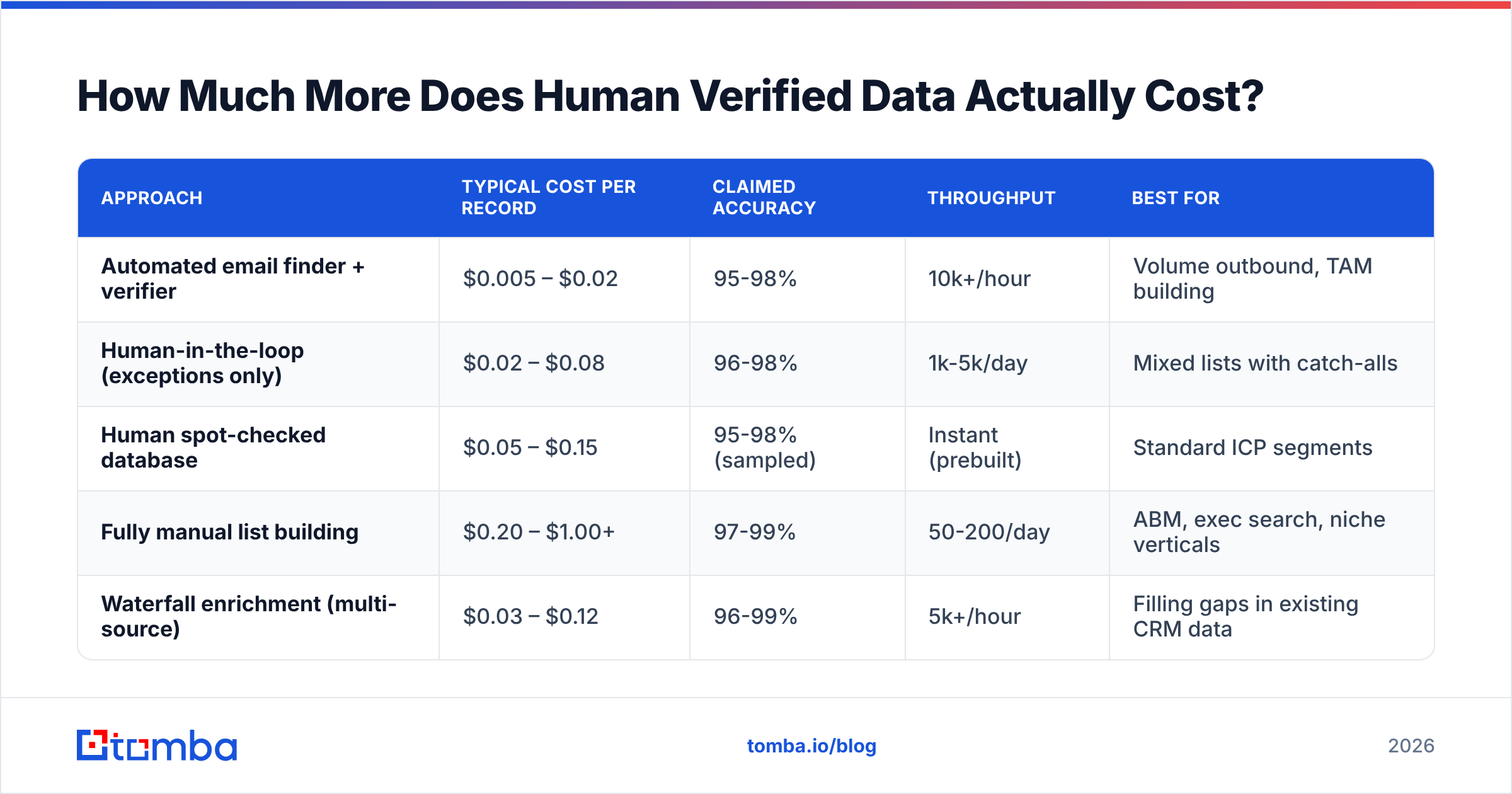
| Approach | Typical cost per record | Claimed accuracy | Throughput | Best for |
|---|---|---|---|---|
| Automated email finder + verifier | $0.005 – $0.02 | 95-98% | 10k+/hour | Volume outbound, TAM building |
| Human-in-the-loop (exceptions only) | $0.02 – $0.08 | 96-98% | 1k-5k/day | Mixed lists with catch-alls |
| Human spot-checked database | $0.05 – $0.15 | 95-98% (sampled) | Instant (prebuilt) | Standard ICP segments |
| Fully manual list building | $0.20 – $1.00+ | 97-99% | 50-200/day | ABM, exec search, niche verticals |
| Waterfall enrichment (multi-source) | $0.03 – $0.12 | 96-99% | 5k+/hour | Filling gaps in existing CRM data |
Two things jump out. First, the accuracy spread across the whole table is about four percentage points, while the price spread is roughly 100x. Second, "claimed accuracy" is measured differently by nearly every vendor — some count only hard bounces, some count soft bounces, some count records they refused to sell you.
Run the math on a real campaign. Sending 5,000 emails a month:
- At 97% accuracy with automated data at $0.01/record: $50 in data, ~150 bounces.
- At 99% accuracy with manual data at $0.40/record: $2,000 in data, ~50 bounces.
You spent $1,950 to avoid 100 bounces. That's $19.50 per avoided bounce. Unless those bounces threaten your sender reputation — and at 3% they generally don't, since most inbox providers get concerned above roughly 2-3% sustained — the automated path wins on pure economics.
Where the math flips: 200 target accounts, six-figure deal sizes, one shot at a named exec. Then $80 total for hand-verified data against a $150k pipeline is not a line item worth optimizing.
For reference on the automated side, Tomba pricing runs a free tier at 25 searches/month, Starter at $49/mo, Growth at $99/mo, and Pro at $249/mo — which puts effective per-record cost well under a cent at volume once you account for included credits.
Is Human Verified Contact Data Worth It for Your Team?#
Depends on three variables: deal size, list size, and how exotic your ICP is.
Buy human verified when:
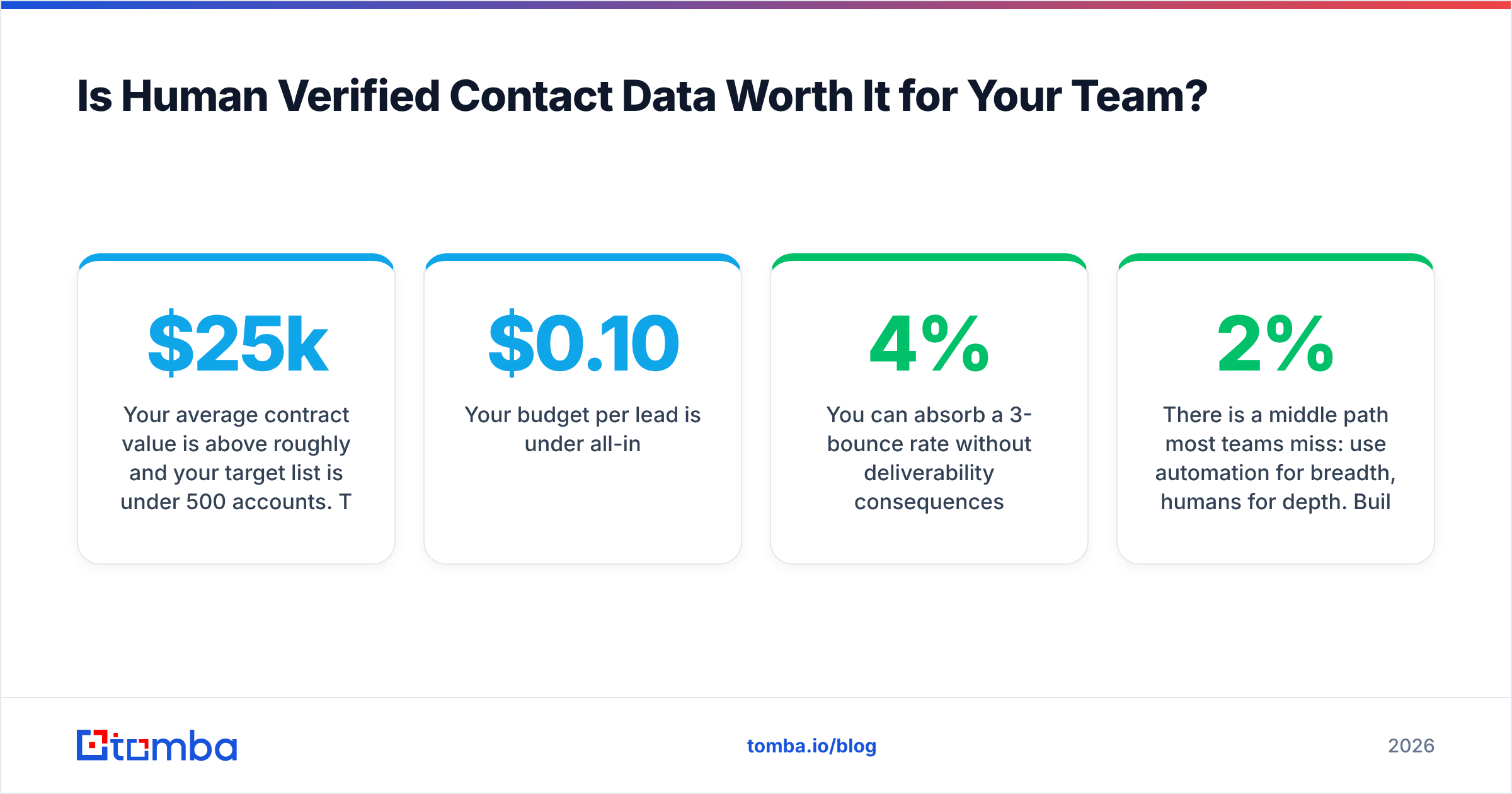
- Your average contract value is above roughly $25k and your target list is under 500 accounts. The per-record premium disappears against deal economics.
- You sell into industries with poor digital footprints — manufacturing, construction, local healthcare, government contractors, family-owned distribution.
- Your ICP is defined by attributes no database indexes well: "companies that just hired a first RevOps lead," "firms using a specific legacy ERP," "teams with exactly 3-8 SDRs."
- You need phone numbers alongside email. Mobile numbers degrade faster than emails and are much harder to verify programmatically — a phone validator confirms the line is live, but not whose it is.
- You've been burned by a spam trap and your domain is on probation.
Skip it and use automated finding + verification when:
- You're running volume outbound (2,000+ sends/month) into standard tech, SaaS, agency, or e-commerce ICPs.
- Your titles are common and well-indexed (VP Sales, Head of Marketing, CTO).
- You're enriching an existing CRM where you already have names and companies and just need the missing email — that's a solved problem for data enrichment at machine speed.
- Your budget per lead is under $0.10 all-in.
- You can absorb a 3-4% bounce rate without deliverability consequences.

There is a middle path most teams miss: use automation for breadth, humans for depth. Build the full addressable list programmatically with a domain search across every target company, verify it in bulk, then hand-review only the 50-100 records that made it to your top-tier account list. You pay manual rates on 2% of your data and automated rates on the rest.
How Do You Test a Vendor's "Human Verified" Claim?#
Never accept an accuracy number from a marketing page. Test it yourself in under an hour.
The 100-record protocol:
- Request a sample of 100 records from your actual ICP — not their demo file. If a vendor won't sample your segment, that tells you something.
- Run every email through an independent verifier. Use a tool that isn't the vendor's own. An email verifier or a free email checker gives you a second opinion on syntax, MX records, and mailbox existence. Note how many come back catch-all or unknown — that's the segment human review is supposed to solve.
- Manually check 20 records against LinkedIn. Does the person still work there? Is the title current within six months? This catches the job-change failure automation can't.
- Send to 25 records from a warmed, non-primary domain. Measure hard bounces at 48 hours. This is the only number that matters, and it's the only one no vendor can fake.
- Check for role addresses and duplicates. Count
info@,sales@,contact@entries. A "human verified" list heavy on role mailboxes was verified for deliverability, not for people. - Ask how the record was verified and when. A real answer sounds like "researcher-confirmed against LinkedIn on 2026-04-12." A vague answer sounds like "our proprietary multi-layer process."
Score it: under 3% hard bounce and over 90% of your LinkedIn spot-checks correct means the data is good. If bounces are fine but titles are stale, you bought deliverability, not accuracy — and you could have gotten deliverability for a tenth of the price.
Worth noting that G2 and Capterra review sections filter by company size, which is the fastest way to find whether a vendor's accuracy holds for your segment rather than their best one. Check G2's data provider category and read the 3-star reviews specifically — those are where the real limitations surface.
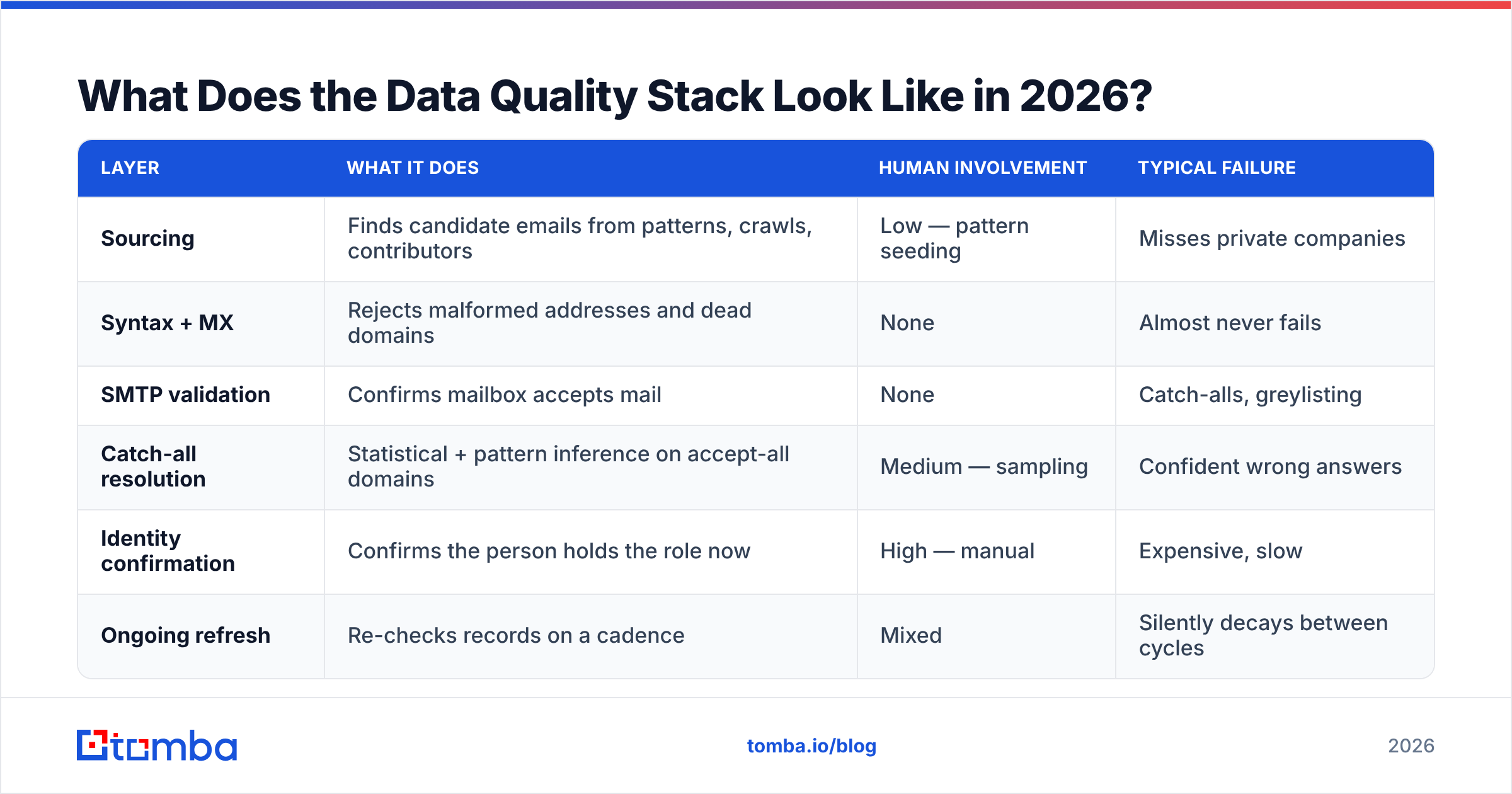
What Does the Data Quality Stack Look Like in 2026?#
The market has consolidated around a layered model rather than a binary human/machine choice.
| Layer | What it does | Human involvement | Typical failure |
|---|---|---|---|
| Sourcing | Finds candidate emails from patterns, crawls, contributors | Low — pattern seeding | Misses private companies |
| Syntax + MX | Rejects malformed addresses and dead domains | None | Almost never fails |
| SMTP validation | Confirms mailbox accepts mail | None | Catch-alls, greylisting |
| Catch-all resolution | Statistical + pattern inference on accept-all domains | Medium — sampling | Confident wrong answers |
| Identity confirmation | Confirms the person holds the role now | High — manual | Expensive, slow |
| Ongoing refresh | Re-checks records on a cadence | Mixed | Silently decays between cycles |
The layer everyone underinvests in is the last one. B2B contact data decays at roughly 25-30% annually — people change jobs, companies rebrand, domains migrate. Salesforce and HubSpot have both published guidance on CRM data hygiene precisely because this decay compounds; HubSpot's data quality documentation treats deduplication and refresh as continuous operations, not one-time cleanups.
Meaning: a human-verified record bought in January is roughly as stale as a machine-verified record by October. You are paying a premium for a freshness advantage that evaporates on a known schedule. The vendors with real value here are the ones that re-verify continuously, not the ones that verified once, thoroughly, a while ago.
Some providers built their whole model around this — BookYourData, for instance, leans on a pay-as-you-go structure with a bounce guarantee, which aligns the vendor's incentive with your bounce rate rather than your seat count. That's a structurally sounder promise than a static accuracy percentage, and it's worth looking for regardless of which vendor you pick.
How Should You Build a Practical Verification Workflow?#
Here's a workflow that gets 97%+ deliverability without manual-list pricing:
Step 1 — Build wide, automatically. Pull every relevant contact at your target domains programmatically. Company-level sweeps give you the full org, not just the one name you already had. Use the Tomba API or a bulk run if you're working from a list of domains.
Step 2 — Verify in bulk, immediately. Verification is cheapest and most accurate right after finding, before the record ages. Run the whole batch through bulk verification and segment the output into three buckets: valid, catch-all, and invalid.
Step 3 — Drop invalid. Send to valid. Quarantine catch-all. Never mix catch-all addresses into your main send. Route them to a separate, lower-volume sequence from a secondary domain so a bad guess doesn't cost you your primary sender reputation.
Step 4 — Human-review only your top tier. Take your 50-100 highest-value accounts and check them by hand against LinkedIn. Twenty minutes of work, and it's where errors are most expensive.
Step 5 — Re-verify on a 90-day cycle. Anything sitting in your CRM unsent for a quarter goes back through verification before it gets touched. This single habit does more for deliverability than upgrading data vendors.
Step 6 — Feed bounces back. Every hard bounce should mark the record dead in your CRM the same day. Most teams never close this loop, which is why the same bad address gets emailed four times across three campaigns.
This workflow costs a fraction of buying human-verified data outright, and it puts the human effort where the marginal value is highest instead of spreading it evenly across records that didn't need it.
What's the Verdict on Human Verified Contact Data?#
Human verification is a real capability sold with unreal marketing. The label means something — a person did confirm something — but it rarely means what the price implies, and it never means the record stays correct.
Your decision rule: if the cost of one wrong contact exceeds $50 in wasted effort or reputation, pay for human review. Otherwise, automate and verify. Most B2B teams sending at volume fall in the second bucket and are overpaying for a two-point accuracy improvement that their bounce rate can't even detect.
The teams getting this right aren't picking a side. They're running automated finding and verification for 95%+ of their volume and reserving hand-checking for the accounts where a single mistake is genuinely expensive.
If you want to see where your current list actually sits, start with the Tomba Email Finder. Pull a sample of your target accounts, verify them, and compare the result against whatever you're currently paying per record. The free tier covers 25 searches a month — enough to run the 100-record test protocol above on a real segment before you commit a budget to anyone's accuracy claim, human or otherwise.
Related guides#
// get started
Find, verify and enrich your first contacts today
Start on the free plan with 25 searches a month, then scale when your team is ready.
Free plan · No credit card required · GDPR & CCPA
// about the author