Humanlinker Reviews 2026: Features, Pricing, and Real Limits
Humanlinker promises AI personality profiling and auto-written sequences for every prospect. Here is what the tool actually does well, where DISC profiling breaks down, what it costs, and when a cheaper data-first stack beats it.
Humanlinker reviews are split, and the split is easy to explain. Reps who work one profile at a time tend to love it. Teams chasing volume find the data thin. Both camps are right. Here is the short version first.
TL;DR
- Humanlinker reviews praise one thing above all: speed. The tool reads a prospect's public posts, guesses a DISC personality type, then drafts LinkedIn notes and emails to match.
- It is a writing layer, not a contact database. Judge it on that job.
- The common gripes: patchy contact data, credits burned on leads you never email, and copy that starts to sound the same at volume.
- The DISC score is a guess from public text, not a real test. Treat it as a hint.
- Pricing is per seat, and the tiers have moved more than once. Price it against your own seat count.
- If your real problem is reaching the right inbox, a verified data stack plus a good sequencer costs less and lands more.
What is Humanlinker, exactly?#
Humanlinker is a French AI sales tool. It sits between your prospect list and your outreach.
You feed it a LinkedIn profile or a company domain. It returns a "360° analysis" of that person: role, recent posts, company signals. It adds a personality read in DISC terms — Dominance, Influence, Steadiness, Conscientiousness. Sometimes it layers an OCEAN (Big Five) read on top.
From there it writes for you. You get icebreakers, connection notes, and multi-step email sequences. Each one is tuned to the tone it thinks that type will answer.
The product is really three parts:
- A Chrome extension that sits over profiles and company pages while you work on LinkedIn.
- A web app where you build lists, run bulk analyses, and manage sequences.
- Integrations with CRMs and senders — HubSpot, Salesforce, Pipedrive, and most sequencers — so the copy does not die in one tab.
That framing matters. Humanlinker does not compete with a contact database on depth. It competes for the budget you would spend on a copywriter, a research VA, or the hour your reps lose each day reading profiles. Check the official product pages for the current feature split. The roadmap moves fast, and older reviews describe a smaller product.
What do Humanlinker reviews actually say?#
Read enough Humanlinker reviews and the same three parts show up.
The praise is about speed. Reps who work LinkedIn by hand like the extension. You go from "open profile" to "solid first line" in seconds. That is a real win, above all for junior reps who freeze at a blank compose box. Scores on G2's Humanlinker listing skew high on ease of use and setup.
The complaints are about data and credits. Two show up again and again. Contact coverage is uneven outside Western Europe and North America. And credits drain on people you were never going to email. Neither is a bug. Any AI writing layer must burn compute per prospect, reachable or not.
The doubts are about output at scale. One tailored email reads great. Two hundred, from the same model and the same prompt, start to rhyme. A prospect who gets three "I noticed you value precision" openers in a month stops reading them. Many reviewers report strong early numbers that flatten after a few weeks. Any pattern gets spotted once it repeats.

None of that makes it a bad product. It makes it a tool with one job: cut the cost of writing, not the cost of finding.
How does DISC personality profiling actually work here?#
Here is the part most reviews skip. A classic DISC assessment is a self-report test. The subject answers questions and gets a profile. Your prospect does none of that.
Humanlinker infers the profile from public signals: post text, headline wording, job history, praise in recommendations, and company context.
That guess helps in one narrow way and misleads in another.
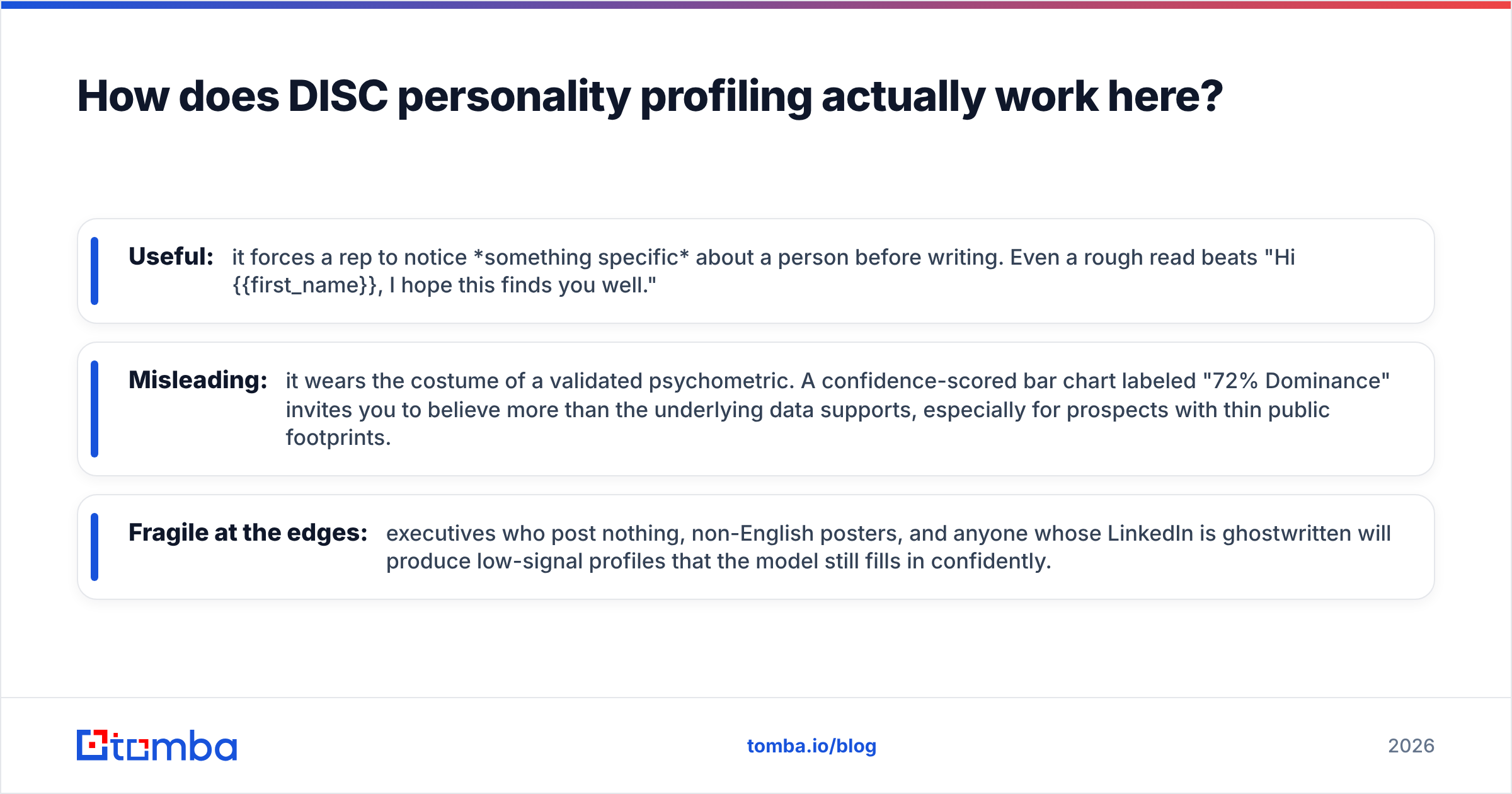
- It helps: the rep must notice something real about a person before writing. Even a rough read beats "Hi {{first_name}}, I hope this finds you well."
- It misleads: the output looks like a real test. A bar labeled "72% Dominance" invites more trust than the data earns, above all for quiet profiles.
- It breaks at the edges: think of the exec who never posts, the prospect who writes in another language, or the ghostwritten feed. The model still fills the gap with confidence.
A better mental model: the DISC read is a shortcut. It is a colleague who glances at a profile and says "this one is blunt, get to the point." You would act on that hint. You would not build a forecast on it.
What does Humanlinker cost, and is it worth it?#
Humanlinker reviews rarely quote a firm price, and that is fair. The tool sells per seat. There is a small free tier, a mid tier for single reps, and higher tiers that unlock bulk analysis, more sending, and team features. The tiers have moved more than once, and big deals are quoted. Open the vendor's pricing page and price your real seat count before you sign for a year.
You can still judge the shape of the cost. Per-seat AI tools get costly in a set way. You pay for each seat, even for reps who prospect twice a month. You pay per analysis, even when the person has no email you can find. A team of ten where four reps prospect daily pays about 2.5x what it uses.
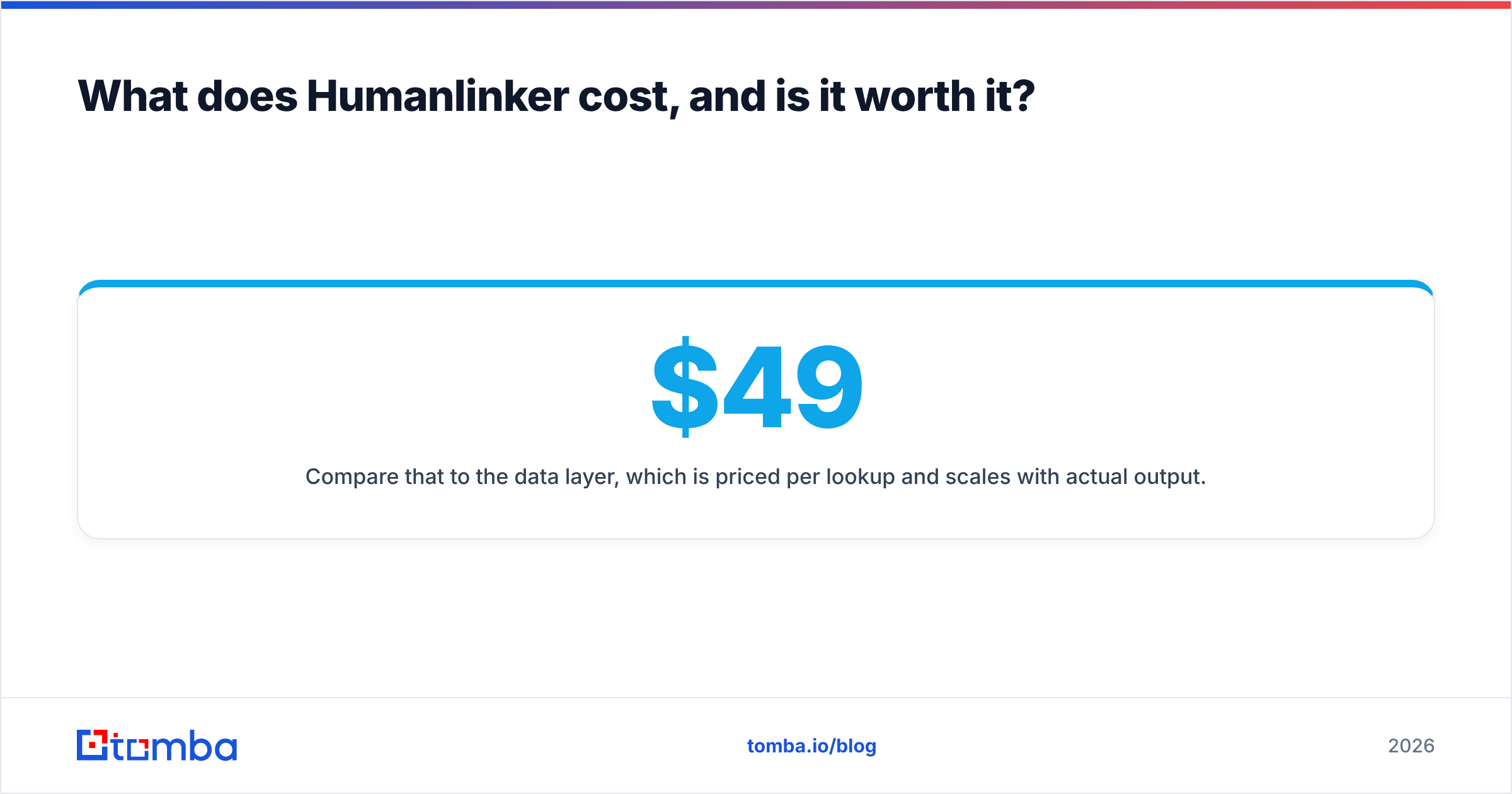
The data layer prices differently. It charges per lookup, so it scales with real output. Tomba pricing starts free at 25 searches a month, then $49, $99, and $249 a month, with custom plans above that. No seat multiplier. Two different curves — which one hurts depends on your team shape.
How does Humanlinker compare to the alternatives?#
The fair question is not "Humanlinker or one rival." It is which layer you need: the writing layer, the data layer, or the sending layer. Three jobs, three kinds of tool.
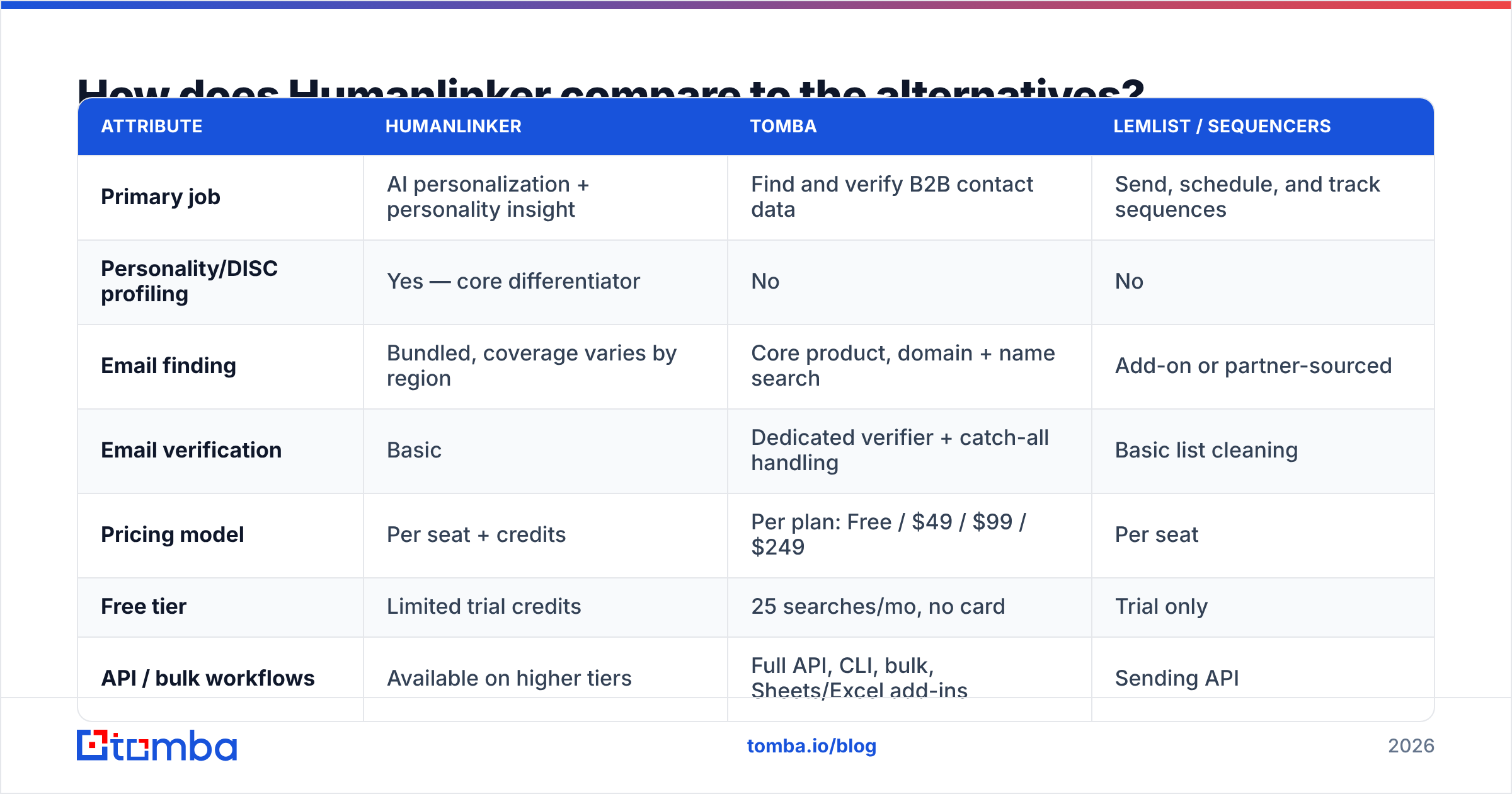
| Attribute | Humanlinker | Tomba | lemlist / sequencers |
|---|---|---|---|
| Primary job | AI copy + personality insight | Find and verify B2B contact data | Send, schedule, and track sequences |
| Personality/DISC profiling | Yes — core differentiator | No | No |
| Email finding | Bundled, coverage varies by region | Core product, domain + name search | Add-on or partner-sourced |
| Email verification | Basic | Dedicated verifier + catch-all handling | Basic list cleaning |
| Pricing model | Per seat + credits | Per plan: Free / $49 / $99 / $249 | Per seat |
| Free tier | Limited trial credits | 25 searches/mo, no card | Trial only |
| API / bulk workflows | Available on higher tiers | Full API, CLI, bulk, Sheets/Excel add-ins | Sending API |
| Best for | Reps who prospect manually on LinkedIn | Teams that need reachable, verified contacts at volume | Teams that already have lists and copy |
Look at the rows. They barely overlap. That is the real finding.
Buying Humanlinker to fix a data problem is the classic mis-buy here. So is buying a data tool to fix a copy problem. It also explains why Humanlinker reviews clash so often. The reviewer's own bottleneck decides the verdict.
Where does Humanlinker fall short?#
Most Humanlinker reviews land on the same five limits. Here they are, in the order they tend to bite.
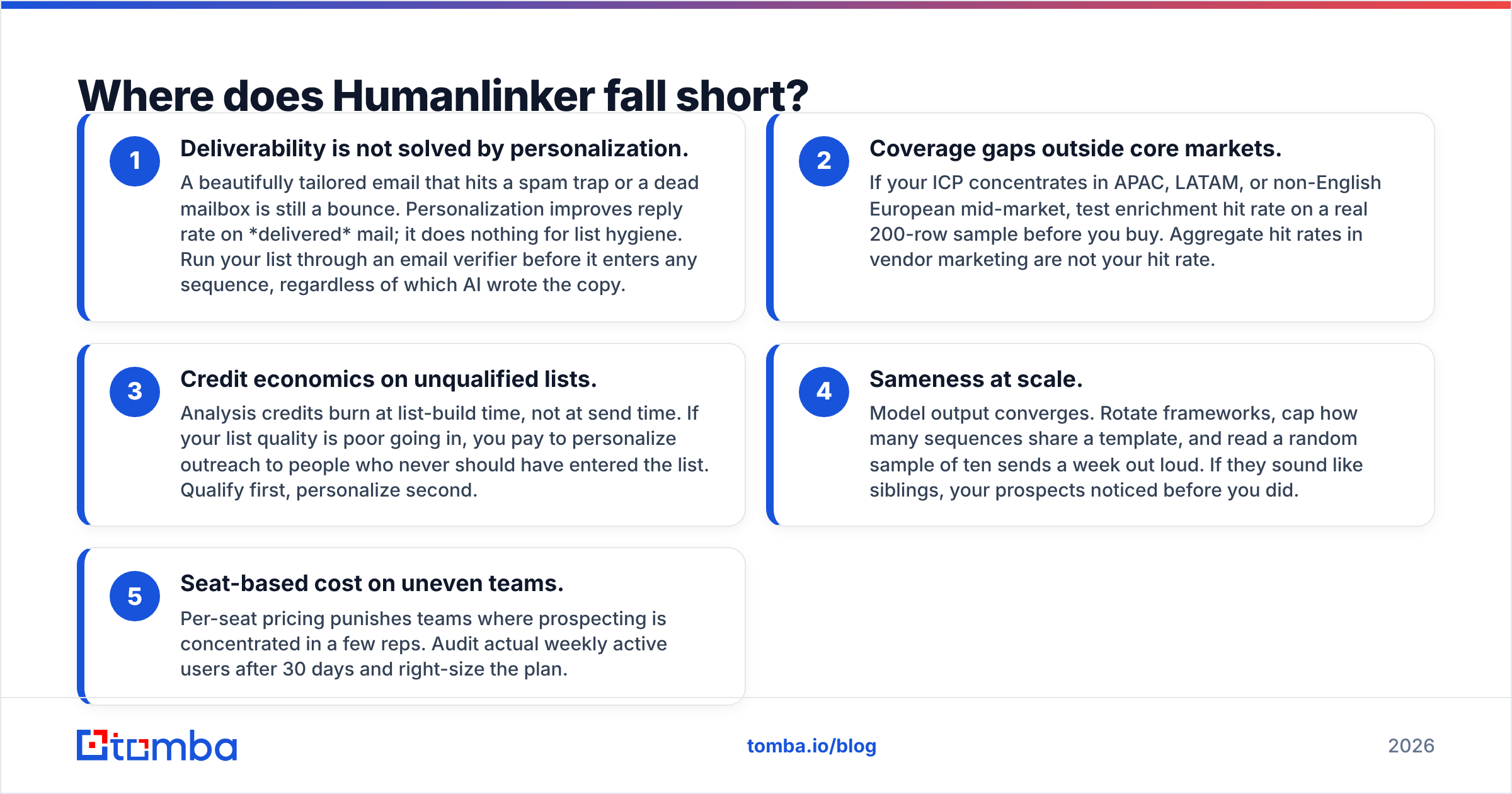
- Great copy does not fix a bad list. A tailored email that hits a dead mailbox is still a bounce. Good writing lifts replies on mail that arrives. It does nothing for list hygiene. Run every list through an email verifier first, no matter who wrote the copy.
- Coverage gaps outside core markets. Is your ICP in APAC, LATAM, or non-English Europe? Test the hit rate on a real 200-row sample before you buy. The rate in vendor marketing is not your rate.
- Credits burn on weak lists. Credits go at list-build time, not at send time. Poor list quality means you pay to write to people who should never have made the list. Qualify first, write second.
- Sameness at scale. Model output drifts toward one voice. Rotate your frameworks. Cap how many sequences share a template. Read ten sends out loud each week. If they sound like siblings, your prospects noticed first.
- Seat cost on uneven teams. Per-seat plans punish teams where two or three reps do all the prospecting. Audit weekly active users after 30 days and resize the plan.

None of these rule it out. They are the questions a smart buyer asks in week one, not month six.
Who should buy Humanlinker — and who shouldn't?#
Buy it if your reps work LinkedIn by hand. Buy it if your deals are big enough that research per prospect pays for itself. Buy it if your ICP sits in well-covered markets. Above all, buy it if your real block is "we do not know what to say." In that case the extension earns its seat in week one, and the social selling motion it feeds is where the tool shines.
Skip it if your limit is reachable inboxes, not words. Skip it if you build lists in bulk from domains rather than one profile at a time. Skip it if most of your seats prospect only now and then. You will gain more by fixing the data layer: right address, verified before send, enriched with firm data. Then let a light AI assist write inside the sequencer you already pay for.
A middle path also works well. Keep two or three seats for the reps who live on LinkedIn. Run bulk list building on a data stack. You get deep research where deal size earns it, and cheap reach everywhere else. For a wider view, HubSpot's sales blog covers the research-versus-volume trade in plain terms.
What should you test during a Humanlinker trial?#
Do not buy on vibes. Do not buy on Humanlinker reviews alone, this one included. Run this test in 14 days.
- Hit-rate test: take 200 real ICP prospects. Count coverage, then count how many emails pass verification.
- Blind copy test: write ten emails with the tool. Mix them with ten from your best rep. Have a manager rank all twenty, unlabeled.
- Credit burn test: track credits per contactable prospect, not per analysis.
- Reply-rate test: run one cohort with AI copy and one with a strong plain template. Same verified list, same volume, same window.
- Seat audit: count how many paid users opened the extension more than three times a week.
Does the AI cohort win against a verified baseline? Then the answer is yes. Does it win only against an unverified list? Then you did not measure the copy. You measured email deliverability.
The bottom line#
Humanlinker reviews split along one line: what you hired it for. It is a well-built writing layer with a real hook in prospect insight. Reps who work one profile at a time like it. Teams chasing volume find the data thin. Neither camp is wrong.
Whatever you pick for copy, reach is not optional. Good writing multiplies mail that arrives. It cannot save mail that bounces. So start by making every address real. Use the Tomba Email Finder to build lists from domains and names. Verify before you send. Then let your AI of choice work on a list that lands. The free tier gives you 25 searches a month, so you can test the gap on your own ICP first.
Related guides#
// get started
Find, verify and enrich your first contacts today
Start on the free plan with 25 searches a month, then scale when your team is ready.
Free plan · No credit card required · GDPR & CCPA
// about the author