Hunter Mentality in Sales: How Top Reps Actually Win Deals
Hunter reps outsell farmers on new logos by wide margins — but not because they're louder. Here's what the hunter mentality in sales actually looks like day to day, and how to build it.
TL;DR
- The hunter mentality in sales is a repeatable operating system — daily prospecting blocks, self-sourced pipeline, and fast disqualification — not a personality trait you're born with.
- Hunters own the top of the funnel. Farmers own retention and expansion. Most teams break when they ask one rep to do both and measure them with the same scorecard.
- The single biggest predictor of hunter performance in 2026 isn't call volume. It's contact data quality: bad emails and dead numbers destroy activity metrics before skill ever enters the picture.
- Build the mentality with three levers: a protected prospecting block, a disqualification rule you actually enforce, and a weekly self-sourced pipeline number that's visible to the whole team.
- Hire for it by testing behavior, not vibes. Ask for last quarter's self-sourced percentage and how they built a target list from scratch.
What Is the Hunter Mentality in Sales?#
The hunter mentality in sales is the habit of creating pipeline instead of waiting for it. A hunter assumes no lead will arrive on its own, builds a target list from raw research, initiates cold contact, and treats a silent inbox as a signal to send more — not as evidence the market is dead.
Think of it like the difference between a fisherman and a fish farmer. The farmer feeds stock in a pond they already own and gets paid on how big the fish grow. The fisherman has an empty boat every morning and gets paid only on what they bring back. Same industry, entirely different daily behavior.
Technically, "hunter" describes a role archetype in a split go-to-market motion: new-logo acquisition (hunting) separated from retention and expansion (farming). The mentality is the behavioral layer underneath the role — the willingness to start from zero every month and the tolerance for the rejection density that comes with it.
Three things define it in practice:
- Self-sourced pipeline is non-negotiable. A hunter tracks the percentage of their pipeline they created themselves. If marketing gave them every opportunity, they didn't hunt — they harvested.
- Speed of disqualification beats persistence. Hunters kill weak deals faster than anyone, because pipeline time is their scarcest resource. Chasing a bad-fit account for six weeks is a hunter's version of failure.
- Prospecting is a fixed cost, not a variable one. It happens on days when quota is already hit and on days when three deals just died. The block doesn't move.
Is a Hunter Better Than a Farmer?#
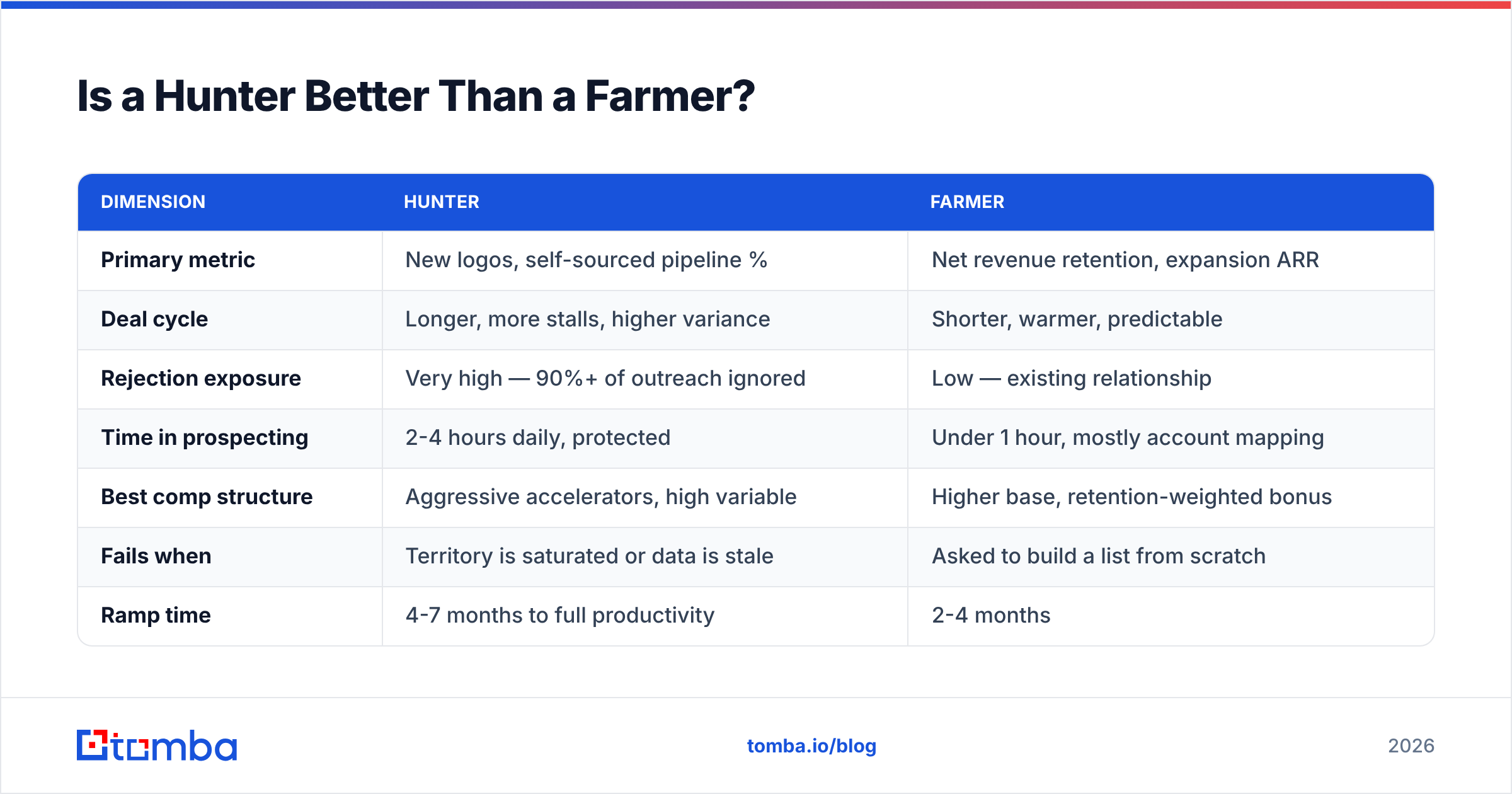
No. They're optimized for different math, and the industry keeps re-litigating this because leaders conflate "hunter" with "good."
A farmer working a $2M book of accounts with 118% net revenue retention generates more predictable revenue than a hunter closing $600K in new logos — and does it at a lower cost of acquisition. The problem is that farmer economics only work if someone acquired those accounts first.
| Dimension | Hunter | Farmer |
|---|---|---|
| Primary metric | New logos, self-sourced pipeline % | Net revenue retention, expansion ARR |
| Deal cycle | Longer, more stalls, higher variance | Shorter, warmer, predictable |
| Rejection exposure | Very high — 90%+ of outreach ignored | Low — existing relationship |
| Time in prospecting | 2-4 hours daily, protected | Under 1 hour, mostly account mapping |
| Best comp structure | Aggressive accelerators, high variable | Higher base, retention-weighted bonus |
| Fails when | Territory is saturated or data is stale | Asked to build a list from scratch |
| Ramp time | 4-7 months to full productivity | 2-4 months |
The mistake most teams make is hiring a hunter and then handing them a book of 40 existing accounts to "grow." Within two quarters the hunter is doing QBRs, the prospecting block is gone, and the skill atrophies. It works the other way too: a strong farmer forced into cold outbound will spend three weeks perfecting a target list to avoid making the first call.
According to HubSpot's sales research, reps spend a shrinking fraction of their week actually selling — most of it goes to research, data entry, and administrative work. For a hunter, that ratio is the whole ballgame. Every hour lost to bad data is an hour not spent on first conversations.
What Do Hunters Actually Do Differently Each Day?#
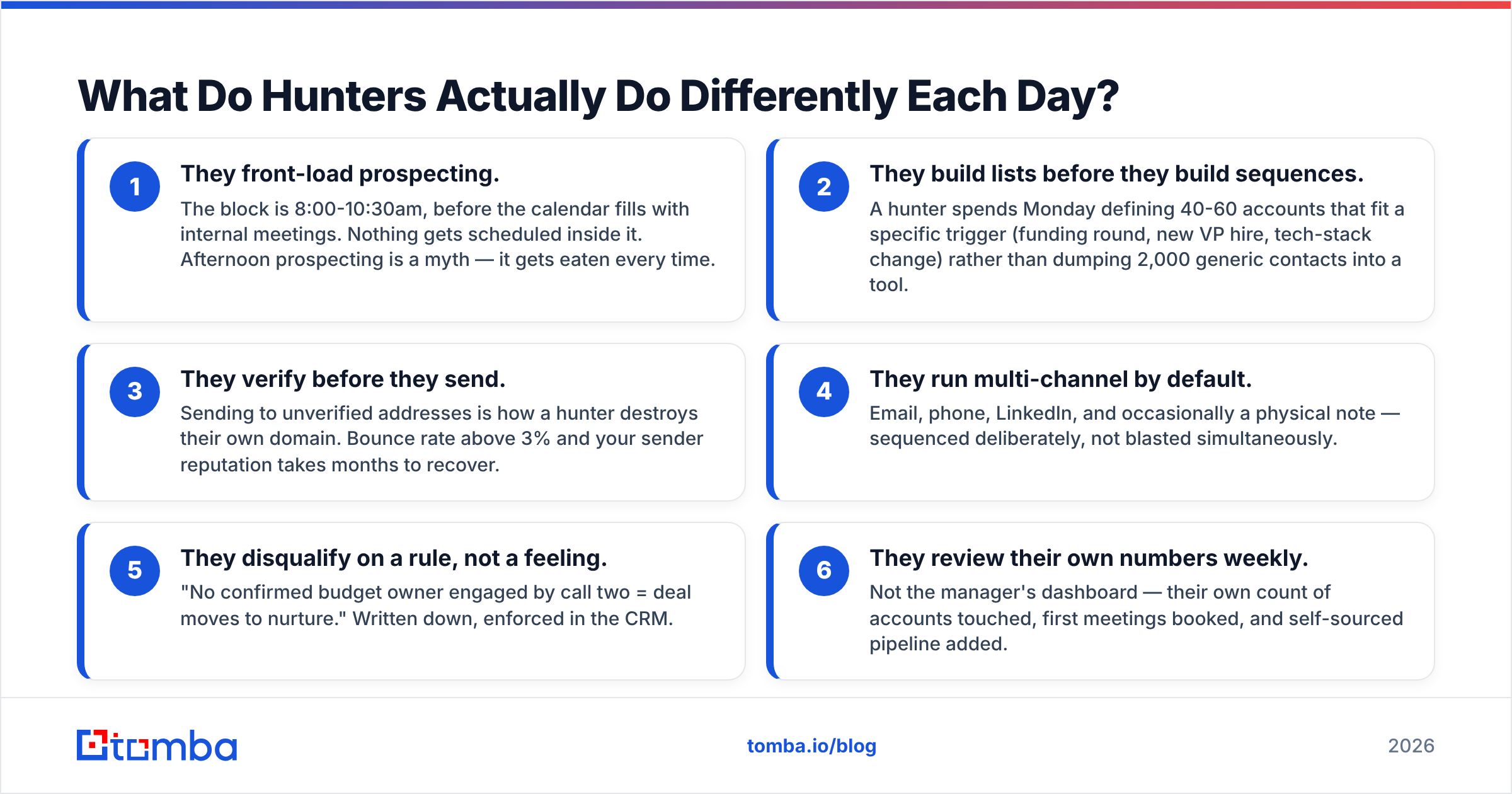
The gap between a hunter and an average rep isn't effort. It's structure. Watch a genuinely good hunter for a week and you'll see the same five behaviors:
- They front-load prospecting. The block is 8:00-10:30am, before the calendar fills with internal meetings. Nothing gets scheduled inside it. Afternoon prospecting is a myth — it gets eaten every time.
- They build lists before they build sequences. A hunter spends Monday defining 40-60 accounts that fit a specific trigger (funding round, new VP hire, tech-stack change) rather than dumping 2,000 generic contacts into a tool.
- They verify before they send. Sending to unverified addresses is how a hunter destroys their own domain. Bounce rate above 3% and your sender reputation takes months to recover.
- They run multi-channel by default. Email, phone, LinkedIn, and occasionally a physical note — sequenced deliberately, not blasted simultaneously.
- They disqualify on a rule, not a feeling. "No confirmed budget owner engaged by call two = deal moves to nurture." Written down, enforced in the CRM.
- They review their own numbers weekly. Not the manager's dashboard — their own count of accounts touched, first meetings booked, and self-sourced pipeline added.
That third point is where most hunter motions quietly break. You can have perfect messaging and a flawless cadence, and if 28% of your addresses bounce, none of it matters. Running your list through an email verifier before a send is the cheapest insurance in outbound.
How Do You Build a Hunter Mentality on an Existing Team?#
You can't train it in a workshop. You install it with constraints.
Lever 1 — Protect the block, publicly. Put a recurring calendar hold on the whole team, decline internal meetings that land inside it, and have the manager sit in the same block doing the same work. A prospecting block that leadership skips is a suggestion, not a standard.
Lever 2 — Make self-sourced pipeline the headline metric. Report it weekly, per rep, in a shared channel. Not activity counts — activity is easy to game. Self-sourced pipeline dollars is not.
Lever 3 — Give them a disqualification quota. This sounds backwards until you try it. Ask each rep to kill five deals a week with a written reason. It reframes disqualification as productive work instead of a personal loss, and it surfaces the stalled deals hiding in the forecast.
Lever 4 — Fix the data before you fix the rep. If a rep is making 60 dials and connecting on four, the problem may not be their opener. Pull a sample of 50 records and check how many phone numbers are current. Coaching a rep on tone when their list is 40% stale is malpractice.
Lever 5 — Change the comp curve. Hunters respond to accelerators. A flat commission rate rewards hitting 100% and nothing beyond it. Steep accelerators past quota are the clearest signal that overachievement is the point.
What Tools Support a Hunter Motion in 2026?#
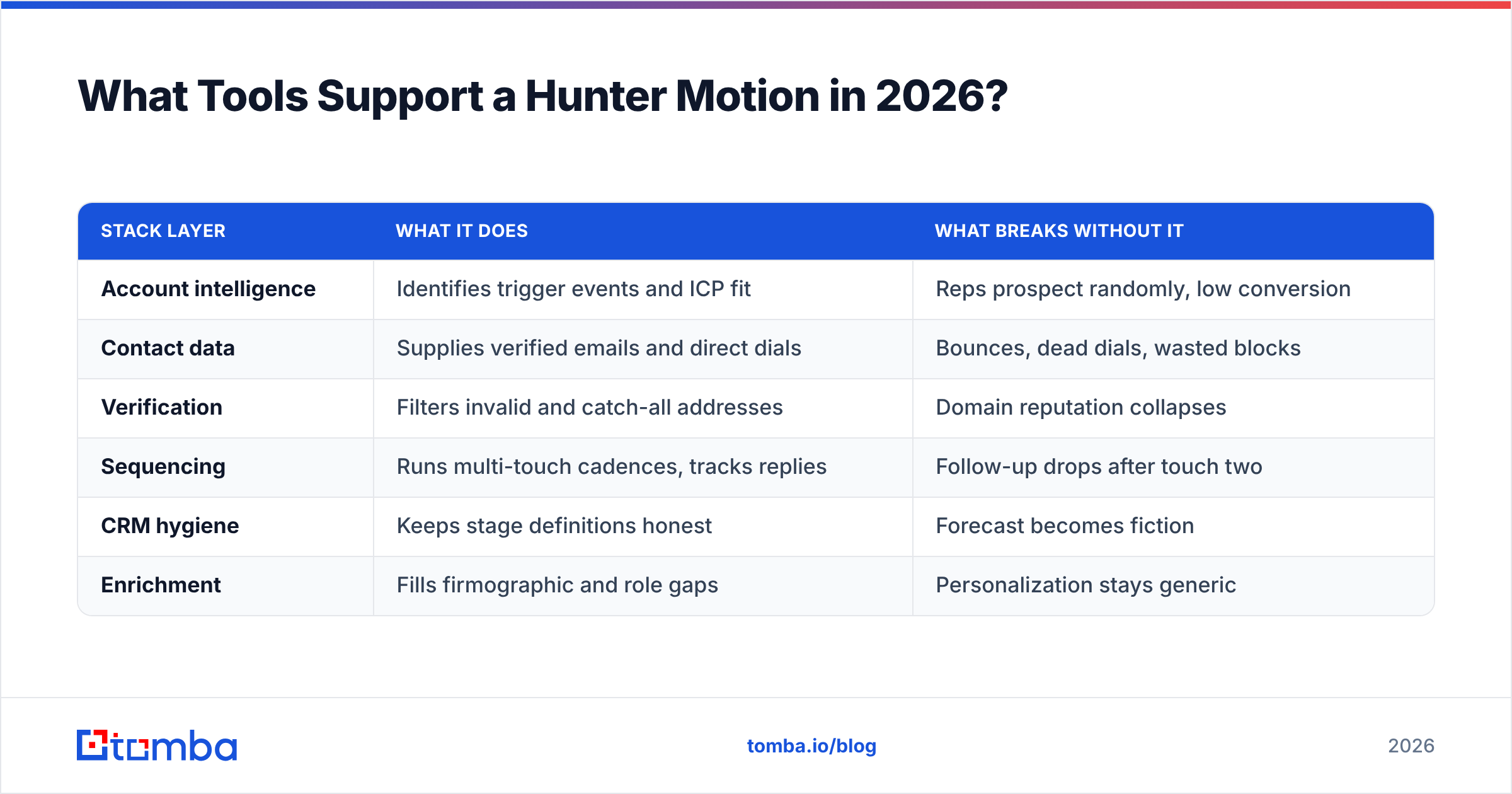
A hunter's stack has three jobs: find the right accounts, get accurate contact data, and sequence outreach without wrecking deliverability. Most teams over-invest in the third and under-invest in the second.
| Stack layer | What it does | What breaks without it |
|---|---|---|
| Account intelligence | Identifies trigger events and ICP fit | Reps prospect randomly, low conversion |
| Contact data | Supplies verified emails and direct dials | Bounces, dead dials, wasted blocks |
| Verification | Filters invalid and catch-all addresses | Domain reputation collapses |
| Sequencing | Runs multi-touch cadences, tracks replies | Follow-up drops after touch two |
| CRM hygiene | Keeps stage definitions honest | Forecast becomes fiction |
| Enrichment | Fills firmographic and role gaps | Personalization stays generic |
The contact-data layer deserves more scrutiny than it usually gets. Free-tier tools and scraped lists carry accuracy rates that look fine in a demo and fall apart at volume. Before committing, check independent review data on G2 rather than vendor-published accuracy claims — vendors measure themselves generously.
Practical setup that works for a two-to-eight-rep hunting team:
- Use a domain search to map every relevant contact at a target account in one pass, instead of hunting individuals one at a time.
- Push the list through verification, and specifically handle catch-all domains — a catch-all verifier separates "probably fine" from "will bounce" on domains that accept everything.
- Enrich with direct dials via a phone finder so the call block isn't dependent on a switchboard.
- Sync everything to the CRM automatically. Manual copy-paste is where prospecting blocks go to die.
Cost matters here because hunters run volume. Tools priced per seat with unusable credit caps push reps back to manual research. Compare the entry tiers honestly — Tomba pricing starts at $49/mo for Starter with a free tier at 25 searches a month, which is enough to validate a workflow before committing budget. Competitors like BookYourData take a different approach with pay-as-you-go credit packs, which suits teams with lumpy, campaign-driven prospecting rather than steady daily volume. Both models are legitimate; pick the one that matches how your team actually works.
How Do You Hire for the Hunter Mentality?#
Stop asking "are you a hunter or a farmer?" Everyone says hunter.
Ask these instead, and listen for specifics:
- "What percentage of your pipeline last quarter did you source yourself?" A real hunter knows this number without checking. Vague answers mean marketing fed them.
- "Walk me through how you built a target list for a new territory." You're listening for a research method — trigger events, data sources, list criteria. Not "I used the CRM."
- "Tell me about a deal you killed early." Hunters have these stories and tell them with pride. Reps who can't disqualify will describe six months of heroic persistence on a deal that never closed.
- "What did your prospecting block look like?" If there wasn't one, the mentality isn't there yet.
- "How many touches before you stopped?" Under four means they quit early. Over twelve on a cold account with zero engagement means they don't read signals.
Reference the role expectations against something concrete. Gartner's sales research consistently finds that buyer preference has shifted toward self-directed research, which means hunters now compete for a smaller window of buyer attention. Hire people who understand that the goal of a cold touch in 2026 is relevance, not reach.
One more filter: ask candidates how they handle a list that bounces. The good answer involves verification and data hygiene. The bad answer involves sending harder.
What Metrics Prove the Mentality Is Working?#
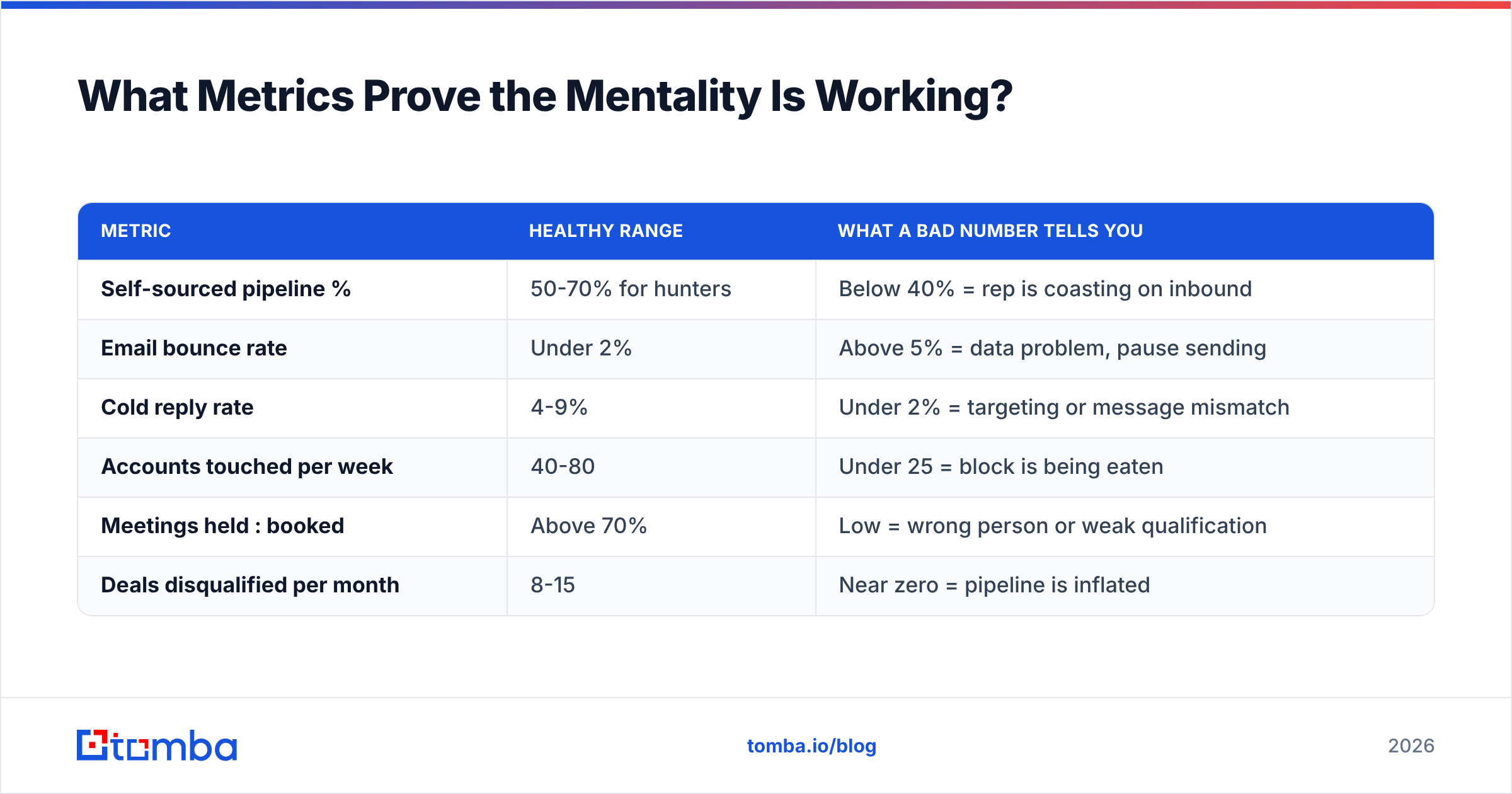
Activity metrics are the most-gamed numbers in sales. Track outcomes and inputs together, and check the ratios monthly:
| Metric | Healthy range | What a bad number tells you |
|---|---|---|
| Self-sourced pipeline % | 50-70% for hunters | Below 40% = rep is coasting on inbound |
| Email bounce rate | Under 2% | Above 5% = data problem, pause sending |
| Cold reply rate | 4-9% | Under 2% = targeting or message mismatch |
| Accounts touched per week | 40-80 | Under 25 = block is being eaten |
| Meetings held : booked | Above 70% | Low = wrong person or weak qualification |
| Deals disqualified per month | 8-15 | Near zero = pipeline is inflated |
The bounce rate row is the leading indicator for everything else. When it climbs, reply rates fall two weeks later, then meetings, then pipeline. Watching email deliverability alongside performance metrics catches problems before they show up in the forecast — by then it's a quarter too late.
Where Does the Hunter Mentality Break Down?#
Four failure modes show up over and over:
Territory saturation. A hunter who has worked the same 300 accounts for two years has no hunting left to do. Either expand the territory or accept that the role has become account management.
Data decay. B2B contact data goes stale at roughly 25-30% per year through job changes alone. A list built 18 months ago is functionally a different list today. Re-verification isn't optional maintenance — it's a scheduled task.
Manager drift. When a hunting manager starts spending most of their time in forecast calls, the prospecting standard erodes within a quarter. The block needs an owner who's still in it.
Comp misalignment. Hunters put on retention-heavy comp plans will optimize for retention. People do what they're paid for. If new-logo growth matters, the plan has to say so with real accelerators.
None of these are mindset problems. They're system problems that get misdiagnosed as mindset problems, which is why "we need more hunters" rarely fixes anything on its own.
Start With the Data Layer#
The hunter mentality in sales is built on a boring foundation: a protected block, an enforced disqualification rule, and contact data that actually connects. Get those three right and the rest — persistence, resilience, the traits people romanticize — follow naturally, because effort finally produces results.
If your reps are working hard and connecting rarely, start by auditing the list. Tomba's Email Finder returns verified professional addresses by name and domain, with a free tier of 25 searches a month so you can test accuracy against your own target accounts before you spend anything. Run 50 known contacts through it, compare against what your current provider returned, and let the bounce rate settle the argument.
Related guides#
// get started
Find, verify and enrich your first contacts today
Start on the free plan with 25 searches a month, then scale when your team is ready.
Free plan · No credit card required · GDPR & CCPA
Get the Tomba newsletter
Product and data updates
// about the author