Hunter vs Infofree: Which B2B Data Tool Wins in 2026?
Hunter sells verified email discovery. Infofree sells unlimited lead lists. They solve different problems, and picking wrong costs you a quarter of pipeline. Here's the honest breakdown on data sources, accuracy, pricing and fit.
TL;DR
- Hunter and Infofree are not competitors in the same category. Hunter is a domain-based email finder and verifier built for outbound teams. Infofree is a subscription lead-list database built on the infoUSA/Database USA lineage, aimed at SMB and local sales.
- Pick Hunter if you already know which companies you want and need deliverable work emails for named people at those companies.
- Pick Infofree if you need volume-first prospect lists filtered by SIC code, geography, revenue and headcount — and you're comfortable verifying the output yourself.
- Accuracy is the real split. Hunter verifies at query time. Infofree ships compiled records from periodic database builds, so freshness varies by segment.
- A third option exists: a verification-first email finder like Tomba covers Hunter's job at a lower entry price with an API, and pairs cleanly with any list source — including Infofree exports.
What are Hunter and Infofree, exactly?#
Think of it like grocery shopping. Hunter is the butcher counter — you name the cut, they hand you one piece, and they'll tell you when it was packed. Infofree is the bulk warehouse — you leave with a pallet, cheap per unit, and you sort the good from the questionable in your own kitchen.
Hunter launched in 2015 as an email-pattern discovery tool. You give it a domain (stripe.com) or a name plus a domain, and it returns the most likely work email plus a confidence score and the public sources it saw that address on. Over the years it added a verifier, a bulk uploader, a Chrome extension, a light campaign sender, and an API. Its identity is still "find and confirm work email addresses."
Infofree comes from a different tradition entirely. It's the Vin Gupta lineage — the same founder behind infoUSA — and it sells subscription access to compiled U.S. business and consumer databases. The core pitch is unlimited leads for a flat monthly fee: filter by industry code, city, revenue band, employee count, credit rating, then export or work the records inside a bundled CRM. It also bundles mailing lists, a mobile app for door-to-door reps, and consumer records for B2C sellers.
That difference in DNA explains almost every disagreement people have when comparing them.
How do Hunter and Infofree source their data?#
This is the section that actually predicts your bounce rate.
Hunter's model — public web crawl plus live verification. Hunter indexes publicly available pages where email addresses appear: team pages, press releases, GitHub commits, conference bios, publications. From those observations it infers the company's email pattern ({first}.{last}@, {f}{last}@, etc.) and applies that pattern to names you request. Before returning a result it runs SMTP-level checks and grades the address. You see the sources it found, which is genuinely useful for auditing a questionable record.
Infofree's model — compiled database records. Compiled data is assembled from phone directories, business filings, public records, credit sources, annual survey calls and third-party feeds. The strength is coverage of businesses that have no web presence worth crawling — the 12-person HVAC contractor, the regional insurance broker, the dental practice. The weakness is inherent: compiled records describe an organization well and an individual inbox less well, and refresh cycles run on database build schedules rather than on your query.
Neither model is dishonest. They are optimized for different questions:
- "Is jane.doe@acme.com real and will it accept mail?" — Hunter's model answers this directly.
- "Give me every plumbing contractor in Ohio doing $2M–$10M." — Infofree's model answers this directly.
- "Who is the ops director at these 400 Series B SaaS companies?" — neither is ideal alone; you need a people-level provider plus verification.
- "Are these 30,000 addresses I already own still deliverable?" — Hunter's verifier handles it; Infofree does not position itself here.
Which one is more accurate in 2026?#
Short answer: for email deliverability, Hunter wins clearly. For firmographic breadth on small local businesses, Infofree holds ground Hunter never tried to take.
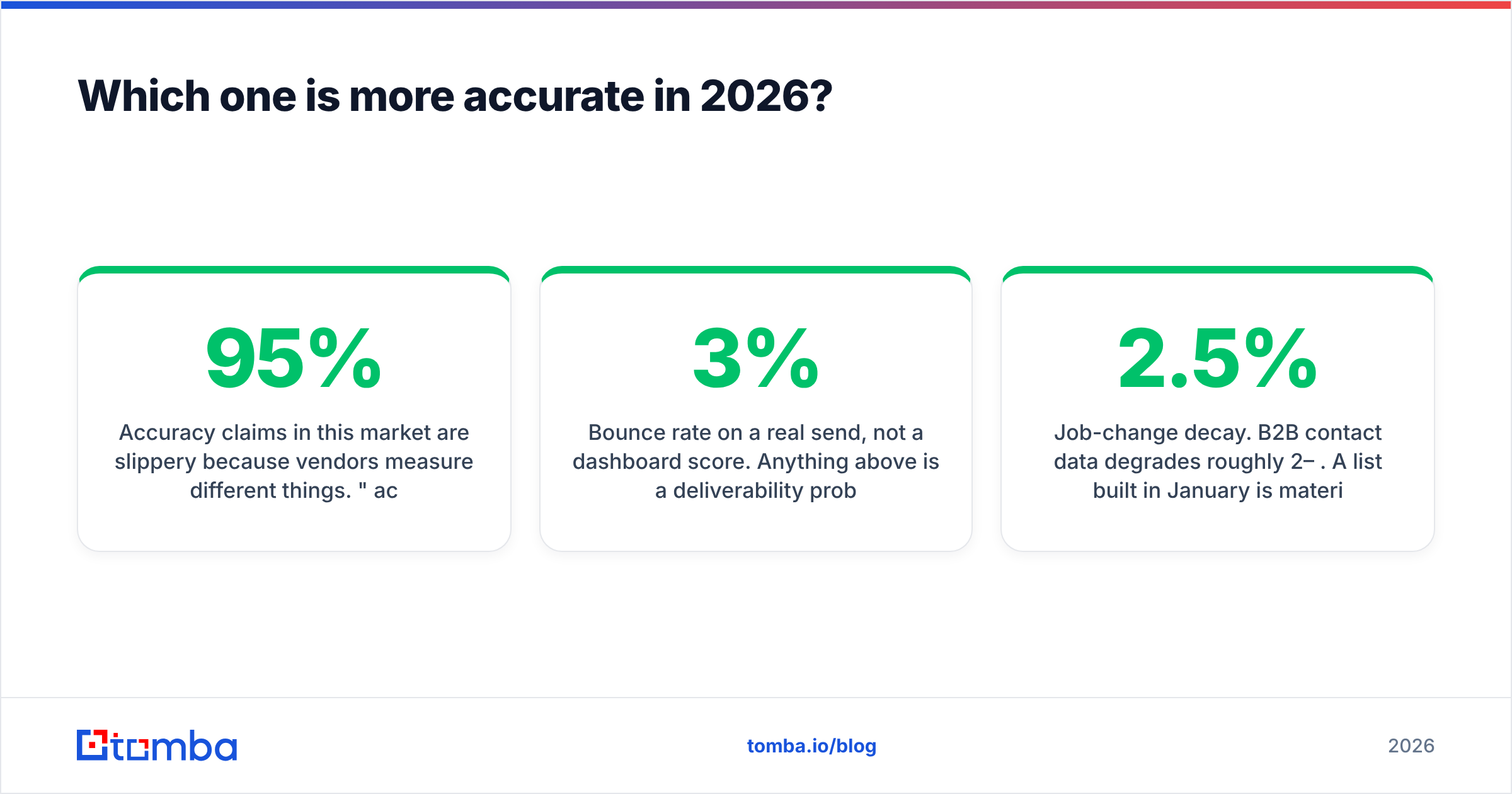
Accuracy claims in this market are slippery because vendors measure different things. "95% accurate" can mean the syntax parsed, the domain has valid MX records, the SMTP server accepted the recipient, or the human still works there. Those are four different tests with four different pass rates.
Here's the practical way to evaluate any provider, including these two:
- Bounce rate on a real send, not a dashboard score. Anything above 3% is a deliverability problem, not a data problem you can ignore.
- Catch-all handling. Roughly a fifth of B2B domains accept everything. A tool that marks these "valid" is inflating its own numbers. Check whether the vendor exposes a separate catch-all state or hides it — a dedicated catch-all verifier is the honest approach.
- Job-change decay. B2B contact data degrades roughly 2–2.5% per month. A list built in January is materially wrong by June regardless of who sold it to you.
- Coverage of your actual ICP, tested on 100 domains you care about — not the vendor's demo domains.

Run that 100-domain test before you buy anything. Both vendors offer a way to sample; use it. If a provider won't let you test on your own domain list, that itself is the answer.
How do Hunter and Infofree compare feature by feature?#
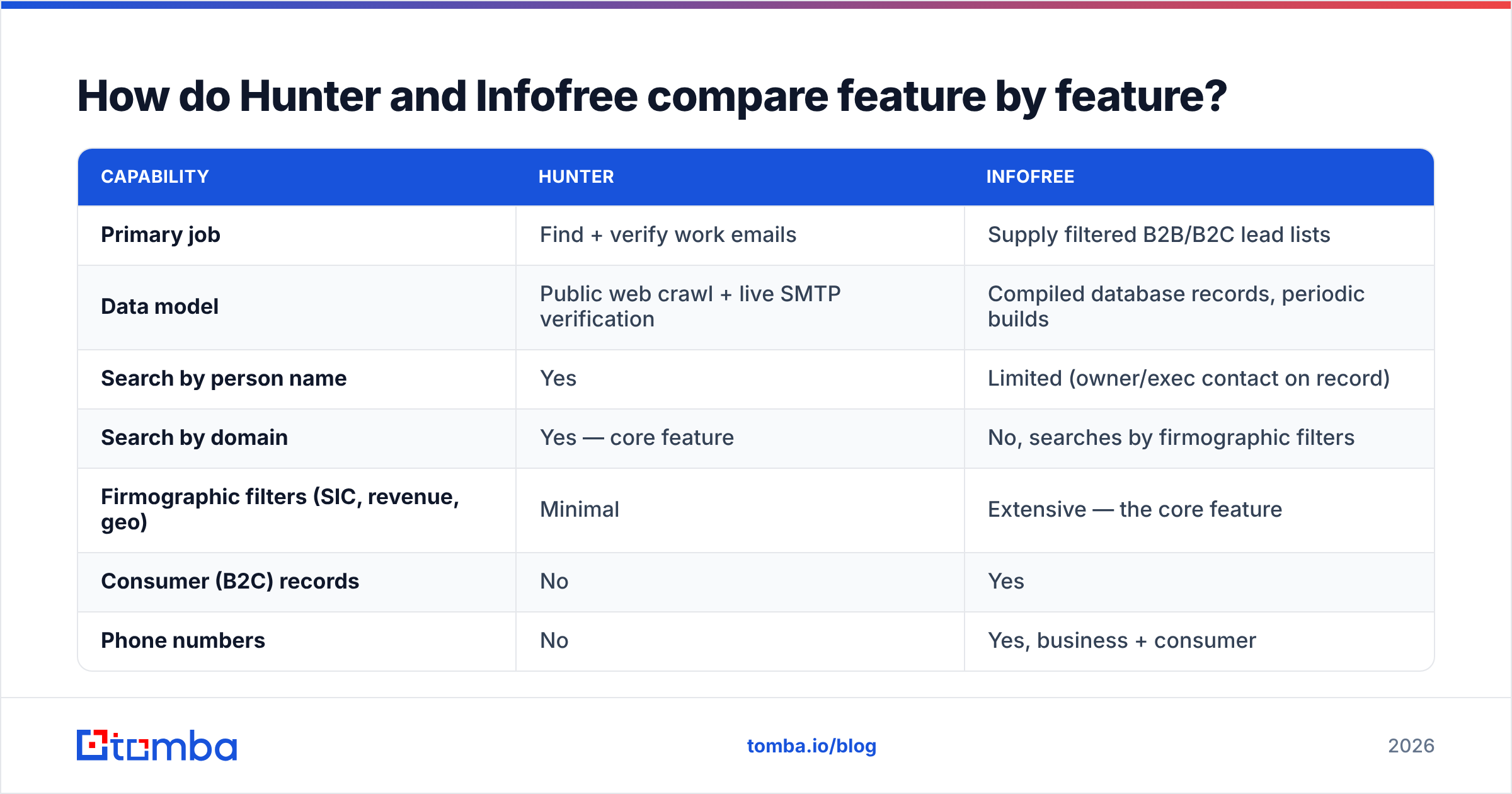
| Capability | Hunter | Infofree |
|---|---|---|
| Primary job | Find + verify work emails | Supply filtered B2B/B2C lead lists |
| Data model | Public web crawl + live SMTP verification | Compiled database records, periodic builds |
| Search by person name | Yes | Limited (owner/exec contact on record) |
| Search by domain | Yes — core feature | No, searches by firmographic filters |
| Firmographic filters (SIC, revenue, geo) | Minimal | Extensive — the core feature |
| Consumer (B2C) records | No | Yes |
| Phone numbers | No | Yes, business + consumer |
| Email verification | Yes, built in | Not a core capability |
| Bulk processing | Yes, CSV upload | Yes, list export |
| Public API | Yes, well documented | Limited |
| Bundled CRM | No (integrates with yours) | Yes, included |
| Chrome extension | Yes | No |
| Best for | SaaS, agencies, tech outbound | Local SMB, insurance, home services, B2C |

The table exposes the real decision. If your ICP has a website with a team page, Hunter's model works and Infofree's filters are largely irrelevant to you. If your ICP is a physical business in a specific ZIP code that may not have a LinkedIn presence at all, Infofree's compiled records reach places a crawler never will.
What do Hunter and Infofree cost?#
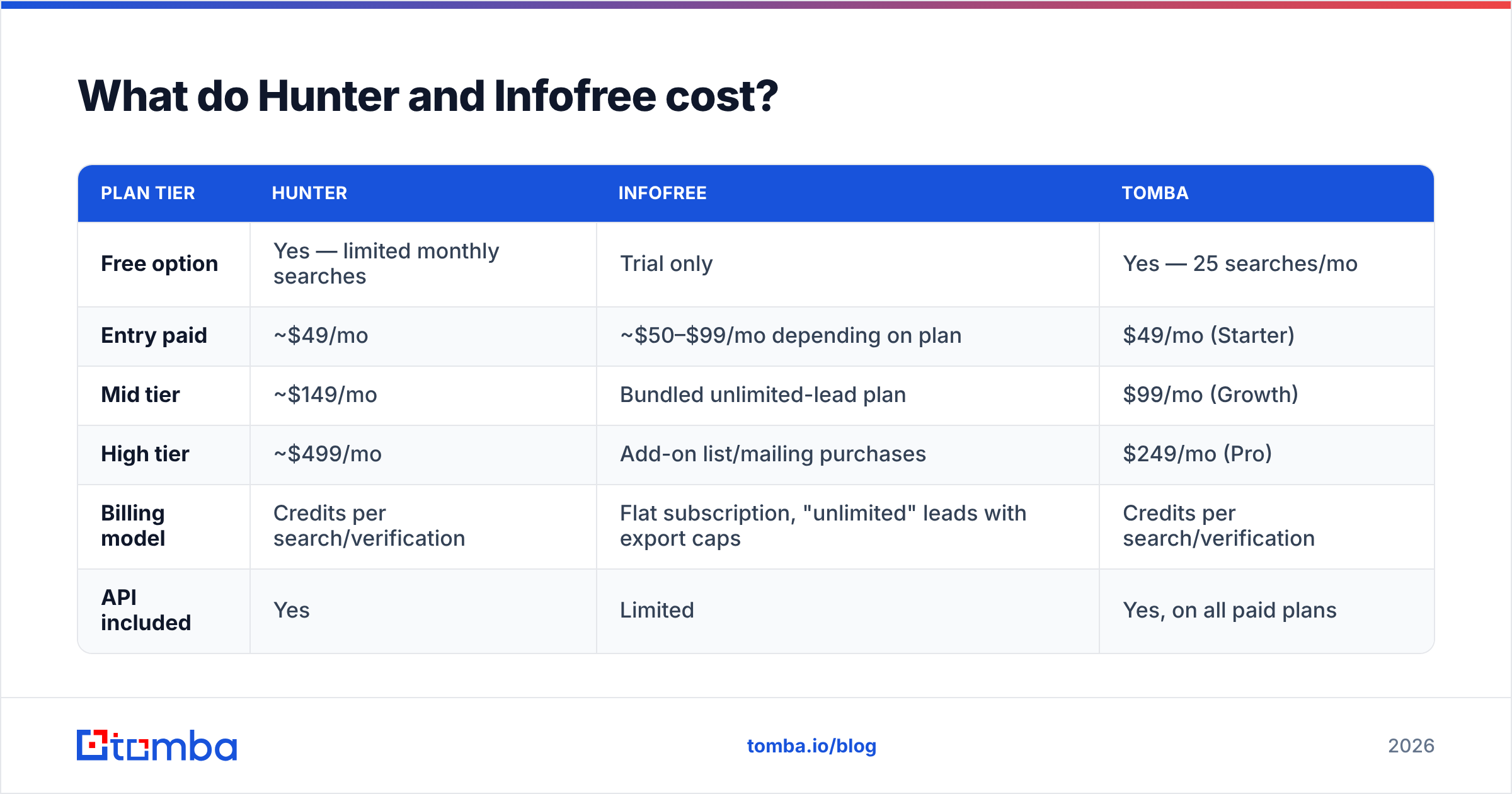
| Plan tier | Hunter | Infofree | Tomba |
|---|---|---|---|
| Free option | Yes — limited monthly searches | Trial only | Yes — 25 searches/mo |
| Entry paid | ~$49/mo | ~$50–$99/mo depending on plan | $49/mo (Starter) |
| Mid tier | ~$149/mo | Bundled unlimited-lead plan | $99/mo (Growth) |
| High tier | ~$499/mo | Add-on list/mailing purchases | $249/mo (Pro) |
| Billing model | Credits per search/verification | Flat subscription, "unlimited" leads with export caps | Credits per search/verification |
| API included | Yes | Limited | Yes, on all paid plans |
Prices move; check hunter.io and infofree.com directly before budgeting, and compare against Tomba pricing if you want a like-for-like on the email-finding side.
Two cost traps worth naming. First, "unlimited" in list-data pricing almost always carries a daily or monthly export cap — unlimited to view, capped to download. Read that clause. Second, credit-based tools charge for verification separately from discovery on some plans, so a 10,000-contact campaign can consume far more than 10,000 credits. Model your actual monthly volume, not the sticker price.

Who should choose Hunter?#
Choose Hunter when your motion is account-first. You've built a target list from a funding database, a G2 category, a conference attendee page or your own CRM, and what you're missing is the inbox.
Hunter fits well if:
- Your ICP is web-visible. Software, agencies, e-commerce, professional services, media — anywhere team pages and public bylines exist.
- You need source transparency. Hunter showing you where it saw an address is a real compliance and QA advantage when a prospect asks how you got their email.
- Deliverability is a board-level metric. The built-in verification path keeps bounce rates low without bolting on a second vendor.
- You want a light all-in-one. The bundled campaign sender is not going to displace a dedicated sequencer, but it's enough for a founder sending 50 emails a week.
Where Hunter frustrates buyers: it doesn't do firmographic discovery. It won't tell you which companies to target, and it has no phone data. Credit costs also climb quickly at volume, which is why Hunter comparison shopping is so common — see our breakdown of Apollo alternatives for how the credit-heavy tools stack up.
Who should choose Infofree?#
Choose Infofree when your motion is territory-first. You sell to businesses defined by what they do and where they are, not by what technology they run.
Infofree fits well if:
- You sell locally or by trade. Insurance, payments, merchant services, home services, staffing, commercial cleaning, medical supply.
- Phone is your primary channel. Compiled business databases carry main-line phone coverage that web-crawl tools generally lack.
- You need B2C records too. Very few B2B tools touch consumer data at all.
- You want budget predictability. Flat monthly beats credit anxiety when a rep is pulling lists every day.
Where Infofree frustrates buyers: individual contact-level email accuracy, and the fact that compiled records don't refresh on demand. Read current user reviews on G2 before committing to an annual term — sentiment on list-data vendors is heavily segment-dependent, and a tool that's excellent for insurance agents may be poor for your niche.
Where does Tomba fit in this comparison?#
Honestly: Tomba competes with Hunter, not with Infofree. It does the same job — turn a domain or a name into a deliverable work email — and it's worth putting on your shortlist for three specific reasons.
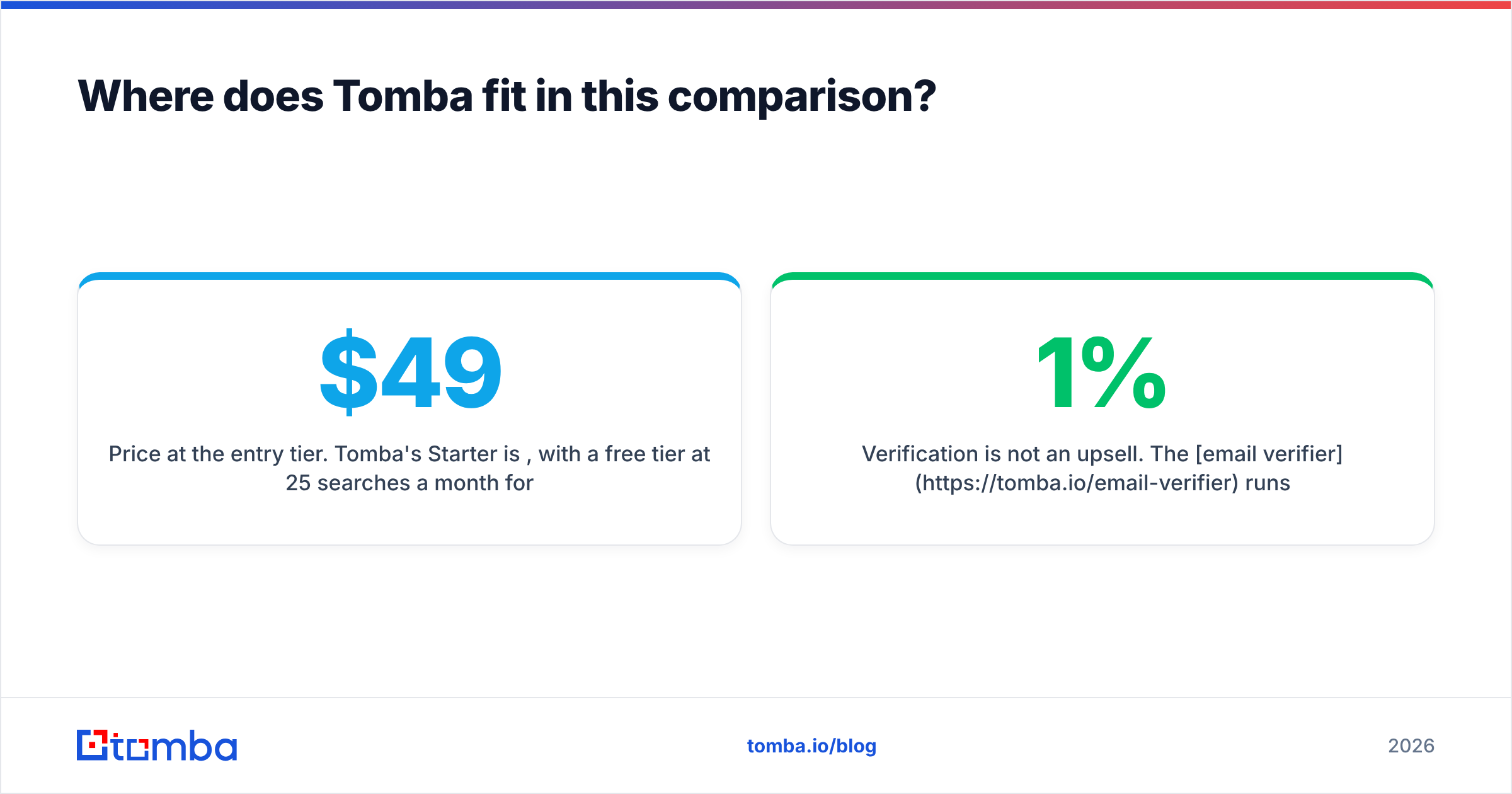
Price at the entry tier. Tomba's Starter is $49/mo, with a free tier at 25 searches a month for testing. The Growth plan lands at $99/mo, which is where credit-based competitors often sit closer to $149.
Verification is not an upsell. The email verifier runs on the same account as the finder, with explicit catch-all states rather than a single blended "valid" label. That distinction alone is the difference between a 1% and a 6% bounce rate on catch-all-heavy lists.
It plays well with list vendors. If you're already an Infofree subscriber and happy with the firmographic targeting, you don't need to replace it. Export the companies, run them through domain search to pull the people and patterns per company, then verify. That's a genuinely strong pairing: compiled breadth from one vendor, live email accuracy from another.
For engineering-led teams, the Tomba API exposes finder, verifier, enrichment and phone lookup on every paid plan, so you can push enrichment into your own pipeline instead of managing CSV round-trips. High-volume operators should look at bulk email finder processing rather than one-at-a-time queries.
Hunter vs Infofree: which one actually wins?#
Neither, universally — and any post claiming otherwise is selling you something.
Infofree wins if your buyer is a local business you'd find in a trade directory, you sell by phone, and you need volume plus predictable billing. Nothing in Hunter's product line replaces a compiled database.
Hunter wins if your buyer is a web-visible company, email is your channel, and bounce rate is a metric someone in your org watches. Infofree isn't built to compete here.
Neither wins the specific case of "I know my accounts, I need accurate emails, and I don't want to pay $149/mo to get them." That's the gap a verification-first finder fills — and it's the most common gap in mid-market outbound stacks in 2026.
One last operational note regardless of vendor: verify immediately before you send, not when you buy. A record validated three months ago and sent today is a coin flip. Build verification into the send step, not the acquisition step, and your email deliverability problems mostly disappear.
Ready to test the email side of your stack? Run 25 free searches through the Tomba Email Finder against 100 domains from your real target list — the same domains you'd test Hunter or Infofree against. Compare bounce rates on an actual send, not dashboard scores. If Tomba's verified results beat what you're paying for now, the Starter plan at $49/mo covers most SMB outbound teams; if they don't, you've lost nothing but an afternoon.
Related guides#
// get started
Find, verify and enrich your first contacts today
Start on the free plan with 25 searches a month, then scale when your team is ready.
Free plan · No credit card required · GDPR & CCPA
Get the Tomba newsletter
Product and data updates
// about the author