Hunter vs No2bounce: Which Email Tool Wins in 2026?
Hunter finds email addresses. No2bounce cleans the ones you already have. Here is an honest 2026 breakdown of coverage, accuracy, pricing models and the workflow where each one actually pays for itself.
TL;DR
- Hunter and No2bounce are not really competitors. Hunter is a sourcing tool (find the address), No2bounce is a hygiene tool (confirm the address won't bounce). Comparing them head to head only makes sense once you decide which half of the problem is costing you money.
- If your list is empty, a verifier gives you nothing to verify. Start with a finder.
- If your list came from a scrape, a purchased CSV, or a two-year-old CRM export, a finder won't help. Start with a verifier.
- Pricing models differ structurally: Hunter sells monthly seats with search + verification credits bundled; No2bounce sells verification credits, typically pay-as-you-go. Budget comparisons across those two models are only meaningful per useful contact, not per credit.
- Most teams under 20 reps end up wanting one vendor that does discovery, verification and catch-all handling on the same credit pool, which is where Tomba and a handful of other consolidated platforms compete.
What are Hunter and No2bounce, actually?#
Hunter is one of the oldest names in B2B email discovery. Its core loop is domain-first: you give it acme.com, it returns the email addresses it has observed or inferred for that domain, plus a confidence score and the public sources it saw the address on. Around that core it has stacked a verifier, a Chrome extension, a Google Sheets add-on, a lightweight cold email sender ("Campaigns"), and an API.
No2bounce sits at the other end of the pipeline. It is an email verification and list-cleaning service: you upload a list (or hit the API in real time), and it runs syntax checks, DNS and MX lookups, mailbox-level probing, disposable-domain detection, role-account flagging and catch-all classification, then hands back a deliverable/undeliverable/risky verdict per row.
The everyday analogy: Hunter is the person who finds you a phone number. No2bounce is the person who dials it once to check the line is live before you make your pitch. Both jobs are real. Neither replaces the other.
That distinction matters more in 2026 than it did five years ago, because inbox providers have tightened bulk-sender enforcement. Google and Yahoo's sender requirements — authentication, one-click unsubscribe, and a spam-complaint rate held under 0.3% — turned list hygiene from a nice-to-have into a gating requirement. A bad bounce rate now damages the domain you send everything from, not just the campaign.
How do Hunter and No2bounce compare feature by feature?#
Here is the honest side-by-side. Where a vendor doesn't offer a capability, that isn't a knock — it's just scope.
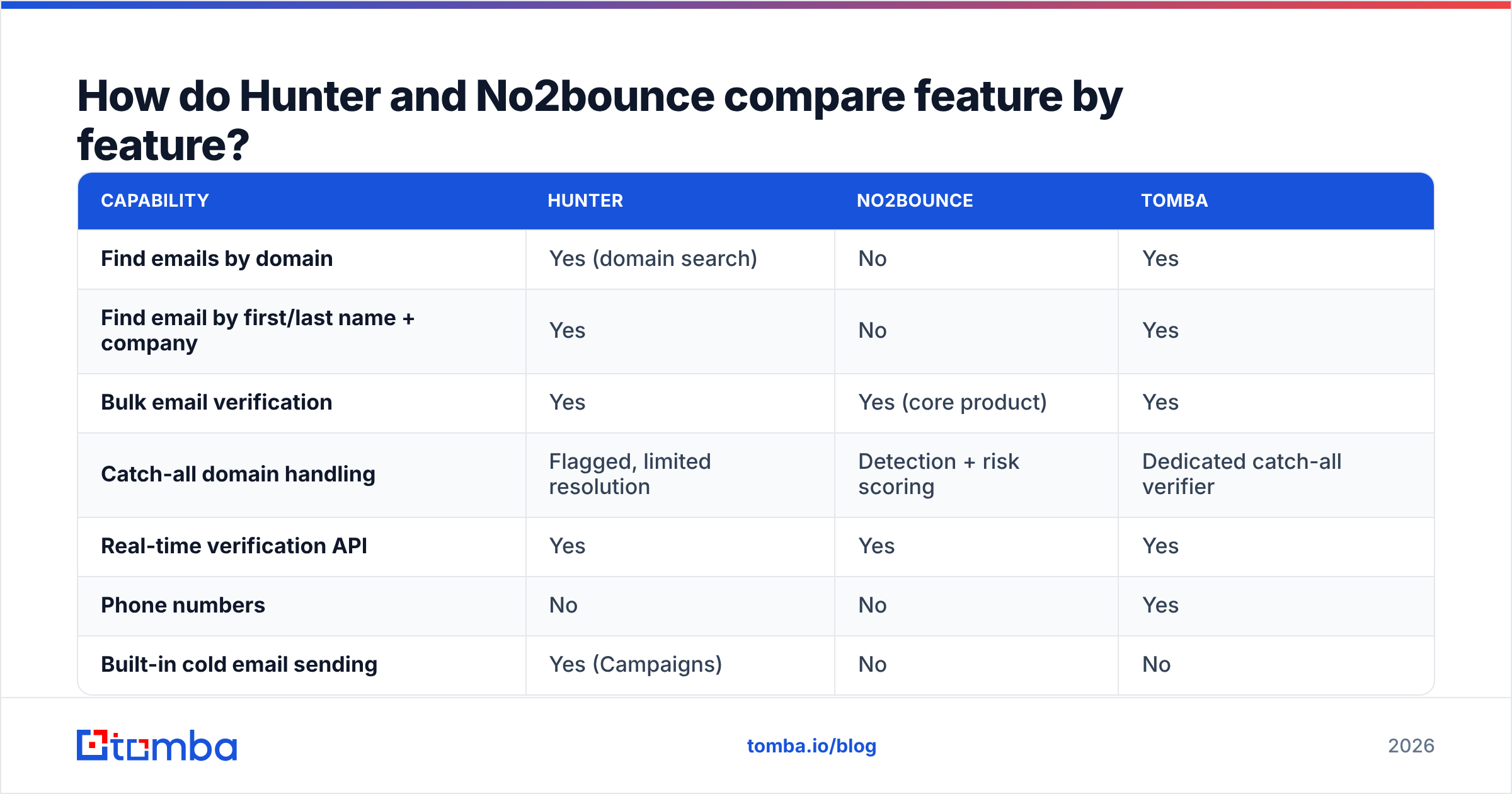
| Capability | Hunter | No2bounce | Tomba |
|---|---|---|---|
| Find emails by domain | Yes (domain search) | No | Yes |
| Find email by first/last name + company | Yes | No | Yes |
| Bulk email verification | Yes | Yes (core product) | Yes |
| Catch-all domain handling | Flagged, limited resolution | Detection + risk scoring | Dedicated catch-all verifier |
| Real-time verification API | Yes | Yes | Yes |
| Phone numbers | No | No | Yes |
| Built-in cold email sending | Yes (Campaigns) | No | No |
| Chrome extension | Yes | Varies by plan | Yes |
| Pricing model | Monthly subscription | Credit packs / PAYG | Monthly subscription |
| Free tier | 25 searches/mo | Trial credits | 25 searches/mo |
Two things jump out of that grid.
First, No2bounce's row is short on purpose. It is a focused verification product, and focused products often verify better than the bolt-on verifier inside a sourcing suite, because verification is the whole roadmap rather than a checkbox. If your only question is "will these 80,000 addresses bounce?", a specialist is a rational choice.
Second, Hunter's Campaigns feature is a genuine differentiator against No2bounce — but a weak one against dedicated sending platforms. Treat it as a convenience for solo founders sending a few hundred emails a month, not as a replacement for a real sequencer with inbox rotation.

Which one is more accurate, and how would you even know?#
Accuracy means two different things here, and vendors exploit the ambiguity.
For a finder, accuracy means: of the addresses returned, what share actually reach a human inbox? The failure mode is a confident-looking guess like first.last@company.com on a domain that actually uses flast@.
For a verifier, accuracy means: of the verdicts issued, what share are correct in both directions? The failure mode nobody advertises is the false negative — a real, reachable mailbox marked "risky" or "invalid," which quietly deletes good prospects from your list.
Almost every verification vendor in this category, No2bounce included, publishes an accuracy figure in the 97–99% range. Those figures are self-reported against private test sets and are not comparable across vendors. The only number that matters is the one you produce yourself.

Run this test before you buy anything:
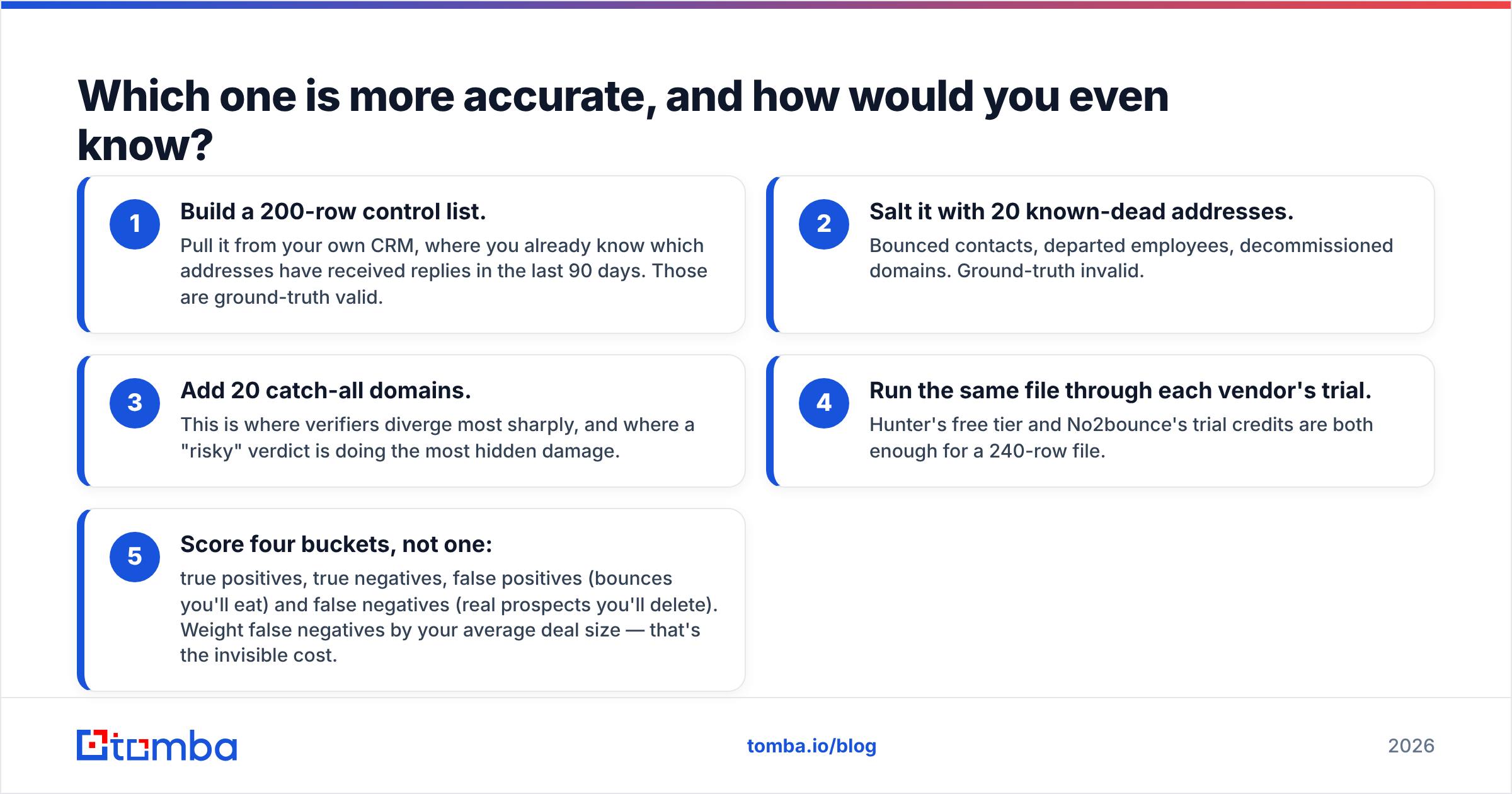
- Build a 200-row control list. Pull it from your own CRM, where you already know which addresses have received replies in the last 90 days. Those are ground-truth valid.
- Salt it with 20 known-dead addresses. Bounced contacts, departed employees, decommissioned domains. Ground-truth invalid.
- Add 20 catch-all domains. This is where verifiers diverge most sharply, and where a "risky" verdict is doing the most hidden damage.
- Run the same file through each vendor's trial. Hunter's free tier and No2bounce's trial credits are both enough for a 240-row file.
- Score four buckets, not one: true positives, true negatives, false positives (bounces you'll eat) and false negatives (real prospects you'll delete). Weight false negatives by your average deal size — that's the invisible cost.
Teams that run this test usually find the headline accuracy claims are directionally fine and the catch-all handling is wildly different. Catch-all domains are 15–25% of most B2B lists, and a tool that dumps all of them into "risky" has effectively opted out of the hard part. That's why a dedicated catch-all verifier is worth checking separately rather than assuming your general verifier covers it.
What do Hunter and No2bounce cost in 2026?#
Prices change; check both vendors' pricing pages before you commit. The structural difference, however, is stable and it's the part that should drive your decision.
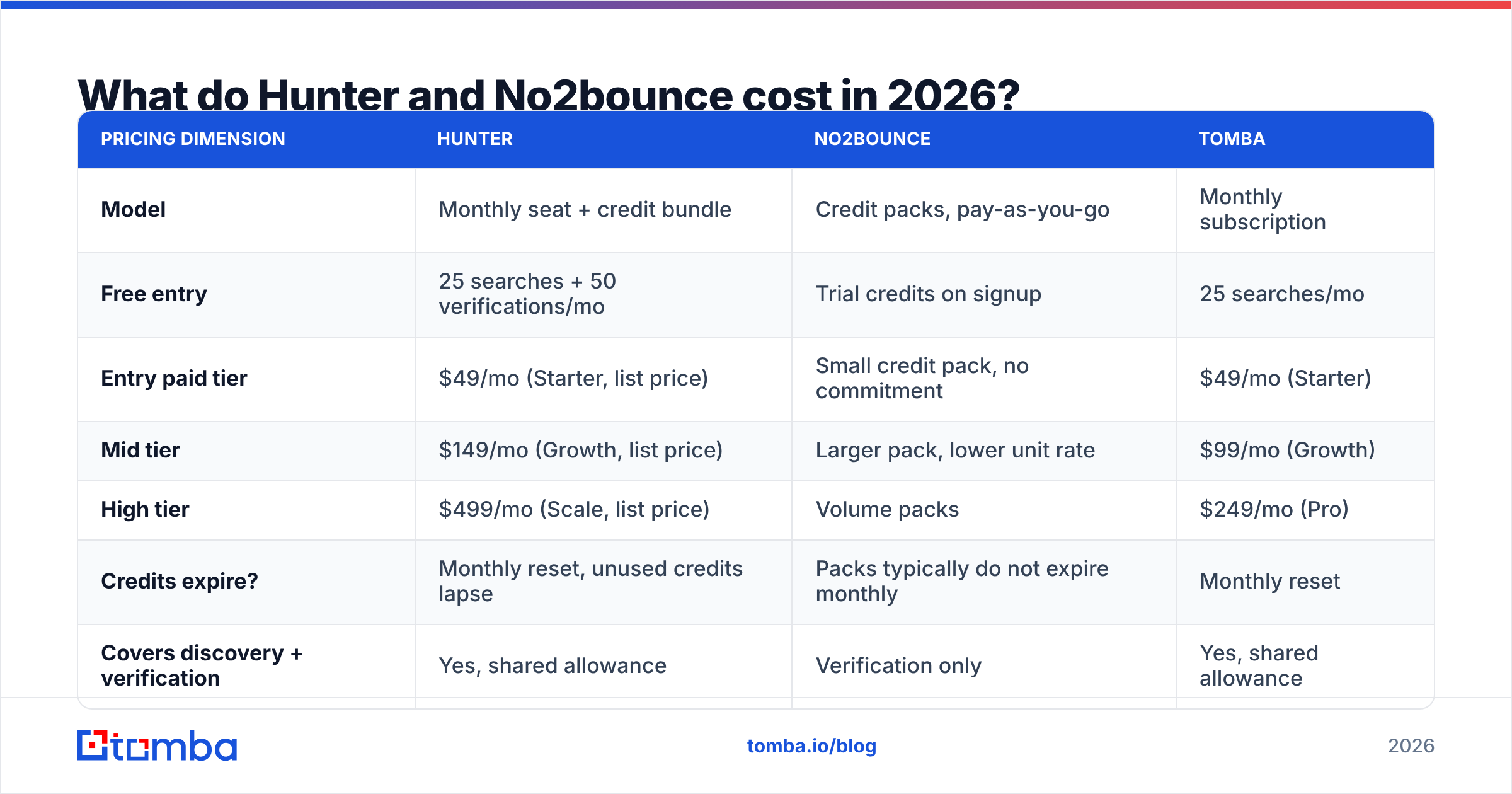
| Pricing dimension | Hunter | No2bounce | Tomba |
|---|---|---|---|
| Model | Monthly seat + credit bundle | Credit packs, pay-as-you-go | Monthly subscription |
| Free entry | 25 searches + 50 verifications/mo | Trial credits on signup | 25 searches/mo |
| Entry paid tier | $49/mo (Starter, list price) | Small credit pack, no commitment | $49/mo (Starter) |
| Mid tier | $149/mo (Growth, list price) | Larger pack, lower unit rate | $99/mo (Growth) |
| High tier | $499/mo (Scale, list price) | Volume packs | $249/mo (Pro) |
| Credits expire? | Monthly reset, unused credits lapse | Packs typically do not expire monthly | Monthly reset |
| Covers discovery + verification | Yes, shared allowance | Verification only | Yes, shared allowance |
Read that table with one question in mind: do you have steady monthly volume or lumpy project volume?
Subscription pricing punishes lumpy usage. If you clean a list twice a year, a $149/mo seat that resets unused credits every 30 days is a bad instrument. Pay-as-you-go credits that sit on the shelf until you need them — No2bounce's model — is straightforwardly the better fit, and it's the strongest argument in its favour.
The inverse is equally true. If you're running continuous outbound, you're consuming both discovery and verification every week, and paying two vendors means two invoices, two credit balances that drain unevenly, and a manual export-import step between them. That's where a single allowance covering both wins on operational cost even when the sticker price is similar. You can compare the full Tomba pricing tiers against Hunter's list prices directly; the tier names differ but the volume bands are close enough to map.
One more line item people forget: the cost of a bounce isn't the wasted credit. It's the sender-reputation damage spread across every campaign sent from that domain for the following weeks.
Should you pick Hunter or No2bounce for your workflow?#
Skip the feature grid and answer this instead — which of these describes your Monday morning?
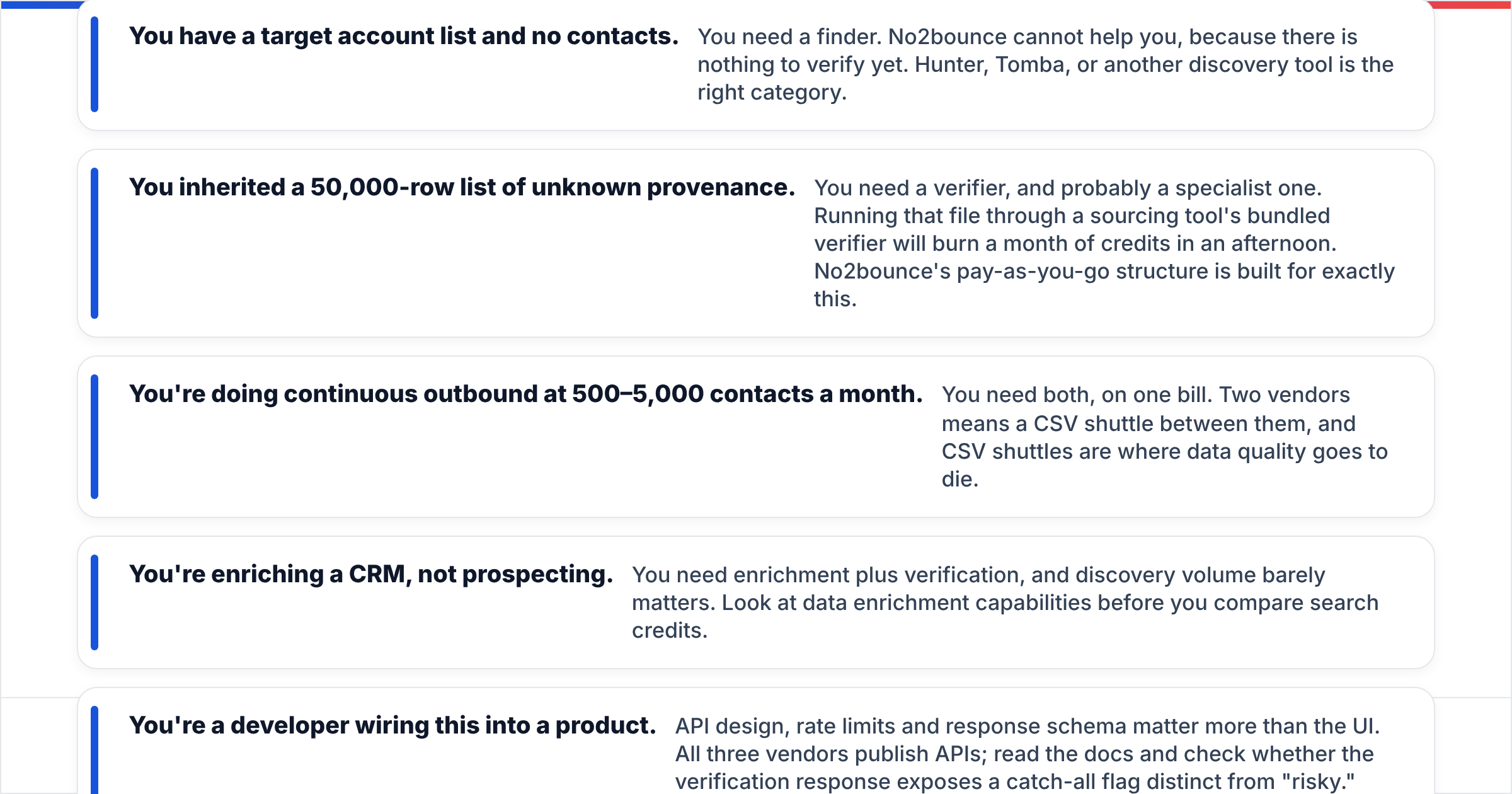
- You have a target account list and no contacts. You need a finder. No2bounce cannot help you, because there is nothing to verify yet. Hunter, Tomba, or another discovery tool is the right category.
- You inherited a 50,000-row list of unknown provenance. You need a verifier, and probably a specialist one. Running that file through a sourcing tool's bundled verifier will burn a month of credits in an afternoon. No2bounce's pay-as-you-go structure is built for exactly this.
- You're doing continuous outbound at 500–5,000 contacts a month. You need both, on one bill. Two vendors means a CSV shuttle between them, and CSV shuttles are where data quality goes to die.
- You're enriching a CRM, not prospecting. You need enrichment plus verification, and discovery volume barely matters. Look at data enrichment capabilities before you compare search credits.
- You're a developer wiring this into a product. API design, rate limits and response schema matter more than the UI. All three vendors publish APIs; read the docs and check whether the verification response exposes a catch-all flag distinct from "risky."
Do you need both tools, or one that does both?#
Three viable stacks, ranked by how many teams they actually suit.
Stack A — one consolidated platform. Discovery, verification and catch-all resolution on a single credit pool. Fewest moving parts, one invoice, no export step. This is the right default for teams under roughly 20 reps. The trade-off is that you accept the platform's verification quality rather than shopping for the best-in-class verifier.
Stack B — finder plus specialist verifier. Source with Hunter or Tomba, then push everything through No2bounce (or another dedicated verifier) before it touches a sending tool. More expensive and more plumbing, but you get the best verification available and you can swap either half without disrupting the other. Sensible above roughly 20 reps, or in any regulated context where bounce rate is audited.
Stack C — verifier only. You buy or scrape lists elsewhere and only need hygiene. Cheapest per contact, and honestly fine for some markets. Just be clear-eyed that purchased-list quality is the ceiling on your results, and no verifier repairs bad targeting — it only stops you from emailing dead addresses.

Whichever stack you choose, keep the sequence intact: find, verify, then send. Verifying after you send is just counting the damage. And review vendor experiences on G2 with a skeptical eye — sort by recency, because verification quality moves as providers change their SMTP behaviour, and a 2023 review describes a product that no longer exists.
How does Tomba compare to both?#
Directly, since you're comparing categories anyway.
Against Hunter, Tomba plays in the same lane — domain-first discovery, name-and-company lookup, browser extension, API — at a lower mid-tier price ($99/mo Growth vs Hunter's $149/mo Growth list price), with phone numbers and a separate catch-all verifier that Hunter doesn't match. Hunter's advantage is tenure, a very polished Sheets integration, and built-in Campaigns if you want sending in the same tab.
Against No2bounce, Tomba is not a specialist and doesn't claim to be. Tomba's email verifier covers syntax, MX, mailbox probing and catch-all classification on the same credits as discovery — convenient, and good enough for the majority of outbound teams. If verification is your entire problem and you're processing six-figure list volumes, a dedicated verification vendor is a legitimate choice and No2bounce belongs on that shortlist.
Where Tomba wins is the seam between the two jobs. Finding an address and confirming it are the same workflow in practice, and every export-import boundary between them adds latency, cost and a place for rows to get lost.
What's the verdict?#
There is no single winner, because they answer different questions.
Pick No2bounce if you already have the addresses and your problem is bounce rate — especially with irregular, project-shaped volume where non-expiring credits beat a monthly seat.
Pick Hunter if your problem is that you don't have the addresses, you want a mature product with deep integrations, and the higher mid-tier price is inside your budget.
Pick a consolidated platform if you're doing both every week and the CSV shuttle between two vendors is already annoying you.
Run the 240-row control test above before you commit to any of them. It takes an hour, costs nothing on the free tiers, and it will tell you more about your specific data than any comparison post — including this one — possibly can.
Ready to test the discovery half? Start with the Tomba Email Finder free tier — 25 searches a month, no card — and run your own control list against it alongside Hunter and No2bounce. If the numbers hold up on your data, the $49/mo Starter plan covers discovery, verification and catch-all handling on one credit pool. If they don't, you'll at least know exactly which vendor to hand your money to.
Related guides#
// get started
Find, verify and enrich your first contacts today
Start on the free plan with 25 searches a month, then scale when your team is ready.
Free plan · No credit card required · GDPR & CCPA
// about the author