Hunter vs Null Bounce: Which Email Tool Wins in 2026?
Hunter finds addresses. Null Bounce cleans them. Here is an honest breakdown of what each tool actually does, where the overlap ends, and which one belongs in your 2026 outbound stack.
TL;DR
- Hunter and Null Bounce are not really competitors. Hunter is a discovery tool (find addresses that exist). Null Bounce is a hygiene tool (confirm the addresses you already have won't bounce). Comparing them head-to-head only makes sense if you're deciding which problem to solve first.
- If your list is empty, Hunter wins by default — a verifier has nothing to verify.
- If your list came from a scrape, a trade show, an old CRM export, or a purchased file, a dedicated verifier like Null Bounce will save you more money in one pass than a finder will.
- The trap most teams fall into: paying two vendors for two halves of one job. Tools that do find-then-verify in a single credit pool (Tomba, Hunter's own verifier, Findymail) usually cost less per usable contact than a finder plus a standalone bounce checker.
- Catch-all domains are where all three categories get uncomfortable. Ask any vendor what they return for a catch-all before you buy — the honest answer is "unknown," not "valid."
What are Hunter and Null Bounce, exactly?#
Hunter is one of the oldest and best-known email-finding platforms on the market. Its core function is domain search: you give it stripe.com, it returns the addresses it has indexed for that domain, the detected pattern ({first}@stripe.com), and a confidence score for each result. Around that core sit an email finder (first name + last name + domain), a bulk uploader, a Chrome extension, a small campaign sender, and a built-in verifier.
Null Bounce sits on the other side of the workflow. It belongs to the email-verification category — the same shelf as ZeroBounce, Bouncer, Debounce, and Clearout. You upload a list you already own, it runs syntax checks, MX record lookups, disposable-domain detection, role-account detection, and SMTP handshakes, then hands back a labelled file: valid, invalid, risky, unknown. It does not go out and find new contacts for you.
That distinction matters more than any feature table, so hold onto it: Hunter creates contacts, Null Bounce protects deliverability. Everything below is downstream of that.
One honesty note before we go further. Hunter is a large, heavily documented, publicly reviewed product — its pricing page, API docs, and thousands of G2 reviews are easy to audit. Null Bounce is a smaller, less widely reviewed verifier, and public documentation on its exact tiers and accuracy claims is thinner. Where I don't have a verifiable number, I say so instead of inventing one. Check the vendor's own pricing page before you commit budget.

How do Hunter and Null Bounce compare head-to-head?#
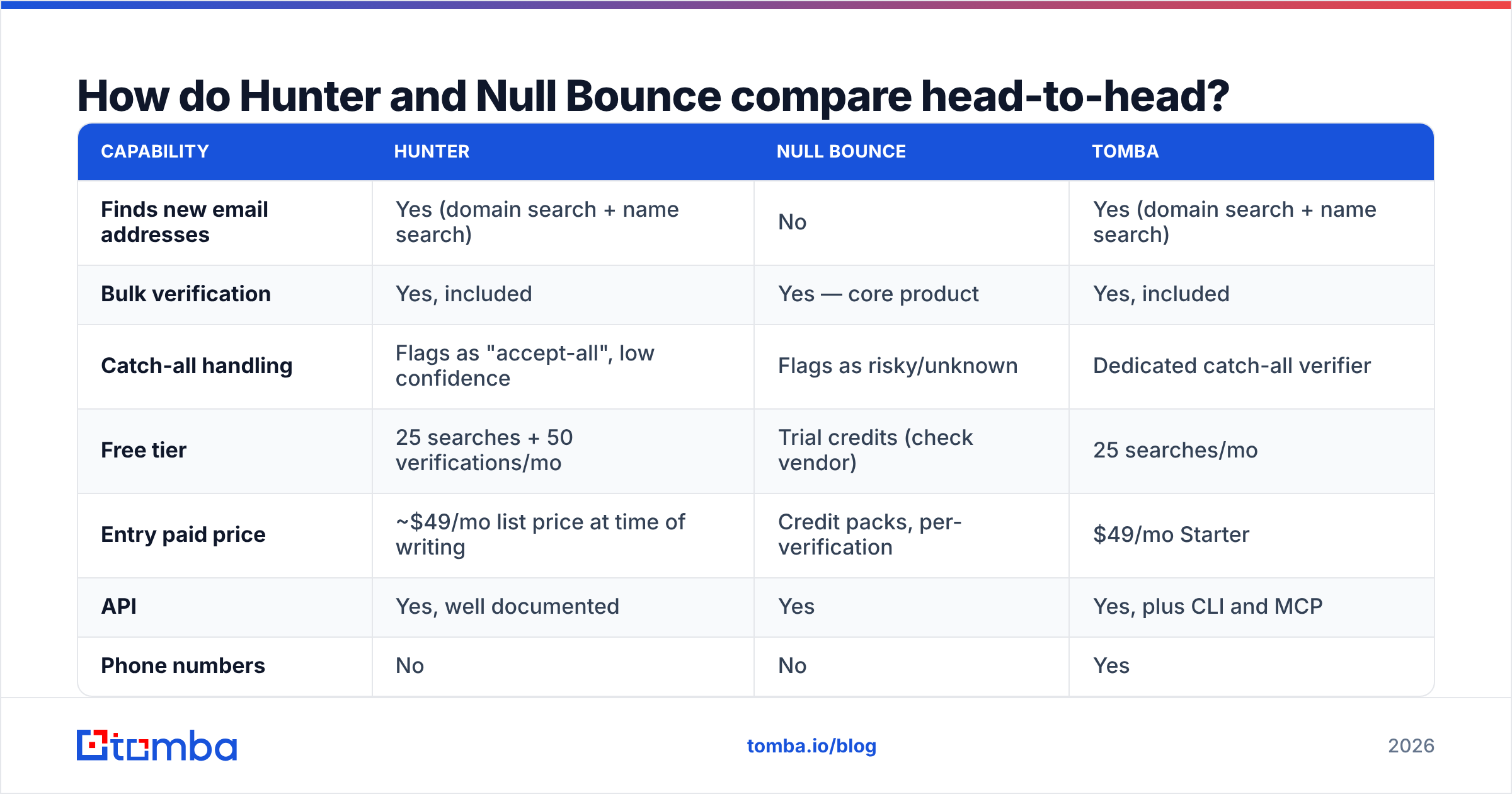
Here's the practical comparison — what each tool does, not what each markets.
| Capability | Hunter | Null Bounce | Tomba |
|---|---|---|---|
| Finds new email addresses | Yes (domain search + name search) | No | Yes (domain search + name search) |
| Bulk verification | Yes, included | Yes — core product | Yes, included |
| Catch-all handling | Flags as "accept-all", low confidence | Flags as risky/unknown | Dedicated catch-all verifier |
| Free tier | 25 searches + 50 verifications/mo | Trial credits (check vendor) | 25 searches/mo |
| Entry paid price | ~$49/mo list price at time of writing | Credit packs, per-verification | $49/mo Starter |
| API | Yes, well documented | Yes | Yes, plus CLI and MCP |
| Phone numbers | No | No | Yes |
| Chrome extension | Yes | Not a core feature | Yes |
| Best for | Building lists from scratch | Cleaning lists you already own | Doing both in one credit pool |
Two rows do most of the decision-making work here. If "finds new email addresses" is a hard requirement, Null Bounce is out — not because it's weak, but because it's a different tool. If your CSV already has 40,000 rows from a 2023 scrape, "finds new addresses" is worth nothing to you and per-verification pricing is the only column you care about.

What does each tool actually do well?#
Rather than a feature dump, here's where each one earns its money:
- Hunter's domain search is genuinely best-in-class for coverage on mid-market and enterprise domains. Feed it a company with a public web footprint and you'll usually get a pattern plus several confirmed addresses. This is the thing it's been doing since 2015 and it shows.
- Hunter's confidence score is transparent. It tells you why a result scores 92 versus 55 — number of sources, whether the address was found on public pages, whether the pattern matched. That auditability is rarer than it should be.
- Null Bounce's per-verification pricing model suits spiky workloads. If you clean a big list twice a year, credit packs beat a monthly subscription you don't use in month three.
- Standalone verifiers generally run deeper SMTP checks than bundled ones. A verification-first product has one job, and greylisting, throttling, and retry logic are where the engineering goes. If your bounce rate is the fire you're fighting, a specialist is a reasonable buy.
- Neither tool solves intent. A verified, valid, deliverable address for someone who has zero reason to hear from you is still a wasted send. Tooling fixes deliverability, not targeting.
How accurate is each one, really?#
Accuracy in this category is a slippery word, because vendors measure different things.
A finder's accuracy means: of the addresses returned, what share actually receive mail? A verifier's accuracy means: of the addresses I labelled valid, what share actually receive mail — and of those I labelled invalid, how many were false negatives? Those are different tests, and a tool can be excellent at one and mediocre at the other.

What I'd actually recommend, regardless of which vendor you're evaluating:
- Build a holdout list of 200 addresses you already know are live — colleagues, customers, partners. Run it through the tool. Anything labelled invalid on that set is a false negative, and false negatives are the expensive error. They quietly delete real prospects from your pipeline.
- Then take 200 addresses you know are dead — bounced sends from six months ago. Anything labelled valid is a false positive, and those are what wreck your sender reputation.
- Run the same two sets through every vendor in your shortlist on the same afternoon. Vendor-published accuracy percentages are marketing numbers measured on their own test sets; your test set is the only one that predicts your bounce rate.
Hunter publishes a confidence score rather than a binary verdict, which is more honest than most, but it means you have to pick your own cutoff. Most teams land somewhere between 80 and 90 as the send threshold. Null Bounce, like most dedicated verifiers, returns categorical labels — which is easier to automate against but hides the underlying uncertainty.
Which one handles catch-all domains better?#
Neither, and be suspicious of anyone who claims otherwise.
A catch-all (or "accept-all") domain is configured to accept mail for every address at that domain, real or not. asdfjkl@example.com gets a 250 OK exactly like ceo@example.com does. The SMTP conversation gives you no signal, which means a verifier that returns "valid" for a catch-all is guessing and calling it a fact. That guess is how you end up with a bounce message storm two weeks into a sequence.
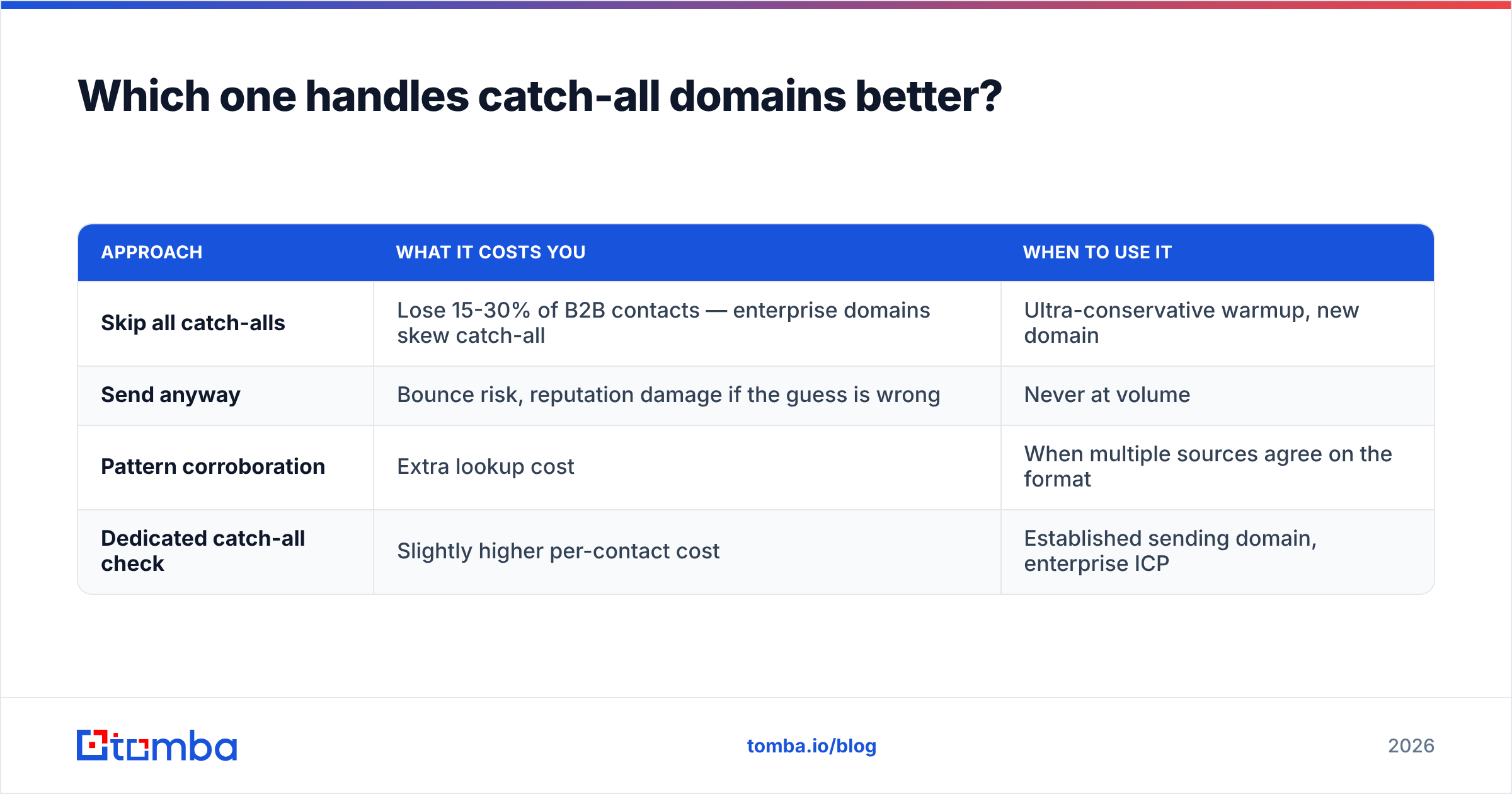
Hunter marks these as accept-all with reduced confidence. Null Bounce, like most verifiers, buckets them as risky or unknown. Both are correct behaviours. The differentiator is what you can do next:
| Approach | What it costs you | When to use it |
|---|---|---|
| Skip all catch-alls | Lose 15-30% of B2B contacts — enterprise domains skew catch-all | Ultra-conservative warmup, new domain |
| Send anyway | Bounce risk, reputation damage if the guess is wrong | Never at volume |
| Pattern corroboration | Extra lookup cost | When multiple sources agree on the format |
| Dedicated catch-all check | Slightly higher per-contact cost | Established sending domain, enterprise ICP |
Tomba's catch-all verifier exists specifically for that fourth row — it corroborates a catch-all address against pattern evidence and source signals rather than shrugging. It's not magic and it won't turn an unknown into a certainty, but it beats discarding a third of your enterprise TAM.

Is Hunter better than Null Bounce for cold outreach?#
For starting a cold outreach motion, yes — because you cannot verify a list you don't have. For sustaining one, the answer flips, and here's why.
Cold outreach lists decay at roughly 22-30% per year through job changes alone. That decay is a verification problem, not a discovery problem. Six months into a serious outbound program, most of your list-quality pain comes from contacts who were real when you found them and aren't anymore. At that point a finder-only stack starts feeling thin and a verifier earns its keep.
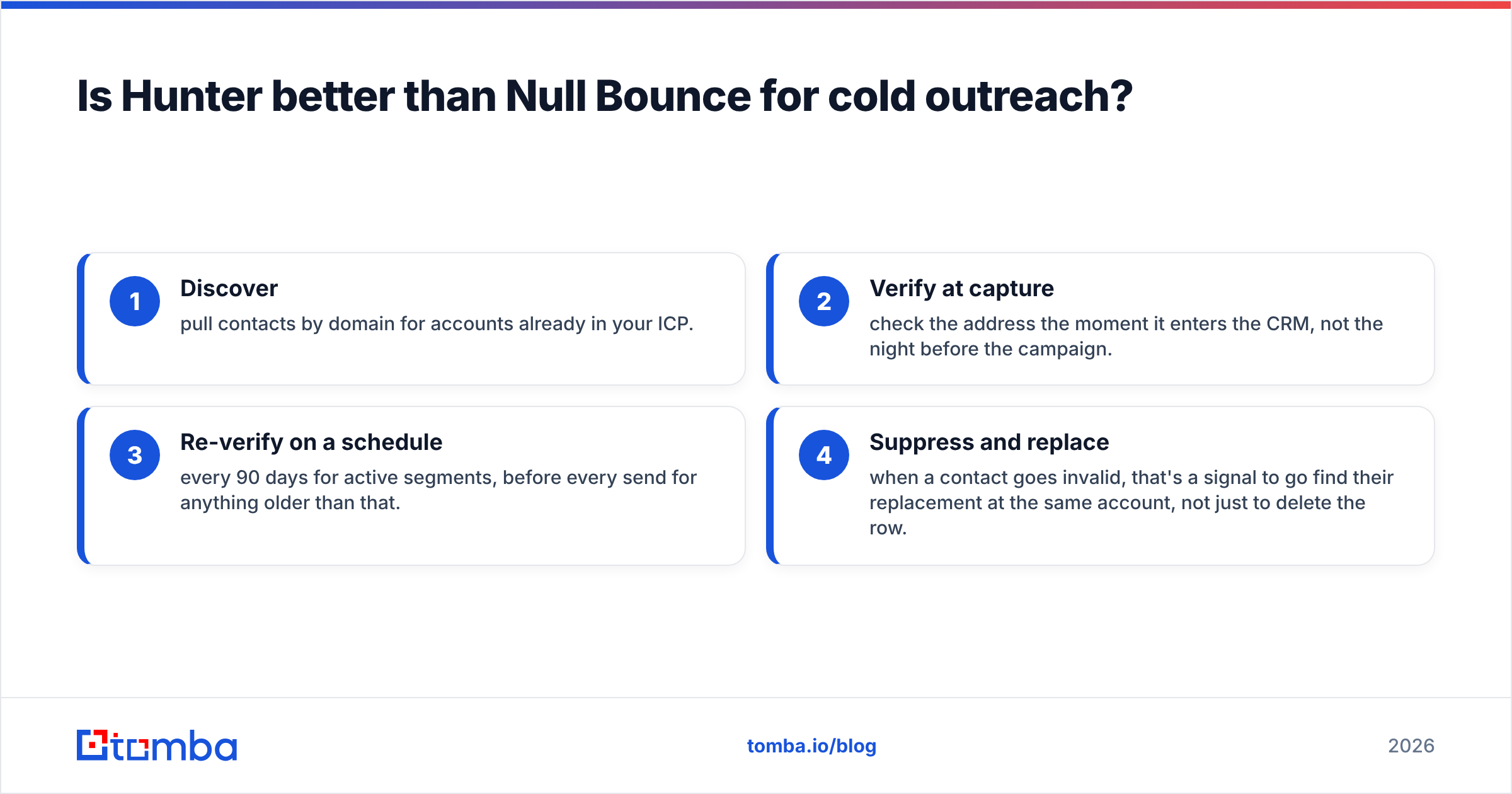
The teams that get this right run a loop, not a purchase:
- Discover — pull contacts by domain for accounts already in your ICP.
- Verify at capture — check the address the moment it enters the CRM, not the night before the campaign.
- Re-verify on a schedule — every 90 days for active segments, before every send for anything older than that.
- Suppress and replace — when a contact goes invalid, that's a signal to go find their replacement at the same account, not just to delete the row.
Step 4 is the one that quietly requires both capabilities. If your finder and your verifier are separate vendors with separate credit pools and separate APIs, that loop is a integration project. If they share a credit pool, it's a workflow.
Where does Tomba fit in this comparison?#
Honestly: in the same bucket as Hunter, with a verifier attached that's closer in depth to a standalone product.
Tomba's email verifier runs the full chain — syntax, MX, disposable detection, role-account flagging, SMTP handshake, catch-all classification — on the same credits as the finder. Bulk verification handles list-cleaning jobs, and the pricing runs Free (25 searches/mo), Starter $49/mo, Growth $99/mo, Pro $249/mo, and Enterprise.
The argument for consolidating isn't that Tomba beats a specialist verifier on every SMTP edge case — a dedicated verifier with one product to obsess over will always have edge-case advantages. The argument is total cost per usable contact. When you're paying a finder subscription plus verification credits plus the engineering time to keep two APIs in sync, the specialist's better per-check price rarely survives contact with the full invoice.
Where a specialist genuinely wins: you have a 500,000-row legacy database, you need it cleaned once, and you have no discovery need at all. Buy credits from a verification specialist. That's a hygiene project, not a prospecting stack.
Which should you choose?#
| Your situation | Pick |
|---|---|
| Empty list, need to build from scratch | Hunter or Tomba — a verifier can't help you yet |
| Large purchased/scraped list, no discovery need | Null Bounce or another dedicated verifier |
| Ongoing outbound, list decays monthly | A combined finder + verifier on one credit pool |
| Enterprise ICP, heavy catch-all exposure | Whichever tool gives you a real catch-all verdict, not a shrug |
| Under $50/mo budget, small volume | Free tiers first — Hunter's 25/50 and Tomba's 25 searches will tell you a lot |
| Need phone numbers too | Neither Hunter nor a verifier covers this — look at enrichment platforms |
The mistake to avoid is treating "hunter vs null bounce" as an either/or when your workflow needs both halves. Run the free tiers of each against the same 200-row holdout list this week. The vendor that returns the fewest false positives on your data — not the one with the best-looking accuracy claim — is the one to pay.
Ready to stop guessing at addresses?#
If you're building lists rather than just cleaning them, start with the Tomba Email Finder. Search by domain, by name, or in bulk, and every result comes back with a verification verdict attached — including a real answer on catch-all domains instead of an "unknown" you have to make a judgement call on. The free tier gives you 25 searches a month with no card, which is enough to run the holdout test described above and see the false-positive rate for yourself before you spend anything.
Related guides#
// get started
Find, verify and enrich your first contacts today
Start on the free plan with 25 searches a month, then scale when your team is ready.
Free plan · No credit card required · GDPR & CCPA
Get the Tomba newsletter
Product and data updates
// about the author