Hunter vs Pitchbox: Which Tool Wins for Outreach in 2026?
Hunter finds the emails. Pitchbox runs the campaigns. They overlap less than the search results suggest — here's the honest breakdown of pricing, data quality, and which one your team actually needs.
TL;DR
- Hunter and Pitchbox are not really competitors. Hunter is an email-finding and verification tool; Pitchbox is a link-building and outreach workflow platform that layers prospecting on top of campaign management.
- Pick Hunter if your bottleneck is contact data and you already have a sending tool. Pick Pitchbox if you run a link-building or digital-PR agency and need multi-step sequences, approval workflows, and client reporting in one place.
- Pricing is the sharpest divide: Hunter starts around $34–$49/mo for individual usage, while Pitchbox is a quote-based enterprise platform that commonly lands in the $500–$1,000+/mo range.
- Most SEO and outreach teams end up running a data layer + sending layer split rather than paying a single vendor for both. That combo is usually cheaper and more accurate.
- If it's the data layer you're solving for, Tomba covers finding, verifying, and enriching at $49/mo Starter with a free 25-search tier to test against your own list first.
Why does "Hunter vs Pitchbox" even come up?#
Because both tools show up when you search "how do I email 500 bloggers." That's where the similarity ends.
Think of it like building a house. Hunter is the supplier that delivers verified lumber to your site. Pitchbox is the general contractor that schedules the crew, tracks who did what, and shows the client a progress report. You can't frame a wall with a project plan, and you can't run a 12-person agency off a pile of lumber.
The confusion is understandable. Pitchbox includes prospecting — it pulls contacts from its own discovery engine and integrates third-party email-finding APIs. Hunter includes Campaigns — a lightweight sequencer bolted onto its finder. So each has a toe in the other's pool. But the depth is wildly different, and buying the wrong one means either overpaying by 10x or hitting a workflow ceiling in month two.
Here's how to tell which side of the line you're on.
What is Hunter and what is it actually good at?#
Hunter.io is an email-finding platform. You give it a domain, it returns the email addresses associated with that domain plus a confidence score and the public sources it found them on. You give it a first name, last name, and domain, and it predicts the address using the company's detected pattern, then verifies it.
Its real strengths:
- Domain Search depth — Hunter's index is built primarily from public web crawling, so it's strong on companies with public-facing staff: media, agencies, SaaS, publishers. That's exactly the profile a link builder targets.
- Verification quality — The verifier does SMTP-level checking with syntax, MX, and disposable-domain filtering. Confidence scores are honest; Hunter marks things "risky" rather than pretending certainty.
- Distribution — Chrome extension, Google Sheets add-on, Excel add-in, and a clean REST API. It slots into existing workflows instead of demanding you move into a new UI.
- Price transparency — Published tiers, no sales call required. Rare in this category.
Its real limits: Campaigns is a basic sequencer, not a workflow engine. There's no approval queue, no per-client workspace with white-label reporting, no built-in content-quality scoring of prospect sites, and no native way to manage a team of ten outreach specialists each owning different accounts.
What is Pitchbox and who is it built for?#
Pitchbox is an outreach and link-building platform aimed at SEO agencies, in-house SEO teams, and digital PR shops. It was built around one specific job: run hundreds of simultaneous personalized outreach campaigns to site owners, journalists, and bloggers, and prove the results to a client.
What it does that a finder can't:
- Prospect discovery with SEO context — It surfaces target sites with Moz/Majestic/Ahrefs metrics attached, so you filter by domain authority, spam score, and traffic before you ever write an email.
- Multi-stage automated follow-up — Sequences with conditional logic, auto-stop on reply, and per-campaign sending schedules across many mailboxes.
- Team workflow — Assign prospects to specialists, route replies, set approval gates, and track who closed which placement.
- Client-facing reporting — Link acquisition reports, campaign ROI, and white-label exports that agencies bill against.
- Integrated CRM behavior — Every contact carries its own relationship history, which matters when the same blogger gets pitched by three of your clients.
The trade-off is cost and commitment. Pitchbox is quote-based, onboarding-heavy, and priced for teams whose outreach directly produces billable deliverables. A solo founder sending 200 emails a month will not get their money back.
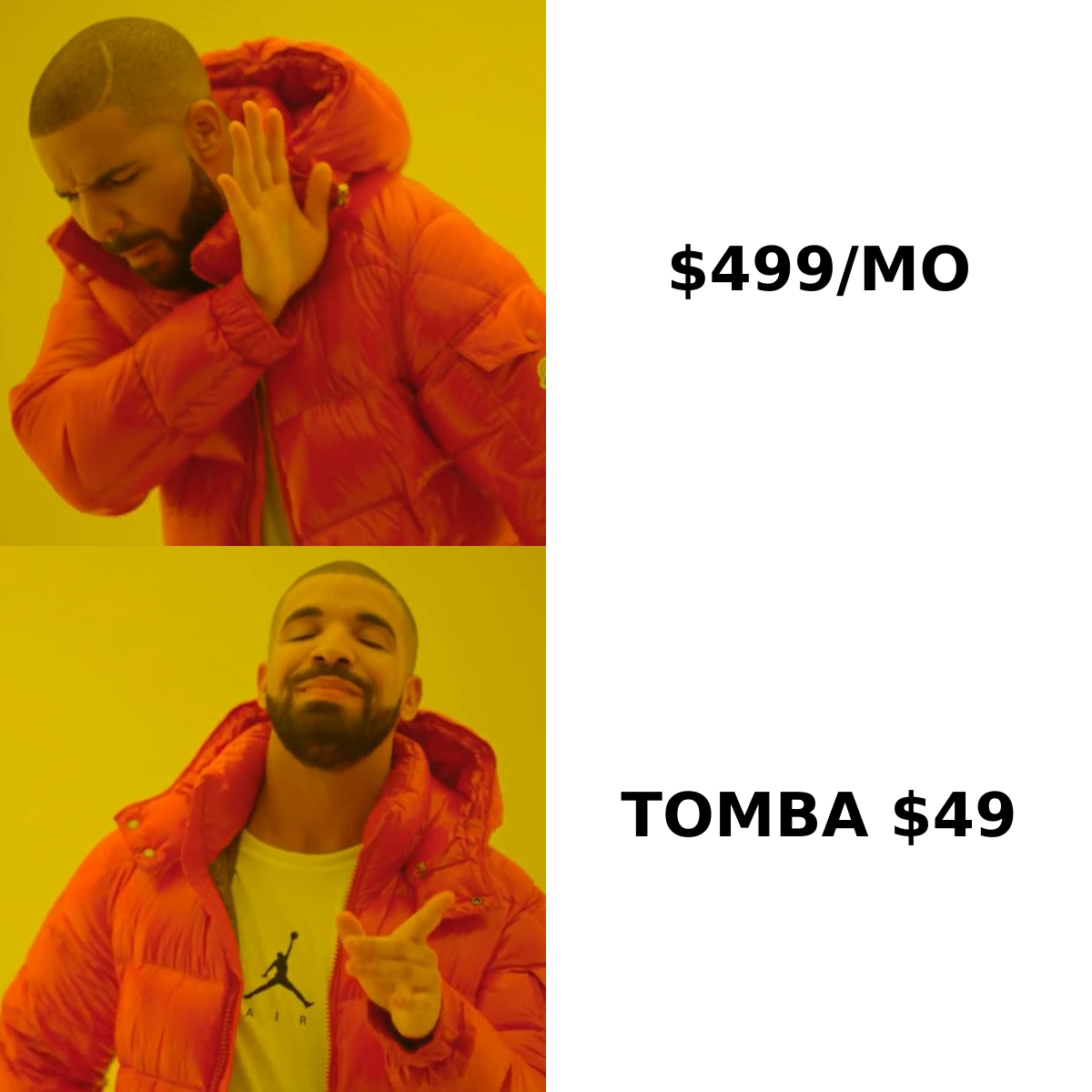
Hunter vs Pitchbox: how do they compare head to head?#
| Dimension | Hunter | Pitchbox | Tomba |
|---|---|---|---|
| Primary job | Find + verify emails | Run outreach campaigns at scale | Find, verify + enrich contacts |
| Entry price | ~$34–$49/mo | Quote-based (commonly $500+/mo) | $49/mo Starter |
| Free tier | 25–50 searches/mo | No — demo only | 25 searches/mo |
| Email verification | Yes, SMTP-level | Via integration | Yes, incl. catch-all handling |
| Sequences / follow-ups | Basic (Campaigns) | Advanced, conditional | No — integrates with your sender |
| SEO metrics on prospects | No | Yes (Moz, Majestic, Ahrefs) | No |
| Team workflow / approvals | Minimal | Full — roles, queues, assignment | API + team seats |
| Client reporting | No | Yes, white-label | No |
| API access | Yes | Yes | Yes, on all paid plans |
| Bulk processing | Yes | Yes | Yes, bulk finder + verifier |
| Best for | Data layer for any team | Agencies running link building | Data layer, cheaper per credit |
| Setup time | Minutes | Days (onboarding call) | Minutes |
The table makes the real decision obvious: these tools sit in different rows of your stack, not different columns of the same row.
Which one is more accurate at finding emails?#
Neither is universally better — accuracy is segment-dependent, and any vendor claiming a flat "98% accurate" number across all industries is selling you a marketing figure.
What actually drives hit rate:
- Target type. Public-facing roles at content-heavy sites (editors, bloggers, PR contacts) are well covered by crawl-based indexes like Hunter's. Deep enterprise org charts — a VP of Procurement at a 40,000-person manufacturer — are not.
- Catch-all domains. Roughly a fifth of business domains accept all mail, which means SMTP verification returns "unknown" instead of valid. How a tool handles that gap is the single biggest quality differentiator. Tools that silently mark catch-alls as valid inflate their stats and your bounce rate. Tools that discard them shrink your list. A dedicated catch-all verifier that scores rather than guesses is the honest middle path.
- Data freshness. Job changes run 15–20% annually in tech. A contact found in March is measurably worse by October.

Pitchbox doesn't really compete on this axis. It resolves emails through its own discovery plus integrations, so if your finder layer is weak, Pitchbox inherits that weakness. That's a strong argument for keeping your data vendor separate and swappable — you can upgrade the lumber without firing the contractor.
Before you commit to either, run the same 100 target domains through each tool's free tier or trial, send to the results, and measure bounce rate. That single test tells you more than every G2 review combined. Independent review aggregators like G2 are useful for spotting support and billing complaints, less so for accuracy claims — those are self-reported.
What does each one actually cost you per month?#
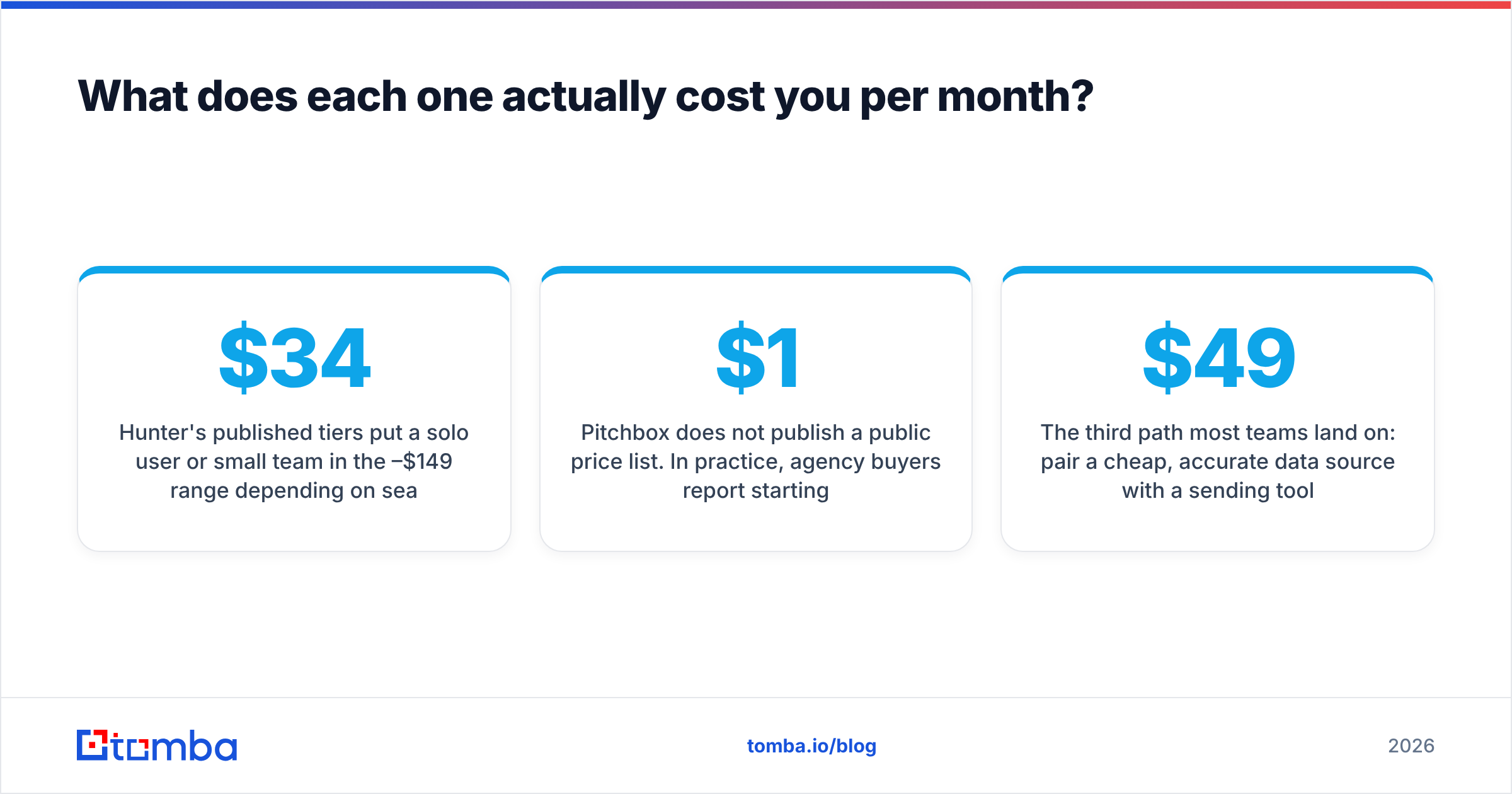
Hunter's published tiers put a solo user or small team in the $34–$149/mo range depending on search volume, with API access and verification credits scaling alongside. You can start free and upgrade when you hit the wall.
Pitchbox does not publish a public price list. In practice, agency buyers report starting engagements in the several-hundred-to-over-$1,000 per month range, often with annual commitments and an onboarding period. That is not a criticism — it's positioned as a platform with a services-grade support layer, and agencies that bill $5k–$20k/mo per client absorb it easily. But it disqualifies Pitchbox for anyone testing whether outreach works at all.
The third path most teams land on: pair a cheap, accurate data source with a sending tool you already pay for (Instantly, Smartlead, Lemlist, or plain Gmail with a sequencer). Tomba pricing runs Free at 25 searches/mo, Starter at $49/mo, Growth at $99/mo, and Pro at $249/mo — so the data layer for a serious outreach operation costs less than a single Pitchbox seat, and you keep the freedom to change senders.
When should you actually choose Pitchbox?#
Choose Pitchbox when all three of these are true:
- You run outreach as a billable service. Link building, digital PR, or guest-post placement for clients. The reporting layer is the product you're reselling.
- You have more than three people doing outreach. Assignment, approval, and reply routing only matter when handoffs exist. Below that headcount, a spreadsheet and a sequencer are fine.
- Prospect quality metrics gate your sends. If you need to filter by domain authority and spam score before an email goes out, that filtering inside the outreach tool saves real hours versus exporting from Ahrefs and re-importing.
If you can't check all three, you'll pay platform pricing for spreadsheet-level usage.
When is Hunter (or a cheaper finder) the right call?#
Choose a data-first tool when:
- Your bottleneck is "I don't have the email," not "I can't manage the campaign." This is most teams. You already have a sender you like.
- You need programmatic access. Enriching a CRM, hydrating a signup form, or building an internal tool means you want an email finder API, not a UI you have to log into.
- Volume is spiky. Campaign-based work means some months you need 5,000 lookups and some months you need 200. Credit-based finders flex; annual platform contracts don't.
- You want to swap layers independently. Data vendor accuracy varies by segment. Keeping it modular means switching costs you a config change, not a migration.
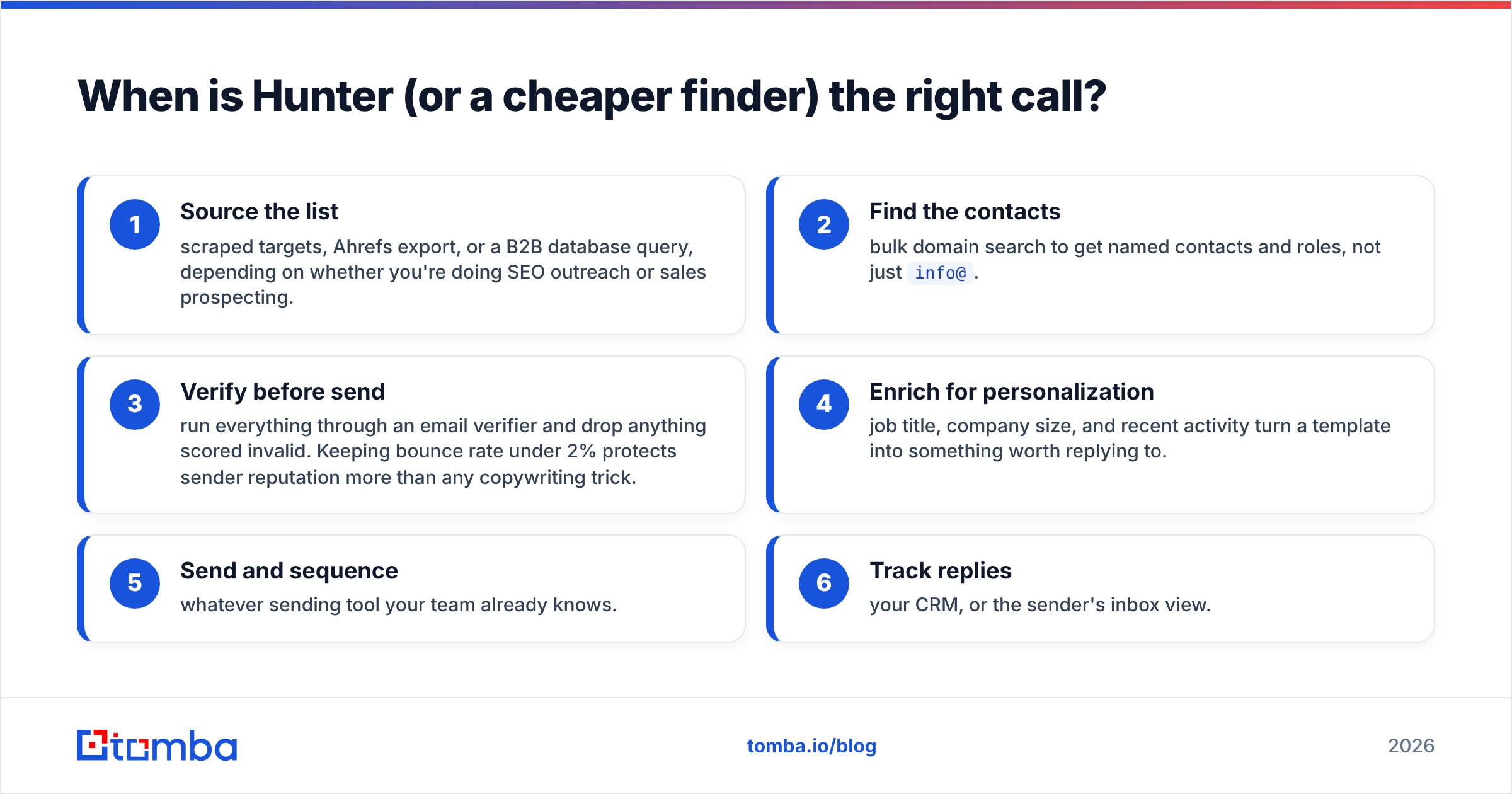
Here's the practical stack most people who searched "hunter vs pitchbox" end up building:
- Source the list — scraped targets, Ahrefs export, or a B2B database query, depending on whether you're doing SEO outreach or sales prospecting.
- Find the contacts — bulk domain search to get named contacts and roles, not just
info@. - Verify before send — run everything through an email verifier and drop anything scored invalid. Keeping bounce rate under 2% protects sender reputation more than any copywriting trick.
- Enrich for personalization — job title, company size, and recent activity turn a template into something worth replying to.
- Send and sequence — whatever sending tool your team already knows.
- Track replies — your CRM, or the sender's inbox view.
Steps 2–4 are the data layer. Step 5 is Pitchbox's territory. Buying Pitchbox to solve steps 2–4 is the most common expensive mistake in this comparison.
What about the alternatives to both?#
The landscape is wider than these two names suggest:
| Need | Options worth testing |
|---|---|
| Email finding + verification | Tomba, Hunter, Findymail, Snov.io |
| Verified B2B contact lists | BookYourData, Apollo, Cognism |
| Cold email sending at scale | Instantly, Smartlead, Lemlist |
| Link-building workflow | Pitchbox, BuzzStream, Respona |
| All-in-one sales engagement | Outreach, Salesloft, Reply.io |
A note on data-list vendors: if you'd rather buy a verified list than build one, BookYourData is a solid option with pay-as-you-go pricing and per-record verification guarantees — a genuinely different model from credit-based search tools, and a reasonable fit when you need a static list fast rather than an ongoing API.
For link-building workflow specifically, BuzzStream and Respona both sit below Pitchbox on price with meaningfully less automation depth. If Pitchbox quoted you higher than expected, those are the natural down-market comparisons rather than switching to an email finder.
And if your target list is content sites, an author finder that resolves the actual byline author of an article beats emailing a generic editorial inbox by a wide margin. Personalized outreach starts with reaching a person who exists.
What's the verdict?#
They solve different problems, so buy for the problem you actually have.
- Pitchbox wins if you're an agency running link building or digital PR at scale, with a team, clients, and reporting obligations. Nothing on the finder side replaces its workflow layer.
- Hunter wins if you need reliable, transparent, publicly-priced email data with good tooling and no sales call.
- Neither wins outright for the majority of readers, who need a cheap accurate data layer plus a sending tool they already own — and should stop looking for one vendor to do both.
The honest test costs you nothing: pull 100 domains from your real target list, run them through the free tiers, send, and count bounces. Vendor benchmarks are marketing. Your bounce rate is data.
If the data layer is your gap, start with the Tomba Email Finder. The free tier gives you 25 searches a month to run exactly that test against your own targets, Starter is $49/mo when you're ready to scale, and the finder, verifier, catch-all handling, and enrichment all sit behind one API — so whatever you plug in for sending, the contact data underneath stays accurate.
Related guides#
// get started
Find, verify and enrich your first contacts today
Start on the free plan with 25 searches a month, then scale when your team is ready.
Free plan · No credit card required · GDPR & CCPA
// about the author