Hunter vs Span Global Services: Which B2B Data Source Wins?
One is a self-serve email finder, the other is a bought-list data vendor. We compare Hunter and Span Global Services on accuracy, pricing, compliance and bounce risk - and name the better fit for cold outbound in 2026.
TL;DR
- Hunter is a self-serve email finder: you search a domain or a name, you get an address back, you pay per credit. Span Global Services is a list vendor: you brief a sales rep, they scope a segment, they invoice you for records.
- Hunter wins for repeatable, verifiable, low-volume-per-day outbound where you control the list and can audit every address. Span Global wins when you need a large, pre-segmented dataset for a specific vertical (healthcare, tech installs, C-suite by SIC code) and you have budget to buy it in bulk.
- The real cost gap is not the sticker price — it is bounce rate. A 5% bounce on 10,000 bought records will cost you more in sender reputation than the list cost.
- Neither is a great fit if you want per-record verification, transparent pricing and an API in the same product. That is where tools like Tomba sit, starting at $49/mo with a free tier.
- Verdict: for most B2B teams building outbound in 2026, buy search access, not a static list.
What is Hunter and what is Span Global Services?#
They are not the same category of product, which is exactly why this comparison keeps coming up — buyers search for both when the real question is "where do I get emails I can actually send to?"
Hunter (formerly Hunter.io, and before that Email Hunter) is a search-first email finder. You give it a company domain and it returns the addresses it has crawled and inferred for that domain, along with a confidence score and the public sources where the pattern was observed. It also ships an email verifier, a Chrome extension, a Google Sheets add-on, and a campaign sender. Pricing is public and self-serve. You can sign up and be running searches in about ninety seconds.
Span Global Services is a B2B data and list provider. Its model is closer to traditional list brokerage plus data appending: you describe a target — say, IT decision-makers at US hospitals with 500+ beds — and their team builds and delivers a file. They also offer data appending, cleansing, and multichannel (email, mailing, phone) records. Pricing is quote-based. There is no self-serve checkout, no free tier, and no public API you can wire into a workflow on your own.
So the honest framing of hunter vs span global services is: pull versus push. Hunter gives you a machine to pull addresses on demand. Span Global pushes a finished file at you and moves on.

How do Hunter and Span Global Services compare head-to-head?#
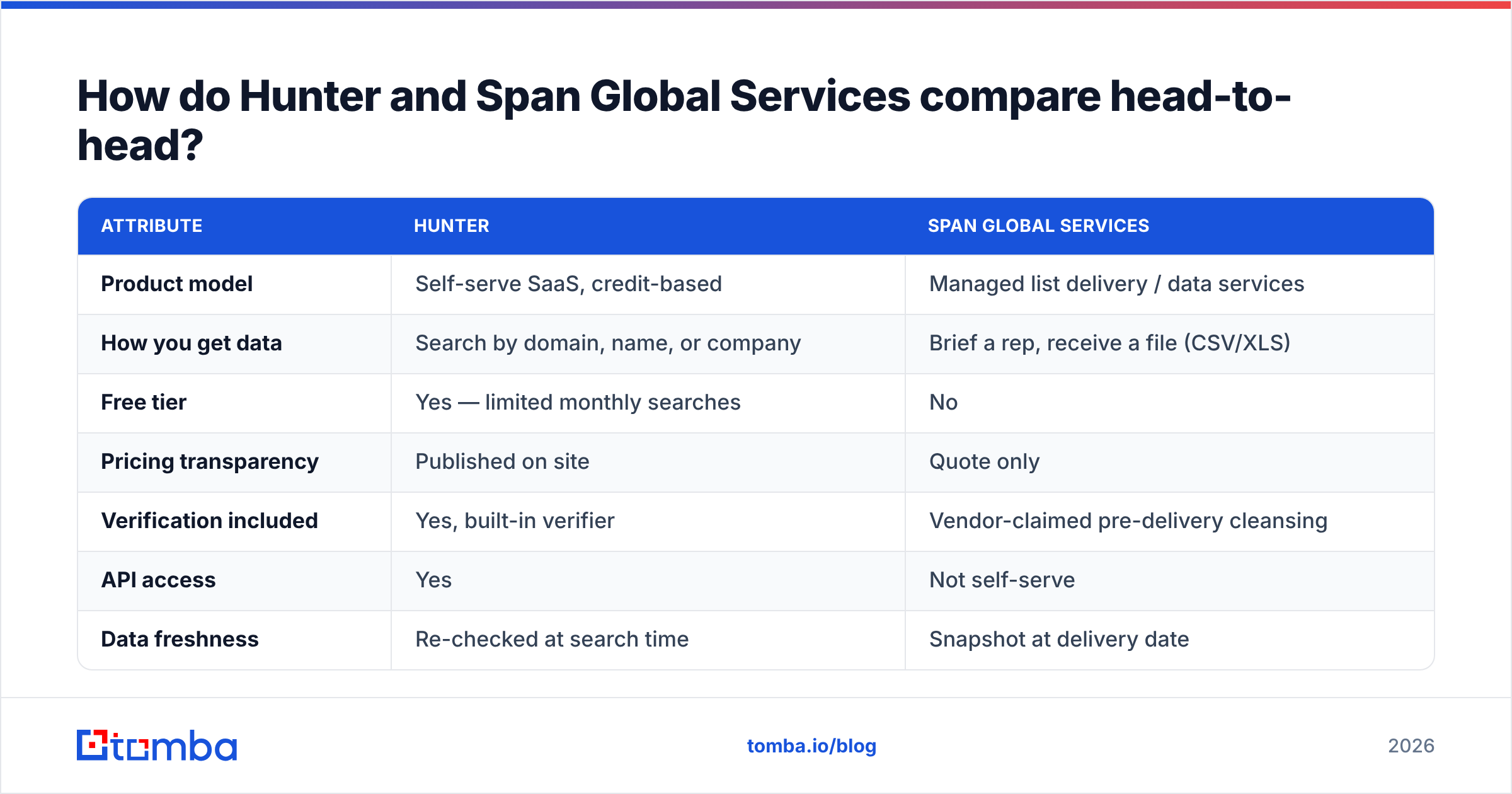
| Attribute | Hunter | Span Global Services |
|---|---|---|
| Product model | Self-serve SaaS, credit-based | Managed list delivery / data services |
| How you get data | Search by domain, name, or company | Brief a rep, receive a file (CSV/XLS) |
| Free tier | Yes — limited monthly searches | No |
| Pricing transparency | Published on site | Quote only |
| Verification included | Yes, built-in verifier | Vendor-claimed pre-delivery cleansing |
| API access | Yes | Not self-serve |
| Data freshness | Re-checked at search time | Snapshot at delivery date |
| Coverage strength | Company domains with public web presence | Deep vertical segments (healthcare, tech, education) |
| Phone numbers | No | Yes, on multichannel records |
| Minimum spend | One month of the entry plan | Typically a bulk record order |
| Best for | Founders, SDRs, agencies, developers | Enterprise campaigns with a defined ICP file |
The table hides one thing worth saying plainly: with Hunter you can validate a claim in ten seconds. With a purchased list, you validate a claim after you have paid for it. That asymmetry drives most of the buyer regret in this category.
Which one gives you more accurate email data?#
Accuracy is not a single number, and any vendor quoting one without a methodology is quoting marketing. What matters is the split between verified, guessed, and stale.
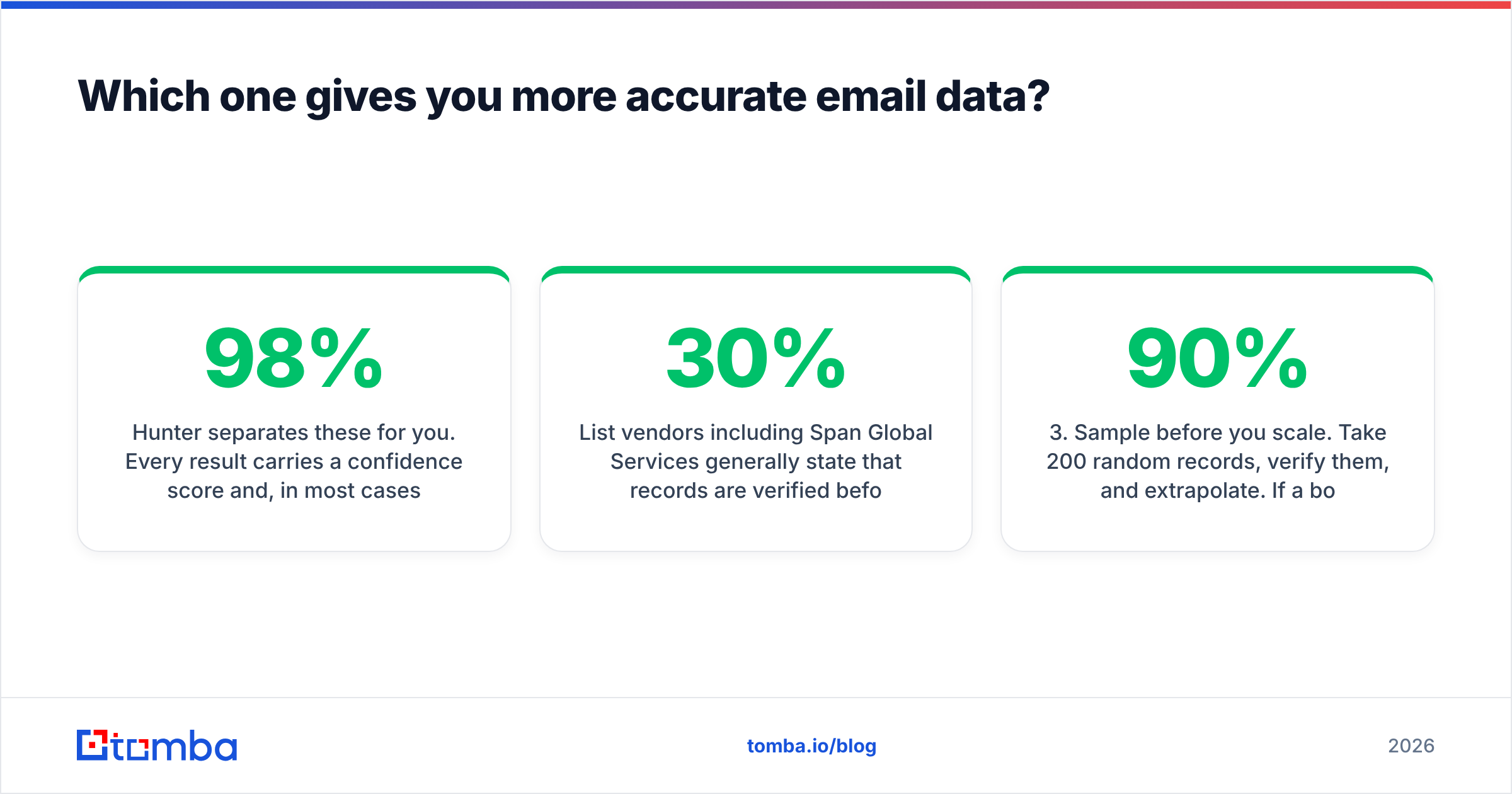
Hunter separates these for you. Every result carries a confidence score and, in most cases, the public URLs where that address or pattern was found. A 98% score on a pattern-confirmed address is a genuinely different asset from a 62% score on a permutation guess — and you get to decide whether to send. That auditability is the single biggest practical advantage of a finder over a file.
List vendors including Span Global Services generally state that records are verified before delivery. That is usually true at the moment of delivery. The problem is decay: B2B contact data goes stale at roughly 25-30% per year, and it decays unevenly — a file heavy on startups or recently-restructured enterprises will rot faster than a file of tenured hospital administrators. If a segment was assembled eight months before it reached your inbox, a meaningful slice of it is already gone.

Three habits protect you regardless of which side you land on:
- Re-verify at send time, not at purchase time. Run any file — bought or found — through an email verifier within 48 hours of your first send. This is non-negotiable for purchased data.
- Segment catch-all domains separately. Catch-all servers accept everything, so standard SMTP checks return "valid" for addresses that do not exist. Isolate them and treat them as a lower-confidence cohort.
- Sample before you scale. Take 200 random records, verify them, and extrapolate. If a bought file returns below 90% deliverable on a fresh sample, renegotiate before you load it into a sequence.
- Track bounces by source. Tag every contact with where it came from. Within two weeks you will know which source deserves budget — and you will stop arguing about it in meetings.
What does each actually cost?#
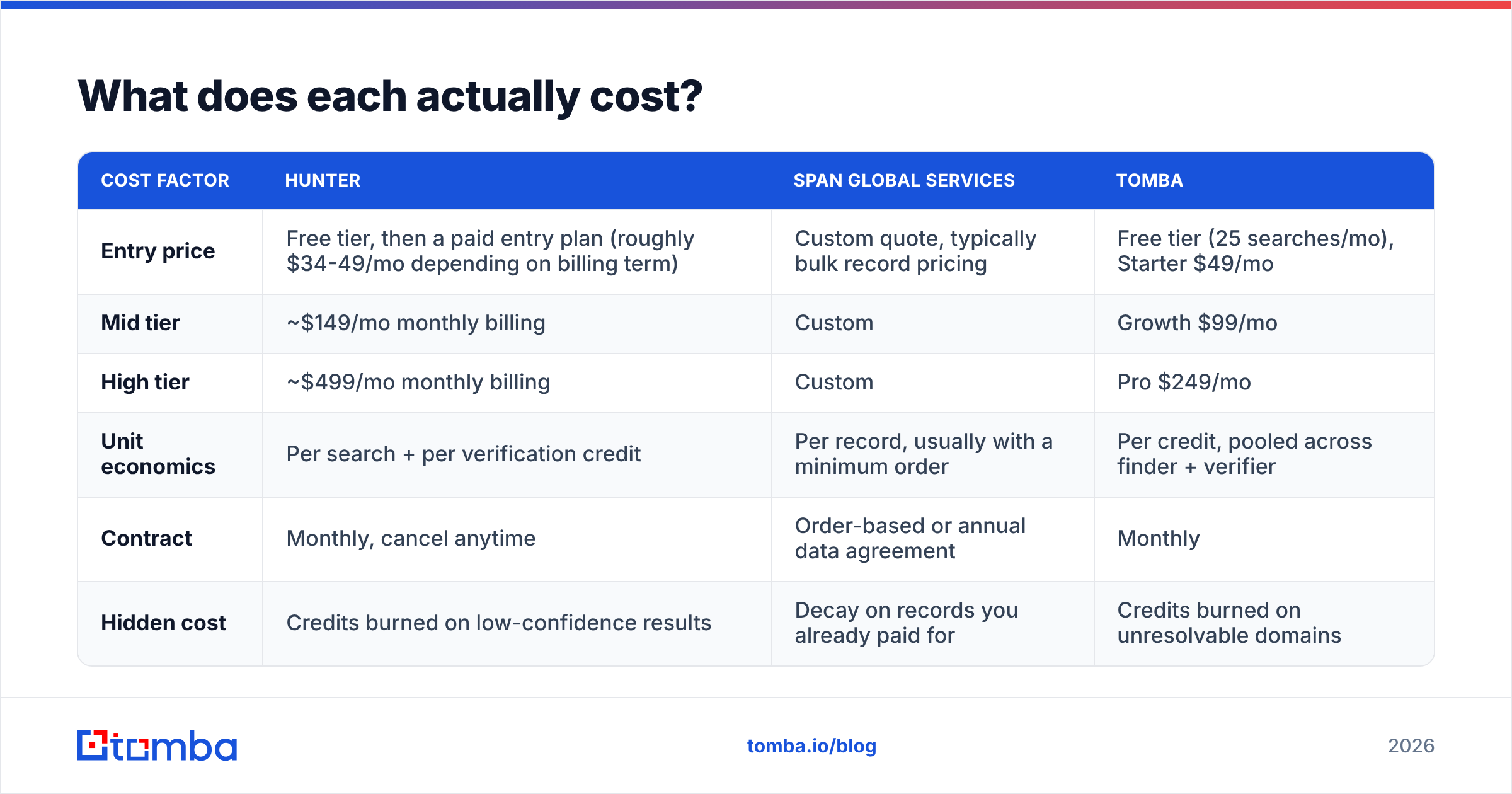
Hunter publishes its plans; Span Global does not. Verify current numbers on each vendor's site before you budget, because both change.
| Cost factor | Hunter | Span Global Services | Tomba |
|---|---|---|---|
| Entry price | Free tier, then a paid entry plan (roughly $34-49/mo depending on billing term) | Custom quote, typically bulk record pricing | Free tier (25 searches/mo), Starter $49/mo |
| Mid tier | ~$149/mo monthly billing | Custom | Growth $99/mo |
| High tier | ~$499/mo monthly billing | Custom | Pro $249/mo |
| Unit economics | Per search + per verification credit | Per record, usually with a minimum order | Per credit, pooled across finder + verifier |
| Contract | Monthly, cancel anytime | Order-based or annual data agreement | Monthly |
| Hidden cost | Credits burned on low-confidence results | Decay on records you already paid for | Credits burned on unresolvable domains |
Run the arithmetic that actually matters. Suppose you need 5,000 usable contacts. If a bought file lands at 80% deliverable, you paid for 5,000 and can send to 4,000 — plus you burned a chunk of sender reputation discovering that. If a finder returns 3,200 high-confidence addresses out of 5,000 attempted lookups, you spent fewer credits than you feared, but you also have to source the remaining 1,800 elsewhere. Neither model is free of waste. The difference is that finder waste is visible before you send, and list waste is visible after.
For teams comparing spend directly, our Tomba pricing page lays out credits per tier so you can model cost-per-verified-contact rather than cost-per-record.
Where does each fit in a real outbound workflow?#
Pick by motion, not by feature list.
- Founder-led outbound, 20-60 accounts a week. Hunter or any self-serve finder. You are researching accounts individually anyway; a bought file is dead weight and a compliance liability you do not need.
- SDR team with a defined ICP and a CRM. Finder plus enrichment, ideally via API so records populate automatically. A bulk email finder run against an account list beats manual lookups at this volume.
- Vertical campaign in a hard-to-crawl segment. This is Span Global's genuine strength. Hospital procurement, K-12 administration, specific ERP install bases — these segments are poorly represented on public company sites, which is exactly where crawl-based finders are weakest. A specialist list vendor can reach them.
- Multichannel plays needing phone plus email. Hunter does not do phone. A list vendor does, and so do dedicated tools like a phone finder if you would rather keep everything self-serve.
- Developer or RevOps automation. API-first is the only workable answer. A CSV delivered by email cannot be part of a pipeline that runs nightly.
Is buying a list ever the right call in 2026?#
Sometimes — with conditions.
Buying is defensible when the segment is genuinely non-crawlable, when you have legal sign-off for your target geography, and when you treat the file as a research artifact rather than a send list. That last part is the one teams skip. A bought file is a great source of company names, job titles, and account structure. Loading it straight into a sequencer and hitting send is how domains get burned.
The compliance picture matters more than it used to. Under CAN-SPAM, US B2B cold email is legal with accurate headers, a physical address, and a working opt-out — purchased lists are not automatically illegal. Under GDPR, the calculus for EU contacts is different: you need a legitimate-interest basis you can document, and "we bought it from a broker" is a weak record to defend. Ask any vendor, Span Global included, for source documentation and consent provenance per record before you send to European contacts. Reputable vendors will provide it.
Also check reviews from actual buyers rather than case studies. Sites like G2 carry unfiltered feedback on both list vendors and finder tools, and the pattern of complaints tells you more than any average star rating.
How does Tomba compare to both?#
Full disclosure: this is the Tomba blog, so weigh this section accordingly. Here is the honest positioning.
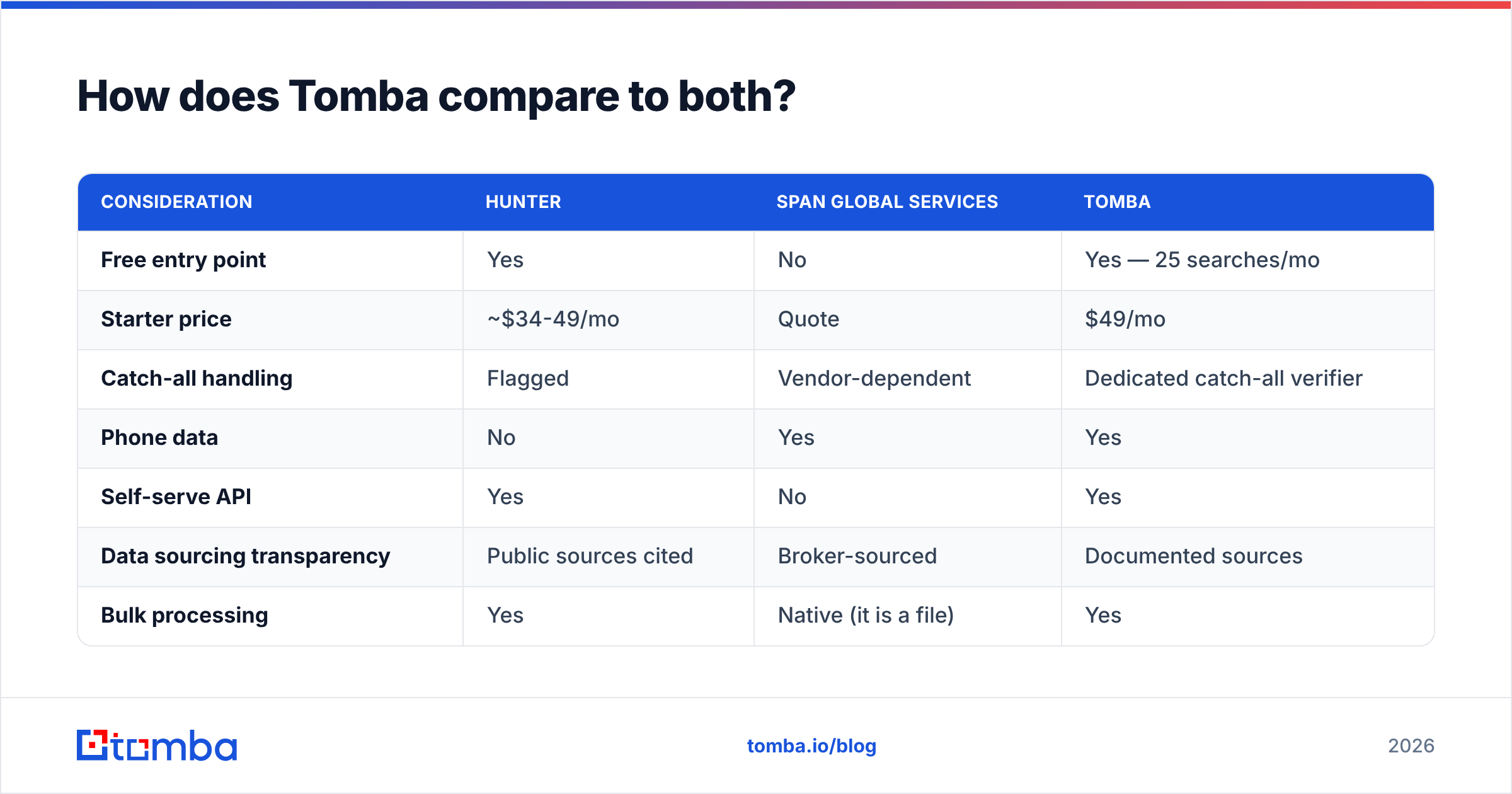
Tomba sits on the finder side of the line, close to Hunter in category but with a wider tool surface. The email finder is the core product; alongside it sit a verifier, domain search, catch-all verification, phone finding, and enrichment — the pieces you would otherwise buy from three vendors. Everything is exposed through an API, a CLI, Sheets and Excel add-ins, and a Chrome extension, so the same data path works whether a human or a cron job is asking.

| Consideration | Hunter | Span Global Services | Tomba |
|---|---|---|---|
| Free entry point | Yes | No | Yes — 25 searches/mo |
| Starter price | ~$34-49/mo | Quote | $49/mo |
| Catch-all handling | Flagged | Vendor-dependent | Dedicated catch-all verifier |
| Phone data | No | Yes | Yes |
| Self-serve API | Yes | No | Yes |
| Data sourcing transparency | Public sources cited | Broker-sourced | Documented sources |
| Bulk processing | Yes | Native (it is a file) | Yes |
Where Tomba does not win: if you need a hand-built vertical file for a segment with almost no public web footprint, a specialist list vendor will out-cover any crawl-based finder, including this one. Buy from the vendor, then verify the file yourself. That is a perfectly sane combination and we would rather tell you that than pretend otherwise.
Where Tomba does win: cost-per-verified-contact when you are running continuous outbound rather than one-off campaigns, and the ability to check exactly where the data comes from instead of accepting a vendor's word.
So which should you choose?#
Choose Hunter if you want a proven, transparent, self-serve finder and your targets are companies with a normal public web presence. It is a mature product and it does what it says.
Choose Span Global Services if your ICP lives in a vertical that public crawling cannot reach, you have budget for a bulk order, and you have the process discipline to verify the file before it touches a sequencer.
Choose a broader finder platform like Tomba if you want finder, verifier, catch-all checks, phone data, and API access under one bill — and you would rather scale credits than negotiate quotes.
The one choice that reliably fails is buying a large file, skipping verification, and sending from a single domain. That is not a vendor problem. That is a process problem, and no amount of comparison shopping fixes it.
Ready to test the finder side yourself? Run your next 25 target accounts through the Tomba Email Finder on the free tier — no card, no sales call, no minimum order. Check the confidence scores against whatever list you are currently paying for, and let the bounce rate settle the argument.
Related guides#
// get started
Find, verify and enrich your first contacts today
Start on the free plan with 25 searches a month, then scale when your team is ready.
Free plan · No credit card required · GDPR & CCPA
// about the author