Hunter vs Warpleads 2026: Email Finder Accuracy vs Volume
Hunter sells verified precision. Warpleads sells export volume. We break down pricing, accuracy, data freshness, and cost per usable contact so you can pick the one your outbound motion actually needs.
TL;DR
- Hunter is a precision email finder: domain search, per-contact confidence scores, built-in verification, and a small free tier. You pay per search, and searches are scarce.
- Warpleads is a volume play: a large B2B contact database with "unlimited export" style plans plus on-demand scraping. You pay for the pipe, not the row.
- They solve different problems. Hunter answers "what is this specific person's email?" Warpleads answers "give me 40,000 rows matching this filter."
- Cost per usable contact is the only metric that matters. Unlimited exports at 60% deliverable are more expensive than 500 verified finds at 95% — once you price in burned domains.
- Most teams end up running two tools anyway. If you want one stack that does targeted finding, bulk enrichment, and verification on one credit pool, Tomba starts at $49/mo with a free tier at 25 searches.
What are Hunter and Warpleads, exactly?#
They get compared because both put email addresses in your CRM. That's where the similarity ends.
Hunter is the older, better-known product — a domain-first email finder. You give it a company domain and it returns the addresses it has seen for that domain, the detected pattern ({first}.{last}@, {f}{last}@, and so on), the public sources it crawled the address from, and a confidence score. It ships an email verifier, a Chrome extension, a small campaign sender, and a well-documented API. Its defining trait is citation: Hunter will usually tell you where it saw an address.
Warpleads sits on the other end. It's an outbound data platform built around bulk export from a large contact database, with on-demand scraping for prospects the static database doesn't cover. The pitch is straightforward: stop counting credits, filter a list, export it, load it into your sequencer. For agencies running many client campaigns at once, or for anyone whose ICP is "all 22,000 HVAC companies in Texas," that model removes a real constraint.
So the honest framing of hunter vs warpleads isn't "which is better." It's which failure mode can you afford — running out of credits mid-week, or running out of domain reputation mid-quarter.
How do Hunter and Warpleads compare on price and limits?#
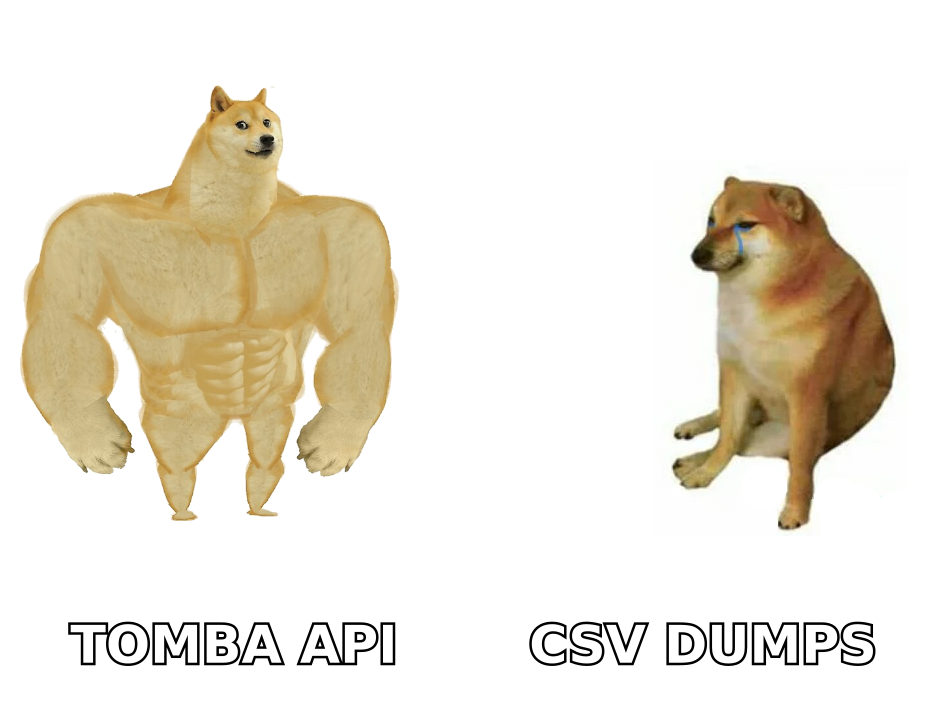
Pricing on both platforms moves — treat the numbers below as directional and confirm on each vendor's page before you commit. Hunter publishes standard tiers; Warpleads is closer to a volume/seat negotiation, and its "unlimited" tiers carry fair-use terms.
| Attribute | Hunter | Warpleads | Tomba |
|---|---|---|---|
| Model | Per-search credits | Bulk export volume | Per-search credits |
| Free tier | 25 searches + 50 verifications/mo | Trial / demo-gated | 25 searches/mo |
| Entry paid plan | ~$49/mo (≈500 searches) | Low-to-mid three figures/mo | $49/mo |
| Mid tier | ~$149/mo (≈5,000 searches) | Volume-based | $99/mo Growth |
| High tier | ~$499/mo (≈50,000 searches) | Unlimited-export tier | $249/mo Pro |
| Core strength | Verified, sourced addresses | Raw export volume | Finder + verifier on one pool |
| Verification included | Yes | Partial — export ≠ verified | Yes |
| API | Yes, mature | Yes | Yes |
| Best for | ABM, low-volume high-value | Broad SMB/local sweeps | Both, on one bill |
The pattern you should notice: Hunter's price scales with how many questions you ask. Warpleads' price scales with how big the pipe is. If your ICP is 300 enterprise accounts, Hunter's model is cheap. If your ICP is 80,000 local businesses, Hunter's model is punishing and Warpleads' looks like a rescue.
Which one finds more usable emails?#
"Usable" is the operative word, and it splits into three separate questions that vendors love to blur together:
- Hit rate — of the contacts you asked for, how many came back with any address at all?
- Deliverability — of those addresses, how many survive verification and actually land?
- Freshness — of the ones that land, how many still belong to someone in that role?
Hunter tends to score well on 2 and 3 and modestly on 1. It is conservative: if it can't corroborate an address from a crawled source or a strong pattern match, it either returns nothing or flags low confidence. That conservatism is why Hunter users report low bounce rates and also why they complain about empty results on smaller companies with no web footprint.
Bulk-export platforms including Warpleads invert that. Hit rate looks spectacular because the database returns something for nearly every row. But a meaningful slice of any large static B2B database is stale — people change jobs constantly, and a database refreshed quarterly will always trail reality. If you export 20,000 rows and blast them without an independent verification pass, you're gambling your sending domain on someone else's refresh cadence.

The practical rule: never trust an export as a verified list. Run every bulk pull through an email verifier that does SMTP-level checks and flags catch-all domains separately. A 20,000-row export that verifies down to 11,000 sendable addresses is a good outcome — you just paid for 20,000 and got 11,000, which is the real unit price.
What does each actually cost per usable contact?#
Run the math instead of comparing sticker prices. Take a 5,000-contact target list.
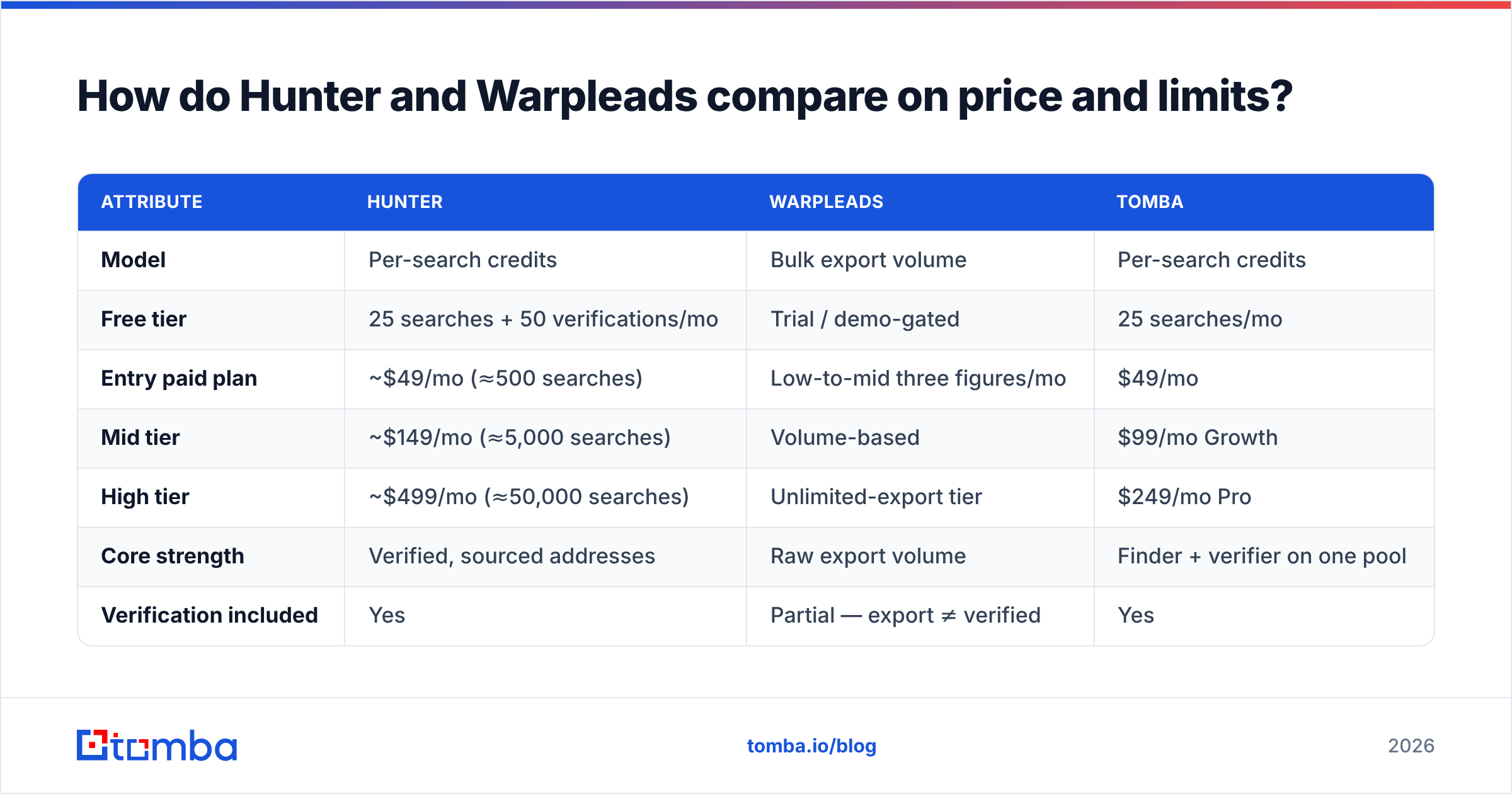
With Hunter at the mid tier: roughly $149/mo buys about 5,000 searches. Assume a 70% hit rate and 93% of those verify clean. That's ~3,255 usable contacts, or about $0.046 each. Verification is bundled, so no second line item.
With a volume-export platform: assume a $249/mo unlimited-ish tier. You export 20,000 rows because you can. Assume 60% verify clean after an independent check — 12,000 usable contacts, or about $0.021 each, plus verification costs on 20,000 rows (typically $0.002–$0.007 per check elsewhere, or bundled if your finder includes it).
On raw cost per usable contact, volume wins — that's not controversial. What the spreadsheet hides:
- Domain risk. The 8,000 rows that didn't verify are only harmless if you actually caught them. Teams that skip the verification pass see 12–18% bounce rates, and mailbox providers start throttling well before that.
- Rep-time cost. A rep working a 12,000-row list at 2% reply rate spends the same hours as one working a 3,000-row list at 8% reply rate, for similar meeting counts and much worse brand impression.
- Sequencer seats. Many sending tools price per contact or per active lead. A huge list can cost more downstream than it did upstream.
Cheap contacts stop being cheap the moment they cost you a sending domain. Google and Yahoo's bulk sender requirements put a hard 0.3% spam-complaint ceiling on high-volume senders, and unverified bulk lists are the fastest way through it.
Hunter vs Warpleads: which should you pick?#
Match the tool to the motion, not to the review score.
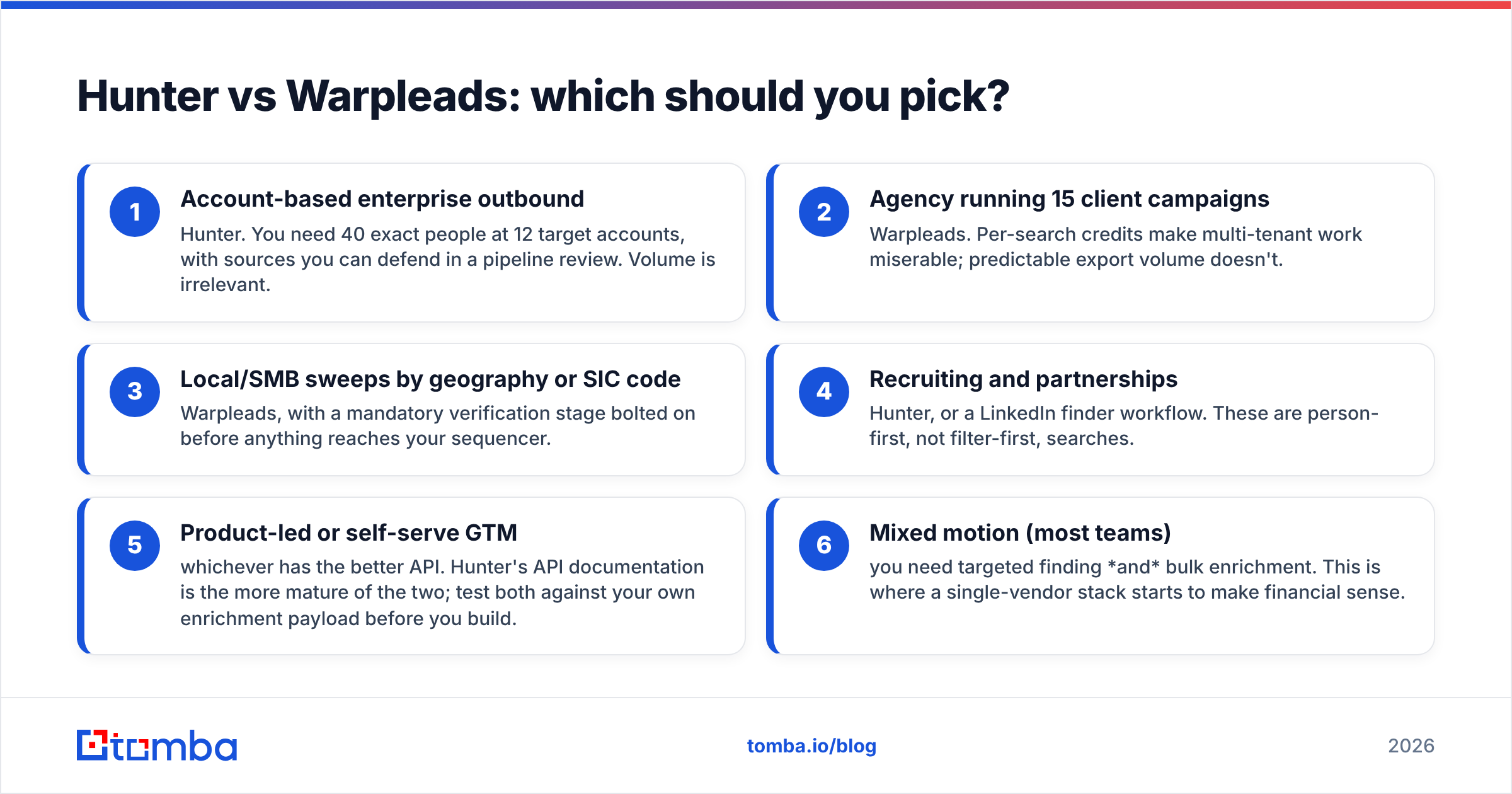
- Account-based enterprise outbound — Hunter. You need 40 exact people at 12 target accounts, with sources you can defend in a pipeline review. Volume is irrelevant.
- Agency running 15 client campaigns — Warpleads. Per-search credits make multi-tenant work miserable; predictable export volume doesn't.
- Local/SMB sweeps by geography or SIC code — Warpleads, with a mandatory verification stage bolted on before anything reaches your sequencer.
- Recruiting and partnerships — Hunter, or a LinkedIn finder workflow. These are person-first, not filter-first, searches.
- Product-led or self-serve GTM — whichever has the better API. Hunter's API documentation is the more mature of the two; test both against your own enrichment payload before you build.
- Mixed motion (most teams) — you need targeted finding and bulk enrichment. This is where a single-vendor stack starts to make financial sense.

What are the honest downsides of each?#
Hunter's weak spots. Search credits evaporate faster than new users expect — a single domain search that returns 40 contacts can consume a chunk of a Starter plan. Coverage thins out on companies with no crawlable web presence, on non-English markets, and on very small businesses. The built-in campaign tool is fine for a first sequence but nobody is churning off Instantly or Smartlead for it. And because Hunter is conservative, you will sometimes see a competitor return an address Hunter refused to guess — that address is right about as often as it's wrong.
Warpleads' weak spots. "Unlimited" always has fair-use terms; read them. Static database freshness is the perennial issue for every bulk-export vendor, not a Warpleads-specific flaw, but it means the burden of verification moves onto you. Filtering granularity on niche technographic or intent attributes is generally thinner than what a dedicated intelligence platform offers. And the brand has far less third-party review history than Hunter — check current G2 listings yourself rather than trusting any single blog's snapshot, including this one.
What are the alternatives worth testing alongside them?#
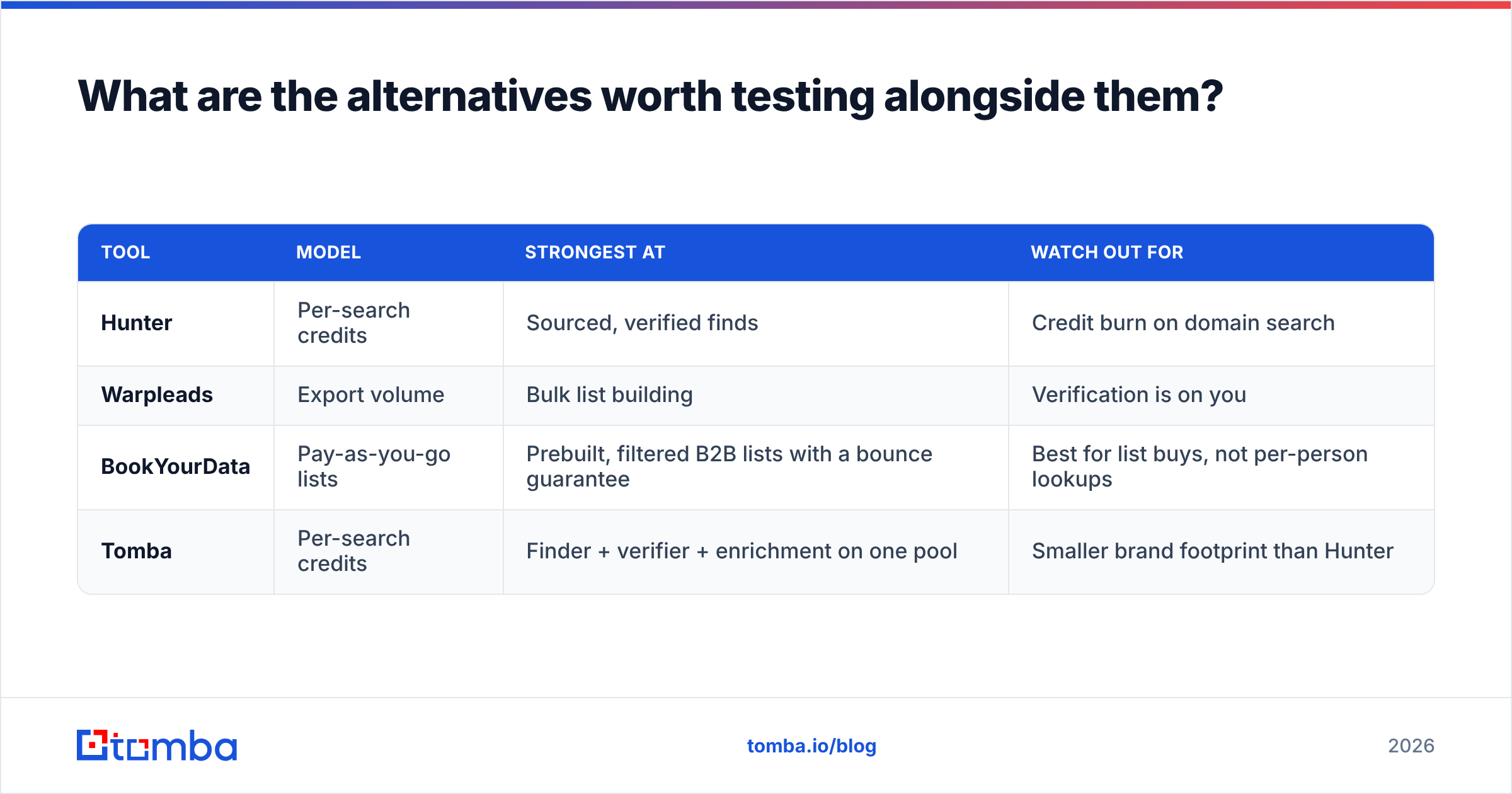
Neither tool is the only shape available. Three that belong on a shortlist:

| Tool | Model | Strongest at | Watch out for |
|---|---|---|---|
| Hunter | Per-search credits | Sourced, verified finds | Credit burn on domain search |
| Warpleads | Export volume | Bulk list building | Verification is on you |
| BookYourData | Pay-as-you-go lists | Prebuilt, filtered B2B lists with a bounce guarantee | Best for list buys, not per-person lookups |
| Tomba | Per-search credits | Finder + verifier + enrichment on one pool | Smaller brand footprint than Hunter |
BookYourData is worth a look specifically if your buying pattern is "I want a clean, filtered list delivered now" rather than "I want an API in my product" — its pay-as-you-go structure and bounce guarantee suit one-off campaign buys well.
Tomba covers the overlap that forces most teams into two subscriptions. The email finder handles person-level and domain search lookups; the bulk email finder handles list-scale jobs; verification, catch-all checks, and enrichment draw from the same credit pool rather than a second invoice. Tomba pricing runs Free (25 searches/mo), Starter $49/mo, Growth $99/mo, and Pro $249/mo, with an Enterprise tier for higher volume.
How should you run the evaluation yourself?#
Vendor benchmarks are marketing. Build your own in about two hours:
- Pull a 100-row control list from accounts you already have verified contacts for — closed-won customers work perfectly, because you know the ground truth.
- Strip the emails, keep name + company domain, and run the same 100 rows through each tool's free tier or trial.
- Score three columns: returned an address (hit rate), matched your known-good address (precision), and passed independent verification (deliverability).
- Weight by your ICP. If 70% of your control list is sub-50-employee companies, the tool that wins on enterprise coverage is irrelevant to you.
- Time the workflow. Count clicks and API calls per 100 contacts. A tool that's 4% more accurate but doubles your ops time loses.
That test costs you a morning and settles the argument with data from your own market rather than someone else's aggregate.
The verdict#
Pick Hunter if precision and provenance matter more than volume — enterprise ABM, partnerships, recruiting, anything where a wrong address costs you a relationship and a right one is worth hundreds of dollars.
Pick Warpleads if your bottleneck is list size — agency work, SMB sweeps, geographic campaigns — and budget a verification step into the workflow from day one, not after your first bounce spike.
Pick neither if the real problem is that you're paying twice. If you're already eyeing a finder plus a separate verifier plus a bulk data subscription, consolidate. Tomba's email finder gives you domain search, person lookup, SMTP verification, catch-all detection, and enrichment on one credit pool and one bill — free for the first 25 searches a month, $49/mo when you're ready to scale. Run your 100-row control list through it alongside Hunter and Warpleads and let the numbers pick the winner.
Related guides#
// get started
Find, verify and enrich your first contacts today
Start on the free plan with 25 searches a month, then scale when your team is ready.
Free plan · No credit card required · GDPR & CCPA
// about the author