I Hope This Email Finds You Well: Better Openers for 2026
The most-used opener in B2B email says nothing, costs you a line of preview text, and trains prospects to skim. Here is what the phrase actually signals, when it is harmless, and 12 replacements that earn the second sentence.
TL;DR
- "I hope this email finds you well" is not offensive, it is invisible. It burns the single most valuable line in your email — the one that shows in the inbox preview — on zero information.
- The phrase is a formality marker, not a persuasion tool. It signals "template" to anyone who reads more than five cold emails a week.
- Replacing it with a specific, verifiable observation about the recipient is the single cheapest rewrite available to most outbound teams.
- There are three situations where the phrase is genuinely fine: warm replies, cross-cultural formal correspondence, and long-dormant reconnects.
- Openers only matter if the email lands. Bad data and unverified addresses kill more sequences than clichéd first lines ever will.
What does "I hope this email finds you well" actually mean?#
It means nothing, and that is the point. It is a phatic expression — language whose job is to open a social channel rather than transmit content, the same category as "how are you" from a cashier or "cheers" at the end of a Slack message. Linguists call this phatic communion; the closest everyday analogy is a handshake. A handshake is not information. It is a ritual that says we are now in a conversation.
Handshakes work in person because they cost the other party nothing. In an inbox, they cost something real: attention, screen space, and credibility. The phrase occupies roughly 32 characters at the exact place where Gmail, Outlook, and Apple Mail render the preview snippet next to your subject line. That snippet is the second thing a prospect reads after the sender name. Spending it on a wish about their wellbeing is like putting "hello" on a billboard.
Historically the wording is inherited from letter-writing conventions, where a physical letter genuinely might arrive weeks later and finding the recipient in good health was a real question. See the entry on formal salutation conventions for how much of business email is still fossilized correspondence etiquette. Email arrives in under a second. The premise the phrase was built on no longer exists.
Is "I hope this email finds you well" bad for reply rates?#
The honest answer: it is weakly negative, and the effect is smaller than the internet claims.
Nobody deletes an email because of the opener. What actually happens is subtler and worse. The phrase functions as a template detector. A buyer who receives 40 cold emails a week has learned that this exact string correlates with mass sends, so it triggers the skim-and-archive reflex before your value proposition gets a hearing. You are not being rejected on the merits. You are being pattern-matched into a bucket.
Three measurable costs, in order of size:
- Preview-text waste. Mobile clients show 35 to 90 characters of body text. If the first 32 are a pleasantry, most of your snippet is gone. This is the largest and most provable cost.
- Delayed relevance. The reader's implicit question is "why me, why now." Every sentence that does not answer it increases the odds of an archive. Your relevance signal moves from line one to line two.
- Perceived effort. Buyers infer research quality from the opener. A generic first line implies a generic list, which implies the rest of the email is generic too — even when it is not.
What the phrase does not do: trigger spam filters, damage sender reputation, or offend anyone. Claims that it "tanks deliverability" are made up. Filters score authentication, engagement history, and link reputation, not politeness. If your emails are landing in spam, the opener is not your problem — your authentication, list hygiene, and sending volume are.
What should you write instead?#
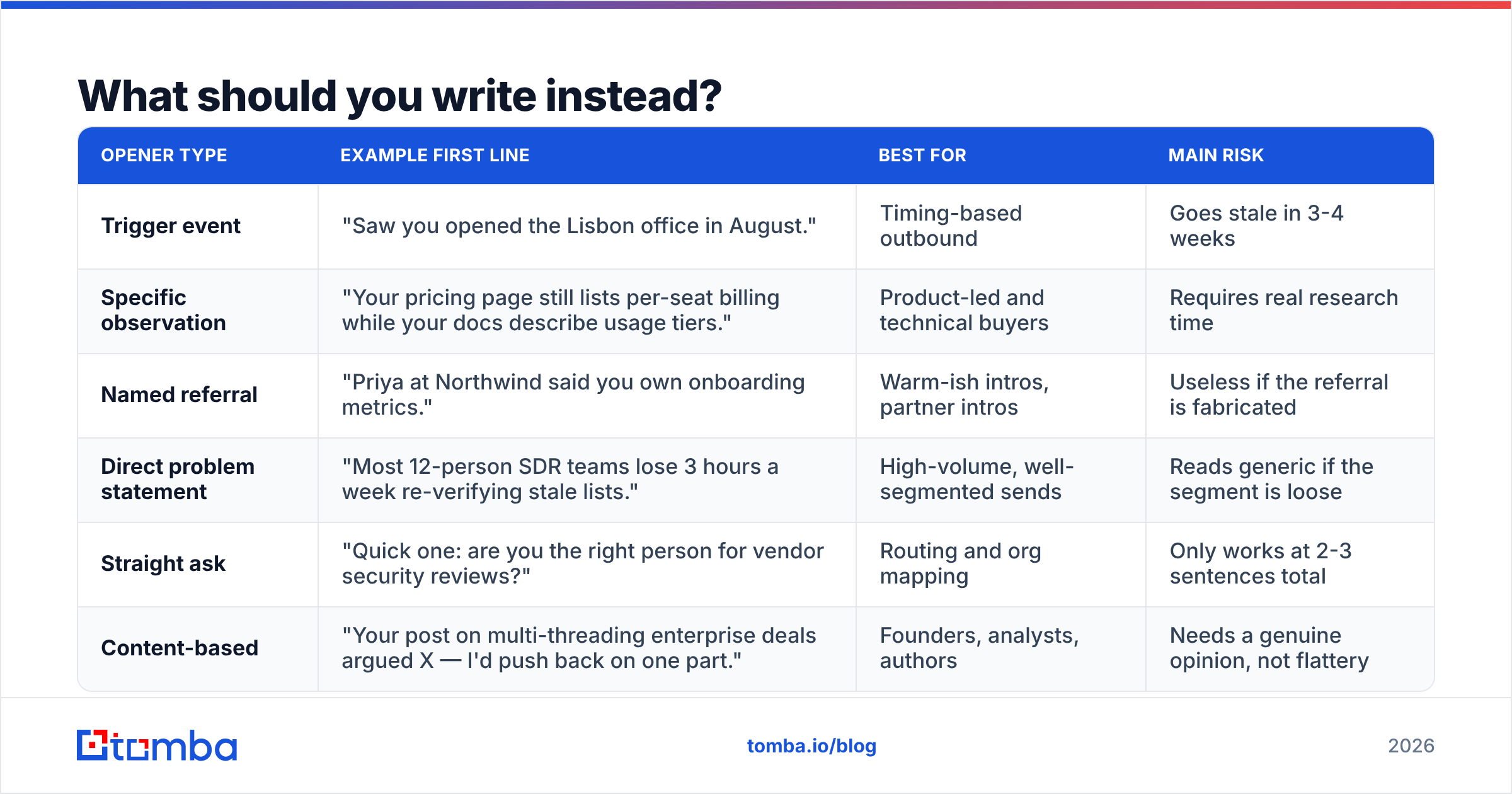
Replace the wish with an observation. The rule is simple: your first sentence should be a sentence you could not have sent to anyone else. If it survives a find-and-replace of the company name, it is not an opener, it is filler.
Here are the replacement patterns that consistently outperform, with the tradeoffs stated honestly.
| Opener type | Example first line | Best for | Main risk |
|---|---|---|---|
| Trigger event | "Saw you opened the Lisbon office in August." | Timing-based outbound | Goes stale in 3-4 weeks |
| Specific observation | "Your pricing page still lists per-seat billing while your docs describe usage tiers." | Product-led and technical buyers | Requires real research time |
| Named referral | "Priya at Northwind said you own onboarding metrics." | Warm-ish intros, partner intros | Useless if the referral is fabricated |
| Direct problem statement | "Most 12-person SDR teams lose 3 hours a week re-verifying stale lists." | High-volume, well-segmented sends | Reads generic if the segment is loose |
| Straight ask | "Quick one: are you the right person for vendor security reviews?" | Routing and org mapping | Only works at 2-3 sentences total |
| Content-based | "Your post on multi-threading enterprise deals argued X — I'd push back on one part." | Founders, analysts, authors | Needs a genuine opinion, not flattery |
The trigger-event and specific-observation rows outperform everything else in practice, and they share one dependency: you need accurate data about the person before you write. That is why opener quality and data quality are the same problem wearing two hats. A perfect first line sent to a role that left the company nine months ago is worth exactly zero.
For teams building these at scale, a cold email AI draft plus a human pass on the first sentence is a reasonable compromise: let the machine handle sentences two through five, and spend your human minutes only on line one.
How do you rewrite an email you already send?#
Take a real email and cut, do not add. Most weak cold emails are not missing anything; they are carrying three sentences of throat-clearing.
Before:
Hi Marcus,
I hope this email finds you well. My name is Dana and I'm a Senior Account Executive at Northbound, a leading provider of revenue intelligence solutions for high-growth B2B organizations. I wanted to reach out because I believe we could add tremendous value to your team.
Would you be open to a quick 15-minute call next week to explore synergies?
After:
Hi Marcus,
You're hiring three enterprise AEs in Q4 but your careers page shows no enablement role — that combination usually means ramp time lands on the frontline manager.
We cut ramp from 5 months to 11 weeks for two teams in the same spot (both around 40 reps). Worth 15 minutes, or should I send the 2-page breakdown instead?
Dana
The second version is shorter, contains one verifiable observation, one proof point with a scoped claim, and an ask with a low-friction alternative. Nothing was invented. The research was two browser tabs. Note also that the opener now doubles as the preview text — Marcus sees "You're hiring three enterprise AEs in Q4" next to the subject line, not a wellness wish.
If you want templated starting points rather than a blank page, the cold email templates library is structured around this pattern: observation, implication, scoped proof, single ask.
When is "I hope this email finds you well" actually fine?#
Do not turn this into dogma. There are real contexts where the phrase is correct and removing it makes you look worse.
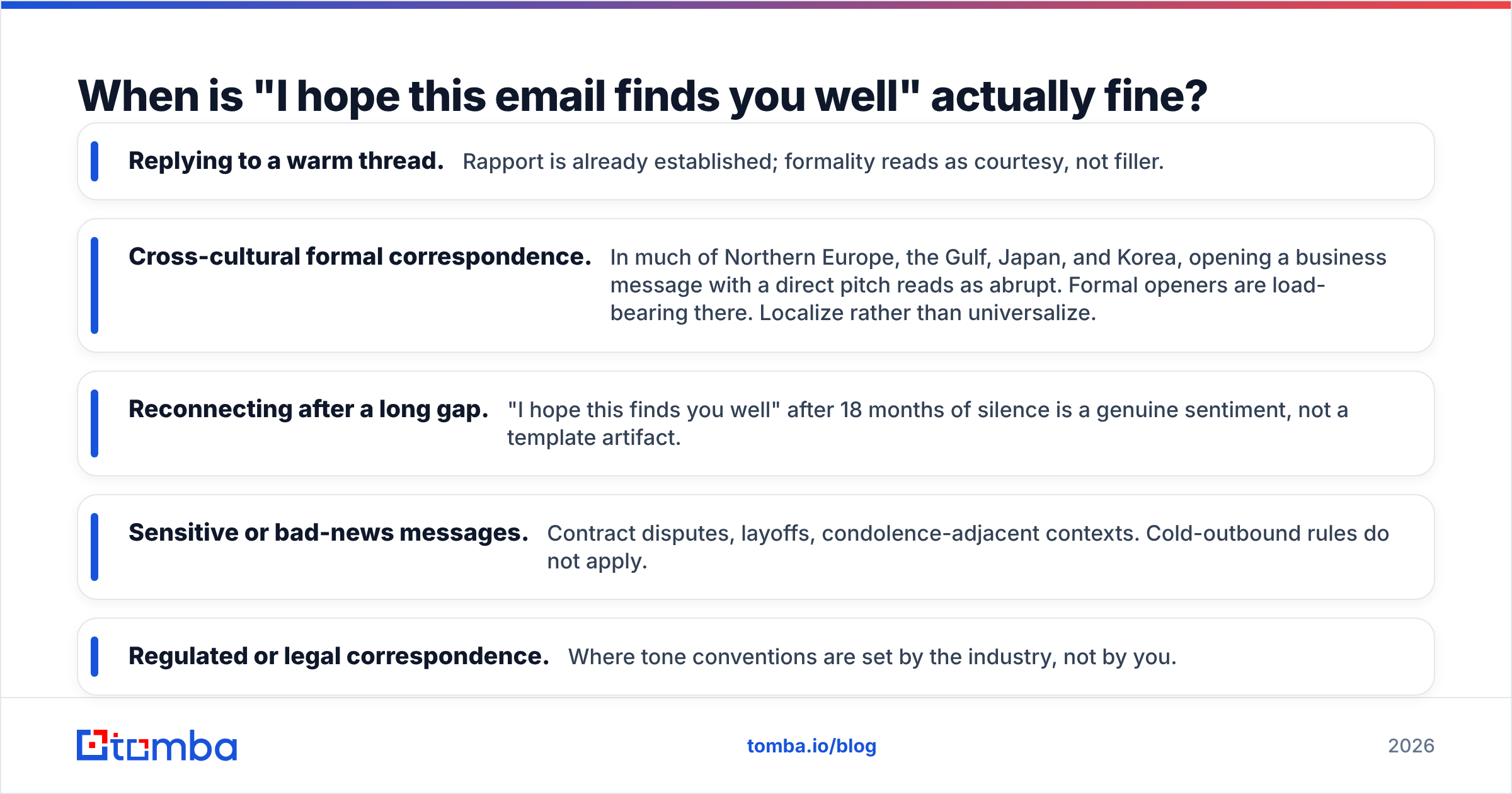
- Replying to a warm thread. Rapport is already established; formality reads as courtesy, not filler.
- Cross-cultural formal correspondence. In much of Northern Europe, the Gulf, Japan, and Korea, opening a business message with a direct pitch reads as abrupt. Formal openers are load-bearing there. Localize rather than universalize.
- Reconnecting after a long gap. "I hope this finds you well" after 18 months of silence is a genuine sentiment, not a template artifact.
- Sensitive or bad-news messages. Contract disputes, layoffs, condolence-adjacent contexts. Cold-outbound rules do not apply.
- Regulated or legal correspondence. Where tone conventions are set by the industry, not by you.
The distinction that matters is cold versus warm. In cold outbound you are borrowing attention from someone who did not ask for the email, so every character has to earn its place. In warm correspondence you already have permission, and social lubricant is worth more than efficiency. HubSpot's sales blog has covered this split at length, and most credible practitioner guidance lands in the same place.
Do openers matter more than deliverability and data?#
No, and this is where most opener advice goes wrong. Ranked by impact on a cold outbound program:
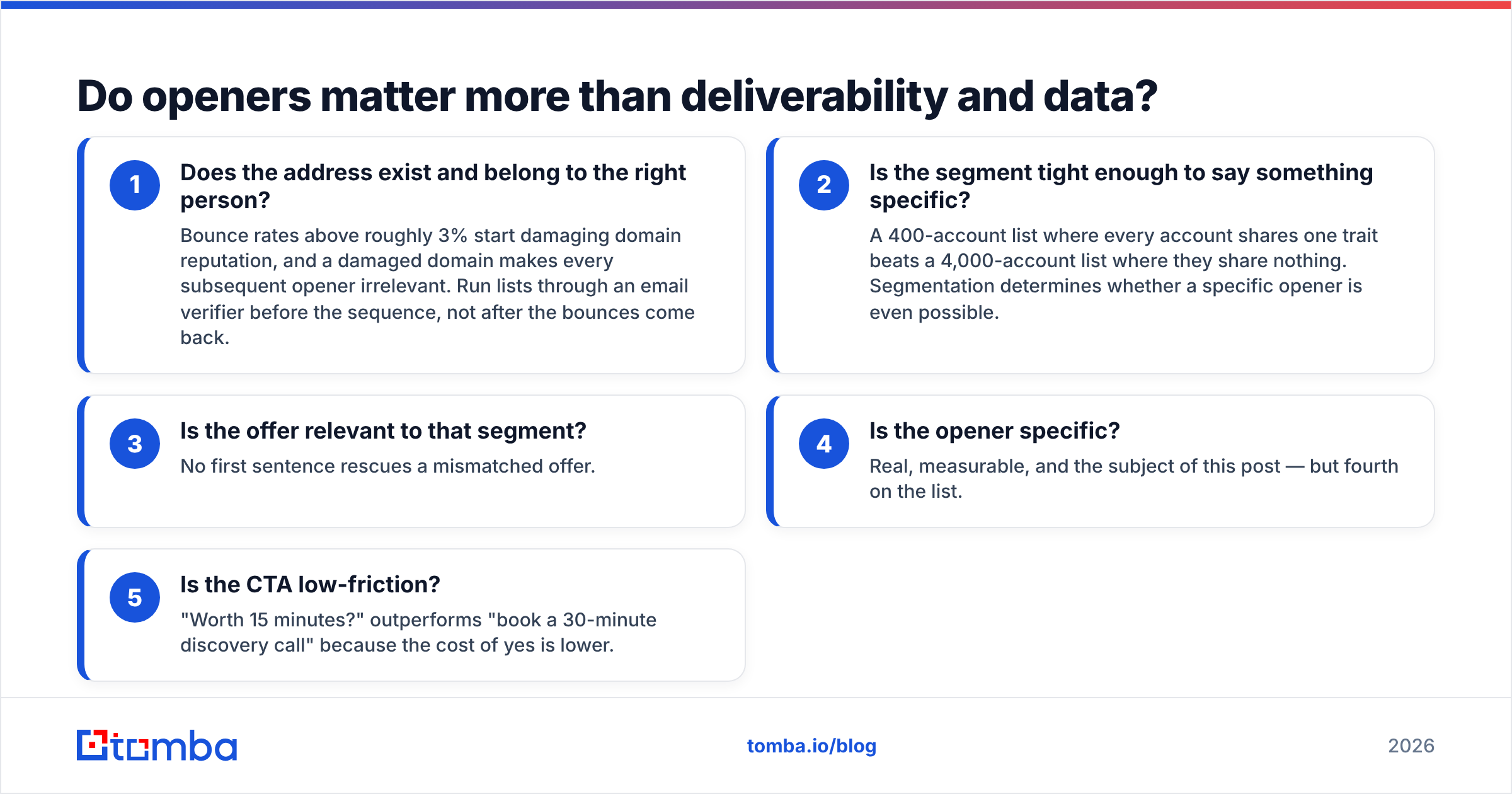
- Does the address exist and belong to the right person? Bounce rates above roughly 3% start damaging domain reputation, and a damaged domain makes every subsequent opener irrelevant. Run lists through an email verifier before the sequence, not after the bounces come back.
- Is the segment tight enough to say something specific? A 400-account list where every account shares one trait beats a 4,000-account list where they share nothing. Segmentation determines whether a specific opener is even possible.
- Is the offer relevant to that segment? No first sentence rescues a mismatched offer.
- Is the opener specific? Real, measurable, and the subject of this post — but fourth on the list.
- Is the CTA low-friction? "Worth 15 minutes?" outperforms "book a 30-minute discovery call" because the cost of yes is lower.
Teams that obsess over line one while sending to a list scraped 14 months ago are polishing the paint on a car with no engine. If you are unsure where your program actually leaks, measure response rate alongside bounce rate and spam-complaint rate before touching copy. Analyst coverage of sales technology stacks — Gartner's sales research is a reasonable neutral starting point — consistently ranks data quality above messaging craft as the constraint on outbound performance.
What does a good opener workflow look like end to end?#
Here is the sequence that produces specific first lines without burning an hour per prospect.
| Step | What you do | Time per prospect | Tooling |
|---|---|---|---|
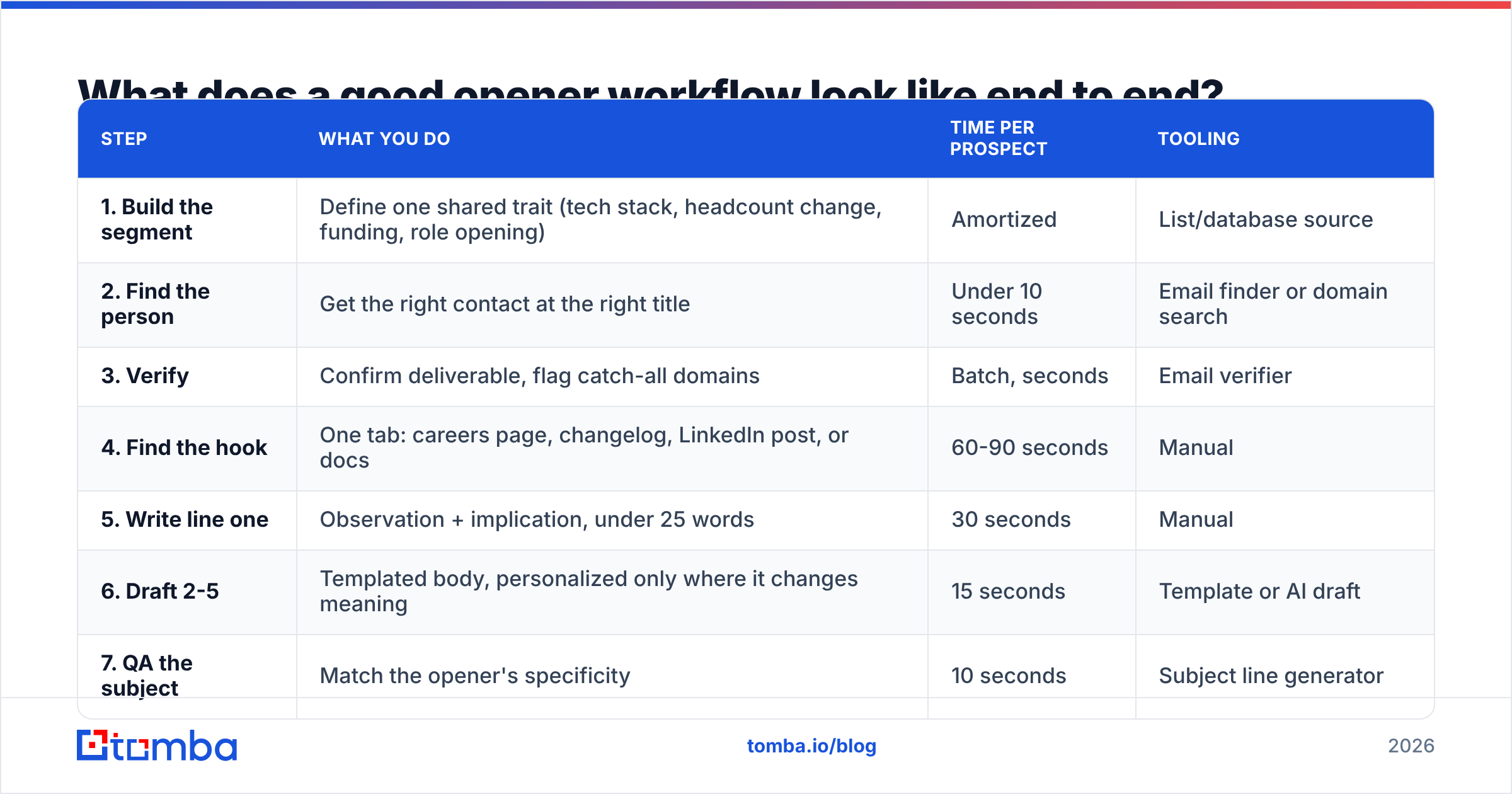
| 1. Build the segment | Define one shared trait (tech stack, headcount change, funding, role opening) | Amortized | List/database source |
| 2. Find the person | Get the right contact at the right title | Under 10 seconds | Email finder or domain search |
| 3. Verify | Confirm deliverable, flag catch-all domains | Batch, seconds | Email verifier |
| 4. Find the hook | One tab: careers page, changelog, LinkedIn post, or docs | 60-90 seconds | Manual |
| 5. Write line one | Observation + implication, under 25 words | 30 seconds | Manual |
| 6. Draft 2-5 | Templated body, personalized only where it changes meaning | 15 seconds | Template or AI draft |
| 7. QA the subject | Match the opener's specificity | 10 seconds | Subject line generator |
Two to three minutes per prospect. At 30 prospects a day that is 90 minutes, which is a realistic ask for a rep who is not also doing steps 2 and 3 by hand. Automating discovery and verification is what buys you the time to do step 4 and 5 properly — the mechanical work funds the human work.
For teams running this at volume, Tomba pricing starts with a free tier at 25 searches per month, then $49/mo for Starter, $99/mo for Growth, and $249/mo for Pro. Most two-to-five-rep teams doing 30 to 60 prospects per rep per day land on Growth.
What about subject lines — same rules?#
Same principle, tighter constraint. The subject line and the opener are read as one unit, and they should not repeat each other. If your subject is "Question about your Q4 AE hiring" and your opener is "I saw you're hiring three AEs in Q4," you have spent two slots on one idea.
Better pairing: a short, low-key subject that creates a small gap, and an opener that fills it. "Ramp time, 3 new AEs" as the subject, then the observation as the opener. Avoid subject lines that sound like campaign copy — title case, exclamation marks, and words like "exclusive" or "unlock" mark the message as bulk before anyone reads a word of it.
The one thing worth testing formally is subject line plus opener as a pair, not in isolation. Split your list, keep the body identical, change only the first two lines, and require at least 200 sends per variant before you believe anything. Most teams call winners on 40 sends and learn nothing.
The bottom line#
"I hope this email finds you well" is not a crime. It is a wasted line. In warm and formal contexts, keep it. In cold outbound, replace it with one sentence that proves you know who you are writing to — and make sure that sentence is true, current, and going to an address that actually exists.
That last part is the unglamorous half of the job. If your opener is sharp but 18% of your list bounces, you have optimized the wrong variable. Start with Tomba Email Finder to get the right contact at the right company, verify before you send, and spend the time you save writing a first line that could only have been written for one person. That is the whole trick.
Related guides#
// get started
Find, verify and enrich your first contacts today
Start on the free plan with 25 searches a month, then scale when your team is ready.
Free plan · No credit card required · GDPR & CCPA
Get the Tomba newsletter
Product and data updates
// about the author