ICP Pain Points in 2026: How to Find, Rank, and Sell to Them
Most ICP pain point lists are internal guesses dressed up as research. Here's how to source real buyer pain from calls, tickets, and churn data, rank it by revenue impact, and turn it into outbound that gets replies.
TL;DR
- ICP pain points are the specific, expensive, recurring problems a segment already spends money or headcount trying to solve — not "they want to grow faster."
- Most pain point lists fail because they were written in a conference room instead of pulled from call recordings, support tickets, churn interviews, and job postings.
- Rank pain by three things: frequency across accounts, cost of the status quo, and whether there's an owner with budget. Anything scoring low is a nice-to-have, not a wedge.
- A pain-led ICP outperforms a firmographic-only ICP because two 200-person SaaS companies can have completely different problems — and completely different buying triggers.
- Operationalize it: attach 2-3 validated pains to every segment, map each to a message, a proof point, and a contact role, then build the list with an email finder so the right person actually receives it.
What are ICP pain points, and how are they different from firmographics?#
Firmographics tell you who to contact. Pain points tell you why they'd care.
Think of it like a doctor's intake form. Your firmographics — industry, headcount, revenue band, tech stack, geography — are the demographic section: age, weight, height. Useful for narrowing things down, useless on their own. The pain points are the symptoms: what actually hurts, how long it's been hurting, and what the patient has already tried. Nobody books an appointment because they turned 42. They book because something hurts.
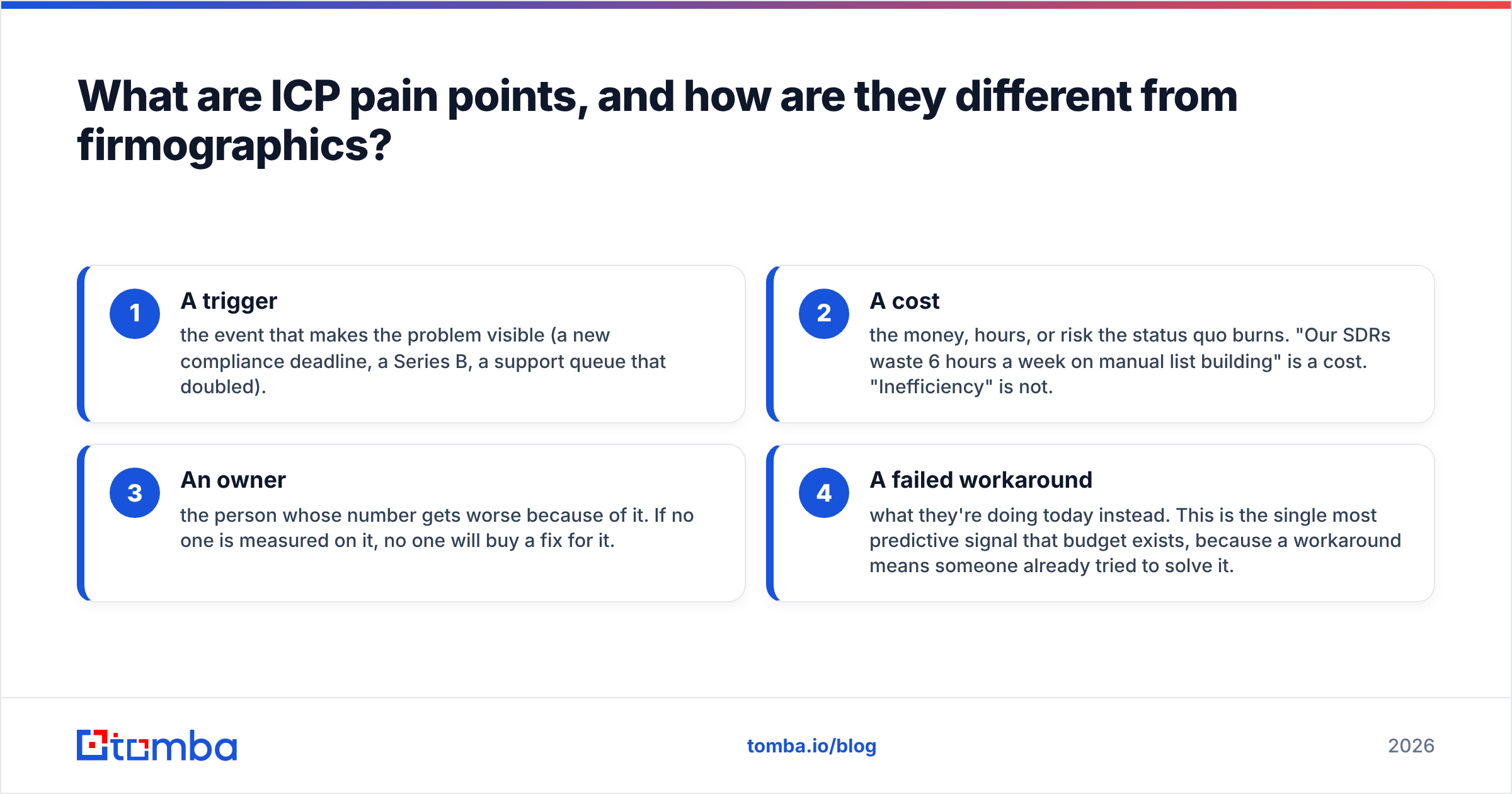
An ICP pain point, defined properly, has four parts:
- A trigger — the event that makes the problem visible (a new compliance deadline, a Series B, a support queue that doubled).
- A cost — the money, hours, or risk the status quo burns. "Our SDRs waste 6 hours a week on manual list building" is a cost. "Inefficiency" is not.
- An owner — the person whose number gets worse because of it. If no one is measured on it, no one will buy a fix for it.
- A failed workaround — what they're doing today instead. This is the single most predictive signal that budget exists, because a workaround means someone already tried to solve it.
If your ICP doc lists "wants to scale outbound" as a pain point, it's missing all four. That's a category, not a pain.
Why do most ICP pain point lists fail?#
Because they're written by the people furthest from the buyer.
The typical process: a product marketer opens a template, interviews two AEs and a founder, and produces a slide with six bullets. Every bullet is directionally true and operationally useless. Then the SDR team is told to "lead with pain," writes emails about "streamlining workflows," and reply rates sit at 1.2%.
Here are the four failure modes worth naming:
- Pain inflation. Describing an annoyance as a crisis. If the buyer wouldn't take a meeting about it on a Friday afternoon, it's not a wedge pain.
- Pain at the wrong altitude. The CFO's pain and the RevOps manager's pain are different problems in the same company. A single-pain ICP breaks the moment you sell to more than one persona.
- Pain that isn't yours. Real pain your product doesn't actually fix. You'll book meetings and lose them at the demo.
- Stale pain. Something that was urgent in 2023 and is now solved by a default setting in the tool they already own.
Gartner's research on B2B buying behavior consistently finds that buyers spend a small fraction of the cycle with any individual vendor and arrive with problems already partly diagnosed — which means your job isn't to create pain, it's to name a pain they already recognize faster and more precisely than your competitors do. You can read more of their buying-behavior work at Gartner's sales research hub.
Where do you actually source ICP pain points?#
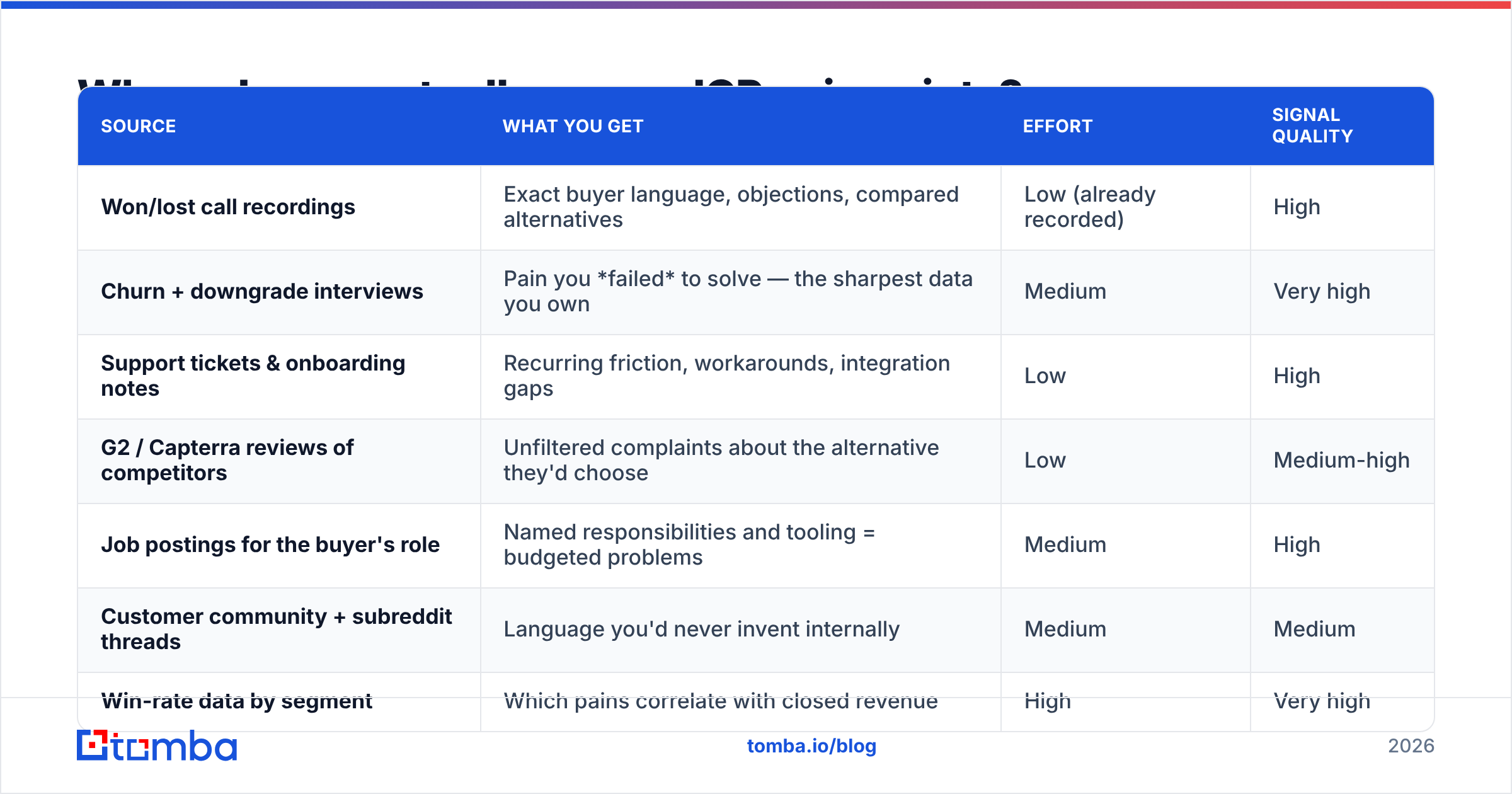
From evidence you didn't author. The best sources are ones where the buyer was talking to someone other than your sales team.
| Source | What you get | Effort | Signal quality |
|---|---|---|---|
| Won/lost call recordings | Exact buyer language, objections, compared alternatives | Low (already recorded) | High |
| Churn + downgrade interviews | Pain you failed to solve — the sharpest data you own | Medium | Very high |
| Support tickets & onboarding notes | Recurring friction, workarounds, integration gaps | Low | High |
| G2 / Capterra reviews of competitors | Unfiltered complaints about the alternative they'd choose | Low | Medium-high |
| Job postings for the buyer's role | Named responsibilities and tooling = budgeted problems | Medium | High |
| Customer community + subreddit threads | Language you'd never invent internally | Medium | Medium |
| Win-rate data by segment | Which pains correlate with closed revenue | High | Very high |
Two of these deserve special attention.
Churn interviews are underused because they're uncomfortable. They are also the only place where a customer will tell you, with no incentive to be polite, exactly which problem was severe enough to buy for and not severe enough to keep paying for. That gap is your ICP boundary.
Job postings are the cheapest trigger data in B2B. When a company posts a "Marketing Operations Manager" role that lists "own lead routing and data hygiene," you've learned three things at once: the problem exists, it's now owned, and there's headcount budget attached to it. That's a pain point with a receipt.
For competitor reviews, G2 is the practical starting point — filter by company size to make sure the complaints you're reading come from accounts that resemble your ICP, not from a 5-person startup on a free plan.
How do you rank ICP pain points by revenue impact?#
Score every candidate pain on three axes, 1-5 each, then multiply. Multiplication matters: a zero on any axis should sink the whole thing.
- Frequency — In what share of your target accounts does this pain exist right now? A pain in 15% of the segment isn't an ICP pain, it's a niche play.
- Cost of status quo — Can you express it in dollars, hours, or risk? If you can't quantify it in one sentence, your rep can't either.
- Budget ownership — Is there a named role whose metrics improve when it's fixed? No owner, no purchase order.
- Urgency trigger — Is there an event that makes it urgent this quarter? Pain without a clock produces "great conversation, let's revisit in Q3."
- Your differentiation — Do you solve it visibly better than the workaround? If the answer is "about the same," you're competing on price.
Anything scoring above 300 (of a possible 3,125) is a wedge. Anything below 100 is supporting material for the deck, not a subject line.
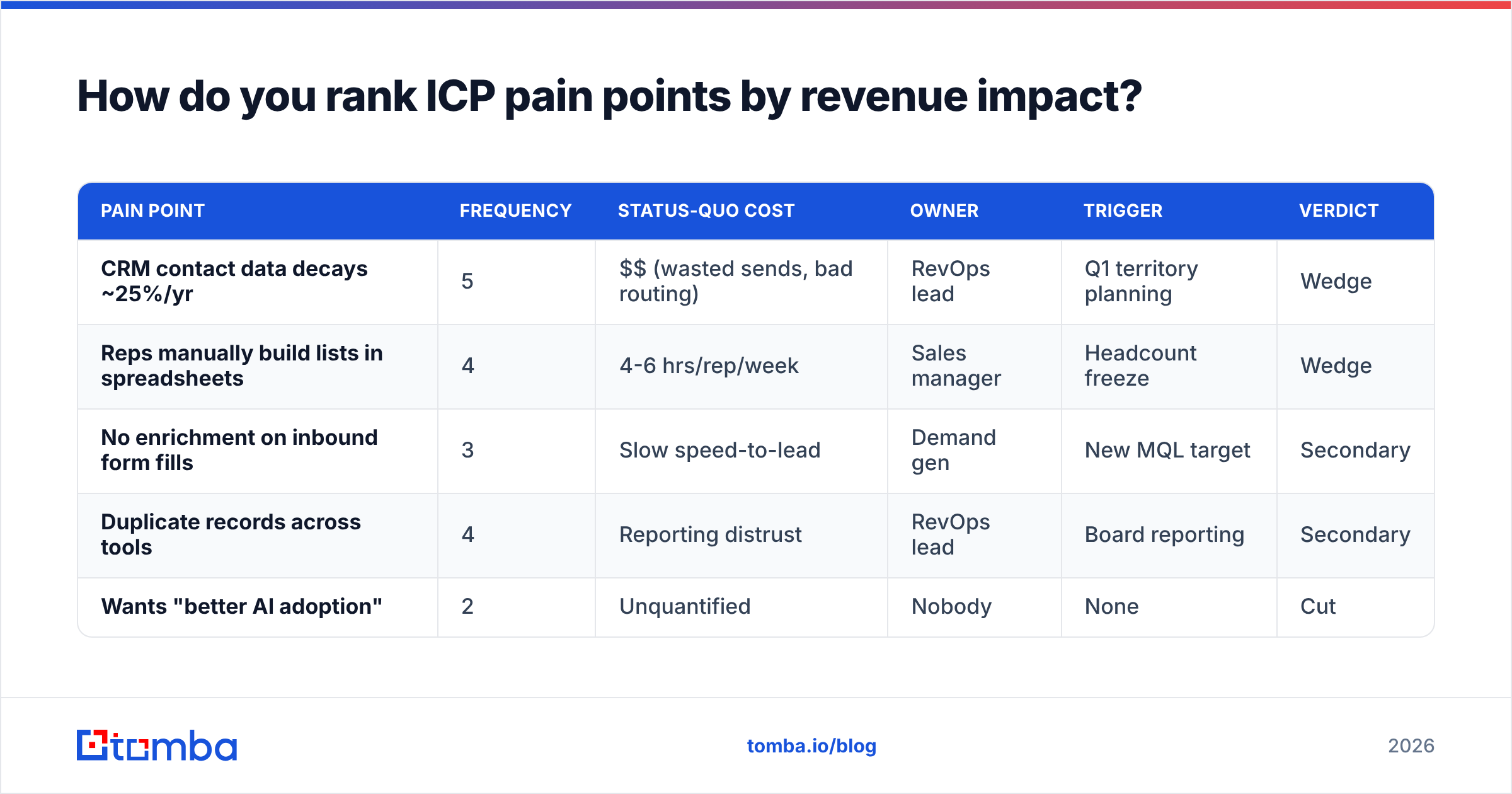
Here's what the output looks like for a mid-market RevOps ICP:
| Pain point | Frequency | Status-quo cost | Owner | Trigger | Verdict |
|---|---|---|---|---|---|
| CRM contact data decays ~25%/yr | 5 | $$ (wasted sends, bad routing) | RevOps lead | Q1 territory planning | Wedge |
| Reps manually build lists in spreadsheets | 4 | 4-6 hrs/rep/week | Sales manager | Headcount freeze | Wedge |
| No enrichment on inbound form fills | 3 | Slow speed-to-lead | Demand gen | New MQL target | Secondary |
| Duplicate records across tools | 4 | Reporting distrust | RevOps lead | Board reporting | Secondary |
| Wants "better AI adoption" | 2 | Unquantified | Nobody | None | Cut |
That last row is the one most ICP documents lead with. Notice it has no owner and no cost. Cut it.
What does a pain-led ICP actually look like in practice?#
Rewrite your ICP so each segment carries its pains inline. Instead of:
ICP: B2B SaaS, 50-500 employees, US, using HubSpot or Salesforce.
You write:
Segment A: B2B SaaS, 50-500 employees, US, Salesforce-based, 5+ SDRs.
Primary pain: list building consumes 4-6 hours per rep per week; current workaround is a shared spreadsheet plus a Chrome extension with inconsistent coverage.
Owner: VP Sales (measured on meetings booked per rep).
Trigger: hiring freeze or an increased meeting quota.
Proof point: "One 12-rep team cut list-building time by 70% and reallocated it to calls."
Entry contact: Sales Ops Manager → VP Sales.
Now every downstream asset writes itself. The subject line comes from the pain. The first line comes from the trigger. The CTA comes from the proof point. And the contact role tells your data team exactly whose address to find — which is where domain search and data enrichment stop being generic "tools" and start being the thing that makes the segment executable.

How do you turn ICP pain points into messaging that gets replies?#
The mechanical translation is simpler than most teams make it.
- Subject line = the cost, not the solution. "6 hours a week on list building" beats "Tomba for SDR teams."
- First line = the trigger. Reference the observable event (the job posting, the funding round, the new tool in their stack). This is the only personalization that survives at scale.
- Second line = the failed workaround. "Most teams your size are doing this with a shared sheet and a Chrome extension that misses ~30% of contacts." Naming the workaround proves you've talked to people like them.
- Third line = one proof point with a number. Not three. One.
- CTA = low-commitment and specific. "Want the 4-line teardown of how the 12-rep team did it?" outperforms "open to a quick 15-min chat?"
HubSpot's sales blog has a long-running body of data on what actually moves reply rates — worth reading alongside your own numbers rather than instead of them: HubSpot's sales research.
One caution: pain-led messaging fails hard if the email doesn't land. A perfectly diagnosed pain sent to a stale or catch-all address is invisible. Run your list through an email verifier before the first send, and treat bounce rate as a targeting metric, not just a deliverability one — a segment that bounces heavily usually means your firmographic filter is picking up dead or acquired companies.
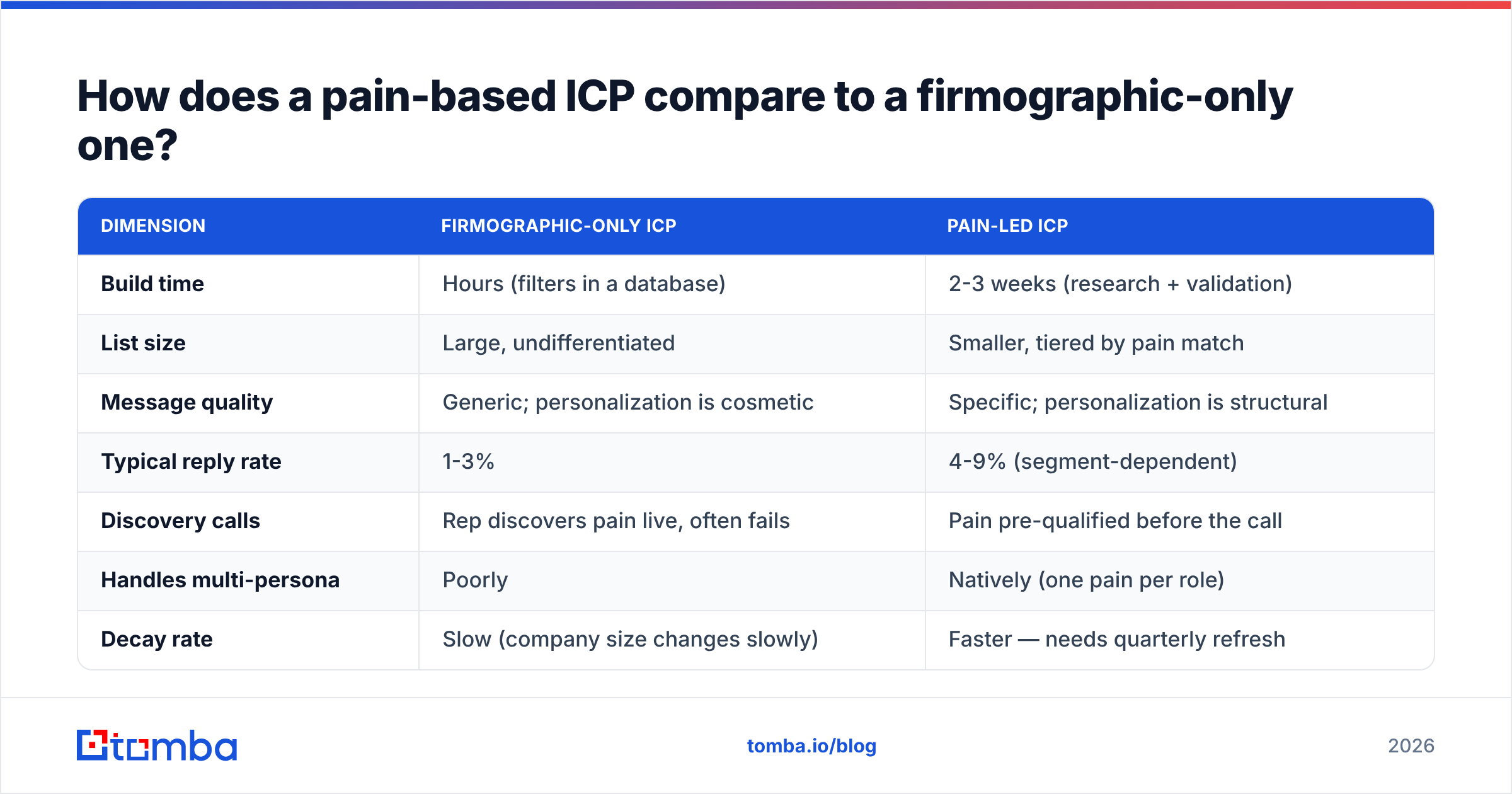
How does a pain-based ICP compare to a firmographic-only one?#
| Dimension | Firmographic-only ICP | Pain-led ICP |
|---|---|---|
| Build time | Hours (filters in a database) | 2-3 weeks (research + validation) |
| List size | Large, undifferentiated | Smaller, tiered by pain match |
| Message quality | Generic; personalization is cosmetic | Specific; personalization is structural |
| Typical reply rate | 1-3% | 4-9% (segment-dependent) |
| Discovery calls | Rep discovers pain live, often fails | Pain pre-qualified before the call |
| Handles multi-persona | Poorly | Natively (one pain per role) |
| Decay rate | Slow (company size changes slowly) | Faster — needs quarterly refresh |
| Best for | Broad TAM, low ACV, high volume | Mid-to-high ACV, competitive category |
The honest tradeoff is in the last two rows. Pain-led ICPs are more work and they go stale faster. If you're selling a $200/year product to 400,000 potential accounts, the firmographic approach may genuinely be more efficient. Above roughly $10K ACV in a crowded category, the math flips decisively.
If you're not sure where a given account sits, the standard qualification vocabulary still helps — our B2B glossary covers terms like MQL if you're aligning definitions across sales and marketing.
How often should you refresh your ICP pain points?#
Quarterly, with a hard annual rebuild.
Set a standing 90-minute review each quarter with one person from sales, one from CS, and one from product. The agenda is three questions:
- Which pain showed up in closed-won deals we didn't have on the list? Add it.
- Which listed pain produced meetings that didn't convert? Demote or cut it.
- What changed in the market that solved a pain for free? Platform defaults, new regulations, and competitor feature releases quietly kill wedges.
Bring evidence to each answer — deal notes, call transcripts, win-rate splits. A pain point that survives on someone's confidence rather than data is exactly how the list rotted the first time.
The jobs-to-be-done framing is a useful mental model here if you want a more formal structure for the interviews; the Jobs to Be Done overview is a reasonable primer before you commit a quarter to it.
What's the fastest way to put this into production?#
Pick one segment. Pull twenty call recordings and ten churn notes. Extract every problem statement verbatim. Cluster them. Score the clusters on the five axes above. Keep the top two. Write one email sequence per pain, per role. Build the list. Send. Measure reply rate by pain, not by campaign.
That last part is what separates teams who say they run a pain-led ICP from teams who actually do. If you can't tell which pain produced which meetings, you're still guessing — just with better slides.
Once you know which pain and which role you're targeting, the bottleneck becomes getting accurate contact data for that specific person at scale. That's the job Tomba Email Finder was built for: find verified professional addresses by domain, name, or company so your pain-led sequences reach the RevOps manager you actually researched — not a generic info@ inbox. The free tier includes 25 searches a month to test it against your first segment, and paid plans start at $49/mo when you're ready to run the whole list. Check Tomba pricing for the full breakdown.
Related guides#
// get started
Find, verify and enrich your first contacts today
Start on the free plan with 25 searches a month, then scale when your team is ready.
Free plan · No credit card required · GDPR & CCPA
// about the author