7 Best iCustomer Alternatives in 2026 for GTM Data Teams
iCustomer sells an agentic GTM platform, but most teams only need clean contact data and fast enrichment. Here are seven alternatives compared on pricing, coverage, and how long they take to deliver value.
TL;DR
- iCustomer is an AI-native GTM platform: it unifies your CRM, product, and third-party data, then runs agents on top of it for ICP scoring, enrichment, and account research. It is a platform purchase, not a point tool.
- Pricing is not published on the site at the time of writing, so every evaluation starts with a demo call and a scoping exercise. That alone pushes a lot of small teams toward alternatives.
- If your actual bottleneck is "I need verified email addresses and phone numbers for a defined list of accounts," a focused data tool costs 10-50x less and ships the same week.
- The seven alternatives below split into three groups: focused contact-data tools (Tomba, BookYourData), data orchestration layers (Clay), and full GTM suites (Apollo, ZoomInfo, Cognism, Common Room).
- Pick by the bottleneck you can name out loud. If you can't name it, you are buying a platform to postpone a decision.
What is iCustomer and what does it actually do?#
iCustomer positions itself as an agentic go-to-market platform. The pitch: instead of stitching together a data provider, an enrichment vendor, a scoring model, and a research workflow, you connect your systems once and let AI agents handle account research, ICP definition, segmentation, and data hygiene continuously.
That is a genuinely useful category. Modern GTM data is fragmented across your CRM, your product telemetry, billing, support tickets, and three or four third-party sources that disagree with each other. A unification layer that resolves identities and keeps them fresh solves a real problem for companies past roughly $10M ARR with a dedicated RevOps function.
The catch is the shape of the purchase. Platform products in this category share a profile:
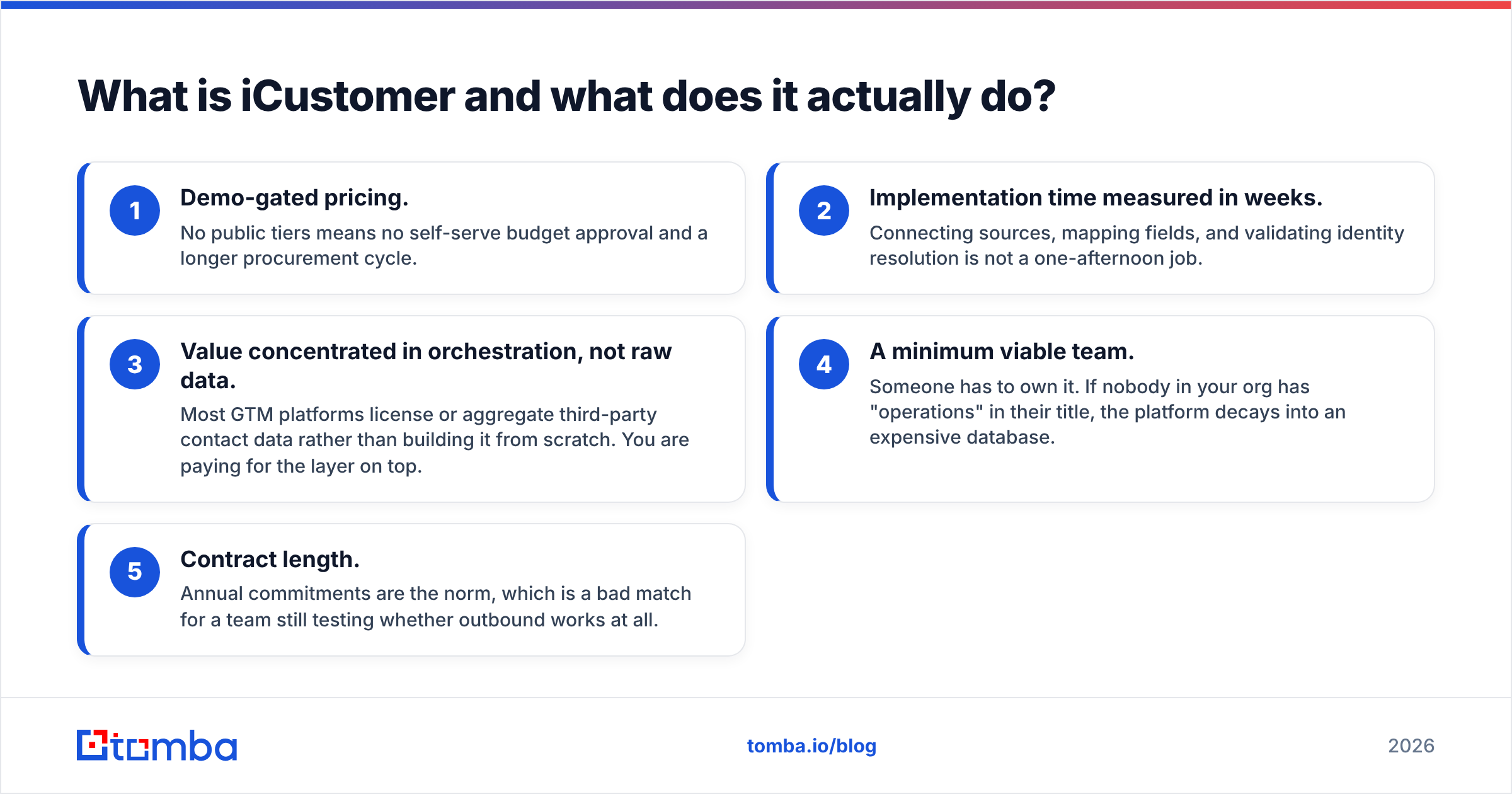
- Demo-gated pricing. No public tiers means no self-serve budget approval and a longer procurement cycle.
- Implementation time measured in weeks. Connecting sources, mapping fields, and validating identity resolution is not a one-afternoon job.
- Value concentrated in orchestration, not raw data. Most GTM platforms license or aggregate third-party contact data rather than building it from scratch. You are paying for the layer on top.
- A minimum viable team. Someone has to own it. If nobody in your org has "operations" in their title, the platform decays into an expensive database.
- Contract length. Annual commitments are the norm, which is a bad match for a team still testing whether outbound works at all.
None of that makes iCustomer a bad product. It makes it a specific product for a specific buyer. The reason people search for iCustomer alternatives is usually that they recognized themselves in the wrong column.
Why do teams look for iCustomer alternatives?#
Four patterns come up repeatedly in evaluation calls:
- Budget mismatch. A seed-stage team with two SDRs does not need identity resolution across six systems. It needs 3,000 verified emails a month.
- Time to first value. Outbound teams are judged quarterly. A platform that produces its first useful segment in week six has already burned half a quarter.
- Data ownership. Some buyers want the raw contact data exportable and portable, not locked inside a scoring layer they can't audit.
- Overlap with existing stack. If you already run HubSpot or Salesforce with a decent enrichment feed, a second unification layer duplicates work. Gartner's recurring finding on sales tech is that stack sprawl, not stack gaps, is what kills adoption.
The honest version of the question is not "what else does what iCustomer does?" It is "what is the smallest thing that fixes my actual bottleneck?"
How do the top iCustomer alternatives compare?#
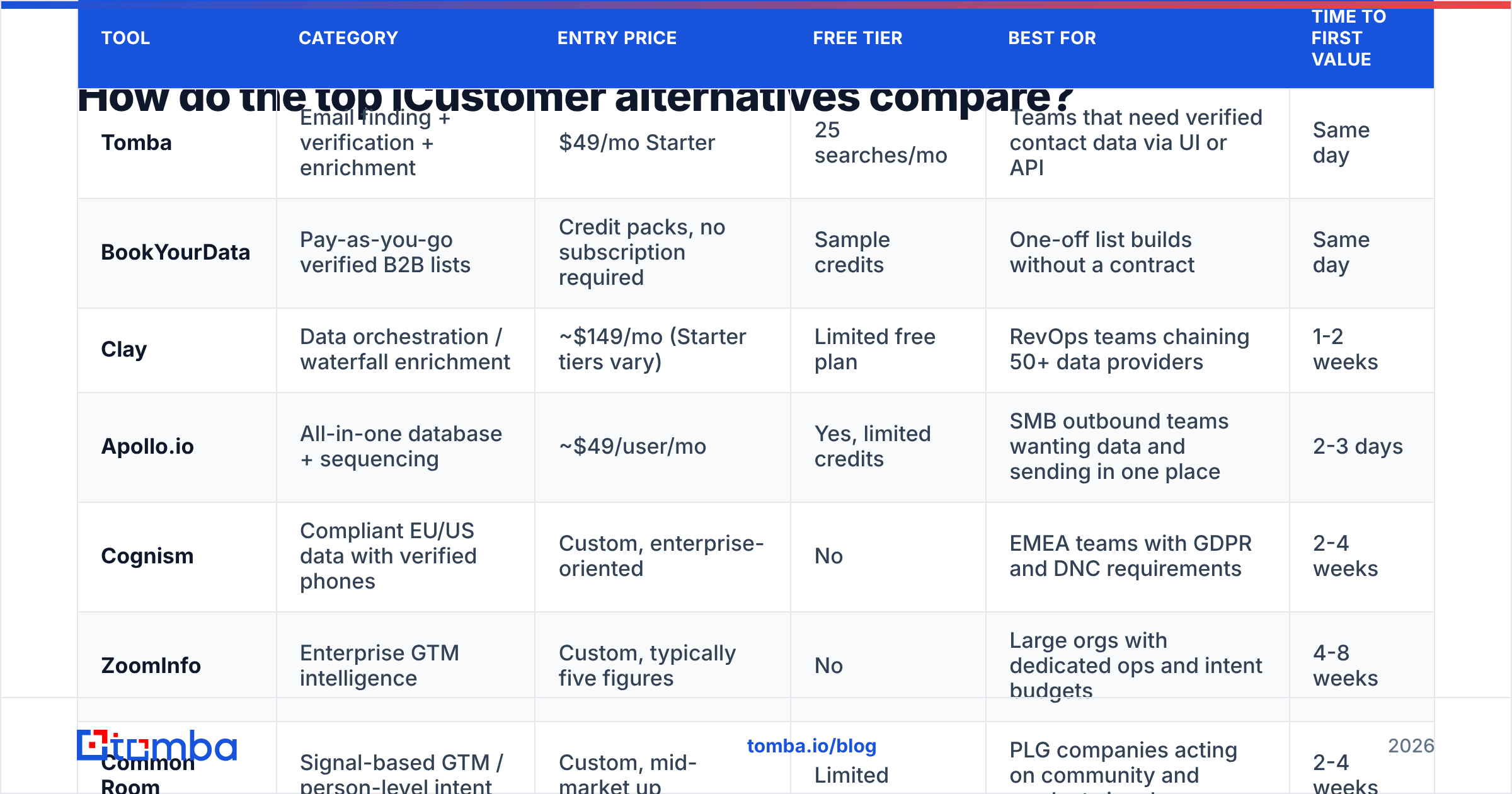
| Tool | Category | Entry price | Free tier | Best for | Time to first value |
|---|---|---|---|---|---|
| Tomba | Email finding + verification + enrichment | $49/mo Starter | 25 searches/mo | Teams that need verified contact data via UI or API | Same day |
| BookYourData | Pay-as-you-go verified B2B lists | Credit packs, no subscription required | Sample credits | One-off list builds without a contract | Same day |
| Clay | Data orchestration / waterfall enrichment | ~$149/mo (Starter tiers vary) | Limited free plan | RevOps teams chaining 50+ data providers | 1-2 weeks |
| Apollo.io | All-in-one database + sequencing | ~$49/user/mo | Yes, limited credits | SMB outbound teams wanting data and sending in one place | 2-3 days |
| Cognism | Compliant EU/US data with verified phones | Custom, enterprise-oriented | No | EMEA teams with GDPR and DNC requirements | 2-4 weeks |
| ZoomInfo | Enterprise GTM intelligence | Custom, typically five figures | No | Large orgs with dedicated ops and intent budgets | 4-8 weeks |
| Common Room | Signal-based GTM / person-level intent | Custom, mid-market up | Limited | PLG companies acting on community and product signals | 2-4 weeks |
Prices reflect publicly listed figures at the time of writing and change often. Verify on each vendor's pricing page before you build a business case, and cross-check user-reported costs on G2.
Which iCustomer alternative fits which problem?#
Tomba — when the bottleneck is contact data, not orchestration#
Tomba is deliberately narrow. It finds and verifies business email addresses, and it exposes everything through both a UI and a documented API. The email finder takes a name and a domain and returns a deliverable address with a confidence score and the sources behind it. The email verifier checks syntax, MX records, and SMTP acceptance before you send. Domain search returns every known address at a company with role and department labels.
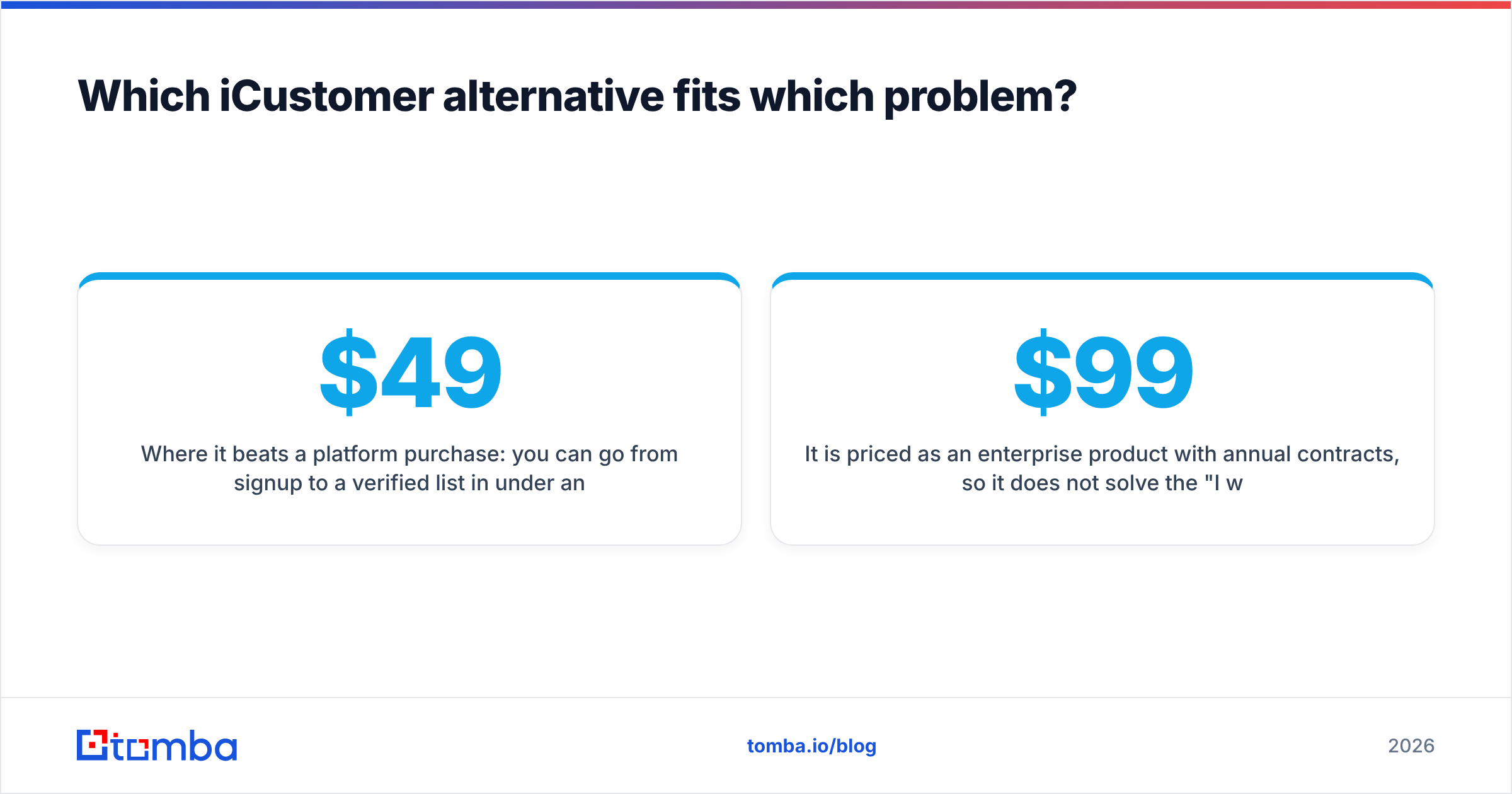
Where it beats a platform purchase: you can go from signup to a verified list in under an hour, on a free tier of 25 searches per month, then $49/mo Starter, $99/mo Growth, and $249/mo Pro. There is no scoping call and no annual contract. Tomba pricing is published, which matters more than it sounds when you are trying to get a card approved.
Where it does not compete: Tomba is not an identity-resolution layer for your product telemetry. If your problem statement is "our CRM has four versions of the same account and nobody trusts the ICP score," Tomba is the wrong shape. Use data enrichment to fill gaps in records you already have, and something else to decide which records matter.
Best for: founders, SDR teams, agencies, and any engineering team that would rather call an API than log into a dashboard.
BookYourData — when you want a list without a subscription#
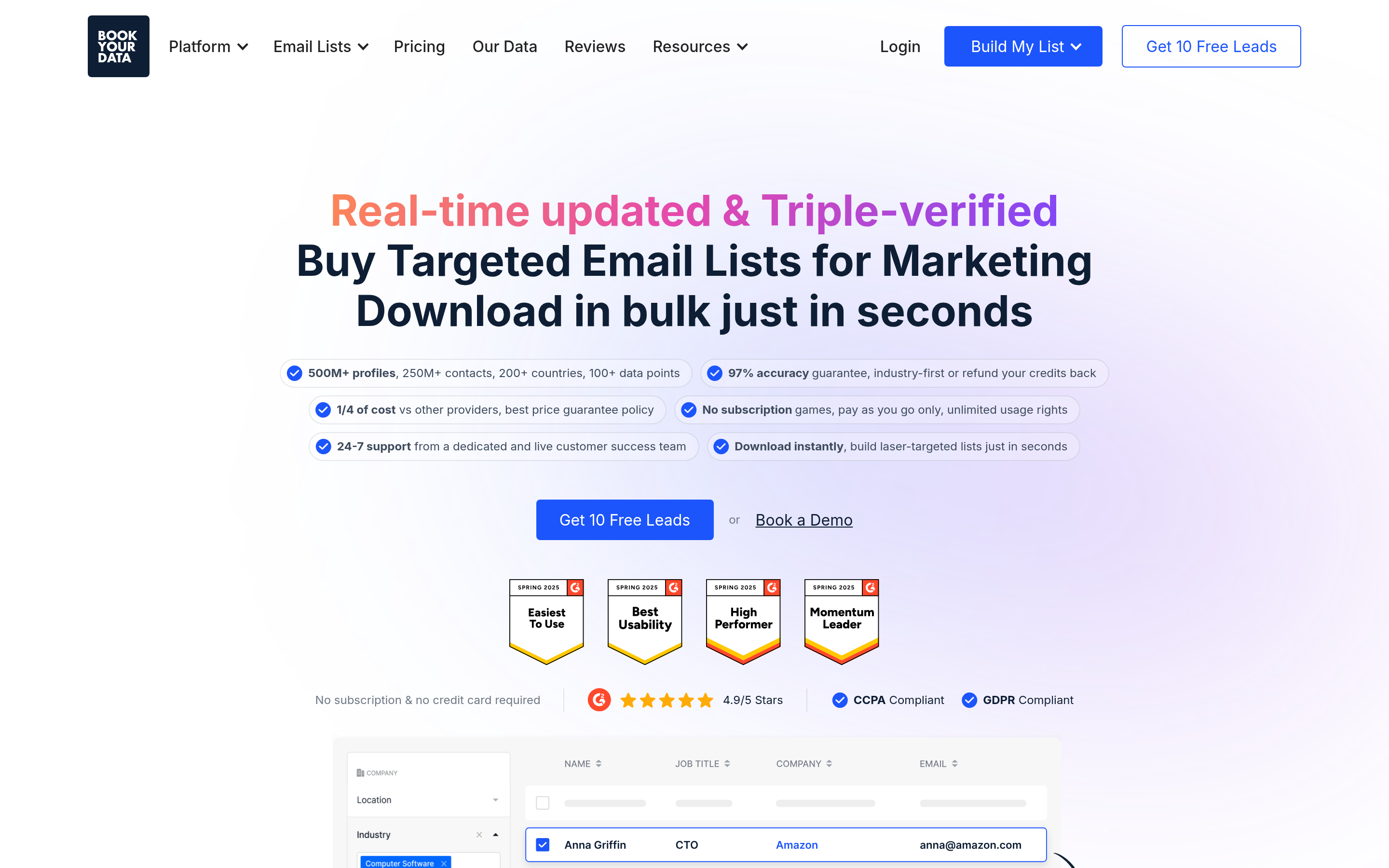
BookYourData sells verified B2B contact lists on a pay-as-you-go basis with an accuracy guarantee. You filter by industry, title, geography, and company size, preview the count, and buy exactly that. It is a clean fit for teams running a defined campaign against a defined segment: a conference follow-up, a regional expansion test, an ABM pilot against 400 named accounts.
The model is the appeal. No seats, no annual commitment, no unused credits expiring at month end. For companies that run outbound in bursts rather than continuously, that beats any subscription on effective cost per usable contact.
Best for: campaign-based outbound, ABM pilots, and teams that hate recurring software line items.
Clay — when the bottleneck is orchestration across many sources#
Clay is the closest structural analogue to what iCustomer sells, approached from the opposite direction. Instead of one unified platform, Clay gives you a spreadsheet-shaped canvas where each column can call a different provider, an LLM, or a scraper, with waterfall logic that falls through to the next source when the first misses.
The power is real and so is the learning curve. Clay rewards teams with an operator who enjoys building systems. Credit consumption is also the thing everyone underestimates: a waterfall that hits six providers per row burns budget fast on a 50,000-row table. Budget for a build phase of one to two weeks before the first campaign ships.
Best for: RevOps teams with a builder mentality and enough volume to justify the tuning.
Apollo.io — when you want data and sending in one bill#
Apollo bundles a large contact database with sequencing, dialing, and basic CRM functionality. For an SMB team that wants one tool and one invoice, that consolidation is worth real money.
The tradeoffs are well documented by users: data freshness varies by segment, European coverage lags North America, and email deliverability suffers when thousands of accounts blast the same contacts from similar templates. Many teams end up pairing Apollo's sequencer with a separate verification step before send. If you are already down that path, an Apollo alternative for the data half of the stack is a cheaper fix than replacing the whole thing.
Best for: small teams prioritizing consolidation over precision.
Cognism — when compliance is the constraint#
Cognism's differentiator is compliance posture and phone-verified mobile numbers, with notification-based processing across EMEA and DNC list screening. If you sell into Germany, France, or the UK and your legal team asks pointed questions about lawful basis, this is the category answer.
It is priced as an enterprise product with annual contracts, so it does not solve the "I want to start Monday for $99" problem. It solves a different one.
Best for: EMEA-heavy teams where a compliance failure costs more than the license.
ZoomInfo — when you have the budget and the ops headcount#

ZoomInfo remains the deepest firmographic and technographic dataset in the category, with intent signals, org charts, and workflow automation layered on top. It is also the most expensive line item most GTM teams carry, and it demands an owner. Teams that buy it without one report the same failure mode: rich data nobody operationalizes.
Best for: enterprises with dedicated RevOps and a real intent-data strategy.
Common Room — when the signal matters more than the record#
Common Room aggregates person-level signals from community, social, product, and web sources, then tells you which known humans at target accounts are showing activity right now. It is not a replacement for a contact database; it is a replacement for guessing at timing.
Pair it with a contact-data source and it works well. Buy it expecting a list of emails and you will be disappointed.
Best for: PLG and community-led companies with a signal-rich footprint.

How do you choose without booking six demos?#
Run this in order. It takes an afternoon.
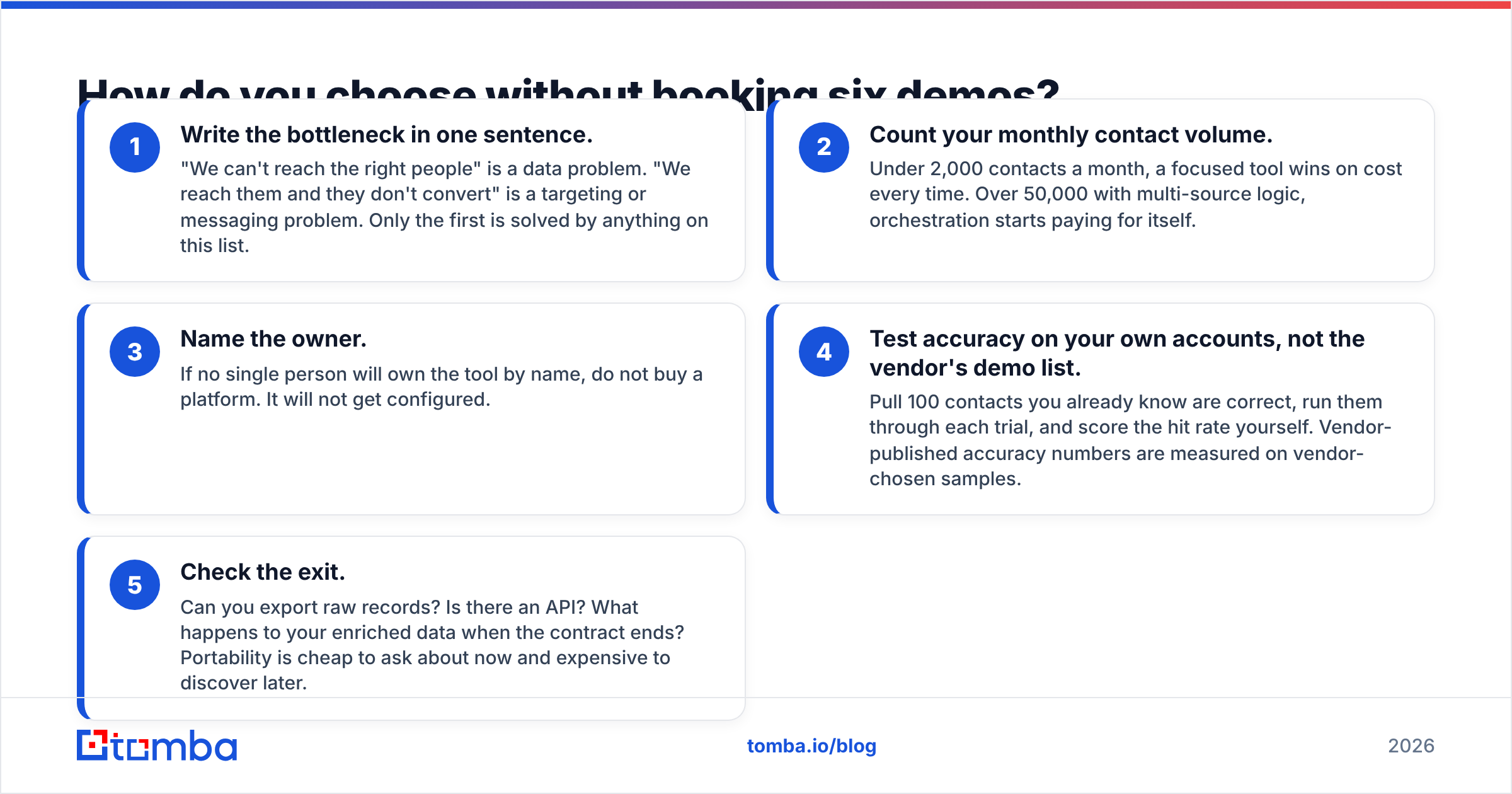
- Write the bottleneck in one sentence. "We can't reach the right people" is a data problem. "We reach them and they don't convert" is a targeting or messaging problem. Only the first is solved by anything on this list.
- Count your monthly contact volume. Under 2,000 contacts a month, a focused tool wins on cost every time. Over 50,000 with multi-source logic, orchestration starts paying for itself.
- Name the owner. If no single person will own the tool by name, do not buy a platform. It will not get configured.
- Test accuracy on your own accounts, not the vendor's demo list. Pull 100 contacts you already know are correct, run them through each trial, and score the hit rate yourself. Vendor-published accuracy numbers are measured on vendor-chosen samples.
- Check the exit. Can you export raw records? Is there an API? What happens to your enriched data when the contract ends? Portability is cheap to ask about now and expensive to discover later.
On step four, one detail decides the outcome: bounce rate. A provider claiming 95% accuracy that delivers 88% deliverability will cost you sender reputation faster than the extra contacts help. Always verify before send, whichever source you buy from.
Is a GTM platform ever the right answer?#
Yes, under three conditions together: you have more than one system holding customer truth, you have someone whose full-time job is making those systems agree, and your deal sizes justify a five-figure annual line item. Enterprise teams in that position get real leverage from unification and agentic research, and iCustomer is a credible option there alongside the larger suites.
Below that bar, the platform is a bet that tooling will produce a GTM motion you haven't found yet. It rarely does. The teams that fix pipeline first usually do it with a clean list, a verified send, and a message worth reading — then buy the platform once the motion is proven and the volume hurts.
Where should you start?#
Start with the smallest tool that fixes the sentence you wrote in step one.
If that sentence was about reaching the right people, run 25 free searches through the Tomba Email Finder against accounts you already know. Check the hit rate and the bounce rate yourself, then decide whether you have a data problem or a platform problem. It costs nothing to find out, and the answer will save you a quarter either way.
Related guides#
// get started
Find, verify and enrich your first contacts today
Start on the free plan with 25 searches a month, then scale when your team is ready.
Free plan · No credit card required · GDPR & CCPA
// about the author