iCustomer Pricing and Reviews (2026): Pros, Cons, Real Costs
iCustomer sells AI GTM agents on quote-only pricing. Here's what buyers report paying, what reviews actually praise, where the platform frustrates teams, and when a cheaper data stack does the same job.
TL;DR
- iCustomer does not publish a public price list. Every plan is quote-based, which means your cost depends on data volume, seat count, and how hard your procurement team pushes back.
- Buyers who have shared numbers publicly describe annual commitments rather than monthly credit cards. Treat any figure you read online — including the ranges below — as directional, not a quote.
- The strongest reviews praise the unified GTM data layer and the AI agents that stitch CRM, product, and intent signals together. The most common complaints are onboarding time, opaque credit consumption, and the gap between demo and production quality.
- iCustomer competes with platform-level tools (Clay, Apollo, 6sense), not with single-purpose data providers. If all you actually need is verified contact data, you are overbuying.
- A lean alternative: pair a focused email finder and verifier at a published price with the CRM you already own. Tomba's Starter plan is $49/mo with public pricing, no sales call required.
What is iCustomer and who is it actually for?#
iCustomer positions itself as an AI go-to-market platform rather than a contact database. The pitch on icustomer.ai is a unified data layer plus AI agents that run research, scoring, segmentation, and outbound orchestration on top of it. Think of it less as a phone book and more as a general contractor: it does not just hand you materials, it tries to run the build.
That framing matters for pricing. Single-purpose tools price per lookup or per credit, and you can do the arithmetic in your head. Platform tools price per outcome, per workspace, or per "GTM engineer seat," and the arithmetic happens in a spreadsheet a rep emails you after the demo.
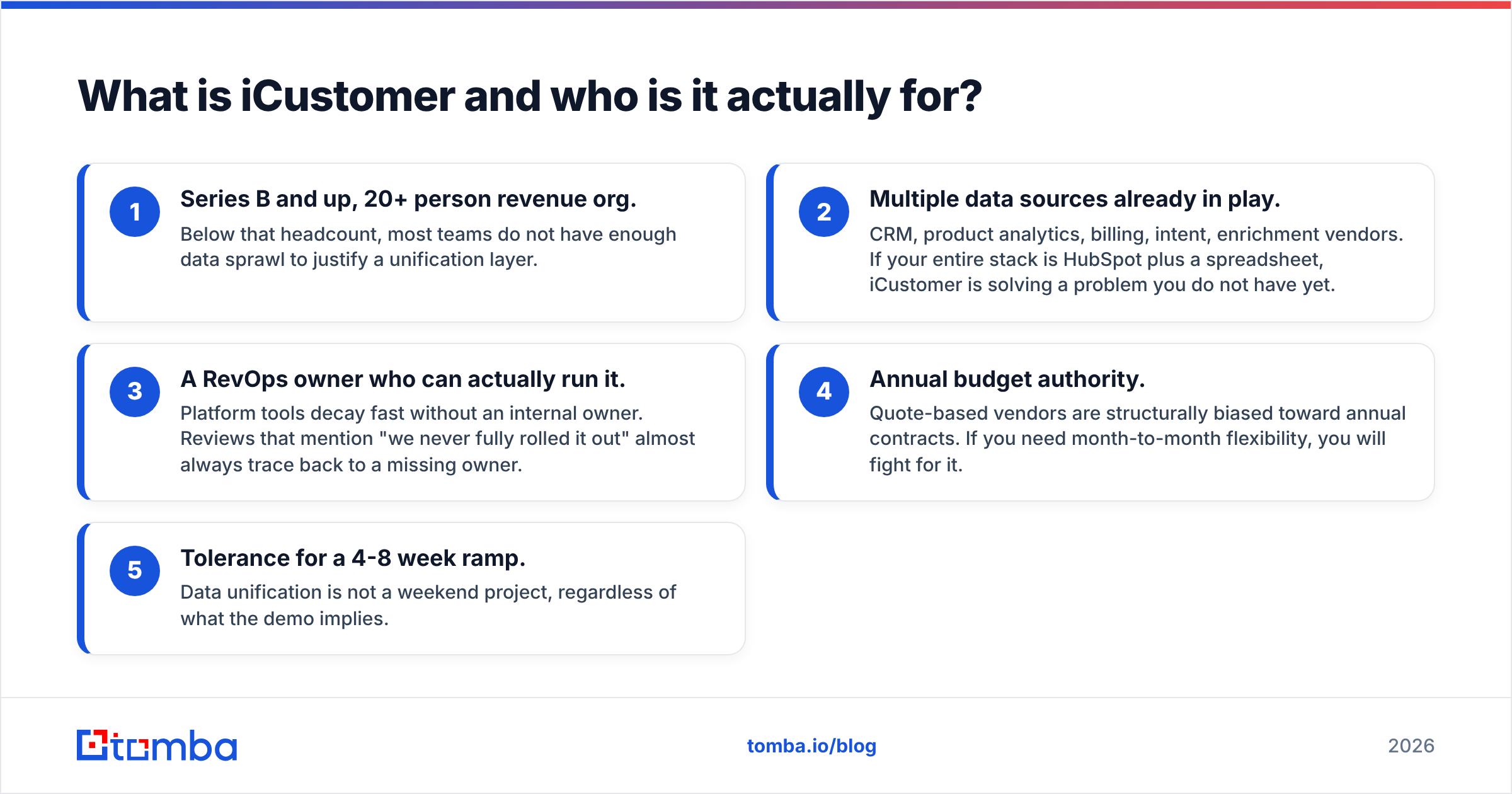
The realistic buyer profile looks like this:
- Series B and up, 20+ person revenue org. Below that headcount, most teams do not have enough data sprawl to justify a unification layer.
- Multiple data sources already in play. CRM, product analytics, billing, intent, enrichment vendors. If your entire stack is HubSpot plus a spreadsheet, iCustomer is solving a problem you do not have yet.
- A RevOps owner who can actually run it. Platform tools decay fast without an internal owner. Reviews that mention "we never fully rolled it out" almost always trace back to a missing owner.
- Annual budget authority. Quote-based vendors are structurally biased toward annual contracts. If you need month-to-month flexibility, you will fight for it.
- Tolerance for a 4-8 week ramp. Data unification is not a weekend project, regardless of what the demo implies.
If three or more of those describe you, iCustomer belongs on your shortlist. If one or fewer does, keep reading — the last two sections are for you.

How does iCustomer pricing actually work?#
Quote-based, with the usual platform levers. Here is what governs the number on your proposal:
- Data volume. Records enriched, profiles resolved, or accounts monitored per year. This is almost always the dominant term.
- Seats. Some platform vendors bundle unlimited viewers and charge for builders; others charge per seat flat. Ask which model applies before you size the team.
- Agent or workflow runs. AI agents consume compute. Vendors meter this as credits, runs, or tasks, and overage is where budgets quietly break.
- Integrations and connectors. Standard CRM connectors are usually included. Warehouse sync, reverse ETL, or custom sources frequently sit behind a higher tier.
- Implementation and onboarding. A one-time services fee is common for data-layer products. Ask whether it is waivable on a multi-year term — it often is.
- Support tier. Named CSM, SLA response times, and solution-architect hours are classic upsells.
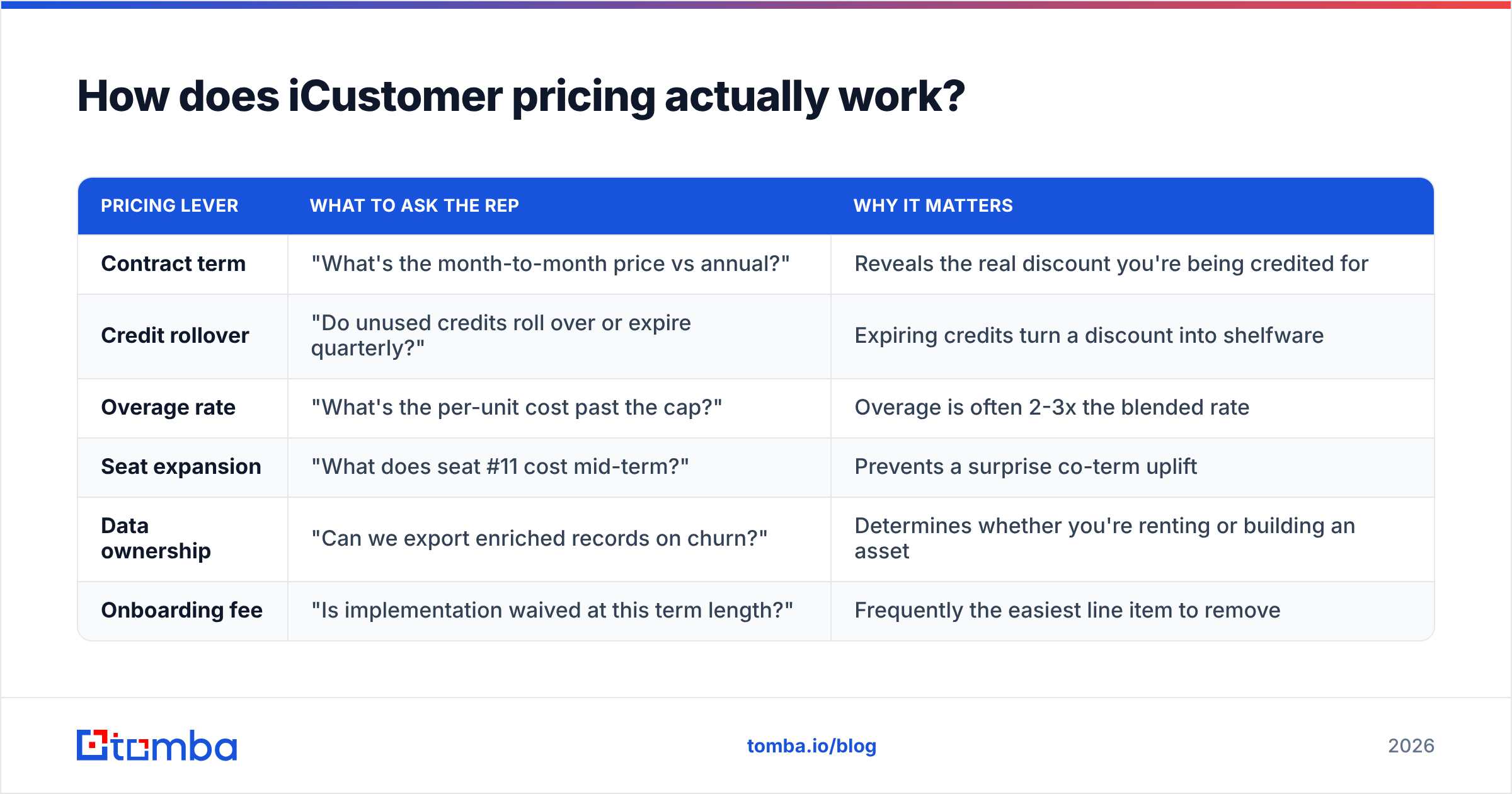
Because none of this is published, the honest answer to "what does iCustomer cost?" is: whatever your volume and negotiating position produce. What you can control is how the quote is structured.
| Pricing lever | What to ask the rep | Why it matters |
|---|---|---|
| Contract term | "What's the month-to-month price vs annual?" | Reveals the real discount you're being credited for |
| Credit rollover | "Do unused credits roll over or expire quarterly?" | Expiring credits turn a discount into shelfware |
| Overage rate | "What's the per-unit cost past the cap?" | Overage is often 2-3x the blended rate |
| Seat expansion | "What does seat #11 cost mid-term?" | Prevents a surprise co-term uplift |
| Data ownership | "Can we export enriched records on churn?" | Determines whether you're renting or building an asset |
| Onboarding fee | "Is implementation waived at this term length?" | Frequently the easiest line item to remove |
Print that table, bring it to the call, and do not accept a single blended number in response. A vendor that will not itemize is a vendor whose renewal will surprise you.
What do iCustomer reviews say?#
Review coverage for AI GTM platforms is thinner than for established categories — you will find far more entries under sales intelligence on G2 than for the agentic GTM niche specifically. That is normal for a young category, and it means you should weight reference calls more heavily than star ratings.
The recurring themes across public reviews and buyer discussions of this class of product:
What reviewers consistently like
- The unified profile. Having account, contact, product usage, and intent signals resolved into one record genuinely removes work that RevOps teams were doing by hand.
- Agent-driven research. Automated account briefs that would have taken an SDR 15 minutes each are the single most-cited time saver.
- Segmentation speed. Building a list from behavioral criteria without opening a warehouse query tool is a real unlock for marketers.
- Responsiveness of the team. Younger vendors ship fast and answer support tickets fast. That is a genuine advantage over incumbents.
What reviewers consistently flag
- Time to value. Multi-source data unification takes weeks. Buyers who expected a two-day setup are the unhappiest cohort.
- Output variability. AI-generated research is excellent on well-documented mid-market and enterprise accounts, noticeably weaker on small private companies and non-English markets.
- Credit opacity. When an agent run consumes a variable number of credits, forecasting spend gets hard. Ask for a usage dashboard during the trial, not after.
- Overlap with existing tools. Many teams discover they are paying twice — once for the platform's enrichment, once for the point solution they never turned off.
That last point is the most expensive one, and it is the reason the next section exists.
What are the pros and cons of iCustomer versus a lean stack?#
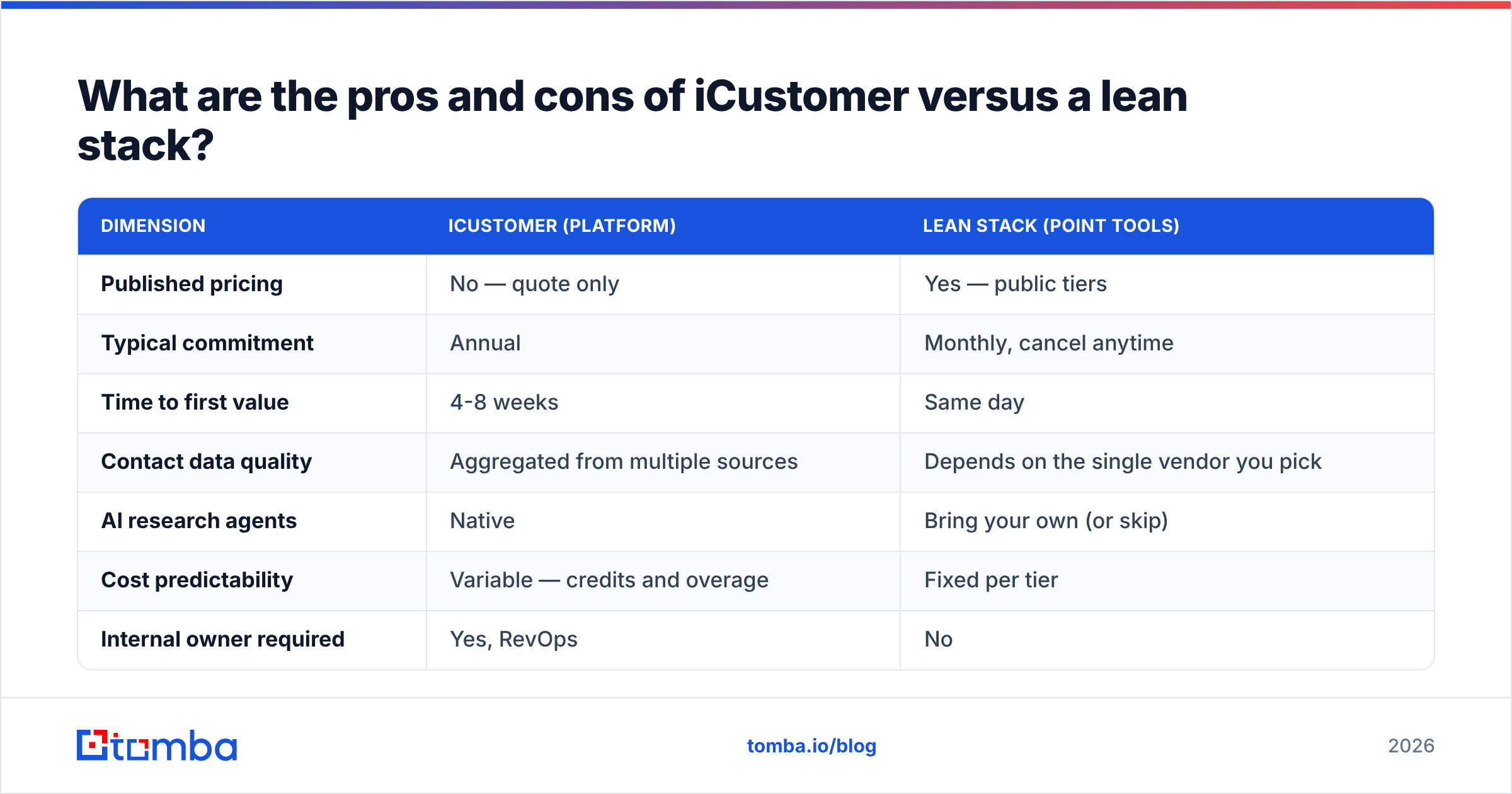
Here is the tradeoff in plain terms. A platform buys you integration; a point solution buys you predictability. Neither is universally correct.
| Dimension | iCustomer (platform) | Lean stack (point tools) |
|---|---|---|
| Published pricing | No — quote only | Yes — public tiers |
| Typical commitment | Annual | Monthly, cancel anytime |
| Time to first value | 4-8 weeks | Same day |
| Contact data quality | Aggregated from multiple sources | Depends on the single vendor you pick |
| AI research agents | Native | Bring your own (or skip) |
| Cost predictability | Variable — credits and overage | Fixed per tier |
| Internal owner required | Yes, RevOps | No |
| Best for | 20+ person revenue orgs with data sprawl | Teams under 20 who need contacts, not orchestration |
The honest read: iCustomer's pros are real and its cons are the standard cost of the platform model. Nothing here is a scandal. The mistake buyers make is not choosing iCustomer — it is choosing a platform when their actual bottleneck was "we cannot reliably reach the right person."

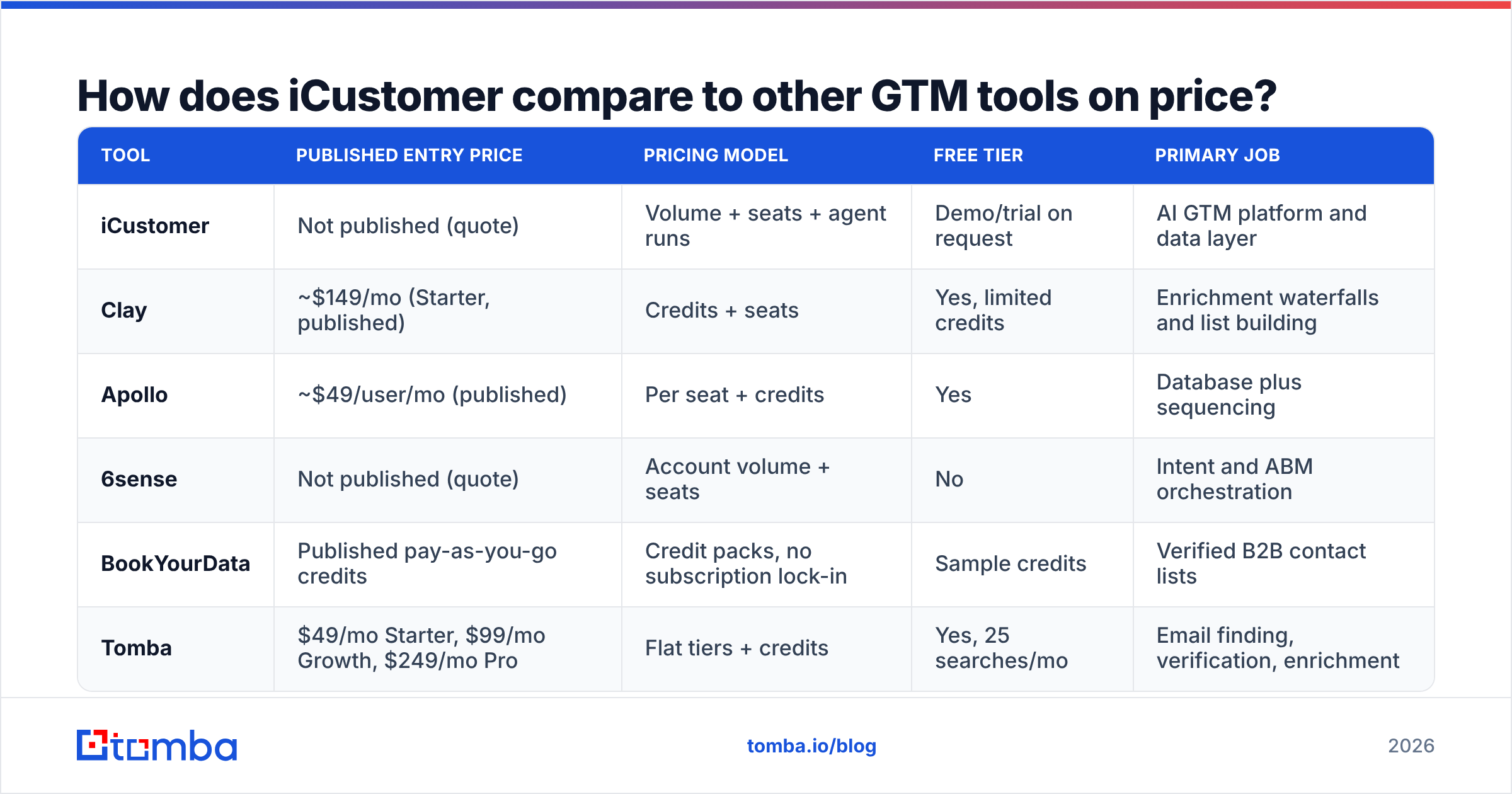
How does iCustomer compare to other GTM tools on price?#
Below is a price-transparency comparison, not a feature scorecard. Published entry prices change often — verify each one on the vendor's own site before you build a business case.
| Tool | Published entry price | Pricing model | Free tier | Primary job |
|---|---|---|---|---|
| iCustomer | Not published (quote) | Volume + seats + agent runs | Demo/trial on request | AI GTM platform and data layer |
| Clay | ~$149/mo (Starter, published) | Credits + seats | Yes, limited credits | Enrichment waterfalls and list building |
| Apollo | ~$49/user/mo (published) | Per seat + credits | Yes | Database plus sequencing |
| 6sense | Not published (quote) | Account volume + seats | No | Intent and ABM orchestration |
| BookYourData | Published pay-as-you-go credits | Credit packs, no subscription lock-in | Sample credits | Verified B2B contact lists |
| Tomba | $49/mo Starter, $99/mo Growth, $249/mo Pro | Flat tiers + credits | Yes, 25 searches/mo | Email finding, verification, enrichment |
Two things stand out. First, the transparency split is stark: the platform vendors quote, the point solutions publish. Second, the price gap between "AI GTM platform" and "verified contact data" is roughly an order of magnitude — which is fair if you use the platform, and wasteful if you do not.
BookYourData deserves a specific note here. Its pay-as-you-go credit model is genuinely useful for teams with lumpy, campaign-driven demand — you buy a list, you use it, you stop. That is a different and legitimate shape of buying from both the platform model and the subscription model, and it is worth pricing out if your outbound runs in bursts rather than continuously.
Is iCustomer worth it for your team?#
Run this four-question test before you take the demo:
- Can you name the specific decision the unified data layer will change? "Better data" is not a decision. "Route inbound trials to AEs when product usage crosses X" is. If you cannot name one, you are buying a capability, not a fix.
- Do you already pay for enrichment you would cancel? Platform math only works if it consolidates spend. Add up the tools you would genuinely turn off. If that number is under 30% of the quote, the ROI case is thin.
- Who owns it on day 31? Name the person. If the answer is "we'll figure that out," the platform will become shelfware and the renewal will be a painful conversation.
- Is your contact reach rate actually the problem? If your sequences bounce, your emails land in spam, or your lists are stale, a GTM platform will orchestrate bad data faster. Fix the data layer at the source first.
That fourth question sends more teams to a point solution than vendors like to admit. Bounce rates above 5% are a deliverability problem, not an orchestration problem, and no amount of AI agent tooling repairs a list that was never verified.
What's a cheaper way to get most of the outcome?#
For teams under roughly 20 revenue headcount, this stack covers 80% of what a GTM platform promises at a fraction of the cost:
- Verified contact data at a published price. A dedicated email finder plus an email verifier run before every send. This is the non-negotiable base layer — everything downstream inherits its quality.
- Your existing CRM as the system of record. HubSpot and Salesforce both ship workflow tools most teams have never fully enabled. Audit before you buy a second orchestration layer.
- Programmatic enrichment where it matters. An email finder API that writes directly into your CRM on record creation replaces a surprising amount of manual research, and you can measure exactly what it costs.
- Targeted contact enrichment on high-intent accounts only. Enrich the accounts that showed a signal, not your entire TAM. Volume-based pricing punishes indiscriminate enrichment.
- A clear definition of a qualified account. The go-to-market strategy work is the part no tool does for you, and it is the part that determines whether the tool pays back.
The gap this stack leaves is real: no autonomous research agents, no unified profile across product and billing data, no ABM orchestration. If those are your bottleneck, buy the platform. If your bottleneck is "we cannot consistently reach the right person at the right company," you can solve that this afternoon for $49.
What should you do next?#
Get the quote — but get it itemized, with the six levers from the table above priced separately. Then price the lean alternative honestly against it. A vendor with a genuinely strong product will survive that comparison; one that only wins on a blended number will not.
And if the comparison tells you what it tells most teams under 20 people — that the actual gap is verified contact data, not orchestration — start there. Tomba's Email Finder finds professional addresses by domain, name, or company, verifies them before you send, and does it on published Tomba pricing: free for 25 searches a month, $49/mo on Starter, $99/mo on Growth. No demo call, no annual commitment, no credits that expire on a quarterly cliff. Fix the data layer first — then decide whether you still need the platform on top of it.
Related guides#
// get started
Find, verify and enrich your first contacts today
Start on the free plan with 25 searches a month, then scale when your team is ready.
Free plan · No credit card required · GDPR & CCPA
// about the author