Icypeas Pricing, Reviews, Pros and Cons: A 2026 Breakdown
Icypeas sells cheap credits and fast bulk lookups, but the plan limits and accuracy trade-offs matter more than the sticker price. Here is the honest 2026 breakdown.
Icypeas pricing reviews pros and cons come down to one number: what a usable contact really costs you. The credits are cheap. The results are mixed. Here is the honest 2026 read.
TL;DR
- Icypeas is a low-cost French email finder and verifier. It runs on credits. Paid plans start near $20–$25 a month and scale by volume, not by feature set.
- The best case for it is cost per lookup on big bulk jobs. The worst case is patchy coverage. Hit rates drop on small domains, non-US firms, and catch-all servers.
- Reviews on G2 and Capterra split two ways. People love the price and the bulk speed. They dislike credit burn, slow support, and vague "found vs verified" labels.
- Cheap credits stop being cheap when 30% of them come back unusable. Cost per usable contact is the only number worth comparing.
- Need one vendor for finding, checks, catch-all, and extra data? Tomba's $49/mo Starter and $99/mo Growth plans often beat two cheap tools stitched together.
What is Icypeas and who is it built for?#
Icypeas is a B2B contact data tool. It does three jobs. It finds a work email from a name and a domain. It checks whether that address is live. And it runs both in bulk, from a CSV upload or an API call. There is also a Chrome add-on and a LinkedIn flow. Most users meet the tool there first.
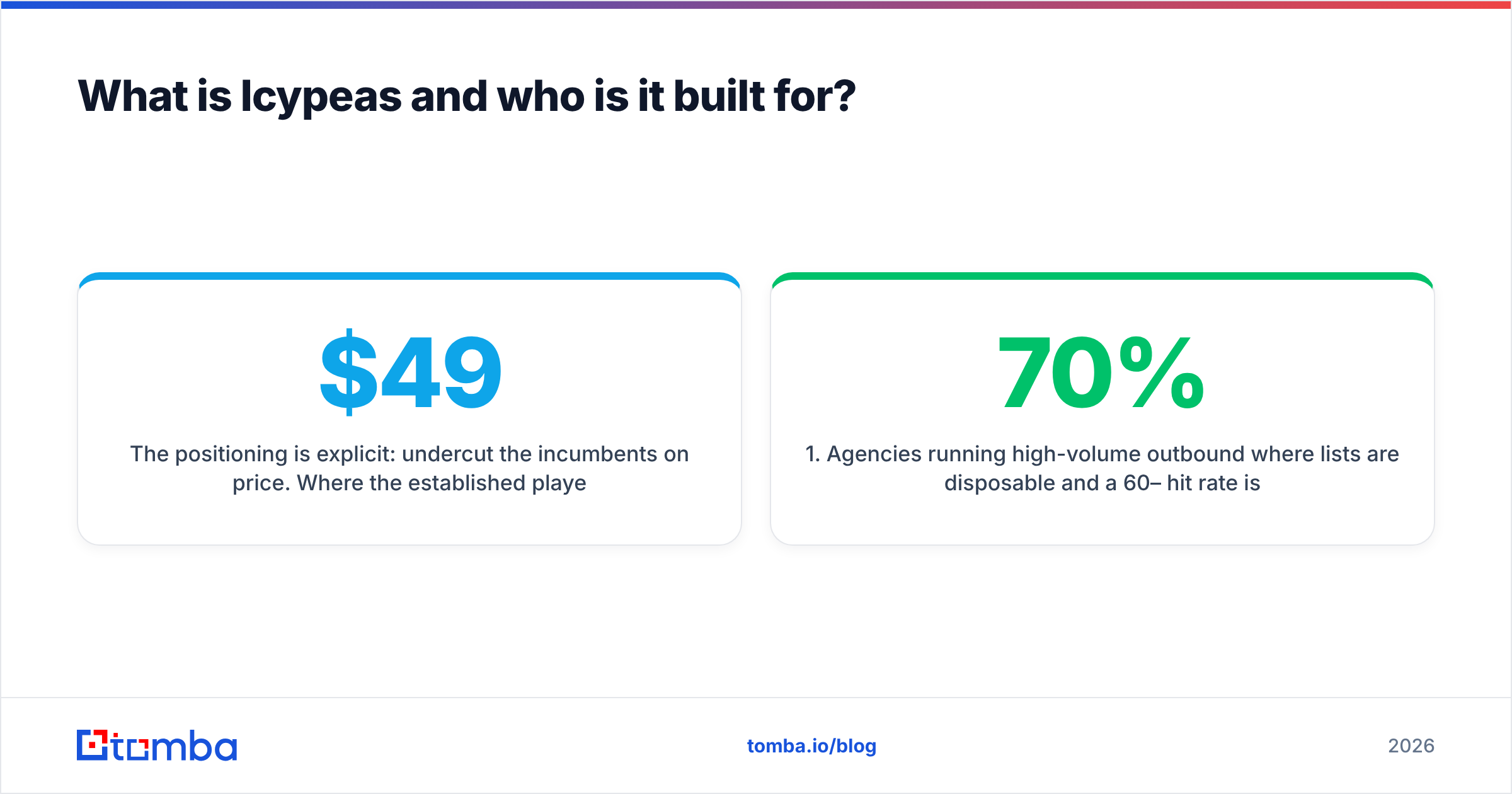
The pitch is blunt: beat the big names on price. They charge $49–$99 for a first tier. Icypeas sells credits for a slice of that, and its ads lean on volume math — "X thousand credits for Y dollars." That suits one kind of buyer. It fails another.
It works well for:
- Agencies with high-volume outbound. Lists are throwaway. A 60–70% hit rate is fine, since you re-run the misses somewhere else.
- Small teams testing a channel. You want the cheapest way to learn whether cold email books meetings.
- Developers building in-house tools. You want a cheap API, and you can write your own retry logic.
- Recruiters sourcing on LinkedIn. You need an address, not a full company profile.
- Teams that already pay for a sequencer (Instantly, Smartlead, Lemlist) and only need the find step.
It works poorly for RevOps teams that want one source of truth. It also falls short in markets full of catch-all servers, and at firms where a bounce is a legal problem, not a nuisance.

What does Icypeas pricing actually cost in 2026?#
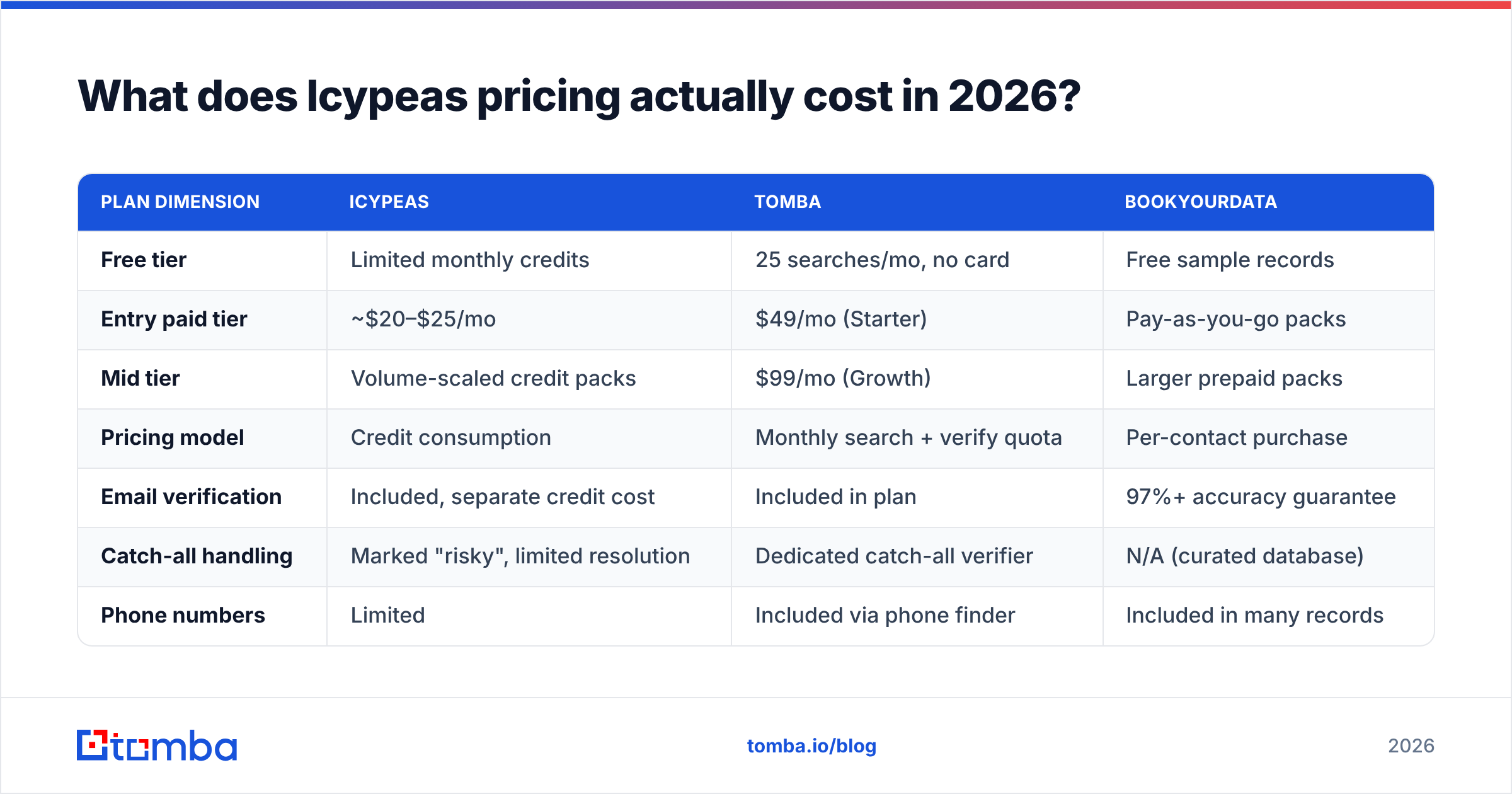
Icypeas bills in credits. On most plans a credit is spent per lookup, not per hit. That one detail drives most of the bad reviews.
Published tiers sit roughly like this. Check the vendor's own pricing page before you buy, since credit bundles shift.
| Plan dimension | Icypeas | Tomba | BookYourData |
|---|---|---|---|
| Free tier | Limited monthly credits | 25 searches/mo, no card | Free sample records |
| Entry paid tier | ~$20–$25/mo | $49/mo (Starter) | Pay-as-you-go packs |
| Mid tier | Bigger credit packs | $99/mo (Growth) | Larger prepaid packs |
| Pricing model | Pay per credit | Monthly search + verify quota | Per-contact purchase |
| Email verification | Included, extra credit cost | Included in plan | 97%+ accuracy guarantee |
| Catch-all handling | Marked "risky", limited fix | Dedicated catch-all verifier | N/A (curated database) |
| Phone numbers | Limited | Included via phone finder | Included in many records |
| API access | Yes | Yes, on all paid plans | Yes |
| Best fit | Cheapest raw lookups | All-in-one finding + verify | Buying pre-built lists |
The headline price is truly low. The price that matters is not the headline. Run this math before you sign:
Cost per usable contact = (monthly price ÷ credits) ÷ (hit rate × delivery rate)
Take a $20 plan with 5,000 credits. That looks like $0.004 per lookup. Say 62% of lookups return an address. Say 88% of those land. Your real cost per usable contact is about $0.0073. That is nearly double the sticker price. A $49 plan with a 75% hit rate and 95% delivery can match it, with far fewer bounces. Judge the Tomba pricing tiers on that basis, not on the monthly figure.
Two more line items catch people out:
- Checks cost extra. Finding an address and proving it is live are two jobs. Budget for both, or you will run dry mid-campaign.
- Failed lookups can still burn credits. It depends on your plan and the call type. Read the fine print. This is the top billing gripe in user reviews.
How accurate is Icypeas next to other email finders?#
Accuracy is where the cheap-credit model shows its true cost. Testers who run one seed list across tools put Icypeas mid-pack. It is solid on big, well-known domains with clear patterns. It is weaker on firms under 50 staff. It is weaker again outside North America and Western Europe.

Three failure modes show up again and again:
- Catch-all guesswork. Some mail servers accept every address. Most tools mark those "risky" and stop. That is honest, but it leaves you with dead rows. A catch-all verifier that clears a real share of them is worth more than a cheaper credit.
- A guess sold as a find. A tool may infer
first.last@domain.comfrom a known pattern with no live check. That is a guess with a score on it. Guesses bounce. Ask whether your result has a true status or just a pattern score. - Stale sources. B2B data goes off by 25–30% a year as people switch jobs. How often a vendor refreshes matters as much as raw size. So read how a vendor sources data before you trust a hit-rate claim.
The fix is the same for any finder you pick. Never send to a list you have not checked. Run every export through an email verifier first. Bounce rates above 3% start to hurt your sender reputation. That damage costs more than any credit pack you will ever buy.
What do Icypeas reviews say — pros and cons?#
Public reviews on G2 and Capterra plus forum threads split cleanly.
What reviewers praise:
- Price. The top strength by far. Teams that used to pay $99+ a month save real money, right away.
- Bulk speed. Big CSV jobs run fast, and the batch screen is easy to follow.
- Clean UI. The dashboard is plain and quick to learn, so new reps get going fast.
- Usable API. The docs are good enough, and setup is quick for anyone who has used a REST API.
- Chrome add-on. Handy for one-off lookups while you browse LinkedIn.
What reviewers flag:
- Credit burn. The most common gripe by a wide margin. Packs run out faster than planned, above all when a find and a check are billed apart.
- Hit rate swings. "Great on some lists, poor on others." That matches the weak coverage on small and non-Western domains.
- Slow support. Many reviews cite slow replies on billing and credit disputes. That is common for lean teams that compete on price. There is no margin for a big support desk.
- Thin extra data. You get an email. You often do not get the firm and tech detail that a full data enrichment layer adds. So you buy a second tool.
- Vague labels. Users are unsure what "found", "risky", and "verified" mean in practice, and how much to trust each one.

That last point matters. Every vendor here prints an accuracy number. Almost none print the method behind it. Treat a claimed number as a guess to test. Run 200 rows of your target list first. Your niche, your region, and your company sizes will move the result more than any global average.
Is Icypeas better than the alternatives?#
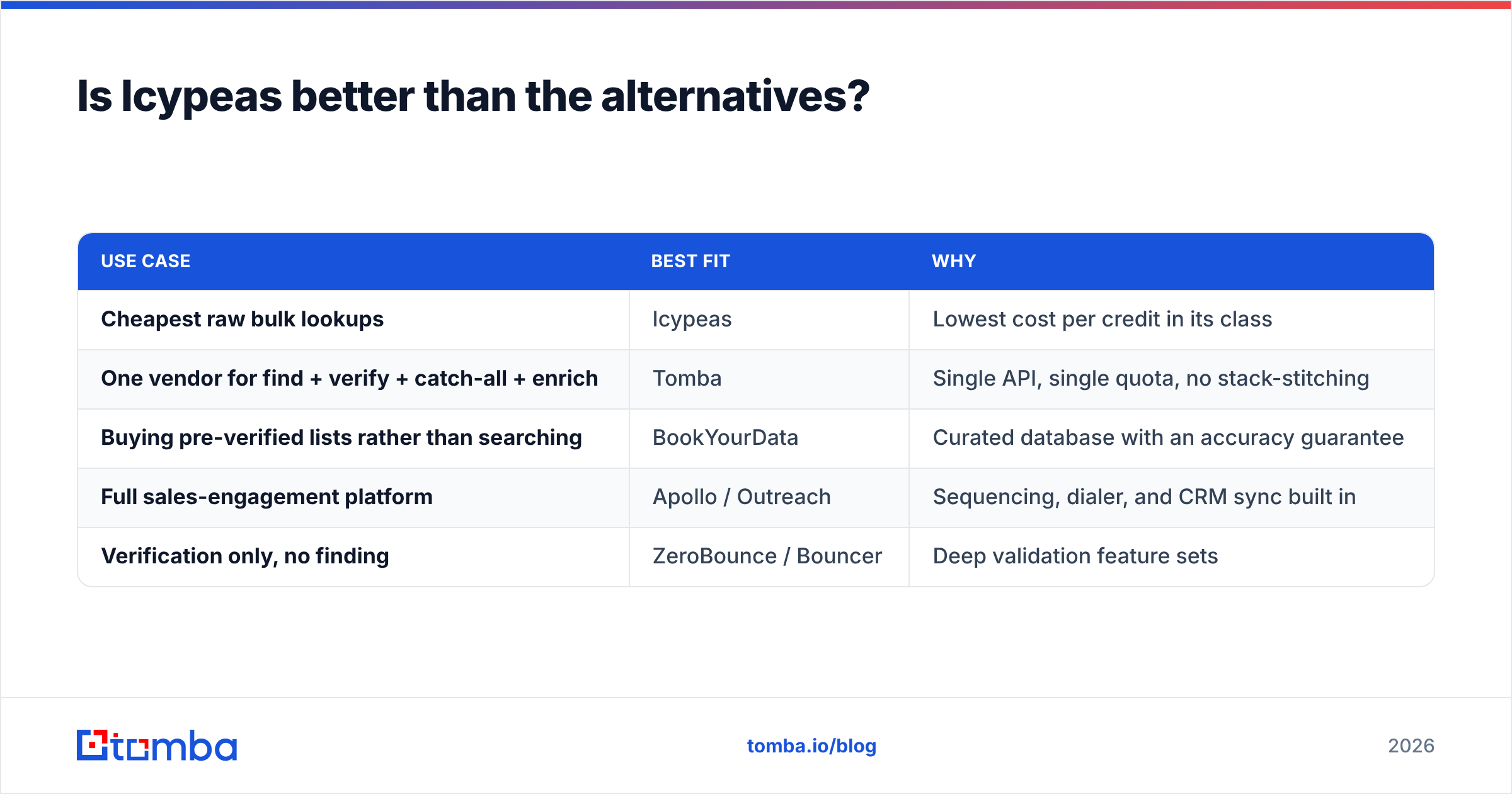
It depends on the job you are hiring the tool to do.
| Use case | Best fit | Why |
|---|---|---|
| Cheapest raw bulk lookups | Icypeas | Lowest cost per credit in its class |
| One vendor for find + verify + catch-all + enrich | Tomba | Single API, single quota, no stack to stitch |
| Buying pre-checked lists rather than searching | BookYourData | Curated database with an accuracy guarantee |
| Full sales-engagement platform | Apollo / Outreach | Sequencing, dialer, and CRM sync built in |
| Verification only, no finding | ZeroBounce / Bouncer | Deep validation feature sets |
Here is the honest read on Icypeas pricing reviews pros and cons. It is a decent point tool. It wins on price and loses on depth. Is your flow "scrape a list, find emails, check them, send, bin the rest"? Then it does that job, as long as you can live with a lower hit rate.
The math turns when you buy a second tool to patch the first. Two $25 plans, plus the work of merging two exports, is not cheaper than one $49 plan that does both. Add a third for phone numbers. Now the "cheap" stack costs more and the data is messier.

For a feature-by-feature view, the Icypeas alternative page maps the two side by side. BookYourData is worth a look if your real problem is "I need a list". That is not the same as "I need to look up named people". Buying records and searching a database are two different buys. Mixing them up is why teams end up unhappy with both.
Icypeas pricing reviews pros and cons: how to test before you buy#
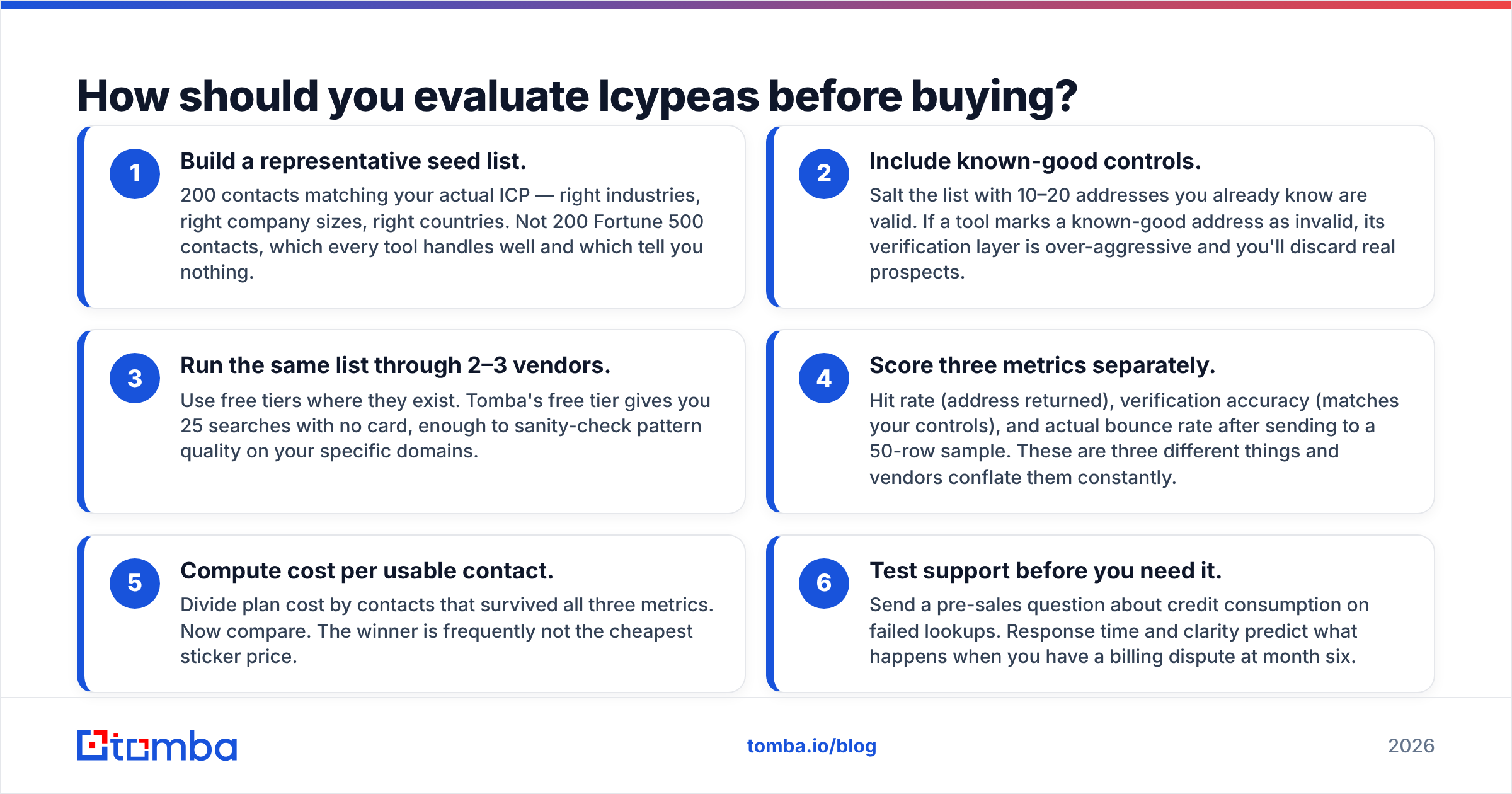
Run a 200-row test. It takes an afternoon and saves months of bad data.
Build a seed list that looks real. Use 200 contacts that match your target market — right sectors, right sizes, right countries. Not 200 Fortune 500 names. Every tool wins on those, so they teach you nothing.
Add known-good controls. Salt the list with 10–20 addresses you know are live. If a tool calls one of them bad, its checks are too harsh, and you will bin real buyers.
Run the list through 2–3 vendors. Use free tiers where they exist. Tomba's free tier gives you 25 searches with no card. That is enough to sanity-check pattern quality on your own domains.
Score three things apart. Hit rate, match with your controls, and real bounce rate on a 50-row send. Vendors blur these three. You should not.
Work out cost per usable contact. Divide plan cost by the contacts that survived all three. Now compare. The winner is often not the cheapest.
Test support before you need it. Ask a pre-sales question about credits on failed lookups. The reply time tells you what month six will look like.
Pulling contacts from LinkedIn? Run the same test through a LinkedIn finder flow, not just a CSV upload. Hit rates often differ between the two paths. Measure the one you will use daily.
Icypeas pricing reviews pros and cons: the verdict#
Icypeas is a fair buy if you fit its profile. High volume. Thin margin per contact. Room for a lower hit rate. No need for deep data or fast support. On those terms it does what it says, and the price is not a trick.
It is the wrong buy in four cases. You need steady coverage across regions. Catch-all domains are common in your market. You want one API, not three. Or a bounce is costly. Then the cheap credits are a false economy. You pay the gap in dev time, in lost inbox trust, and in the second vendor you end up adding.
The rule is simple: compare cost per usable contact, not cost per credit. Every other line in a pricing table is noise until you do that division.
Want to test this against your own list? Start with the Tomba Email Finder. You get 25 free searches a month, no card needed. Every result carries a true status, not just a pattern score. One quota covers finding, checks, catch-all, and extra data. Run your 200-row test, work out cost per usable contact, and let the numbers pick the winner.
Related guides#
// get started
Find, verify and enrich your first contacts today
Start on the free plan with 25 searches a month, then scale when your team is ready.
Free plan · No credit card required · GDPR & CCPA
// about the author