Identifying Buying Signals: The 2026 B2B Playbook
Most buying signals are noise. Here is how to tell the three that predict revenue from the dozens that just look busy — plus the data stack, scoring model, and outreach timing that turn a signal into a booked meeting.
TL;DR
Most "intent data" is noise. Only three signal families reliably predict a closed deal: hiring for the problem you solve, technology change, and repeat high-intent page visits from multiple people at the same account.
Signal decay matters more than signal strength. A job posting is worth acting on for about 30 days; a pricing-page visit is worth acting on for about 48 hours.
A signal without a contact is a dead end. Roughly half of the work in identifying buying signals is detection; the other half is resolving the account into a verified email or phone number fast enough to matter.
Score signals by who triggered them, not just what happened. A VP of Engineering reading your docs beats twelve anonymous marketing-site sessions.
Build the cheap version first: three signal sources, one scoring sheet, one enrichment step. Teams that buy a $60k intent platform before they have a working playbook usually get a dashboard nobody opens.
What are buying signals, actually?#
A buying signal is any observable event that raises the probability an account will purchase in the next 90 days. That is the whole definition, and the word doing the work is observable.
Think of it like a house going on the market. The listing is the obvious signal, but the neighbors saw it coming months earlier: a dumpster in the driveway, a realtor's car, the lawn suddenly getting mowed. By the time the sign goes up, twelve agents are calling. The advantage lives in the earlier, quieter events.
B2B works the same way. By the time a prospect fills out a demo form, they have typically completed 60-70% of their evaluation and shortlisted two or three vendors. Gartner's research on the B2B buying journey has been making this point for years: buyers spend the majority of their process independent of any seller. The form fill is not the start of the deal. It is the start of a race you may have already lost.
Signals fall into three tiers, and confusing them is the most common mistake in the discipline.
Fit signals — headcount, funding stage, industry, tech stack. These tell you whether an account belongs in your pipeline at all. They are stable and slow-moving. They are not buying signals; they are qualification.
Intent signals — content consumption, review-site activity, competitor research, repeat site visits. These tell you that someone is in-market. They are noisy and decay fast.
Trigger signals — a new VP of Sales, a Series B round, a data breach, a compliance deadline, a competitor's price increase. These tell you why now. They are rare, high-value, and have an obvious conversational hook.
The revenue is in the overlap. An account with good fit and a fresh trigger is worth a same-day call. An account with intent but no fit is a time sink dressed up as a lead.
Which buying signals actually predict revenue?#
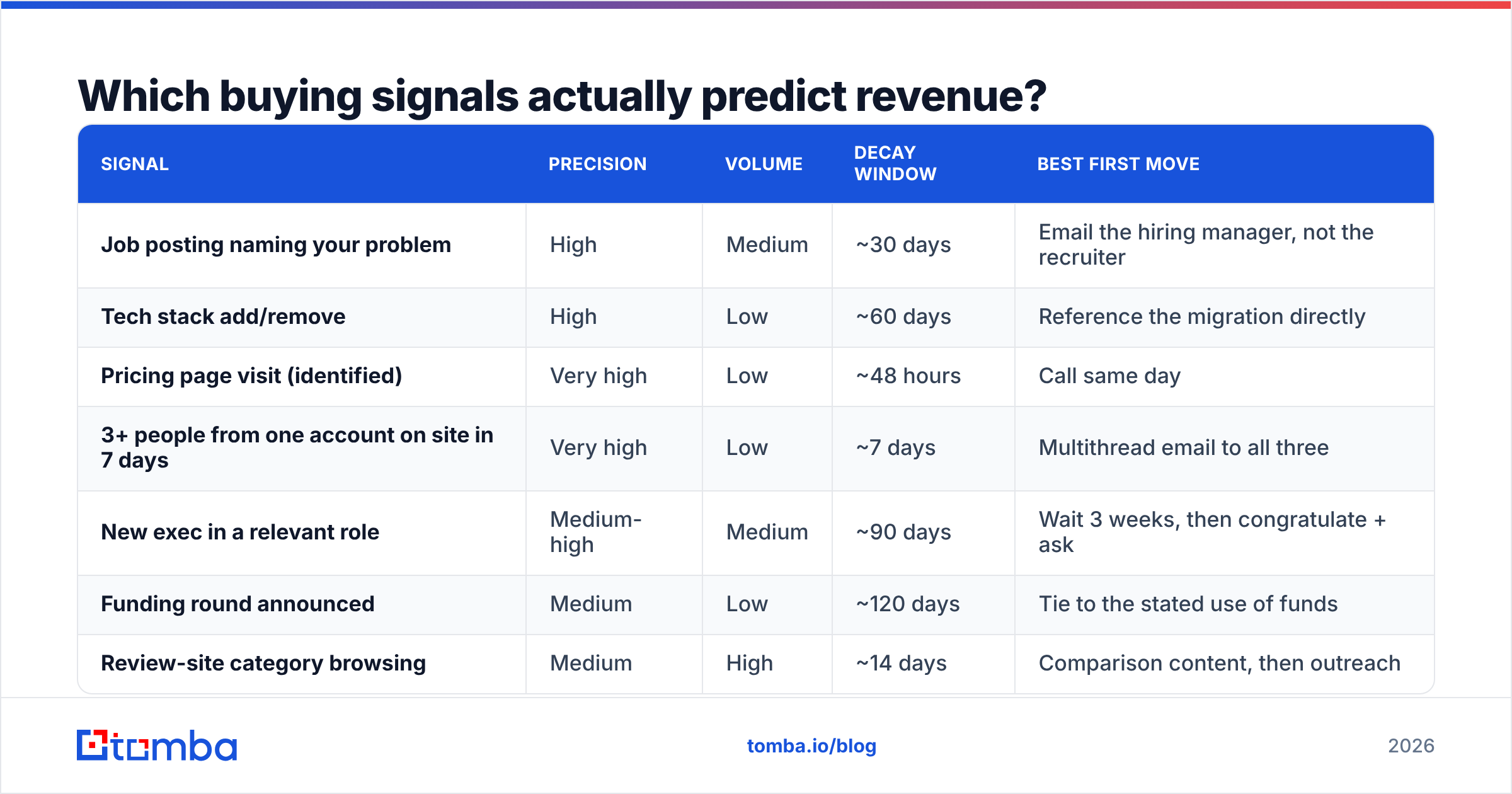
Here is the honest ranking, based on how these behave in practice across most B2B motions. Precision means "how often acting on this leads to a real conversation." Volume means "how many you will see per month per 1,000 target accounts."
Signal
Precision
Volume
Decay window
Best first move
Job posting naming your problem
High
Medium
~30 days
Email the hiring manager, not the recruiter
Tech stack add/remove
High
Low
~60 days
Reference the migration directly
Pricing page visit (identified)
Very high
Low
~48 hours
Call same day
3+ people from one account on site in 7 days
Very high
Low
~7 days
Multithread email to all three
New exec in a relevant role
Medium-high
Medium
~90 days
Wait 3 weeks, then congratulate + ask
Funding round announced
Medium
Low
~120 days
Tie to the stated use of funds
Review-site category browsing
Medium
High
~14 days
Comparison content, then outreach
Generic "intent topic" spike
Low
Very high
~7 days
Ignore unless it stacks with something else
Social post like or follow
Very low
Very high
—
Do not treat as a signal
Two things stand out.
High-volume signals are usually low-precision. Third-party intent topic data — the "this account surged on the topic 'email verification' this week" variety — has enormous volume and weak precision, because it is often modeled from bidstream data with account-level resolution that is a guess. It is useful as a tiebreaker, not a trigger.
Low-volume signals are where the money is. Three people from the same domain hitting your pricing page in a week is a near-certain evaluation in progress. You will see that maybe eight times a month. Those eight are worth more than 800 topic surges.
How do you build a buying-signal stack without overspending?#
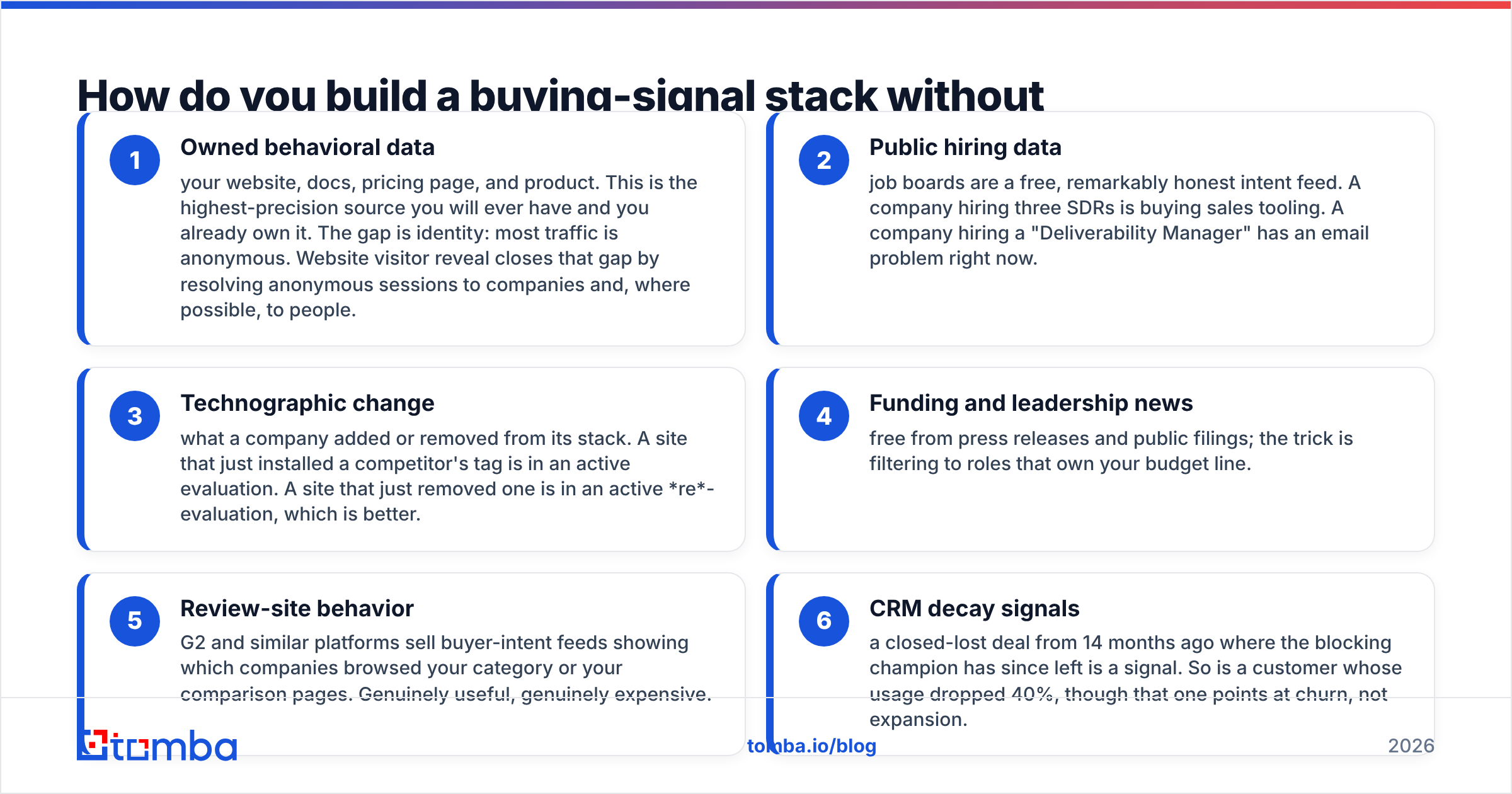
Start with what you can observe for free or near-free, and only buy data you cannot generate yourself.
Owned behavioral data — your website, docs, pricing page, and product. This is the highest-precision source you will ever have and you already own it. The gap is identity: most traffic is anonymous. Website visitor reveal closes that gap by resolving anonymous sessions to companies and, where possible, to people.
Public hiring data — job boards are a free, remarkably honest intent feed. A company hiring three SDRs is buying sales tooling. A company hiring a "Deliverability Manager" has an email problem right now.
Technographic change — what a company added or removed from its stack. A site that just installed a competitor's tag is in an active evaluation. A site that just removed one is in an active re-evaluation, which is better.
Funding and leadership news — free from press releases and public filings; the trick is filtering to roles that own your budget line.
Review-site behavior — G2 and similar platforms sell buyer-intent feeds showing which companies browsed your category or your comparison pages. Genuinely useful, genuinely expensive.
CRM decay signals — a closed-lost deal from 14 months ago where the blocking champion has since left is a signal. So is a customer whose usage dropped 40%, though that one points at churn, not expansion.
Notice that four of the six are free or already yours. Most teams invert this: they buy the expensive feed first and never instrument their own pricing page.
Why does a signal without a contact go nowhere?#
Because you cannot email a company. You can only email a person.
This is the step where most signal programs quietly fail. The dashboard lights up — Acme Corp is showing intent — and the rep opens it, finds a company name, and then spends 20 minutes hunting for someone to actually contact. By the time they find a valid address, the 48-hour window on that pricing-page visit has closed.
The fix is to treat contact resolution as part of the signal pipeline, not a downstream manual chore. Concretely:
Signal fires → account domain is captured.
Domain resolves to roles → a domain search returns the people at that company in the job functions that matter for your product, not a dump of all 400 employees.
Contact is verified → run it through an email verifier before it touches a sequence. Acting fast on a signal and bouncing is worse than acting slow, because it damages sender reputation on top of losing the deal.
Contact lands in the rep's queue with the signal attached, so the first line of the email can reference the actual reason for the call.
That last part is what makes signal-based outreach work at all. "I saw you're hiring two deliverability engineers" is a different email from "I wanted to reach out about our platform." The signal is not just timing intelligence — it is the copy.
For high-urgency signals where email is too slow, a phone finder closes the loop faster. A same-day call on a pricing-page visit converts at multiples of a next-week email.
How should you score and stack signals?#
Single signals are weak. Stacked signals are strong. The model that works is additive with a decay multiplier — not a machine-learning project, a spreadsheet.
Give each signal a base score, then multiply by how fresh it is:
Fit gate (pass/fail) — if the account fails ICP, score is zero regardless of activity. Do not let intent data drag you into segments you cannot serve.
Persona weight (0.5x–3x) — the same page visit from a director-level economic buyer is worth 3x an intern's. Anonymous is 0.5x.
Base signal value (1–10) — from the table above. Pricing page 9, job posting 6, topic surge 2.
Freshness multiplier (0.1x–1x) — full value inside the decay window, dropping sharply after. A 40-day-old job post is worth a fraction of a 4-day-old one.
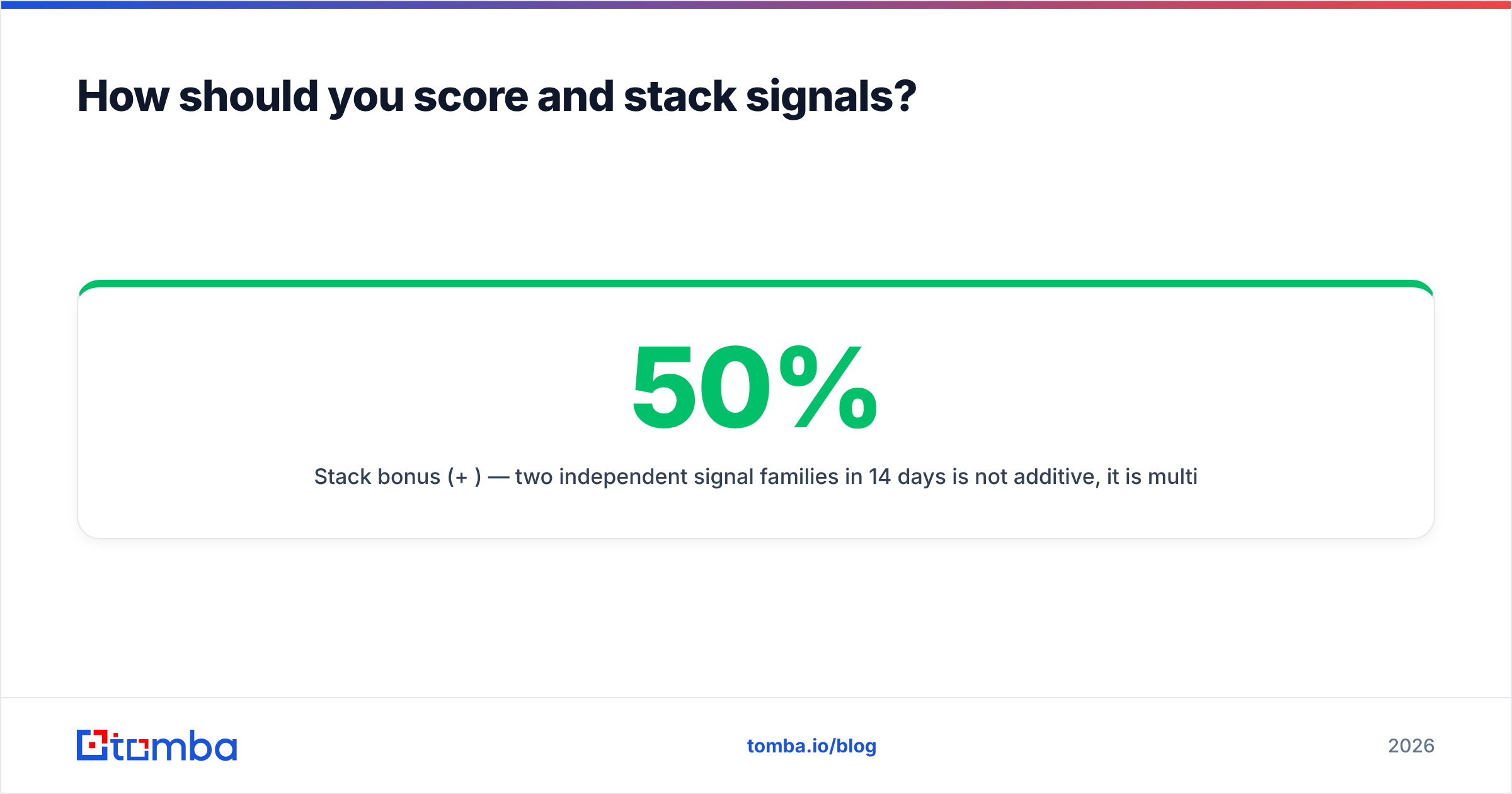
Stack bonus (+50%) — two independent signal families in 14 days is not additive, it is multiplicative. Hiring plus a pricing-page visit is a deal.
Anything above your threshold goes to a rep same day with the signal in the record. Anything below it goes to nurture. The threshold is a dial you tune against rep capacity, not a truth you discover.
The failure mode to avoid: scoring everything and routing nothing. If your model produces 900 "hot" accounts a week and your team can work 60, the model has told you nothing. Calibrate the threshold to capacity first, then improve precision.
What does signal-based outreach look like in practice?#
Take a mid-market cybersecurity vendor. Their ICP is 200–2,000 employee companies in regulated industries. Here is a realistic week.
Monday. A target account posts a req for a "Compliance Analyst — SOC 2." Base value 6, fresh, persona relevant. The rep uses a bulk email finder to pull the VP of Security and the Director of IT, verifies both, and sends a two-line email referencing the specific hire. No pitch, one question: "Is the SOC 2 push driven by a customer requirement or a renewal?"
Wednesday. Two people from the same domain visit the pricing page and the security-docs page. Stack bonus applies. Score triples. The rep calls the VP that afternoon — not to sell, but to offer the compliance checklist the docs page implies they were looking for.
Friday. The account books a call. Cycle time from first signal to meeting: four days.
Compare that to the same account arriving through a generic intent feed six weeks later, when the evaluation is over and two competitors are in a bake-off.
The difference is not the tooling. It is that the signal was specific, the contact was resolved in minutes rather than days, and the first message referenced the actual event. Signal-based outreach is mostly a speed problem wearing a data costume. Response rate research consistently shows that first-responder advantage dominates message quality — HubSpot's sales statistics round-ups have shown response odds dropping by an order of magnitude within the first hour on inbound-adjacent leads.
How do you avoid the three common failure modes?#
Failure 1: treating volume as validation. A vendor demo that shows 4,000 in-market accounts is showing you a modeled guess, not 4,000 buyers. Ask any intent vendor two questions: what is the underlying observation, and at what resolution — account or individual? If the answer is "bidstream, account-level," treat the output as a soft ranking signal only.
Failure 2: acting on the signal without acting on the person. Automating a sequence to "everyone at the account showing intent" is how you burn a domain. Signals justify relevance, not volume. Two well-targeted emails beat fourteen sprayed ones, and they keep your email deliverability intact.
Failure 3: never measuring decay. Most teams never check whether their signals still predict anything. Run this quarterly: take last quarter's closed-won deals, look backward, and ask which signals actually preceded them and by how long. You will usually find one signal doing most of the work and three you can delete. Delete them.
Also worth saying plainly: buying signals do not create demand. They find demand that already exists. If your total addressable market has 400 companies and 12 are in-market this quarter, no amount of intent tooling produces a 13th. Signal work is an efficiency multiplier on a fixed pool, which is exactly why it is worth doing — and exactly why it will not fix a positioning problem.
Which tools fit which stage?#
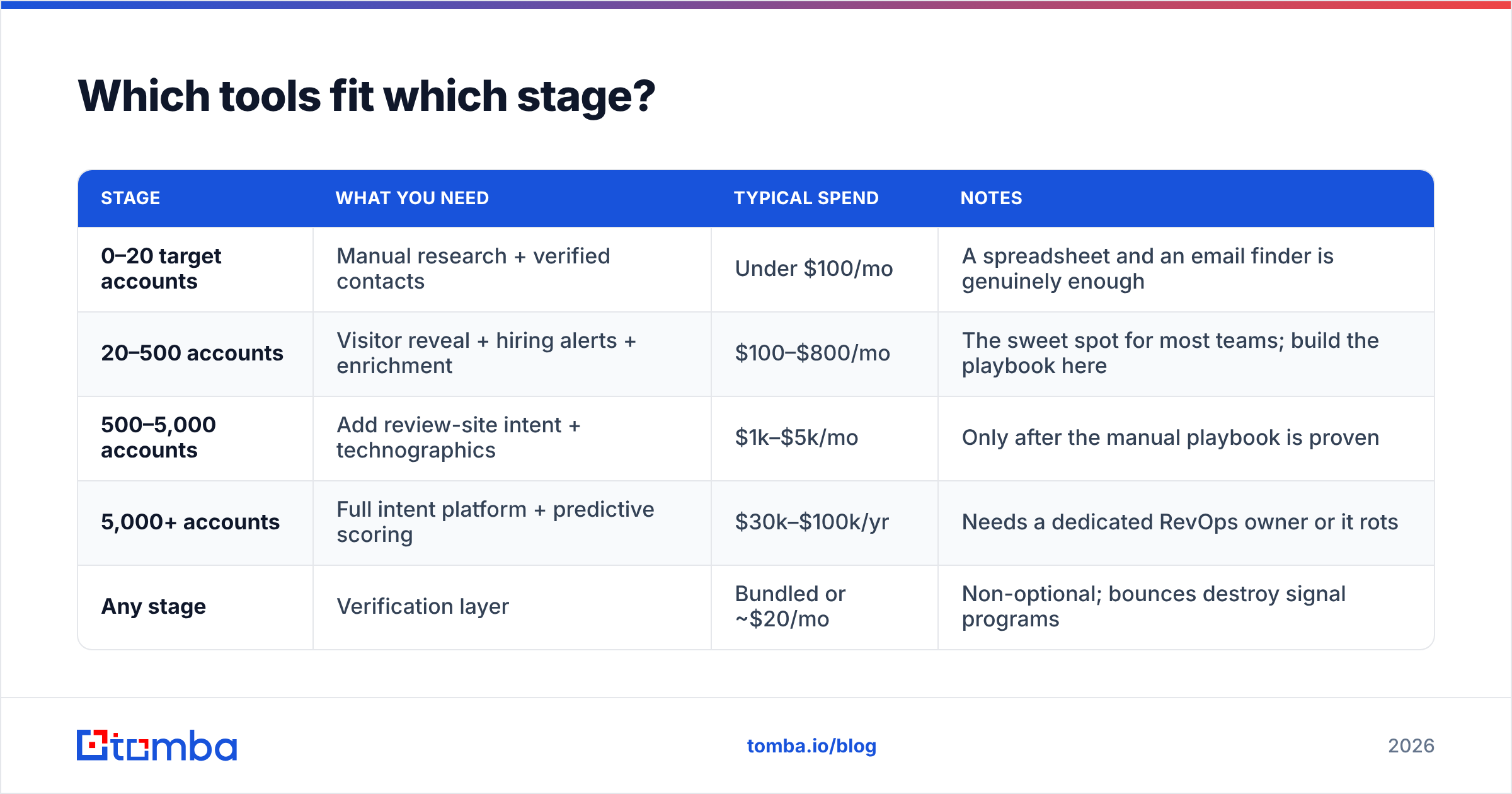
A rough map. Budgets are directional and change constantly, so treat them as orders of magnitude rather than quotes.
Stage
What you need
Typical spend
Notes
0–20 target accounts
Manual research + verified contacts
Under $100/mo
A spreadsheet and an email finder is genuinely enough
20–500 accounts
Visitor reveal + hiring alerts + enrichment
$100–$800/mo
The sweet spot for most teams; build the playbook here
500–5,000 accounts
Add review-site intent + technographics
$1k–$5k/mo
Only after the manual playbook is proven
5,000+ accounts
Full intent platform + predictive scoring
$30k–$100k/yr
Needs a dedicated RevOps owner or it rots
Any stage
Verification layer
Bundled or ~$20/mo
Non-optional; bounces destroy signal programs
For the contact-resolution layer specifically, Tomba pricing starts with a free tier at 25 searches a month, Starter at $49/mo, Growth at $99/mo, and Pro at $249/mo — which puts real enrichment inside the budget of a two-person team testing a signal playbook. Peers in the space like BookYourData take a database-first approach that suits teams who want to buy a list up front rather than resolve contacts event-by-event; both models are legitimate, and which one fits depends on whether your motion is list-driven or trigger-driven.
What should you do in the next 30 days?#
Skip the platform evaluation. Do this instead.
Week 1 — instrument. Put identification on your pricing, docs, and comparison pages. Set up job-board alerts for the three role titles that correlate with your problem.
Week 2 — score. Build the spreadsheet. Five signals, base values, decay windows, persona multiplier. Set the threshold at whatever produces roughly one account per rep per day.
Week 3 — resolve. Wire contact enrichment into the flow so a fired signal produces a verified, named person within the hour. Test on 50 accounts and measure how many resolve to a valid contact.
Week 4 — measure. Track one number: meetings booked per signal acted on, split by signal type. After 30 days you will know which two signals to keep and which three to kill.
That is the entire program. It costs a few hundred dollars and produces a defensible answer to "which signals matter for us" — which is the question every expensive platform assumes you have already answered.
Ready to turn signals into conversations? A detected signal is worthless until it becomes a named, verified person in a rep's queue. The Tomba Email Finder resolves an account domain into the right contacts in seconds, with verification built in so your fast-moving outreach does not bounce. Start free with 25 searches a month and see how many of your existing signals were pointing at contacts you could already reach.
Related guides#
// get started
Find, verify and enrich your first contacts today
Start on the free plan with 25 searches a month, then scale when your team is ready.
Free plan · No credit card required · GDPR & CCPA
Get the Tomba newsletter
Product and data updates
// about the author