Implicate the Pain: How to Make Prospects Feel the Cost
Naming a prospect's problem changes nothing. Implicating the pain — linking that problem to a cost they can feel — is what moves a deal from "interesting" to "we need to fix this." Here's the method, with scripts.
TL;DR
- Implicating the pain means connecting a problem to its downstream consequence — time, money, risk, or reputation — so the prospect calculates the cost themselves instead of hearing you assert it.
- Naming a problem is not implicating it. "Your reps waste time on bad data" is an observation. "What happens to your ramp plan when a new AE burns their first month on 40% bounced contacts?" is an implication.
- The technique fails when it turns into interrogation. Two or three implication questions per conversation is the ceiling, and each one needs a real hypothesis behind it.
- In cold email, implication has to be short: one specific observation, one consequence the reader has felt, one low-friction ask. No four-paragraph pain essays.
- Implication only works on top of accurate targeting. If you're guessing at the pain — or emailing the wrong person entirely — better questions won't save the sequence.
What does "implicate the pain" actually mean?#
Implicating the pain means making the consequence of a problem visible, not the problem itself.
Think of a dentist. Nobody books a root canal because a hygienist says "you have a small cavity." People book when they understand the sequence: small cavity, then nerve exposure, then a crown, then $2,400 and three appointments you didn't budget for. The cavity is the problem. The crown, the money, and the missed workdays are the implication. Same fact, wildly different urgency.
Sales works identically. Buyers live with known problems for years. Your CRM hygiene is bad, your onboarding takes six weeks, your outbound reply rate is 1.2% — these are all things a VP already knows and has decided to tolerate. Telling them again produces a polite nod. Helping them trace the line from that tolerated problem to a consequence they haven't priced out produces movement.
The mechanic is old. Sandler's "pain funnel" and SPIN's implication questions both point at the same thing: Sandler's methodology formalized the descent from surface complaint to business impact to personal impact in the 1970s, and every modern variation is a repackaging of it. What changed is the volume of noise. When a buyer gets 60 cold emails a week, the rep who asks one sharp implication question stands out more than the rep who lists nine features.
Why doesn't naming a problem move the deal?#
Because your prospect's real competitor is not another vendor. It's doing nothing.
Status quo bias is the most reliable force in B2B. Analysis of enterprise deals consistently shows a large share ending in "no decision" rather than a loss to a named competitor — the deal doesn't go to a rival, it evaporates. A buyer who agrees you've identified a real problem and still does nothing has simply concluded that the pain of change exceeds the pain of staying.

That's the calculation you're actually competing with. And you can't win it by increasing enthusiasm for your product. You win it by increasing the perceived cost of the current path.
There's a second reason naming fails: when you assert the cost, the prospect discounts it. You're an interested party. When the prospect states the cost out loud — "honestly, we probably lose two deals a quarter to this" — it becomes their number, defended in their own internal meetings after you hang up. Your job is to ask the question that produces that sentence, then stop talking.
What's the difference between agitating pain and implicating it?#
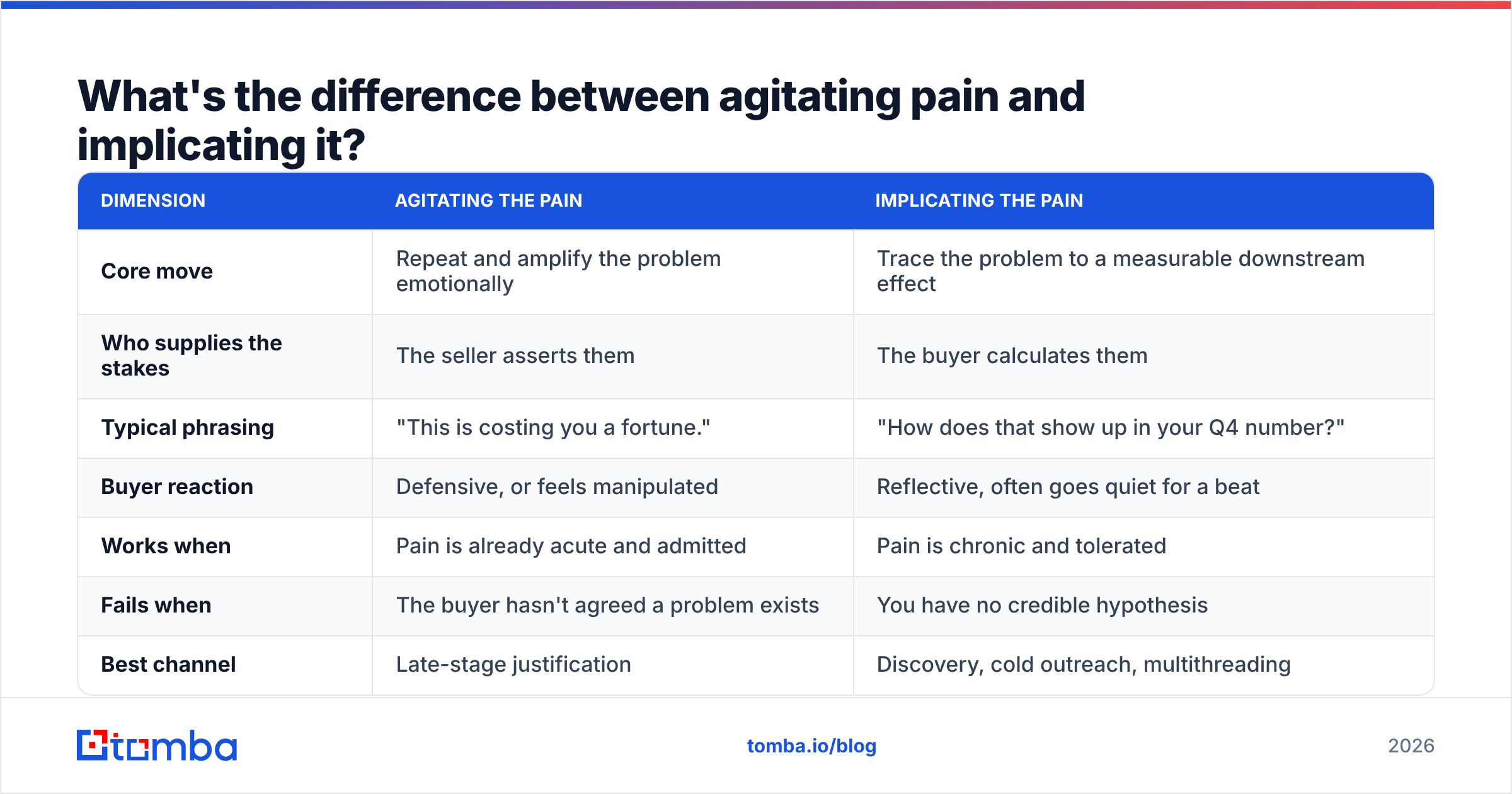
Agitation is pressure. Implication is arithmetic. They feel completely different on the receiving end, and one of them gets you blocked.
| Dimension | Agitating the pain | Implicating the pain |
|---|---|---|
| Core move | Repeat and amplify the problem emotionally | Trace the problem to a measurable downstream effect |
| Who supplies the stakes | The seller asserts them | The buyer calculates them |
| Typical phrasing | "This is costing you a fortune." | "How does that show up in your Q4 number?" |
| Buyer reaction | Defensive, or feels manipulated | Reflective, often goes quiet for a beat |
| Works when | Pain is already acute and admitted | Pain is chronic and tolerated |
| Fails when | The buyer hasn't agreed a problem exists | You have no credible hypothesis |
| Best channel | Late-stage justification | Discovery, cold outreach, multithreading |
The tell is who does the math. If you're the one supplying the dollar figure, you're agitating. If they are, you're implicating. Sellers reach for agitation because it's faster and feels decisive. It also triggers the exact skepticism you were trying to avoid — buyers have heard "this is costing you millions" from every vendor in the category, and the claim carries no information.
How do you implicate the pain in a discovery call?#
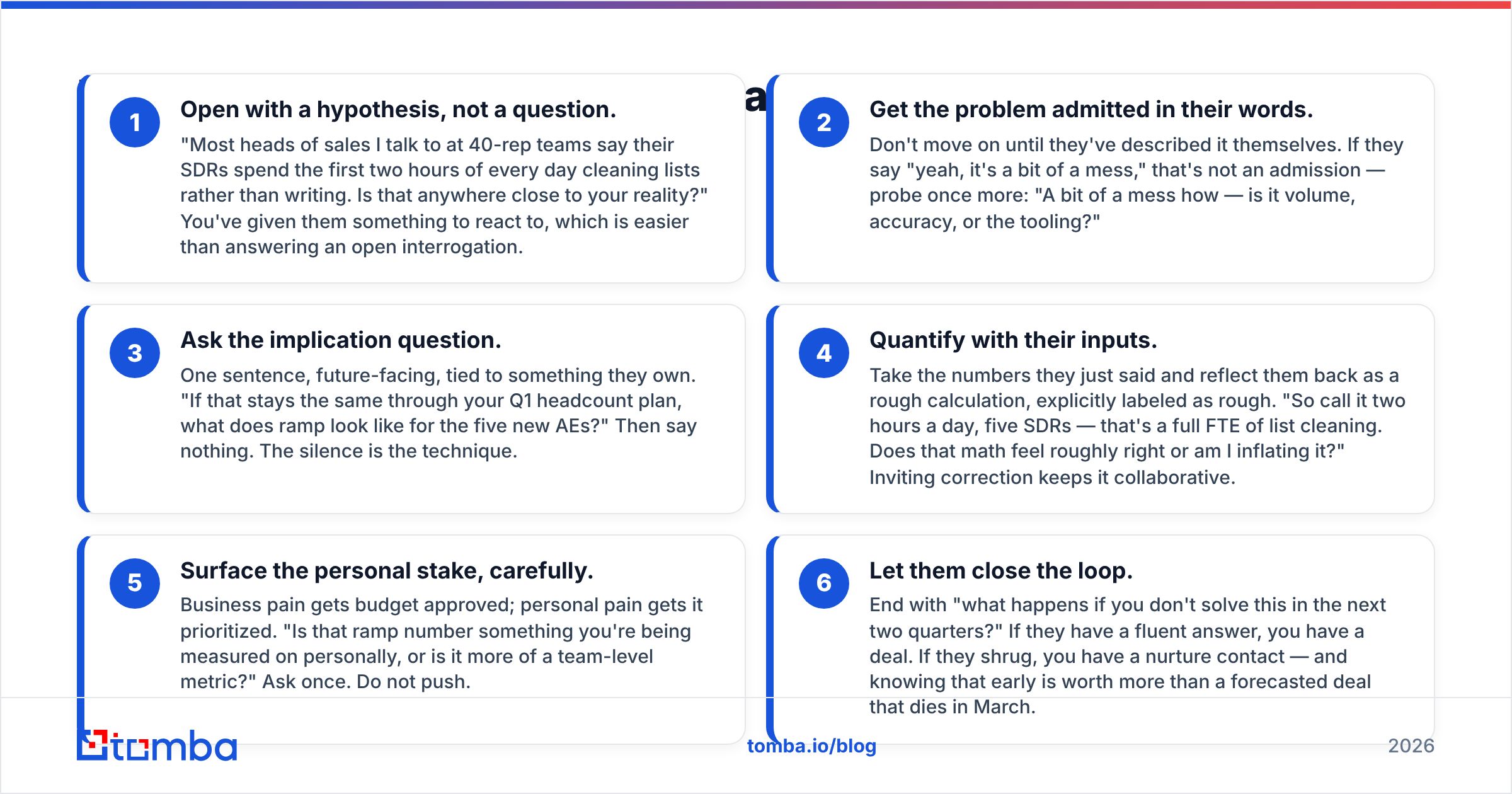
Use a ladder, not a checklist. Each rung is only earned if the previous one landed.
- Open with a hypothesis, not a question. "Most heads of sales I talk to at 40-rep teams say their SDRs spend the first two hours of every day cleaning lists rather than writing. Is that anywhere close to your reality?" You've given them something to react to, which is easier than answering an open interrogation.
- Get the problem admitted in their words. Don't move on until they've described it themselves. If they say "yeah, it's a bit of a mess," that's not an admission — probe once more: "A bit of a mess how — is it volume, accuracy, or the tooling?"
- Ask the implication question. One sentence, future-facing, tied to something they own. "If that stays the same through your Q1 headcount plan, what does ramp look like for the five new AEs?" Then say nothing. The silence is the technique.
- Quantify with their inputs. Take the numbers they just said and reflect them back as a rough calculation, explicitly labeled as rough. "So call it two hours a day, five SDRs — that's a full FTE of list cleaning. Does that math feel roughly right or am I inflating it?" Inviting correction keeps it collaborative.
- Surface the personal stake, carefully. Business pain gets budget approved; personal pain gets it prioritized. "Is that ramp number something you're being measured on personally, or is it more of a team-level metric?" Ask once. Do not push.
- Let them close the loop. End with "what happens if you don't solve this in the next two quarters?" If they have a fluent answer, you have a deal. If they shrug, you have a nurture contact — and knowing that early is worth more than a forecasted deal that dies in March.
Notice that four of the six steps are questions and none of them mention your product. Conversation-analytics vendors like Gong have published repeatedly on the correlation between question quality, talk ratios, and win rates — the pattern holds across datasets: sellers who ask fewer, better questions and let silence sit outperform sellers who fill the air.
The ceiling matters as much as the method. Three implication questions in a 30-minute call is plenty. Six is a deposition, and buyers describe that experience with words you don't want attached to your brand.
What does implicating the pain look like in a cold email?#
Compressed. You have roughly four seconds and no permission to ask six questions. The structure that works:
Observation → implication → tiny ask.
Weak version, the one everyone sends:
Hi Sarah, I noticed you're hiring SDRs. Most teams struggle with data quality. Tomba helps sales teams find verified emails with 99% accuracy. Open to a quick 15-minute call Thursday?
There's no implication anywhere. "Struggle with data quality" is a category, not a consequence, and the ask is the largest one available.
Stronger version:
Sarah — saw the three SDR roles posted this month. The thing that usually bites teams scaling that fast isn't the hiring, it's that new reps burn weeks 1–4 emailing a list nobody re-verified since last quarter. Their first-month reply rate tanks, and you can't tell whether it's the rep or the data. Is that a problem you've already solved, or one you're expecting to hit?
That's still under 90 words. It names a specific trigger, traces it to a consequence the reader has personally experienced (not being able to diagnose a struggling new hire), and asks a question that's genuinely easy to answer either way — including "already solved," which is a real out.
Three rules for implication in writing:
- One consequence, not three. A stacked list of pains reads as a template. A single, oddly specific one reads as a person.
- Make the consequence diagnostic, not catastrophic. "You can't tell if it's the rep or the data" beats "you'll lose millions in pipeline." Small and true outperforms large and unfalsifiable.
- Give them a graceful exit. "Or is this already handled?" costs you nothing and dramatically raises reply rates, because you're no longer asking them to concede a weakness to a stranger.
If you want structural starting points rather than blank-page paralysis, our cold email templates library is built around this observation-implication-ask shape, and the subject line tester will tell you quickly whether your framing reads as curiosity or as a pitch.
How do you quantify the cost without making up numbers?#
Use ranges the buyer supplies and label your assumptions out loud. Fabricated precision is the fastest way to lose credibility — the moment you say "this is costing you $312,000 a year" and the CFO in the room knows the real number is $80,000, everything else you said is now suspect.

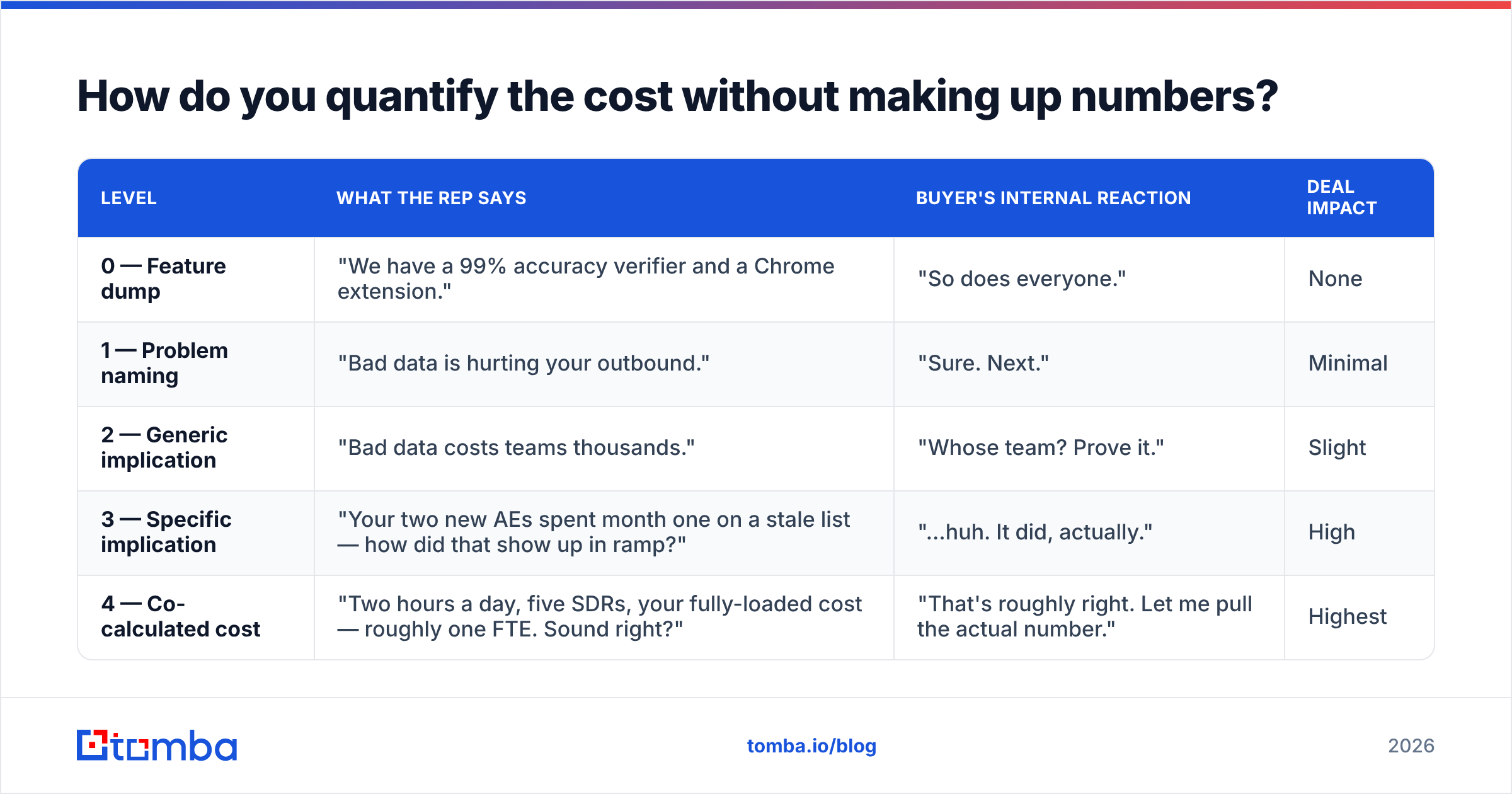
Here's how the maturity ladder actually looks in practice:
| Level | What the rep says | Buyer's internal reaction | Deal impact |
|---|---|---|---|
| 0 — Feature dump | "We have a 99% accuracy verifier and a Chrome extension." | "So does everyone." | None |
| 1 — Problem naming | "Bad data is hurting your outbound." | "Sure. Next." | Minimal |
| 2 — Generic implication | "Bad data costs teams thousands." | "Whose team? Prove it." | Slight |
| 3 — Specific implication | "Your two new AEs spent month one on a stale list — how did that show up in ramp?" | "…huh. It did, actually." | High |
| 4 — Co-calculated cost | "Two hours a day, five SDRs, your fully-loaded cost — roughly one FTE. Sound right?" | "That's roughly right. Let me pull the actual number." | Highest |
Level 4 is where deals get internal champions, because you've handed the buyer a slide they can use without you in the room. HubSpot's sales research has made the same point for years in different words: the seller who helps a buyer build the internal business case wins more often than the seller with the better product demo.
Two guardrails:
- Always show your inputs. "Assuming 40 emails a day and your stated 6% bounce rate" invites correction rather than a private eye-roll.
- Round down. A conservative number that survives scrutiny is worth more than an aggressive one that gets challenged and discarded.
When does implicating the pain backfire?#
Four situations, all common:
When there's no real problem. If the buyer genuinely has this handled, implication questions read as manufactured doubt. Disqualify and move on — you'll get referrals from people you didn't waste.
When you're talking to the wrong person. Implication requires the listener to own the consequence. Ask an IC about board-level revenue risk and you get a blank stare, correctly. Ask a CRO about daily list hygiene and you get delegated to someone junior.
When the pain is personal and you push. "So this is on you, then?" is not a discovery question, it's a threat. One light touch, then retreat.
When your targeting was wrong to begin with. This is the silent killer. Perfect implication logic aimed at a company with the wrong size, stack, or trigger produces nothing. No script recovers from a bad list — which is why the pre-work of building an accurate, verified contact list is upstream of every messaging decision. Getting the email verification step right before the sequence goes out isn't a data-hygiene chore, it's what makes the implication land on someone who can actually feel it.
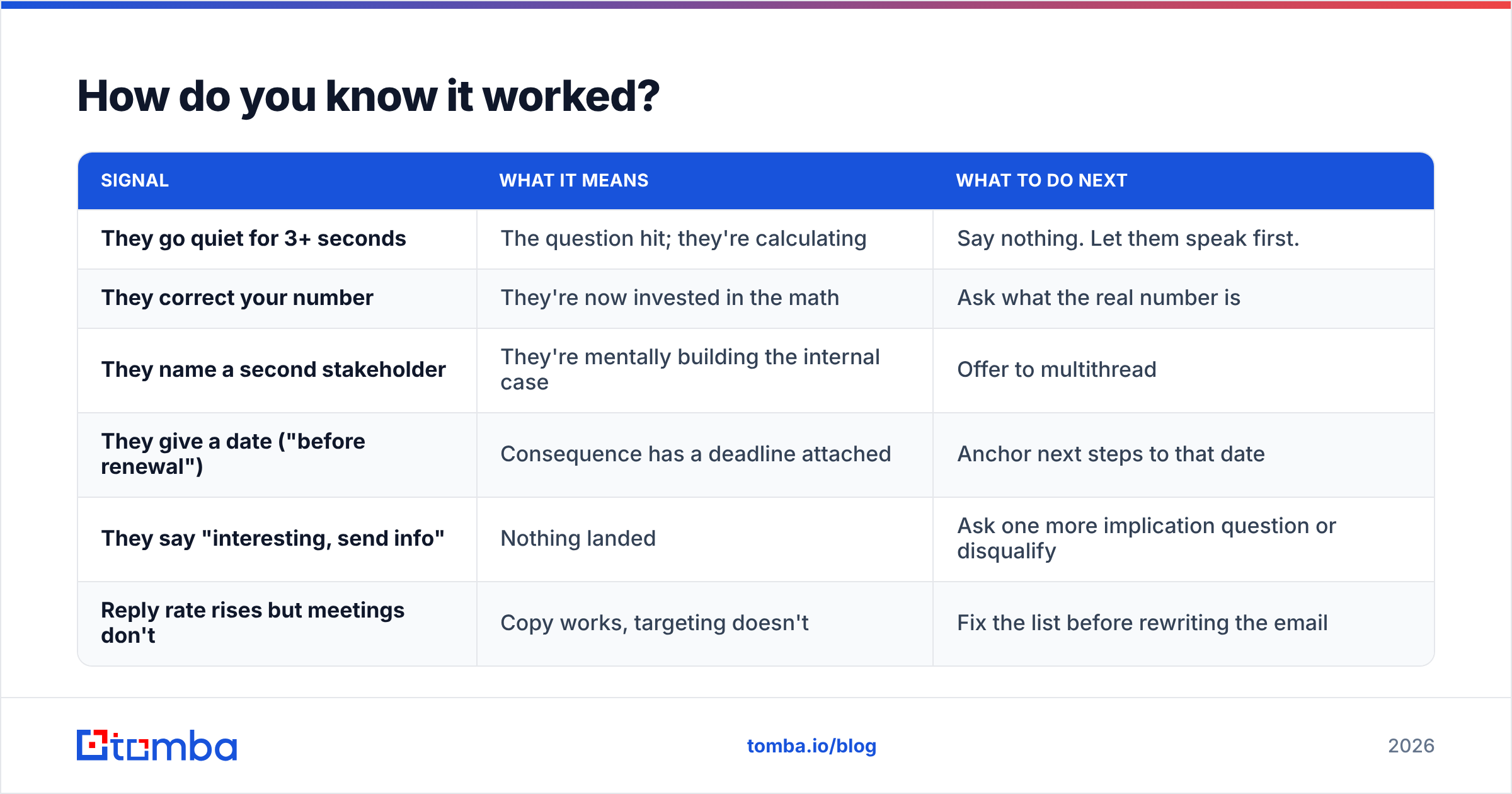
How do you know it worked?#
Look for behavioral signals, not agreement. Buyers agree with everything to end calls politely.
| Signal | What it means | What to do next |
|---|---|---|
| They go quiet for 3+ seconds | The question hit; they're calculating | Say nothing. Let them speak first. |
| They correct your number | They're now invested in the math | Ask what the real number is |
| They name a second stakeholder | They're mentally building the internal case | Offer to multithread |
| They give a date ("before renewal") | Consequence has a deadline attached | Anchor next steps to that date |
| They say "interesting, send info" | Nothing landed | Ask one more implication question or disqualify |
| Reply rate rises but meetings don't | Copy works, targeting doesn't | Fix the list before rewriting the email |
That last row is the one most teams misread. If your response rate climbs after you rewrite for implication but booked meetings stay flat, the messaging isn't the constraint — you're reaching people for whom the consequence is real but not theirs to solve.
Where should you start this week?#
Pick one sequence and one call type. Rewrite the sequence's second email around a single specific consequence instead of a value prop. In your next five discovery calls, ask exactly one implication question and count to four before saying anything. Log which questions produced silence and which produced "sure, makes sense." Within two weeks you'll have three questions that reliably work in your market and a much shorter list of prospects worth forecasting.
None of it matters if the message reaches the wrong inbox. Implication is a precision instrument, and precision instruments need accurate inputs — the right person, at the right company, at a moment when the consequence is live. Start there: use the Tomba Email Finder to build a verified list of the exact roles who own the consequence you're implicating, and check the Tomba pricing tiers — the free tier gives you 25 searches a month to test the approach, and Starter runs $49/mo when the questions start working.
Related guides#
// get started
Find, verify and enrich your first contacts today
Start on the free plan with 25 searches a month, then scale when your team is ready.
Free plan · No credit card required · GDPR & CCPA
Get the Tomba newsletter
Product and data updates
// about the author