Inbound Sales Call: How to Run One That Actually Closes
Most inbound sales calls are lost before the rep says hello. Here's the five-step frame, the speed-to-lead math, and the qualifying questions that turn a raised hand into a closed deal.
TL;DR
- An inbound sales call is a live conversation with a prospect who already raised a hand — a demo request, a pricing question, a callback form, a chatbot escalation. The intent is given; your job is speed, context, and control.
- Speed-to-lead is the single biggest lever. Calls placed within five minutes of a form fill connect and qualify at multiples of calls placed the next day.
- The call itself should follow a five-step frame: confirm the trigger, diagnose the problem, quantify the impact, test fit honestly, and lock a next step with a date on it.
- Enrichment before dialing beats improvisation during the call. Knowing the company, the role, and the direct line changes the first thirty seconds.
- Track connect rate, time-to-first-touch, and inbound-to-opportunity rate separately from outbound. Blending them hides the problem.
What is an inbound sales call?#
An inbound sales call is any live phone conversation initiated by buyer intent rather than rep prospecting. The lead came to you: they filled out a demo form, requested pricing, clicked "talk to sales," escalated out of a chatbot, or dialed the number on your site.
That distinction matters more than it sounds. On an outbound call, you spend the first ninety seconds earning permission to exist. On an inbound sales call, permission is already granted — and the clock starts ticking on a different problem: the buyer is almost certainly evaluating two or three competitors in the same window. Inbound marketing generates the hand-raise; the call decides who gets the deal.
Four things separate an inbound sales call from every other call in your pipeline:
- Intent is pre-qualified. The prospect has a problem and has already decided a vendor might solve it. You are not creating demand, you are routing it.
- The window is short. Buyers who submit a form typically submit several. Whoever calls first frames the evaluation criteria for everyone who follows.
- The rep has less control over timing. Inbound arrives when it arrives — Friday at 4:50pm, mid-quarter, during your all-hands. Coverage rules matter as much as talk tracks.
- Discovery is compressed. The prospect expects you to already know something about them. Repeating questions they answered on the form burns credibility fast.
Why does an inbound sales call convert better than outbound?#
Because the expensive part — creating awareness that a problem is worth paying to solve — already happened. Gartner's sales research has consistently shown that B2B buyers complete most of their evaluation before they ever speak to a vendor. An inbound caller is not at the top of the funnel. They are mid-funnel, with a shortlist forming in their head.
The practical effect: inbound conversations skip straight to fit and mechanics. Instead of "why should I care about deliverability," you get "we run 40,000 sends a month and our bounce rate hit 6% — what do you do about that?" That is a qualification question disguised as a support question, and it should take you ten minutes to answer, not a 45-minute deck.
The trap is assuming inbound closes itself. It doesn't. Inbound leads have higher intent and higher competitive density. The prospect who found you found three of your competitors on the same G2 category page. Your advantage decays by the hour.
How fast do you actually have to call back?#
Within five minutes, and the drop-off after that is steeper than most teams believe. The widely cited Lead Response Management research (the Oldroyd study behind almost every speed-to-lead deck you have seen) found the odds of a meaningful qualifying conversation collapse by an order of magnitude once you cross the one-hour mark.
Here is the shape of the curve most teams see when they instrument it themselves:
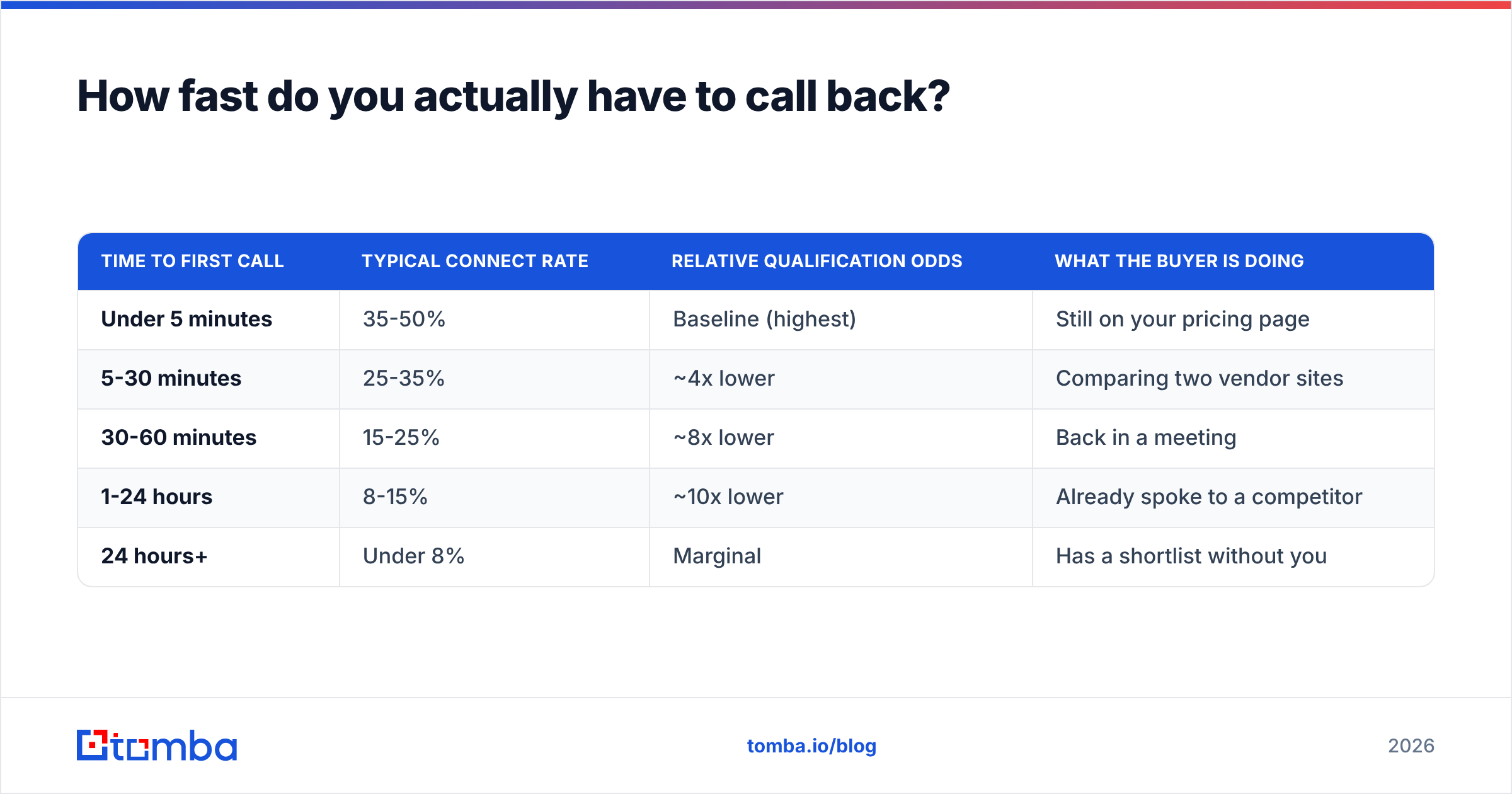
| Time to first call | Typical connect rate | Relative qualification odds | What the buyer is doing |
|---|---|---|---|
| Under 5 minutes | 35-50% | Baseline (highest) | Still on your pricing page |
| 5-30 minutes | 25-35% | ~4x lower | Comparing two vendor sites |
| 30-60 minutes | 15-25% | ~8x lower | Back in a meeting |
| 1-24 hours | 8-15% | ~10x lower | Already spoke to a competitor |
| 24 hours+ | Under 8% | Marginal | Has a shortlist without you |
Exact numbers vary by market — enterprise buyers with procurement calendars behave differently from a self-serve SaaS trial. But the ranking never inverts. Faster always wins.
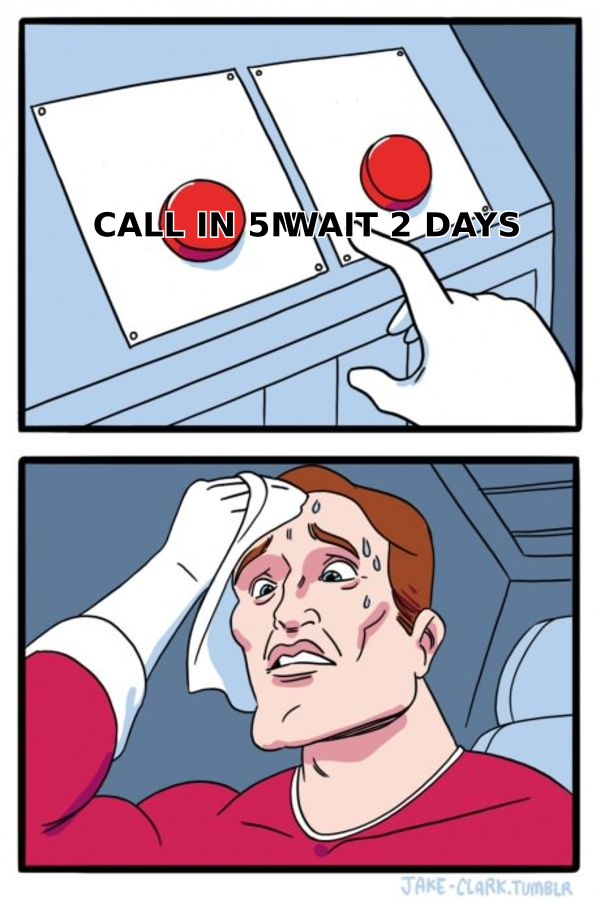
Three operational fixes get most teams from "next business day" to "under fifteen minutes" without hiring anyone:
- Round-robin with a fallback. Assign inbound to a live queue, not to a named owner who might be on PTO. If the primary does not accept in 60 seconds, it reassigns.
- Alert where reps already live. Form submissions should hit a Slack channel or mobile push, not an email digest. A Slack integration that posts the lead plus enrichment in one message removes the CRM round trip.
- Pre-attach the phone number. Half of "we couldn't reach them" is actually "we only had a work email." Running the record through a phone finder before the alert fires means the rep taps to dial instead of hunting.
What should you know before you pick up?#
Enough to skip the first three questions. Not more.
The goal of pre-call research on an inbound sales call is not a dossier — you have four minutes, not forty. It is to arrive with three facts that let you open with a hypothesis instead of an interrogation.
The minimum viable context:
- Company shape — headcount, industry, funding stage, and whether they are the buyer or an agency buying on behalf of someone else.
- The person's actual role — a "Marketing Manager" at a 12-person startup is the decision maker; the same title at a 4,000-person enterprise is a researcher with no budget authority.
- The trigger — which page they converted on, what they typed in the notes field, whether they have been on your site before.
- The tech stack — if they already run a competitor product, the call is a switching conversation, and switching conversations have entirely different objections.
- Contact completeness — a verified direct line and a working email, so the follow-up does not bounce and undo the whole call.
Most of that can be automated. Point a data enrichment step at the submitted email and the record fills itself in before the rep's phone rings. If the form only captured a personal address, a reverse email lookup will usually resolve it back to a company and a role — which is the difference between "thanks for reaching out, what do you do?" and "I saw you're running growth at a Series B fintech, so I'm guessing compliance is part of this."
How should you structure the inbound sales call?#
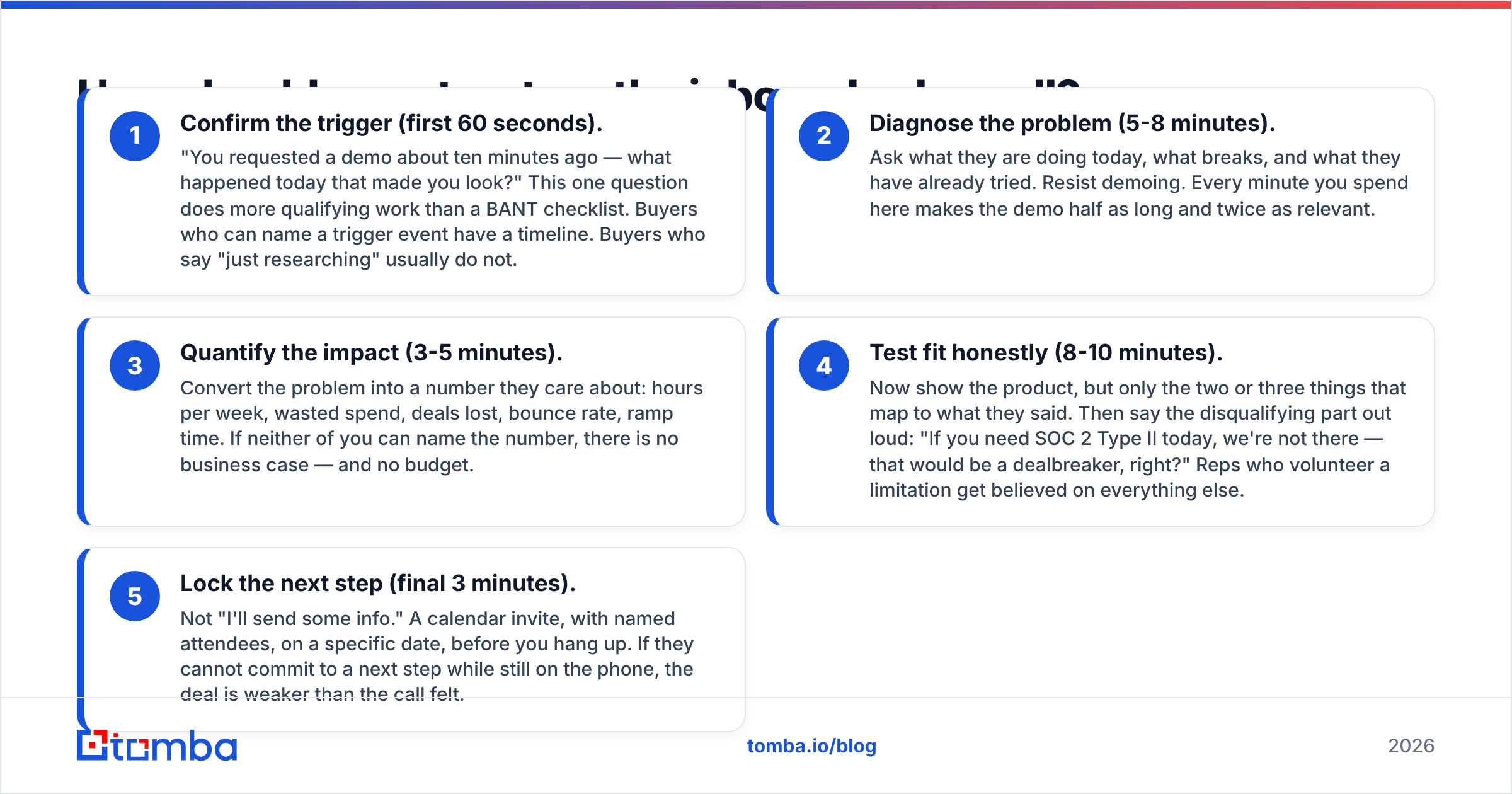
Five steps. Twenty to thirty minutes. No deck until step four.
- Confirm the trigger (first 60 seconds). "You requested a demo about ten minutes ago — what happened today that made you look?" This one question does more qualifying work than a BANT checklist. Buyers who can name a trigger event have a timeline. Buyers who say "just researching" usually do not.
- Diagnose the problem (5-8 minutes). Ask what they are doing today, what breaks, and what they have already tried. Resist demoing. Every minute you spend here makes the demo half as long and twice as relevant.
- Quantify the impact (3-5 minutes). Convert the problem into a number they care about: hours per week, wasted spend, deals lost, bounce rate, ramp time. If neither of you can name the number, there is no business case — and no budget.
- Test fit honestly (8-10 minutes). Now show the product, but only the two or three things that map to what they said. Then say the disqualifying part out loud: "If you need SOC 2 Type II today, we're not there — that would be a dealbreaker, right?" Reps who volunteer a limitation get believed on everything else.
- Lock the next step (final 3 minutes). Not "I'll send some info." A calendar invite, with named attendees, on a specific date, before you hang up. If they cannot commit to a next step while still on the phone, the deal is weaker than the call felt.
The fourth step is where most inbound calls go wrong. A hand-raise creates pressure to impress, so reps over-demo, the call runs 55 minutes, and the prospect leaves with a feature tour instead of a decision. HubSpot's sales guidance has been making this point for years and it still holds: discovery quality predicts close rate better than demo quality.
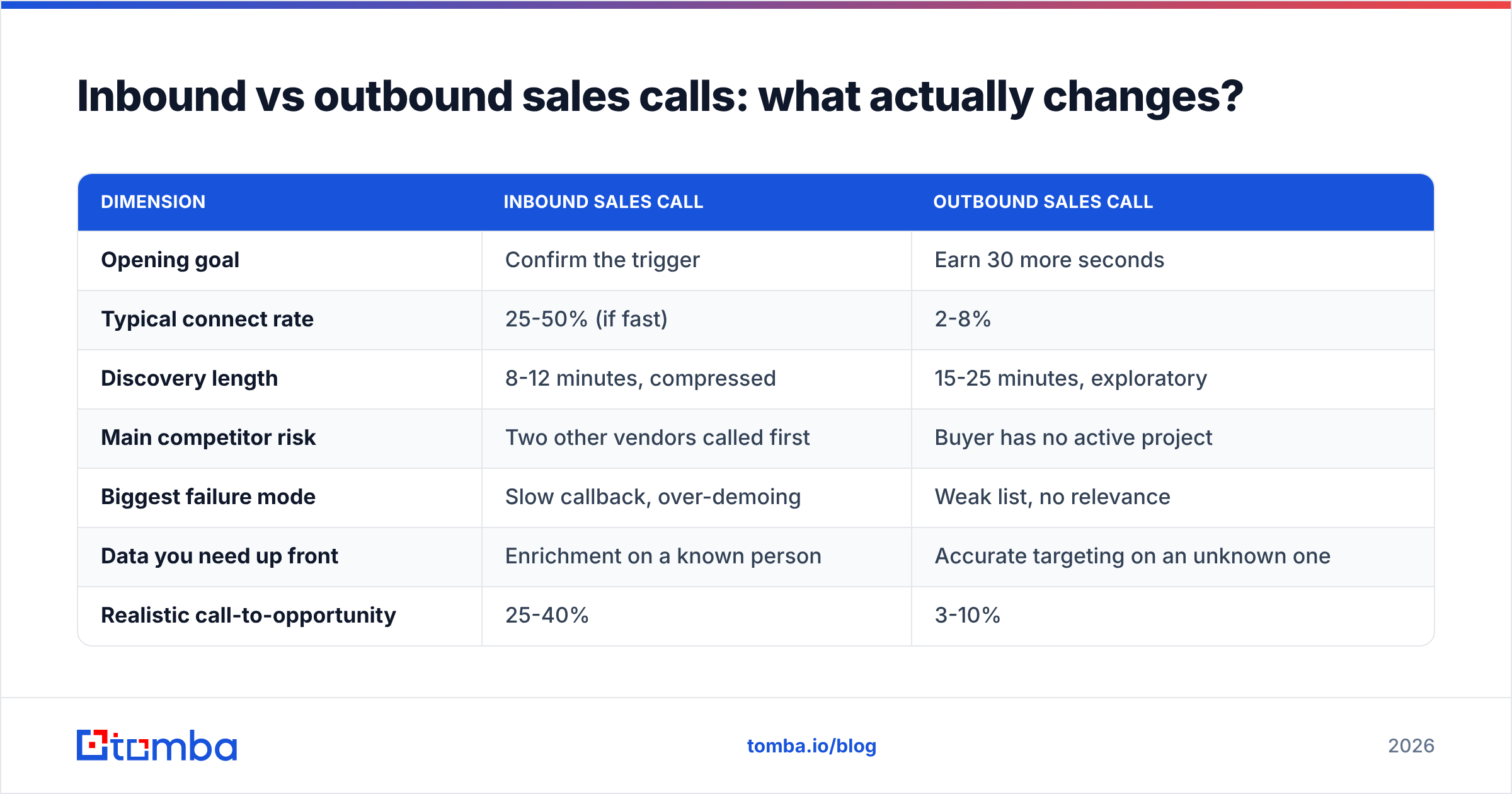
Inbound vs outbound sales calls: what actually changes?#
| Dimension | Inbound sales call | Outbound sales call |
|---|---|---|
| Opening goal | Confirm the trigger | Earn 30 more seconds |
| Typical connect rate | 25-50% (if fast) | 2-8% |
| Discovery length | 8-12 minutes, compressed | 15-25 minutes, exploratory |
| Main competitor risk | Two other vendors called first | Buyer has no active project |
| Biggest failure mode | Slow callback, over-demoing | Weak list, no relevance |
| Data you need up front | Enrichment on a known person | Accurate targeting on an unknown one |
| Realistic call-to-opportunity | 25-40% | 3-10% |
| Who controls timing | The buyer | The rep |
The row that matters most is the last one. Outbound is a volume game you schedule; inbound is a response game you staff. Teams that manage both with the same dashboard and the same cadence rules will underperform on inbound every quarter.
What questions qualify an inbound lead fastest?#
Five, in this order. Each one is designed to be answerable in a sentence.
- "What made you look today?" — surfaces the trigger and the timeline in one move.
- "What are you using now, and what does it cost you?" — reveals the incumbent, the switching cost, and the budget ceiling.
- "Who else feels this problem?" — maps the buying committee without the awkward "are you the decision maker?"
- "If this works, what changes for you personally?" — separates a champion from a researcher.
- "What would have to be true for you to sign by [date]?" — converts vague interest into a list of real blockers.
Notice none of them are "what's your budget?" On an inbound sales call, budget questions asked early read as qualification theatre. Ask about cost of the current state instead; the budget answer arrives on its own.
What does the follow-up require?#
A recap email within fifteen minutes, sent to an address you have actually verified.
This sounds trivial until you audit it. A meaningful share of inbound form fills contain typos, role aliases, or shared inboxes that silently drop mail. You run a great call, send the recap, it soft-bounces, and the deal dies looking like a ghosting. Running the address through an email verifier before the recap goes out costs nothing and removes an entire category of invisible loss.
The recap itself should be short and structurally boring: the problem in their words, the number you quantified together, what you agreed the product would do, the honest limitation you named, and the next step with the date. Three sentences and a bulleted list. If they forward it internally — and on real deals they will — it needs to survive being read by someone who was not on the call.
For teams whose inbound comes from list-based campaigns as well as organic traffic, contact quality upstream is what makes any of this work. Providers like BookYourData and self-serve tools such as Tomba both solve for the same underlying requirement: a record that is complete and accurate at the moment a rep needs to act on it. The buying decision usually comes down to whether you need a bulk purchased list or on-demand lookups against your own inbound traffic.
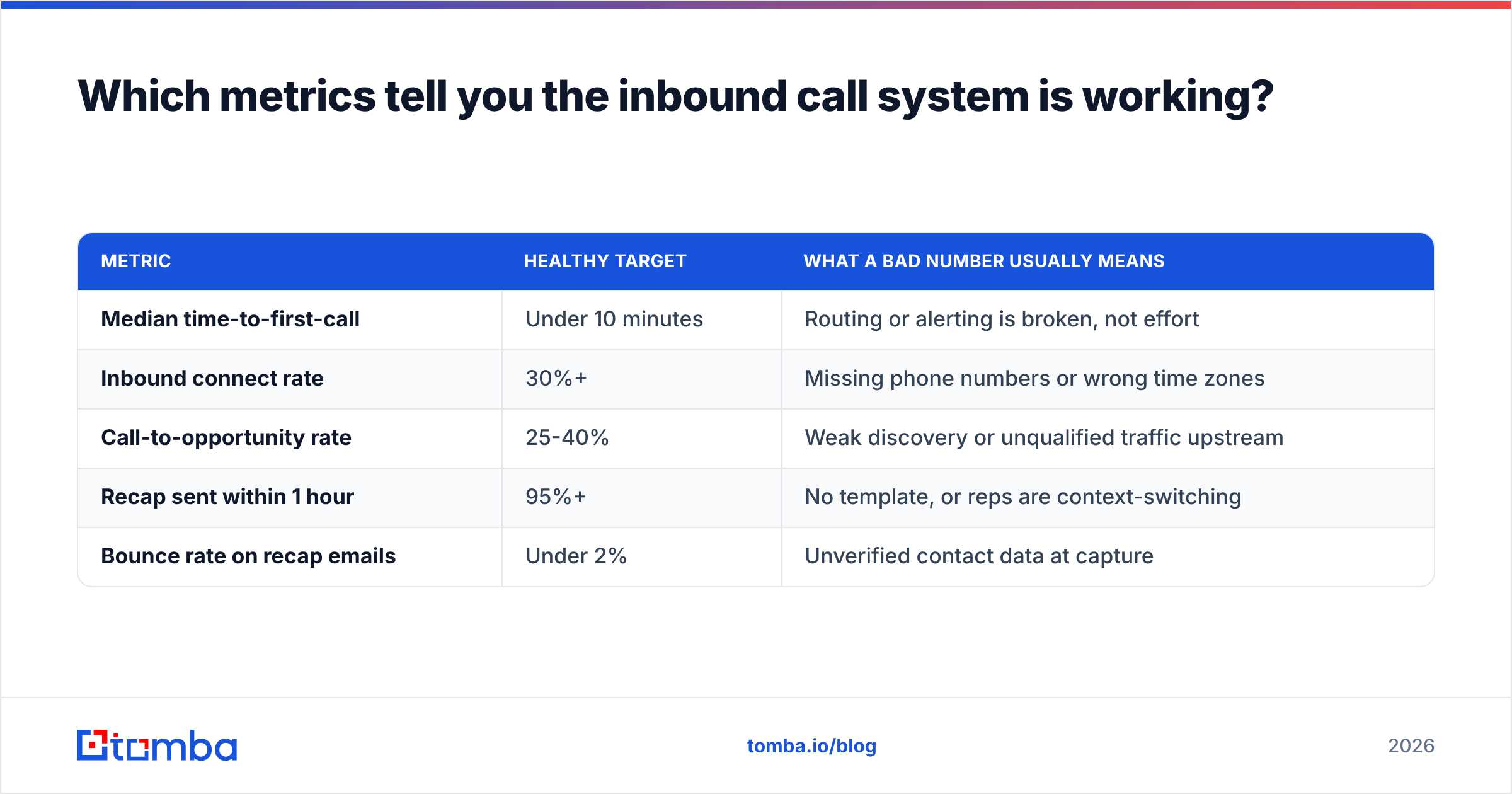
Which metrics tell you the inbound call system is working?#
Four, tracked separately from outbound:
| Metric | Healthy target | What a bad number usually means |
|---|---|---|
| Median time-to-first-call | Under 10 minutes | Routing or alerting is broken, not effort |
| Inbound connect rate | 30%+ | Missing phone numbers or wrong time zones |
| Call-to-opportunity rate | 25-40% | Weak discovery or unqualified traffic upstream |
| Recap sent within 1 hour | 95%+ | No template, or reps are context-switching |
| Bounce rate on recap emails | Under 2% | Unverified contact data at capture |
If time-to-first-call is under ten minutes and call-to-opportunity is still below 20%, the problem is not the call — it is the traffic. That is a marketing conversation about which pages and campaigns produce hand-raises worth answering, and it is a far better use of a QBR than another talk-track workshop.
Where should you start this week?#
Pick the cheapest fix with the largest slope: response time. Instrument it, publish the median in a channel everyone sees, and set a fifteen-minute service level. Most teams find they beat their own baseline within a week purely because the number is now visible.
Then fix the data underneath it. Every inbound sales call gets better when the rep opens with context instead of questions, and context comes from enrichment that fires the moment a form is submitted — company, role, direct line, verified email.
That is exactly the gap the Tomba Email Finder fills for inbound teams: resolve a partial form fill into a complete, verified contact record before the phone rings, so your first call lands on a real number and your recap lands in a real inbox. Start on the free tier at 25 searches a month, or check Tomba pricing — Starter runs $49/mo and scales through Growth at $99/mo — and wire it into your inbound routing before the next form comes in.
Related guides#
// get started
Find, verify and enrich your first contacts today
Start on the free plan with 25 searches a month, then scale when your team is ready.
Free plan · No credit card required · GDPR & CCPA
Get the Tomba newsletter
Product and data updates
// about the author