Inbound Sales Rep: Role, Skills, and Pay Guide for 2026
Inbound sales reps work leads that already raised a hand — but the role is not the easy seat people assume. Here's what the job actually involves, what it pays, and when inbound beats outbound.
TL;DR
- An inbound sales rep works leads that already raised a hand — demo requests, trial signups, content downloads, pricing-page visits — and converts them into pipeline. The job is speed, qualification, and context, not persuasion from zero.
- Inbound reps close at roughly 2-4x the rate of pure cold outbound, but they control almost none of their own volume. When marketing has a bad quarter, so do you.
- Median US comp in 2026 sits around $55K-$75K base with $90K-$130K OTE for a mid-market inbound AE; SDR-level inbound (MQL qualification) runs lower.
- The single biggest performance lever is speed-to-lead. Responding in under five minutes versus 30 minutes changes qualification odds by an order of magnitude.
- The best inbound teams do not wait passively. They enrich inbound signals — reverse-lookup the work email, pull the rest of the buying committee — and turn one hand-raise into a multi-threaded account.
What is an inbound sales rep?#
An inbound sales rep sells to people who contacted your company first. Instead of building a list and cold emailing it, you pick up demand that marketing, product, or word-of-mouth already generated, then qualify it, run the deal, and close it.
The mechanics vary by company size. At a 20-person startup, "inbound sales rep" often means one person handling every demo request end to end. At a 500-person SaaS company, the inbound function splits: an inbound SDR (sometimes called an MDR, or market development rep) qualifies the raw form fills, and an account executive takes the qualified ones into a real sales cycle.
The confusion in job listings is real. Titles like "inbound sales representative," "inbound SDR," "demand response rep," and "growth AE" can all describe the same daily work. What actually distinguishes the role is the source of the pipeline, not the title.
Here is what the day looks like in practice:
- Triage the queue. New form fills, trial signups, chat conversations, and pricing-page alerts land in a shared inbox or CRM view. You sort by fit and recency.
- Enrich before you touch. Before the first reply, you want company size, funding, tech stack, and who else at the account matters. A raw form fill gives you a name and an email — nothing more.
- Respond fast. Speed-to-lead is the metric that dominates everything else in inbound. The rep who calls in four minutes beats the rep with the better script who calls in 40.
- Qualify against real criteria. Budget, authority, timing, and use-case fit. A demo request from a student writing a term paper is not pipeline.
- Multi-thread the account. One person filled out the form. Five to eleven people will influence the purchase. Finding the other four to ten is where inbound reps separate themselves.
- Hand off or close. Depending on the org chart, you either book the AE meeting or you run the cycle yourself.

Is an inbound sales rep the same as an SDR?#
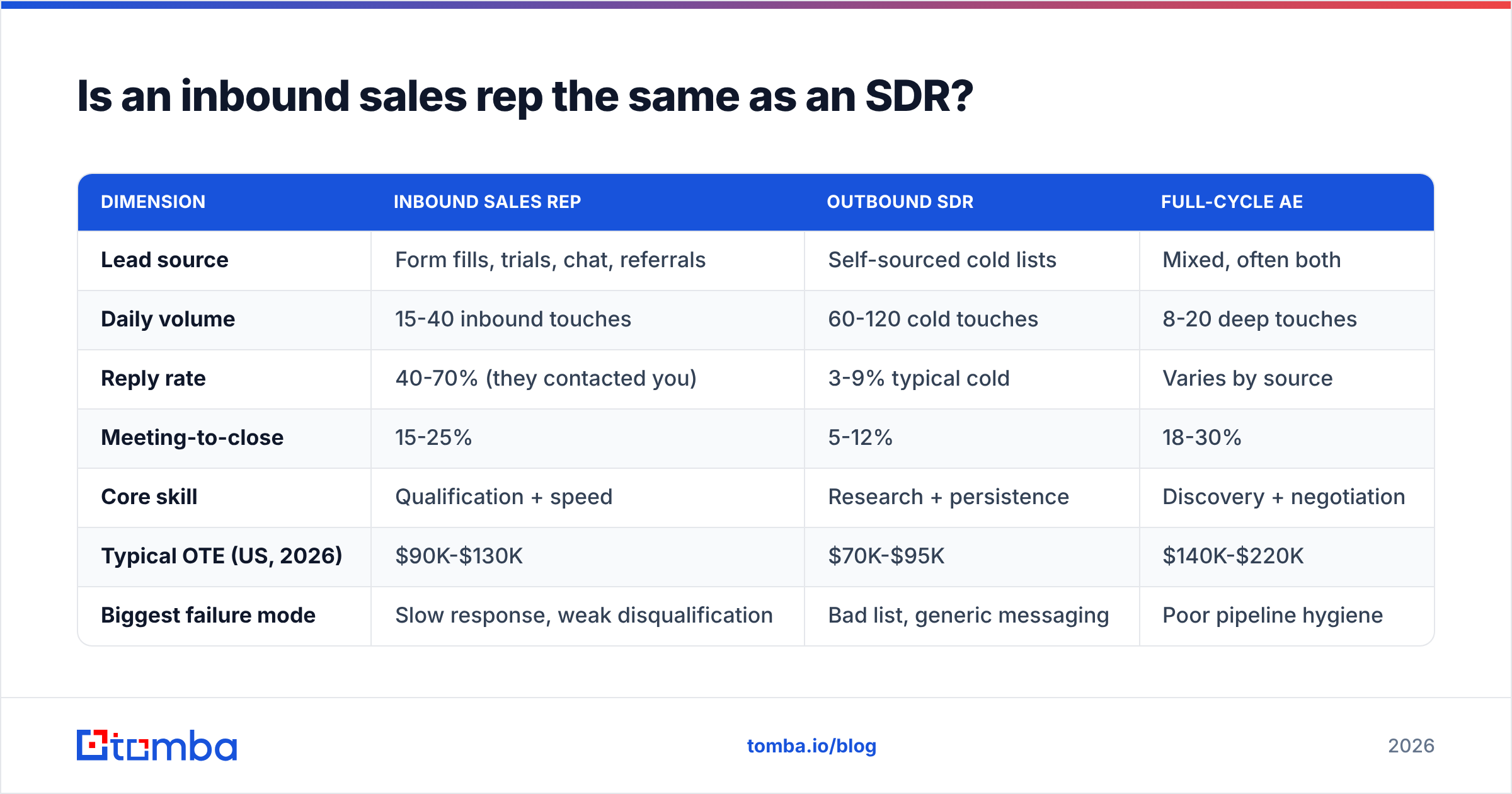
No, though the roles overlap enough to cause real confusion in hiring. The cleanest way to think about it: SDR is a stage in the pipeline, inbound is a source of the pipeline. You can be an inbound SDR or an outbound SDR, and the two jobs feel almost nothing alike.
| Dimension | Inbound Sales Rep | Outbound SDR | Full-Cycle AE |
|---|---|---|---|
| Lead source | Form fills, trials, chat, referrals | Self-sourced cold lists | Mixed, often both |
| Daily volume | 15-40 inbound touches | 60-120 cold touches | 8-20 deep touches |
| Reply rate | 40-70% (they contacted you) | 3-9% typical cold | Varies by source |
| Meeting-to-close | 15-25% | 5-12% | 18-30% |
| Core skill | Qualification + speed | Research + persistence | Discovery + negotiation |
| Typical OTE (US, 2026) | $90K-$130K | $70K-$95K | $140K-$220K |
| Biggest failure mode | Slow response, weak disqualification | Bad list, generic messaging | Poor pipeline hygiene |
| Control over volume | Low — marketing owns it | High — you own it | Medium |
That "control over volume" row is the honest tension in the role. Inbound reps have better conversion math and worse autonomy. In a quarter where paid spend gets cut or a top-of-funnel keyword loses rank, an inbound rep's number moves for reasons entirely outside their control. Outbound reps complain about rejection; inbound reps complain about drought.
The strongest sales orgs blur the line deliberately. They give inbound reps an outbound quota floor — maybe 20% of pipeline must be self-sourced — precisely so the team keeps prospecting muscle alive. If you are hiring for this role, ask candidates whether they can still build a list from scratch. Many pure inbound reps cannot, and that is a risk.
What skills does an inbound sales rep actually need?#
Fast disqualification is the skill nobody screens for and everybody needs. Inbound queues are full of noise: competitors doing research, students, job seekers, people who wanted a free tool and clicked the wrong button. A rep who tries to "nurture" all of them will run out of hours before they run out of leads.
The skill set that separates a $130K inbound rep from a $70K one:
- Sub-five-minute triage. Not just responding fast, but deciding fast which leads deserve a call versus a templated email versus nothing.
- Contextual discovery. The prospect already read three of your pages. Asking "so what does your company do?" burns the goodwill their hand-raise created. Read the page history in your CRM first.
- Account expansion from one contact. Turning a single form-fill into a mapped buying committee. This is a research skill, and it is learnable.
- Objection handling on price, not on need. Inbound prospects rarely need convincing they have a problem — they searched for a solution. The friction is almost always budget, timing, or an incumbent vendor.
- CRM discipline. Inbound volume punishes sloppy record-keeping harder than outbound does, because leads recycle and re-engage months later.
- Comfort with a hybrid quota. Most inbound roles in 2026 carry some self-sourced expectation. Pretending otherwise in an interview will not survive month three.
Notice what is missing: cold-calling stamina and rejection tolerance rank far lower here than in outbound. That is why the roles are not interchangeable, and why moving a great outbound SDR into an inbound seat sometimes flops. The outbound rep keeps pitching when they should be listening.
How do you enrich inbound leads before the first reply?#
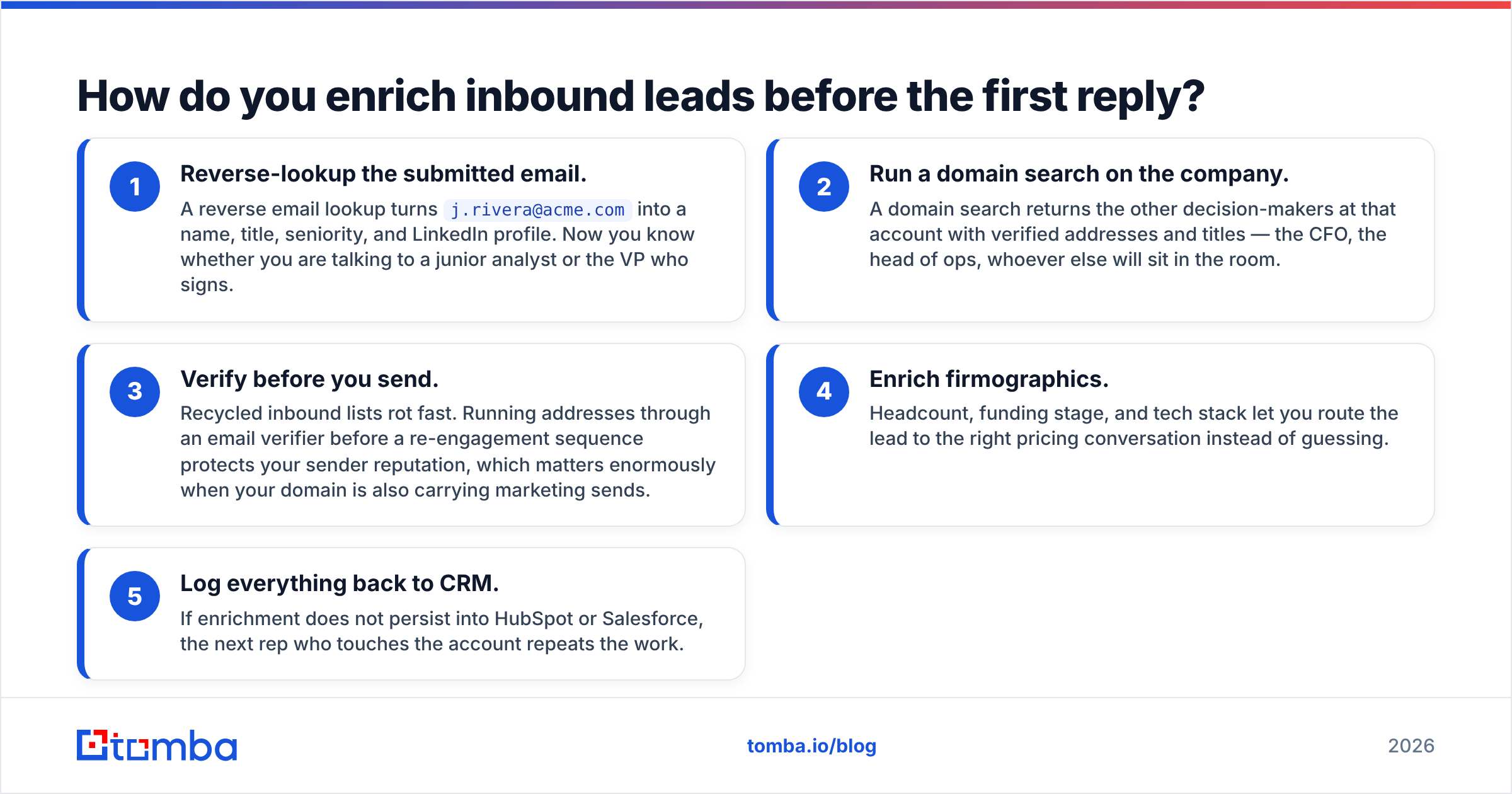
Enrichment is the highest-ROI habit in inbound sales, and most teams do it badly or not at all. A form fill gives you a name, a work email, and maybe a company. That is not enough to run good discovery, and it is definitely not enough to multi-thread.
The workflow that works:
- Reverse-lookup the submitted email. A reverse email lookup turns
j.rivera@acme.cominto a name, title, seniority, and LinkedIn profile. Now you know whether you are talking to a junior analyst or the VP who signs. - Run a domain search on the company. A domain search returns the other decision-makers at that account with verified addresses and titles — the CFO, the head of ops, whoever else will sit in the room.
- Verify before you send. Recycled inbound lists rot fast. Running addresses through an email verifier before a re-engagement sequence protects your sender reputation, which matters enormously when your domain is also carrying marketing sends.
- Enrich firmographics. Headcount, funding stage, and tech stack let you route the lead to the right pricing conversation instead of guessing.
- Log everything back to CRM. If enrichment does not persist into HubSpot or Salesforce, the next rep who touches the account repeats the work.
Step two is where most teams leave money on the table. HubSpot's research on B2B buying committees consistently shows multiple stakeholders per deal — the person who filled out your form is frequently a researcher, not a buyer. If your only contact is that researcher and they go quiet, the deal dies silently. If you have three contacts at the account, it survives one person changing jobs.
For teams running this at volume, doing it manually per lead does not scale past about 30 leads a day. That is when a bulk email finder or an API-driven enrichment step inside your lead-routing workflow pays for itself. Tools like Tomba, Clearbit, and BookYourData each cover this from different angles — Tomba and BookYourData lean toward verified contact discovery, Clearbit toward firmographic enrichment inside the CRM.
What does an inbound sales rep get paid in 2026?#
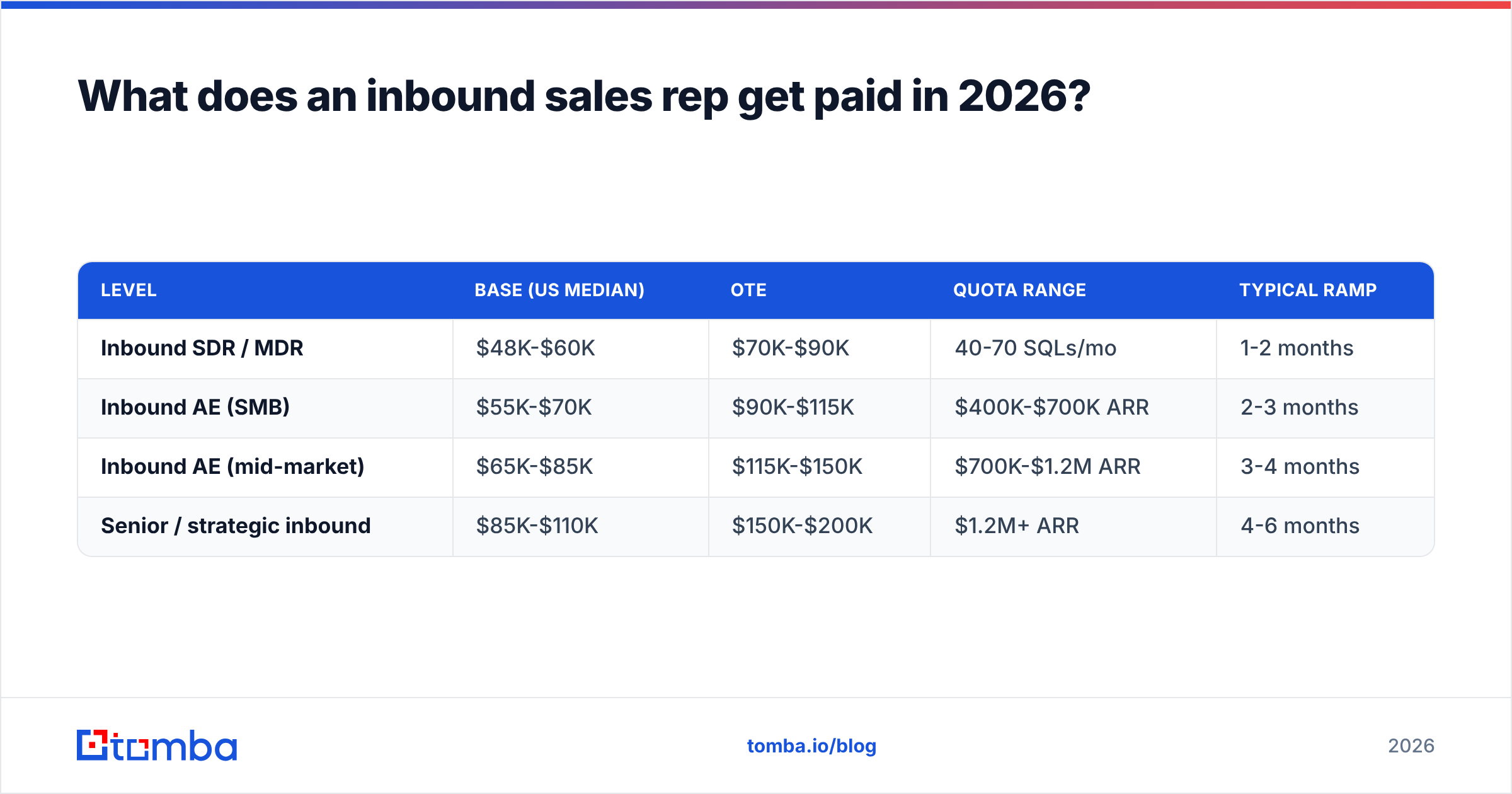
Median OTE for a mid-market inbound AE in the US sits in the $90K-$130K range, with base typically 55-65% of total. But the spread is wide, and the variables matter more than the median.
| Level | Base (US median) | OTE | Quota range | Typical ramp |
|---|---|---|---|---|
| Inbound SDR / MDR | $48K-$60K | $70K-$90K | 40-70 SQLs/mo | 1-2 months |
| Inbound AE (SMB) | $55K-$70K | $90K-$115K | $400K-$700K ARR | 2-3 months |
| Inbound AE (mid-market) | $65K-$85K | $115K-$150K | $700K-$1.2M ARR | 3-4 months |
| Senior / strategic inbound | $85K-$110K | $150K-$200K | $1.2M+ ARR | 4-6 months |
Three things move these numbers more than experience does:
Deal size. An inbound rep at a $50/month product and one at a $50K/year product have the same title and completely different economics. Ask about average contract value before you ask about OTE.
Lead volume guarantee. Some companies contractually commit to a minimum number of MQLs delivered per rep per month. Most do not. If they do not, your quota is a promise built on marketing's performance, and you should discount the OTE accordingly.
Commission on renewals and expansion. Inbound reps at product-led companies often see meaningful expansion revenue. That can add 15-25% to realized comp and rarely shows up in the posted range.
Check the aggregate ranges on G2 and vendor-neutral comp reports before negotiating, and treat any posted OTE without a stated quota attainment percentage as marketing copy. If only 40% of the team hits quota, the "OTE" is fiction.

Is inbound sales better than outbound sales?#
Neither wins outright — they fail in opposite directions, which is why serious revenue teams run both. Inbound has better unit economics and worse predictability. Outbound has worse conversion and better control.
The decision framework that actually holds up:
- Choose inbound-heavy when you have category demand (people search for what you sell), a content or product-led engine that works, and a price point low enough that a self-serve path makes sense.
- Choose outbound-heavy when you are creating a new category, selling to a narrow, nameable list of accounts, or carrying an ACV high enough to justify the cost per touch.
- Run both when you are past roughly $3M ARR. At that point, inbound alone plateaus and outbound alone gets expensive.
The failure mode worth naming: companies that hire inbound reps before they have inbound. A rep with 12 form fills a month is not an inbound rep, they are an outbound rep with a misleading title and a demoralizing quota. This is the most common reason inbound hires wash out in under a year.
There is a second, subtler failure. Teams with strong inbound often let their response rate discipline decay because the leads keep coming. Then a channel dries up — an algorithm update, a competitor outbidding on paid — and the team has no prospecting capability left to compensate. Keeping a self-sourced quota floor is cheap insurance against that.
How do you measure inbound sales rep performance?#
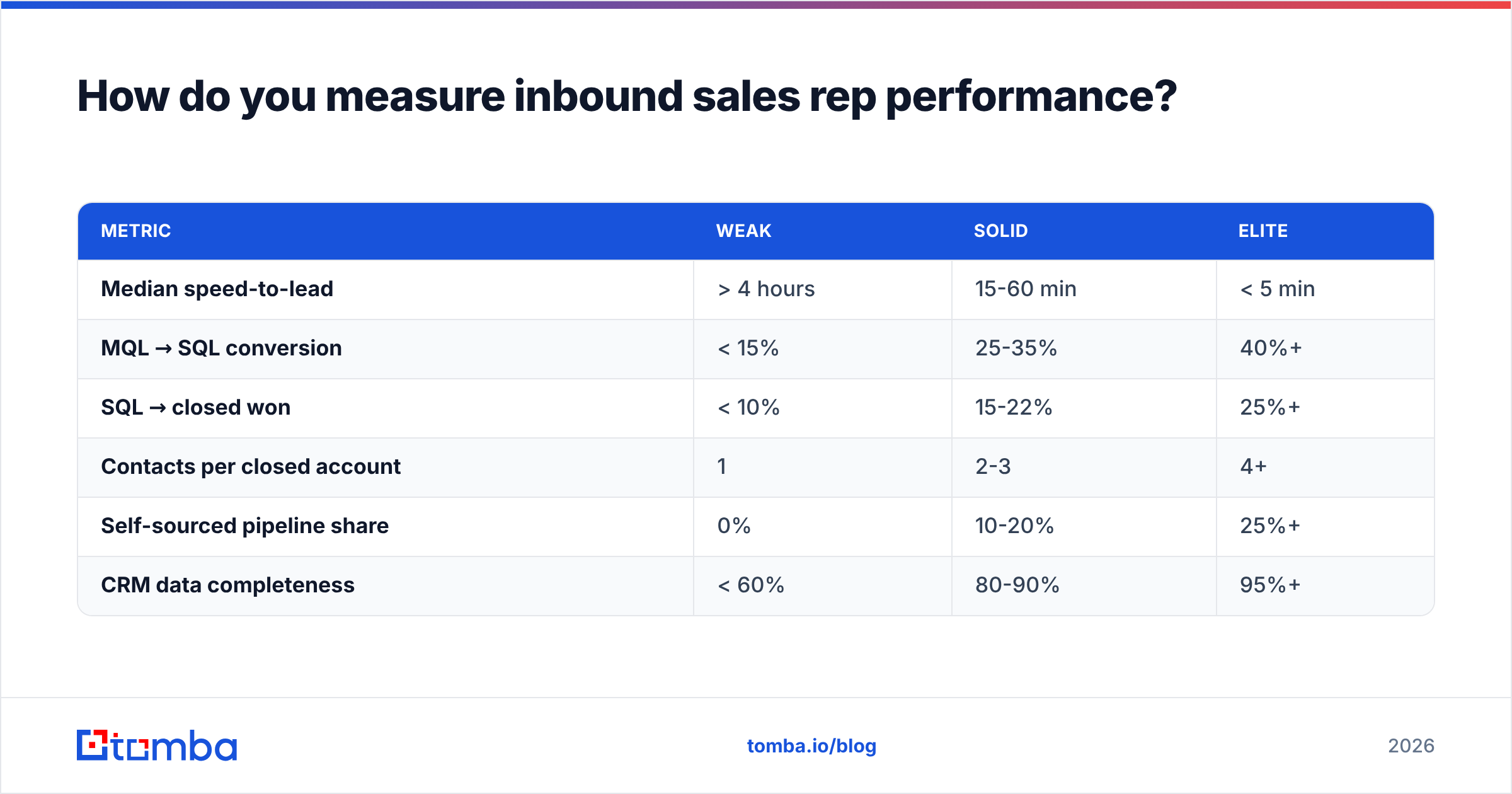
Speed-to-lead, MQL-to-SQL conversion, and SQL-to-close are the three metrics that matter. Everything else is diagnostic.
| Metric | Weak | Solid | Elite |
|---|---|---|---|
| Median speed-to-lead | > 4 hours | 15-60 min | < 5 min |
| MQL → SQL conversion | < 15% | 25-35% | 40%+ |
| SQL → closed won | < 10% | 15-22% | 25%+ |
| Contacts per closed account | 1 | 2-3 | 4+ |
| Self-sourced pipeline share | 0% | 10-20% | 25%+ |
| CRM data completeness | < 60% | 80-90% | 95%+ |
Two rows deserve comment. "Contacts per closed account" is the metric almost nobody tracks and the one that most predicts win rate — it is a direct measure of whether the rep multi-threaded. And "self-sourced pipeline share" is the resilience metric; a rep at 0% is entirely dependent on channels they do not control.
For managers, the diagnostic sequence when an inbound rep misses is: check volume first (did marketing deliver?), then speed (did the rep respond?), then qualification (are the SQLs real?), then close skill. Most misses are diagnosed as a skill problem when they are actually a volume or speed problem.
Salesforce and other CRM vendors publish reasonable benchmarks in their annual State of Sales research if you want external anchors, but your own historical baseline beats any industry median. Track your own numbers for two quarters before you borrow someone else's targets.
What tools does an inbound sales rep need?#
Four categories, in order of impact: CRM, lead routing, contact enrichment, and sequencing. Everything else is optional.
- CRM (required). HubSpot, Salesforce, or Pipedrive. Whatever routes your inbound and stores the history. Non-negotiable.
- Lead routing with instant alerts. The value of speed-to-lead collapses if the alert sits in an email digest. Slack or mobile push, routed by territory or fit score.
- Contact enrichment. Turning one form-fill into a mapped account. This is where data enrichment and email discovery sit.
- Sequencing for re-engagement. Roughly 60-70% of inbound leads are not ready now. They need a light-touch nurture that a rep does not manually run.
- Verification. If your inbound domain also sends marketing email, bounce rates hurt twice. Verify before re-engagement sends.
- Call recording. For inbound specifically, recordings are how you diagnose whether a rep is skipping discovery because the prospect "already knows."
The tool stack matters less than the routing logic on top of it. A rep with Salesforce and a five-minute SLA beats a rep with a fifteen-tool stack and a two-hour SLA, every quarter.
Where should you start if you are hiring or becoming one?#
If you are hiring: audit your actual inbound volume first. Divide monthly qualified hand-raises by the number of reps you plan to hire. If the answer is under 30 per rep per month, you are hiring an outbound rep and should say so in the job post. Then set a speed-to-lead SLA before the rep starts, not after.
If you are becoming one: get sharp at enrichment and multi-threading, because those are the two skills that transfer upward into AE and strategic roles. Reps who only know how to work a queue plateau. Reps who can turn a queue into a mapped account portfolio get promoted.
And whichever side you are on, instrument the funnel before you optimize it. You cannot fix a speed-to-lead problem you are not measuring, and you cannot fix a qualification problem you have mistaken for a closing problem.
Turn one form fill into a full buying committee. Every inbound lead arrives with a single name and a work email — that is a fraction of the account. Tomba's Email Finder lets you take that one contact and surface the rest of the decision-makers at the company with verified, deliverable addresses, so a demo request becomes a multi-threaded opportunity instead of a single point of failure. Start free with 25 searches per month, or move to Starter at $49/mo when your inbound volume outgrows manual research — see Tomba pricing for the full breakdown.
Related guides#
// get started
Find, verify and enrich your first contacts today
Start on the free plan with 25 searches a month, then scale when your team is ready.
Free plan · No credit card required · GDPR & CCPA
// about the author