Inbound Sales Script: Frameworks, Examples, and Templates
Most inbound leads die in the first 90 seconds because the rep reads a pitch instead of running a diagnosis. Here is the line-by-line inbound sales script structure that converts demo requests into pipeline.
TL;DR
- An inbound sales script is not a pitch. It is a diagnostic sequence: confirm context, uncover the trigger event, qualify, then earn the next step.
- Speed beats polish. Leads contacted inside five minutes convert dramatically better than leads contacted in an hour — no script rescues a 24-hour delay.
- The best-performing structure is six blocks: pattern interrupt, permission, trigger question, qualification, objection handling, and a specific close.
- Pick one qualification framework and stick to it. GPCTBA/C&I fits self-serve SaaS; MEDDIC fits enterprise; BANT is fine for transactional deals under $10k.
- Enrich the lead before the call. Knowing the company size, tech stack, and verified contact details turns a generic script into a personalized conversation.
What is an inbound sales script?#
An inbound sales script is a structured conversation guide used when a prospect has already raised their hand — a demo request, a pricing-page form fill, a trial signup, or a chat conversation. Unlike a cold script, you are not fighting for attention. You are fighting against ambiguity: the buyer knows they have a problem, but they rarely know how to describe it, how urgent it is, or whether you are the right fix.
Think of it like a doctor's intake. Nobody walks into a clinic and gets a prescription in the first sentence. The intake nurse takes vitals, the doctor asks where it hurts, and only then does treatment get discussed. Reps who open an inbound call with "let me walk you through our platform" are prescribing before diagnosing.
A working inbound sales script has six distinct blocks:
- The context opener — reference the exact action they took ("you downloaded the deliverability checklist Tuesday"), not a generic greeting. This proves you did the homework and buys you 60 seconds.
- The permission ask — "Do you have seven minutes, or should I find time later this week?" Explicit permission raises completion rates and kills the "I'm in a meeting" hang-up.
- The trigger question — "What changed recently that made you start looking?" This is the single highest-value line in the entire script. It surfaces urgency, budget authority, and the competitive set in one answer.
- The qualification block — three to five fixed questions that map to your framework. Fixed, so your CRM data stays comparable across reps.
- The objection loop — pre-written responses to the four or five objections that account for ~80% of inbound stalls.
- The specific close — never "I'll send some info." Always a named next step with a date, an attendee list, and a stated purpose.
Everything else — feature talk, pricing detail, case studies — is optional payload that only gets deployed when the diagnosis calls for it.
Wait — that renders wrong. Here it is properly:
Why do most inbound sales scripts fail?#
Because they are written by marketing and read by humans under pressure. Three failure modes dominate.
Failure one: the script is a monologue. If a rep is speaking more than 45% of a discovery call, the script is a brochure. Conversation-intelligence vendors have published talk-ratio benchmarks for years and the pattern is consistent: winning discovery calls sit around 43–46% rep talk time. Scripts that front-load a product tour push that number past 70%.
Failure two: the script ignores the entry point. A person who requested a demo and a person who downloaded a template are not the same lead. The first has a project; the second has curiosity. Running identical openers on both wastes the demo request and annoys the researcher. Route by intent, then branch the script.
Failure three: the script assumes the buyer is alone. Gartner's B2B buying research has documented buying groups of six to ten stakeholders for typical complex solutions. Your script needs a line that surfaces the other people in the room — "who else would need to sign off before this goes live?" — or you will get a great call and a dead deal.
What does an inbound sales script look like, block by block?#
Here is a working skeleton for a mid-market SaaS demo request. Adjust the vocabulary, keep the sequence.
Opener (0:00–0:20)
"Hi [Name], it's [Rep] from [Company]. You booked time after looking at our [specific page] — thanks for that. Before I show you anything, I'd rather understand what you're actually trying to fix, so I don't waste your time on the wrong half of the product. Fair?"
Trigger question (0:20–2:00)
"What changed in the last month or two that made this a priority now?"
Then shut up. The silence is the tool. The answer tells you whether this is a funded initiative or a research project.
Current-state question (2:00–5:00)
"Walk me through how your team handles [process] today — what's the actual workflow, and where does it break?"
Impact question (5:00–7:00)
"If that stayed broken through Q4, what does it cost you — hours, missed pipeline, headcount?"
Consequence and decision (7:00–9:00)
"Assuming this looks right, what does the approval path look like on your side, and what timeline are you working against?"
Close (9:00–10:00)
"Based on what you described, the piece worth showing you is [specific capability]. I'd like to bring [SE name] to a 30-minute working session Thursday at 10, and I'll come with your domain already loaded so you can see real output, not a sandbox. Does Thursday work, or is Friday better?"
That last sentence is the difference between a booked meeting and a follow-up email. You named a person, a length, a day, and a reason.
Which qualification framework should the script use?#
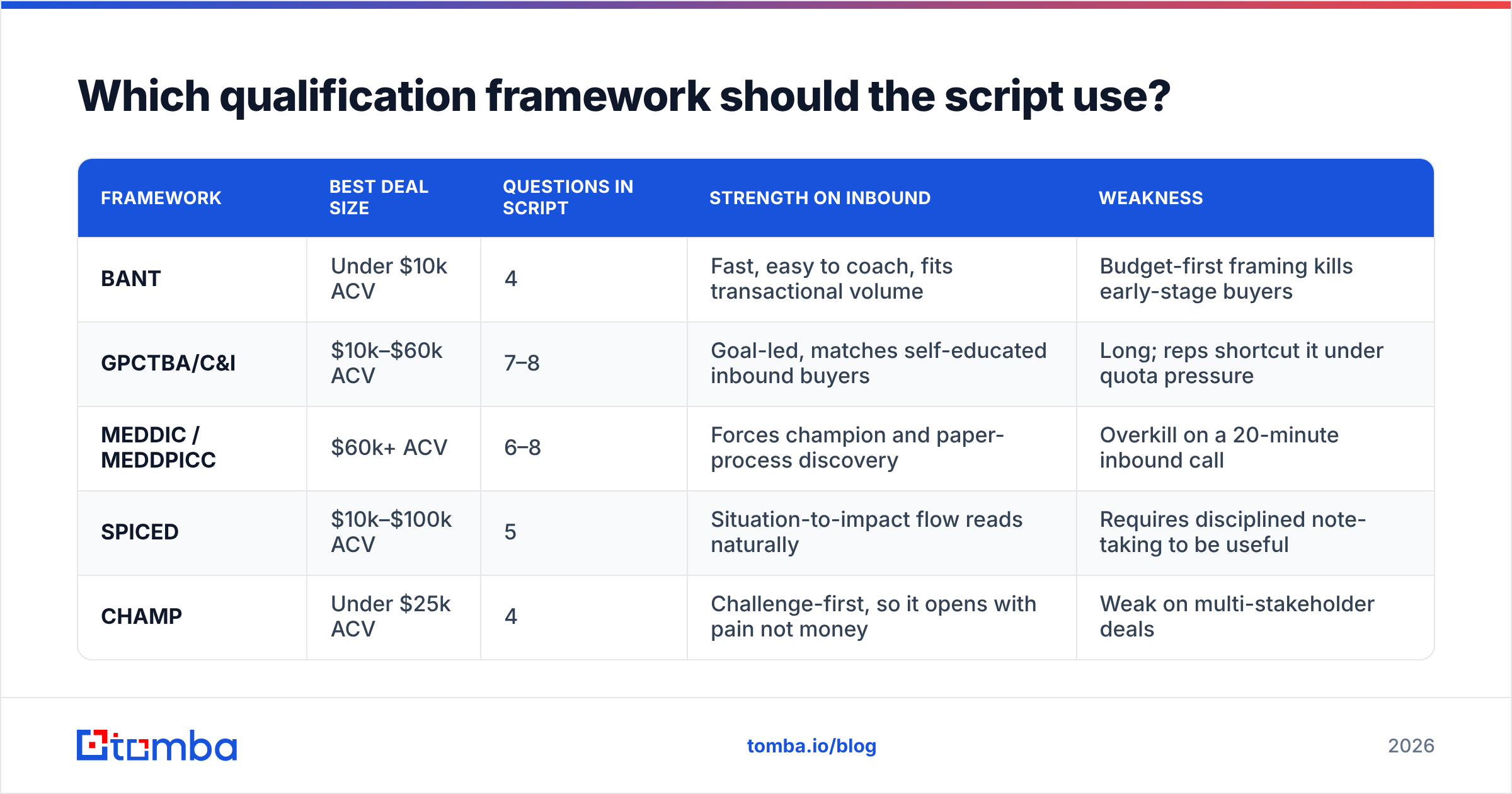
Pick one. Mixing frameworks produces CRM fields nobody trusts. Here is how the common options compare for inbound specifically.
| Framework | Best deal size | Questions in script | Strength on inbound | Weakness |
|---|---|---|---|---|
| BANT | Under $10k ACV | 4 | Fast, easy to coach, fits transactional volume | Budget-first framing kills early-stage buyers |
| GPCTBA/C&I | $10k–$60k ACV | 7–8 | Goal-led, matches self-educated inbound buyers | Long; reps shortcut it under quota pressure |
| MEDDIC / MEDDPICC | $60k+ ACV | 6–8 | Forces champion and paper-process discovery | Overkill on a 20-minute inbound call |
| SPICED | $10k–$100k ACV | 5 | Situation-to-impact flow reads naturally | Requires disciplined note-taking to be useful |
| CHAMP | Under $25k ACV | 4 | Challenge-first, so it opens with pain not money | Weak on multi-stakeholder deals |
HubSpot's inbound sales methodology documents the GPCTBA/C&I structure in detail if you want the full question set. For most teams running inbound demo requests between $15k and $50k, GPCTBA trimmed to six questions is the sweet spot.
How do you handle the four objections that actually show up?#
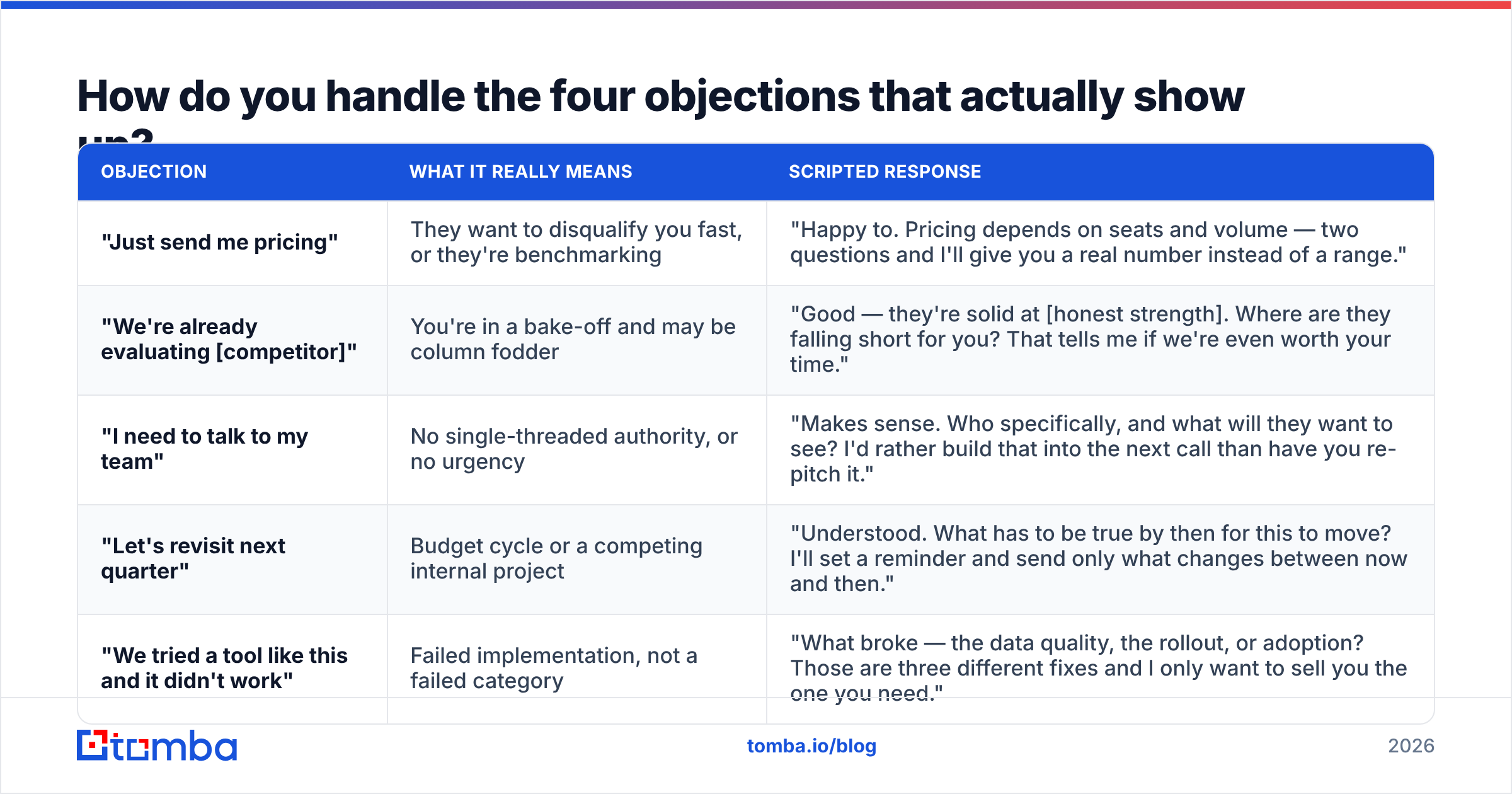
Inbound objections are different from cold objections. Nobody says "I'm not interested" — they already asked you to call. Instead you get stalls. Map each stall to a scripted response and drill it until it sounds unrehearsed.
| Objection | What it really means | Scripted response |
|---|---|---|
| "Just send me pricing" | They want to disqualify you fast, or they're benchmarking | "Happy to. Pricing depends on seats and volume — two questions and I'll give you a real number instead of a range." |
| "We're already evaluating [competitor]" | You're in a bake-off and may be column fodder | "Good — they're solid at [honest strength]. Where are they falling short for you? That tells me if we're even worth your time." |
| "I need to talk to my team" | No single-threaded authority, or no urgency | "Makes sense. Who specifically, and what will they want to see? I'd rather build that into the next call than have you re-pitch it." |
| "Let's revisit next quarter" | Budget cycle or a competing internal project | "Understood. What has to be true by then for this to move? I'll set a reminder and send only what changes between now and then." |
| "We tried a tool like this and it didn't work" | Failed implementation, not a failed category | "What broke — the data quality, the rollout, or adoption? Those are three different fixes and I only want to sell you the one you need." |
Notice that every response ends in a question. An objection you answer with a statement ends the conversation. An objection you answer with a question continues the diagnosis.
What should you know before the call starts?#
The script is only half the work. The other half is research, and this is where inbound teams leave the most money on the table. A form fill gives you a name, a work email, and maybe a company. That is not enough to personalize an opener.
Before the call, you want four things: firmographics (headcount, funding, industry), the buyer's actual role and seniority, a verified phone number for the callback, and any signal that another person from the same domain has been on your site.
- Enrich the record automatically. Feeding form submissions through data enrichment on capture means the rep opens a full account view, not a blank contact card.
- Get a direct line, not the switchboard. Speed-to-lead only works if the number connects. A phone finder step before the dial removes the biggest cause of failed first attempts.
- Verify the email before the follow-up. Free-mail typos and role addresses tank your sequence stats. Running the address through an email verifier before it enters the nurture flow protects sender reputation.
- Watch for the accounts that never fill in a form. Most of your high-intent traffic stays anonymous. Visitor identification turns those sessions into outbound-worthy accounts you can approach with a warm, inbound-flavored script.
Inbound vs outbound scripts: what actually differs?#
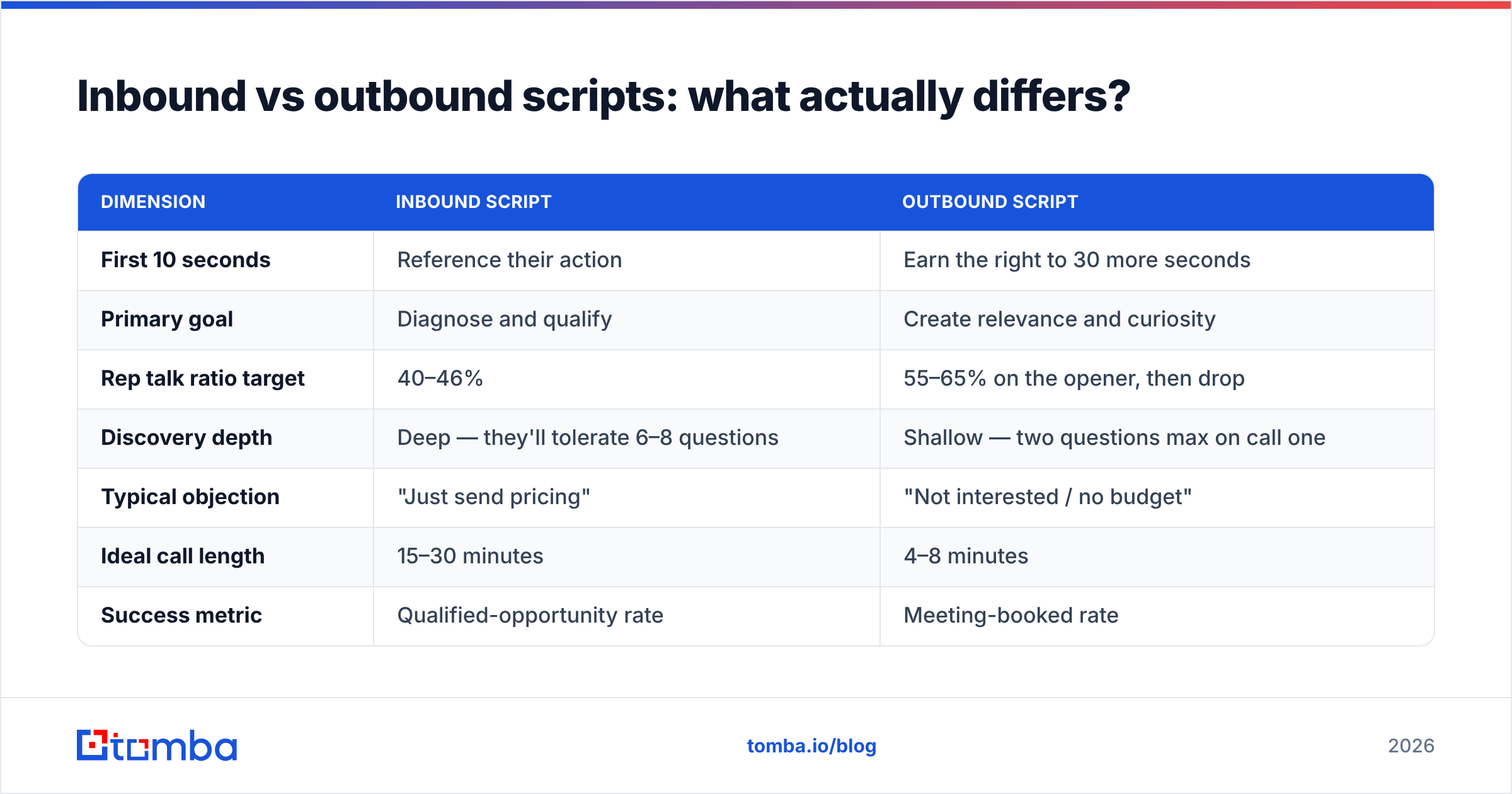
Teams often hand reps one script and expect it to work in both directions. It won't. The buyer's psychological starting point is inverted.
| Dimension | Inbound script | Outbound script |
|---|---|---|
| First 10 seconds | Reference their action | Earn the right to 30 more seconds |
| Primary goal | Diagnose and qualify | Create relevance and curiosity |
| Rep talk ratio target | 40–46% | 55–65% on the opener, then drop |
| Discovery depth | Deep — they'll tolerate 6–8 questions | Shallow — two questions max on call one |
| Typical objection | "Just send pricing" | "Not interested / no budget" |
| Ideal call length | 15–30 minutes | 4–8 minutes |
| Success metric | Qualified-opportunity rate | Meeting-booked rate |
Where they overlap is data quality. Both collapse when the contact record is wrong. If you are running a hybrid motion — inbound forms plus targeted outbound into the same accounts — one clean contact layer feeding both is worth more than two clever scripts.
How do you know the script is working?#
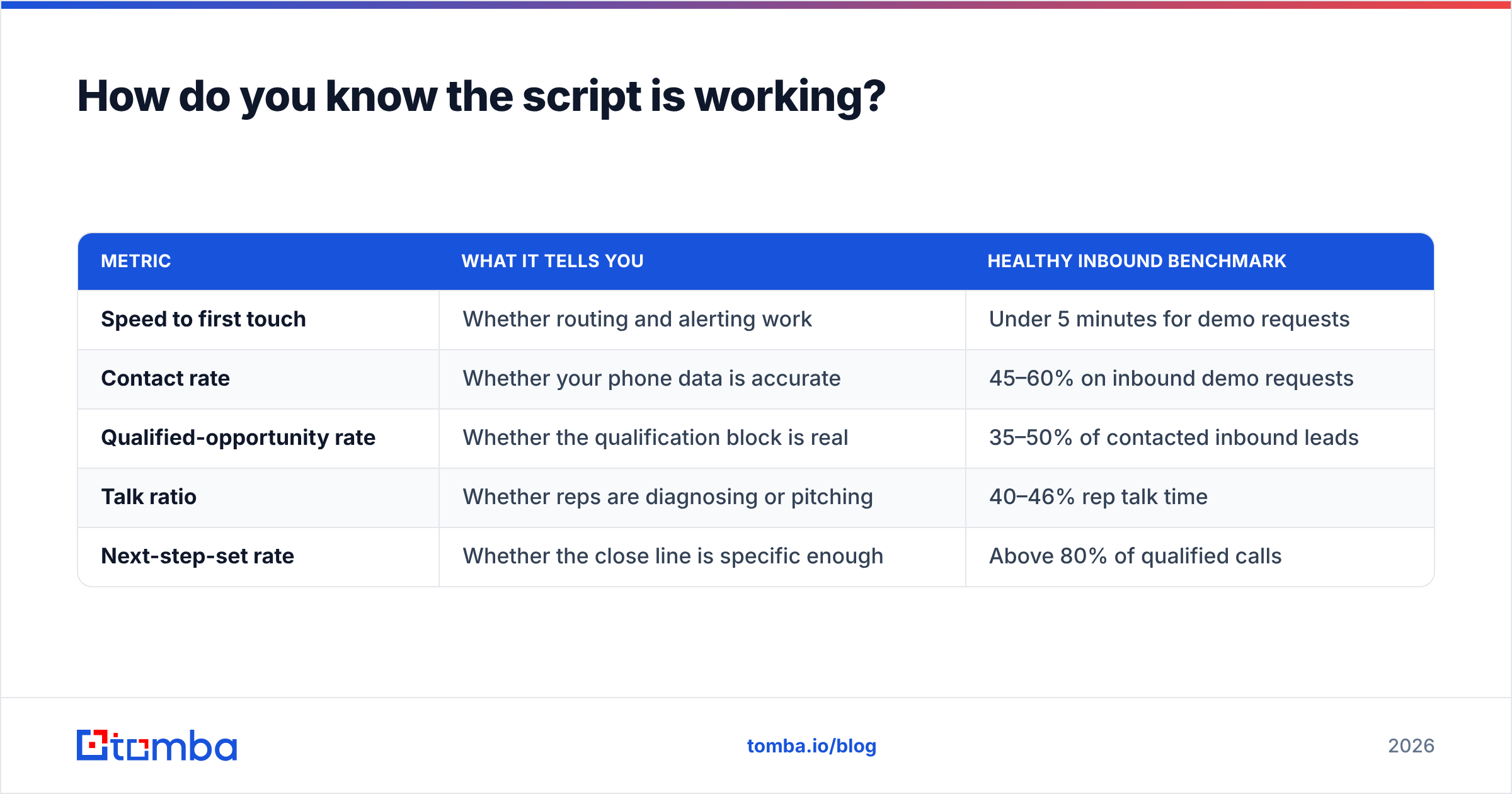
Track four numbers weekly. If you only track "meetings booked," you will optimize for the wrong behavior and your reps will book unqualified calls to hit activity targets.
| Metric | What it tells you | Healthy inbound benchmark |
|---|---|---|
| Speed to first touch | Whether routing and alerting work | Under 5 minutes for demo requests |
| Contact rate | Whether your phone data is accurate | 45–60% on inbound demo requests |
| Qualified-opportunity rate | Whether the qualification block is real | 35–50% of contacted inbound leads |
| Talk ratio | Whether reps are diagnosing or pitching | 40–46% rep talk time |
| Next-step-set rate | Whether the close line is specific enough | Above 80% of qualified calls |
Record calls, tag them by script block, and review the ones that stalled. Nine times out of ten the failure is at the trigger question — the rep asked it, got a vague answer, and moved on instead of following up with "say more about that." Sales-engagement and conversation-intelligence platforms listed on G2 all support this kind of block-level tagging; so does a shared doc and 30 minutes on a Friday.
How often should you rewrite the script?#
Quarterly, and only where the data points. Rewriting the whole script every quarter destroys rep muscle memory. Instead, change one block at a time and measure it for four weeks. If your qualified-opportunity rate is fine but your next-step rate is under 70%, the close line is broken — leave the discovery alone. If reps are getting deep, engaged calls that never produce a second meeting, you have a stakeholder problem and need a multi-threading question, not a new opener.
Also revisit the script whenever your pricing, ICP, or competitive set changes. A CRM field that nobody fills in is usually a sign the corresponding script question stopped making sense months ago.
Ready to make every inbound call a personalized one?#
A script only sounds personal when the rep already knows who they're talking to. Pipe your form fills, trial signups, and chat leads through Tomba Email Finder to attach verified work emails, company data, and direct contacts to every inbound record before the first dial. Start on the free tier with 25 searches a month, or move to Starter at $49/mo once your inbound volume justifies it — full Tomba pricing is public, no sales call required to see it.
Write the script once. Let the data make it sound like you wrote it for them.
Related guides#
// get started
Find, verify and enrich your first contacts today
Start on the free plan with 25 searches a month, then scale when your team is ready.
Free plan · No credit card required · GDPR & CCPA
// about the author